Shortwave listening and everything radio including reviews, broadcasting, ham radio, field operation, DXing, maker kits, travel, emergency gear, events, and more
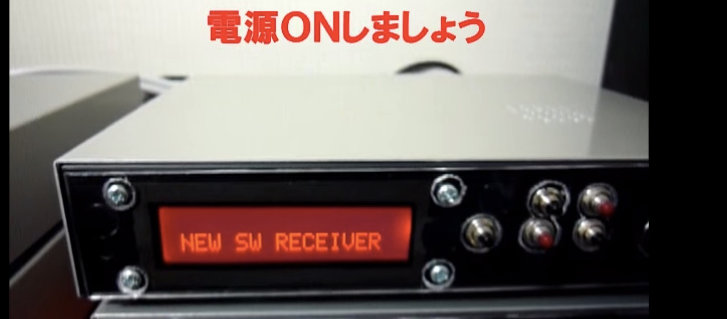
The Silicon Labs Si4730 series DSP receiver chip powers many of the portable shortwave radios currently on the market.
Manufacturers are not the only ones implementing the chip in receiver design, however; radio enthusiasts are too.
I recently discovered this short video by a Japanese hobbyist who implemented the Si4734 in his receiver design:
While I don’t speak Japanese, the author also has a webpage of detailed design notes you might check out (click here to view). I used Google translate for a rough English translation of the page.
Have any readers made a homebrew receiver from a Silicon Labs DSP chip? If so, please comment!
My Grandfather had the same exact radio. I used to play around with the radio as a child, (especially with the shortwave bands, looking for number stations…). When my Grandfather died, about 23 years ago, the radio disappeared.
I decided this is the radio I want for my birthday. I could not remember the maker of the radio, nor it’s model, but I remembered how it looked.
I spent many days looking for all variations like “portable transistor radio” and so on, until I found a photo on the Internet: I was looking for a Philips 90AL765 radio.
I found it on Ebay. A very kind seller from Australia had it.
I purchased and receive the radio on the 26th of June (my birthday was the 12th of July). As soon as I got the radio, I opened it up; it needed cleaning (the case itself and the contacts).
After cleaning the contacts and washing the case, the radio runs (and looks) like new. I thought I would have to recap the radio, but it sounded perfect and without even a hint of hum, so I left it as it is.
It has the volume and tone knobs missing, but it can be operated with no problem. Sound quality is amazing (I added a video of the radio playing All India Radio on 6155 kHz)–it works very well on all bands and is very sensitive. By ear, the bandwidth sounds like 8 kHz or more. Radio bands are: MW, SW (2 bands) And FM.
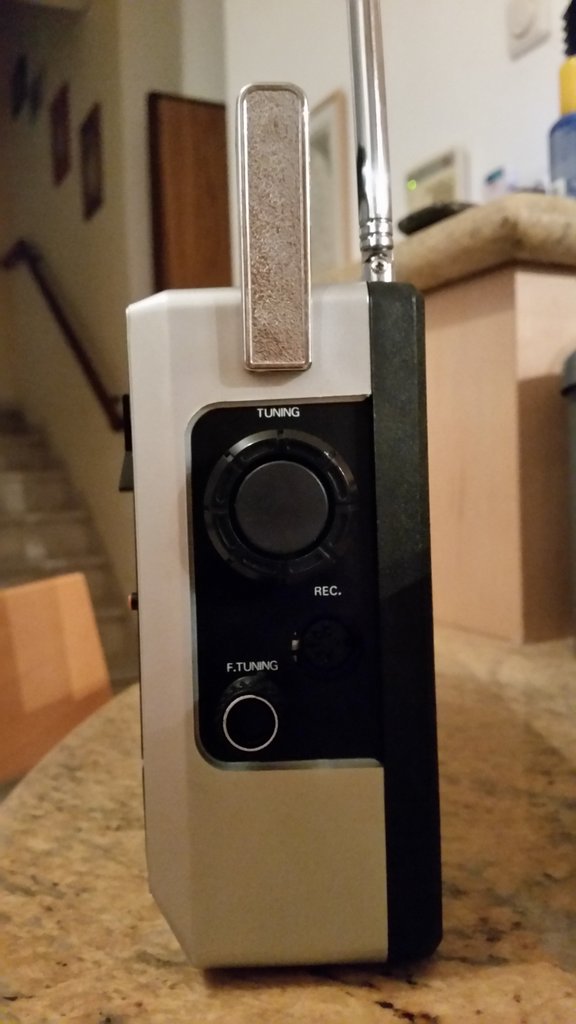
The shortwave band is divided in two: SW1: 2.3MHz- ~7.4MHz, SW2: ~9.4MHz- 22.5MHz. For fine tuning on shortwave, the radio has a “Fine Tuning” control, which is a potentiometer connected to a varicap.
If you place the control in the middle (It lacks a detent spot) and tune in a station, this control will put you spot-on (the receiver is very stable).
Some info about the radio: According to Radiomuseum.org, the radio is dated to 1977, and was made in Austria (mine and my Grandfather’s were made in Singapore).
It contains 13 transistors, 3 of them are can transistors (not plastic).
Tuning is slide ruler type, and the only connection is A DIN5 for recording (wired for mono).
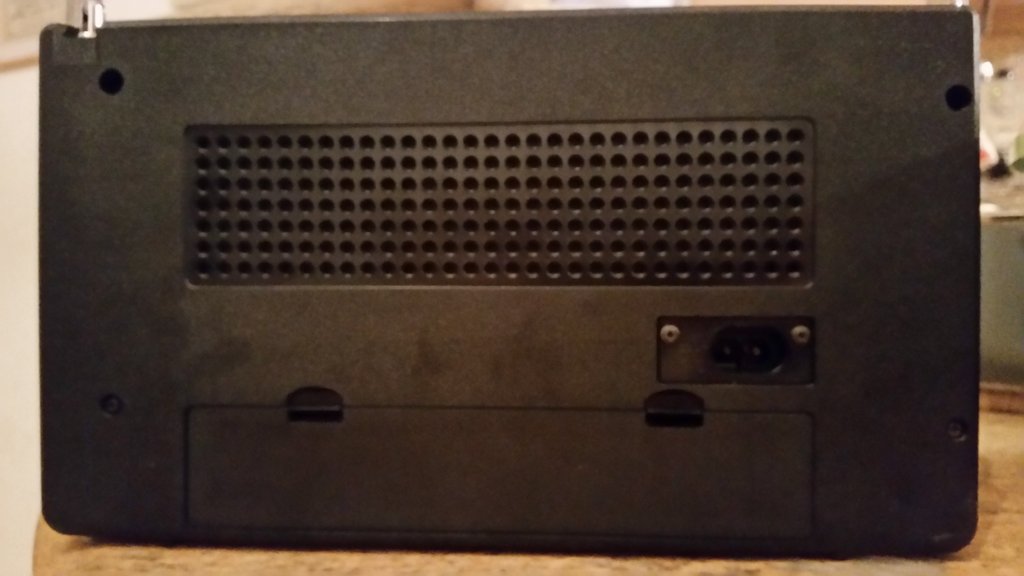
The radio can be operated from 4 D cells, or directly from AC (in the picture you can see the transformer). It can be operated from 230V or 120V. Note that if you move the plastic pin cover from the left pin to the right one, the center pin remains visible at all times. Also you will have to move the plastic cover piece on the back to the left.
The Ferrite is 14cm long, the telescopic antenna is 79cm fully extended, and it has an elbow joint that allows you to place the radio in your lap and still the antenna will point up with no problem. Only thing is that if the antenna is extended, the handle cannot change position since the antenna is in the way.
Width of the radio itself is 29cm (31cm with the handle and the knobs).
Depth is 7cm.
Height is 16.5cm (21cm with the handle).
All in all, it is a very fine radio and I love it!
Moshe, thanks so much for sharing your story!
Perhaps, one of the true virtues of sites like eBay is that they allow us to search the world for somewhat obscure devices that have such a strong family and nostalgic connections. Congratulations on your find!
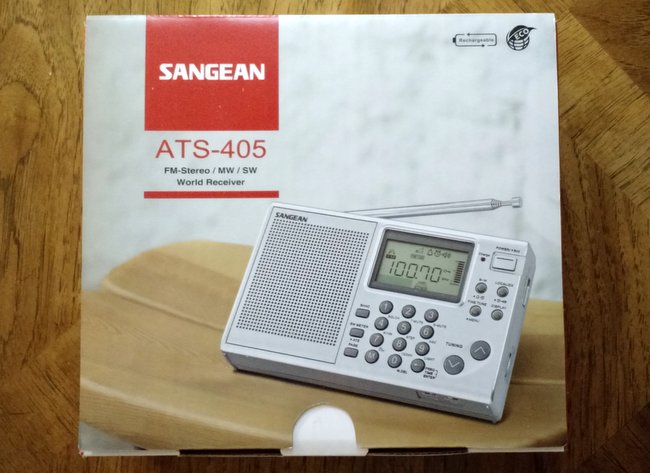
Just last week, I received the new Sangean ATS-405 on loan from Universal Radio. Though I’ve only had the radio for a week, I thought I’d share a few un-boxing photos (by request) and my initial impressions/review of this radio.
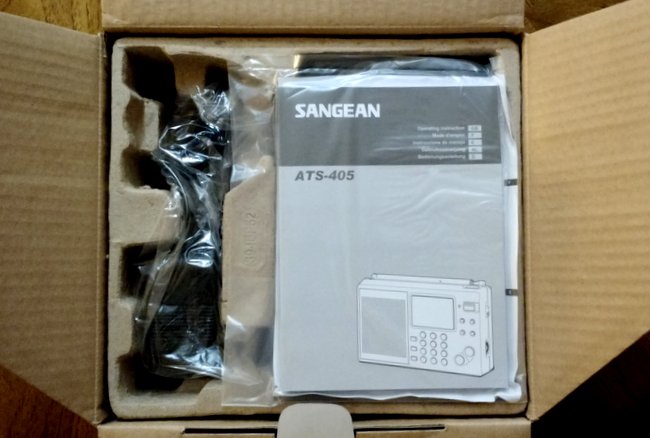
Unboxing
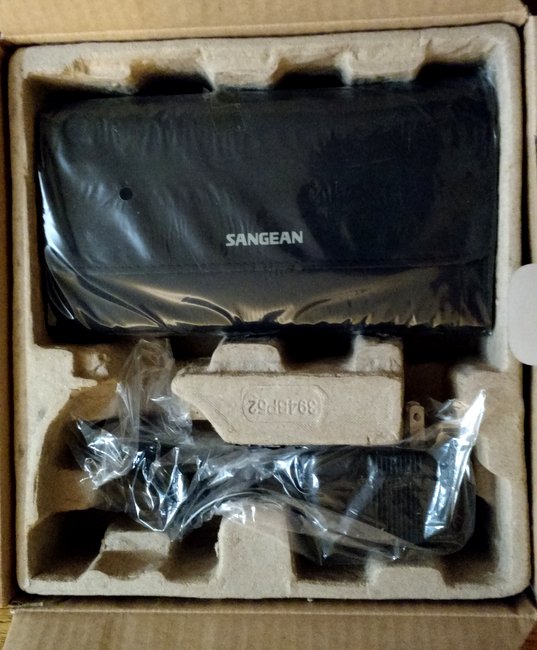
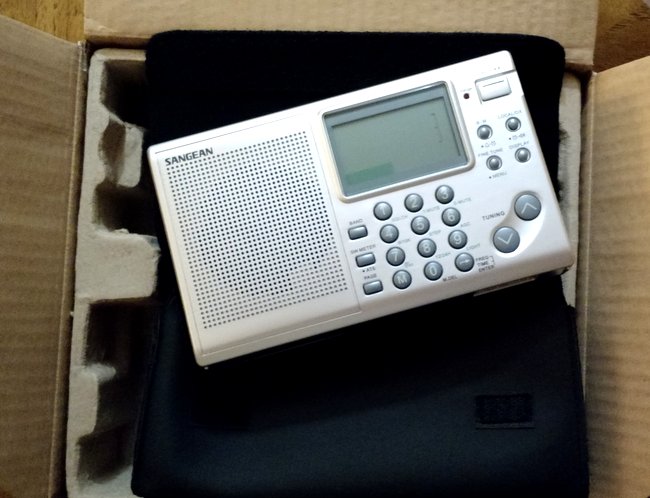
The ATS-405 comes with a thick owner’s manual (in five languages), a 7.5 volt AC adapter, and a soft radio case. The package does not contain rechargeable batteries nor a clip-on wire antenna (like many Tecsun products do, for example).
Overall, the packaging accommodates the radio and accessories efficiently and would probably ship safely even if the carrier doesn’t handle it with particular care.
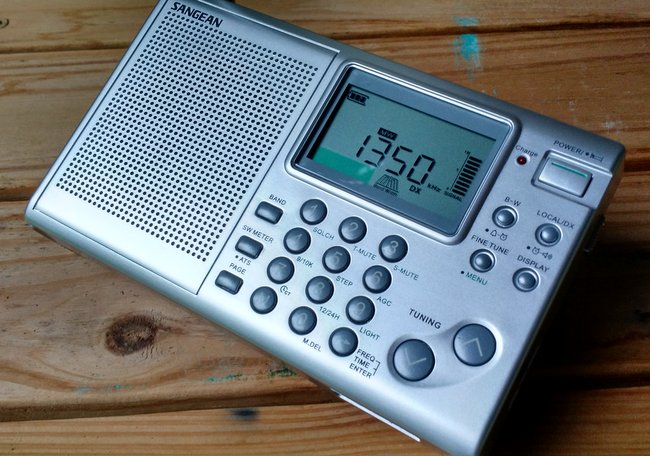
The first thing I noticed about the ATS-405 is the near-identical design and layout Sangean has used in their design of past shortwave radios. If you’re a Sangean fan, you’ll find all of the functions, buttons, and labels pretty much in the same place; virtually no learning curve.
Performance: first impressions
After unboxing the ATS-405, I installed a fresh set of AA batteries in it and turned on the radio…
Display
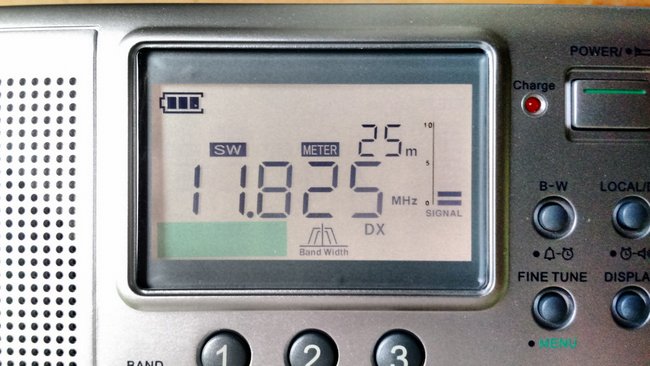
Like most Sangeans, the display is crisp, clear and can easily be read straight-on or at low angles, like when the radio is resting on its back stand, for example. If you look at the display from a higher angle, however, you’ll find that the LCD digits nearly disappear.
Back-lighting is perfect: it’s soft and consistent across the display, very much like the ATS-909X.
Audio
Audio from the internal speaker is good. It’s in the same league with most similarly-priced competitors.
Receiver performance
Keeping in mind that I’ve only logged a few days of listening time on the ATS-405, I do have some initial impressions about receiver performance across the bands:
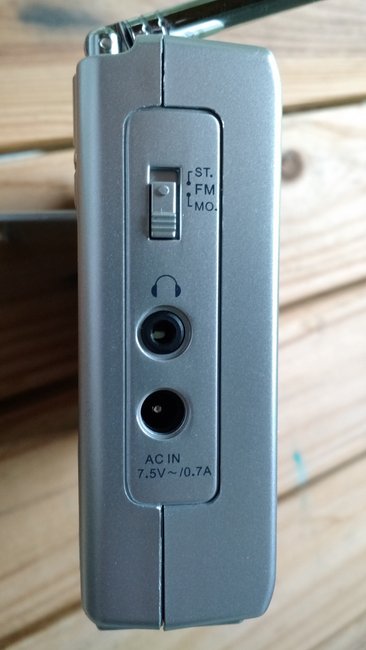
Right side view (click to enlarge)
FM
On a positive note, I believe FM performance is quite good. Perhaps not in the same league with my PL-660 or PL-680, but still the Sangean offers above-average sensitivity. I was able to pick up my distant benchmark FM stations with ease, though to help with the signal lock, I had to switch from stereo to mono reception.
AM/Mediumwave
AM reception is a bit of a mixed bag. I find that the ‘405’s overall sensitivity and selectivity are quite good for broadcast band listening.
When I first tuned around on the AM broadcast band, however, I found the noise floor a little too high. Regardless of whether I was tuned in to a station or not, there was an ever-present high-pitched hiss, like static. It was quite disappointing, especially since I read a review by Jay Allen that really complimented the AM performance on the ATS-405.
I trust Jay’s reviews, however, so I promptly contacted him. Jay pointed out that the problem may be that I was listening in the default “wide” filter setting on AM. And indeed, he was right–though I had changed filter settings a few times while tuned to local stations, I had moved it back to wide and didn’t make note of this. (The ATS-405, by the way, has three filter settings: wide, medium and narrow.)
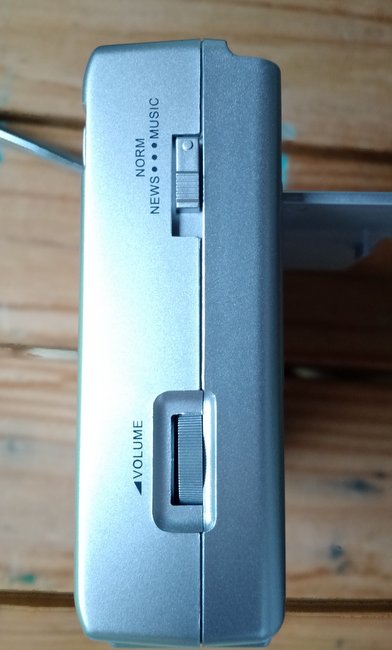
Left side view (click to enlarge)
But the wide setting is really too wide, and was certainly the source for the bulk of the high-pitched hiss I heard. The best filter setting for most broadcast band listening is the middle position, which sounds like a 5-6 kHz filter. In the middle position, noise is decreased significantly. I also believe selecting the “music” audio tone setting helps dissipate some of the noise.
Regarding the noise floor: to be clear, I still feel like the noise level is slightly more noticeable, to my ear, on the ATS-405 than on the PL-660, PL-600, and PL-310ET when band-scanning or weak signal listening. This is most likely some internally-generated noise that somehow still meets Sangean’s engineering spec.
Local AM stations sound fantastic, and the ATS-405 can detect all of my benchmarks. AM audio fidelity is better than that of my PL-660 and, even, PL-310ET. When locked on a local station, the noise floor also seems to disappear. For some reason, I even find that the ATS-405 does a better job receiving local AM stations from indoors–even near noisy electronics–than other sub-$100 portables with which I’m familiar.
Uh-oh, birdies
The most disappointing discovery I made on the Sangean’s AM broadcast band is that it has DSP birdies. Birdies are internally-generated noises resulting from the outputs of the oscillators that form part of the DSP receiver circuit. While almost all receivers do have birdies somewhere in the receiver’s reception range, radio engineers try to keep them out of the way of the important parts of the band.
Unfortunately, my ATS-405 has strong DSP birdies on 800 and 1600 kHz. This is a big negative for me, since my favorite regional AM broadcast station is located on 1600 kHz (WTZQ). Rather than attempting to describe what the birdies sound like, here are a few audio clips that will give you an idea–I start with 1350 AM, which has no birdies and is representative of good AM reception:
WZGM 1350 kHz (broadcast sample with no birdie):
800 kHz (birdie on frequency with no broadcast signal):
WTZQ 1600 kHz (birdie on broadcast signal):
The ATS-405’s birdies almost sound like a jamming signal on 1600 kHz. Indeed, if this station were only located on a different frequency, I’m sure it would be quite audible on this radio…too bad.
Birdies on 800 and 1600 kHz may very well be deal-breakers for many of us. Again, since one of my favorite regional independent broadcasters is on 1600 kHz, it’s a deal-breaker for me.
Jay specifically mentioned a lack of birdies on the AM broadcast band in his review. It could very well be that he doesn’t hear them on his particular receiver–variations in quality control on a radio production line are certainly a real phenomena (the Grundig G3 is a case in point). This could indicate that some units may have pronounced birdies while others don’t. If you purchase an ATS-405, I would check to see if your unit has birdies after powering it up.
When I contacted an engineer for Sangean North America, and described my listening experience, he confirmed that he believed these are, indeed, DSP birdies. I may ask Sangean if they can send another ATS-405 for comparison.
On a more positive note, I checked harmonics in the HF/shortwave bands and heard no DSP birdies there.
Country of origin?
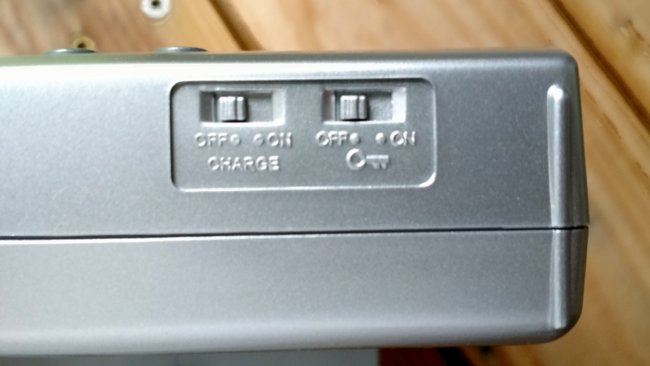
Bottom view with charge and keylock mechanical switches (click to enlarge)
One additional question I posed to Sangean: where is the ATS-405 made? One reader told me the radios are produced in both Taiwan and China. Thinking variations in quality control may be accounted for by two different production lines, I checked my radio to see where it was made. Unfortunately, my unit has no mention of country of origin; not on the radio, the box, the manual, behind the battery cover, nor on the back stand. It’s possible it could be marked internally, but I didn’t want to take apart a receiver I’ve been loaned.
Sangean came back with a firm answer:
“I can confirm that the ATS-405, along with all our radios, are manufactured in China. We have an office in Taipei for engineering, sales, marketing and customer support.”
Not a big surprise here; I expected China was the country of origin.
To sum up AM performance: if you aren’t bothered by the birdies on 800 and 1600 kHz, or if your unit isn’t producing them, you’ll find the ATS-405 a capable little AM broadcast band receiver.
Shortwave
Our HF propagation conditions since last Friday (when I first turned on the ATS-405) have been poor. Other than a few short band openings, I’ve struggled to hear anything other than the normal blow-torch broadcasters we hear in North America. Still, bad propagation conditions are actually good for reviewing some aspects of a shortwave receiver, so I used the opportunity.
In terms of sensitivity on the shortwave bands, I think the ATS-405 is mediocre. It lags behind my Tecsun PL-660, PL-600, PL-310ET, and CC Skywave. Adding a clip-on wire antenna to the telescoping whip (there is no aux antenna port) does help in terms of sensitivity.
Since I do most of my listening on the shortwave bands, this, too, is a deal-breaker for me. If you primarily listen to stronger shortwave stations, or spend most of your time on the FM/AM bands, then you might still consider the ATS-405.
The ATS-405’s selectivity seems to be on par with my other DSP-based portables. In truth, though, band conditions have been so unfavorable, I don’t feel like I’ve had ample opportunity to test selectivity. I’ll likely follow up this initial review with an update.
And as on medium wave, the noise floor on the shortwave bands seems a little high to me–especially with the filter set to the “wide” position.
Cool, innovative features
While I clearly haven’t been wowed by the ATS-405’s shortwave performance, I have been more favorably impressed with some of its innovative features: specifically, the ability to control squelch, tuning mute, and soft mute.
Using the menu button (see image above), you can engage or disengage the tuning mute and soft mute by pressing the “2” or “3” buttons on the keypad, then using the tuning up/down buttons to toggle these features on and off. Squelch works the same way, using the “1” button and volume control to set the threshold.
This menu control works regardless whether the radio is turned on or off.
Of course, by using the menu button and the keypad, you can also control the ‘405’s tuning steps, AGC, clock, and backlighting functionality; each of these are marked in green next to the appropriate button on the keypad (see image above), a very useful feature.
I wish other radio manufacturers would give users the ability to control some of the DSP chip’s built-in functionality, as the ‘405 does with the muting–especially since over-active soft muting has been the downfall of several DSP-based radios. Thanks for trail-blazing, Sangean!
Summary
Invariably, all radios have strengths and weaknesses; here is a list of my notes from the moment I put the ATS-405 on the air:
Pros:
Improved features and controls:
Soft Mute
Tuning Mute
Squelch
AGC
Crisp, clear display
Good travel size, similar to the Grundig YB400
Good AM/mediumwave sensitivity
Three audio/tone settings: Music, Norm, and News
Good FM sensitivity
Dedicated mechanical switches for keylock, audio tone, FM stereo/mono, and charging.
Cons:
Lackluster shortwave sensitivity
DSP Birdies on 800 and 1600 kHz
Higher SW/AM noise floor (especially in wide filter setting)
No tuning wheel
No AUX antenna port
No shortwave SSB reception (AM only)
No audio line-out port
I’m going to hold onto the Sangean ATS-405 for a few more weeks, as I’d like to give it a more thorough test on the shortwave bands. I hope to follow up with a post offering a few representative recordings.
My nutshell opinion of the ATS-405 so far is that it’s a decent little radio with a lot of functionality and features for a rig in its price class. But overall, its performance seems to me rather mediocre. If you primarily listen to FM, you’ll be pleased. If you’re a mediumwave listener, you’ll be pleased only if you don’t mind the 800/1600 kHz DSP birdies. If you’re primarily a shortwave listener, you’ll need to carry a clip-on wire antenna to bring the sensitivity up to the level of similarly-priced receivers.
In short, I do want to like this radio unreservedly. But it appears that Sangean may need to pull up its socks on their quality control. Readers: please comment if you’ve purchased the ATS-405–I’m very curious to learn whether there are QC discrepancies in performance from one unit to the next.
PLEASE NOTE: After publishing this following review, Sangean kindly agreed to dispatch a second unit for comparison.
SWLing Post reader, Robert Gulley (AK3Q), has just informed me that he’s started a radio blog on ak3q.com. Robert notes:
“One of the recurring themes will be on the importance and relevance of shortwave radio, and nothing denotes this more than your work with Ears To Our World.
Very cool, Robert! I’ve always wanted to work the ISS, but never have managed to do it so far. But, hey, there’s always tomorrow!
Thanks, also, for mentioning Ears To Our World–so far, this year, we’ve distributed radios in Kenya, Cameroon, and South Sudan. There are still remote and impoverished parts of the world that benefit from the lifeline of information radio brings to them.
Neil Goldstein, W2NDG, has just informed me that he’s updated his comprehensive radio kit guide which can be found at RadioKitGuide.com. Many thanks, Neil!
The next kit I have on the table is the Sawdust Regenerative Receiver by BreadBoard Radio. Should be a lot of fun and a nice weekend project (once I have a free weekend to complete it). Still, I think I’ll check out Neil’s list to see if there are any new kits I’ve overlooked–after all, fall and winter kit-building seasons are just around the corner!
SWLing Post contributor, Jim Clary (ND9M/VQ9JC) contacted me in June to obtain details about the BBC’s Midwinter broadcast to the British Antarctic Survey Team. Jim has been working on board the USNS Sgt William R Button since mid-June. While on board Jim has no web access, but he can send and receive emails and some files. I kept Jim informed about the time and frequencies of the BAS broadcast.
Jim had hoped to make a recording of the Midwinter broadcast at sea, but timing and some technical problems got in the way and he missed the bulk of the 30 minute program.
That’s okay, though, because Jim is an avid SWL and ham radio operator. During time off, he has logged a number of stations, so I asked if he would consider making a recording for us. I mean, SWLing from a Navy ship?! How cool is that?!
Within a week, Jim sent me a recording of the Voice of Korea. Here are some of his notes:
I’d heard [the Voice of Korea] many times before when Stateside (and they were Radio Pyongyang at the time), but their signals were always weak and had major polar flutter. Out here, the signal was in-my-face loud, so even though the station is not much of a rare DX catch, I wanted to get them on tape.[…]
[M]y location is the east southern Atlantic Ocean, not far from St. Helena.
[…]My ship is named USNS Sgt William R Button. The ship has been active since the mid 80s and was a “motor vessel” (M/V) until we became a Navy asset in 2009.
[…]My receiver that I’m currently using is my QRP rig, a Yaesu FT-817ND. I changed over to a Navy antenna that I’m feeding with about 70 feet of 75-ohm RG-6 cable. There’s obviously some signal loss from both the length and impedance mismatch of the coax, but at these freqs it’s fairly negligible.
The antenna itself is an AS-2815/SSR-1 that’s mounted above the wheelhouse (bridge) of the ship. I can’t really describe the make up of the antenna simply because I don’t see why it works so well but it really does a good job. If I’d figured out where its feed point is a couple weeks ago, I would’ve had no problem logging the BBC’s Antarctic service!
The Radio Broadcaster Who Fought the Cold War Abroad but Remained Unheard at Home
By DOUG RAMSEY
During the Cold War, listeners in captive nations behind the Iron Curtain huddled around radios in basements and attics listening to the imposing bass-baritone voice of the man who sent them American music. His greeting—“Good evening, Willis Conover in Washington, D.C., with Music U.S.A.”—was familiar to millions around the world. At home, relatively few people knew him or his work. A proposal for a postage stamp honoring Conover may give hope to those who want the late Voice of America broadcaster to be awarded a larger mark of distinction.
For 40 years, until shortly before his death in 1996, Conover’s shortwave broadcasts on the Voice of America constituted one of his country’s most effective instruments of cultural diplomacy. Never a government employee, to maintain his independence he worked as a freelance contractor. With knowledge, taste, dignity and no tinge of politics, he introduced his listeners to jazz and American popular music. He interviewed virtually every prominent jazz figure of the second half of the 20th century. His use of the VOA’s “special English”—simple vocabulary and structures spoken at a slow tempo—made him, in effect, a teacher of the language to his listeners.
Countless musicians from former Iron Curtain countries have credited Conover with attracting them to jazz, among them the Czech bassists George Mraz and Miroslav Vitous, the Cuban saxophonist and clarinetist Paquito D’Rivera and the Russian trumpeter Valery Ponomarev. On the Conover Facebook page established in 2010, Ponomarev wrote that Conover had done as much for jazz “as Art Blakey, Duke Ellington, Horace Silver, Count Basie, Charlie Parker, Miles Davis and Dizzy Gillespie.” Conover’s New York Times obituary said, “In the long struggle between the forces of Communism and democracy, Mr. Conover, who went on the air in 1955 . . . proved more effective than a fleet of B-29’s.” In his publication Gene Lees Jazzletter, the influential critic wrote, “Willis Conover did more to crumble the Berlin Wall and bring about the collapse of the Soviet Empire than all the Cold War presidents put together.”[…]
Regular SWLing Post readers know that I’m a huge fan of Willis Conover. Much like VOA’s Leo Sarkisian, Conover represented some of the best diplomacy this country has had to offer. [I’ve actually had the honor of meeting and interviewing Leo Sarkisian at his home in Maryland, a few years ago–one of the highlights of my career.]
Are there any SWLing Post readers out there who listened to Willis Conover from behind the “Iron Curtain?” Please comment!

 The Silicon Labs Si4730 series DSP receiver chip powers many of the portable shortwave radios currently on the market.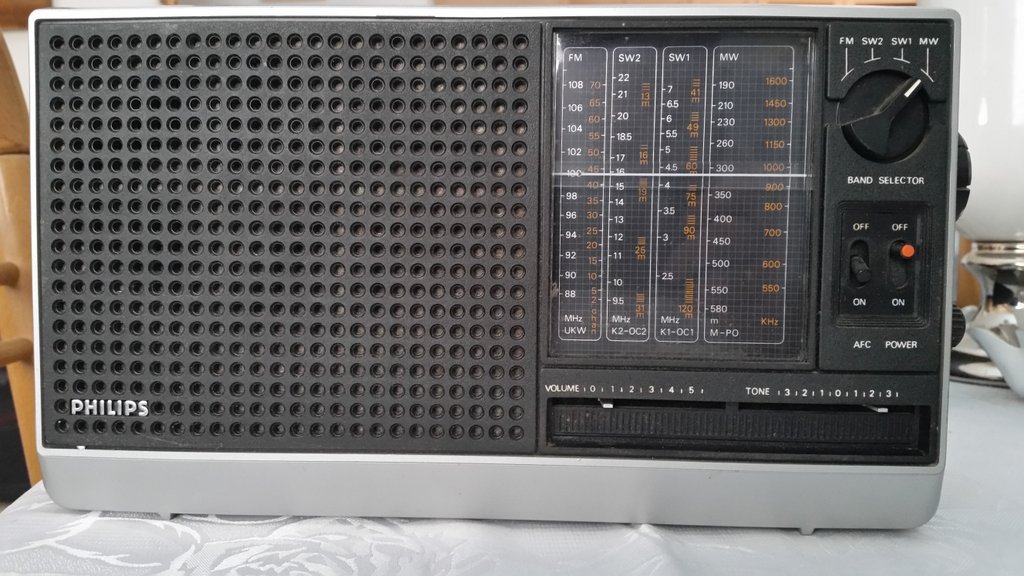

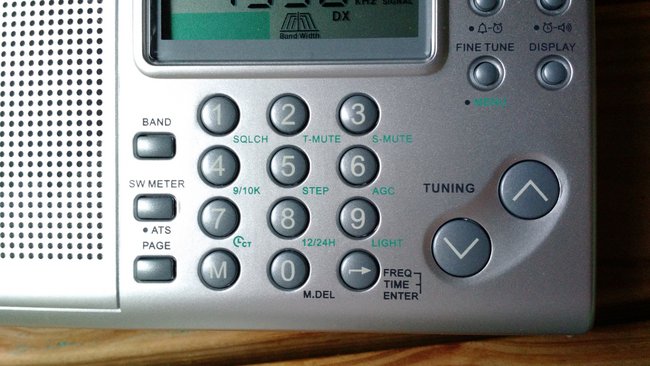 Using the menu button (see image above), you can engage or disengage the tuning mute and soft mute by pressing the “2” or “3” buttons on the keypad, then using the tuning up/down buttons to toggle these features on and off. Squelch works the same way, using the “1” button and volume control to set the threshold.
 SWLing Post reader, Robert Gulley (AK3Q), has just informed me that he’s started a radio blog on