Category Archives: What’s On Shortwave

Pirate Radio Recordings: Radio Borderhunter

"Woah! Timmy, is that Europe calling???"

“Whoa! Timmy, is that Europe calling?”

You’ll typically find North American radio pirates here on the SWLing Post, but on occasion, I do manage to pull in a station or two from Europe.  Last night was one of those rare occasions, and I have Ragnar at Pirates Week to thank for the tip.

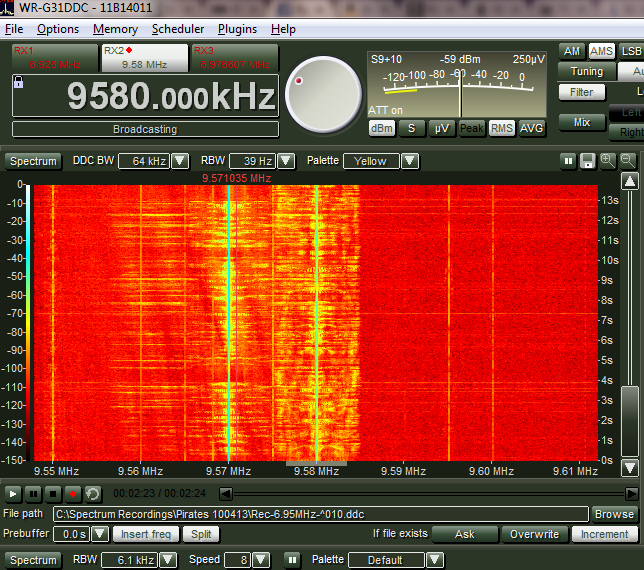
I tuned in Europirate Radio Borderhunter on 15,500 kHz AM, starting around 21:50 UTC. For an AM signal out of Europe, I was most impressed with Radio Borderhunter‘s strong signal.

I recorded about forty minutes of the pirate’s broadcast before propagation shifted.  He then moved down to 6,210 kHz in the 48 meter band, a prime Europirate hangout, to continue his show.

Click here to download the recording as an MP3, or simply listen via the embedded player below:

By the way, check out Ragnar’s latest podcast on Pirates Week!

Shortwave radio: the secret item found in many North Korean homes

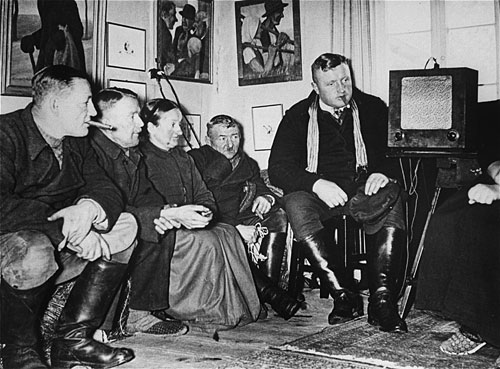
de321dialI’m not surprised to find that North Korean families hide shortwave radios. After all, if it’s well hidden, and listened to privately, there is no way the government can monitor what is heard on shortwave, nor trace it back to the family listening. This is what separates radio from the Internet and mobile devices:

(Source: New Focus International)

Many North Korean families keep a secret item at home, whose discovery may lead to harsh punishment. Away from prying eyes and in the privacy of their homes, North Koreans enjoy using items forbidden by the state, according to North Koreans who have recently escaped from the country.

“In every North Korean home, there is at least one secret item” says Jung Young-chul* (age 34), who left Korea in 2012. He had a short-wave radio in the house and the family would secretly listen to South Korean broadcasts. To avoid being caught, they kept the radio hidden under a container for keeping rice.

They were not the only ones with a hidden radio. Jung explains, “Once, a friend described a story that I had heard the night before while listening to a South Korean broadcast. I brought it up with him one night in drink, and he confided that his family too had a radio. We laughed about it together.”

[Continue reading]

If you want to hear North Korean propaganda on shortwave radio (via the Voice of Korea), check here for the latest schedule or even listen to this recent recording.

This post tagged in the category: Why shortwave radio?

DRM Test Transmission from PCJ International

drmlogoOn October 13, 2013 PCJ Radio International will conduct a two hour DRM test transmission.

Date: October 13, 2013

Time: 10:30 to 12:30 UTC

Frequency: 15,645 khz

Beam: South East & East Asia

Send your reception reports for this transmission to [email protected]

Shortwave Radio Recordings: BBC World Service Hausa

BBC-HausaFor your listening pleasure: the BBC World Service Hausa language service recorded on 17,885 kHz on September 16, 2013, starting at 19:30 UTC. This BBC WS broadcast originated from a 250 kW transmitter located on Ascension Island in the south Atlantic ocean.

Click here to download the recording as an MP3, or simply listen via the embedded player below:

Shortwave Radio Recordings: Voice of Russia

VoiceOfRussiaSyria is one of the biggest international news items at the moment. If you want to hear Russia’s side of the story, there’s no better place than via the Voice of Russia.

Many thanks to Shortwave Radio Audio Archive contributor, Frank, for submitting this recording of the Voice of Russia English language service. Frank recorded this broadcast on September 14, 2013 starting at 22:00 on 9,465 kHz with his Kenwood R-5000 receiver.

Click here to download an MP3 of the broadcast, or simply listen via the embedded player below:

Shortwave Radio Recordings: Radio Thailand

wiki-800px-Watchaiwattanaram050617Many thanks to Frank, a contributor on the Shortwave Radio Audio Archive, for this recording of Radio Thailand World Service.

This broadcast was recorded in Europe on September, 13 2013 starting at 19:00 UTC on 9,390 kHz.

Click here to download the recording as an MP3, or simply listen via the embedded player below:

VOA Radiogram, 7-8 September 2013: Fldigi, Flmsg, Flamp, RSIDs, MFSK

VOARadioGram(Source: VOA Radiogram)

VOA Radiogram for the weekend of 7-8 September 2013 will include more experiments with RSIDs, the brief signals that automatically switch your decoding software to the correct mode.

For best results, please install Fldigi 3.21.75 from w1hkj.com. When you have 3.21.75 installed, go to Configure > ID > RsID, and adjust Errors to 0 (zero). This will prevent Fldigi from flipping to another mode while decoding our MFSK transmissions. For more information about this, seewww.w1hkj.com/FldigiHelp-3.21/ConfigID.html

Please also download the latest versions of Flmsg and Flamp (2.1.00) from w1hkj.com.

This weekend’s VOA Radiogram will include another transmission in MFSK128. This will be done mainly to see if the RSID works. However, to improve the chances for a successful decode of the very fast MFSK128, it will be in Flamp format. A paragraph will be divided into seven blocks of 64 characters each. And it will be transmitted three times, with the second and third passes filling in any blocks with incorrect checksums. Make sure Flamp is running before the MFSK128 transmission begins; it does not turn on automatically like Flmsg.

The foreign language for the weekend will be Spanish, with brief VOA news items in both plain text and Flmsg formatted. Please turn off and restart Fldigi before each of this weekend’s VOA Radiogram broadcasts to ensure the accented Spanish letters display correctly. You will need the UTF-8 character set. The adjustment can be found via Configure > Colors & Fonts.

In the Flmsg-formatted Spanish news story, you will see several html codes such as í for the accented characters. They might look like decoding errors, but the story should look OK when the web page renders.

To make Flmsg work with Fldigi, in Fldigi: Configure > Misc > NBEMS — Under Reception of flmsg files, check both boxes, and under that indicate where your Flmsg.exe file is located.

Here is the lineup for VOA Radiogram, 7-8 September 2013:

3:55  MFSK16: Program preview

2:09  MFSK32: VOA Spanish news re old iPhones

3:41  MFSK32/Flmsg: VOA Spanish news re new iPhone model

2:29  MFSK64: VOA News re Al Jazeera in Egypt

2:48  MFSK32: YouTube screen capture of Al Jazeera

:50  MFSK32: Introduction to MFSK128 item

1:30  MFSK128/Flamp: Brief description of VOA

:45  MFSK32: Introduction to MFSK64

2:55  MFSK64: VOA News re LADEE moon mission

2:56  MFSK32: Artist’s rendition of LADEE spacecraft

1:11  MFSK16: Closing announcements

:41  MFSK32: VOA Radiogram logo

:20  Surprise mode of the week

Please send reception reports to [email protected].

VOA Radiogram transmission schedule

(all days and times UTC)

Sat 1600-1630 17860 kHz

Sun 0230-0300 5745 kHz

Sun 1300-1330 6095 kHz

Sun 1930-2000 15670 kHz

All via the Edward R. Murrow transmitting station in North Carolina.

There will also be a minute of MFSK32 on The Mighty KBC, via Germany, Saturday at approximately 1130 UTC on 6095 kHz, and Sunday at approximately 0130 UTC on 7375 kHz (Saturday evening 9:30 pm EDT).

Also check out their post:  Base64 VOA logo via MFSK128: a few unexpected successes. Fascinating!