Category Archives: What’s On Shortwave

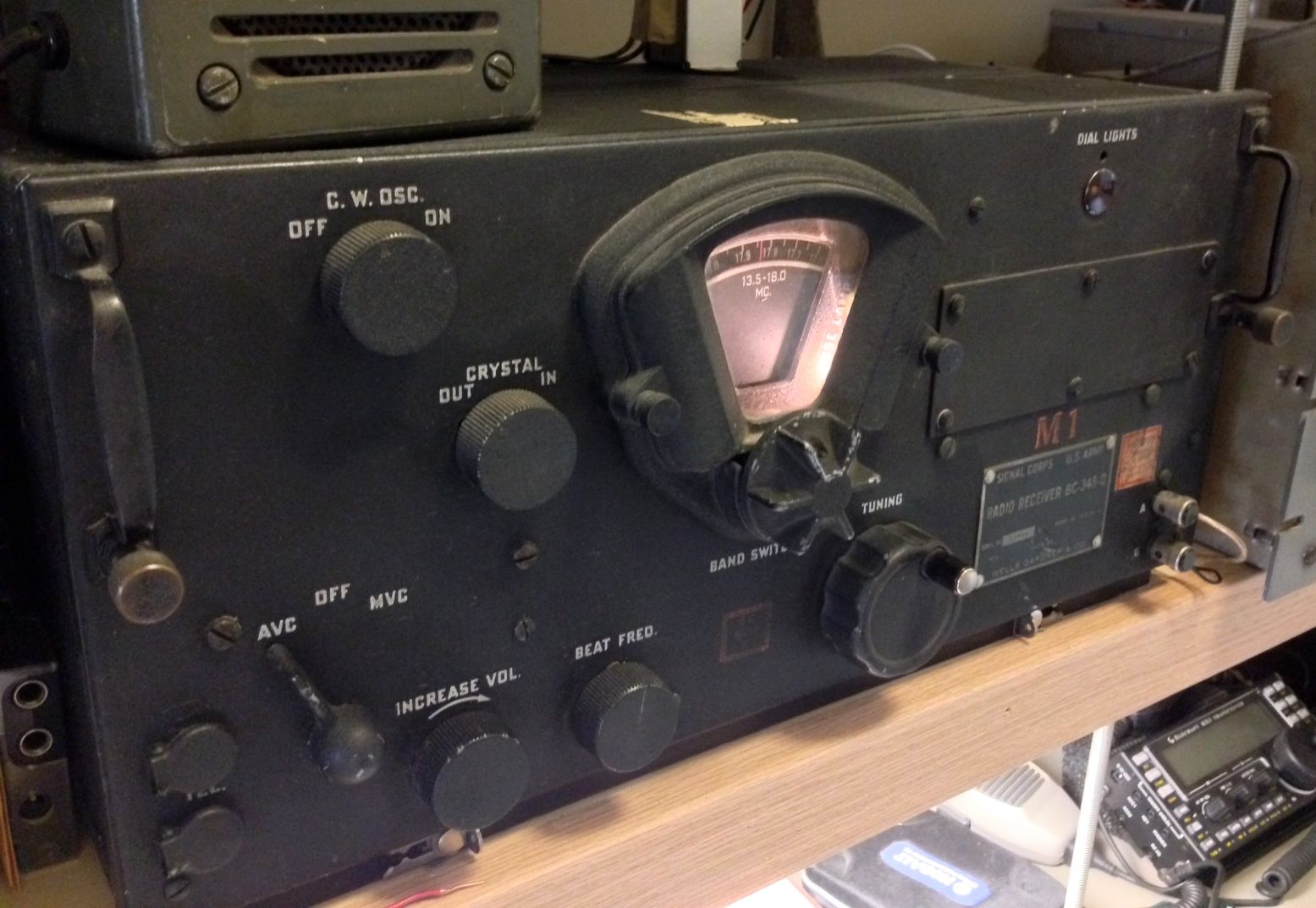
SWLing with heavy metal: my Signal Corps BC-348-Q

SignalCorps-BC-348-Q

I write a great deal about DSP portables, SDRs, and modern ham radio transceivers, but truth be known, my passion is for older rigs–ahem, much older–the antique “boat anchors” of the radio world.

Tuesday afternoon, I had a rather involved soldering project to do on behalf of my organization, Ears To Our World.  While I worked, I decided to fire up my Signal Corps BC-348-Q to hear what was on the air. I promptly discovered Radio Exterior de España on 17,850 kHz–starting with their interval signal; REE, care of my BC-348-Q, kept me company while I soldered almost three hundred connections.

The BC-348-Q frequency dial

The BC-348-Q frequency dial (Click to enlarge)

I listen to my BC-348-Q nearly every week. Usually, she’s tuned to 9,580 kHz for my morning dose of Radio Australia.  In the winter, the ‘348’s tubes keep my little radio room a little warmer than the rest of my house. In the summer–well, I just sweat a little more.

I love this radio, and my other “boat anchors,” because when I listen to these rigs I can’t help but hear the past.  I wonder about the others who have listened to the same radio, and what was happening in their lives as they listened…

The BC-348 series, for example, is well-known for its use in WWII allied bombers–these rigs were mounted in the likes of the B-17, B-24, B25, and others of the era. Indeed, mine still has the original clips on the base that anchored it to the radio operator’s onboard work table. The ‘348 was used as a long-distance liaison receiver during WWII. 
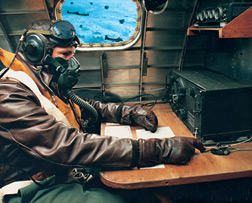
The B-17 radio operator's position (Source: AZ Commemorative Air Force)

The B-17 radio operator’s position (Source: AZ Commemorative Air Force Base)

The BC-348 series was built with simplicity, functionality, and serviceability in mind. It was built to withstand life on a B-17 bomber–the extreme vibration on start up, the extremely low temps in the upper atmosphere; it could be serviced by the radio operator in flight, if necessary. Its controls are simple, bare-bones, even. The tuning knob and analog dial are beautifully engineered and precise.

The ‘348 has a power switch, volume control (switchable from auto to manual gain), crystal filter, CW switch, beat frequency control, tuning knob, and a band switch (located just below the dial). The antenna and ground terminals are mounted on the front of the radio for easy accessibility. All controls are spaced so that the radio operator could use the ‘348 even while wearing thick cold-weather gloves.
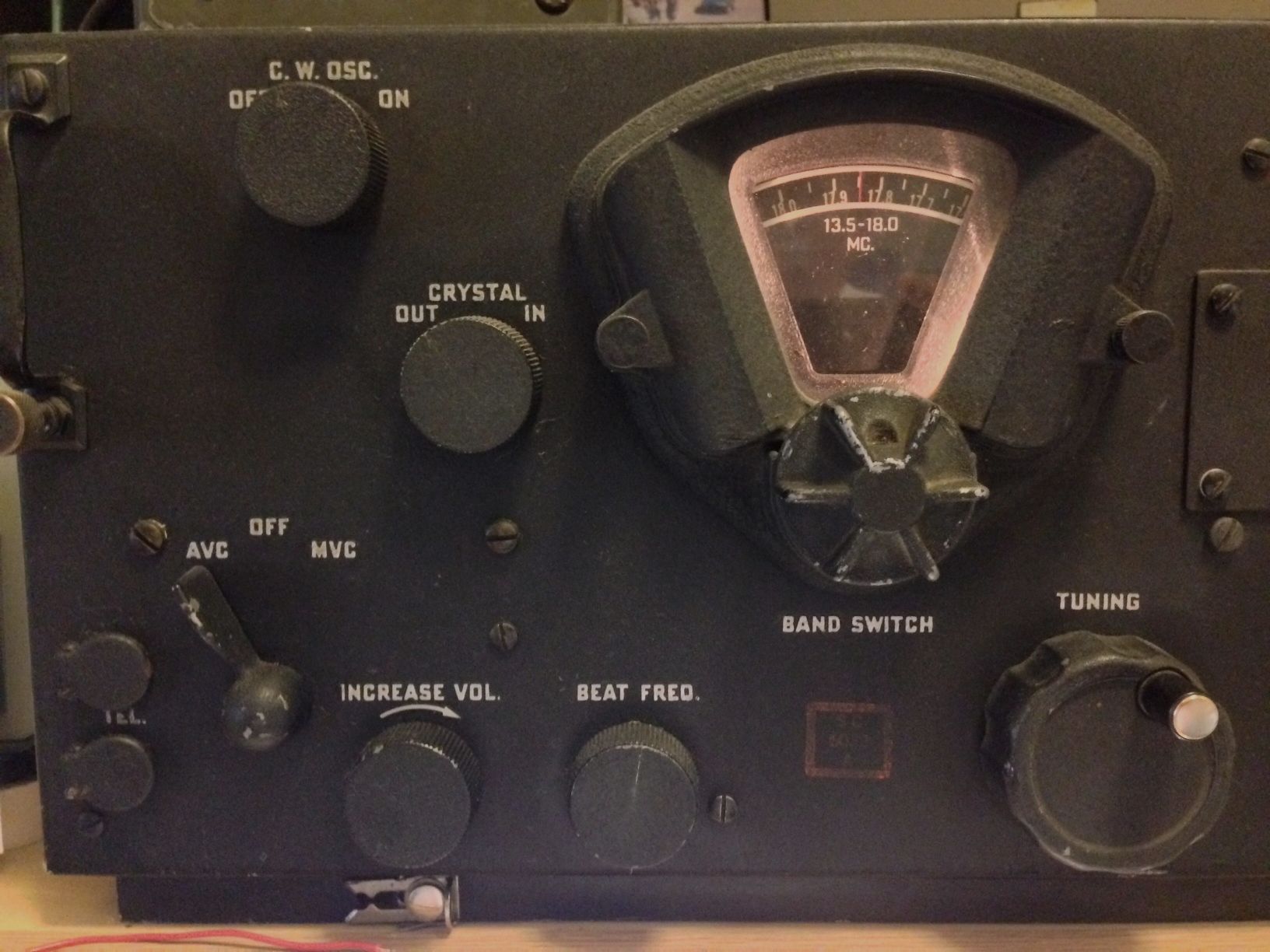
BC-348-Q-FrontControls

You can’t do any medium wave DXing on the ‘348, however: this receiver was intentionally designed with the medium wave band omitted. Evidently, Uncle Sam wanted radio ops to be focused on communications instead of entertainment (but that’s okay; the government also made morale radios for the latter).

When I go to the Dayton Hamvention–or any hamfest, for that matter–it’s radios like the BC-348-Q I seek. Tube/valve radios sometimes lack the sensitivity and (digital) accuracy of modern tabletop shortwave receivers, but they make up for this in audio fidelity. As long as you have a properly-matched speaker, the sound can be…nothing short of amazing. Even though the ‘348 was never designed for robust audio, it still sounds richer and fuller than most modern tabletop radios. The sound is so warm it literally glows. Moreover, I’d be willing to wager that there are few modern receivers that can stand the test of time like these rigs.
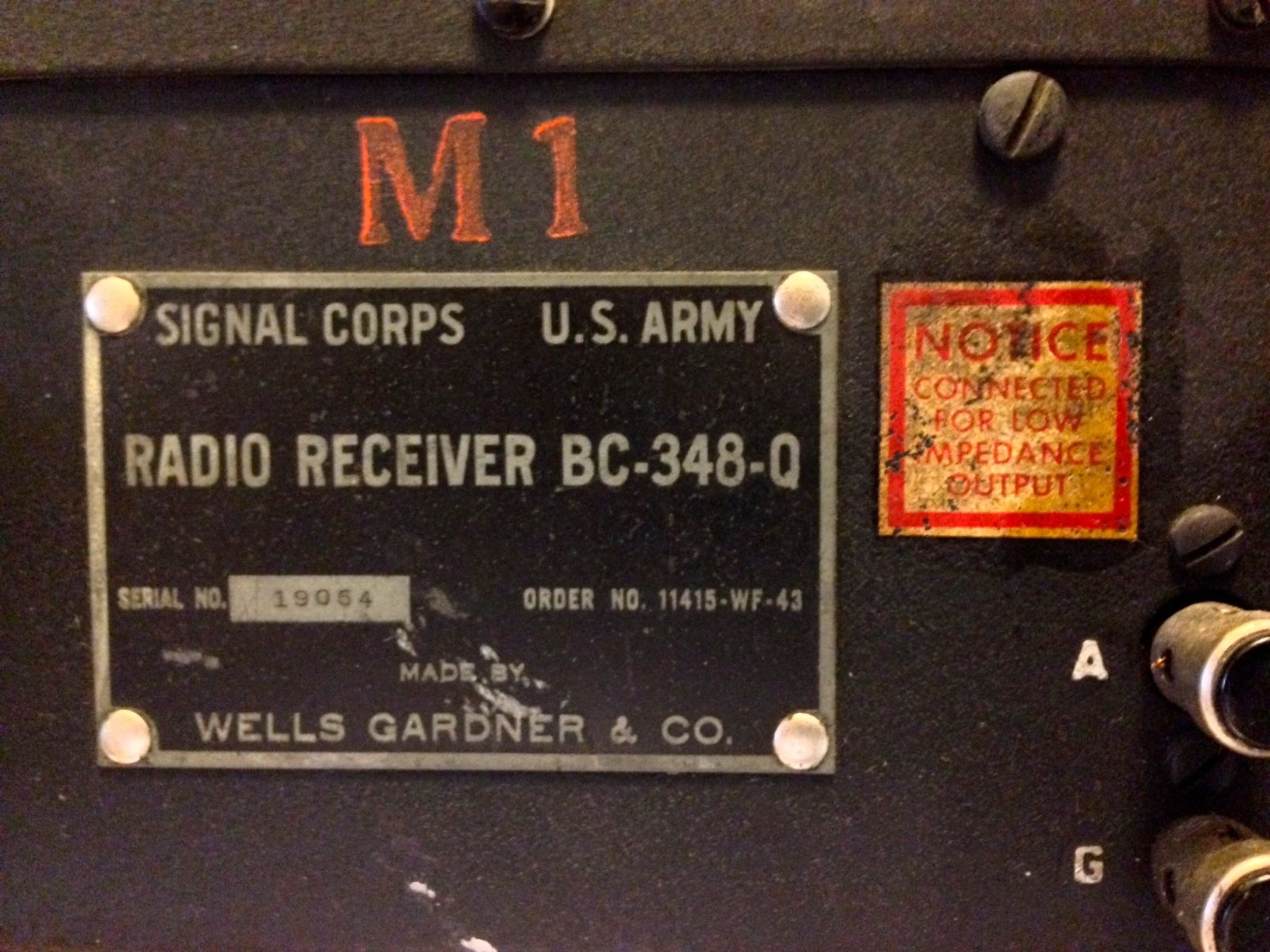
BC-348-Q-Label

If you buy one of these old beauties, you must be ready to service them; inevitably, a capacitor or tube will fail in time.  But they just…keep…going.

I’m very much in debt to my good friend and radio elmer, Charlie (W4MEC) who kindly teaches me everything I need to know about these great rigs. He’s exceedingly patient, and that counts for much, as I’m not by nature technically inclined. But I do enjoy learning about these radios and how to service them; the romance of their history draws me in, and I simply can’t get enough.

Note: It’s important to work with a knowledgeable elmer/mentor or a professional repair technician when servicing these boat anchors, because, unlike with our modern radios, their high voltages can severely injure (or even kill) you if you don’t know exactly what you’re doing inside the chassis.  This is repair work for the professional.
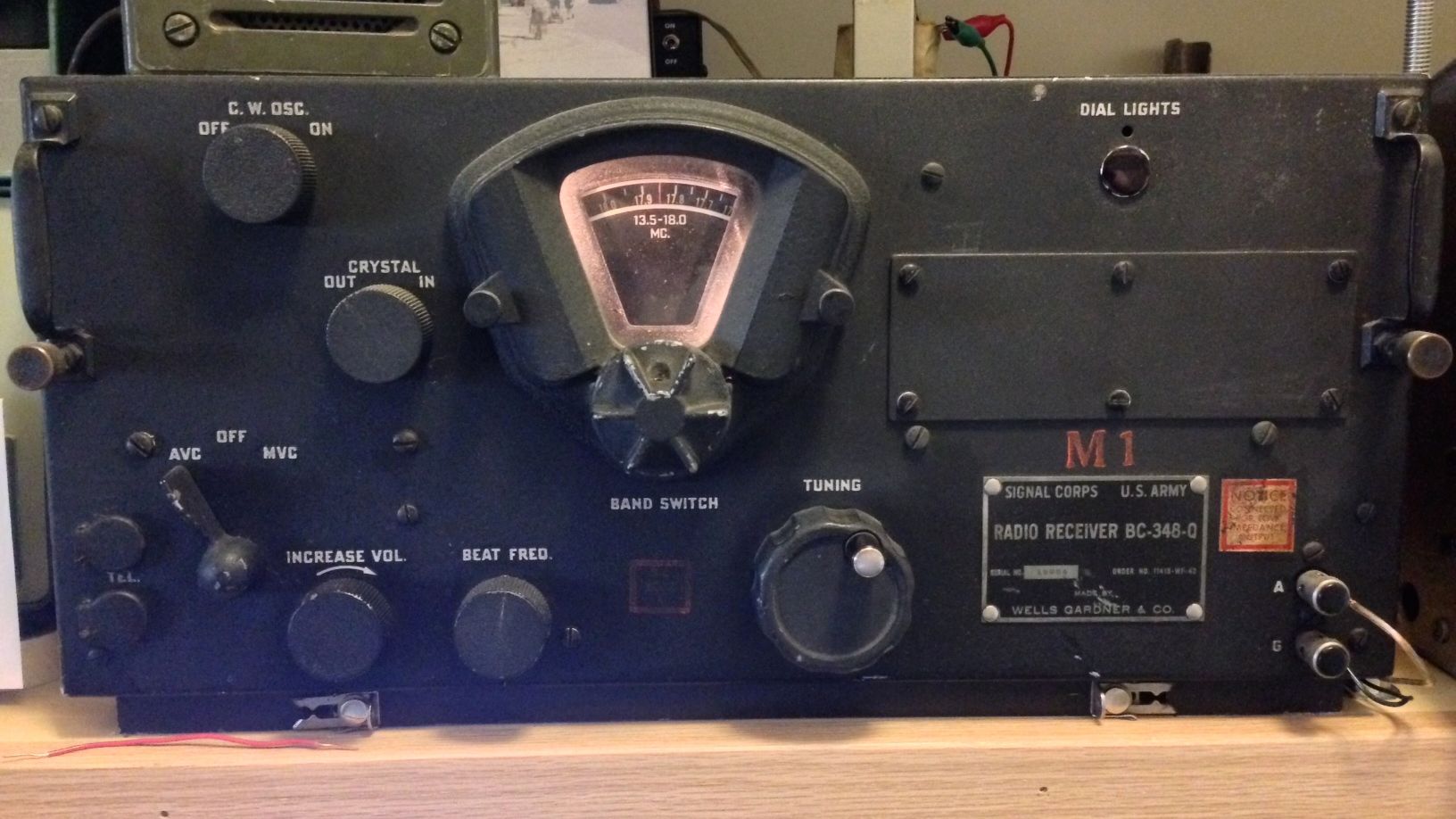
BC-348-Q-FrontView

My BC-348-Q turns 71 this year–and I’m sure it has at least that many more years to go. I know that I’ll give it as much TLC as it can take. We must keep these still functioning pieces of history on the air.

If you, too, have boat anchors or antique radios alongside your modern rigs, please comment! I’d love to learn about your favorites. In other words, what heavy metal is in your shack?

Resources:

Pirate Radio Recordings: MAC Shortwave

820px-Annex_-_Stewart,_James_(Call_Northside_777)_01

For your listening pleasure: over one hour of the pirate radio station, MAC Shortwave. I recorded this broadcast on April 27, 2014 starting around 00:05 UTC, on 6,950 kHz AM.

MAC Shortwave features host “Jimmy Stewart” and some excellent big band music.

The first SWLing Post reader to identify this MAC Shortwave interval signal gets extra credit!

Simply click here to download an MP3 of the recording, or listen via the embedded player below:

Chris field records NHK while traveling in Peru

Chris-Peru

SWLing Post reader, Chris, has just shared a recording of NHK World he made while traveling in Peru on Monday (April 21st, 2014).

Yes, that’s his photo above taken in the picturesque coastal town of Máncora. Can you tell I’m envious? 

Chris recorded this broadcast starting at 10:00 UTC on 9,625 kHz with a Sony ICF-SW7600G and using a Sangean ANT-60 antenna. The actual recording was made with Chris’ Sony ICD SX712 digital recorder and he uploaded it using a Dell Windows 8.1 (8 inch) tablet.

That, Chris, is a nice field recording combo!

Click here to download his recording as an MP3, or simply listen via the embedded player below. This recording will also be available on the Shortwave Radio Audio Archive.

The Mighty KBC: surfing the shortwaves

Many thanks to Peter Quinn at The Mighty KBC for sharing the following announcement for his new summer radio show:BigBeachRadio-KBC

“Great news if you love surf music and like exploring shortwave radio. The Big Beach Radio Show is coming to The Mighty KBC Europe on 6095 kHz for the summer of 2014. The show’s presenter Peter Quinn describes the venture as “a mirage of the perfect day on the beach.”

Peter has been heard on a range of radio stations over the years including Radio Caroline, The Voice of Peace, Island Sound Malta and numerous UK and European radio stations. He says he’s delighted to be appearing on The Mighty KBC and cordially invites you to catch some surf on shortwave every week at 11.00 UTC .

The show starts Saturday 19th April and goes to air whatever the weather. The Big Beach Radio Show Station – The Mighty KBC Freq – 6095 kHz ( 49 meter band shortwave) Day – Saturday Time – 11.00 UTC

SABA conference to feature special DRM broadcast from Ascension Island

SABA

(Source: DRM Consortium via Alokesh Gupta)

The DRM Consortium is a Sector Partner at The Southern African Broadcasting Association (SABA), Digital Radio Broadcasting Summit in Cape Town from 22nd – 24th April. The event will include a presentation by the DRM Chair, Ruxandra Obreja, on April 22nd at 11.50am and a dedicated DRM workshop on the 23rd April, from 4.00pm to 5.30pm under the title “The DRM Platform: A detailed and practical look at its superior functionalities and flexibility”.

The workshop will offer a live demonstration of DRM30 with a two-hour BBC broadcast, from Ascension Island – a site managed by DRM member, Babcock – to Southern Africa carrying BBC World Service English from 13:30 to 15:30GMT/UTC (114 degrees) 21735 kHz.

During and after the workshop DRM representatives and South African DRM supporters will be available to meet you and explain the features and to answer any questions.

The DRM Consortium has already been present at SABA events in Johannesburg and in Arusha (Tanzania) last year. The DRM standard is the only global standard which can be used in all radio frequency bands and is ideal for the large countries of Southern Africa. From national networks and regional stations to smaller commercial and community stations, all are able to broadcast their digital radio programmes with enhanced content and in excellent sound quality to everyone in their respective countries, regardless of whether people live in large cities, in small towns or villages.

Numbers Stations in the news

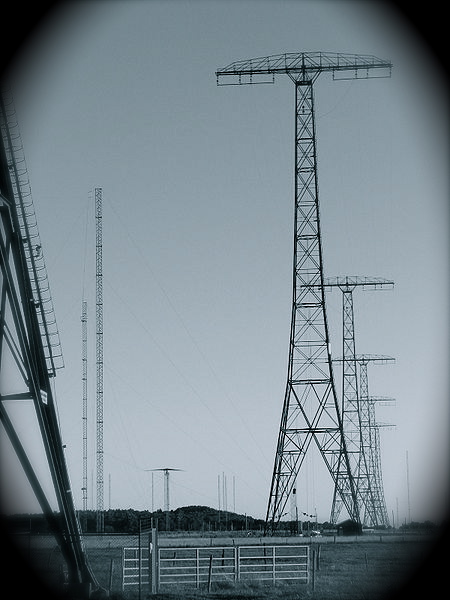
towersThere have been a lot of numbers in the news lately.

Earlier this week, David Goren’s numbers station radio documentary was featured on the ABC Radio National show, Sounds Like Radio.

Click here to listen.

This morning, I also noticed this excellent BBC News Magazine piece on numbers stations, which includes an interview with Akin Fernandez, the creator of the Conet Project.

Here’s an excerpt from The spooky world of the ‘numbers stations’:

“This is the era of hyper-tech espionage, encrypted emails and mindboggling cryptography. But you can hear a very old-fashioned form of espionage on shortwave radio.

It is 13:03 on a Tuesday in a little crammed room of the BBC Monitoring building in Caversham and what is suddenly heard on a shortwave receiving station is a 10-minute message in Morse code.

There is a small community of aficionados who believe messages like this are a throwback to the era of Cold War espionage. They are the mysterious “numbers stations”.

At the apex of the Cold War, radio lovers across the globe started to notice bizarre broadcasts on the airwaves. Starting with a weird melody or the sound of several beeps, these transmissions might be followed by the unnerving sound of a strange woman’s voice counting in German or the creepy voice of a child reciting letters in English.

[…]Times have changed and technology has evolved, but there’s evidence that this old-fashioned seeming method of communication might still be used. Shortwave numbers stations might seem low-tech but they probably remain the best option for transmitting information to agents in the field, some espionage experts suggest.

“Nobody has found a more convenient and expedient way of communicating with an agent,” says Rupert Allason, an author specialising in espionage issues and writing under the pen name Nigel West.

“Their sole purpose is for intelligence agencies to communicate with their agents in denied areas – a territory where it is difficult to use a consensual form of communications,” Allason says.

A former GCHQ officer, who does not wish to be named, whose duty was to intercept signals towards the UK and search for these numbers stations in the 1980s is also adamant that these were broadcasts to agents in the field or in residencies or directed to embassies.

It was “one-way traffic” – the transmitters broadcast numbers to the recipient. The recipient did not reply.”

[…]”This system is completely secure because the messages can’t be tracked, the recipient could be anywhere,” says Akin Fernandez, the creator of the Conet Project – a comprehensive archive of the phenomenon of numbers stations. “It is easy. You just send the spies to a country and get them to buy a radio. They know where to tune and when,” he says.

Continue reading on the BBC Magazine website…

If you would like to know more about numbers stations, click here to read other numbers posts.

Click here to go to David’s website, Shortwaveology.net.

STF Radio: 1 Hour Million Watt Special, April 20

STF Radio sent the following announcement for their “1-hour Million-Watt Special”:

    ___________ ____  ____  __   ___  _  ___    
   / ___/_   __| ___||    \|  \ |   \(_)/ _ \   
   \___ \ | | | __|  | |) /| \ \| |) | | (_) |  
   \____/ |_| |_|    |_|\_\|_|\_\___/|_|\___/   
 
            I N T E R N A T I O N A L
 
               ***ANNOUNCEMENT***
 
            STF Radio International
                       
          1-hour Million-Watt Special 
                       
            April 20, 2014 0400 UTC
 
               –Frequency List–
                   
  5050 (The Americas)         Saturday Night
  5110 (N+C. America)                “
  7490 (N+C. America)                “
  7570 (N. America)                  “
  7730 (Mex/C. America)              “
  9925 (N. America)                  “
  9955 (Caribbean)                   “
  6025 (EU)                   Sunday Morning
 17630* DRM (EU, alternate program)  “
 17760 (Asia)                Sunday Afternoon
 21490 (Pacific Aus/NZ)              “
   
                   Music
                   Voice
          Digital Mode Text+Images
            Internet Hyperlinks
                   ….and more!