Virtual Radio Challenge III will include a prize!

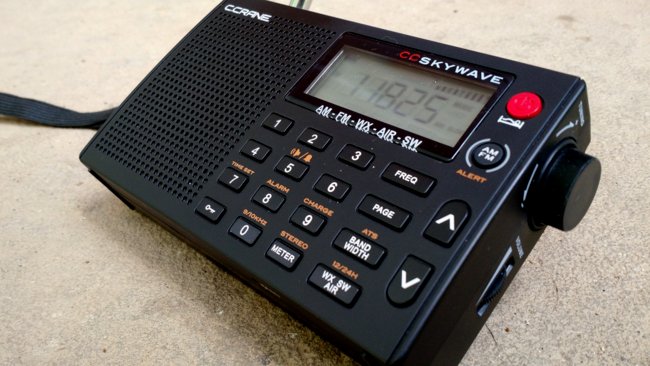
GP5SSB-FrontA new SWLing Post reader challenge is on the way–the Virtual Radio Challenge III–and I’m especially pumped about this one. Like the previous two challenges, this one is not just hypothetical, but based on an actual query from an SWLing Post reader.  Yet this one is just a bit different from the previous challenges.

What I’m really excited about is this:  for the first time, there’s going to be a prize on the table for the winner!

Here’s how the challenge will work.  I’ll post the query this week; if you’re interested in participating, you’ll have until August 1st to craft and submit your response via a form on the reader challenge post or via email.

I’ve already lined up an expert who is uniquely qualified to choose the best entry for this particular reader challenge.

But that’s not all:  whoever our expert selects will receive…(drumroll)…a new CountyComm GP5/SSB portable radio, courtesy of Universal Radio. Thanks, Universal!  How cool is that?

So, stay tuned! The Virtual Radio Challenge III will be posted soon.

Vote: Support the production of a car shortwave radio

c300 photo in operation

SWLing Post contributor, Fred Studenberg, recently contacted me about an ingenious car (mobile) shortwave radio he’s designed. Though originally designed for his own personal use, Fred’s now considering initiating a production run of the radio for the commercial market. To do so, however, he needs funding to help pay for parts, and this is where we can help:  by voting for his shortwave car radio design in this contest–! Fred writes with details about his radio:

I wanted a high performance shortwave receiver in my car without the clutter of a separate unit under the dash.  It had to be easy to tune stations and not require any modifications to my car’s built-in radio and audio system.   I looked everywhere, and there was nothing that even came close to meeting my requirements.

Being a retired RF communications engineer, I set about designing a high performance digital radio.  It installs remotely in the trunk or hatchback area and broadcasts tuned shortwave audio to your car FM radio.  No modifications at all to the car radio or FM system are required.  It is powered right off your car’s power plug.

new bst photo

Operation is simple: tune your car FM radio to 88.1 or 88.3 and use a small handheld wireless key fob controller to scan through the 100 preset channels.  You have access to full shortwave band coverage in 5 KHz tuning steps with excellent sensitivity and selectivity.  There is even a digital noise blanker to eliminate spark plug ignition interference.   You can also manually scan to find new stations to add to preset memory, quick tune to WWV for time checks, and even switch the audio bandwidth for voice or music.

If your FM radio has RDS display you can see the tuned shortwave frequency as well as a digital “S” meter.  If your car radio does not have RDS, it still works.  Just press the scan button on the wireless controller until you hear something interesting or go into manual mode and scan the various shortwave bands listening for something of interest.

This started as a project just for my use, but after I showed it to a few people, I was encouraged to make it commercially available.   I’ve entered it in a design contest that will provide $10,000 worth of parts to help launch a production run.

You can see full information on the radio at www.carshortwaveradio.com and there is a link right at the top to take one to the voting site, or go directly to the voting site at Your IoT and look for the car shortwave radio entry.

If readers are interested in seeing this in production, indicate your interest by voting.  You have to vote by logging in with your Facebook account, which presumes you have a FB account–if not, they are easy to set up, and you can use a pseudonym and leave out all the personal info they ask [for] at signup.

I voted for Fred’s design earlier today. It does require using your Facebook login to vote, but the contest site can only read the public profile you choose to provide, and–if you allow it–your email address.

If you have a Facebook account, please consider helping Fred out by voting for his shortwave car radio design!

Click here to vote!

PL-680 and ATS-405 radio reviews now online

PL-680-BBC-Click-FrequencyThis week, both Jay Allen and Chris Freitas have reviewed the Tecsun PL-680. If you’re considering purchasing a PL-680, you should check out both reviews and also our PL-680 review and radio comparison from February.

Jay has also reviewed the Sangean ATS-405 on his website and Keith Perron tells me he will include a review of the ATS-405 on today’s episode of Media Network Plus. Keith has informed me he was very disappointed with the ATS-405, but Jay’s review is mostly positive, focusing on its great AM (medium wave) performance and new tuning/muting functions.

This is certainly the week for reviews!

On that note, Universal Radio is kindly sending me a loaner Sangean ATS-405 for review. I hope to compare it with some other benchmark portables in the next few weeks. Follow the tag ATS-405 for updates.

Click on the following links to check pricing for both the PL-680 and ATS-405:

Tecsun PL-680

Sangean ATS-405

BBC World Service as a lifeline and making radio as “a symbol of resistance”

BurundiMany thanks toSWLing Post contributor,  Richard Cuff, for sharing this article from the NewStatesman:

In the week when Apple’s Beats 1 radio station was launched – “Worldwide. Always on . . . It broadcasts 24/7 to over 100 countries from our studios in Los Angeles, New York and London” – there was also discussion of the BBC’s latest global audience measurement figures. The most striking thing in the report, which tracked listening habits and how they had changed over the past year, was how short-wave radio – in rural and poorer areas where there is no FM, no cable and no electricity, it’s still the only way of tuning in – is under increasing threat from something as basic as jamming.

Apple’s idea of radio as digital and impermeable never felt more breezily First World. Listeners to the English-language programmes on the BBC World Service, for example – in India, Nepal and Bangladesh, in particular – have almost halved in number because of deliberate disruption on the short-wave signal, apparently from China, forcing stations to rotate frequencies on the same band to at least attempt a slot.

“Tune around . . . You’ll find us. We will be there,” advised a technician on Over to You (4 July, 5.50pm). It conjured that most antiquated and urgent of images: a person clutching their temples, coaxing a dial, trying and trying to find a signal.

“I grew up with short-wave radio,” insisted a caller to the show, “and I got to understand the world, got to understand life. If you don’t know short-wave radio, you don’t know life.” Only moments later, there was talk of the closure of all the non-state-run radio stations in Burundi (one of the poorest and least connected countries in the world). Before the recent coup attempt, independent radio stations played a huge role in holding the government to account but many radio journalists are now forced to report using what social media is available.

“The exercise of making radio matters,” said a caller. “It’s a symbol of resistance.” And another, with some disdain, said: “Doing it on the internet is just a way of keeping it on record.” The more than century-long act of turning a dial and finding a signal, with a human voice hitching a ride on electromagnetic energy through space, is something it seems our species now feels in the bones. But worldwide? Always on? Only for some.

Read the full article at the NewStatesman.

A three transistor homebrew shortwave radio

(Photo source: netZener.net)

(Photo source: Instructables)

SWLing Post contributor, Richard Langley, writes:

Came across this site on building a 3-transistor shortwave radio similar to the kit offered by Radio Shack years ago:

http://www.netzener.net/index.php/8-project-articles/5-3-transistor-short-wave-radio

It was featured on the Instructables site:

http://www.instructables.com/id/Three-Transistor-Short-Wave-Radio/

Very cool!  Thanks for sharing this, Richard.

When I have a little time, I’ll go through my parts box and see how many of these components I already have. The author also supplies an excellent assembly manual for download and print. It would be fantastic if someone would kit up the parts list and offer it as a package. Regardless, this will make for a fun winter project!

Night of Nights XVI: July 12, 2015

Photo: US Coast Guard

Photo: US Coast Guard

SWLing Post contributor, Brian D. Smith, writes:

“Thought I’d forward you this information on the annual “Night of Nights” event on July 12 (U.S. local time)/July 13 UTC, which provides an opportunity for shortwave QSLs – assuming the listener understands Morse code!

I’m sure you’re familiar with this one-night-a-year happening, in which maritime radio stations rise from the dead and transmit Morse code messages again for a few hours.

As a guy who honed his CW sending skills by listening to these stations’ constantly repeating messages, I have a sense of nostalgia and gratitude toward these stations, which helped me obtain my first Novice license, WN9ICB, at the age of 15 … less than 2 months after I taped the WWV recording that I submitted.”

Many thanks for the notice and sharing your nostalgia! Brian also forwarded an announcement from the Maritime Radio Historical Society of America. The MRHS describe the event:

It’s that time of year again. Time to honor all those ops who came before us by preserving their skills, traditions and culture through on the air operations.

Why 12 July? Long time True Believers know the story. But it may be worth repeating for new arrivals and to remind everyone of the traditions we hope to keep alive.

On 12 July 1999 some very tough looking grizzled old radio pioneers had tears in their eyes as the last commercial Morse code radiogram was sent. It was the end of an era. And as the last beeps faded away into the static they witnessed the end of the career to which they had devoted their lives.

These men – and some women – had stood watch over the airwaves on shore and at sea. Theirs was mostly the business of maritime commerce. But when their ship was in peril they were called upon to send the most electrifying three letters in radio, S O S, knowing that all their fellow radio operators would press their earphones close to get every scrap of information and bring aid to their stricken ship.

Once, our coasts were dotted with great Morse code radio stations, all communicating with ships at sea. They’re all gone now… all except one, the one they called the Wireless Giant of the Pacific, located at Point Reyes.

On that sad day in 1999 another event took place. The Maritime Radio Historical Society (MRHS) was formed. We made it our life’s work to honor the men and women of wireless by restoring that wireless giant. One year and one minute later the giant’s voice once again spanned the oceas as we picked up the thread and kept the faith with our colleagues of the air.

Every year since, in an event that became known as the Night of Nights, Morse code station KPH has returned to the air, joined by KFS and the station of the MRHS, KSM.

This year our friends and colleagues at USCG station NMC have labored mightily to bring that storied call sign back to life on Morse code for the evening along with NMQ in Cambria, CA..

And station NMW in Astoria, OR will be on the air as well.

Stations WLO and KLB will join us again as hey have in years past.

This is a global and local event. Hundreds of listeners around the world will be waiting with their earphones on, waiting for the signals of the great station to once again arc over the dome of the Earth to their receivers.

You can be with us in person!

My buddy, Mike (K8RAT) also notes that this “Night of Nights” event may witness the last ever Morse communications from the US Coast Guard stations. Indeed, this is mentioned in the MHRS newsletter:

This may very well be the last time ever that USCG stations can be heard on the air using A1A (Morse) emission. As new equipment is installed the hardware and wiring for Morse has been progressively removed. And the personnel who knowledgeable in the art retire or are reassigned. So be sure to listen for these stations.

I’ll not only listen to this Night of Nights, but hope to record some of the stations as well.

The frequencies for this event are numerous! I have listed the USCG (NMC) frequencies below, but please check the MHRS newsletter for MRHS and other maritime station frequencies.

Again, Brian, thanks for the heads-up!

Happy listening, everyone!


NMC (Transmit Bolinas, Receive Pt. Reyes)

Frequency            Transmitter                         Antenna

472.0                    Nautel ND2500TT/6           173′ monopole tower
500.0                    Nautel ND2500TT/6           173′ monopole tower
6383.0                  Rockwell-Collins RT-2200  Omni-directional
8574.0                  Rockwell-Collins RT-2200  Omni-directional
17220.5                Rockwell-Collins RT-2200  Omni-directional

An eBay caution: some sellers are out for a buck–or hundreds

RF2200
SWLing Post contributor, Dan Robinson, has recently noticed exorbitant prices demanded by certain sellers on eBay. Dan writes:

As readers of SWLing Post know, Ebay prices–at least asking prices–can often go completely off the scale.

While it’s true that prices can be as high as the market will bear, some recent examples are cases in point. The RF-2200 by Panasonic was an amazing radio for its time, competing with the SONY 5900W and some other models back in the early days of sophisticated portables. The 2200 was known, and is still respected, for its directional AM loop antenna, and is a prized part of the stables of many SWL’s today.

But let’s face it…only a 2200 found new-in-the-box, or in [like]-new condition, should fetch anything over $250-300. Other examples recently include a DX-302 for which the owner was seeking something like $1200. Price inflation has also been seen with SONY ICF-6800Ws. The [difference] with these sets is that they truly are in new or 10.0 condition, worth several hundred dollars.

New SONY ICF-2010s–[and] there are still some circulating that are new-in-the-box or in [like]-new condition–can and do bring prices north of $400, sometimes more. So do new-in-box SONY ICF-SW100s if they are complete with all accessories, in the box–but beware, they should be the newer modified versions and not the old version (you can tell this by looking at the hinge on the SONY, which should have a notch to indicate the revised version of the radio).

Another classic portable that deserves somewhat higher pricing is the Panasonic RF-B65. In [new-in-the-box] condition, these can go for more than $300.

So, [unless] you’re seeing astronomically high prices for RF-2200s, stop and think about it. These are old portables, and you should not be paying exorbitant prices–UNLESS you [encounter] a time capsule with a radio in the box that was never used. Even so, buyers need to ask multiple questions of sellers to protect yourself.

I agree completely, Dan. If you want to purchase an item at a fair market price or even a bargain, you must do your research before simply using the “Buy It Now” option on eBay. There are plenty of sellers who charge fair prices still; leave the stratospheric-priced items on the eBay shelf.

Tecsun-PL-365-Ebay-Crazy-Price

A case in point (above): never mind the grammar error in the above listing, the $125 “Buy It Now” price for the Tecsun PL-365 is frankly excessive. The PL-365 is identical to the CountComm GP5/SSB–a radio I recently reviewed–and is available new from Universal Radio for $79.95 plus shipping. And since there are currently no other listings for the PL-365 on eBay (I’m not sure why) this price might appear reasonable to a new buyer.

This same seller initially offered the Tecsun PL-365 for a much higher price–in excess of $180, I believe. While this seller has excellent ratings, and no doubt would stand behind the product, the markup is simply too high for me to endorse (hence, no eBay link here).

In the past, I’ve also noted a semi-rare vintage radio–a “boat anchor” variety with a market price of perhaps $1,500–up for auction with a first bid amount in excess of $20,000 US! Yet I felt confident of the $1500 market price because I checked and cross-referenced it in Fred Osterman’s Shortwave Receivers Past & Present, which provides fair market values.

So, while I continue to support eBay, which remains one of the most secure platforms from which to buy unique and vintage goods on the open market, I want to encourage readers to heed Dan’s warning: research all pricing before making radio purchases on eBay…and keep the holes out of your pockets. Note that I will never directly link to unreasonable eBay listings.