All India Radio: A Welcome Voice

taj_mahalMany afternoons, I’m drawn to All India Radio on 9,445 kHz. I love what the ether does to their Bengaluru transmitting station’s signal as it travels at the speed of light over 8,700 miles to my home here in the southeastern US.

I enjoy, too, the way All India Radio announcers speak the news, in slow cadence, honoring the fine tradition of radio: “This is the general overseas service of All India Radio. It’s time now for the news.  Please stand by…” I also delight in their English language news bulletins, which begin with “Namaskar.”  I appreciate this–it makes it much easier for me to identify the station when listening on an analog radio like my BC-348-Q. I’m sure this makes a difference for many other listeners seeking their station, too.

I also love All India Radio–like I do the Voice of Greece–for their superb music. Where else on the shortwave dial will I hear the sitar sing, as on AIR?

But don’t take my word for it. If you live in North America and Europe, when conditions are favorable, All India Radio is a favorite listening experience for many–myself obviously included.

For your listening enjoyment, here is a 30 minute recording I made of All India Radio only an hour ago on 9,445 kHz, starting at 22:00 UTC. Click here to download the recording as an MP3, or simply listen via the embedded player below:

Voice of Greece update

GreeceFlagGood news from our reader and regular Greek correspondent, Christos:

I listen to the programmes of ERT, almost everyday.
They continue transmitting as usual, with full programming, even these days around 15th of August (Virgin Mary Day) which is the peak of the Greek holidays. Other years we had a 2-3 minutes news bulletin and a lot of uninterrupted music.

I have written some comments about it in my blog but only in Greek.

I also have another post with photos of the radio programming producers. I am sure you have listened to some of them from the VoG.

Christos then sent this listening report:

I have checked the frequencies of VoG at my summer house in Marathon. I found out that VoG is on air on 7450kHz and 9420kHz. I couldn’t hear anything on 15630kHz, the one that was active yesterday.

Be sure to check out Christos’ blog for more details (in Greek).

Additionally, Moshe commented on my last post with this logging:

VOG Was heard last night at the 19 Meter band (I was monitoring it with my tube radio, later on confirmed it on 15650KHz).

As for now, VOG is on the air on 19 Meter Band.

Thank you, Christos and Moshe–you’ve set my mind at ease for the moment. In my current travels I can’t easily receive VoG with my portable, so I’m grateful for these reports.

Shortwave Radio Recordings: Voice of Greece 8-14, but no signal last night

greeceI’m a little concerned: last night I couldn’t hear the Voice of Greece on 9,420 kHz. Not even a carrier.

Though I’ve noticed they’ve had intermittent transmitter problems in some broadcasts (you can even hear it in the first minutes below) they haven’t gone off the air this long in recent memory. Not even when they were ordered to stop broadcasting. I fear that when the new Greek national broadcasting service emerges, their international arm may be cut. Their budget is tight and I imagine their shortwave service will receive strong scrutiny.

I would appreciate any news and reports from listeners. If you hear VOG on the air, please comment with frequency and time. [Update: Check out this post from Christos.]

In the meantime and for your listening pleasure: one hour and forty three minutes of the Voice of Greece. Recorded Wednesday, August 14, 2013 on 9,420 kHz starting at 00:00 UTC.

Click here to download the recording as an MP3, or simply listen via the embedded player below:

Atlantic 2000 on air Sunday August 18

1-RadioListening2Thanks to HK for the tip:

Atlantic 2000 will be on the air this Sunday 18th of August from 08:00 to 09:00 UTC (10:00 to 11:00 CEST) on 6005 and 9480 kHz, and at the same time on our webstream.

Only precise and detailed reception reports will be confirmed by QSL-card.

Atlantic 2000 émettra sur 6005 et 9480 kHz ce dimanche 18 août de 08:00 à 09:00 TUC (10:00 à 11:00 heure de Paris).

L’émission sera diffusée à la même heure sur notre site internet.

Seuls les rapports d’écoute précis et détaillés seront confirmés par QSL.


Visit our website :
http://radioatlantic2000.free.fr

Trilingual VOA Radiogram this weekend

VOARadiogram

(Source: VOA Radiogram)

VOA Radiogram on 17 and 18 August will include our first attempt to transmit Chinese characters. (It’s part of a VOA Chinese story about the future of BlackBerry.) And there will be a VOA News story in Spanish. To view the Spanish accents and the Chinese characters, your character set should be UTF-8. In Fldigi: Configure > Colors & Fonts to change the character set.

The broadcast will also include an Flmsg VOA News story including an SVG-formatted VOA logo created by Mark Hirst in the UK. If you have Internet Explorer, and cannot see the logo, try renaming the Flmsg file with an .xhtml suffix.

If you listen to more than one broadcast of VOA Radiogram this weekend, close Flidigi and restart it between broadcasts. This is because something in Flmsg turns off the UTF-8 character set, even though Fldigi is still configured for UTF-8.

Two of this weekend’s VOA News stories on VOA Radiogram feature VOA journalists who are radio amateurs. VOA Asia correspondent Steven Herman, W7VOA (@W7VOA), is interviewed about his visit to North Korea, and George Putic, KI4FNF, wrote the story about the renewed search for extraterrestrial life.

And there will be a VOA News story about a way to keep older brains healthy — other than experimenting with digital modes.

Here is the lineup for VOA Radiogram, 17 and 18 August 2013:

3:04  MFSK16: Program preview
4:50  MFSK32: VOA Spanish logo and news re VOA app
1:46  MFSK32: VOA Chinese logo and sample text
3:26  MFSK32: VOA News re benefits of hot chocolate
1:22  MFSK32: VOA Radiogram logo and addresses
4:43  MFSK64: VOA’s W7VOA visits North Korea
1:18  MFSK32: Photo of W7VOA in Pyongyang
3:28  MFSK64/Flmsg*: VOA’s KI4FNF on search for extraterrestrials
1:18  MFSK32: Photo of Gemini Observatory
1:12  MFSK16: Closing announcements
0:16  Surprise mode of the week

*To make Flmsg work with Fldigi (both can be downloaded from w1hkj.com), in Fldigi: Configure > Misc > NBEMS — Under Reception of flmsg files, check both boxes, and under that indicate where your Flmsg.exe file is located.

As always, reception reports are much appreciated and should be sent to[email protected]

VOA Radiogram transmission schedule
(all days and times UTC)
Sat 1600-1630 17860 kHz
Sun 0230-0300 5745 kHz
Sun 1300-1330 6095 kHz
Sun 1930-2000 15670 kHz
All via the Edward R. Murrow transmitting station in North Carolina.


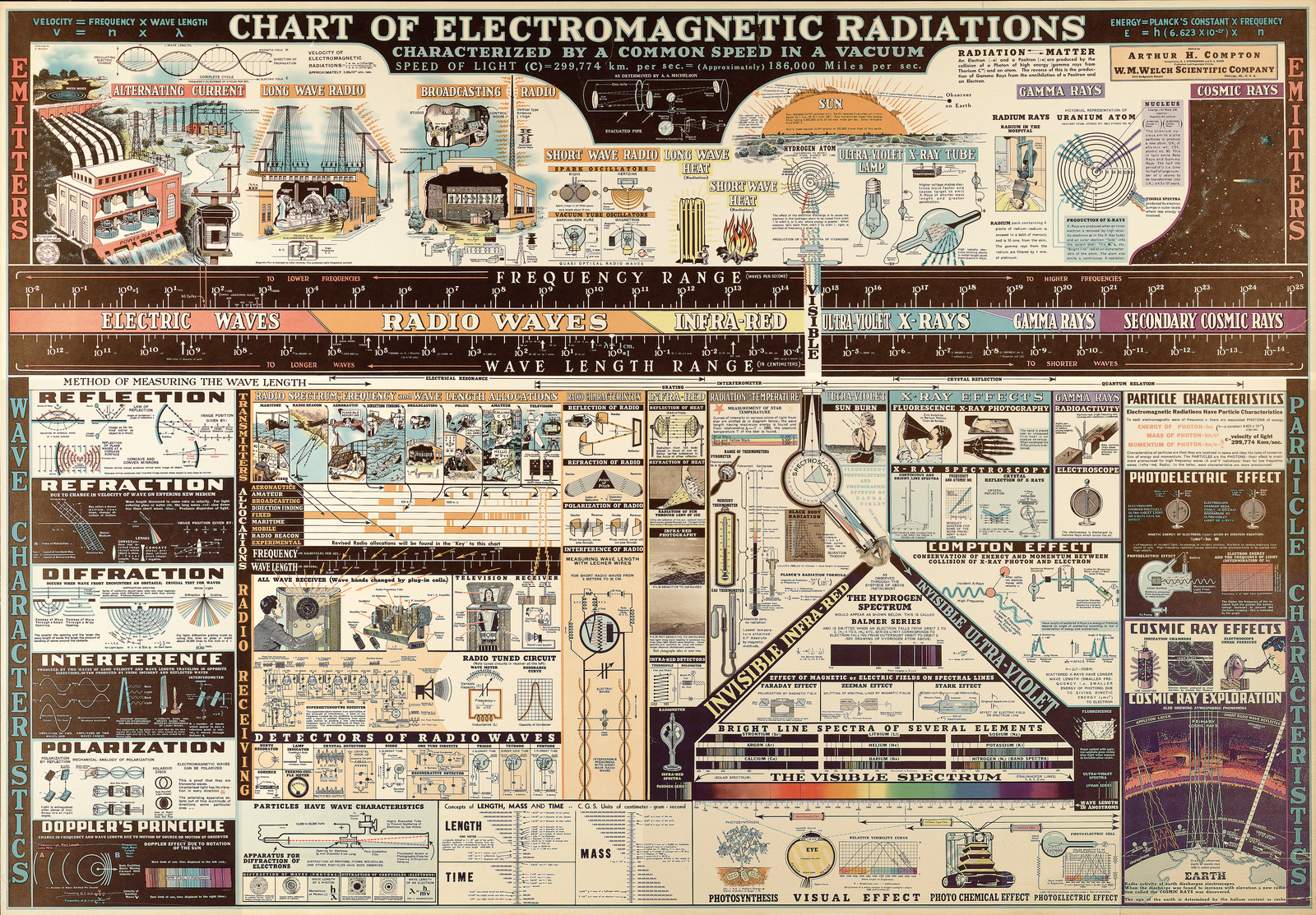
1944 “Chart of Electromagnetic Radiations”

Hat tip to Dennis Walter for sending me a link to this beautiful circa 1944 “Chart of Electromagnetic Radiations” by W.M Welch Scientific Company. According to Flickr user llnl photos, it was found, “tucked away in the back of an unused office years ago, but now hangs framed in a high-traffic hallway populated by Lawrence Livermore engineers.”

ChartOfElectromagneticRadiation

Being a big fan of vintage maps and technical illustrations, I would love to dedicate a wall of my radio room to this chart.

Click on the photo above to enlarge this image to 1600 × 1113.

You can download the original, high resolution image by visiting llnl photos’ Flickr page.