Call me anachronistic, but I listen to digital tech shows on shortwave

BBC_ClickWhile I’m passionate about shortwave radio–a technology that has, of course, been around for many decades–I also love to hear about emerging digital technologies, especially those that make our world a better place.

These days, I listen to several shows about technology, many of which are only available as a live stream or podcast (like TWIT, for example).

There are two shows, however, that I like to listen to on shortwave radio when my schedule allows.

One such show is the BBC World Service technology show, Click (formerly Digital Planet). I’ve listened to Click for years, and have even been interviewed on the show by its marvelous host Gareth Mitchell (click here to listen). I especially love the show’s focus on technologies that have a positive impact in developing countries (hence my interview, about my non-profit, ETOW). Mitchell, I’m delighted to add, is quite the fan of shortwave radio as well, and is not afraid of reporting on technologies that are not exclusively tied to smart phones and the like.
DownloadThisShow-RadioAustraliaAnother show I’ve been listening to for a few months is Download This Show on Radio Australia. It’s a fun and informative technology program and always has a great panel discussion on technology news. What I really love about this show is its take on Australian technology in particular, and how this compares with technology in the rest of the world.

Since Download This Show is broadcast via Radio Australia’s Shepparton transmitting site, the signal is quite strong here in North America and easily received on portable shortwave radios.

Click here to download over two hours of Radio Australia, including Download this Show, or listen via the embedded player below. This broadcast was recorded on August 2, 2013, on 9,580 kHz, starting around 13:00 UTC.

You’ll find Download This Show in the second hour of the recording, following the news headlines at 1:05.
Jeff designs an SDR “Go Kit” around the Softrock Ensemble

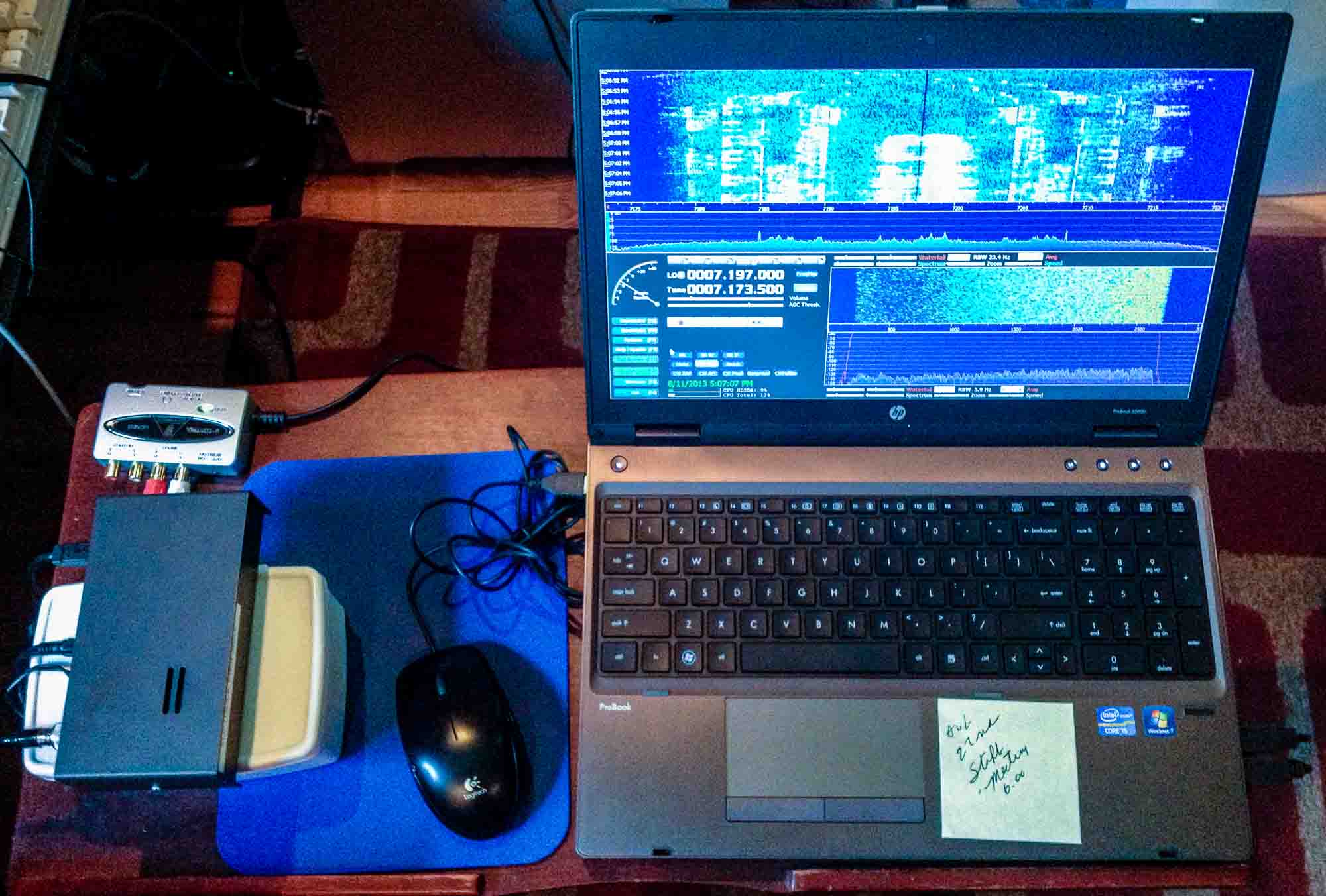
SoftrockGoKit1Jeffrey Fritz (WB1AAL) contacted me with details about his SDR (Software Defined Radio) “Go Kit” and has kindly allowed me to post it.

Jeff writes:

As a reader of the SWLing blog, I know that you are very interested in SDR. And you probably know that a “Go Kit” is a portable ham radio system in a case that can be moved at a moment’s notice and set up at another moment’s notice virtually anywhere.

I have a VHF Go Kit made up for emergency events. It is complete with waterproof carrying case, Aden PCS-7000H two-meter transceiver, a Kenwood VHF tuner, a Kenwood SW-100 VHF SWR bridge and two antennas (a 2-meter J-pole made out of twin lead and a two meter mag mount.) But what if there is a need to monitor the HF bands during the same event?

Now that I own a Flex-1500 SDR transceiver, the Softrock Ensemble SDR receiver that I bought a while ago has become somewhat redundant. It is still a serviceable radio and works fine, but it can’t hold a candle to the amazing Flex-1500. While I could turn it into a panadapter or sell it on eBay, eHam, etc., I had a better idea.

To monitor the HF ham bands, I could use something like my Grundig G3 shortwave radio in my Go Kit. While it is portable, battery operated and will tune LSB and USB, listening to SSB or even CW in an emergency situation with the G3 can be a bit of a chore. (Think of the old boat anchors with their main tuning and fine tuning band spread dials, but now make both dials tiny and you’ll get the idea.) Instead, why not build a 12-volt battery supply with common, easy to obtain batteries? I could connect it to the Softrock Ensemble and then via a USB audio interface to a battery powered laptop. Add a pair of headphones and we are in business.

That is just what I’ve done.

I’ve attached some photos of my most recent project–done this past weekend actually. [Check out photos above and below] It’s an SDR Go Kit. One of the attached photos shows the laptop and the Softrock Ensemble SDR receiving 40-meter band SSB while entirely being operated on battery power. There is no power switch. You simply pull the DC jack out of the Softrock Ensemble SDR radio when it isn’t in use. Simple as it gets! The other photo shows the battery pack built into a (ahem!) Preparation H Pad holder pack. (Now, I am not saying who used this!)

Ah but what will battery life be like with 8 C cells in series driving the receiver? It’s too soon to say because I just put it together an hour ago. But here’s a guess:

SoftrockGoKit2The Softrock Ensemble draws 18 mA at 12.6 volts (my measurement.) An Alkaline ‘C’ battery can supply up to 8,000 mAh, so doing some math and assuming fresh batteries, the battery pack should run the radio for roughly 400 hours. (Hopefully my math is correct!) If so, then I think that the laptop batteries will give out long before the life span of the C Cell is reached!

73,

Jeff, WB1AAL

Jeff, this is an excellent use for the Softrock Ensemble. I imagine it will run for a very long time drawing only 18 mA. I have a “Go Kit” for QRP ham radio purposes and one for SWLing during travels. You’ve inspired me to piece together a proper receiver “Go Kit” to be used in case of emergencies.

Readers: If you have a project, like Jeff, that you’d like to share on the SWLing Post, feel free to contact me with details!

Pirate Radio Recordings: Radio Free Whatever

1924VintageTorontoLast night, I caught pirate radio station Radio Free Whatever; a new one for me.

Pirate radio listening has been difficult this summer between travels and thunderstorms, so I was happy to hear a carrier on 6,945 kHz AM, starting around 01:55 UTC.

Though a tad weak, with AM sync detection enabled, the signal to noise ratio tilted in my favor and made for pleasant listening through the turbulent summer ether.

Click here to download the entire broadcast of Radio Free Whatever, or simply listen via the embedded player below:


Standard Pirate Radio Disclaimer: This is a recording of a real pirate radio broadcast, and as such, may include colorful language. In general, if you are easily offended by the words, ideas, music lyrics, or music herein, you should slowly…back… away…

Radio Free Sarawak is back on the air!

RadioFreeSarawakThanks to Rob Wagner’s blog, The Mount Evelyn DX Report, I just learned that the clandestine station, Radio Free Sarawak, is back on the air after declaring a break on May 8, 2013 (see our previous post).

Radio Free Sarawak will broadcast daily from 11:00-12:30 UTC on 15,420 kHz.

The following is the press release from Radio Free Sarawak‘s website (via their Facebook page):

AUGUST 11, 2013: Press release, Radio Free Sarawak back on air from Monday

Sarawak’s independent radio station Radio Free Sarawak is back on air Monday 12th August following its holiday recess.

The rural radio station, which broadcasts mainly in Iban, but also in Malay has received numerous enquiries from listeners eager for information about pressing issues in the state, including the on-going plans to dam key rivers and evict thousands of native people from their lands.

“The state government has moved swiftly to try and take advantage of its dubious election wins by tripling Ministers’ own salaries (back-dating the increase by a whole year and a half) and pushing through further land grabs in native territories, including the proposed Baram Dam region” points out the UK based station head, Clare Rewcastle Brown. “Ordinary folk want to be heard on these issues and it seems their opinions may often be different from the propaganda put out on the state controlled licensed media, which only promotes the narrow interests of the super-wealthy and politically powerful”.

Radio Free Sarawak is the 2013 winner of the prestigious Pioneer of Free Media Award by the International Press Institute, which applauded the station’s efforts to bring freedom of information and freedom of speech to the isolated communities in Malaysia’s Borneo rainforest state.

The station’s call-in facility also provides an opportunity for longhouse dwellers to express their own views and concerns about the effects of deforestation, oil palm plantation, rural poverty and endemic political corruption. The radio station is linked to the online portal, Sarawak Report, which shares the same agenda to shine light on these and related issues.

Radio Free Sarawak is transmitted from London and its familiar team of DJs will be broadcasting from Monday on Short Wave 15420kHz from 7pm-8.30pm local time Monday-Saturday.

It is also available via podcast online www.radiofreesarawak.org , from where it can be downloaded via smart phone for mobile listeners or onto UBS sticks for car radio.

The local call-in line is 082-237191 and listeners are invited to get in touch with their comments and issues.

HackRF: open source SDR on Kickstarter

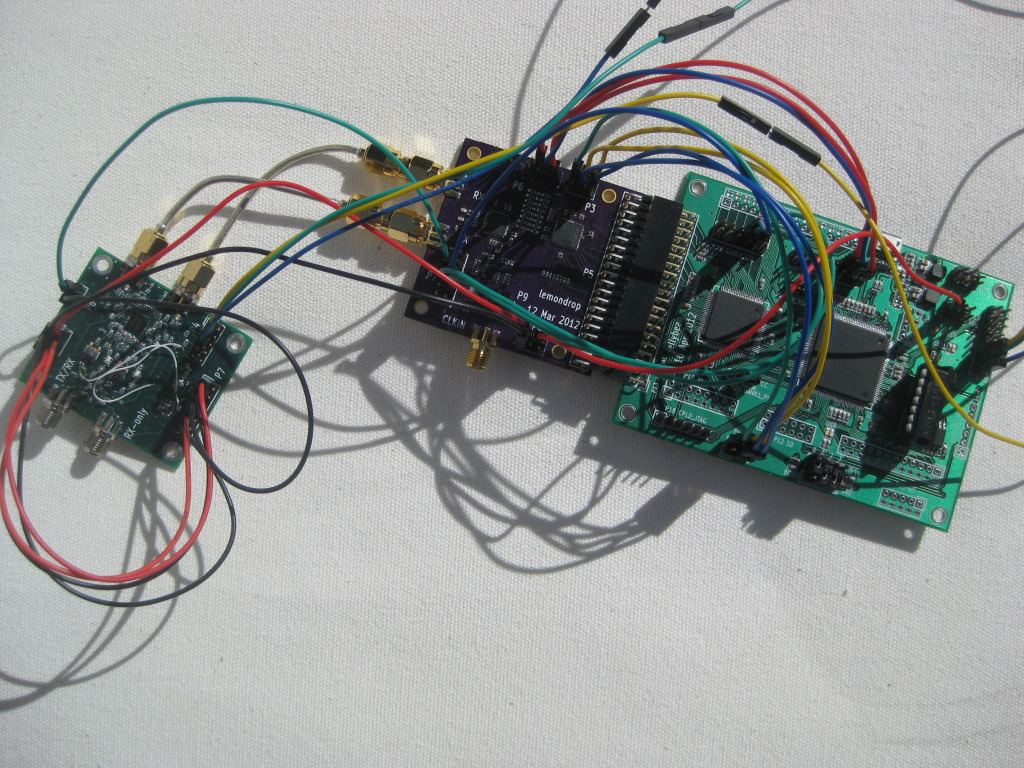
HackRF prototype (Source: ossmann.blogspot.com)

HackRF prototype (Source: ossmann.blogspot.com)

Michael Ossmann is making a business out of developing and producing open-source hardware.

His latest creation is called HackRF, and in less than a day, it has been fully backed on Kickstarter raising over $290,000 US with 25 days left to go in the campaign (at time of posting). Backers can contribute to this campaign with some confidence as Ossmann has successfully delivered products from Kickstarter in the past.

What makes HackRF unique is the fact that the stand alone unit can operate between 30 MHz and 6 GHz; a frequency range substantially wider than any SDR currently on the market. Indeed, when combined with the Ham It Up converter, the HackRF will also cover HF bands and lower.

Additionally, HackRF is a fully open-source transceiver; applications are limited only to a developer’s imagination. You could potentially use HackRF for ham radio, radio astronomy, scanning, shortwave radio listening, remote control applications, wide band monitoring, and commercial/industrial applications. If you use two HackRFs in tandem, they’ll even work in full-duplex applications.

Though the project is fully-backed, you can still support HackRF in the Kickstarter phase and save a bit on the eventual retail cost of the unit. Production units are expected to ship early 2014. Check out the HackRF Kickstarter video below:


Additional information:

VOA Radiogram, 10-11 August 2013, includes MFSK 16, 22, 32

VOARadioGram(Source: VOA Radiogram)

In this weekend’s VOA Radiogram, one VOA News item will be in the MFSK22 mode (80 words per minute), a mode we have generally not used for complete VOA News stories.

Another “feature” in this weekend’s program will be five seconds of silence whenever modes are changed. This might improve the performance of the RSID.

The Flmsg-formatted VOA News story in this weekend’s program is 9 minutes, 6 seconds long. That might seem unusually long, but it includes 4 minutes, 20 seconds for a VOA logo in SVG format as part of the html. This was created for us by Mark Hirst in the UK.

Here is the lineup for VOA Radiogram, 10-11 August 2013:

2:30  MFSK16: Program preview

3:26  MFSK22: VOA News re import of Apple products

3:12  MFSK32: Greetings to l’Associazione Italiana Radioascolto

2:10  MFSK32 image: AIR logo

9:06  MFSK32/Flmsg*: VOA News re one year of Curiosity on Mars

2:26  MFSK32 image: Curiosity tire tracks

1:10  MFSK16: Closing announcements

2:20  Surprise image, text, image of the week

*To make Flmsg work with Fldigi (both can be downloaded from w1hkj.com), in Flmsg: Configure > Misc > NBEMS — Under Reception of flmsg files, check both boxes, and under that indicate where your Flmsg.exe file is located.
VOA Radiogram transmission schedule
(all days and times UTC):
Sat 1600-1630 17860 kHz
Sun 0230-0300 5745 kHz
Sun 1300-1330 6095 kHz
Sun 1930-2000 15670 kHz
All via the Edward R. Murrow transmitting station in North Carolina.

Please send your reception reports, audio samples, screenshots, comments, ideas, suggestions to[email protected] .

The new Tecsun PL-880 sounds promising

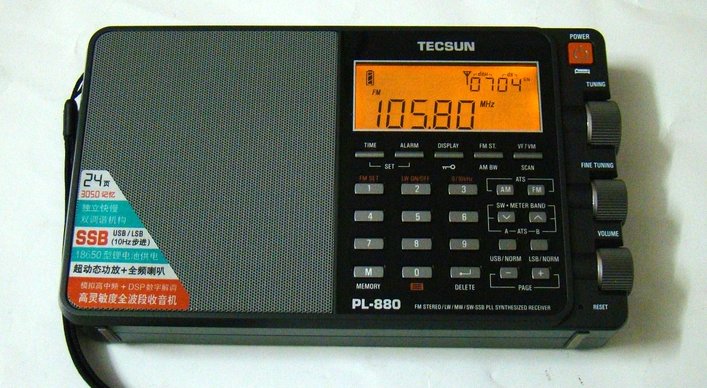
The Tecsun PL-880 (Photo: bbs.tecsun.com.cn/)

The Tecsun PL-880 (Photo: bbs.tecsun.com.cn/)

Last night, I discovered news of the new Tecsun PL-880 on Jeff’s excellent blog, the Herculodge.

Out of all of the current shortwave radio manufacturers, Tecsun seems to be one of the only companies making new models for the radio hobbyist–models with important features like SSB, bandwidth control, fine tuning steps, capable AGC, etc.

According to a comment Owl left on this post, it sounds like the PL-880 could be a performer:

Two photos of Tecsun’s new model PL880 appeared yesterday. It uses an analog+DSP architecture similar to ATS909X but has made some significant improvements (4 AM bandwidth + 5 SSB bandwidth) and better audio compared to previous Tecsun portables.

http://herculodge.typepad.com/herculodge/2013/08/new-tecsun-pl-880-on-its-way.html

I will plan on reviewing the PL-880, once it hits the market. If it’s no larger than my Sony ICF-SW7600GR, it might make for a great travel radio.

TecsunPL-880Box

(Photo source: bbs.tecsun.com.cn)