Shortwave Radio Recordings: Radio Romania International

RRI-RadioRomaniaInternationalRadio Romania International is on of my favorite international broadcasters. I routinely listen to their broadcasts in English and French. With the demise of Radio Bulgaria in 2012, I turn to RRI for news not only about Romania, but Eastern Europe in general.

I do fear for the future of Radio Romania International on the shortwaves as so many broadcasters are pulling out of the spectrum and putting all of their faith into online “broadcasting.” If you enjoy RRI as much as I do, consider submitting a reception report and letting them know that you’re listening.

Tuesday, I recorded RRI’s English broadcast from Tiganesti on 9.435 MHZ (21:30 UTC)–quite an easy and reliable catch in eastern North America. You can click here to download the recording as an MP3, or simply listen via the embedded player below:

The Mighty KBC testing fast digital modes this weekend

KBC Propagation Map (Source: The Mighty KBC)

KBC Propagation Map (Source: The Mighty KBC)

The Mighty KBC will broadcast this Sunday (January 20) on 9,450 kHz between 00:00-02:00 UTC (that’s Saturday night in North America from 19:00-21:00 EST). Details below:

(Source: The Mighty KBC)

We will try some fast text modes this weekend on The Mighty KBC, to see if they can survive the rigours of shortwave.

This will be during the North America broadcast at 0000-0200 UTC 20 January on 9450 khz. At about 0130 UTC, 4XPSK63R will be centered on 1000 Hz and MFSK64 centered on 2000 Hz. (For 4XPSK63R, use Fldigi 3.21.65 or newer: OpMode > PSKR > MultiCarrier > 4XPSK63R.) At just before 0200 UTC, MT63-2000 (long interleave) will be centered on 1500 Hz, and PSKR250 on 2800 Hz. This will be an Flmsg formatted transmission, with html. Fldigi and Flmsg can be downloaded from www.w1hkj.com.

Deutsche Welle: spies received secret messages on their shortwave receiver

towersIf you’ve ever been curious who listens to and acts upon the coded messages we hear in numbers stations (a.k.a. spy numbers stations), follow this German-based couple who are being accused of spying on NATO and and the EU:

(Source: DW)

A spectacular trial at a Stuttgart court is about to begin, involving a German-based couple accused of spying on NATO and the EU for decades on Russia’s behalf. Neighbors say they knew something was fishy.

It reads like a John le Carre novel: “dead mail boxes,” secret radio signals, encrypted messages hidden in plain sight on the Internet.

According to accusations, a married couple has been spying in Germany for more than 20 years – first at the behest of the Soviet Union and thereafter for its post-Soviet incarnation, the Russian Foreign Intelligence Service.

On Tuesday (15.01.2013) 54-year-old Andreas Anschlag and his 48-year-old wife, Heidrun, will stand trial in Stuttgart. Federal prosecutors accuse them of “secret agent activity” and of “forgery of documents.”

[…]The history of the purported agent couple begins at a time when the Soviet Union still existed and the Cold War was still cold. According to accusations, Andreas Anschlag traveled to West Germany in 1988 with the help of a forged Austrian passport. His wife did the same in 1990. Both were supposed to have been born in South America. The two settled in Aachen, close to the western border with Belgium, where Mr. Anschlag studied mechanical engineering.

[…]The files were delivered via “dead mail boxes,” according to official charges, to the Russian Foreign Intelligence Service in Moscow. The couple apparently received further commands through an agent radio network and sent their own messages via satellite and through an internet video platform.

When they were arrested in October 2011, the German news magazine Der Spiegel reported that the woman was sitting in front of a shortwave receiver, writing down secret messages. At that point the pair was living in a house in Michelbach, a small community in the German state of Hesse.

“Suddenly we had this spy thriller taking place right outside our window – it was better than the movies,” one of the neighbors told DW.

Read the full article on DW’s website.

Note that this story reads much like the Russian couple who spied on the US a few years ago.


Pirate Radio Recordings: Renegade Radio

1-RadioListeningFriday night (late) I caught Renegade Radio on 6.93 MHz in the upper side band.

Renegade’s signal was consistently clear for unusually noisy conditions, though the station was occasionally plagued with transmitter problems.  I did not edit these out in the recording because dead air never exceeded a few minutes. So, if you hear dead air, simply fast-foward a minute or two. Total broadcast exceeds one hour and, near the end, Renegade informs us that his transmitter was getting hot.  I’ll bet: I don’t know Renegade’s set-up, but many pirates use modified ham radio transceivers that were never intended for those 100% duty cycles, often at full power. Keeps a pirate warm on a winter night, though!

Feel free to listen to the recording of Renegade Radio in the embedded player below, or right click and save this link to download the MP3 directly:

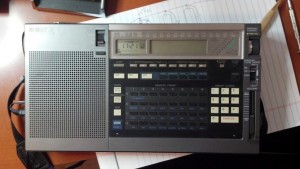
Vlado’s thrift store find: A Sony ICF-2010

The Sony ICF-2010

Vlado’s Sony ICF-2010 (Click to enlarge)

While visiting my friend, Vlado, this weekend, he showed me his thrift store find: a Sony ICF-2010 in very good condition`. The ‘2010 is a well-known portable amongst serious DXers, and is highly sought-after. Since this radio has not been in production for many years, used models routinely sell for a price in excess of $200 US. Parts radios sell for $50 US or more.

We suspect that the previous owner thought it stopped working. You see, when Vlado plugged in the AC power adapter, nothing happened.

But take note: there is a quirk, at least with some ICF-2010s–they will not power up, even with the AC adapter plugged in, if you don’t have AA batteries installed. Indeed, two AA cells are required for either DC or 120 VAC operation. Once Vlad put AAs in, the radio came to life.

How much did  he pay for his Sony ICF-2010? Five dollars.

Paint me envious!

Mark Your Calendars: PCJ Media tests new shortwave transmitters February 16

pcjWhile so many broadcasters are cutting or eliminating shortwave broadcasting, there is one who has built a new transmission site in Taiwan and has ambitious goals for the future: PCJ Media! Mark your calendars–though no frequencies yet, PCJ has announced a date and time for their first test:

(Source: PCJ Media)

PRESS RELEASE

The first phase of PCJ’s own relay is completed. There are four phases to be completed until the station will be up and running to full capacity.

Technical Data:

  • 1 /20kw
  • 1/5kw
  • 2/1kw
  • 2/curtain type antennas
  • 2/horizontal dipole type antennas
  • 4/Orban Optimods

On February 16, 2013 we will conduct our first test. It will begin at 1600UTC until 1800UTC. The test will be done using the 2/1kw transmitters. Both will be directed to South East China. One frequency to be directed to Fujian Province and the second frequency directed to  Guangxi Province.

Frequencies for this test will be published closer to the date of transmission. We have been given permission to use out of band frequencies. At the moment we are looking at around 12100 to 12500khz and 11400 to 11500khz. This was decided since these will be running 1kw and to reduce any type of interference it would be better to transmit in this range.

For more information please contact [email protected]

Shortwave Radio Recordings: All India Radio on the Bonito RadioJet

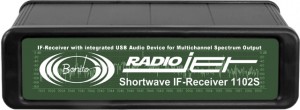
The Bonito 1102S RadioJet IF receiver

The Bonito 1102S RadioJet IF receiver

After posting my latest All India Radio recording, SWLing Post reader, Pete, suggested that I check out their broadcasts starting around 21:00 UTC on 11,670 and 9,445 kHz, as they are quite strong into North America. He was right.

On Thursday afternoon, I tuned the Bonito RadioJet to 9,445 kHz, where I was greeted with a strong signal from AIR’s Bengaluru, India, transmitter site (over 8,500 miles from my home). I compared the signal on the RadioJet with that of my trusty WinRadio Excalibur to find that the RadioJet’s audio was somewhat fuller and richer. In situations where AM sync detection is not needed, I may start using the RadioJet for recordings. I’ve been using it strategically over the past few months for DRM reception and digging weak stations out of the static–something I typically don’t record, but probably should, as the RadioJet deserves even more air and recording time!

AllIndiaRadioLogo1I recorded this AIR broadcast on Thursday January 10th–around 21:30 UTC–on 9.445 MHz. This particular broadcast features news, commentary and the wonderful music I’ve come to expect from All India Radio. You can download the MP3 by clicking here, or simply listen in the embedded player below. Enjoy!