Syria stifles the Internet while Canada stifles shortwave

This past Saturday, I found the irony a bit much to take: on one hand, there was Syria, a highly volatile country struggling for stability, while on the other hand, there was…Canada? Both, on the same fateful day, effecting media shut downs.

No doubt, most every Syrian with Internet access knew their Internet had been shut down this past weekend, while very few Canadians knew that their international radio voice had been quelled.  In both cases, the government was mostly to blame, though in Canada the CBC was left holding the knife.

The venerable, yet vulnerable Internet

I’ve mentioned numerous times how vulnerable the Internet is to simply being shut off. In most cases, this happens because those in power are attempting to control free speech and communications. Unfortunately, it’s not an infrequent occurrence; if anything, it’s a growing trend. In this NPR story from Saturday, Andrew McLaughlin, former White House adviser on technology policy, was quoted as saying:

“The pattern seems to be that governments that fear mass movements on the street have realized that they might want to be able to shut off all Internet communications in the country, and have started building the infrastructure that enables them to do that[.]”
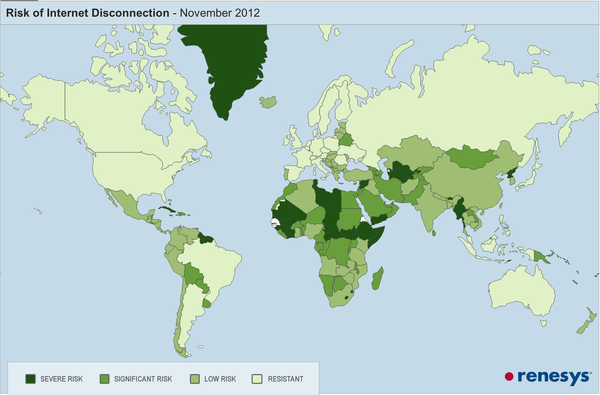
Renesys map showing vulnerable internet networks by country (click to enlarge). Note that most of the countries with low risk are those who have (or had) a strong international broadcasting presence on shortwave.

Not good.  And as unethical as it sounds for Syria (or Egypt or Libya or the Maldives or China or Burma) to have shut down the Internet, if the U.N.’s World Conference on International Telecommunications (WCIT-12) meeting is successful, it will make Syria’s shutdown a legally supported scheme for every country in the world.

So what countries are technically vulnerable to this sort of shut down? It depends to a great extent on the diversity of a state’s communications infrastructure, and the number of its service providers that are connected to the rest of the world.  Syria, sadly, is among the most vulnerable. James Cowie, at the Web monitoring firm, Renesys, was recently quoted in the Washington Post describing just how easy this shut-down process is:

“Make a few phone calls, or turn off power in a couple of central facilities, and you’ve (legally) disconnected the domestic Internet from the global Internet.”

Information of last resort
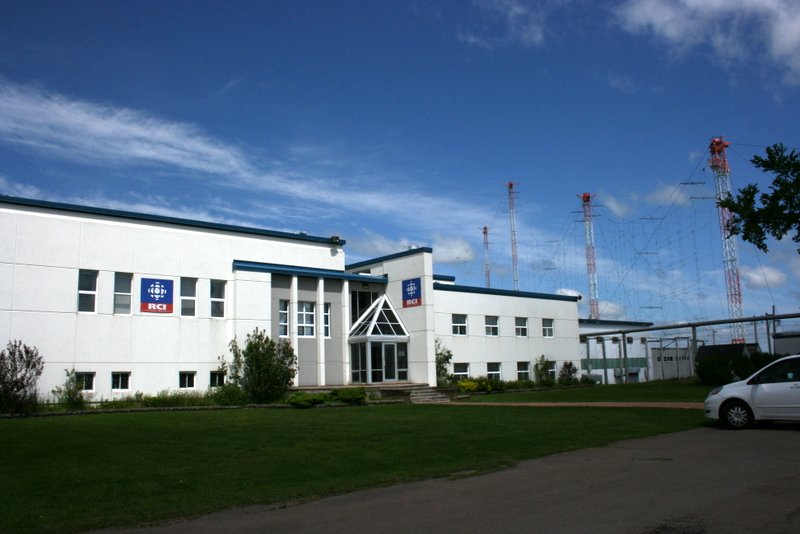
RCI’s Sackville Transmission site went off the air Saturday, December 1st.

In January of 2011, Egypt, too, shut down its Internet service. Radio Netherlands Worldwide (RNW) responded by adding shortwave broadcasts targeting Egypt. Since then, RNW has been silenced. I would like to think that if RNW, with its once-powerful human rights and free press missions, were still around, the organization would have leapt to the aid of the Syrians. Alas, where are they now?

True, shortwave radio is not a comprehensive replacement for the Internet any more than it is for mobile phone service. It lacks the peer-to-peer connectivity of either medium.  But it is interactive and accessible.

Indeed, recent history proves that, when all other communications systems are shut down, information still leaks from a country via various means. This very information is often broadcast by international voices over every medium, including shortwave radio.  So there exists an intimate interaction between those living under a repressive regime and the foreign press that is impossible to deny. Shortwave radio is, in a very real sense, an arm of the foreign press and diplomacy, one that still reaches out to the citizens of oppressed countries.

What about satellite?

To be fair, did Egyptians seek out shortwave radio when their country’s Internet went down? Not all, but quite a number did.  In truth, satellite TV is king in many growing countries, and the information found on satellite was still flowing freely. Therefore, many turned to satellite.

So is shortwave radio still needed? Of course. Satellite TV, like the Internet, is much easier to jam or block. Shortwave radio is the only broadcast medium that streams at the speed of light across borders with no regard for those in power, that requires no subscription or expensive equipment, and is 100% untraceable (provided you listen through headphones).

Lessons learned

I’d like to think that even the UN or similar state networks would consider pooling funds to keep shortwave radio broadcasters on the air to protect this valuable resource. Still, it’s those countries with the wealth, the stability, and the democracy, that feel shortwave is so dispensable. When budgets are being cut, governments view their foreign broadcast service as a quick chop. They don’t realize that an international radio voice is actually the most reliable, most cost-effective arm of foreign diplomacy–especially in areas of the world where information does not flow freely.  In such regions, they have a captive audience at pennies a head.

So, who will be next country to shut down their Internet services and leave their citizens in the dark? Follow the headlines.  And who will silence the next shortwave broadcaster? Follow the money.
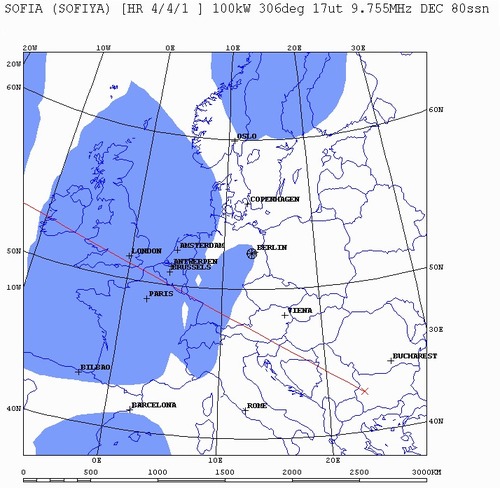
The Mighty KBC to broadcast in DRM (Digital Radio Mondiale)

DRM propagation map for Europe (image courtesy: The Mighty KBC)

The Mighty KBC has announced that they’re going to broadcast in DRM again on the 22, 23, 25 & 26 of December from 16:00 – 18:00 UTC. This is in addition to their previous announced December specials. The DRM broadcasts will come from a 100 kW transmitter and curtain antenna in Kostinbrod (Sofia) Bulgaria on 9,755 kHz DRM.

Tune in and let us know if you heard The Mighty KBC in DRM.

Help Myke fund a 2013 ShortWaveMusic series on Socotra, Yemen

We’ve mentioned Myke Dodge Weiskopf before on the SWLing Post, he’s a radio producer, historian, broadcast artist, multi-instrumentalist, sound recordist, and composer based in Los Angeles, CA.

Myke travels around the world with his trusty Eton E1 and recording equipment in tow to capture both sounds from the ether and live performances. He then makes them available on his website, Myke.me.

He’s now planning a recording trip to isolated island of Socotra and needs your help.  He has a Kickstarter campaign which outlines plans for his trip. Watch the video below and consider helping him by contributing to his goal of raising $3,500 US.

Radio Exterior de Espana (REE) has returned to shortwave

As a follow-up to my previous post on Radio Exterior de Espana, I can confirm that I’m hearing REE on all of their scheduled frequencies today.

We’re not totally sure why their analog shortwave broadcasts were cut last week, but it could certainly have been a knee-jerk reaction to the financial woes in Spain and at RTVE.

Again, if you’re an REE fan, I suggest you contact them ASAP ([email protected]) and show your support. Tell them what you listen to and why. Though services have been re-established, I suspect REE shortwave broadcasts may be on the chopping block again in the near future.


Radio Exterior de España leaving shortwave? Not yet.

This week, Radio Exterior de España (REE) suddenly dropped many of their analog shortwave broadcasts. I waited to mention this on the SWLing Post because, even though they were no longer on the air, I had heard no rumors beforehand and I had recently been in contact with them.

SWLer, Mark Coady, made a post on Facebook today with a message from REE stating that there was a lot of internal confusion and frustration regarding REE suddenly dropping shortwave services. They also mentioned that REE is planning to restore shortwave services again, possibly as soon as this weekend. I just received a short message from an REE contact to the same effect.

So, we will see if they restore services this weekend or early next week.  I personally enjoy listening to REE’s services in English and French.  I especially love their music, when they play it.

If you’re an REE fan, I suggest you contact them ASAP ([email protected]) and show your support. Though services are being re-established, shortwave broadcasts may be on the chopping block again in the near future.


2013 WRTH now available

WRTH has announced that their 2013 edition is now available online. Every year, I look forward to searching a new WRTH’s pages for the first time. What is the WRTH (World Radio and TV Handbook)? Click here to read my reviews of the 2010, 2011 and 2012  editions of WRTH. In the 2010 edition, I even include an interview with the publisher, Nicholas Hardyman.

To order your copy of WRTH 2013, go to this page on WRTH’s website.

One bag + radio = the way to go

Though I only travel with one carry on bag, it doesn’t mean I can’t accommodates my shortwave radio/recording pack.

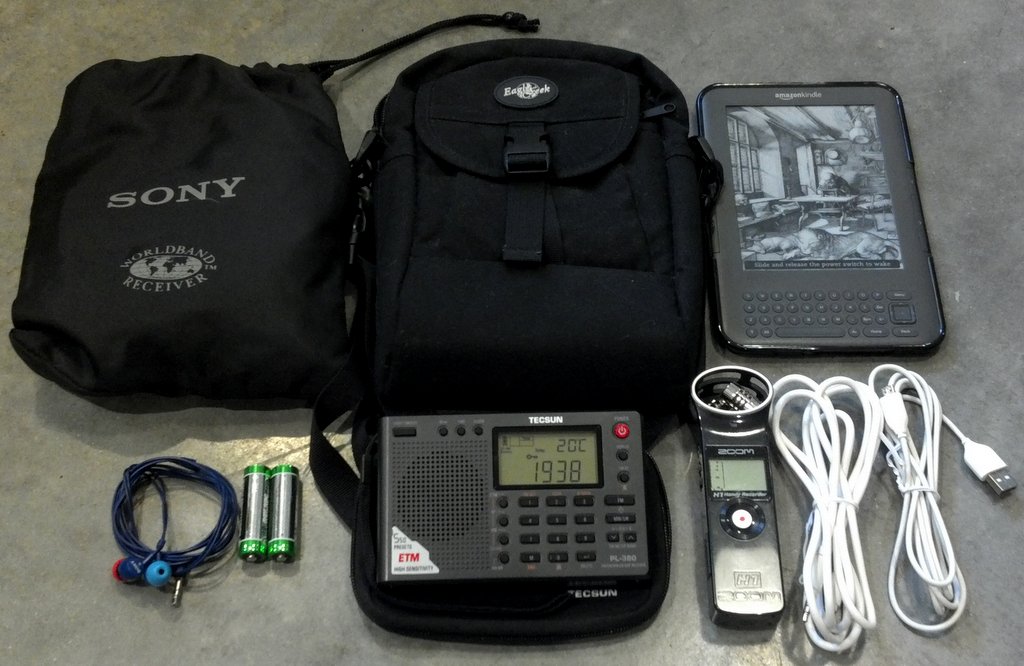
Having just returned from nearly three full weeks of traveling, I’m more convinced than ever that my just-one carry-on bag approach makes absolute sense. In one bag, I’m able to take everything I need, including casual and business attire, toiletries, first aid and, yes, of course, my portable shortwave radio (never leave home without it!) and my Zoom H1 recorder.

One bag freedom

Years ago, while working for a fiber optics company in Europe, I learned the trick to keeping my cool during frequent air travel was simply to avoid, at all costs, checking in baggage. Over the course of several years, I honed the contents of my travel bag down to the bare essentials, and even for longer trips in developed countries, made the (correct) assumption that any supplies I required could be found at my destination.

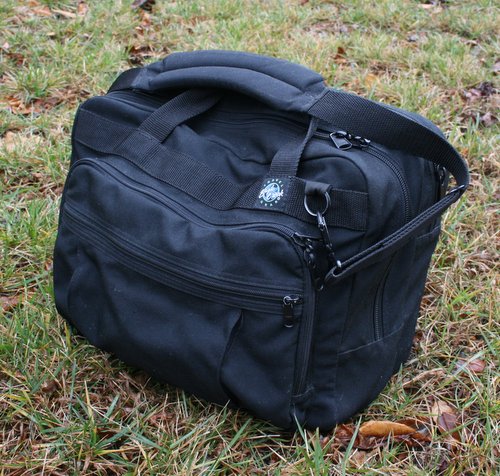
My circa 1999 Eagle Creek convertible laptop bag has traveled thousands of miles. It’s just big enough to accommodate everything I need for several days or even weeks travelling.

For twelve years now, I have been using one of three Eagle Creek carry-on convertible bags. Two of these plain black bags look much like the ubiquitous vertical rolling luggage you see every day in major airports, but they hide two secrets: each can be converted into a full-fledged backpack, and each meets the most stringent standards for carry-on luggage. They’re also built to take a beating, which they’re getting, and have a lifetime warranty.

The third Eagle Creek pack is basically a roomy laptop (and radio) bag (see photo on left). It has no wheels, and can be worn with a shoulder strap…or, again, converted into a simple two-strap backpack.

When traveling alone, I can easily get by with only the third and smallest of my Eagle Creek pack: the laptop bag. It has a very roomy, padded compartment for my laptop, a middle compartment where I fit my bundled clothes, first aid, and radio pack (which also holds my Kindle), and a front section with organizers for office supplies and a convenient place to stash my travel docs and passport. It’s also a very simple to make this pack virtually pickpocket-proof.

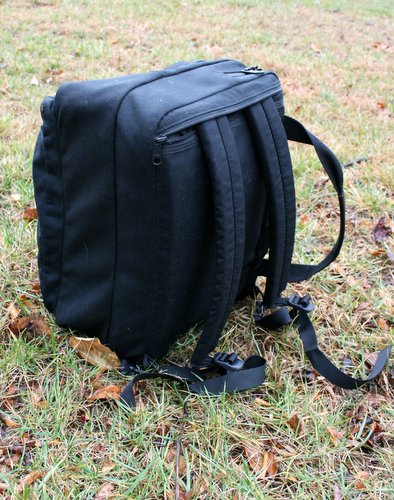
This laptop bag quickly converts into a backpack–a useful feature when it’s fully loaded and you need both arms free.

Check-in-proof!

The benefit of using this particular Eagle Creek laptop bag (important: the one without wheels) is that–even if I’m being loaded in the last zone of a flight, even if the flight is fully booked, and even if the flight is on a De Havilland Dash 8-100–I always find a place for my bag on board, and never, ever, have to gate-check my bag. It will fit in a small overhead compartment, or at the very least, under the seat in front of me.

Though the compromise is that I travel light, the great benefit is that I never have lost any bags, rarely miss a connecting flight (it typically takes at least five extra minutes to claim even a gate-checked bag), and I zoom in an out of an airport. I have the luxury of sitting back and reading while I watch others panic at a gate, waiting for their appropriate “zone” to load.

From my seat, I watched US Air load wheeled carry-on luggage that they required some unfortunate passengers (who were already on the plane!) to check in.

Over the past decade, air travel has really changed. Most of the domestic flights I took throughout Europe a decade ago used to be only about two-thirds full. Here in the US, it appeared to be roughly the same. Today, however, airlines have cut back their offerings and frequently overbook flights. In fact, on a recent flight returning from Denver International Airport, the airline warned of penalty charges if passengers attempted to carry on more luggage or weight than allowed. The airline was making anyone with a wheeled bag–no matter how small–check it in.

Since I was in the eighth row seat, and I only had my Eagle Creek laptop bag on a shoulder strap, I waited until almost everyone else had boarded before I got in line. I walked straight into the 737, pulled my radio pack out of my laptop bag, stowed the laptop bag in the overhead compartment, and settled into my seat. No sweat. Meanwhile flight attendants were taking extra baggage from travelers in the back of the plane and checking in their luggage on the spot. Though their bags met overhead compartment criteria, there simply wasn’t enough room.

Confession time: So, I am something of a pack addict…!

My wife recently pointed out that, besides radios, I have too many packs. I’m convinced I do this because I’m always searching for the best, most versatile way to travel. Most of the packs I buy these days are smaller ones to compliment my Eagle Creek packs. I’m a choosy pack connoisseur, too: I often save my dollars and seek something made in the US–or in Europe, Australia or South Africa (true of pack-maker Karrimore, at one point). I don’t typically like the mass-produced stuff, which I find is not as well-made. My original three Eagle Creek packs were made in the USA, but after the company was featured on the American TV talk show Oprah, receiving the host’s endorsement, the unfortunate result is that the company’s products have since (in my opinion) been compromised and manufacturing moved overseas, likely to keep up with new demand.

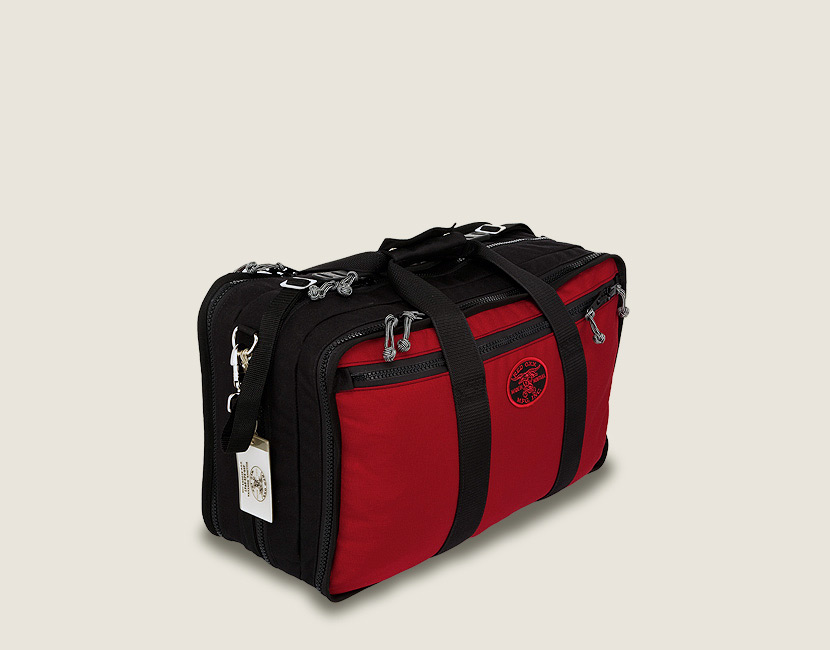
Red Oxx actually designed their Air Boss bag for one-bag travelers like me. It even meets the strictest international carry-on standards.

Since a good friend just sang US company RedOxx’s praises, I’m currently drooling over the RedOxx’s Air Boss and SkyTrain. Both look like they would do the trick, but make me slightly nervous because they are a couple of inches larger than my trusty-if-“rusty” Eagle Creek laptop bag, in two dimensions. If RedOxx’s uber-affordable Extra Small Aviator Bag had a shoulder strap and could accommodate a small laptop, I would even consider trying that bag–perhaps in combo with their Gator Carry-On Bag, this would make sense (but that would make for two bags, not sure about that).

Could I fit all of my stuff in the Red Oxx extra small aviator bag? T’would be a challenge!

I suppose I could also consider the US company Tom Bihn Tri-Star, though it is probably more bag than I really need.

Note that although these bags are pricey, all come with a no-hassle, no-questions-asked, lifetime warranty–the Redd Oxx warranty, in particular, is worth a read–both companies are also noted for excellent customer service and the bags should last my lifetime.

Unless, that is, I find another that I want to test drive. Filled with of radio gear, of course. Ah, well…My wife appears to be right.

Have radio, will travel

I suppose the reason I’m entertaining this slightly off-topic travel subject is not just due to my recent travel, but because I’m now enlightened enough to realize that traveling light never means traveling without a radio. With some careful planning and packing, choosing the right bag–and travel-companion radio–the whole world is waiting for you.  And you won’t find yourself spending your travel time–and radio listening time!–watching bulky suitcases drift round on the conveyor belt at baggage claim, as you wait for yours.

Anyone else out there have a similar bag addiction?  Got one you like? Radio travelers, share your thoughts!

If you are into one-bag travel, you should check out the following excellent sites (thanks for the links, Ed):