The Degen DE1129 features 10 kHz steps on medium wave

I just received confirmation from a representative at TecsunRadio.com that the Degen DE1129 will offer selectable 10kHz steps for the medium wave (AM) band in North/South America (ITU Region 2).

My contact had to verify this fact by actually trying out a radio and making the selection manually (see photo), as the written radio specifications were unclear.

Upon learning that its predecessor, the Degen DE1128, did not have 10 kHz stepping, it lost an audience in the Americas.  I feared that the DE1129 would have the same limitations, but fortunately (for Degen) it is not. Of course, here in North and South America, we have the Grundig G2 Reporter–which is sold and supported here in the US as a DE1128 alternative.  But this newest member of the Degen line is a welcome addition.

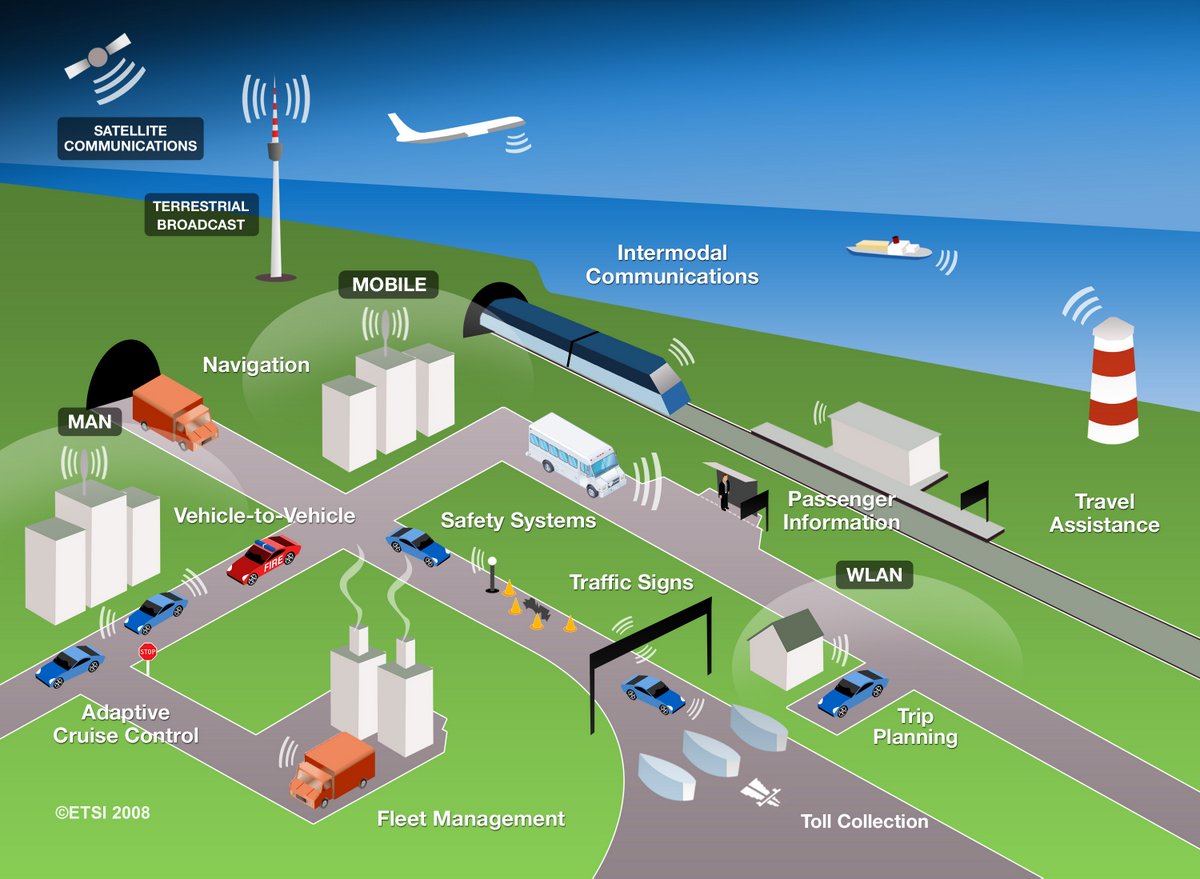
ITU (International Telecommunication Union) Regions Map

Frank’s assessment of the Elad FDM-S1

The ELAD FDM-S1 Software Defined Receiver

SWLing reader Frank Holden (VK3JFH/VP8DNM) contacted me by email to share his experience with the ELAD FDM-S1–of particular interest because we have yet to see many reviews of this particular software defined receiver. Although the FDM-S1 was announced with some modest fanfare, its actual release and availability skipped over many of us. Not over Frank, however:  he purchased an FDM-S1 and had it shipped to his home in Australia, where he apparently put it through its paces.

Frank’s overview of the ELAD FDM-S1 is quite good, and he has kindly given us permission to post his observations here:

I have had an ELAD FDM-S1 now for over a month, having purchased it directly from the manufacturers, and while I don’t feel qualified to write a review you may be interested in my opinion of it.

In my shack at present I have an Icom R-1500, Icom 718, Tecsun 390, Tecsun 660, Grundig G6, Sangean ATS 909, Drake SW 8, Kenwood R5000, a Funcube Dongle and an Alinco DJ-X11. In the way of antennas I have a couple of dipoles, a G5RV , and a 10 metre vertical for TX together with an AOR DC to Daylight, a Diamond discone , a GWhip longwire and a simple 7 metre long untuned vertical on a squid pole for RX.

I was going to buy my ELAD pre-release from WoodBoxRadio but language difficulties and confusion over getting it VAT-free put paid to that. I take full responsibility for the confusion……

In the end I bought one direct from ELAD sdr for 362.81 Euros VAT-free, which price included 10 Euros postage to Australia. It arrived within a week… would that everything that I bought from overseas was as cost effective and fast.

Out of the box it was simple enough to set up with just a USB connection to the computer. I have it connected to a Dell Netbook and this had to be upgraded to XP Service Pack 3 together with some .Net software, the purpose of which remains something of a mystery. I imagine with a newer computer it would operate straight out of the box. It came with a DVD which had both the .net software on it plus an early version of the operating software. I immediately upgraded this software to v3.07 which is what I am currently using.

I believe that originally the frequency range stopped at 30 MHz… however, it can now receive up to 452 MHz if this is selected in the advanced menu. As I write this I am monitoring aviation traffic on 132.200.  Likewise the original viewable spectrum was quite restricted,  but in the latest version 1.2 MHz can be viewed in the waterfall.

Tuning is straightforward… either by direct keyboard entry or by clicking on the waterfall…. there are also three ‘sliders’ at the bottom of the screen which permit ‘mouse tuning’ by either metre band, MHz, or kHz. Mode selection and quite a bit of other stuff (did I mention that this is not a technical review?) are on a drop down menu at the right hand side of the screen. DRM is included amongst the modes and I listen to RNZI DRM most evenings.

I haven’t used any of the recording options on this radio yet.  What I have been doing is either simple SWLing where the ability to monitor an entire Metre band is excellent, especially when combined with the info on the WRTV frequency guide DVD. I also use it at other times of the day  in what I suppose you could call ‘Ham’ mode where it can be left watching the 20 metre, 40 metre or other ham band and I can see when a band has opened… far simpler than scanning around…

So all in all, I am very satisfied and would recommend this SDR to anyone.

My #2 radio these days is my Tecsun 390 with its ETM… another bit of brilliant kit.

Frank also sent some helpful photos of his screen, and added:

I am currently running v.3.07 beta… the last shot is the latest  ‘polished’ version   3.01.

As you can see in that shot, you can now get three screens, including an AF and an IF screen. That version also comes with a separate program that lets you work with recorded files more easily.

He even included some photos of recording:

Thanks for your most interesting observations, Frank.  If there are any others out there who have experience with the Elad FDM-S1, feel free to comment below or simply contact me.

For those of us here in the US, to my knowledge there still is no FCC approval of this device. I have contacted Elad with this question; they’re on annual holiday leave just now.

Follow our other Elad FDM-S1 posts with the tag: Elad FDM-S1

Shortwave Radio Recordings: Radio Kuwait and music variety

Donovan’s “Mellow Yellow” is tossed into this Radio Kuwait mix (Photo: Billboard.com)

Any of you who’ve been following the SWLing Post for a while know how much I love recording music over the shortwaves. Lately, Radio Kuwait has been booming into my part of eastern North America with great vivacity.

Yesterday, I recorded several hours of their broadcast on my WinRadio Excalibur. I couldn’t help but notice, the last time I posted a recording, that their music had a great deal of variety. Their mix yesterday afternoon encompassed hip hop, country, pop, rock, R&B, and even a little Billy Joel and Donovan.

Though the hip-hop and boy bands don’t particularly hold my personal interest, hearing “Mellow Yellow” over 7,000 miles of ether certainly has appeal.

If you’re looking for music variety (well, a lot of variety), with some items of cultural interest thrown in, check out Radio Kuwait:

The connection between Hallicrafters and 1940s electronic warfare

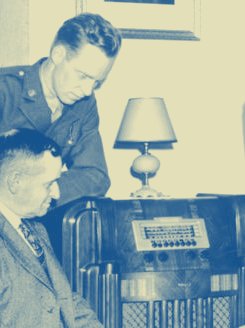
A B24’s Hallicrafters S27 (Photo: AAFRadio.org)

One of my favorite ham radio blogs is that of John (AE5X). Like me, he’s a QRPer–meaning, as amateur radio operators, we love making contacts across this great globe of ours using very low power…typically 5 watts or less. The challenge is fun, the medium is magical.

John’s also a radio historian and shortwave radio listener. Yesterday, he posted a most fascinating look at how the Hallicrafters S27s played an important role during World War II countering very innovative radio guidance techniques by the Third Reich.

You should bookmark John’s blog, as he post many radio related topics that the SWL would find enjoyable, whether it be about numbers stations, QSLs or even his own experience learning Russian via shortwave.

But first, read: Hallicrafters and electronic warfare in 1940 on 10 meters. . .or, an ‘Aspirin’ for the ‘Headache’

The Professor loses a neighbor, gains some radio freedom

(Photo: The Radio Kitchen)

So great to see a new post on The Radio Kitchen, letting us know that The Professor can DX from home again after resolving a spectrum noise disturbance. This is a post many a shortwave listener will relate to, since most of us have had to deal with spectrum noise at some point.

Click here to read:
Goodbye Neighbor, Hello Brazil!

The new Degen DE1129 shortwave radio with MP3 recording and playback

(Photo source: TecsunRadio.com)

TecsunRadio.com has posted the new Degen DE1129 shortwave radio on their website. Though they have not yet posted pricing, it appears pre-orders are being taken.

The DE1129 looks like a decedent of the Degen DE1128 that has not exactly been a market success in North America. The DE1128 lacks medium wave (AM) 10kHz steps (spacing) that allows it to be useful in the North America AM broadcast market.  It also lacks English as a selectible language on the display. (The Grundig G2 Reporter, however, does have the features and is, in essence, the North American version of the DE1128).

The published features/specs of the new DE1129 do not reveal if AM spacing or English language will be an issue in the DE1129. I will try to contact the manufacturer. Until then, I would keep this in mind if pre-ordering. UPDATE: The DE1129 does have 10kHz spacing.

UPDATE: Vimal points out pricing is $102 US/each with shipping.

Thanks for the tip from the excellent Herculodge blog!

Features (per retailer)

  • FM :87.0-108 .0 MHz
  • campus radio:64.0-108.0MHz
  • MW (medium wave) :522-1710KHz
  • SW (shortwave) :2.30-23 .00 MHz
  • Stored radio frequency of 248
  • Radio signal strength indicator
  • High-frequency stereo
  • Five tuning methods: (encoder knob / manual / automatic / memory / ATS)
  • Large-size LED backlit dot-matrix screen, full support of the Chinese display
  • Playback: MP3 and WMA decoding
  • Multiple repeat mode
  • A variety of sound modes
  • Variable speed playback
  • A-B repeat
  • Recording function: MIC recording, recording radio
  • MP3/WAV sound recording format selection
  • Can be used as the active speaker
  • E-book features: TXT document reading
  • Intelligent timer switch
  • Alarm clock function
  • Sleep timer (05-90 minutes)
  • Support software upgrades
  • Support for multiple languages
  • Built-in memory, support for the MICRO SD card playback
  • Key Lock Switch
  • The electronic volume control (31)
  • Built-in top super bass vibration film and wideband audio speaker
  • MINI-USB interface, USB2.0 high-speed transmission
  • The intelligent charging can be connected to the computer charge
  • Battery level indicator, low battery automatically shut down
  • Removable battery, replace the batteries more convenient
  • Machine size: 130 * 78 * 30MM
  • Weight (with lithium battery): about 145G
  • Supplied accessories: USB cable, lithium battery, and Operations Guide