Video: When “Tomorrow’s World” demonstrated digital radio

Many thanks to SWLing Post contributor, Jason W, who writes:

You might be interested in this episode of the BBC series tomorrow’s world from 17th Feb 1993 on YouTube:

10:23 to 14:50 has a introduction and demonstration of digital radio in the UK and concluding with “the experts say we will be fully digital by 2020 it’s a long wait” (referring to the switch from fm to digital radio in the UK which is yet to happen).

I thought it might be interesting to highlight this on the blog in 2020.

We can forgive the bit where she suggests digital radio will operate alongside analogue FM in the same frequency band. This Wikipedia on the history of digital broadcasting in the UK shows the UK adopted the DAB Eureka 147 standard in a SFN (single frequency network) from the start of test transmissions in 1990.
https://en.m.wikipedia.org/wiki/Digital_radio_in_the_United_Kingdom

The same episode has a later piece on wide-screen digital television. (20:18 to 23:41) ending with the line “like digital radio, it is a few years away” 🙂

This is fantastic! I love watching vintage Tomorrow’s World episodes. It’s great to see how well they predicted the future and what they considered to be meaningful future innovations at the time. Thank you for sharing, Jason!

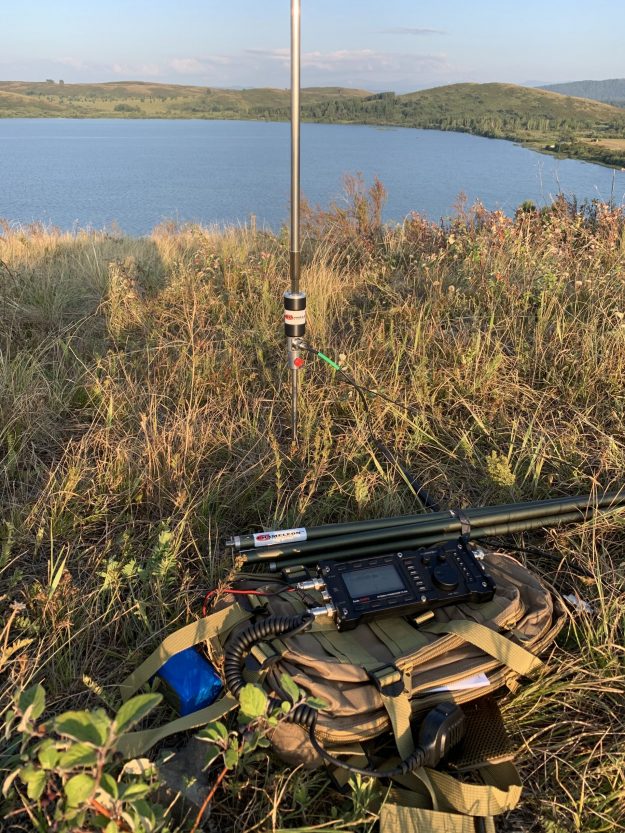
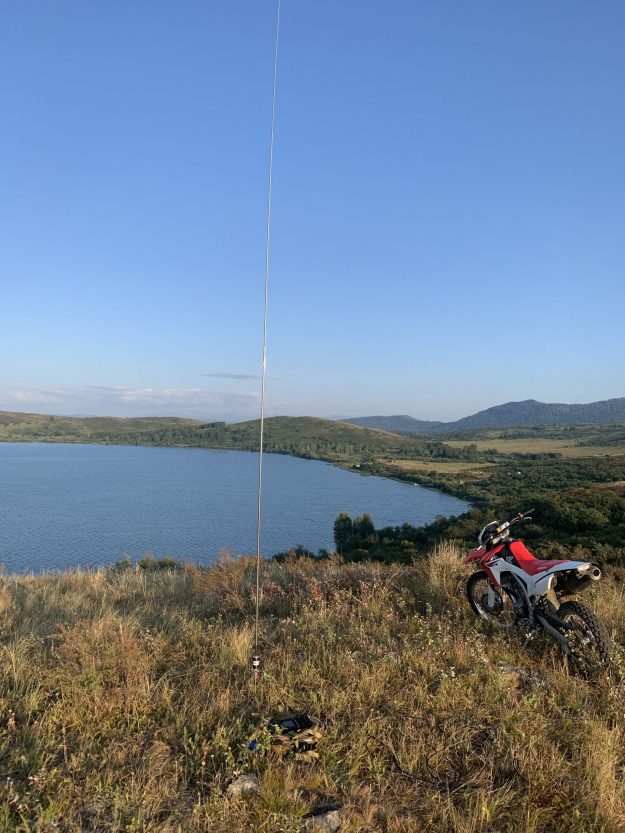
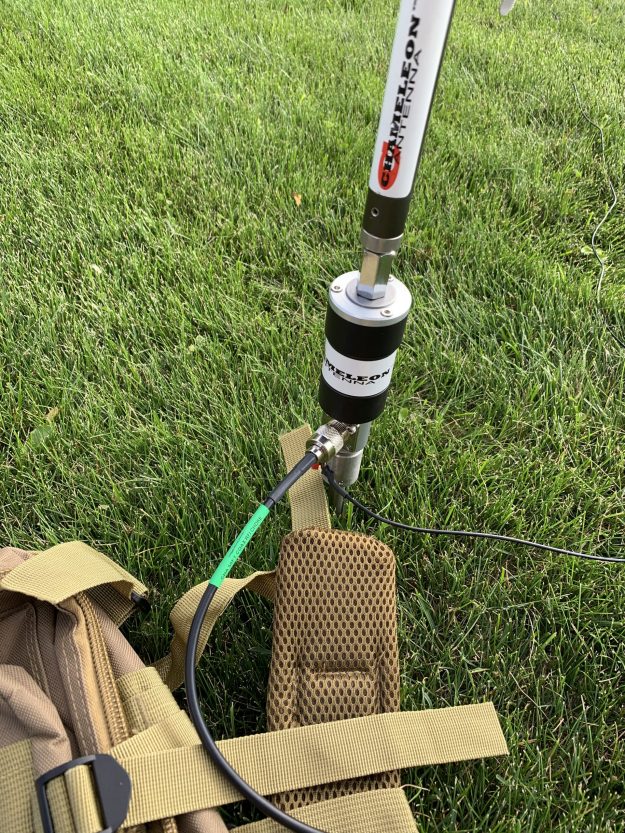
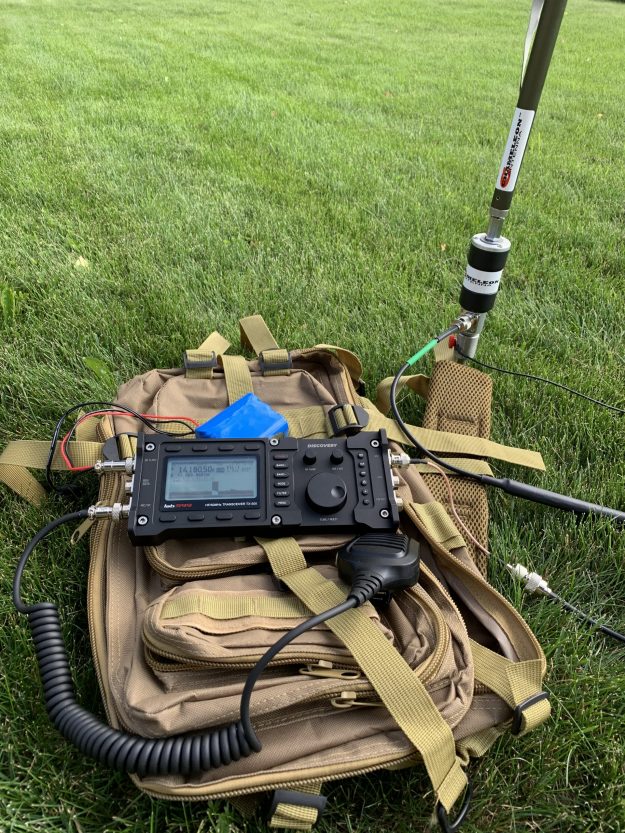
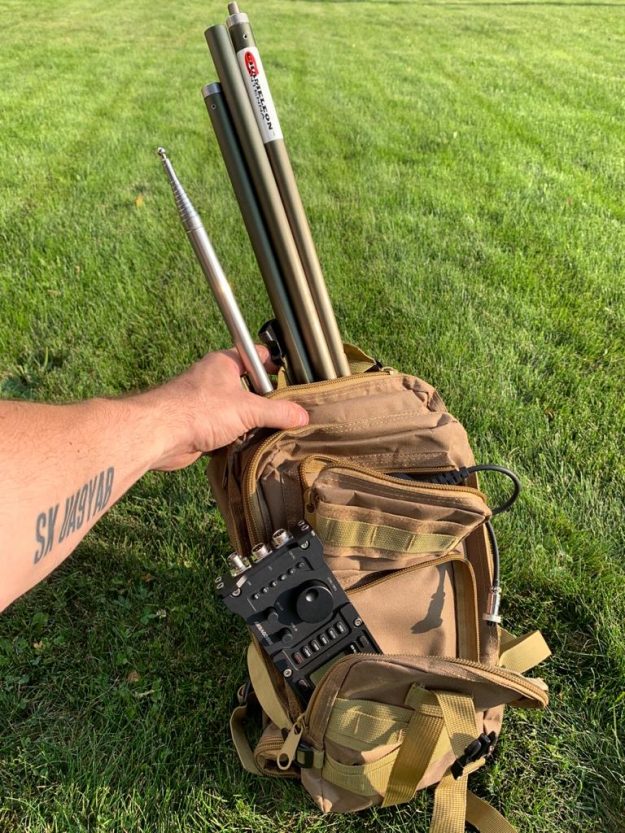
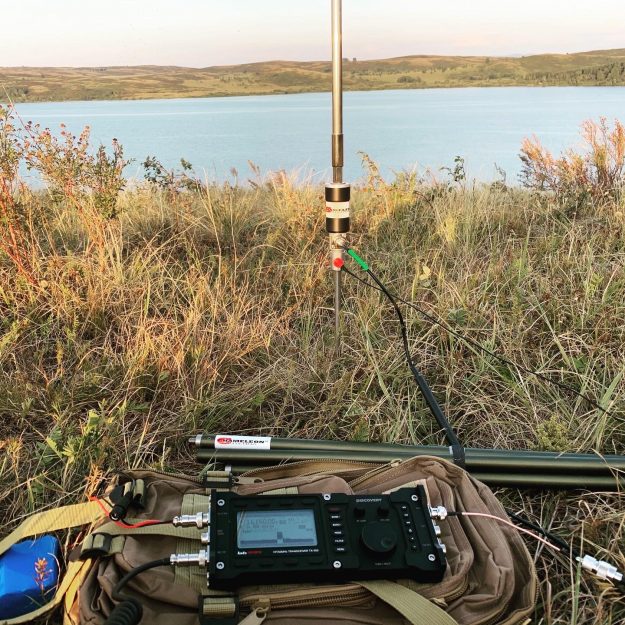
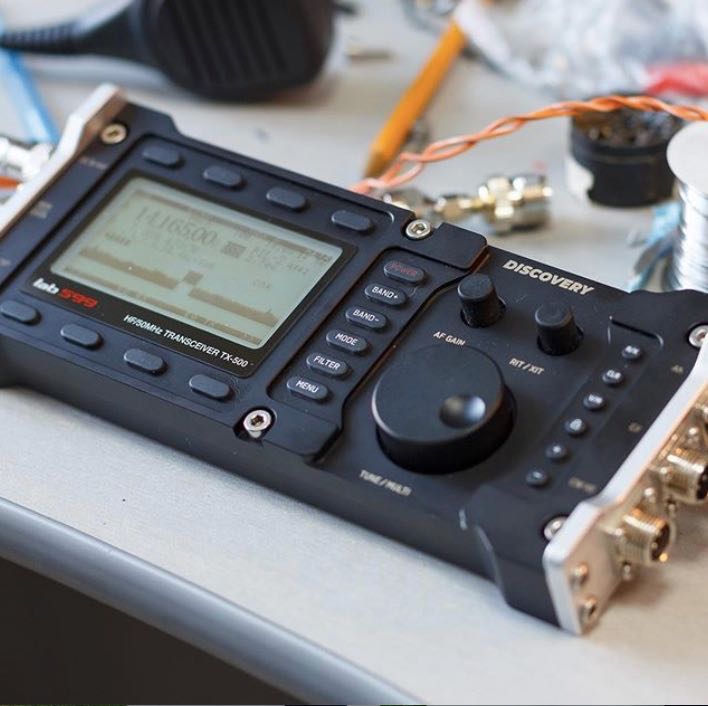
Photos of the lab599 Discovery TX-500 in the field

Many thanks to SWLing Post contributor, Don (W7SSB), who shares the following photos of the new lab599 Discovery TX-500. Don notes that all of these photos were taken in Russia–where the TX-500 is manufactured–and include a number of Chameleon resonant field antennas.

Thanks for sharing these, Don.  The thin form-factor of the TX-500, paired with a resonant antenna, certainly makes for a lightweight portable field setup!

Radio Waves: Radio Six on Shortwave Again, ATN Refrains from Politics, NPR Ratings Drop in C-19, and Grand Central’s Role in Standard Time

A WWV Time Code Generator

Radio Waves:  Stories Making Waves in the World of Radio

Because I keep my ear to the waves, as well as receive many tips from others who do the same, I find myself privy to radio-related stories that might interest SWLing Post readers.  To that end: Welcome to the SWLing Post’s Radio Waves, a collection of links to interesting stories making waves in the world of radio. Enjoy!

Many thanks to SWLing Post contributors Michael Bird,  John Figliozzi, and Jack Dully for the following tips:


Radio Six Pops Up Again on Shortwave (Radio World)

Radio Six International has not been a full-time shortwave broadcaster for some time. But after two recent live broadcasts on 6070 kHz prompted by the pandemic, it says it will continue monthly broadcasts at least for now.

Radio World visited electronically with Tony Currie.[]

WLW’s America’s Truckin’ Network To Refrain From Political Talk (Radio Insight)

iHeartMedia News/Talk 700 WLW Cincinnati has eliminated political talk from its overnight “America’s Truckin’ Network” show hosted by Steve Sommers.

The Cincinnati Enquirer reports that Sommers told listeners of the change on Monday morning’s show after multiple unspecified complaints.

In the on-air statement, Sommers blamed the change on a group of individuals who took offense with comments made by a caller a few weeks ago.[]

NPR Radio Ratings Collapse As Pandemic Ends Listeners’ Commutes (NPR)

Broadcast ratings for nearly all of NPR’s radio shows took a steep dive in major markets this spring, as the coronavirus pandemic kept many Americans from commuting to work and school. The network’s shows lost roughly a quarter of their audience between the second quarter of 2019 and the same months in 2020.

People who listened to NPR shows on the radio at home before the pandemic by and large still do. But many of those who listened on their commute have not rejoined from home. And that threatens to alter the terrain for NPR for years to come, said Lori Kaplan, the network’s senior director of audience insights.

“We anticipated these changes,” Kaplan said. “This kind of change was going to take place over the next decade. But the pandemic has shown us what our future is now.”

Commercial radio is experiencing, if anything, worse declines. But audience research commissioned by Kaplan indicates that NPR’s audience is disproportionately made up of professionals who are able to work from home and who are interested in doing so even after the pandemic subsides.[]

The Day That New York Had Two Noons, a Century After Losing 11 Days (Untapped New York)

New York’s history has included everything from transit strikes to riots over Shakespeare to immigration from nearly every country in the world. Yet, for much of this history, people didn’t always know the “correct” time or date. Until 1883, virtually every place in the country set local time according to the sun. According to Sam Roberts in his book Grand Central: How a Train Station Transformed America, “Typically, noon would be regularly signaled so people could synchronize their clocks and watches.” From dropping a ball down a flagpole in Manhattan to ringing a gong, settlements all across the country would alert people of noon. But as railroads spread throughout the country, it was nearly impossible to standardize the time.

“A passenger traveling from Portland, Maine, to Buffalo could arrive in Buffalo at 12:15 according to his own watch set by Portland time,” Roberts writes. “He might be met by a friend at the station whose watch indicated 11:40 Buffalo time. The Central clock said noon. The Lake Shore clock said it was only 11:25. At Pennsylvania Station in Jersey City, New Jersey, one clock displayed Philadelphia time and another New York time. When it was 12:12 in New York, it was 12:24 in Boston, 12:07 in Philadelphia, and 11:17 in Chicago.”[]


Do you enjoy the SWLing Post?

Please consider supporting us via Patreon or our Coffee Fund!

Your support makes articles like this one possible. Thank you!

Video: Josh takes us on a tour of the lab599 Discovery TX-500 QRP transceiver

Many thanks to SWLing Post contributor, Josh (KI6NAZ), who shares a link to his YouTube channel where he takes us on a tour of the lab599 TX-500 Discovery:

Click here to check out Josh’s channel, Ham Radio Crash Course on YouTube.

Thanks for sharing this, Josh! The TX-500 is certainly a unicorn in the world of field-portable QRP radios since it’s designed to be weather-proof.

lab599 has confirmed that they will dispatch a TX-500 loaner unit for my upcoming review.  I’m looking forward to see how it plays in the field and might compare with other QRP rigs in my arsenal!

Richard shares recordings of The Buzzer

Many thanks to SWLing Post contributor, Richard Lacroix,

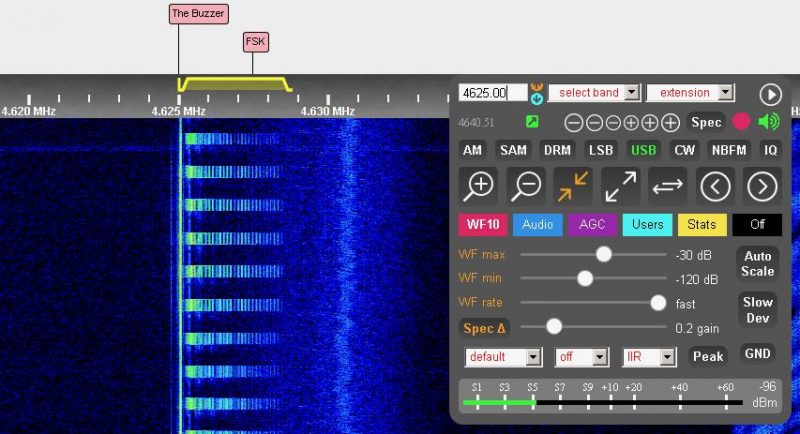
I was intrigued by your post, “The ghostly radio station that no one claims to run (BBC Future)”. I attempted to listening to the station on 4625 kHz from my home location here in Toronto, Ontario Canada but unfortunately could not receive the signal. WebSDR to the rescue. I managed to locate a couple of KiwiSDRs in Russia which yielded great reception of “The Buzzer”.

I figured that some readers may be interested in knowing what the buzzer sounds like. I have therefore included 2 recordings of the broadcast; the first in AM and the second in USB mode with a 3.2 kHz wide filter setting. I am also sharing a screen shot of the waterfall which clearly depicts the signal [see at top of post].

Recordings

The Buzzer recorded July 18, 2020 at 01:07 UTC  on 4625 kHz in AM mode:

The Buzzer recorded July 18, 2020 at 08:26 UTC  on 4625 kHz in upper sideband mode:

Thank you for sharing this, Richard!

Like you, I have difficult receiving The Buzzer from North America (especially in summer conditions with QRN). That’s where KiwiSDRs really come to the rescue. Thanks again for sharing your recordings.

FTIOM & UBMP, July 26-August 1

From the Isle of Music, July 26-August 1:
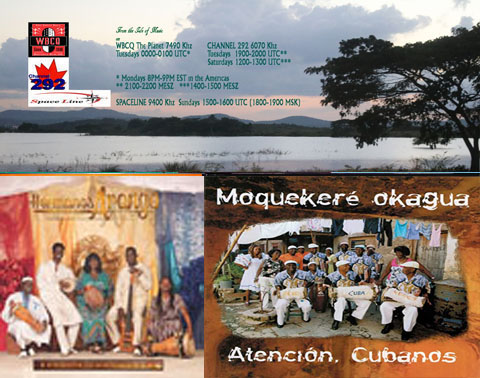
This week, we present some of the more folkloric selections from the album Bendita Guanabacoa by Los Hermanos Arango with commentary in English as well as some rumba by Afrocuba de Matanzas.
The broadcasts take place:
1. For Eastern Europe but audible well beyond the target area in most of the Eastern Hemisphere (including parts of East Asia and Oceania) with 100Kw, Sunday 1500-1600 UTC on SpaceLine, 9400 KHz, from Sofia, Bulgaria (1800-1900 MSK)
If you don’t have a shortwave radio or are out of range, you can listen live to an uplink from a listening radio in the Netherlands during the broadcast at
http://websdr.ewi.utwente.nl:8901/?tune=9400am
2. For the Americas and parts of Europe, Tuesday 0000-0100 on WBCQ, 7490 KHz from Monticello, ME, USA (Monday 8-9PM EDT in the US).
If you don’t have a shortwave or are out of range, you can listen to a live stream from the WBCQ website here (choose 7490): http://www.wbcq.com/?page_id=7
3 & 4. For Europe and sometimes beyond, Tuesday 1900-2000 UTC and Saturday 1200-1300 UTC on Channel 292, 6070 KHz from Rohrbach, Germany.
If you don’t have a shortwave radio or are out of range, you can listen live to uplinks from various websdrs in Europe.
Our Facebook page is https://www.facebook.com/fromtheisleofmusic/
Our V-Kontakte page is https://vk.com/fromtheisleofmusic
Our Patreon page is https://www.patreon.com/tilford

Uncle Bill’s Melting Pot, July 26 and 28:
Episode 175 features music from Nigeria plus our monthly Radio Balcony feature.
The transmissions take place:
1.Sundays 2200-2300 (6:00PM -7:00PM EDT) on WBCQ The Planet 7490 KHz from the US to the Americas and parts of Europe
If you don’t have a shortwave or are out of range, you can listen to a live stream from the WBCQ website here (choose 7490): http://www.wbcq.com/?page_id=7
2. Tuesdays 2000-2100 UTC on Channel 292, 6070 KHz from Rohrbach, Germany for Europe.
If you don’t have a shortwave radio or are out of range, you can listen live to an uplink from different web SDRs in Europe
including a live uplink from a listening radio in the Netherlands at http://websdr.ewi.utwente.nl:8901/?tune=6070am
Our Facebook page is https://www.facebook.com/UncleBillsMeltingPot/
Our V-Kontakte page is https://vk.com/fromtheisleofmusic
Our Patreon page is https://www.patreon.com/tilford