Numbers Stations: “Anonymity in the Airwaves”

Many thanks to SWLing Post contributor, Mark Hirst, who writes:

One of my favourite YouTube channels has just published a video talking about number stations.

There’s nothing there that seasoned SWLing.com readers don’t already know of course:

Thanks for sharing this, Mark!  I just subscribed to Curious Droid!

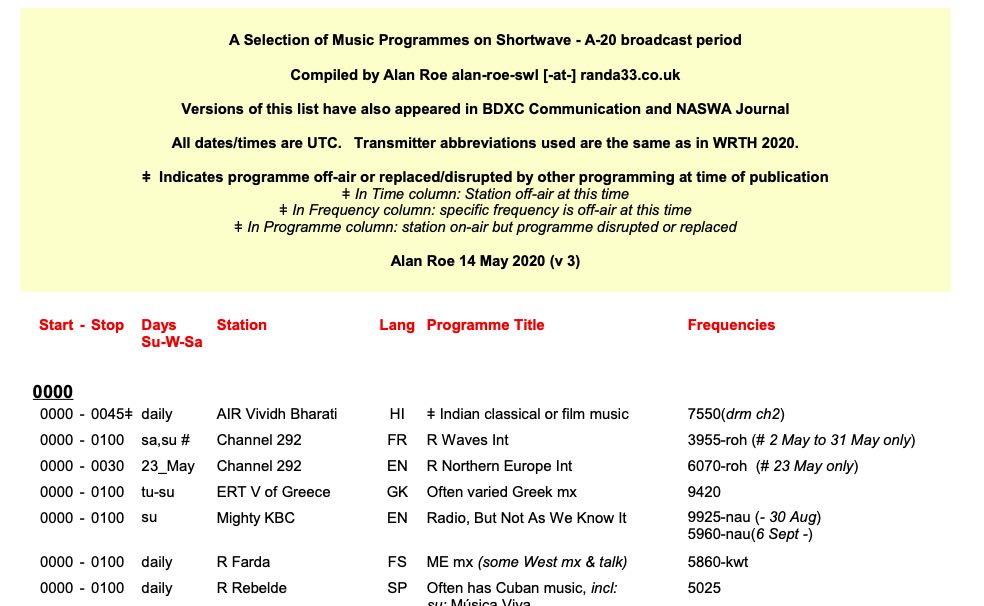
Encore – Classical Music on Shortwave – times and frequencies.

EUROPE:
This weekend Encore – Classical Music on Radio Tumbril will be broadcast again at the NEW TIME in Europe of 11:00 UTC on SATURDAY on 6070 kHz by Channel 292.
There is much less interference from adjacent channels at this time.
There are two repeats – 19:00 UTC Friday on 6070 kHz and 09:00 UTC on Sunday on 7440 kHz by Channel 292.
NORTH AMERICA:
WWCR Nashville will broadcast the Encore on Saturday at 21:00 UTC as usual on 9350 kHz. The propagation is very good over the US and much of Canada and the signal carries to parts of western Europe too.
WBCQ Maine will send out the show on 7490 kHz at 01:00 UTC Monday to the US. (Early evening Sunday local US – obviously.)
Do let us know how well you can pick up Encore at your location by emailing to [email protected]. We try to reply to all emails and will send eQSL cards for full reports – though a brief report is fine.
This week’s programme will start with the Act 3 Prelude to Wagner’s Parsifal, then another – very different overture – William Tell by Rossini. Some of a flute Sonata by Paul Hindemith next, then Chopin, a double bass concerto and some music from Greece.
Monteverdi’s vespers, a Schubert piano work, and late Beethoven Quartet finish the programme.
The playlist is on the website and will be updated soon after Saturday’s broadcast of the new show by Channel 292 at 11:00 UTC – but probably not until Sunday evening.
Both Channel 292 and WBCQ as well as WWCR can be pulled live off the internet if the reception is poor in your location. Easy to find their sites with a google search.
In the meantime – thank you for spreading the word about Encore – Classical Music on Shortwave. And thank you to everyone for letting us know how well the signal is received where you live.
Brice Avery – Encore – Radio Tumbril – www.tumbril.co.uk
Regular Broadcast times are:
11:00 – 12:00 UTC Saturday on 6070 kHz and repeated 19:00 – 20:00 UTC Friday on 6070 kHz Channel 292 (Germany) and 09:00 UTC Sunday on 7440 kHz.
21:00 – 22:00 UTC Saturday on 9350 kHz WWCR (Nashville).
01:00 – 02:00 UTC Monday on 7490 kHz WBCQ – (Maine).

Radio Waves: WBCN, Reactions to AM Digital, More KPH, and Cereal Box Telescopes

Radio Waves:  Stories Making Waves in the World of Radio 
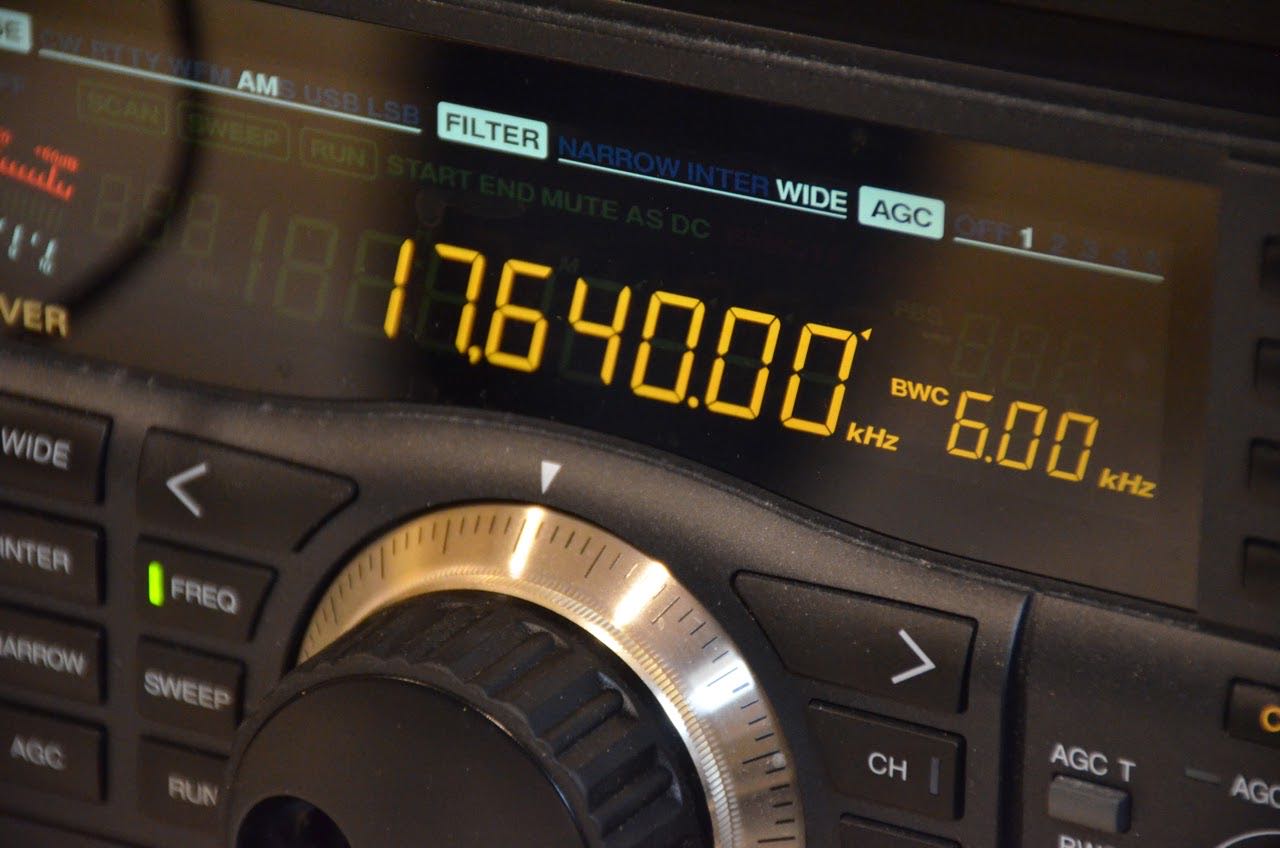
Because I keep my ear to the waves, as well as receive many tips from others who do the same, I find myself privy to radio-related stories that might interest SWLing Post readers.  To that end: Welcome to the SWLing Post’s Radio Waves, a collection of links to interesting stories making waves in the world of radio. Enjoy!

Many thanks to SWLing Post contributors, Mike Terry, Troy Riedel, andGrant Porter for the following tips:


WBCN history reveals revolutionary power in local radio (Boston University News Service)

SOMERVILLE – What started as a midnight to 6 a.m. slot on a failing classical music station, became the voice of a generation in 1970s Boston. Now, more than 50 years after WBCN sparked a “revolutionary new experiment in radio,” the bygone rock station is still making waves.

The 2018 documentary, “WBCN and The American Revolution,” tells the origin story of Boston’s first rock and roll station through a combination of rock hits. Never-before-seen photos, videos and interviews with some of Boston’s most beloved radio hosts, were greeted with cheers at the Somerville Theatre screening Thursday night.

Bill Lichtenstein, who began volunteering with WBCN at 14, directed and produced the film. After crowdfunding and a decade in the making, it has been touring independent theaters and festivals across the U.S. for the last year and a half.

WBCN was grounded in good music. Founded by Ray Riepen, owner of South End music venue The Boston Tea Party, WBCN introduced voices like The Velvet Underground, The Who, Bruce Springsteen and Led Zeppelin to the city, and quickly found a home in Boston’s huge student population. Within three months, the station, run by amateur hosts and young volunteers during classroom breaks, was playing 24 hours per day.[…]


“It Will Make Millions of Receivers Obsolete … This Is Needless” (Radio World)

What people are saying to the FCC about all-digital on the AM band

Radio World is providing an ongoing sampler of comments of what people are telling the FCC about its proposal to allow U.S. stations on the AM band to switch voluntarily to all-digital transmission. Here are more in the series:

Kirk Mazurek told the FCC that he is an avid AM listener who has “invested time and money in equipment towards my hobby as many others have. If this proposal goes through it will make the millions of receivers obsolete requiring the purchase of new equipment. This is needless, there are a lot of people who have vintage radios and a lot of them have been restored. This proposal would make them useless. I urge you not to ratify this proposal.”

Mark Wells raised concern about interference from digital to analog signals on the same channel. “This is especially applicable at night when one is listening to distant stations in out-of-state markets, he wrote. “For example, clear channel stations WBT in Charlotte and KFAB in Omaha are both on both on 1110 kHz. Let’s say one switches to digital, and one does not. As it is they both may fade in and out as the atmosphere does its nightly tricks, but the signals remain mostly useable. But, if one is digital and the other analog would it not ‘blank out’ the analog station?”[…]


Podcast features Coastal Radio Station KPH (DitDit.fm)

There was a time when the airways bristled with Morse Code. There were commercial radio stations all around the world whose business was sending and receiving Morse Code messages to ships at sea. Coast station KPH, located at Point Reyes National Seashore near San Francisco, is one of those stations. Richard Dillman was there in 1997 when KPH sent it’s last message and closed it’s doors. It was the end of the line for the men and women who had spent their careers sending Morse Code to ships at sea. There was nowhere else for them to go…

Two years later, Richard Dillman with a group of volunteers returned to KPH and put it back on the air. Listen as Richard tells us about the future of Maritime Morse Code Coastal Station KPH!


A hydrogen line telescope made from cereal boxes and an RTL-SDR (RTL-SDR.com)

SpaceAustralia.com have recently been hosting a community science project that involves encouraging teams to build backyard radio telescopes that can detect the arms of our Milky Way Galaxy by receiving the Hydrogen line frequency of 1420 MHz.

This can be achieved at home by building a horn antenna out of cardboard and aluminum foil, and a feed from a tin can. Then the Hydrogen line and galactic plane can be detected by using an RTL-SDR, LNA, and software capable of averaging an FFT spectrum over a long period of time.

While most horn antennas are typically made from four walls, one participant, Vanessa Chapman, has shown that even trash can be used to observe the galaxy. Vanessa’s horn antenna is made from multiple cereal boxes lined with aluminum foil and an old tin fuel can. The boxes are held together by some string and propped up by some sticks.

With her cereal box horn antenna combined with an RTL-SDR Blog V3, and an RTL-SDR Blog Wideband LNA, Vanessa was able to use software to average the spectrum over time as the galactic plane passed overhead, revealing the Hydrogen line peak and corresponding doppler shift from the galactic plane.[…]


Do you enjoy the SWLing Post?

Please consider supporting us via Patreon or our Coffee Fund!

Your support makes articles like this one possible. Thank you!

Titanic radio may soon be recovered

Replica of the Titanic’s radio room at the Antique Wireless Museum (Source: Trip Advisor)

(Source: The Washington Post via Davud Iurescia, LW4DAF)

[…]“Lying two and a half miles below the ocean surface, the RMS Titanic is the subject of the most documented maritime tragedy in history,” British Transport and Maritime Minister Nusrat Ghani said in a statement. “This momentous agreement with the United States to preserve the wreck means it will be treated with the sensitivity and respect owed to the final resting place of more than 1,500 lives.”

A century later and the Titanic still fascinates

RMS Titanic Inc. argues that the wireless transmitter must be recovered soon, and ideally within the year, as expeditions to the site more than two miles below the ocean’s surface have noted deterioration over the years. The “Silent Cabin,” the soundproof room where it is housed, withstood years of damage and protected the transmitting switchboards and regulators, the company wrote in court documents.

But the deckhouse above the Marconi transmitter has been falling apart since 2005, and holes have been forming over the Silent Cabin. The overheard will probably collapse within the next few years, Titanic expert Parks Stephenson wrote in court documents, “potentially burying forever the remains of the world’s most famous radio.”

[…]RMS Titanic Inc. President Bretton Hunchak, however, has said the radio recovery mission would be limited in scope and undertaken in an effort to protect the important artifact before it’s too late.

“It’s not some kind of Trojan horse so that we can start grabbing suitcases full of diamonds from the wreck,” he said, according to the Telegraph. “This is a careful, surgical operation to rescue a historically significant item so it can teach future generations about the story of Titanic.”[…]

Click here to read the full article at the Washington Post and note portions may be behind a paywall or geo-blocked.

FTIOM & Extended UBMP, Feb 2-8


From the Isle of Music, February 2-8:

This week our guest is Dayramir González, who led the opening Gala concert at Jazz Plaza in Havana this year. We talk to him before the rehearsal for that concert, and
we will listen to some of his wonderful recordings.
The broadcasts take place:
1. For Eastern Europe but audible well beyond the target area in most of the Eastern Hemisphere (including parts of East Asia and Oceania) with 100Kw, Sunday 1500-1600 UTC on SpaceLine, 9400 KHz, from Sofia, Bulgaria (1800-1900 MSK)
If you don’t have a shortwave radio or are out of range, you can listen live to an uplink from a listening radio in the Netherlands during the broadcast at
http://websdr.ewi.utwente.nl:8901/?tune=9400am
2. For the Americas and parts of Europe, Tuesday 0100-0200 UTC (New UTC) on WBCQ, 7490 KHz from Monticello, ME, USA (Monday 8-9PM EST in the US).
If you don’t have a shortwave or are out of range, you can listen to a live stream from the WBCQ website here (choose 7490):  http://www.wbcq.com/?page_id=7
3 & 4. For Europe and sometimes beyond, Tuesday 1900-2000 UTC and Saturday 1200-1300 UTC on Channel 292, 6070 KHz from Rohrbach, Germany.
If you don’t have a shortwave radio or are out of range, you can listen live to an uplink from a listening radio in Europe.
Visit our Facebook page at https://www.facebook.com/fromtheisleofmusic

Uncle Bill’s Melting Pot, February 2 and 4:
Episode 150 features Greek Jazz-Rock and Folk Fusion inspired by a tip from our friend in Greece Kostas Polyzonis.
On WBCQ only, there is a second half-hour featuring the very first episode of our show in 2017.
The transmissions take place:
1.Sundays 2300-0000 UTC (6:00PM -7:00PM Eastern US) on WBCQ The Planet 7490 KHz from the US to the Americas and parts of Europe
If you don’t have a shortwave or are out of range, you can listen to a live stream from the WBCQ website here (choose 7490)L  http://www.wbcq.com/?page_id=7
2. Tuesdays 2000-2030 UTC on Channel 292, 6070 KHz from Rohrbach, Germany for Europe.
If you don’t have a shortwave radio or are out of range, you can listen live to an uplink from different web SDRs in Europe.
Visit our Facebook Page at https://www.facebook.com/UncleBillsMeltingPot

Mike Ladd’s primer on decoding NAVTEX using an SDRplay SDR with SDRuno

Many thanks to SWLing Post contributor, Mike Ladd with SDRplay, who shares the following PDF primer on decoding NAVTEX with an RSP series SDR.

Click here to download “Basics to decoding NAVTEX using an RSP and SDRuno” (PDF).

Thanks for sharing this excellent guide, Mike.  Without a doubt, SDRplay has some of the best documentation and primers in the world of radio. Click here to check out more.

Also, check out Mario’s post, from our archives, which discusses decoding NAVTEX, RTTY, and Sitor B.

Radio Waves: New BBC Ham, Russian Propaganda, Rotators, USB Continuity, and a Moment of Silence

Radio Waves:  Stories Making Waves in the World of Radio 

Because I keep my ear to the waves, as well as receive many tips from others who do the same, I find myself privy to radio-related stories that might interest SWLing Post readers.  To that end: Welcome to the SWLing Post’sRadio Waves, a collection of links to interesting stories making waves in the world of radio. Enjoy!

Many thanks to SWLing Post contributors, Marty, Mike Terry, and Tracy Wood for the following tips:


BBC World Service presenter is a radio amateur (Southgate ARC)

Gareth Mitchell M7GJM is well known as presenter of the BBC World Service show Digital Planet. He got his amateur licence in 2019 thanks to help from members of Essex Ham

Since getting his licence, Gareth M7GJM has been mentioning amateur radio in his BBC World Service show, most recently, featuring how radio hams in Australia have been helping with emergency comms.

Read the Essex Ham story at
https://www.essexham.co.uk/news/online-learning-and-exam.html

Information on the free Foundation Online course that Gareth took is at
https://www.essexham.co.uk/train/foundation-online/


Russian ‘Propaganda Machine’ Selects Kansas City As Its Second Radio Broadcast Site (KCUR)

Commuters interested in conspiracy theories about George Soros, Hillary Clinton and the Republican National Committee have a new option, courtesy of the Russian government.

Early this month, a radio station based in Liberty, Missouri, signed a three-year deal to broadcast Radio Sputnik across Kansas City.

The English-language programming airs for three hours each morning and again in the evening on three frequencies controlled by KCXL: 1140 AM, 102.9 FM and 104.7 FM.

It’s produced by the U.S.-based branch of an organization created in 2013 by Russian President Vladimir Putin to promote Russian interests abroad.

The organization, Rossiya Segodnya, hopes to restore a “fair attitude to Russia in every country in the world,” according to court records.

For now, Radio Sputnik only broadcasts in two American cities: Kansas City and Washington D.C., where its programming has aired since 2017.

“We’d love to broadcast in all major U.S. markets,” a Radio Sputnik spokesperson told KCUR via email. “But unfortunately, U.S. authorities are working really hard to prevent us from doing so.”[…]


Rotators – How do you turn that thing? (Nuts and Volts)

We’ve had a few columns on antennas and propagation, and there sure is a lot of variation in the types of antennas! All the different ways signals propagate require different antenna directions and types. Hams use dinky finger-sized “rubber ducks” on handheld radios but also some ridiculously big antennas it seems. Hams can’t use as much power as some of the other communication services, so they use antennas to get through by focusing radiated power.

If the antennas can focus a signal, then they need to be able to focus it in the desired direction, right? A few antennas can do that electrically by controlling the signal’s phase or switching antenna elements on and off. Most of the “pointable” ham antennas, though, need to be pointed mechanically and held in place during a contact or to keep a communications link working. The thing that hams use to point their antennas — large and small — is called a rotator.

There are a wide range of rotators, just like antennas. You may have used a TV antenna rotator with its “chunk-chunk-chunk” stepping. At the other end of the scale, whole towers turn! We’ll cover some of the most common types and give you an idea of how they work. (If you want detailed information, including guidelines and illustrations for how to work with these unsung heroes of the antenna farm, see the sidebar, “Rotator and Tower Know-How.”)


Build a USB continuity jig (Nuts and Volts)

If you’re like me, you likely have a drawer or shoebox stuffed with assorted USB cables that are used to either charge or program a USB device. The problem often is that some cables may only be useful for charging, and which only have the +Vcc and ground wires intact with one or both data wires either broken or not connected in the first place.


Every Radio Station in Los Angeles Holds Moment of Silence for Kobe Bryant (Billboard)

Los Angeles has been rendered speechless by the shocking death of NBA legend Kobe Bryant, his 13-year-old daughter Gianna “Gigi” Bryant, and seven others in a helicopter crash in Calabasas, Calif., on Sunday morning. And for one minute and eight seconds — the extra time nodding to Bryant’s original No. 8 Lakers jersey — radio stations across the city held a moment of silence Monday (Jan. 27) at noon.

The Southern California Broadcasters Association asked its members to synchronize their moment of silence, as well as continuously airing reminders about the upcoming tribute.

Before noon, the SCBA requested all local area radio stations to repeat this core introductory message for grieving Angelenos listening in: “Right now All LA radio stations are now broadcasting 1:08 minute silence for LA Sports Legend Kobe Bryant,” according to an announcement posted on the association’s website.[…]


Do you enjoy the SWLing Post?

Please consider supporting us via Patreon or our Coffee Fund!

Your support makes articles like this one possible. Thank you!