Shortwave listening and everything radio including reviews, broadcasting, ham radio, field operation, DXing, maker kits, travel, emergency gear, events, and more
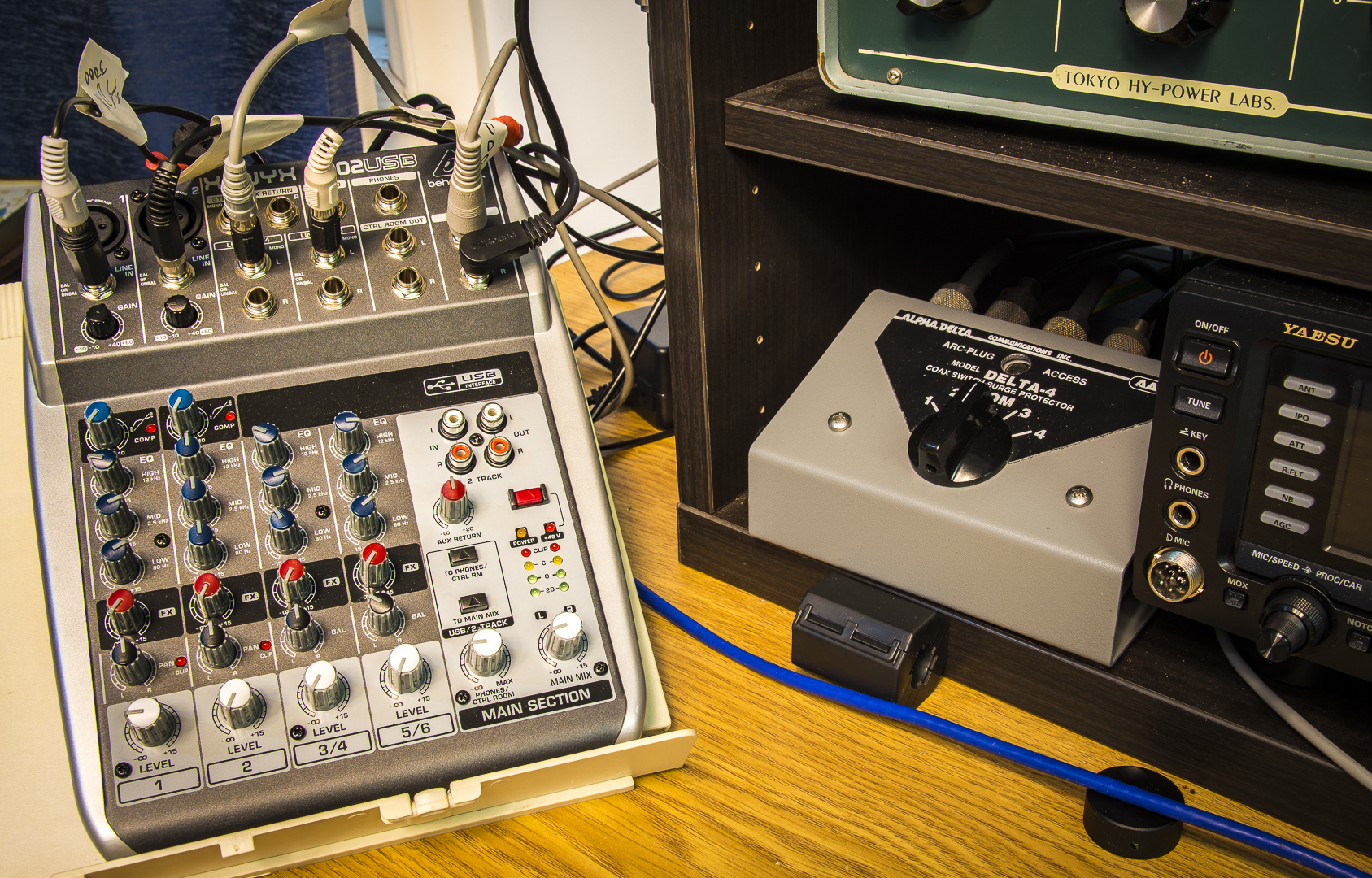
As a result of numerous responses to another video I posted on my YouTube channel a few weeks ago, I have now prepared a video that gives you a detailed look at using the Behringer Xenyx Q802 USB mixing console.
The unit is wired up to four receivers, then sent off to a pair of powered speakers. I cover how the mixer is connected to the radios and the speakers, explain the various controls available to the shortwave radio listener and amateur radio operator, the advantages of using this system in the radio shack, and offer a few tips when buying a mixing console such as this Behringer unit.
If you have a few receivers kicking around in your radio shack, this is one way to hook them all together and send their audio on to your favourite monitoring speakers. Thanks for taking the time to watch this little video. As always, comments and feedback are most welcome.
73 and good DX to you all,
Rob Wagner VK3BVW
Rob Wagner, VK3BVW, is the author of this post and a regular contributor to the SWLing Post. He also blogs at the Mount Evelyn DX Report. He also has a grab bag of assorted radio videos to check out at his YouTube Channel.
That’s BJ on the left and me on the right at our favorite burrito joint.
A few weeks ago, I had lunch with my good friend, BJ Leiderman. If you ever listen to public radio programming, especially NPR, you’ve probably heard BJ’s name.
BJ is a musician, singer, and composer, and has written the bulk of the theme music you hear on National Public Radio (NPR). His music is hard to get out of your head. Every time I listen to NPR shows like Marketplace, Morning Edition, Wait, Wait Don’t Tell Me, Car Talk, or Science Friday, I hear BJ’s catchy tunes.
Moreover, BJ is an awesome fellow. But it’s dangerous hanging with him because he’s also…well, an enabler, when it comes to sound gear.
Often, when we hang out, I walk away from the meet-up with a new app, a new song in my head, or the sudden need for a new piece of kit.
Friday was a prime example. You may notice that I’m wearing headphones in the photo at the top of the page. Here’s how this played out…
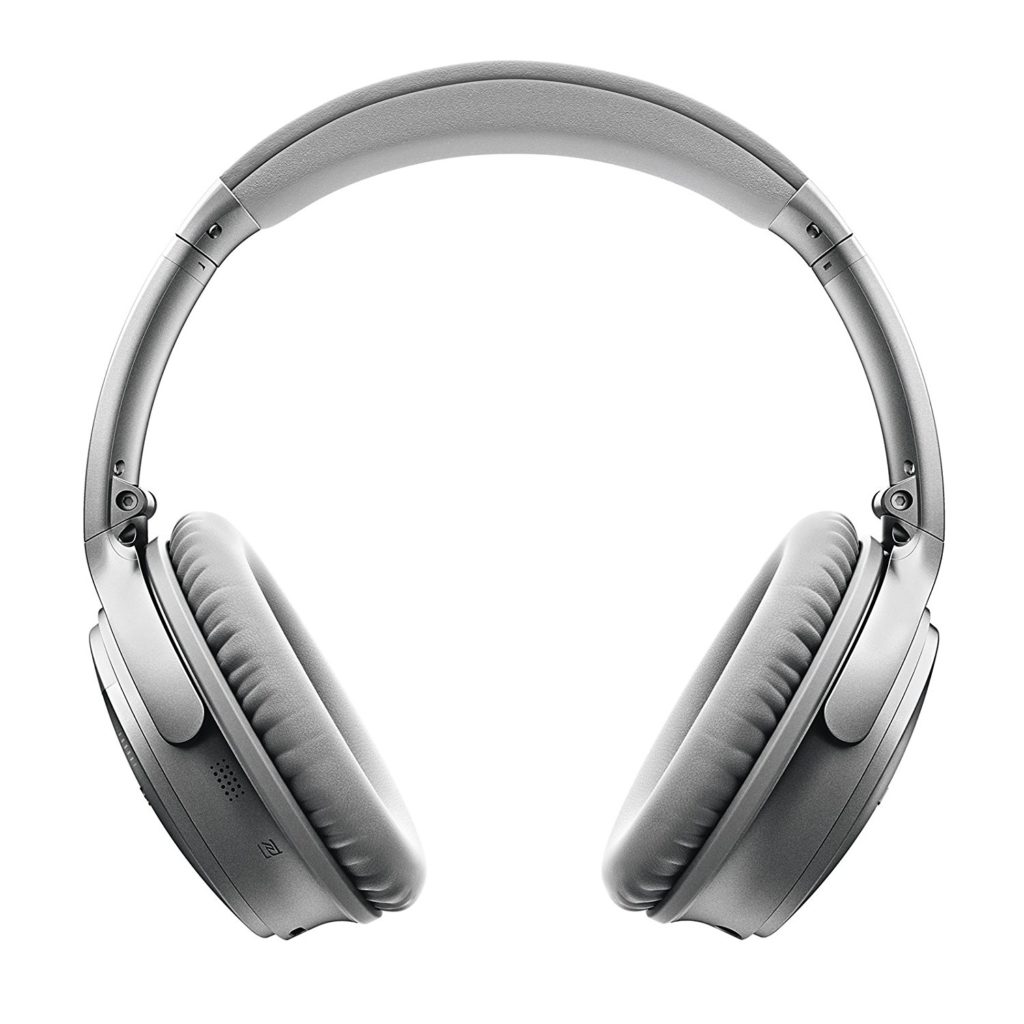
BJ asked if I had seen one of his latest animated music videos–one that is was featured on his new album, “BJ.” Instead of simply showing the video to me on his phone and/or playing the music through his iPhone’s speaker, BJ ran to his car and came back with a set of Bose Quiet Comfort 35 Noise-Cancelling headphones, then handed me his phone with the video queued up.
We were in a crowded, noisy restaurant during the lunch hour, but when I put on the headphones, all ambient sounds were instantly and utterly squelched. As his video played, it sounded like I was sitting in a recording studio listening to monitors. Absolutely phenomenal.
The headphone’s noise-cancelling technology is so good, in fact, I could barely hear my own voice as I spoke.
The audio fidelity was spot-on, too––there’s a nice balance from bass to treble. Though I’m sure your audio player’s EQ could customize this.
I walk around all of the time with a cheap pair of in-ear headphones in my pocket for use with my phone, radios, or simply to decrease ambient noise while I’m trying to work or sleep.
BJ, being the cool and compassionate character he is, had this fun song animated by young adult artists with autism at Exceptional Minds Animation Studios in LA, with the support of Howard Hoffman.
In real life, his dog Maizey is a sweetheart, and certainly BJ’s fuzzy brown soulmate.
With no end in sight for the recovery efforts in Puerto Rico, the radio industry is putting its best foot forward to help the folks on the ground.
This week, the National Association of Broadcasters (NAB), the National Alliance of State Broadcasters Associations, and a number of U.S. broadcasters announced they would fund the donation of 10,000 battery-operated radios to Puerto Rico, with the goal of providing information for those in need.
The battery-operated radios could prove an important resource, as just 16 percent of the island currently has power weeks after Hurricane Maria caused dramatic damage.
NAB President and CEO Gordon Smith emphasized that the situation underlines radio’s role “as a lifeline to communities desperate for information and support.”[…]
I’m very happy to receive this news. At Ears To Our World, we’ve been trying to find the right way to send radios to the areas in Puerto Rico that are still without power. So far, it’s been difficult as distribution lines are clogged and we don’t want to interfere with the delivery of medical supplies, clean water and other basic necessities.
Very happy the NAB has donated so many radios and I hope they can reach the people who need them in good time.
Many thanks to SWLing Post contributor, Tom Taylor, who shares the following schedule:
EMR Relays + More
Scheduled Transmissions from Radio City are:
3rd Saturday at 08.00 to 09.00 UTC on 9510 kHz with Repeats all other Saturdays
4th Saturday at 12.00 to 13.00 UTC on 7265 kHz via Hamburger Lokalradio
Contact address remains: [email protected]
Saturday HLR:
06.00 to 10.00 UTC, on 6190 KHz
10.00 to 16.00 UTC, on 7265 KHz
European Music Radio Relays:
14th October 2017:
08.00 to 09.00 UTC on 6070 KHz – to Western Europe via Ch 292
15th October 2017:
08.00 to 09.00 UTC on 9485 KHz – to Western Europe via MVBR
19.00 to 20.00 UTC on 6070 KHz – to Western Europe via Ch 292
Internet Repeats on 15th October 2017:
EMR will have this months Transmissions via two streams running at the following Times:15.00, 17.00, 19.00 UTC http://nednl.net:8000/emr.m3u will be on 96 kbps /44 KHz stereo for normal listening http://nednl.net:8000/emr24.m3u will be 24 kbps / 22 KHz mono will be especially for low bandwidth like mobile phones.
European Music Radio Relay :
21st October 2017:
21.30 to 22.00 UTC on 7490 KHz – to Central & North America via WBCQ
Earlier today, I published a Guest Post from SWLing Post contributor, Troy Riedel. Somehow, while wrangling with embedded table code, I managed to delete nearly half of his post prior to publishing and heading into town for the day.
I’ve just corrected his post which now includes all of his comparison videos and his conclusion.
Many thanks to SWLing Post contributor, Troy Riedel, for producing this excellent comparison of the Tecsun S-8800 and Grundig Field BT “lunchbox” radios:
The Lunchbox Showdown
by Troy Riedel
I have been watching with interest all of the information & reviews of the new Tecsun S-8800. Frankly, I was especially interested in how it would compare with the other “lunchbox” SW radio – the Eton Grundig Edition Field BT (the Digitech AR-1748 lunchbox radio is also available in AUS for approximately $207US shipped). As I contemplated which lunchbox to purchase, I put together the following Excel comparison table of the S-8800 vs. the Eton Field BT to assist me in making my decision:
Tescun S-8800
Eton Field BT
Price:
$268.00
$129.99
Tuning Methods:
FM / LW / MW / SW
FM / MW / SW
Q.Tune
Q.Tune
Digital tuner, Jog dial manual tuning
Digital tuner, Jog dial manual tuning (Fast, Slow and Hold)
Auto scan tuning with 5 second stop (w/ storage)
Auto scan tuning (no tuning storage)
Direct frequency entry using the remote control
Fine Tuning Knob: SW Meter Band
No soft muting when tuning
“Subtle“ Soft Muting when tuning
Station Storage Methods:
Manual storage: tune into stations manually and store them
Manual storage: tune into stations manually and store them
Semi-auto storage: storing stations during auto scan
Auto Tuning Storage (ATS): automatically tune into and store stations
FM / MW / LW / SW
FM / MW / LW / SW
AM Bandwidth:
Bandwidth selection (2.3, 3.0, 4.0, 6.0)
Narrow & Wide Settings (3.0*, 6.0*) *Reported
SSB:
SSB (USB/LSB)
N/A
SSB tuning steps at 10 Hz / 1 kHz
SSB Bandwidth selection (0.5, 1.2, 2.3, 3.0, 4.0)
N/A
FM with RDS
N/A
Bluetooth
Adjustable shoulder or hand carrying belt
Hand carrying strap
Remote control operation
N/A
SYNC:
N/A
N/A
Gain:
Local / DX antenna gain switch
Local / DX antenna gain switch
SW RF Gain Control
Memories:
650 station memories
50 station memories
Stored stations memory browsing
Auto Sorting Memory
LCD:
Standard Backlight
Orange Backlight
5-seconds or continuous settings
10-seconds or continuous settings
Clock/Alarm Time:
Clock/Alarm time (24H-format)
Clock/Alarm time (12 & 24H-format)
Alarm:
(1) Alarm
(2) Alarms
By radio only
By radio (60-mins) or buzzer (2-mins)
Digital Display:
Frequency & SW meter band
Frequency & Band (e.g. FM, LW, SW1)
Signal strength indicator
Signal strength indicator
Stored station location
Stored station location
Clock & Alarm time
Clock
Volume Level (while using remote)
Battery indicator & charging time
Battery Indicator
Sleep Timer A & B (Selectable)
RDS Info
* No Lock Feature
Display Lock “On”
Tuning Speed (Slow, Fast, Stop)
Sound Tuning:
Bass & Treble
Bass & Treble
Line In:
N/A
3.5mm Stereo Input for mp3 Player
Line Out:
(2) RCA Left & Right Stereo Channel Line Out
(1) 3.5mm Line Out for tape recorder or audio amplifier
Ant Selector:
Int. or Ext. Switch for FM/SW
Int. or Ext. Switch for FM/SW
FM/SW Antenna:
BNC: Low-impedance (50?) FM/SW
Coax: Low-impedance (50-75?)
MW Antenna:
High-impedance (500?) wire clamp terminals
High-impedance (500?) wire clamp terminals
Battery:
2 x 18650 Li-ion Cell
4 x “D” Cell
AC Adapter:
No AC included – does include a USB mini-B charging cable
7v 1200mA DC Neg Center included
Yes, the S-8800 without a doubt has more features than the Field BT. However, the S-8800 is slightly more than twice the price of the Field BT ($268 vs. $130)! Does the performance of the S-8800 equate proportional to the price difference?
Shortly after I made my Excel comparison table, Thomas published video comparisons of the S-8800. I very much appreciated the review and video comparisons that pitted the S-8800 against several popular portables. It gave me a baseline to set my expectations. However, those videos didn’t answer my question: “should I purchase the S-8800 or the Field BT”?
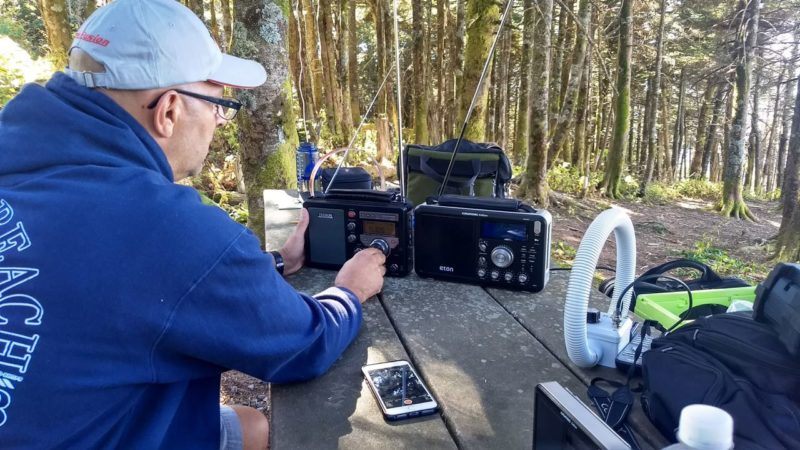
I contacted Thomas and I told him “we need an S-8800 vs. Eton Field BT” video comparison so SWL’ers have a true lunchbox vs. lunchbox comparison! I volunteered to purchase an Eton Field BT and have it delivered to Thomas for him to compare the two (after which he would forward the Field BT to me). After he hesitated, I replied: “what if I buy the Eton and we meet in North Carolina to compare them together”? Fortunately Thomas readily agreed and I made the 6.5-hour journey from Southeast VA to Mount Mitchell State Park for the Lunchbox Showdown (864-miles roundtrip on my odometer)!
Thomas and I had a limited amount of time. I arrived at noon. Thomas and I had 8-hours … and that included time for Thomas’ Parks On The Air (POTA) Activation, our S-8800 vs. Field BT comparison, we had to eat (it was a long drive for me!), and Thomas brought many other toys so we had to carve out time to “play radio” (and I can’t drive 400+ miles to Mount Mitchell and not walk to the summit of the highest point east of the Mississippi River!).
Luckily conditions were as ideal as I have ever seen them (evidenced by the fact Thomas made contacts from TX to the Azores with his Elecraft KX2). So please keep in mind, what follows is in no way a complete comparison. And to be clear, it was never my intention to review either receiver (there are many people more competent than I am that have already done this – Thomas among them!).
My interest re: these two models is primarily limited to each’s shortwave performance (I use a Sangean PR-D15 and a Grundig YB400 for AM DX, I prefer my Sangean PR-D15 for FM and I own 12 shortwave receivers). Thus our goals were to find and compare multiple representative SW signals. Thomas is obviously familiar with local AM stations in the area that he uses in his comparisons, thus we sought out a few AM signals (I recorded one to illustrate one huge difference that we both perceived in the two radios). Due to time, hunger, and eventually darkness we had to call it a day at 8 P.M.
I used my iPhone 6S to record the following comparisons. This was the first time I recorded shortwave signals. In retrospect, I wish I had made the recordings longer but at the time I was unsure of how much memory each recording would used, how much time it would take to upload, etc., so I kept everything at 1-2 minutes. As you will see, I recorded nearly all of the signals with the backlight off. You’ll see me reaching in, on Shootout 5, to tune off frequency – then back on – simply to show how the backlight would/or would not affect the weak signal on the Field BT (you’ll also see that it’s harder, outdoors, to read the Eton display without the backlight vs. the clearer Tecsun S-8880).
The Eton Field BT has its own SW RF Gain (a huge bonus) and you will see me reach into the field of view once or twice to fine tune the Field BT on weaker signals. And if you’ve studied my comparison table, you’ll see that the S-8800 has multiple bandwidth choices whereas the Field BT only has Wide & Narrow settings.
You will see me occasionally change the BW on both. I preferred not to speak during the videos as not to mask the audio of the signal thus I will set-up the specifics of each video with each individual link to my new YouTube Channel, SW Hobbyist, that I set-up to host these (and hopefully many future SW-related videos to include radio recordings & antenna comparisons).
Thomas and I both felt that the AGC of the Tecsun S-8800 was very slightly better (more stable – absolutely no “chug”) than the Eton Field BT (again, a very subtle difference). We both liked the sound of the Eton Field BT much better – it was crisp, full and just seemed to “pop” through its grill (see Shootout #7). The huge thing we both disliked with the Eton Field BT is its tuning dial. Yes, it has Q-Tune so one can jump from 5000, 6000, 7000, etc., with the push of a button but the tuning dial (even in “Fast” mode) is painfully slow and deliberate (dare I say horrible in comparison to the S-8880?). We both love the fact the S-8800 has a remote. But even without the remote, the S-8800 was much more pleasurable to manually tune.
Not to speak for Thomas, but I believe we generally felt [overall] that the SW signals were essentially close enough to call even … the edge to the Tecsun on a couple and the edge to the Field BT on a couple of others (I specifically remember us both commenting on an Arabic language broadcast from Radio Saudi Arabia where we both felt the Field BT was a very clear winner – that was one of the signals that I did not record). The better “sound” of the Field BT’s speaker may have influenced our opinions – a sound that was markedly better on FM, better on AM, but a sound that was much closer on SW.
My final thoughts and conclusion: Radios are like vehicles. No one vehicle is best for everyone. Each vehicle has a specific purpose and each has a subset of features. I own a large travel trailer. I need and thus own a heavy-duty diesel truck to tow it. But I surely wouldn’t recommend my vehicle to somebody who only needs a commuter vehicle. That’s why we have everything from SmartCars, to sedans, to SUVs, to dually diesel trucks. The same goes for radios. Some people will absolutely need SSB, others may demand SYNC (neither of these units has this feature!) while others may choose a radio based on size (compact for travel or larger models with a large, easy-to-read display for desk or tabletop use). Until now, I felt the video comparisons we had for the S-8880 were comparing a truck to an SUV to a sedan. At least now we have a few videos of two lunchbox radios compared side-by-side. True, one (the S-8800) is fully loaded (in vehicle terms: a 4×4 with a touchscreen GPS and DVD entertainment system). But not everyone who requires a truck needs a 4×4 with GPS and DVD entertainment system. Some truck owners prefer the smoother ride from a 4×2 truck. I think that’s the best way to describe these lunchbox receivers.
Am I glad that I bought the Eton Field BT? For me – despite the cumbersome tuning of the Field BT – I feel the S-8800 is not worth 2x the price of the Eton (I got an even sweeter deal for my new, sealed box Field BT off eBay that was well under the $129.99 street price). But you can make your own decision, you can decide which features are must-have, and you can listen to these videos as well as the other videos that Thomas has already posted and determine if one of these lunchbox models are in your future. And because I learned so much regarding the video recording of shortwave signals (I suffered from tunnel vision while recording – not fully aware of what I caught and what I missed), I hope I can meet-up with Thomas again so I can do a better, more thorough job with a “Lunchbox Comparison, Deuxième Partie” (that French was for Thomas – I hope I got that correct!).
Thanks for putting together this comparison, Troy! It was great hanging with you last week on Mt. Mitchell!
If you’re shopping for either of these radios, you have a few options:
The Tecsun S-8800 is only available worldwide via Anon-Co at time of posting. Eventually, they will begin appearing on eBay. There are retailers in Australia and Europe also selling the model (Important: make sure you’re ordering a model from the latest production run which solves the DSP birdie problem in early units).
Many thanks to SWLing Post sponsor, Bob Raymond with DXtreme Software, for sharing the following press release:
Product Announcement: DXtreme Monitor Log 11™
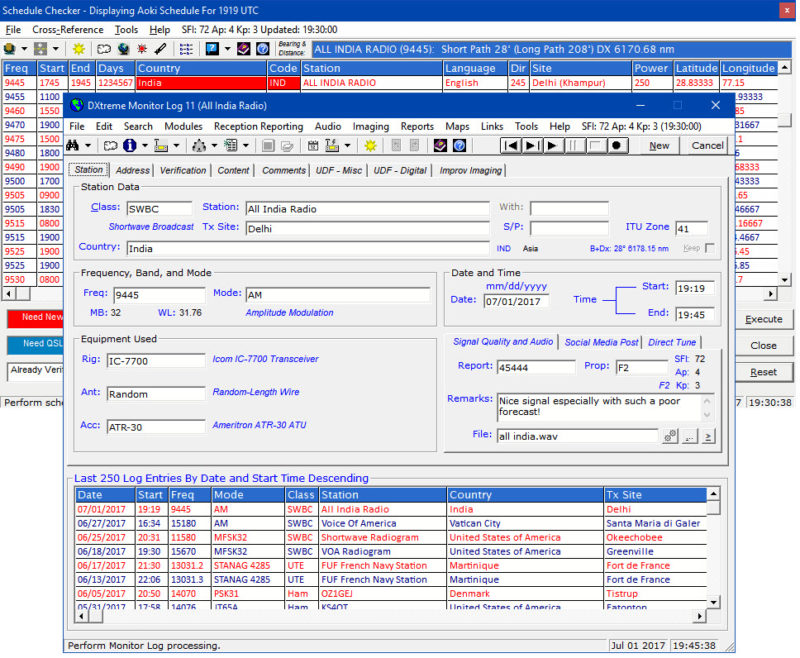
DXtreme Software™ has released a new version of its popular logging program for radio monitoring enthusiasts: DXtreme Monitor Log 11.
Monitor Log 11 lets listeners and DXers log the stations they’ve heard using advanced features that can enhance their monitoring experience.
Finding Broadcast Stations to Monitor
The Schedule Checker™ lets users import schedules from Aoki, EiBi, and FCC AM web sites and display schedule data according to the filter criteria they specify. A list box lets users switch between schedule types, and depending on the schedule type selected, users can filter schedule information by band, frequency, station, country, city, state, time of day, language, antenna direction, and target area.
When the What’s On Now? function is activated, the schedule refreshes automatically at the top of each hour for Aoki and EiBi schedules.
For each schedule item, Schedule Checker queries the Monitor Log 11 database to let users know – through user-defined, foreground and background display colors – whether they need to monitor a station for a brand-new or verified country. Schedule Checker also displays bearing and distance, runs optional Afreet Ham CAP1 propagation predictions, draws optional Afreet DX Atlas2 azimuth plots, tunes supported radios to schedule frequencies when users double-click schedule items3 4 5, and starts log entries for scheduled stations monitored.
Finding Amateur Radio Stations to Monitor
Monitor Log 11 integrates with optional Afreet Band Master6 to let users see, on its graphical interface, where hams are operating. Monitor Log 11 supplies Band Master with an Entity Needed List based on the user’s Monitor Log database, making it possible for Band Master to indicate the stations whose entities (countries) users need to monitor. When invoking Band Master, users can select an Entity Needed List for all bands or individually for the 160- through 6-Meter bands.
Finding Utility Stations to Monitor
A Links menu provides convenient access to user-specified blogs and web sites that can inform users as to where utility and other stations may be operating.
Logging Stations
Monitor Log 11 lets users log all kinds of stations — radio stations, television stations, broadcast stations, Amateur Radio stations, utility stations, military stations, and more! And it lets them log stations across the radio spectrum — from long wave, to medium wave, to short wave, and beyond.
The Last Log Entries Grid on the Monitor Log window shows up to 5000 of the most recent log entries added. Its records can be sorted, and double-clicking records displays detailed data on the Monitor Log window. Users can resize the grid columns and scroll horizontally to columns that do not appear initially. And because the names of stations and NASWA countries can be quite long, users can also display a larger, resizable Last Log Entries window. A Properties window lets users change the order of columns, the number of log entries to display, and the font and color attributes of grids and other program components, such as the Content Editor for describing the content monitored, the Script Editor for creating and editing scripts, the Direct Tune interface for tuning radios, and the Comments tab for typing ad hoc comments.
Reporting Reception
Users can create customized paper and e-mail reception reports for sending to stations plus club report entries for reporting catches to clubs and magazines.
When users add or display a log entry, Monitor Log 11 prepares a post announcing their DX catch and displays it on the Social Media Post tab. From there, users can drag the post to their favorite social media web sites to share their catch with others.
Using the Script Editor window, users can create and edit scripts that format reception reports, eReports, and social media posts to their liking. The software prompts users to select the script they want to use. Dozens of scripts come with Monitor Log 11.
Users can also print SWL and Address labels on industry-standard label stock, and send eQSL requests to hams automatically through the popular www.eQSL.cc site.
Imaging
Improv Imaging™ lets users associate ad hoc images with log entries using Capture, Scan, and Clipboard functions. Captures of stations received on digital applications, waterfall displays, facsimile and Amateur TV pictures are popular. The Improv Imaging tab and Application let users view images anytime, and an Improv Image Explorer lets them peruse their entire collection and display associated log entries.
QSL Imaging™ functions the same as Improv Imaging, but specializes in associating QSL cards and eQSLs with log entries.
Other Features
Rig Control — Retrieves the frequency and mode from supported radios and permits tuning from the Schedule Checker and Direct Tune interface. Rig control is provided through integration with Afreet Omni-Rig and the SDR applications listed on our web site, currently HDSDR4 (High Definition Software Defined Radio) and SDR Console5.
Audio Archiving — An embedded Audio facility lets users maintain an audio archive of stations heard.
Reporting — Produces Performance, Stations, and Log Entry reports that track the performance and progress of the user’s monitoring station. The software lets users FTP those reports to user-provided Web space for remote access. Some reports integrate with Afreet DX Atlas to generate pin maps.
Documentation — Context-sensitive Procedural Help, Field Help, and Microhelp are accessible per window to provide instructions quickly. A web-based Information Center is accessible from the Help menu for late-breaking assistance, and Installation Instructions and a Getting Started Guide are delivered in PDF format with the software.
Operating Systems, Pricing, Contact Information
DXtreme Monitor Log 11 runs in 32- and 64-bit versions of Microsoft Windows 10, 8.1, 8, 7, Vista, and XP. It retails for $89.99 USD worldwide for electronic distribution. Pricing for CD versions and upgrading users is available on our Web site. All prices include product support by Internet e-mail. For more information, visit www.dxtreme.com or contact Bob Raymond at [email protected].
1 — Licenses for Afreet Ham CAP and Omni-Rig are required to use Ham CAP. 2 — A license for Afreet DX Atlas is required to perform plots and create pin reports. 3 — A license for Afreet Omni-Rig is required to use rig control with radios supported by Omni-Rig. 4 — Can be used for rig control. HDSDR is owned by Mario Taeubel. Refer to http://www.hdsdr.de/index.html for more information. 5 — Can be used for rig control. SDR Console is owned by Simon Brown, G4ELI. Refer to http://www.sdr-radio.com for more information. ?6 — A license for Afreet Band Master is required to use Band Master.