30 Year Flashback: From the April 1st Edition of the Cascade Mtn. DX Club Bulletin

Among SWLing Post readers, I’m sure there are others like myself who, decades ago, listened to the Zzzt…Zzzt…Zzzt! sound of a dot-matrix printer as it spit out copy for “pasting up” a DX club bulletin. In the 1980s I was one of those enterprising DXers, taking over publication of the Cascade Mountain DX Club (CMDXC) when a local hobbyist lost interest in producing it.

For a few years I found that creating a regular bulletin was almost as satisfying as DXing itself, and I went on to publish another local bulletin, DX/Northwest. It was a forum for DXers in the Pacific Northwest USA to share loggings and information. I also hosted occasional gatherings of Seattle area DXers who were members of the club.

I recently came across my collection of all the past bulletins and appropriately found the April 1, 1987 edition of the CMDXC. I had completely forgotten I’d made an effort every April 1st to “spice up” the bulletin content with some April Foolery.

The first item was slipped into the midst of the monthly loggings, just to make sure readers were paying attention:

The fictitious DXer named “Grobe” in the spoof logging was a thinly veiled reference to radio hobby publisher Bob Grove of Grove Enterprises and Monitoring Times magazine. He actually wrote to me after the initial April 1st edition, beginning a running joke of humorous responses to my April Fool’s bulletin content, and always signing his letters “Bob Grobe”. I received similar letters from him after each year’s April edition. I don’t recall Bob ever being a member of the CMDXC, so I’m not sure how he knew of the content. I still have one or more of those letters stashed away somewhere.

Perusing the April 1st, 1987 bulletin again, I note that I was feeling charitable towards a certain down-on-his-luck DXer “M.T. Pockitz” from nearby Vancouver, BC Canada, and wanted other club members to help him in his time of need. I was also in close touch with new developments in radio technology, as I am today:
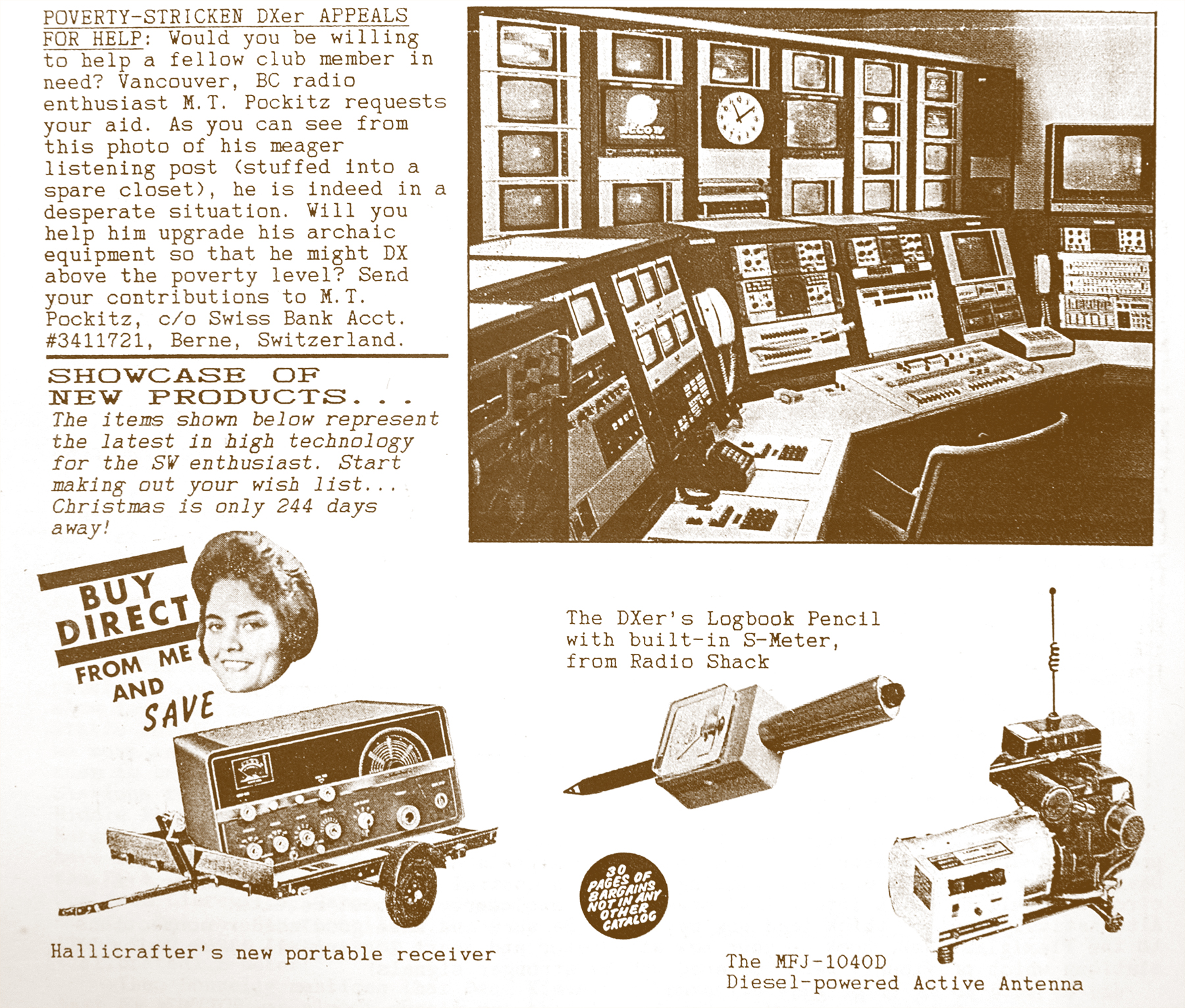
Who else remembers the old DX club bulletins–from the dot-matrix printer era–with fondness? You may even be senior enough to feel nostalgic over the “ditto machine” or Mimeograph produced publications!

To read more humor that only a DXer could love, I highly recommend Don Moore’s excellent web site BLANDX – Historical DX Humor. This site is the web archive of the classic BLANDX parody bulletins. I was an occasional contributor, and on the receiving end of Don’s wonderfully warped funny bone at times. If you can’t laugh at the BLANDX content, watch out–your WPE Callsign might have expired!

Guy Atkins is a Sr. Graphic Designer for T-Mobile and lives near Seattle, Washington.  He’s a regular contributor to the SWLing Post.
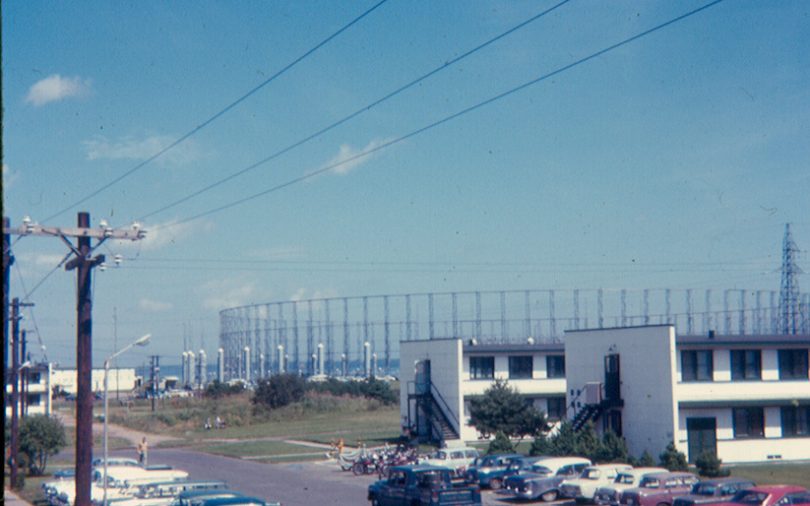
Paul remembers the FLR-9 “Elephant Cage” in Misawa Japan

Many thanks to SWLing Post contributor, Paul, who writes:

I was a morse intercept operator in the USAF in the late 1960s. I have a nice picture of a FLR-9 at Misawa Japan (now gone I think):

I was at Misawa from 68-70 in the USAF Security Service. I copied high speed code, mostly cut numbers. Got my ham license after discharge. I had 3 R390 receivers at my “position” and numerous different “antennas” on the FLR-9 to listen in different directions. While there I received a commendation for: “Providing information that otherwise would not have been known” I’m not sure I can say any more details.

To me [this photo] shows the immensity of the antenna.
Thanks.
Paul

Yes–this antenna is enormous! It must be a site to see up close. I’ve only seen Wullenweber Antennas from satellite imagery. Thank you so much for sharing your photo!

Click here to read previous posts about “Elephant Cages.”

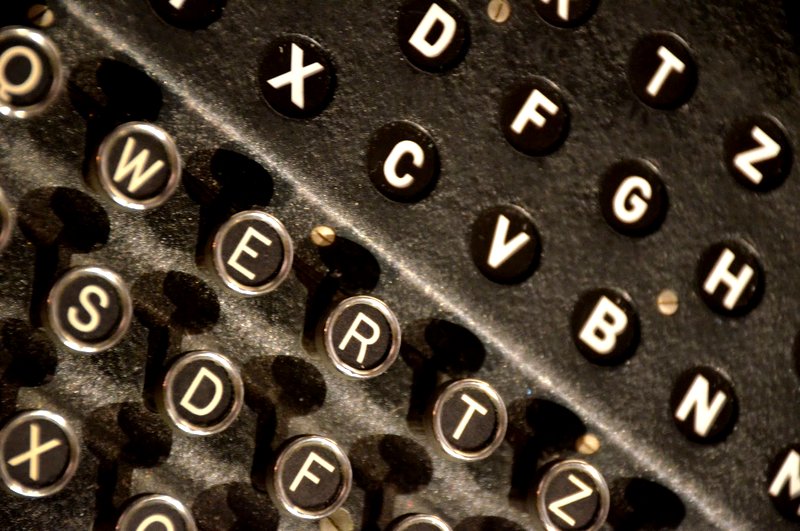
April 7: Decipher an Enigma encrypted message on 40 meters

(Source: Southgate ARC)

Enigma encrypted message to be sent in 40m

In cooperation with Bletchley Park, the Heinz Nixdorf Museum DLØHNF in Paderborn, Germany is hosting a cipher event on April 7

A Google translation of the DARC post reads:

As with the first event of this kind ten years ago, an encrypted message is sent over radio, to which radio amateurs are invited, to follow them and to play with them. This time, however, the message is not generated with a Lorenz machine, but with an enigma and then transmitted in encrypted telegraphy to 40 m from the club station of the Heinz Nixdorf Mueseum, DLØHNF.

DLØHNF will open radio stations with other stations, which also use historical technology and thus recreate a historical radio network, between the transmissions of various encrypted messages – which are specially approved for this event. DLØDM and DLØAFM are also involved. The activities in Bletchley Park go back to the mathematician Alan Turing, who during the Second World War succeeded in decoding the Enigma coded radio spoofs of the Germans with his Turing machine.

In the Heinz Nixdorf Museum you can watch the happenings from 9 o’clock on the spot. Visitors experience encryption with the Enigma, the Morse as well as a live transmission.

A precise frequency for the transmission of the CW transmission from 9:30 is not known. The museum information is at
http://www.hnf.de/start/date/2017/04/07/cal/event/tx_cal_phpicalendar/
cipher_event_wer_knackt_den_enigma_code.html

Source https://www.darc.de/

Standing Inside a Broadcast Transmitter While it’s ON!

I stumbled across a video from the fabulous Mr Carlson’s Lab YouTube channel. If you haven’t check out this channel before, and you are really eager to learn more about electronics, this is a wonderful YouTube site.

So, in the latest episode, Mr Carlson takes us on a tour of a very large Gates BC-250-GY broadcast transmitter from the 40’s era. Lots of big tubes, transformers and capacitors! This is an old mediumwave transmitter that he has restored. Although the technology has changed markedly since the 1940s, the basic principals of transmission are still present. And, interestingly, he points out that this particular unit was in regular service right up until as recently as 2003!

It’s an interesting show and even if you can’t grab onto all the technical information presented, I think you will enjoy looking at technology from a past era.

73 and good DX to you all,

Rob Wagner VK3BVW

Rob Wagner, VK3BVW, is the author of this post and a regular contributor to the SWLing Post. He also blogs at the Mount Evelyn DX Report.
AIR launching Phase II of DRM conversion

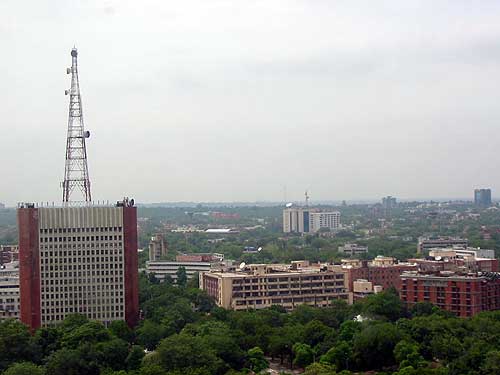
All India Radio (AIR) Headquarters in Dehli, India. Photo courtesy of Wikipedia.

(Source: Radio Mag via Dennis Dura)

AIR Launching DRM Conversion, Phase II

NEW DELHI — All India Radio was recently congratulated by India’s Union Minister for Information and Broadcasting Shri Venkaiah Naidu for having completed phase I of the national DRM digital radio roll-out in India. Thirty-seven DRM transmitters have been installed by AIR throughout the country, and all are now operational, according to DRM news.

Of the 37 new transmitters, 35 are medium wave and 2 are shortwave transmitters. Both SW transmitters are for international service and are broadcasting in pure DRM. […]

AIR is now in the process of launching phase-II of the DRM project by offering full features and services from these DRM transmitters and further improving service quality. When Phase-II is complete, the full-featured DRM services will be available to the audience and a public information campaign will be initiated to inform the Indian citizens of the completely new and future- oriented DRM radio platform and its many benefits. […]

Phase-III, as presented by AIR, will eventually culminate in the complete transition of radio services to the digital DRM platform, further improving the number and quality of radio services and extra features for the listeners, while also saving tremendous amounts of transmission power every year, according to the same article.

Click here to read the full article via Radio Mag Online.

While it sounds like the broadcasting side of DRM is progressing with AIR domestically, I haven’t read anything recently about affordable DRM receivers being developed for the market in India (other than possibly the Titus II and Gospell GR-216 which, I suppose, could be imported).

Based on messages I’ve received from readers/listeners in India, any new DRM receiver must be very affordable ($40 US or so) if wide adoption is to be expected.

I believe this is an opportunity for a manufacturer like Tecsun to step in and make an affordable DRM portable for the market in India–something with a simple display and controls. Otherwise, this might be another “cart before the horse” situation for DRM.  That would be sad.

Titus II at NAB

The least expensive portable DRM receiver on the horizon could be the PantonX Titus II (not yet in production).  PantronX has claimed the Titus II will cost “less than $100.”

And speaking of the Titus II, SWLing Post reader, Ed, notes:

pantronX is reportedly going to announce its Titus II Android SDR boombox at NAB April 22-27, which is another indication this radio is for real.

http://www.thebdr.net/hotlinks/mfgr.html

We’ll post updates about the Titus II as they become available. Follow the tag: PantronX Titus II

Dan Robinson: “Voice of America has never been independent”

SWLing Post contributor, Dan Robinson, is the former White House, Congressional and foreign correspondent for the Voice of America.

I’ve just learned that Dan has authored a piece in the Columbia Journalism Review titled Spare the indignation: Voice of America has never been independent“:

http://www.cjr.org/opinion/broadcasting_board_of_governors_house_trump.php

I encourage you to read his full article and please direct your comments to the original post on the Columbia Journalism Review website.

FCC Approves MF/LF Ham Radio Bands

(Source: CQ Newsroom & FCC)

Hams in the U.S. will soon have two new bands on which to operate, experiment and contribute to the collective knowledge of “the radio art.” In a Report and Order issued on March 30, the FCC approved creation of secondary amateur allocations at 135.7-137.8 kHz (2200 meters) and 472-479 kHz (630 meters), the first amateur bands with wavelengths above 200 meters since the dawn of radio regulation.

The new bands come with lots of strings attached, since they will be shared with “PLC” systems used by electric utilities to control the nation’s power grid. Hams will be limited to fixed station operation, antennas no higher than 60 meters (196 feet) above ground and radiated power limits of 1 watt effective isotropic radiated power (EIRP) on 2200 meters and 5 watts EIRP on 630 meters (1 watt in some parts of Alaska). Plus, operation on these bands will not be allowed within one kilometer of electric transmission lines using PLC and advance notice of all planned operation to the PLC network coordinator will be required.[…]

Continue reading at the CQ Newsroom.

Click here to download the full Report and Order from the FCC (PDF).