Many thanks to SWLing Post contributor TomL, who shares the following guest post:

Illustration 1: Main contents
Backpack-Shack radio listening
by TomL
So, the Car Shack idea was good, but I felt constrained by lack of access to better locations to listen to shortwave radio. I took most of the original equipment and stuffed it into a photo backpack I was not using and now I have a portable listening station. Now I can listen in my car or in the field fairly easily.
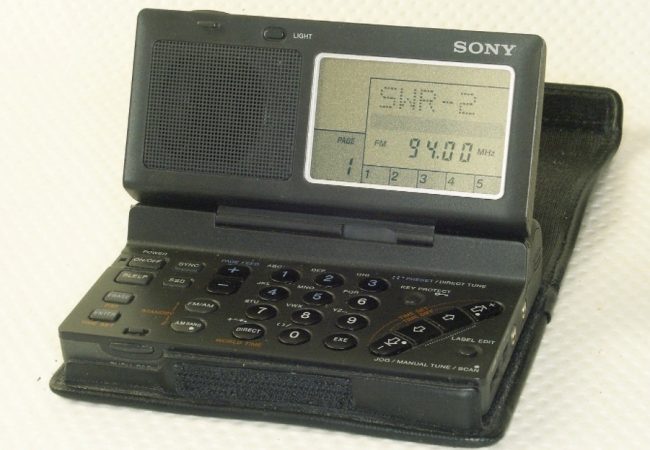
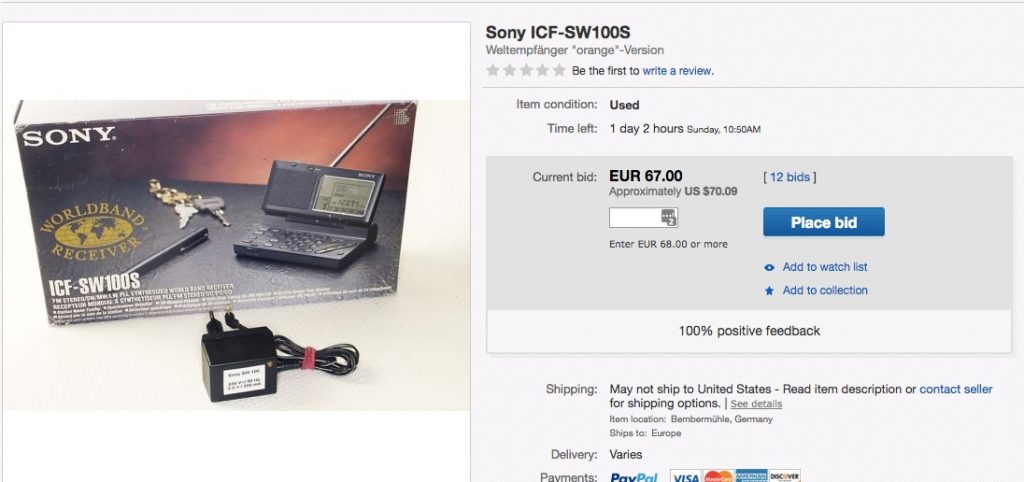
LowePro350AW – The backpack has three main compartments, integrated carry handles, nice padded waist belt, and a couple of ways to stick a 3/4-inch PVC pipe into external tripod or water bottle pouches. My homemade 14-inch loop antenna with Wellbrook amplifier is light enough to be attached to a 3-foot PVC pipe attached to the backpack. The Palstar preselector (active antenna) and KIWA BCB filter are still part of the portable setup. I added a Daiwa two-position switch to cut out the KIWA BCB filter so I can listen to mediumwave. Power for all these devices are Powerex AA’s for the Sony 2010 and two 12V power packs made from three sets of XTAR 14500 lithium batteries + one dummy AA. I have mounted the electronics and wires using large cable tie-wraps to a 14×10 inch polypropylene kitchen cutting board (sturdy and easy to drill through).
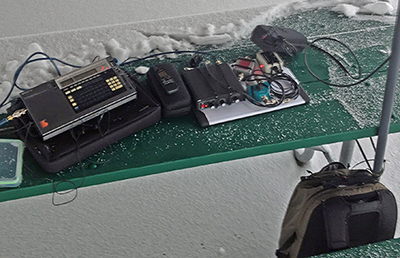
Illustration 2: The electronics board fits neatly into the laptop section of the backpack

Illustration 3: Backpack Shack in operation
Here are some recordings from two test outings around 2100-2200 hours UTC. A local county park (“Forest Preserve”) purposely has few man-made structures (just a trail, picnic shelter made of wood and an outhouse). It is about 15 minutes drive from where I live; the reception is notably clear of local noise. There is an occasional wide-band noise that comes and goes but nothing else I can identify as detrimental noise and it is mostly just a nuisance.
Cuban Numbers station on 11635 kHz:
VOA from Santa Maria di Galeria, Italy in French on 12075 kHz:
All India Radio on 11670 kHz:
BBC Ascension I. on 11810 kHz:
R. Guinea with music and announcer on 9650 kHz:
A big downside of the Forest Preserve, like most parks now, is that it is ONLY open from sunrise to sunset and strictly enforced. So, my personal quest for nighttime access to an RF-quiet location continues (I guess I will have to buy/build my own)! It begs for an even more portable setup than this one. That means buying an SDR (with control via a tablet), miniaturizing the antenna, and modifying the lithium power packs to fit in a very small backpack or fanny pack.
If I can miniaturize it enough, I will be able to use common parts of this setup at home, in the car, and at field locations for either mediumwave or shortwave listening. I could then pre-install the unique parts in those situations and just plug-and-play, so-to-speak!
It could be that the continuing tech wave of small, powerful, wide-band equipment is causing a revolution in general. A type of radio revival may be at hand where regional radio starts to take a foothold, catering to a multi-state area and not just to one local metro area – with its one-city mindset and control (Do I really care that the Big City is installing a downtown-only, 12 million dollar bike and jogging connection + hearing endless whining about how bankrupt pensions are putting that County at risk when I never go there and don’t care to?). Portable wide-band radios allow for hours of listening to various types of broadcasts!
An example could be to use digital broadcasts over longwave (somewhere from 150 kHz-500 kHz) which allows ground wave signals to travel hundreds of miles reliably during the day or night without depending on variable skywave propagation. Digital would enhance the listener experience in stereo. It would probably need a narrower type of digital modulation since the current “HD Radio” standard is really too wide and splatters everything at adjacent frequencies. Pure wishful thinking but the technology is available to make something NEW happen!!
Cheers from NoiZey Illinoiz,
TomL
Thank you, Tom! You certainly have the right idea: taking your radio to the field! Keep us informed about your progress and updates. No doubt, over time you will discover a year-round spot to play radio in the field!