Tag Archives: Shortwave Radio

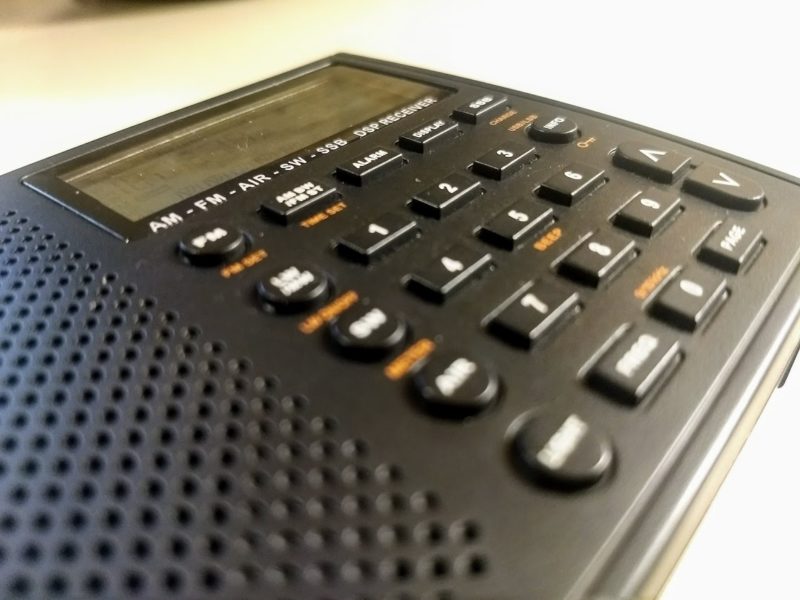
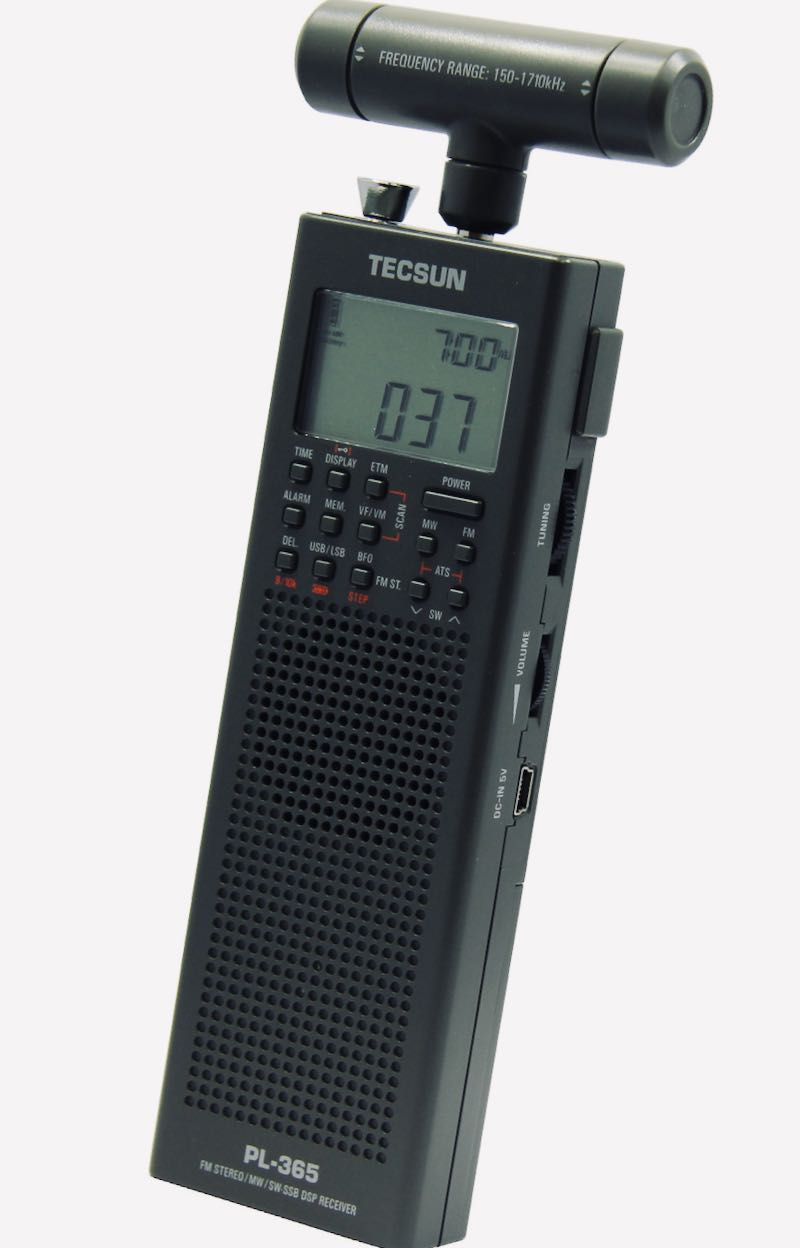
Tecsun PL-365 now in stock at Anon-Co

Many thanks to SWLing Post contributor, Gareth Buxton, who writes:

I “watch” the Anon-Co new additions page for changes and this morning I received an update that the PL-365 has been added. I think they only used to stock the non-usb Pl-360 version.

Click here to view the PL-365 page at Anon-Co.

Thanks for the tip, Gareth! The PL-365 is a very sensitive portable receiver and one of the least expensive with a proper SSB mode. I’m happy Anon-Co has added them to their inventory.

Can you help Bruce identify this buzzing noise from the 31 meter band?

Many thanks to SWLing Post contributor, Bruce Atchison, who writes:

I’m hearing an intermittent buzzing noise on 9820kHz each evening at around 4:00 UTC. What could it be?

Sorry the quality isn’t as good as I’d like, but here’s a recording:

Thank you for sharing this recording, Bruce.  My hope is an SWLing Post reader will be able to correctly ID the source. Please comment!

Listener Post: Mike Stutzer’s love of radio began with a Hallicrafters S-120

Photo: Universal Radio

Many thanks to SWLing Post contributor, Mike Stutzer, who recently shared the following listener post:

I started SWLing as a teenager. My favorite uncle gave me a Hallicrafters S-120.

My dad hung a longwire under an eave and through a casement window frame into my bedroom. I marveled at all the AM international stations broadcasting in English, listening to everything from BBC cricket coverage on Saturday morning to hysterically unbelievable Albanian political news coverage.

After college I could afford something better, so I upgraded to a “boat anchor” Hallicrafters SX 110. It had a useful crystal filter to improve selectivity, but it was still nigh on impossible to decipher a Ham on SSB.
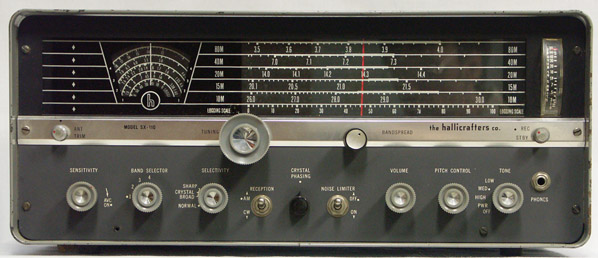
Photo: Universal Radio

Many decades later I bought a house on a steep foothill. Realizing that it was a perfect QTH for a Ham station, I got licensed and now am President of the local ARC. Here is a loving look at the original SWL receiver that got me hooked.

Prof. Mike

Boulder, CO

Thank you for sharing this, Mike!

Mike’s radio story is the latest in our multi-year series called Listener Posts, where I place all of your personal radio histories. Feel free to submit your own by contacting me.

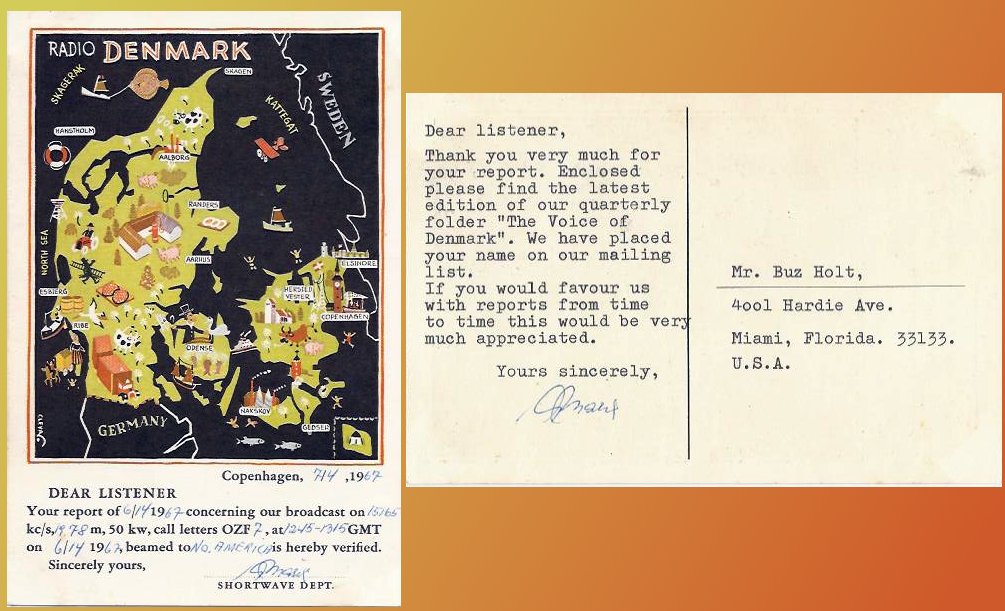
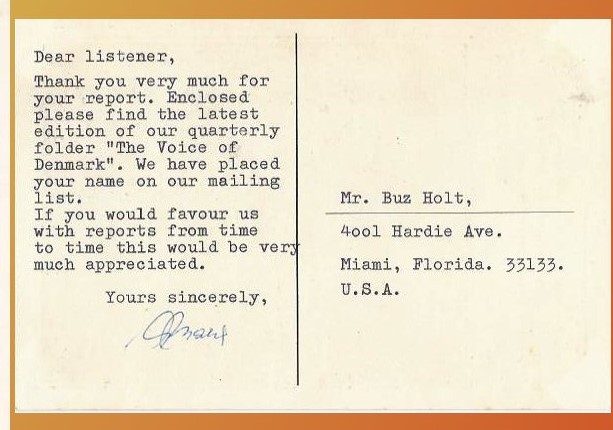
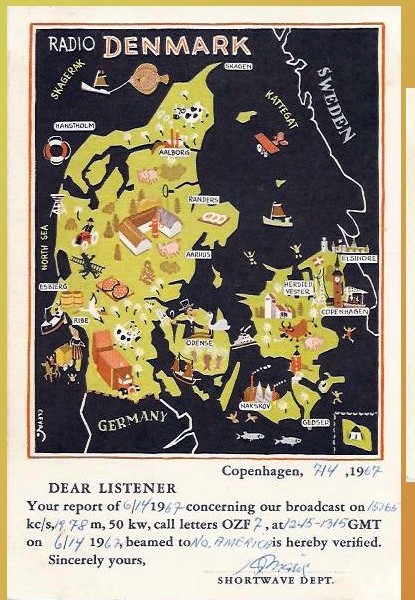
Al’s 1967 Radio Denmark QSL

Many thanks to SWLing Post contributor, Al Holt, who shared the following QSL and note on Twitter:

The posting about WRM and its originating from Denmark got me thinking about my early days SWLing and the wonderful QSL card I got from R. Denmark.

I hope to tune WRM on 19m soon!

Thank you for sharing this, Al!  That particular Radio Denmark QSL cards is one of my all-time favorites. I never received one myself, but I’ve always been fond of maps like this that highlight regional attractions/specialties.

World Music Radio broadcasting 24/7 on the 19 meter band

Many thanks to SWLing Post contributor, Harald Kuhl, who shares the following from Stig Hartvig Nielsen with World Music Radio.

I’m testing a new audio feed for the 15805 kHz transmitter. Hopefully more stable than the previous one, which sometimes would run 24 hrs without a single drop out – at other times produce drop outs almost continuously.

My plan is to keep 15805 kHz (200 W) on the air 24/7 for the next week or two. Should give DXers around the world a chance to catch 15805 when conditions on 15 MHz in some rare cases might improve. Currently propagation on 15 MHz is usually poor with a few fair days, but right now at this time of the years I suppose chances are the best.

WMR on 15805 kHz (200 W) – transmitter site: Randers
WMR on 5840 kHz (100 W) – transmitter site: Bramming
F.pl.: Power increase to 500 W on 5840 kHz. And new transmitter on 927 kHz
(500 W) in Hvidovre

Best 73s
Stig Hartvig Nielsen
www.wmr.radio
Keeping Short Wave Radio Alive!

Thank you for the tip, Harald!

British Antarctic Survey Annual Midwinter Broadcast test today (June 14, 2020) at 2130 UTC

Halley VI Research Station on the Brunt Ice Shelf in Antarctica (Source: British Antarctic Survey)

Many thanks to the British DX Club who shares the following information about a BBC Midwinter Broadcast test being held later today:

The annual 30-minute Midwinter broadcast to British Antarctic Survey staff in Antarctica is scheduled by BBC WS for Sunday 21st June.

Ahead of this, two frequencies will be tested Sunday 14th June 2130-2145 UTC from Woofferton (UK): 5790 and 7360 kHz.

Other frequencies to be confirmed.

I will certainly attempt to catch the test broadcast as I plan to record the 2020 Midwinter Broadcast on June 21 as I do each year.

Of course, I’ll also collect, curate and share SWLing Post community recordings of the midwinter service as well. Always a highlight of my listening year!

Help Jim identify this mystery shortwave “time signal” station

Many thanks to SWLing Post contributor, Jim Meirose, who recently logged a mystery signal and is asking for our help to identify it. Jim notes that it sounds much like a time signal and can be found on 4,806 kHz.

Jim lives in the north east US and is receiving the station each morning between about 5:00 – 8:00 EDT (9:00 – 12:00 UTC). He shares the following video:

Based on Jim’s description, I thought this might even be a local noise, but after hearing the audio and since the signal is following morning propagation, I’m guessing the source could be in Europe or possibly regions further east–?

SWLing Post community: Can you help ID this station? Please comment!