Shortwave listening and everything radio including reviews, broadcasting, ham radio, field operation, DXing, maker kits, travel, emergency gear, events, and more
In this show we kick off with part one of our reports from Hamfest 2017 with a preview of the Icom IC-7610 and IC-R8600 rigs. We meet the new owners of PW Magazine, and Pete tries his hand at the RSGB on-line exam. There’s also an update on the RSGB’s EMC Committee’s findings.
Bob finds his way back to New Broadcasting House in London where the Director General discovers he has amateurs working for the BBC.
And, you can win a mobile linear-amp for your handie in our next free-to-enter draw.
Click here to view Episode 18 on TX Factor’s website, or click here to watch on YouTube.
Thanks for yet another excellent and informative episode, TX Factor!
An on-site description of the ocean cliff environment, FSL antennas and DXpedition results after the breakthrough August 2017 trip to the Oregon coast just north of Manzanita. Multiple South Pacific receptions included a greatly revitalized 558-Fiji, two Western Australian MW stations, five receptions of 531-More FM in New Zealand, etc. (by Gary DeBock). Sorry that the video wasn’t recorded in the usual HD mode because of a “Murphy’s Law” error.
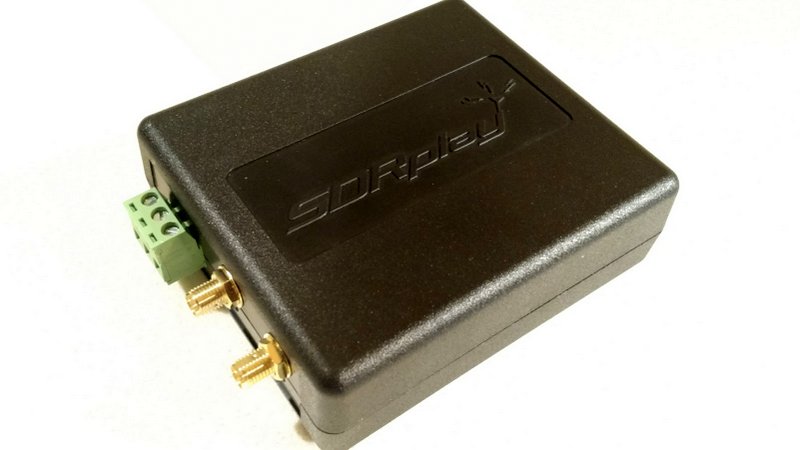
Mike Ladd, with SDRplay, has done an amazing job putting together a comprehensive series of how-to videos for those of us with the SDRplay RSP1 and RSP2 receivers. His first set of videos have focused on using SDRuno (SDRplay’s custom SDR application), and now he’s started an SDR Console series as well.
If you own an SDRplay RSP, take time to watch some or all of these videos as they’ll help you unlock RSP functionality you likely never knew existed. I’ve learned something new in each one I’ve watched.
Below, I’ve embedded 23 SDRuno how-to videos, a new SDR Console video and PDF/printable SDRplay documentation. Enjoy! (And thanks again, Mike!)
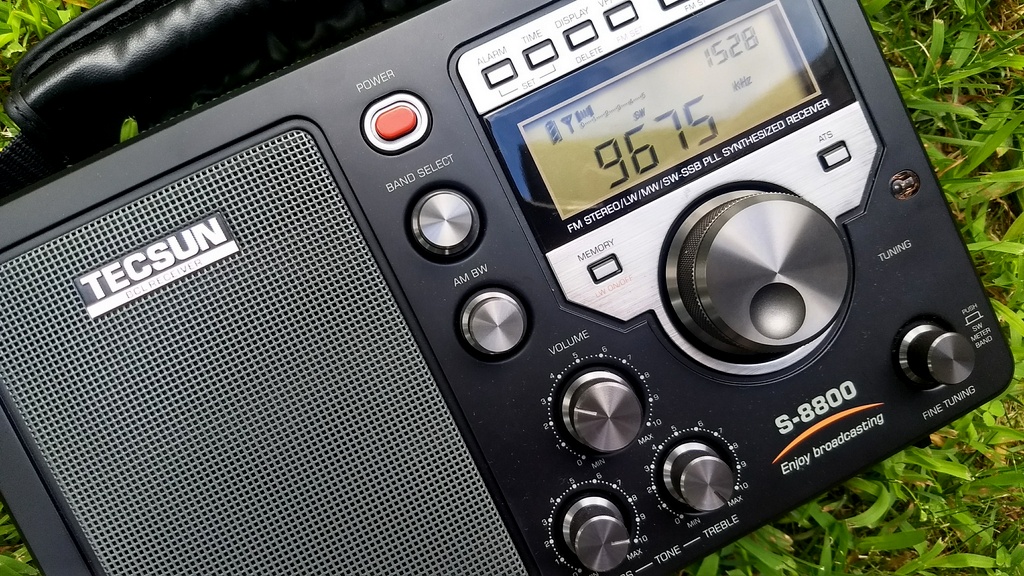
I carved out about two hours of my afternoon and spent the entire time comparing the S-8800 to the Tecsun PL-880 and the Sony ICF-SW7600GR. I tested the radios on several shortwave bands and in both AM and SSB modes.
On Sunday, we discovered that mediumwave performance is lacking on the S-8800. Not so on shortwave!Check out this short video:
In my comparisons, the Tecsun S-8800 has consistently outperformed the PL-880 and Sony ICF-SW7600GR on the shortwave bands. The AGC is pretty stable and sounds much like that of the PL-880 when QSB (fading) is present. Sensitivity is better than the PL-880, though, so the S-8800 can dig those signals out of the noise a little better.
Note, too, I had to pick up both the PL-880 and ‘7600GR in my hand to obtain the best performance–that additional grounding gave each a slight boost. Quite common for portables. The S-8800 didn’t require this.
After I returned home yesterday, it struck me that perhaps a longer telescopic whip gave the S-8800 an advantage. Turns out, it’s only three inches longer than the PL-880’s whip.
Next, I need to spend a little time with the S-8800 mapping out any birdies on HF–a tedious process. I hope to start on that today.
To follow updates on this yet-to-be-released receiver, follow the tag: Tecsun S-8800.
My schedule last week made it impossible to carve out the dedicated time I needed to begin an S-8800 evaluation.
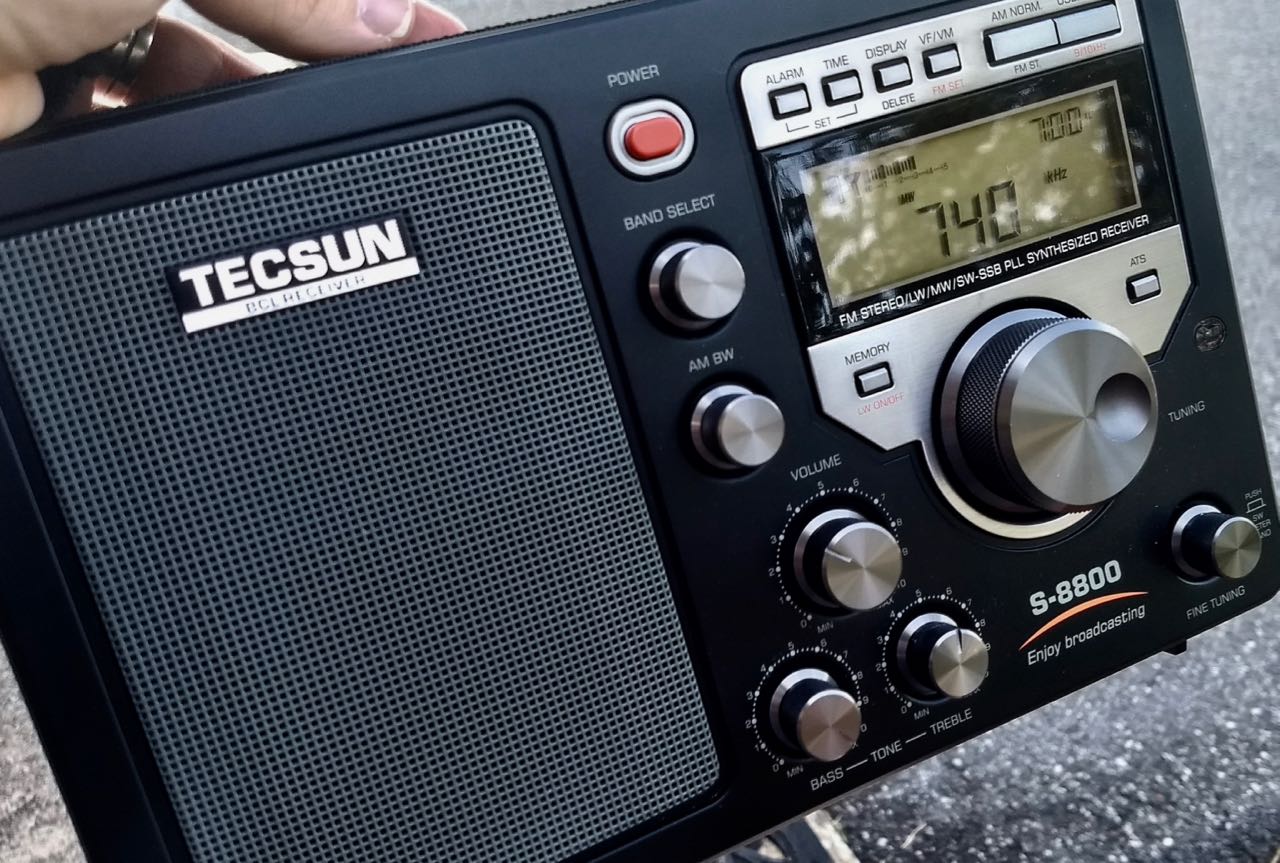
Yesterday, however, I spent the afternoon with my family at Richland Balsam, the highest point on the Blue Ridge Parkway (6,000′ ASL) and a completely RFI-free zone. I brought the Tecsun S-8800 and a few other portables along for the ride–namely the Digitech AR-1780, the C.Crane CC Skywave and the Panasonic RF-2200.
I had just enough available space on my smart phone to record this one short video:
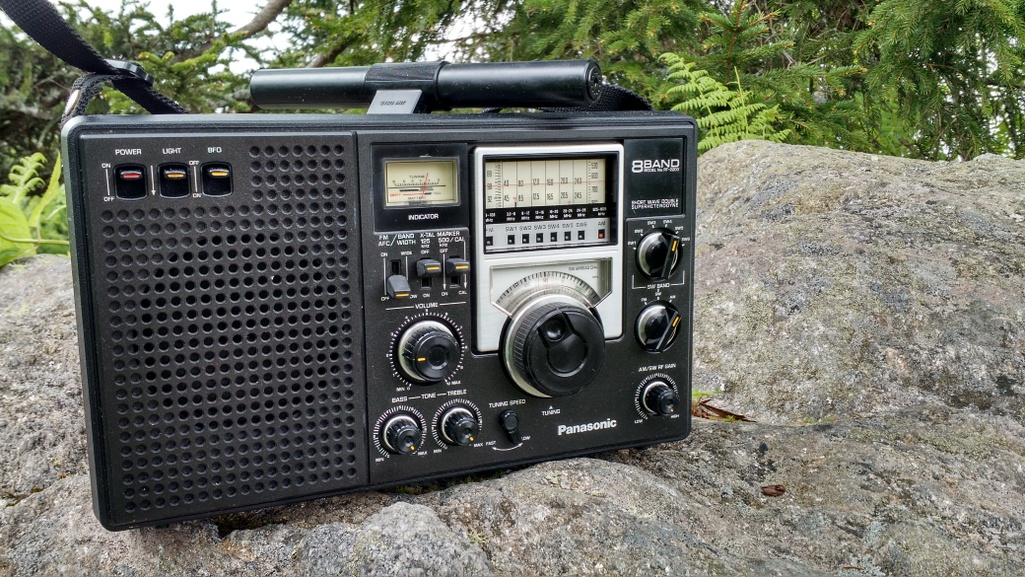
Let’s be clear: comparing any modern radio with the RF-2200 on mediumwave is hardly fair.
For one, the RF-2200 has been out of production for a few decades.
Secondly (what I never finished saying in the video is that) the RF-2200 has a large rotatable ferrite bar antenna that provides excellent gain. The RF-2200 simply wipes the floor with all of my modern portables as their ferrite bar antennas are a fraction of the size.
In other words, the RF-2200 was engineered to rule mediumwave like a boss.
On shortwave, the RF-2200 does a fine job, but isn’t nearly as accurate and stable as modern DSP receivers.
Spoiler alert
Still, as the video indicates, my final review of the Tecsun S-8800 will indicate that it is not a receiver for the serious Mediumwave DXer. It’s been my experience that few shortwave portables are excellent on both HF and MW.
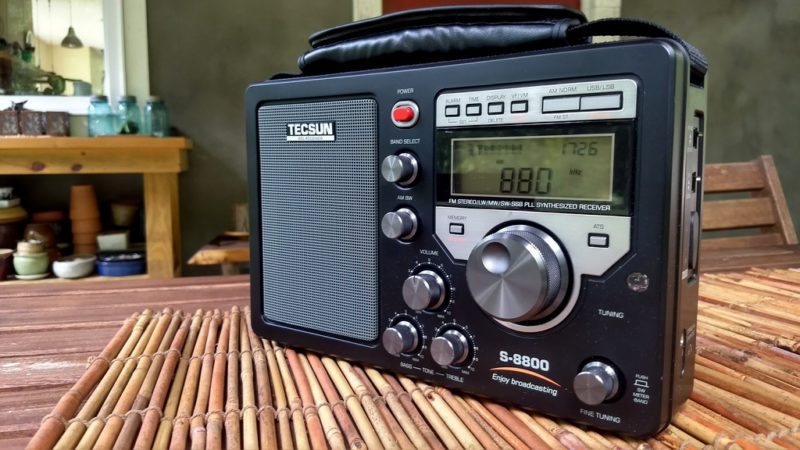
At home, tuned to local station 880 AM.
Of course you can’t tell from the video, but the S-8800 actually sounds brilliant when tuned to a relatively strong/local AM station, but either a lack of sensitivity or internal noise makes MW DXing a challenge.
I spent the better part of two hours yesterday evaluating its daytime MW performance–the video is pretty indicative of my findings. The S-8800 struggles with weak stations, but does a fine job with strong ones. It’s overall audio fidelity almost matches that of the RF-2200 when tuned to a strong broadcast. I’ve yet to test evening MW
The S-8800 still has some birdies on MW, but they’re not the loud warbling kind found on the previous model. Tecsun did properly address this, though in full disclosure, I haven’t fully explored the shortwave bands yet.
Shortwave?
I suspect the S-8800’s performance on shortwave will be much better than mediumwave because the previous S-8800 showed excellent results. As long as sensitivity wasn’t harmed while addressing the DSP birdies, I expect it’ll give the PL-880, PL-680 and Sony ICF-SW7600GR a run for their money.
Still…the lesson learned yesterday?
The Panasonic RF-2200 is the indisputable champion of mediumwave!