Shortwave listening and everything radio including reviews, broadcasting, ham radio, field operation, DXing, maker kits, travel, emergency gear, events, and more
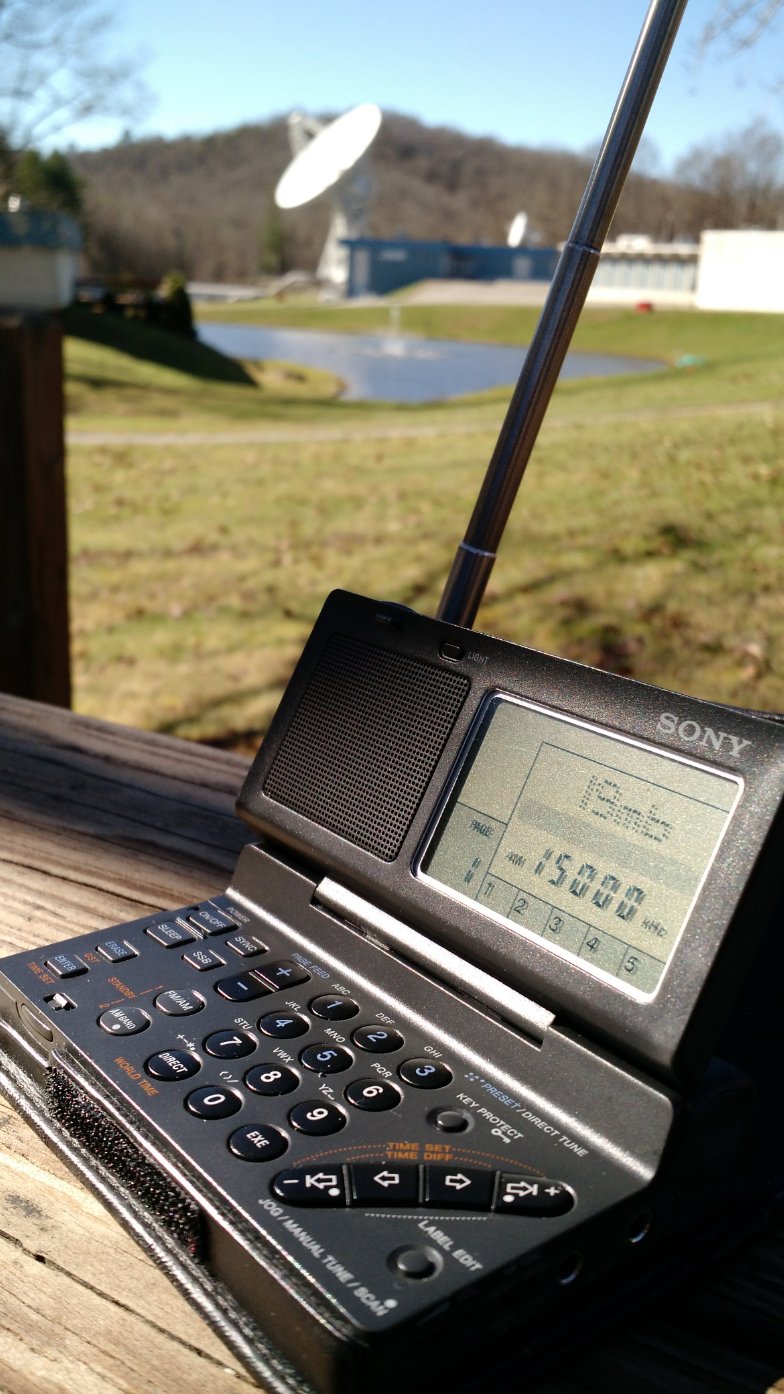
During a break, I had a couple of free hours, so I reached in my messenger bag and pulled out the Sony ICF-SW100: a radio that has quickly surpassed all others as my favorite EDC (everyday carry) radio. It has so many useful features in such a small package!
Radio astronomy observatories are ideal locations for impromptu shortwave radio listening as there is little to no radio interference/noise present.
PARI’s “Building 1” and the 26 West (left) and 26 East (right) radio telescopes.
While the weather on Thursday was gorgeous, HF band conditions were…well…miserable. There was very little to hear other than China Radio International, Radio Havana Cuba and a few other blow torch broadcasters.
I tuned to 15 MHz and, of course, there was reliable WWV in Fort Collins, Colorado on frequency. Though WWV’s signal was relatively strong (despite the conditions) I turned on the SW100’s sync detector because fading (QSB) was pronounced at times.
Here’s a short video of the ICF-SW100 on a picnic table in the middle of the PARI campus. That’s PARI’s 26 (meter) West telescope in the background:
Many thanks to SWLing Post contributor, Dan Robinson, who shares a radio comparison he initially posted in the excellent Extreme Shortwave Listening Facebook group. Dan writes:
When the Sangean ATS-909X was first released a few years ago, I decided that I would hold off obtaining one to let whatever bugs there might be in production get worked out.
I have always been impressed by the design of the 909X, but was cautious when it came to the question of overall sensitivity. I once owned the 909, had it modified by Radio Labs, but that seemed not to do much — the 909, in my view, suffered too much from the well-known deafness issue when using the whip antenna.
Over the years, I used and still own many of the classic portables. This includes the SONY 7600GR, Grundig SAT 500/700, 2010, E-1, SONY SW100/SW07, SONY SW-55, and the radio I consider to be at or near the top of the small portable heap, the Pan RF-B65. But a couple of weeks ago, I broke down and bid for a new in box Sangean 909X. It’s the black version, and arrived a couple of days ago.
I remain impressed by the 909X’s design — beautiful radio, wonderful large LCD and backlight, excellent filtering, along with a feature we used to see in the SONY’s — adjustable/variable attenuation. But I wondered how the 909X would stack up against two of my favorites, the SW-07 and RF-B65. I was crossing my fingers — but alas, initial results are not encouraging.
While the radio initially on its own seems to be quite sensitive, I lined it up next to the SW-07 and RF-B65 and did a comparison. Now, first I must note that propagation continues to be in the dumpster and I conducted this test in late afternoon.
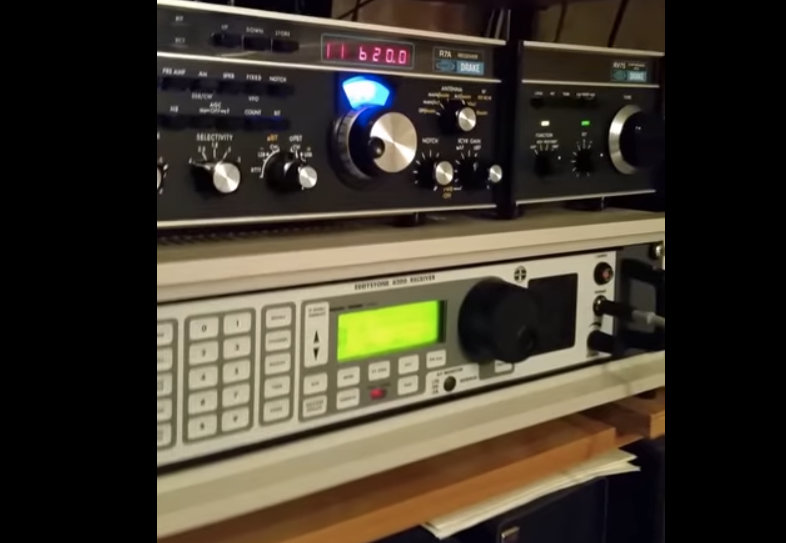
All three receivers were tuned to Cuba on 11,760 khz — they were located next to one another on a table in the top level of my home here in Maryland. The results are seen in the video below.
You can hear how much more clearly the SW-07 and especially the RF-B65 handle a signal. With the Panasonic, stations just pop. Same with the SW-07.
Disappointingly, as you can hear, stations on the 909X appear to be buried in noise. It’s quite extraordinary — I was very surprised by this comparison and intend to perform additional side-by-side tests in different areas of my home, which does suffer from high noise levels likely produced by electric lines and a transformer outside (which is why a run a Wellbrook on my main radio stack downstairs). But it is notable that the 909X appears to struggle so, while the old classic portables SW-07 and B65 excel. Interested in the views of others . . .
Dan, this is very similar to my experience with the Sangean ATS-909X.
“In the face of the internet, mobiles and instant messaging you might expect the hobby of amateur radio – or HAM radio as it’s also known – to be on the decline.
But in the last three years, the number of amateur radio licences has risen by over 8,000 – with 80,000 currently issued in the UK.
Using designated frequencies, amateur radio enthusiasts communicate with people over the world. Many prefer the relaxed approach of ‘rag chewing’ or chatting at length with people, who often become friends – while at the opposite end of the spectrum ‘contesters’ compete to make as many contacts as possible in a given period.
The hobby is also a public service, with Raynet (in the UK) stepping in during emergencies when regular communication networks fail. Amateur radio enthusiasts are currently contributing to relief efforts following Typhoon Haiyan in the Philippines.”
Another episode of the superb UK ham radio program, TX Factor has been published. TX Factor Episode 9 features ham radio “Essex-style!” Here’s a brief description:
“We visit the south east to report on the work of Chelmsford ARS, Essex Repeater Group and Essex Ham. And we’re giving away a CG-PK4 Pocket Memory Keyer in our free-to-enter draw.”
Fans might also take note that TX Factor now has a collection of audio interviews and features called TX Talk.
Many thanks to Jonathan Marks who apprised me of this excellent 1960 film from the BBC. As Jonathan notes, it’s heavily scripted, but fascinating nonetheless.