Tag Archives: Voice of America

The UNT Willis Conover Archive is now online

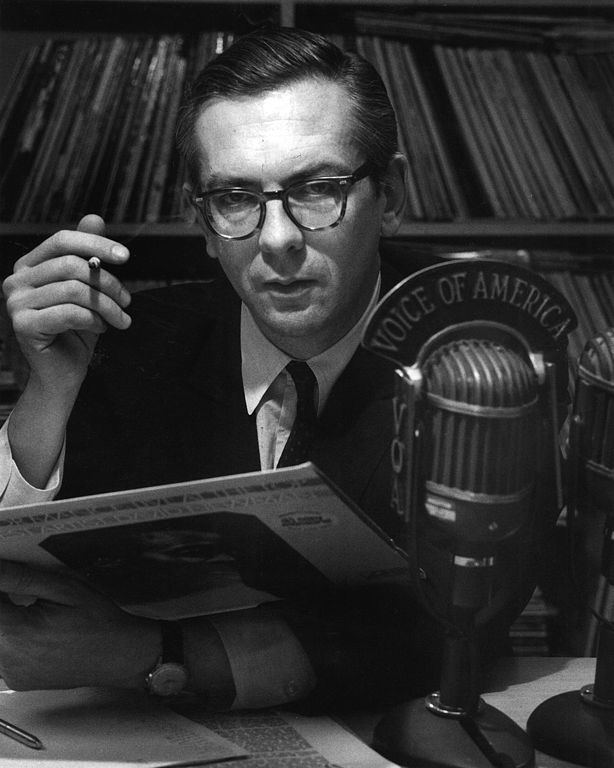
Willis Conover, The Voice of America (Source: Wikimedia Commons)

Regular SWLing Post readers know that I’m a huge fan of the late Willis Conover. I just learned, via the Arts Journal blog, about an amazing collection of Conover audio archives that are now being shared online:

“The music program at the University of North Texas has graduated hundreds of jazz artists who went on to successful careers as professionals.[…]

Under Maristella Feustle of the university’s library, there is an archive devoted to the late Willis Conover of the Voice of America[…]. Conover’s VOA programs sent jazz around the world. For a quarter of a century he was one of the nation’s most valuable cultural diplomats. As of today, parts of the Conover archive are online and open to the public, thanks to a grant from the Grammy Foundation.[…]”

Click here to read the full Arts Journal article.

Many thanks, Maristella, for championing and finding funds for the Willis Conover archive!

Click here to browse the list of recordings and listen to the tapes via the UNT Digital Library.

The WSJ features Willis Conover

Willis Conover, The Voice of America (Source: Wikimedia Commons)(Source: Wall Street Journal via Any Sennitt)

The Radio Broadcaster Who Fought the Cold War Abroad but Remained Unheard at Home

By DOUG RAMSEY

During the Cold War, listeners in captive nations behind the Iron Curtain huddled around radios in basements and attics listening to the imposing bass-baritone voice of the man who sent them American music. His greeting—“Good evening, Willis Conover in Washington, D.C., with Music U.S.A.”—was familiar to millions around the world. At home, relatively few people knew him or his work. A proposal for a postage stamp honoring Conover may give hope to those who want the late Voice of America broadcaster to be awarded a larger mark of distinction.

For 40 years, until shortly before his death in 1996, Conover’s shortwave broadcasts on the Voice of America constituted one of his country’s most effective instruments of cultural diplomacy. Never a government employee, to maintain his independence he worked as a freelance contractor. With knowledge, taste, dignity and no tinge of politics, he introduced his listeners to jazz and American popular music. He interviewed virtually every prominent jazz figure of the second half of the 20th century. His use of the VOA’s “special English”—simple vocabulary and structures spoken at a slow tempo—made him, in effect, a teacher of the language to his listeners.

Countless musicians from former Iron Curtain countries have credited Conover with attracting them to jazz, among them the Czech bassists George Mraz and Miroslav Vitous, the Cuban saxophonist and clarinetist Paquito D’Rivera and the Russian trumpeter Valery Ponomarev. On the Conover Facebook page established in 2010, Ponomarev wrote that Conover had done as much for jazz “as Art Blakey, Duke Ellington, Horace Silver, Count Basie, Charlie Parker, Miles Davis and Dizzy Gillespie.” Conover’s New York Times obituary said, “In the long struggle between the forces of Communism and democracy, Mr. Conover, who went on the air in 1955 . . . proved more effective than a fleet of B-29’s.” In his publication Gene Lees Jazzletter, the influential critic wrote, “Willis Conover did more to crumble the Berlin Wall and bring about the collapse of the Soviet Empire than all the Cold War presidents put together.”[…]

Continue reading at the Wall Street Journal…

Regular SWLing Post readers know that I’m a huge fan of Willis Conover. Much like VOA’s Leo Sarkisian, Conover represented some of the best diplomacy this country has had to offer. [I’ve actually had the honor of meeting and interviewing Leo Sarkisian at his home in Maryland, a few years ago–one of the highlights of my career.]

Are there any SWLing Post readers out there who listened to Willis Conover from behind the “Iron Curtain?” Please comment!

Rep. Salmon introduces bill to defund Voice of America

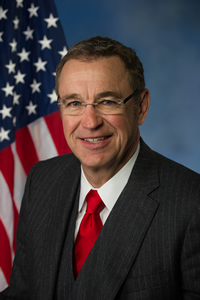
Rep. Matt Salmon (AZ-05)

Rep. Matt Salmon (AZ-05)

(Source:  sonorannews.com via Dan Robinson)

WASHINGTON, D.C.—Rep. Matt Salmon (AZ-05) announced the eighth Shrink our Spending Initiative bill focused on highlighting and cutting wasteful, taxpayer-funded programs. Upon introduction of his latest bill to eliminate federal funding for Voice of America, Salmon released the following statement:

“My eighth SOS bill is aimed at cutting yet another duplicative, federal program and saving you 212 million dollars by doing so. While originally commissioned to provide a ‘clear and effective presentation’ of U.S. policy, Voice of America (VOA) has veered from its original mission and become a government-funded news outlet. The United States already funds organizations that disseminate unfiltered news to regions of the world that lack a free press.

“Technology has also rendered Cold War relics, such as VOA, obsolete. The rise of the Internet and social media, especially in closed countries have connected the world in ways we could have never imagined, and with their success, and other U.S. taxpayer-funded broadcasting programs, it makes fiscal sense to eliminate this superfluous, federally-funded entity.”[…]

Click here to read the full article.

Click here if you would like to contact Rep. Matt Salmon.

VOA to increase broadcasts to Burundi

voa logoMauno Ritola shared the following message on the WRTH Facebook page this morning:

VOA Boosts Broadcasts to Burundi as Civilians Flee Political Violence

Monday through Friday:

  • 0400-0530: 7350 kHz, 9815 kHz, 11905 kHz

  • 1600-1630: 13630 kHz, 15460 kHz, 17530 kHz

  • 1930-2000: 9470kHz, 11615 kHz, 12140 kHz

Mauno also notes that the late evening frequencies are incorrect in the following VOA news release:

(Source: VOA News)

Voice of America today began boosting broadcasts to Burundi where at least 14 people have been and killed and more than 200 injured in protests against President Pierre Nkurunziza running for a third term.

VOA has additional shortwave and FM broadcasts in Kirundi, Kinyarwanda, Kiswahili, French, and English with an expanded call-in show, more reporting from the ground, and new drive-time newscasts.

“At this critical moment for democracy in Burundi, we are stepping up to keep our audiences informed, “ says VOA Director David Ensor. “Voters deserve to know what is going on with presidential elections just one month away.”

The African Union and the United States say the Nkurunziza candidacy violates a regional peace deal that ended civil war in 2005. U.S. Secretary of State John Kerry says the president’s move “flies directly in the face of the constitution of his country.”

President Nkurunziza says he is exempt from the two-term limit because his first term was chosen by parliament.

VOA is one of the last remaining sources of news in Burundi after authorities blocked access to social media, closed Radio Publique Africane, and suspended relay transmissions for two other independently owned stations — Bonesha FM and Isanganiro.

The Committee to Protect Journalists condemns this harassment and says the Nkurunziza government is “blatantly trying to gag” coverage of its opponents.

VOA is adding reporters in Burundi and Rwanda along with additional staff in Washington D.C., where its U.S. government-funded transmissions originate.

Daily broadcasts air on 95.2 FM and 94.9 FM in Bujumbura and on 104.3 FM in Kigali.

There are new VOA shortwave broadcasts from 04:00 to 05:30 UTC and from 19:30 to 20:00 UTC on 7350 kHz, 9815 kHz, and 11905 kHz; and from 16:00 to 16:30 UTC on 13630 kHz, 15460 kHz, and 17530 kHz.

“With thousands of Burundians fleeing to neighboring Rwanda, Tanzania and the Democratic Republic of Congo, VOA is committed to providing accurate and reliable news to this critical region,” says Ensor.


VOA director David Ensor steps down

(Source: NY Times)

David Ensor (Source: BBG)

David Ensor (Source: BBG)

David Ensor, who as director of the Voice of America has presided over significant growth in the news agency’s audience despite budget cuts, announced Tuesday that he was stepping down.

Mr. Ensor, who joined the Voice of America in June 2011, said he would leave the government-funded broadcaster at the end of next month. He did not explain his decision or discuss his plans.

The Broadcasting Board of Governors, which oversees the Voice of America, credited Mr. Ensor with creating new television programming in Russian, Ukrainian, Persian, Mandarin, Burmese and Creole, among other languages. It also said he had led a digital transformation of the agency’s newsroom and expanded media programs in Africa.

[…]His time at the news agency has not been without controversy. Dan Robinson, the former chief White House correspondent for the Voice of America, said its central news operation had been devastated by staffing cuts, and he and other former employees said a number of veteran correspondents had resigned or retired in frustration. [Continue reading…]

CRI, RFA, Sputnik, and the BBC: an “information battle?”

Radio-Dial-Blurred-Dark

Many thanks to SWLing Post contributor, Richard Cuff, for sharing this article from The National:

Radio wars: information battle heats up as Russia and China muscle in

For about 70 years it was the base of the BBC World Service. Bush House, with its grand marble entrance in central London, stood as a powerful symbol of the BBC, home to the short-wave radio services that delivered news to dozens of countries in more than 40 languages. But the lights went out in 2012 when the World Service moved to the more prosaic Broadcasting House; two years later it lost its annual £245 million (Dh1.341 billion) grant from the UK’s government.

Both changes are symptomatic of the BBC’s less certain place in the broadcasting world as other countries significantly ramp up recruitment and funding for their own equivalent services.

Last December, Peter Horrocks, the BBC World Service’s former director, warned that the West was losing the “information war” with Moscow as the old Cold War foe pumped out wave after wave of pro-Kremlin propaganda on its rapidly expanding radio, TV and online platforms.

Horrocks had called for a rethink on financial assistance from the UK government as, even before the grant was ended, cutbacks in 2011 forced the closure of five language services and some short-wave broadcasts.

“We are being financially outgunned by Russia and the Chinese. Medium to long term there has to be an anxiety about the spending of others compared to what the BBC are putting into it,” he said.

It is now all too clear that established broadcasters that are based in the West, such as Radio Free Asia, Voice of America (VOA), Radio Free Europe (RFE) – funded mainly through an agency of the US government – and the BBC are facing increased competition. Last November, Moscow rebranded its international English-language radio service: Radio Sputnik replaced the Voice of Russia and funding was increased for a new state-owned global news agency, Rossiya Segodnya.

Meanwhile, Beijing’s China Radio International (CRI) is an important part of the Communist Party’s foreign policy. CRI uses internet, short wave and satellite to broadcast around the world in dozens of languages, while Radio Sputnik has ambitions to broadcast in 30 languages across more than 130 countries by the end of the year.[…]

Continue reading on The National website…