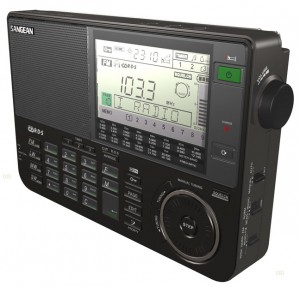
 Universal Radio is now selling the Sangean ATS-909X with a black case. Pricing is the same as the silver case ($259 US).
For more information and reviews of the Sangean ATS-909X, please check it out in our Shortwave Radio Index (SWRI).

Universal Radio is now selling the Sangean ATS-909X with a black case. Pricing is the same as the silver case ($259 US).
For more information and reviews of the Sangean ATS-909X, please check it out in our Shortwave Radio Index (SWRI).
In Emergency Preparedness Part 1: Choosing the right radios, we focused on various types of radios you should consider having on hand in times of disaster. This section focuses on other aspects of emergency preparedness.
Of course, there’s more to the art of being prepared than simply purchasing a few radios. Being prepared is about having enough supplies, making a plan, and knowing how to get in touch with family/friends, where to meet and what to do should you lose contact. Fortunately, a great percentage of the time, being prepared is about dealing with a few days–not months–of difficult conditions.
What I’m trying to say is, don’t feel like you have to spend a lot of money stock-piling months of food, or buy several bricks of gold to bury at your house (hate to burst your bubble, but gold is, unfortunately, a rotten investment).
Don’t feel like there’s a financial barrier to being prepared, either. It’s easy, and you can gather everything you need in one day.

I find that the Federal Emergency Management Agency (FEMA) has a well thought-through list of items you should have in your preparedness “kit.” I have listed them below (courtesy of FEMA) and included my own comments under some of the suggestions.
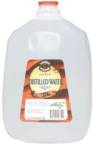
Distilled water is inexpensive and very easy to store.
Water, one gallon of water per person per day for at least three days, for drinking and sanitation
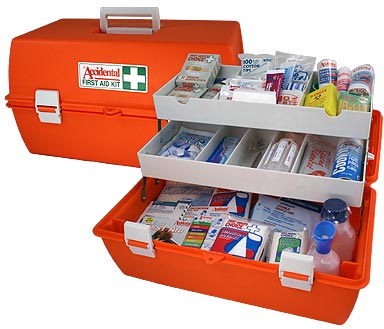
A first aid kit is a must–make sure to include any specific medications family members may need
 Other recommendations I would add
 Being prepared, as I said earlier, is more than just having supplies. It’s about being prepared mentally and having your close family and friends on the same page should disaster strike. Also, you should be well aware of how things are handled locally.
This is, perhaps, one of the longest posts I’ve ever written on the SWLing Post; you can probably tell that I’m an advocate of preparedness. I hope I’ve shown you that there’s a lot to think about prior to a disaster, whether natural or man-made. It’s not expensive to prepare, but does take a bit of dedicated time and energy. Once you you do it, though, I promise that you will feel better prepared and more secure than before. And one more thing: once you’ve taken care of your own or your family’s needs, please be prepared to help others however you can–sharing and caring is part of any disaster recovery process.
Today is the 10th anniversary of the 9/11 terrorist attacks here in the US; also, here in the US, September is National Preparedness Month.
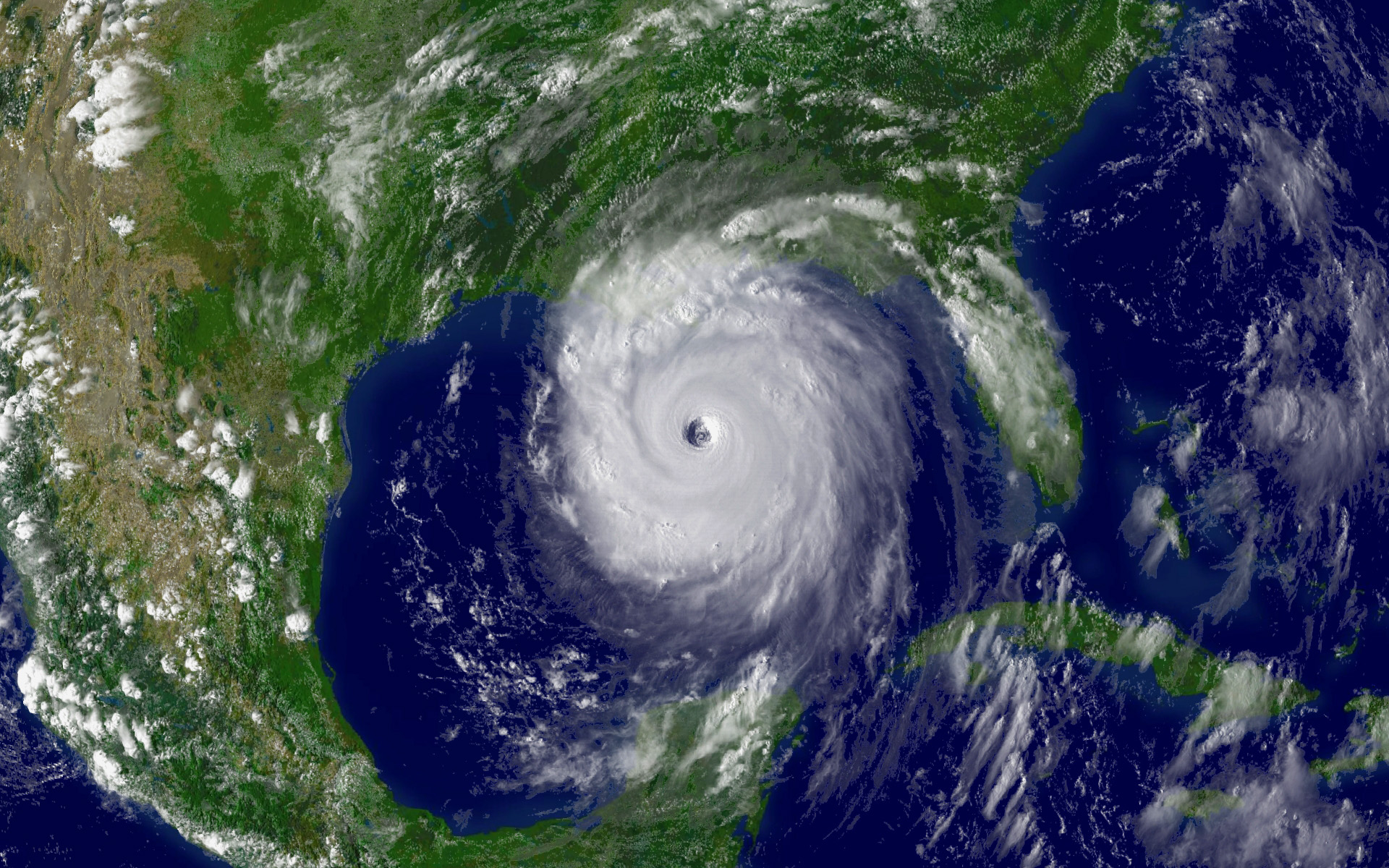
Hurricane Katrina (photo source: NOAA)
These two facts, coming as they do on the heels of several recent natural disasters in the US (hurricane, flooding, fires, an earthquake) have meant that I’ve received several inquiries about what radios (and supplies) are best for emergency preparedness.
So, I’ve decided to offer a comprehensive guide to preparedness. It includes specific suggestions for radios and other supplies (food, medical, etc.) one should have in stock in case of an emergency.
This is a lot of information, so I have broken it down into two posts:
 I’m no preparedness expert–and I’m certainly not a devotee of apocalyptic thinking–but in the rural area where I live, in a passive solar home, preparedness is an everyday fact. Power from the grid goes out here frequently, and when it snows, we can be stuck out here for a day or two at least. When weather or other problems occur, as they invariably do, we’re guided by the three emergen-Cs: we simply stay calm, use common sense, and solve any problems creatively. We keep several days of food in stock, have on hand emergency lighting, a generator (which we regularly maintenance), and spare fuel for the generator; meanwhile, my ham radio station can run on a fully-charged battery bank for days. Our refrigerator and freezer are solar-powered with battery back-up as well. When the power goes out, we may notice it, but only just.
We also believe in helping the neighbors whenever we can. Oh, and a sense of humor helps keeps things in perspective.
As this thought-provoking video points out, no matter where you live in the world, communication is one of the most important ways you can maintain control when the world around you is out of control.
What type of radio do you need? More than one type, in my view, if you can afford them. At a minimum, you should keep on hand the following:
 Below, I’ve laid out what I consider to be the best self-powered radios on the market today. Note that many of these radios cannot receive on shortwave, but do receive AM/FM and NOAA frequencies (NOAA weather frequencies are only helpful in the USA, please remember). During natural disasters or in times of emergency, local AM and FM stations tend to be more information-relevant than international broadcasters on shortwave. Of course, I believe you should have a shortwave radio on hand as well, so I have also provided a list of self-powered shortwave radios.
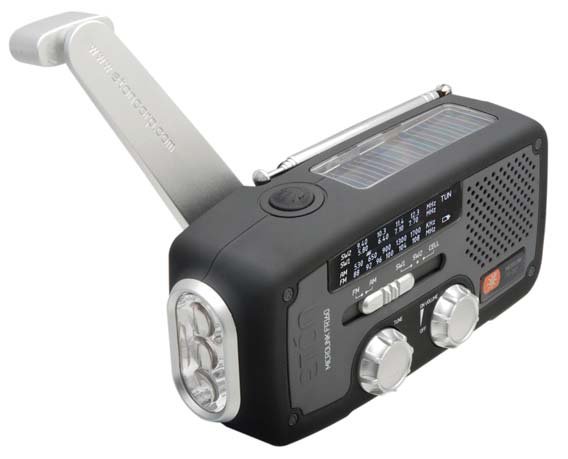
The Eton FR160 self-powered AM/FM weather radio with USB charger
Self-powered AM/FM NOAA weather radios
The Eton FR160 ($30-40 US)
The Eton FR160 is a durable, portable hand-crank and solar powered AM/FM Weather Band radio. It’s quite easy to use and does a fine job tuning in local stations including NOAA weather radio (you can chose from a selection of all seven frequencies). The FR160 has another very useful feature–you can connect any USB-based charger into its built in USB port and use the radio’s hand crank to charge your cell phone or other portable USB device–very cool! Be aware that it takes a lot of cranking to charge a typical cell phone enough for a 5 minute phone call, but in an emergency, it’s worth the trouble. The built-in LED flashlight is also very bright and lasts a long time on 2 minutes of cranking. The solar panel is adequate for charging the radio or for playing it (in full sunlight).
Purchase the FR160 from:
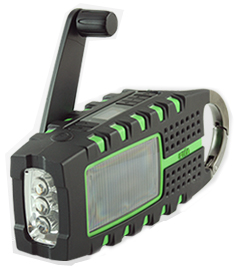
The Eton Scorpion self-powered AM/FM Weather radio with built-in caribbeaner and bottle opener!
The Eton Scorpion ($50-60 US)
The Eton Scorpion is very similar to the FR160, but has the added features of an auxiliary line-in input, a larger solar panel, and is splash-proof. The Scorpion has an aluminum carabineer to attach it to your belt or pack, a bottle opener, and is overall a very rugged device, so is ideal for camping, too.
Purchase the Scorpion from:
Eton Corporation also produces the Axis and Rover–I have never used these, but assume they would be worth considering. Eton is certainly the king of self-powered radio technologies and produces many of their radios branded with the Red Cross. They’re sturdy and effective. I know of no self-powered weather band radios as reliable as those produced by Eton.
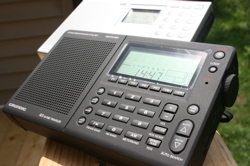
The Grundig G3 or Sony ICF-SW7600GR (in background) are both reliable and have excellent SSB reception.
Shortwave radios
I strongly recommend you have a capable, full-fledged digital shortwave radio tucked away for emergencies. If you already own one, just make sure you always have fresh batteries for it standing by.
What radio, specifically, am I talking about? Basically any radio I have listed on our main reviews page that has SSB capabilities. With SSB, you can tune to the ham radio bands and listen to information which amateur radio operators (both locally, and across the globe) are sharing. If you’re riding out a hurricane (or living in the aftermath of one, such as Hurricane Katrina) SATERN or the Hurricane Watch Net could provide invaluable, immediate and practical information for your situation. You will need SSB to hear them. I actually wrote a tutorial on listening to hurricane watch nets here.
Here are a selection of radios I would recommend:
While these radios lack SSB and the advanced functionality of the modern digital portable, they can operate with the turn of the crank. This is great, just in case you forget to have a set of fresh batteries among your supplies. All of the radios below have excellent reception characteristics for an analog radio. Why did I only choose analog radios? Mainly because I have yet to find a self-powered digital shortwave radio that has the sensitivity of the analog ones, or the battery longevity. Digital radios look cool and are great for casual use, but I wouldn’t rely on one in an emergency. Stick with these analog units instead:
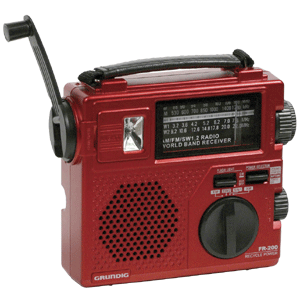
Still on the market as the Tecsun Green 88, this little self-powered radio packs a big punch.
Tecsun Green 88/Grundig FR200 ($25-35 US)
My all-time favorite self-powered shortwave radio is the Grundig FR200 or Tecsun Green 88. This radio used to be widely available as the Grundig FR200, but Grundig has since stopped producing it. The radio can, however, still be purchased by Tecsun Corporation from vendors in Honk Kong on eBay (link provided below).
What do I love about the Tecsun Green 88? It is:
I’m also very fond of several other self-powered shortwave radios, but none of them quite match up to the Tecsun Green 88 (Grundig FR200). I’ve listed a few below that are certainly worth considering.
Click here to read Emergency Preparedness Part 2: All the basics for emergencies.
I’ve often told people that radios should be some of the first things shipped to an area after a natural disaster. Why not food or medicine? Good question. HERE is the answer: information feeds us!
Click here to view if embedded video does not appear above.
 Great news for kit builders! Legendary company Heathkit has started manufacturing kits again. Though their first line-up of products do not include radios, they are planning to cater to the amateur radio community as soon as next year.
I would like to believe that the popularity of the Maker community has given Heathkit the ability to re-enter the growing kit building market (it has certainly given Radio Shack reason to continue carrying components).
Here is an announcement from Heathkit’s website:
Thank you for your overwhelming response to our announcement that Heathkit is back into the Do-it-Yourself kits business. We received many great suggestions for kits you would like to build.
We will be releasing Garage Parking Assistant kit (GPA-100) in late September and soon after the Wireless Swimming Pool Monitor kit will be available.
Based on your input, we are looking at developing amateur radio kits. Our goal is to have kits available by the end of year.
Please keep your suggestions coming so that we can continue to bring you interesting, unique Heathkit products.
Now is the time to let Heathkit know you that you want shortwave and amateur radio kits!
You can contact Heathkit at the following address:
Heathkit
2024 Hawthorne Avenue
St. Joseph, MI. 49085
(269) 925-6000 : Phone
(800) 253-0570 : Toll-free
(269) 925-2898 : Fax
[email protected]
DXing with Cumbre show 703 is now available for download.
DXing with Cumbre, for those of you who are not familiar, is an excellent program for anyone interested in the shortwave radio listening hobby. Best of all, it’s free to everyone!
Click here to download and listen to DXing with Cumbre show 703.
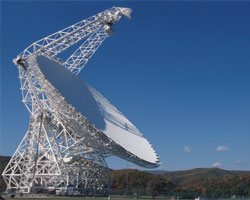
The massive Green Bank Telescope will be listening for CW tuned to put the asteroid's echo at a constant 2380 MHz (Photo Source: NRAO / AUI / NSF)
The excellent Southgate ARC has posted information on receiving signals that the Arecibo Observatory, the Deep Space Network Goldstone facility, the Green Bank Telescope and the Very Long Baseline Array will be bouncing off of the near-Earth asteroid 2005 YU55.
The asteroid will be making a 0.85 lunar distance flyby of Earth on November 8.
While the listening frequencies are well above the HF (shortwave) spectrum, many of you may have wide-band receivers or ham radio equipment that could tune in the signals. So, apologies for this slightly off-topic post. The amateur radio astronomer in me couldn’t help but promote this rather cool and unique opportunity.
From Southgate ARC:
Because YU55 will be so close to Earth, its radar echo will be detectable with even small antennas (~1 m^2). YU55’s echo will be a slowly drifting signal with a bandwidth of ~1 Hz within a few kHz of 2380 MHz or 8560 MHz.
[…]On November 8, 2011, 19:15 – 19:30 UTC, Arecibo will be transmitting a continuous wave tuned to put the asteroid’s echo at a constant 2380.000000 MHz at the Green Bank Telescope. Observers elsewhere on Earth will see the echo within 2 kHz of 2380 MHz, Doppler-shifted by the Earth’s rotation. It will be slowly drifting in frequency and have a bandwidth of ~0.6 Hz.
On November 9, 2011, 01:30 – 02:00 UTC, the Goldstone Deep Space Network facility will be be transmitting a continuous wave tuned to put the asteroid’s echo a constant 8560.000000 MHz at a second antenna at the Goldstone site. Other observers may see the echo shifted by as much as 6 kHz, and it will have a bandwidth of ~2 Hz.