Author Archives: Thomas

B14 broadcast schedules published

SX-99-DialThe new B14 shortwave broadcast schedule started on Sunday, 26 October 2014. You might have noticed that many online resources are in the process of updating schedules.

If you need up-to-date schedules in the meantime:

Happy listening!

Halloween = Pirate Radio

Haloween-Pirate-RadioHalloween is typically the most active day of the year for shortwave pirates…so, here are two things you’ll want to do this Halloween (tonight):

1.

Check out Andrew Yoder’s pirate radio blog with its deceptively simple title, the Hobby Broadcasting blog.

Halloween

Andrew is the author of the Pirate Radio Annual and a guru on shortwave pirate radio. His blog is still relatively new, but he has already posted several station loggings and QSLs. He’s even logged some Halloween stations, as Halloween began last night in Universal Time.

2.

Like Andrew, listen for pirate radio stations today and throughout the weekend!  Turn on your radio anytime today, but especially around twilight and tune between 6,920 – 6,980 kHz. Pirates broadcast on both AM and SSB; you’re bound to hear a few. If you’re brand new to pirate radio listening, you might read my pirate radio primer by clicking here. I will be listening until late in the evening–of course, I’ll also be listening to the Global 24 sign on.

Happy Halloween to all! 

Fire at Radio France building in Paris

Many thanks to SWLing Post reader, @K7al_L3afta, for sharing news that the top floors of the Radio France broadcasting house were on fire this morning:

You can read more about the fire, in English, via Reuters:

A fire broke out at France’s public radio headquarters in Paris on Friday, forcing live programmes off the air as staff evacuated the vast Paris complex where major building work has been underway.

“The fire is not put out but it is under control,” said Paris fire brigade spokesman Gabriel Plus, adding that there were no victims and that there was no longer any risk of the fire spreading to other parts of the building.[…]

Continue reading…

Fortunately, it seems all staff were evacuated and there have been no casualties noted at this point. Time will tell if this has a temporary effect on Radio France International programming.

UPDATE: Jonathan Marks comments, “Unlikely that RFI will be affected as they have moved out of the Maison de la Radio and into the same offices as France 24 a little bit further down the river.”

Thanks, Jonathan!

Global 24 Program List

Global24Many thanks to the Global 24 Radio team for notifying me that they’ve posted their initial programming. I posted the full list below, but you should also check the Global 24 website as they’re making frequent additions.

As a reminder: Global 24 Radio begins broadcasting tomorrow, October 31, 2014, beginning at 2300 UTC on 9,395 KHz.

(Source: Global 24 Radio)

Programs

News:

Feature Story News  – Top of the Hour News
European News Network – Top of the Hour News, Breaking News, Weekly News Review
Global 24 Breaking News –  Top of the Hour News, Developing News, Live News Feeds
Focus Asia Pacific – Daily News from the Pacific

International Relays:

  • Radio France International
  • Channel Africa
  • Voice of Russia
  • World Radio Network

Music:

  • Jazz from the Left – 3 Hours of Weekly Jazz with Raoul van Hall
  • The Rock Pile – 2 Hours of Weekly Classical with Raoul van Hall
  • Jazz for the Asking – 1 Hour of Weekly Jazz with Keith Perron
  • Blues Radio International – 30 Minutes of Weekly Blues with Jesse Finkelstein
  • Song of India – 1 Hour of Weekly Music for the Indian Subcontinent
  • Global Music & Turkish Talent Box –  1 Hour Weekly of International “Trending”
  • Global Music
  • Classical Worldwide on Shortwave – 3 Hours of Weekly Classical Music with Jeffrey Bowman

Easy Listening:

  • The Rendez-Vous  – 3 Hours Weekly of Music, News & Information
  • The Happy Station Show –  1 Hour Weekly of Music & More with Keith Perron
  • Switzlerland in Sound  –  30 Minutes Weekly with Bob Zanotti
  • Old Time Radio Favorites – Comedy

Drama:

  • Global 24 Present’s Shakespeare on Shortwave

Perspective:

  • The Kelly Alexander Show – 1 Hour Weekly of Current Events & Issues for Women
  • Peace Talks Radio – 1 Hour Weekly of Content from Peter Ingles (NPR)
  • Sons of Liberty – Daily Syndicated Broadcast with Bradlee Dean
  • The Stuph File – 1 Hour Weekly of Odd, Off-the-Wall fun stuff with Peter Anthony Holder

Science:

  • Exploration – 1 Hour Weekly with Dr. Michio Kaku

Radio:

  • Global 24 Daily Mailbag – 30 Minutes Daily of Listener Comments, Feedback and
  • Reception Reports
  • This Week in Ham Radio – 30 Minutes Weekly of Ham Radio “On Air” Events
  • World of Radio – 30 Minutes Weekly of Radio News with Glenn Hauser
  • Survival Radio – 30 Minutes of Weekly of Radio Information for Preppers & Planners
  • Viva Miami – 30 Minutes Weekly of Listener Comments and More with Jeff White, GM of WRMI
  • Media Network Plus –  30 or 60 Minutes Weekly with Keith Perron

Survival, Homesteading & Off the Grid Living

(Announcements Pending)

Tecsun PL-380: Displaying temperature in Fahrenheit

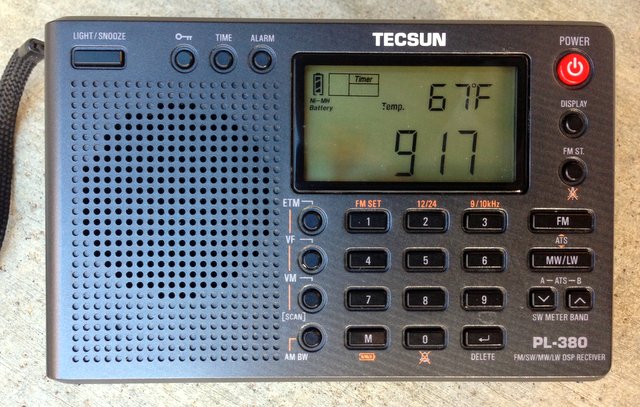
Tecsun-PL380-Temperature

I have owned the Tecsun PL-380 for years now. When my buddy Mike (K8RAT) recently asked if the temperature display could be switched from Celsius to Fahrenheit, I gave him a firm “no” as a response.

A few hours later, Mike wrote back:

“Just found out that the PL -380 will toggle between F and C temperature reading. Push and hold the “3” button with radio turned off. Cool!”

I just tried it and, as you can see, it works brilliantly. Thanks, Mike!

(Note to self: Start responding to this sort of inquiry with a softer “no” in the future!)

PortableSDR: The Holy Grail of portable SDR transceivers?

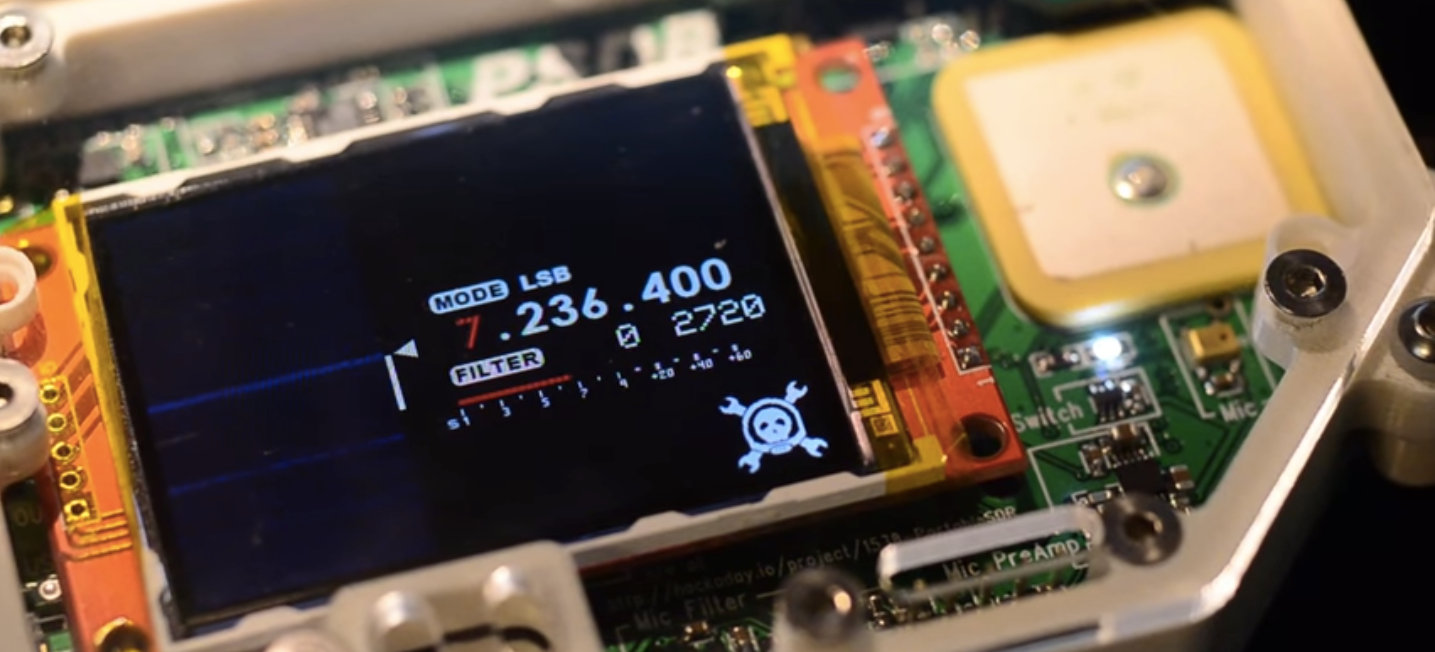
PortableSDRMany thanks to my buddy, Bennett Kobb (AK4AV), who shares information about the PortableSDR, one of five finalists in The Hackaday Prize.

PortableSDR creator, Michael R Colton, describes his project on Hackaday:

“The PSDR is a completely stand-alone (no computer needed), compact, Portable Software Defined Transceiver (hence the name, sorta). Originally designed for backpacking use by Ham Radio operators. It includes complete coverage up to about 30Mhz (plus 144Mhz), it has a 168Mhz ARM processor, color display, and an innovative interface.

Vector Network Analysis (which includes antenna analysis) and GPS functions are included.

The entire design is Open Source. The electronics are designed and laid out to be easy to understand and tinker with. In addition to source code, schematics, board layout and parts lists, articles and videos describing the theory of the design are being created.”

He includes this video of his working prototype:

I will certainly follow this project with interest. I love the fact that PortableSDR has such a small form factor, yet still manages to include room for a battery, display and CW paddles.

San Diego Elephant Cage scheduled for demolition

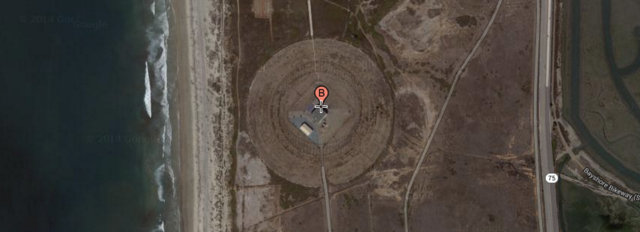
SanDiego

On the topic of Wullenweber antennas, SWLing Post reader, Mike, points to this article on U-T San Diego’s website:

Navy’s mysterious ‘elephant cage’ retired: Cold War-era structure a visual landmark on Silver Strand

Beachgoers will say goodbye this month to the “elephant cage” — the mysterious metal structure that has graced the south end of the Silver Strand for 50 years.

The Navy will demolish the circular cage-like contraption as part of an initiative to get rid of obsolete gear.

Officially known as the Wullenweber Antenna Array, the 1,300-foot-diameter structure was built in 1964.

Many details are shrouded in Cold War-era secrecy, Navy officials say.

[…]In simple terms, the huge circular antenna was used to intercept radio signals and detect which direction they came from.

With a range up to 3,200 nautical miles, the Silver Strand antenna likely monitored the Pacific Ocean and parts of Central and South America.

U.S. allies around the world also housed “elephant cages” during the Cold War.

One was located in the United Kingdom, to intercept signals originating from Warsaw Pact nations in Eastern Europe as well as portions of the former Soviet Union.

Another array, located in San Vito dei Norrnanni Air Station. ltaly, opened in 1960 to monitor areas of the Middle East.

Others were built in West Germany, the Philippines, Japan and Canada.

In order to preserve history, the Navy plans to keep the five tallest screens plus some guy wires and anchorage posts. It is also working on a digital 3-D model of the antenna.

Read the full article at U-T San Diego…