Category Archives: AM

GatesAir halts production of AM transmitters

GatesAir FLEXIVA 3DX AM transmitter (Source: GatesAir)

(Source: Radio World via Bill Patalon)

GatesAir is suspending the sale of new AM transmitters.

When a prominent radio engineer passed along word to Radio World that he’d sought a quote from the manufacturer on a new transmitter but was told the company had discontinued the model and was assessing its AM line, we sought to learn more.

Chief Product Officer Rich Redmond replied: “Recent changes in the long-term availability of critical components from our suppliers, including several last-time buy notices, have caused us to take proactive steps to ensure we can meet our continued support obligation of our AM products,” he said.

“To safeguard our ability to offer an ample supply of spare components — and to secure the ongoing field support of our AM transmitters — GatesAir has taken the responsible step of suspending new AM transmitter sales, and will instead focus on supporting existing customers’ transmitters with our available components.”[…]

Click here to read the full story at Radio World.

Guest Post: Radios I Have Known #2

Many thanks to SWLing Post contributor, Neil Goldstein, who shares the following guest post which originally appeared on his blog, Fofio:


Radios I Have Known #2 The old, the new, and the Select-A-Tenna

by Neil Goldstein

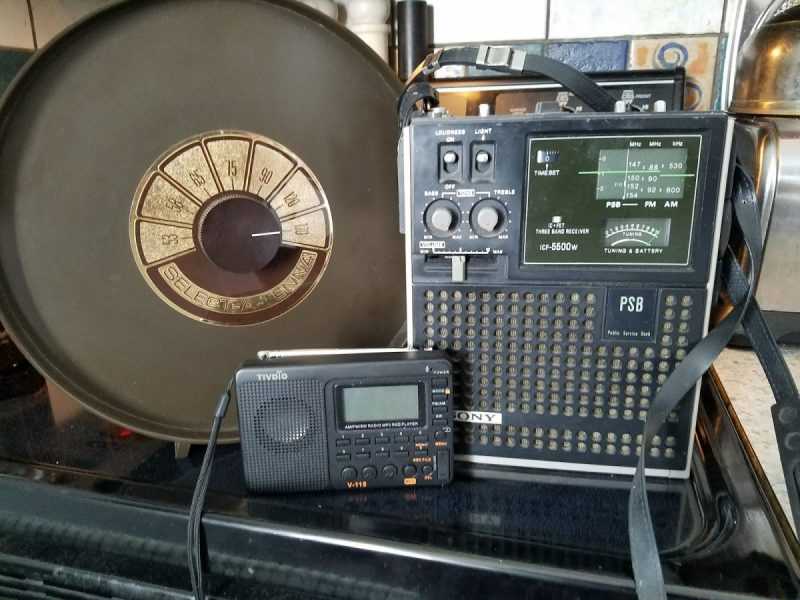
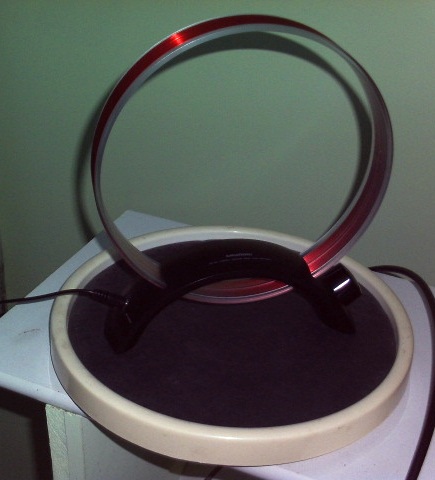
L-R: Select-A-Tenna, Tivdio V-115, Sony ICF-5500W

After promising this series a year and a half ago, I finally have started digging through the collection, and will start posting about once a week.  The radios, and accessories may not have anything in common (as seen in this post), but were all acquired because they were in some way interesting, or sentimental to me.  Here’s the first three:

Select-A-Tenna
One of the original air-core tunable AM antennas.  You just put this near the radio and peak it for reception.  I was watching for one of these in good shape, and not overpriced, and they have been in and out of production over the years.  This one is from a later production run as can be seen by the extended AM range (1700).  Jay Allen reviewed the S.A.T by comparing the the TERK Air Core antenna not long ago here:  https://radiojayallen.com/select-a-tenna-vs-terk-am-advantage/  The TERK reviewed well, and looks more modern, but I wanted the classic cheesy art-deco looking S.A.T.

Tivdio V-115
I won’t post a long, boring review here.  Many have already reviewed this radio.  All I can say is that if you like small, decent-sounding transistor radios, you will not be disappointed.  If you are expecting top-shelf performance, and perfect ergonomics, then you you may not be happy, but for around $19 you really should be happy with this little gem.  A great little radio at a great price and the most impressive thing here is the sound.  The radio has a small passive radiator like the Meloson M8, and M7, and really surprises me.  It can also be used as an amplified speaker, and has a micro SD slot for using it as a standalone MP3 player.  Grab one!

Sony ICF-5500W
Most transistor radio collectors know this radio.  It’s a classic for sure, but I have to give a little background on why I wanted one.  When I was about 12 years old, I had a few analog SW portables, but nothing with direct frequency readout.  Panasonic had introduced it’s series of direct-readout radios, the RF-2200, 2800, and 4800, and Sony was competing with the ICF-5900W.  Dad acknowledged the quality and technology of these radios, and told me that if I saved most of the money by working for him, he may help me get one.  The 2800, and 4800 were way out of reach, but one Sunday in the local paper, a department store in Kingston (Britt’s, which was Newberry’s answer to Macy’s) had the 2200 advertised for $138.88.  I had been flip-flopping between the Sony and the Panasonic for weeks, but that was the clincher.

The radio is still in use.  My sister in law has it.  I had given it to my late brother Paul at some point and she still uses it as her main radio.

Why this Sony though?  I still want a 5900W.  When I saw this one come up at an auction, I recognized the shape it was in.  The ICF-5500W was the companion radio to the 5900W.  AM/FM and VHF Hi (with a basic, but functional squelch control).  The 5500 and 5900 are a monument to Sony design at the time.  The pop-up antenna (which still works flawlessly), The separate Bass, Treble, and Loudness controls, The overall quality of sound and function, all of this is an example of what Sony was producing at the time.  I think their modern small electronics are a shadow of what they were capable of years ago.  This thing still sounds great and performs well next to my modern DSP radios.  I still would love to get a pristine 5900W but they usually fetch premium dollars.  Maybe someday.

Bravo Sony, but where did you go?

More to come!!


Thanks for sharing, Neil!  I, too, have the Tivdio V-115 and the Sony ICF-5900W.

The ‘5900W is a gem of a solid state receiver. It has brilliant AM broadcast band reception and rich audio. I need to open my ‘5900W and clean all of the contacts since some of the sliders are scratchy. It’ll make for a nice rainy day project!

We look forward to your next installment! Post Readers: be sure to check out Neil’s blog, Fofio!

The Sony ICF-M780SL: Peter catches some serious MW DX on Gran Canaria

Many thanks to SWLing Post contributor, Peter Wilson, for sharing the following guest post and DXpedition report:


Sony ICF-M780SL MWDX on Gran Canaria

by Peter Wilson

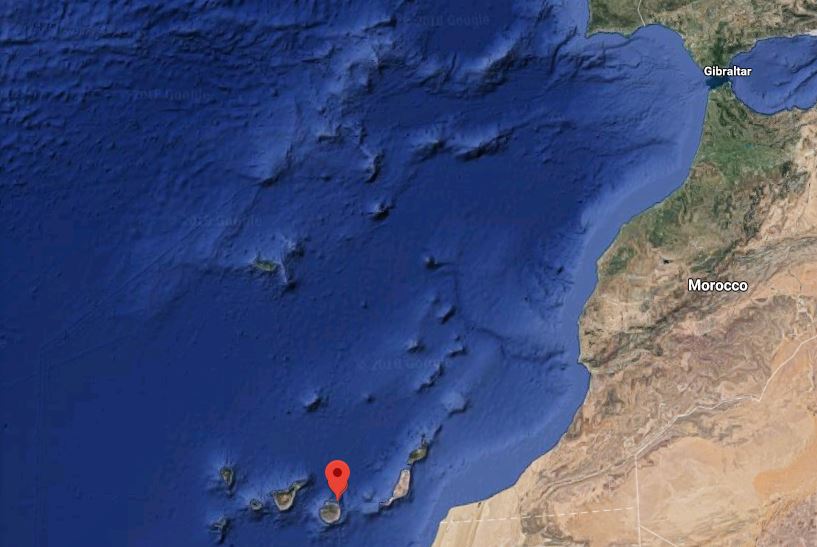
Las Palmas, Gran Canaria, Spain

I have spent the last two months in Las Palmas, Gran Canaria adjacent to the Atlantic Ocean.
I travelled light and didn’t bring my radio/SDR collection with me.

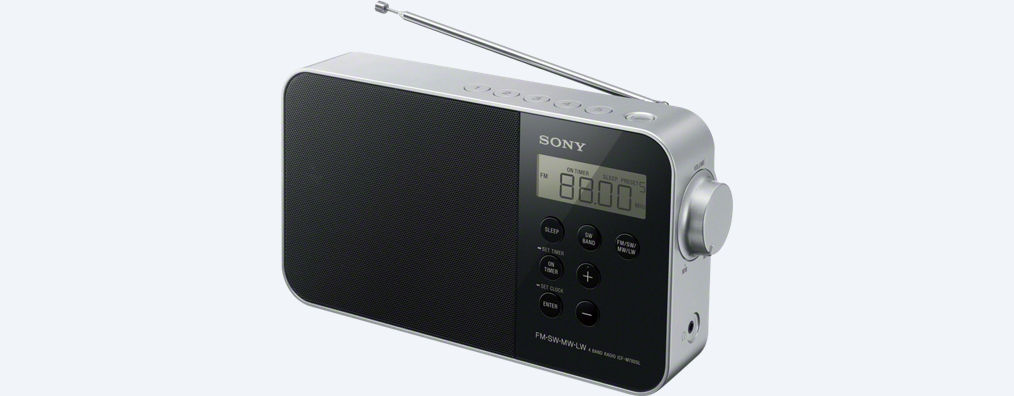
A portable I saw in a local department store caught ny eye, and I ended up buying one from a local electronics retailer which had it on special at €55. It is a Sony ICF-M780SL which as turned out, is something rather special. It is a four band (LW, MW, SW,FM) DSP receiver, with an AM IF (LW, MW,SW) of 45 kHz and an FM IF of 128 kHz.

There’s too much hash in my apartment block to use it at home, but as I am a couple of streets away from the Ocean I intended to use it there.

Problem is there almost as much RF hash at the oceanside as at home. Also the Atlantic breakers crash loudly on the shore, and the wind can howl quite loudly. I did have some limited success and have included a couple of clips.

I discovered a better DX location at a small Plaza a short distance inland from the Ocean. There is an early morning peak for MW TA leading up to about 07:30 UTC (= local time)

The radio is used barefoot in each clip. There is some camera hash.

Here are the highlights:

USA Transatlantic

1500 WFED booming with ID 5736 km

Click here to view on YouTube.

790 WAXY with ESPN Radio ID 6369 km

Click here to view on YouTube.

1540 KXEL 6935 km

Click here to view on YouTube.

1530 WCKY 6373 km

Click here to view on YouTube.

770 WABC 5459 km

Click here to view on YouTube.

1520 WWKB

ESPN Radio with sports talk. 5841 km

Click here to view on YouTube.

Ocean front around dusk

1350 TWR Armenia 5377 km

Click here to view on YouTube.

1521 Duba Saudi Arabia 5004 km

Click here to view on YouTube.

1458 Lyca Radio, Brookmans Park UK 2914 km

Click here to view on YouTube.

The Sony ICF-M780SL is a great MW/LW/FM performer. SW propagation has been mediocre and suffers from the RF hash QRN, so difficult to test.


Amazing, Peter! It’s hard for me to believe the reception you had of WFED (Federal News Radio). I listen to that station every time I go through the DC/Baltimore area and I think your reception is just as good. A TA crossing of almost 5,000 km with armchair copy! Quite an accomplishment!

Thank you for sharing your Gran Canaria DX with us. I’m pretty impressed with the Sony ICF-M780SL as well.

Post Readers: make sure you check out Peter’s YouTube channel by clicking here.

Click here to search Amazon.co.uk and click here to search eBay for the Sony ICF-M780SL.

The Lazy Susan: Mario’s mediumwave companion

Many thanks to SWLing Post contributor, Mario Filippi (N2HUN), who writes:

Grundig AN-200 Loop Antenna and Lzy SusanHere is a handy tip for those using small magnetic loops, like the Grundig AN-200. Using a simple Lazy Susan makes rotating the loop a lot easier as in the picture attached. It gives you a very smooth 360 degree rotation using a simple flip of a finger. Lazy Susans come in all sizes and luckily I had one already which fits the AN-200 perfectly.

This is a handy tip, indeed! In fact, I once spoke with a mediumwave DXer who told me that when he prepares for a DXpedition, he packs the Lazy Susan before he packs his portable’s batteries!

Lazy Susans are quite easy to find. Most “big box” retailers have them, Amazon.com has a massive inventory (affiliate link), IKEA and I’ve had incredible luck finding them at thrift stores for next to nothing! In fact, if you have a local thrift store with a large selection of kitchen accessories, you’ll likely find a Lazy Susan or two on the shelves.

Thank you for the tip, Mario!

iHeart “Prepares for Bankruptcy”

(Source: Bloomberg via Dave Zantow)

IHeart Prepares for Bankruptcy as Soon as This Weekend

Embattled IHeartMedia Inc. is circulating documents for a bankruptcy filing that could come as soon as this weekend for the biggest U.S. radio broadcaster.

Advisers to some of iHeart’s senior creditors have been shown bankruptcy papers that would be used on the first day of court proceedings, according to people with knowledge of the matter. Despite a year of negotiations on a restructuring plan, a formal support agreement still isn’t in place with the most-senior lenders, and the creditors aren’t in restricted talks with the company, said the people, who asked not to be identified discussing private negotiations. Creditors typically agree to restrict some of their activities in exchange for non-public information when talks heat up.

A bankruptcy filing is all but certain, with iHeart and creditors each swapping proposals in recent weeks for a consensual restructuring. But pressure is mounting on iHeart after it missed a Feb. 1 interest payment, with a 30-day grace period about to run out. On top of that, the broadcaster on Thursday skipped payments on two more sets of bonds. If the company files without a pre-negotiated restructuring plan in place, the bankruptcy could turn into a free-fall, with some of the biggest and most contentious specialists in distressed companies potentially tussling for years over about $20 billion of debt.[…]

Continue reading at Bloomberg…

A review of the Tivdio HR-11S self-powered shortwave radio

A few months ago, the radio manufacturer Tivdio contacted me to see if I would be interested in evaluating their new Tivdio HR-11S self-powered emergency radio. I receive requests like this frequently, and often pass on the opportunity since I generally don’t have the time to evaluate the overwhelming number of inexpensive DSP radios that have hit the market in the past few years.

But this time, I seriously considered it.  There were two reasons I was interested in the HR-11S:

  1. I purchased a Tivdio V-117 last year, and have been pretty pleased with it; indeed, I’m overdue a review on this unit. We’ve also posted several positive reviews of the Tivdio V-115.
  2. At our non-profit ETOW, we’re always looking for reliable self-powered radios with shortwave for use in areas of the world where radio remains the primary news source.

Thus this radio is a rather rare breed.  Tivdio dispatched the radio very quickly, but my work with the Radio Spectrum Archive and several other reviews already in the pipeline took priority.

I’ve had the HR-11S in service for several months, and have now explored every feature to some degree. What follows is my summary and review notes.

Green and Red radios are different models
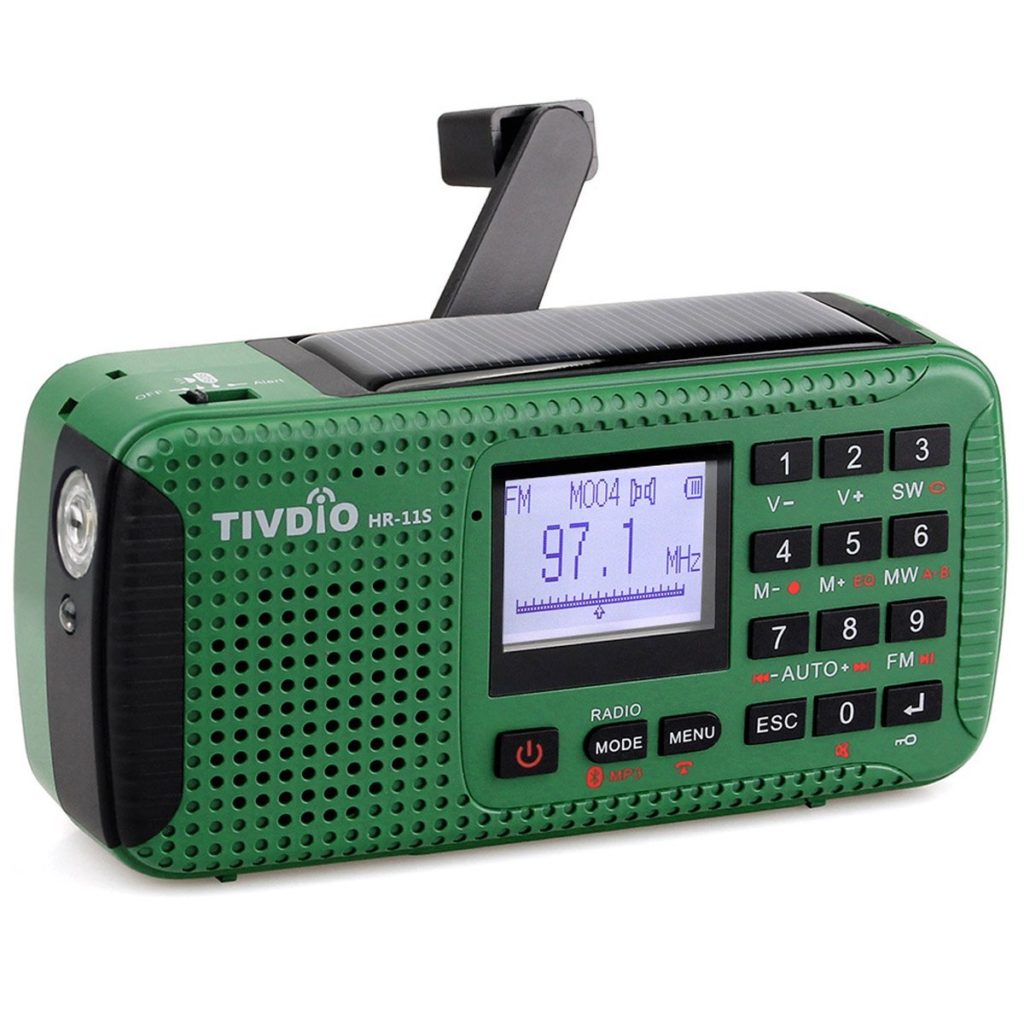
First things first: note that I’m reviewing the Green HR-11S. Tivdio also makes a Red version which is actually a different model number: the HR-11W.
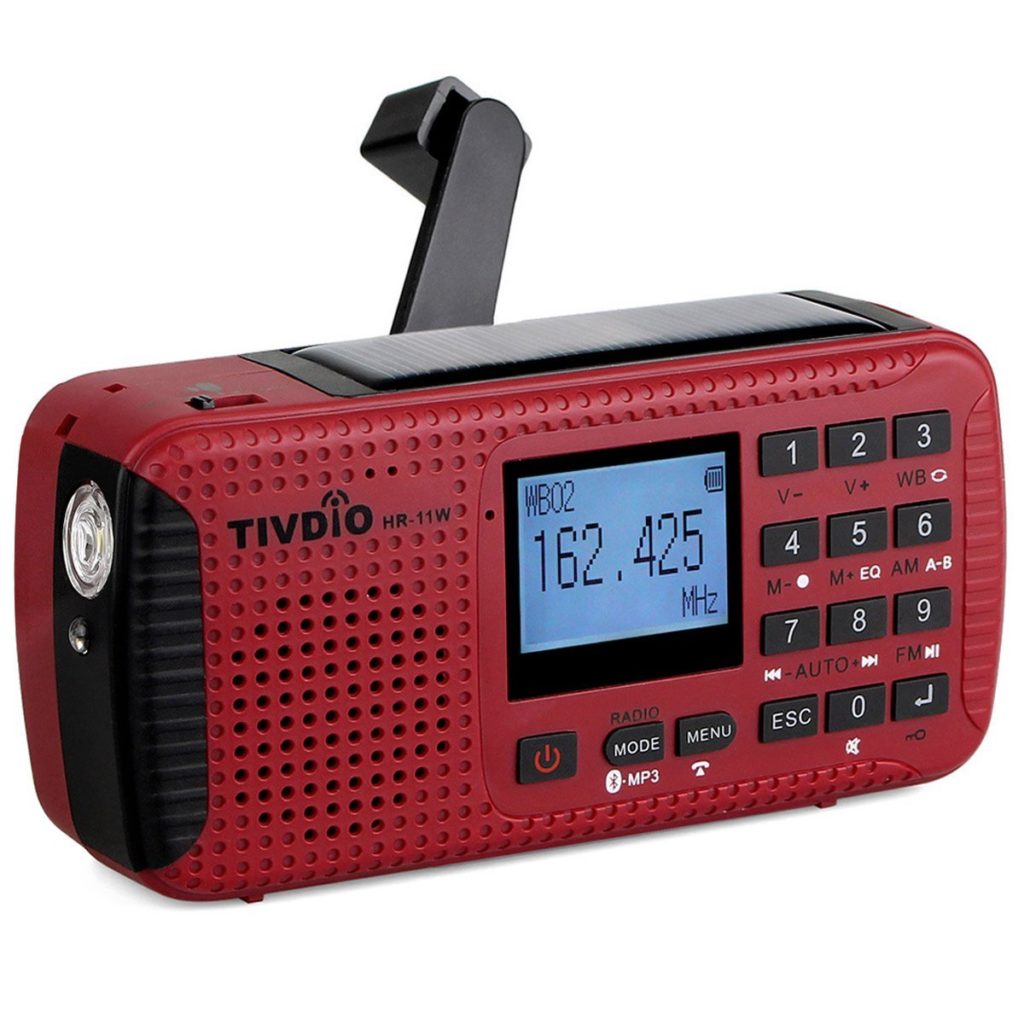
The main difference between these models, as I understand it, is the green HR-11S is a shortwave version, and the red HR-11W is a NOAA weather radio version.

Both are useful; why not combine the two roles in one unit?  I’m not surprised this radio can’t include both shortwave and NOAA weather radio. Through Ears To Our World, I’ve worked with self-powered DSP radios for many years, and know that a limitation of the DSP chip is that it can be set to feature either shortwave or weather radio, but not both, simultaneously, if both AM and FM are included.

Form factor
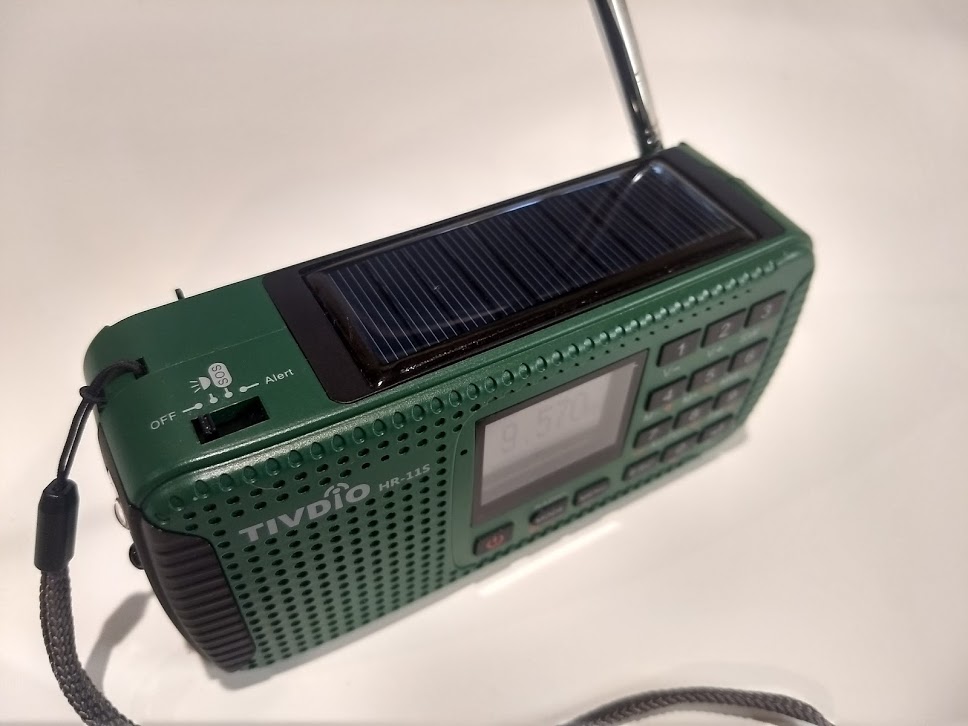
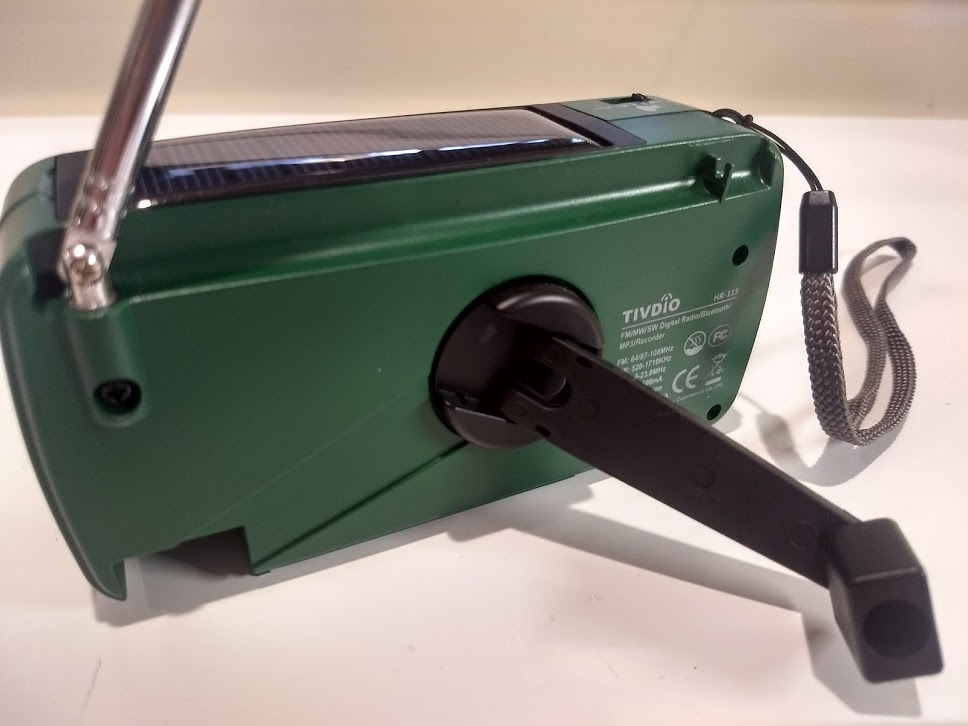
The HR-11S has a built-in solar panel.

The HR-11S adopts the standard “flashlight” form factor found in so many other self-powered radios. I think the flashlight functionality is a useful feature and results in a handy form factor.  It’s compact, lightweight, and seems relatively sturdy, so is suitable for camping, travel, and off-grid utility.

Flashlight/Siren switch

A small switch on top toggles between four positions. The first two positions are off/on for the main white LED. Though the flashlight aperture is relatively small, the white LED provides enough luminosity to light your immediate path at night, and certainly more than enough to read by.
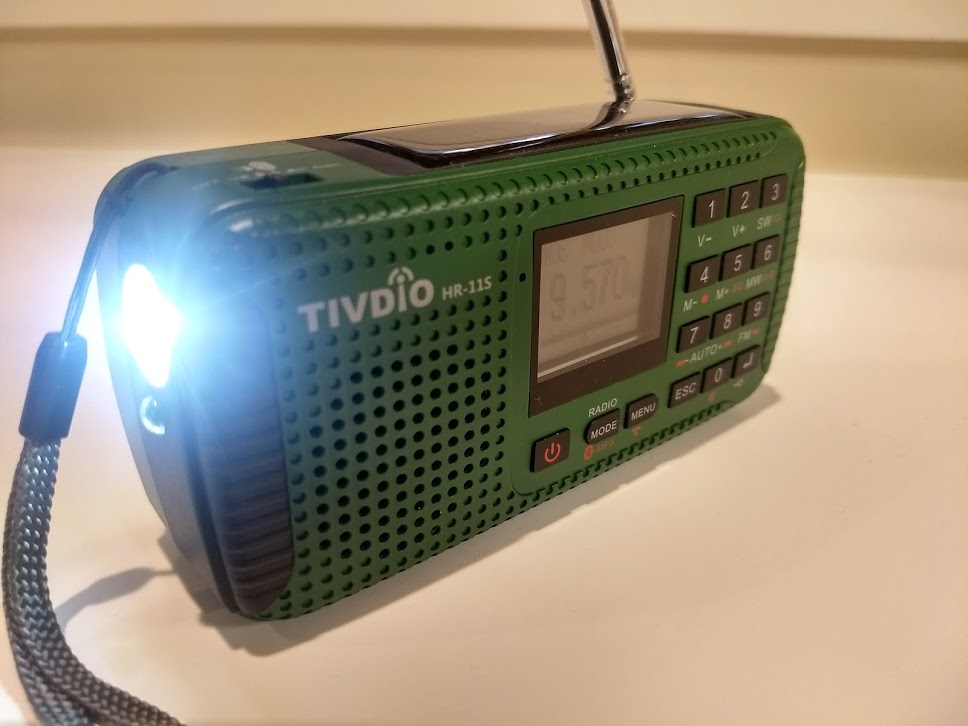
The third switch position engages a flashing red LED. The red LED is not terribly bright and I’m not sure how helpful this would be in an emergency situation.
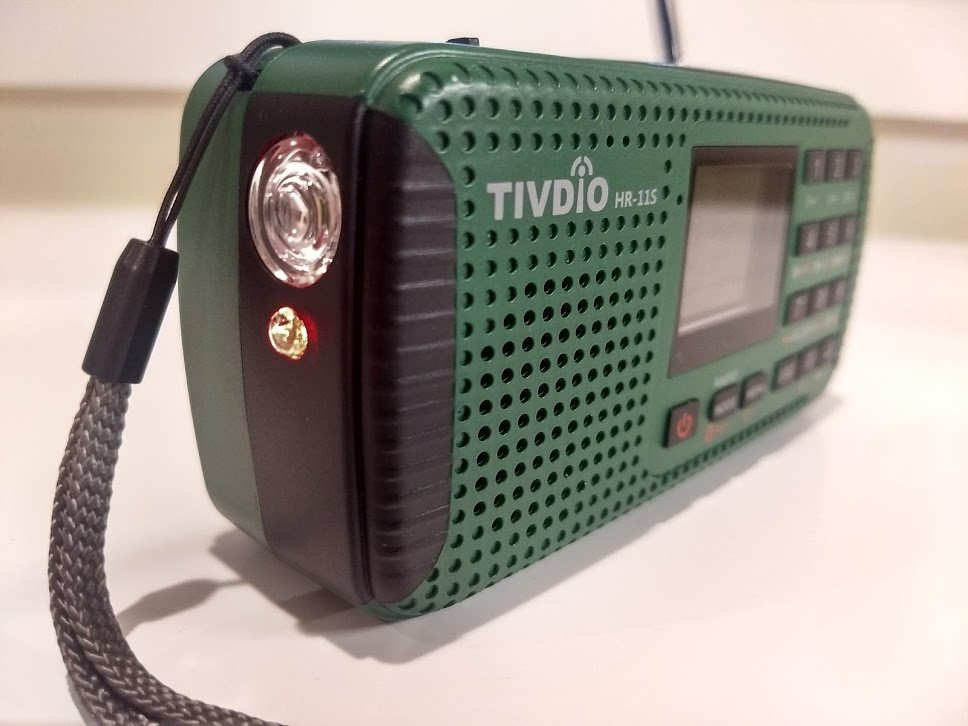
The red LED is rather dim and can only flash.

I would much rather have the red LED maintain a steady beam which would be great for amateur astronomers, campers, or anyone else wishing to preserve their night vision.

The fourth position engages a LOUD siren. More than once when attempting to turn on the flashlight in the dark, I’ve accidentally engaged this pain-inducing feature. The switch is small, thus it’s very easy to engage the siren. In a quiet campground, this might annoy your neighbors––not to mention you, yourself.  Of course, in an emergency situation, a loud siren could come in handy. I just wish its switch wasn’t combined with the flashlight switch.
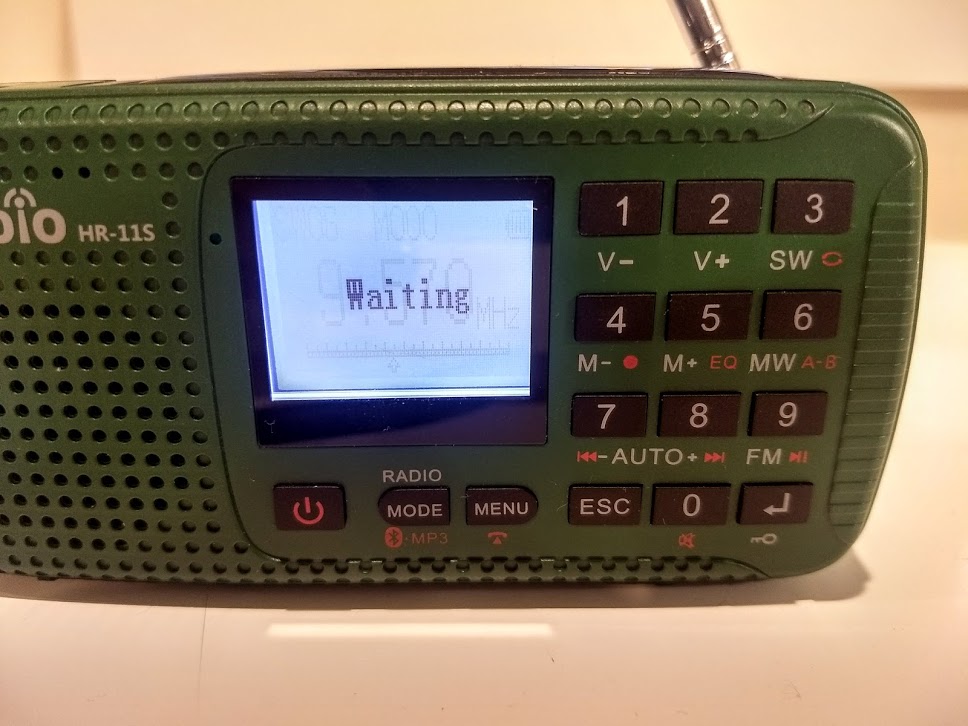
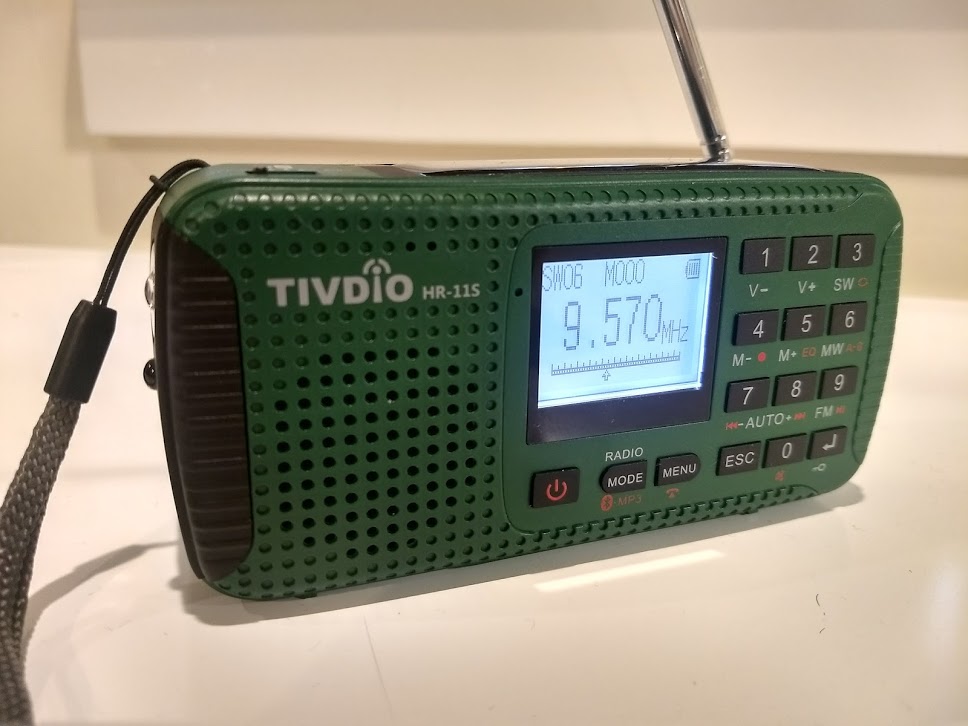
The display HR-11S display is backlit and easy to read.

The HR-11S sports a keypad that allows direct frequency input––a very good thing, considering there is no tuning knob.
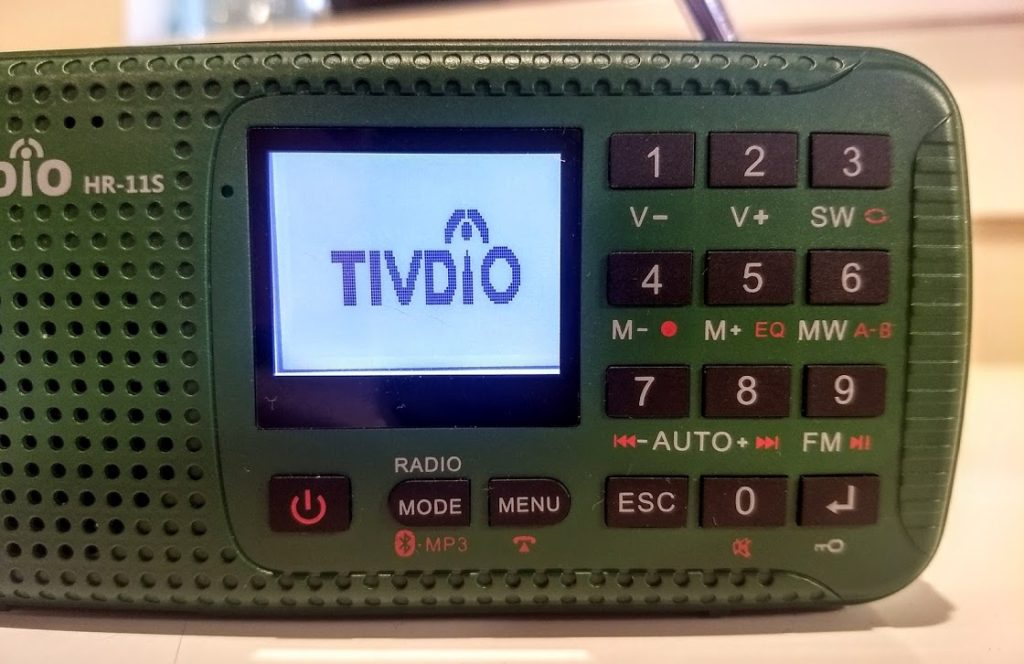
To band scan, you must use the #7 and #8 key on the keypad to increase and decrease frequency in predetermined steps. And, yes, the radio mutes between frequency changes.

You can also press and hold the #7 or #8 buttons to engage an auto-tune feature that finds the next strong signal.
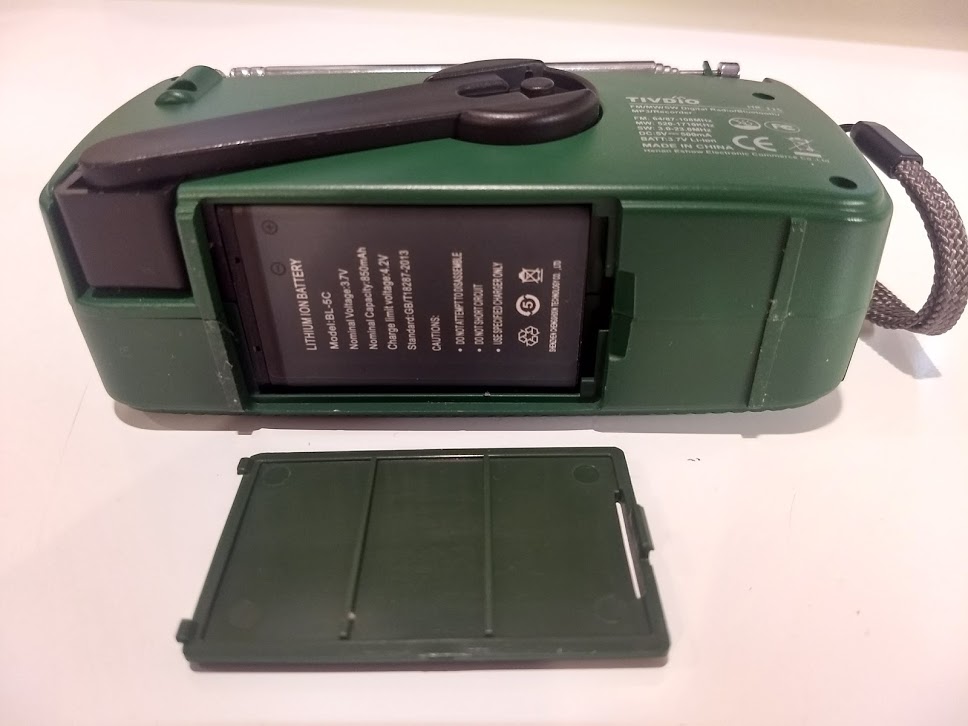
The HR-11S’ rechargeable battery pack.

To input a frequency directly, simply press the enter button, key in the frequency, then press the enter button once more to engage that frequency. Very simple.

The volume up/down buttons are #1 and #2 on the keypad.

The keypad is not backlit and the layout for volume control, tuning, mode switching, etc., is a bit confusing; it doesn’t match any other radio I’ve ever used.  Of course, with time you’ll master the keypad functions, but the design could be made more user-friendly.

Performance: setting expectations
SWLing Post community members know that I tend to review what I call “enthusiast grade” radios: receivers that perform well enough to attract the attention of DXers and dedicated listeners.

Self-powered radios, with few exceptions, rarely impress me in terms of performance. Indeed, some of the best that have been on the market have been analog units (I’m particularly fond of the Grundig FR200).
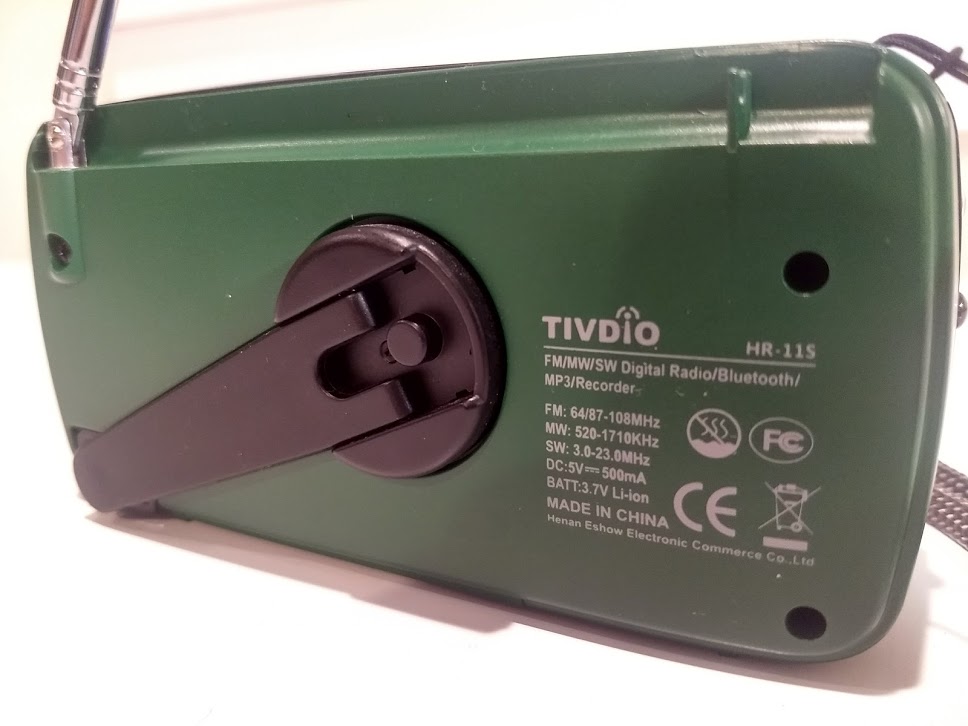
The Tivdio HR-11S is no exception––don’t expect to snag elusive DX with this unit. It’s not going to happen.

FM
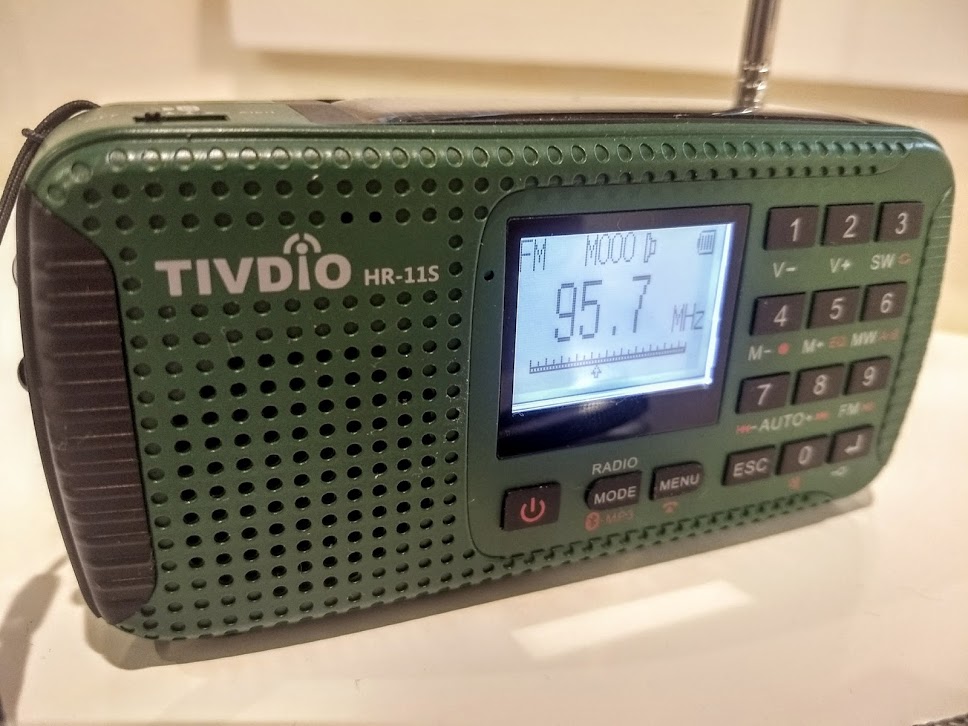
The HR-11S is a capable FM receiver. Performance is on par with most average FM radios: you’ll easily receive all of your local broadcasters, but distant stations may require holding the unit in your hand, careful positioning, or adding an extra bit of wire to the antenna.

The FM audio is quite good via the HR-11S’s built-in speaker.

AM
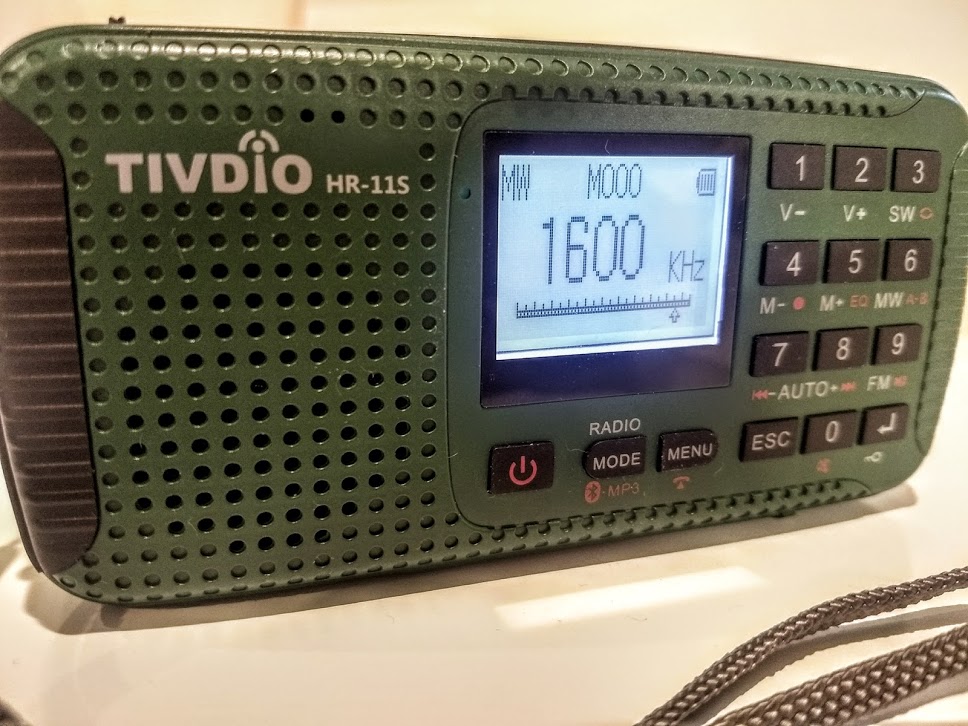
The mediumwave, or AM broadcast band, is the HR-11S’ weakest suit. AM is plagued with internally-generated noises–especially in the lower part of the band–thus you’ll only be able to clearly receive local AM broadcasters that rise well above the noise floor. Thus I cannot recommend this radio for AM reception.

Shortwave
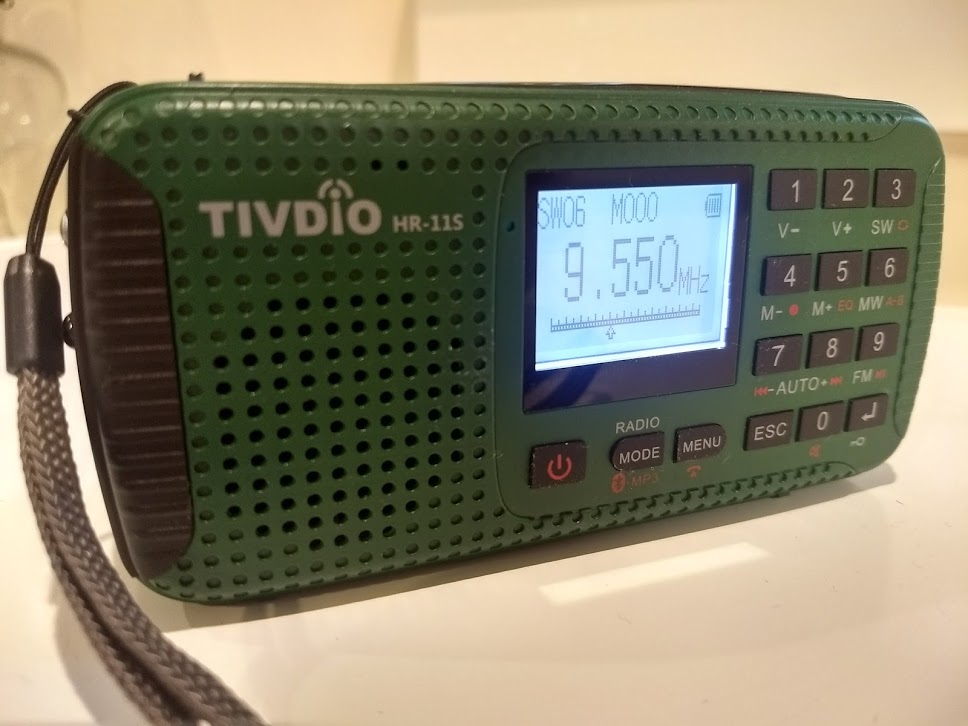
Shortwave reception is on par with other DSP self-powered radios I’ve tested. As I write this section of the review, I’m listening to China Radio International on 9,570 kHz in my office without even having the telescopic whip antenna extended. (CRI is a blowtorch station, however).

I find that the HR-11S can receive most strong broadcasters and even weaker stations, though the AGC is not ideal when fading is present.

If you’re seeking a self-powered radio with shortwave, the HR-11S is somewhat useful in this regard and is worth consideration.

Keep in mind, though, that an inexpensive dedicated ultralight shortwave radio like the Tecsun PL-310ET will perform circles around this unit.

Bluetooth
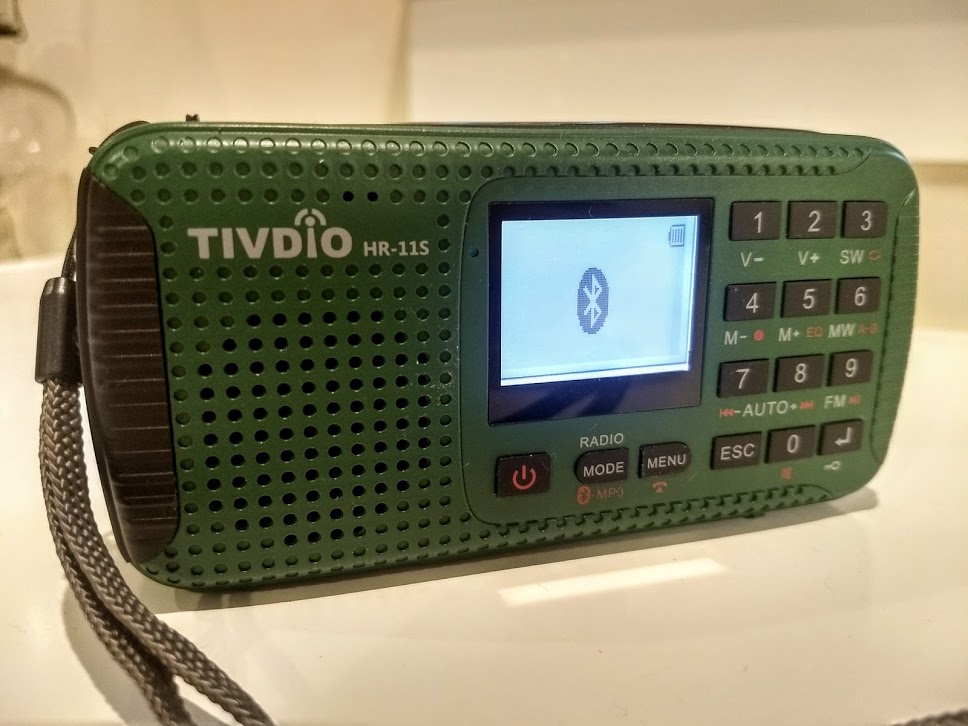
One feature I’ve found incredibly useful is the Bluetooth functionality.  With Bluetooth mode engaged, you can connect the HR-11S to pretty much any mobile device and use it as a wireless portable external speaker. Since the speaker has decent audio fidelity for the size, and can be powered by battery, it’s a brilliant feature and will make watching videos on your smartphone, for example, that much better.

One negative? At least in my unit, I can hear some internally-generated noises in Bluetooth mode. This is especially noticeable at lower volume levels.

Recording

In full disclosure, I haven’t tested the recording functionality extensively. Built-in radio recording is an interesting feature, but one I would rarely use in a self-powered radio. I did make a handful of test recordings, however, and like many other DSP radios with a recording function, the HR-11S injects noise in the recordings.

Summary
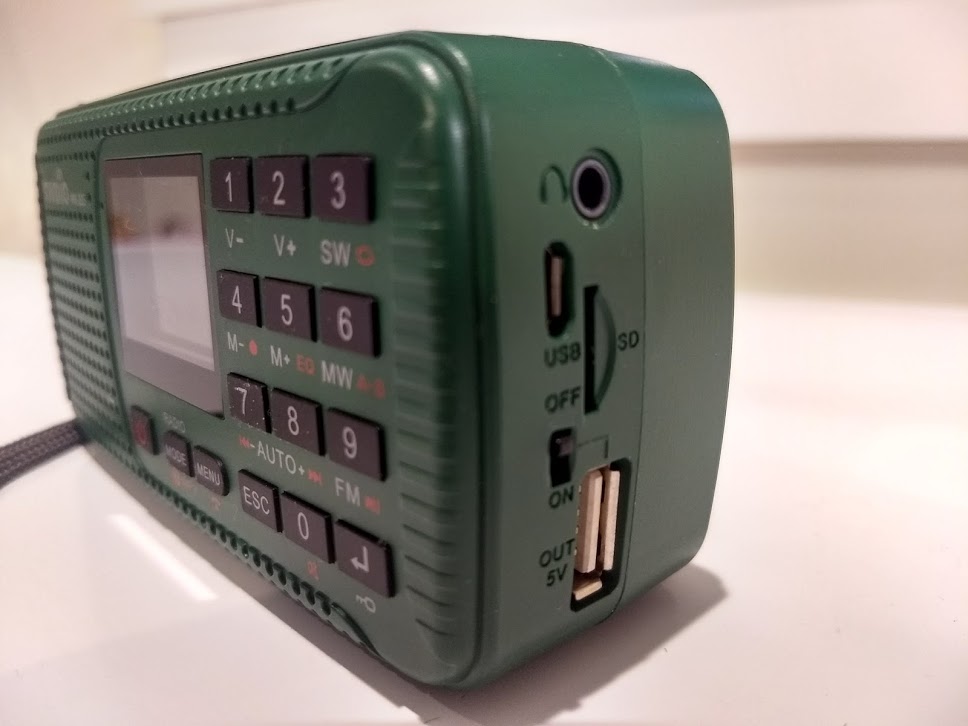
Every radio has its pros and cons. When I begin a review of a radio, I take notes from the very beginning so that I don’t forget my initial impressions and observations. Here’s the Tivdio HR-11S pro/con list, from the first moments I turned it on to the present:

Pros:

  • Keypad entry
  • Great audio for size
  • Replaceable battery (Note: after unboxing unit, you must place battery in battery compartment; it’s packed in the side box)
  • Siren  (see con)
  • Micro SD card for digital storage
  • USB can port audio from PC
  • Bluetooth––use as a portable wireless speaker for mobile devices (see con)
  • ATS (auto tune) function
  • Multiple power sources:
    • 850mAh rechargeable lithium battery
    • hand-crank dynamo generator
    • Mini solar panel
    • DC 5V input (standard micro USB)
  • Backlit informative display
  • Customer service: Tivdio representatives seem to respond quickly to customer emails and comments on Amazon.com.

Cons:

  • Tuning is cumbersome (no tuning knob)
  • Mutes between frequencies
  • Siren too easy to activate, resulting in accidental activation
  • AM broadcast band (MW) is plagued with internally-generated noises
  • Keypad configuration is not intuitive and difficult to memorize for use at night or low light settings
  • Hand strap is very difficult to insert (hint: use a thin loop of wire to help thread it)
  • At low volume, noises can be heard in Bluetooth mode
  • Noises heard in recording function

Conclusion
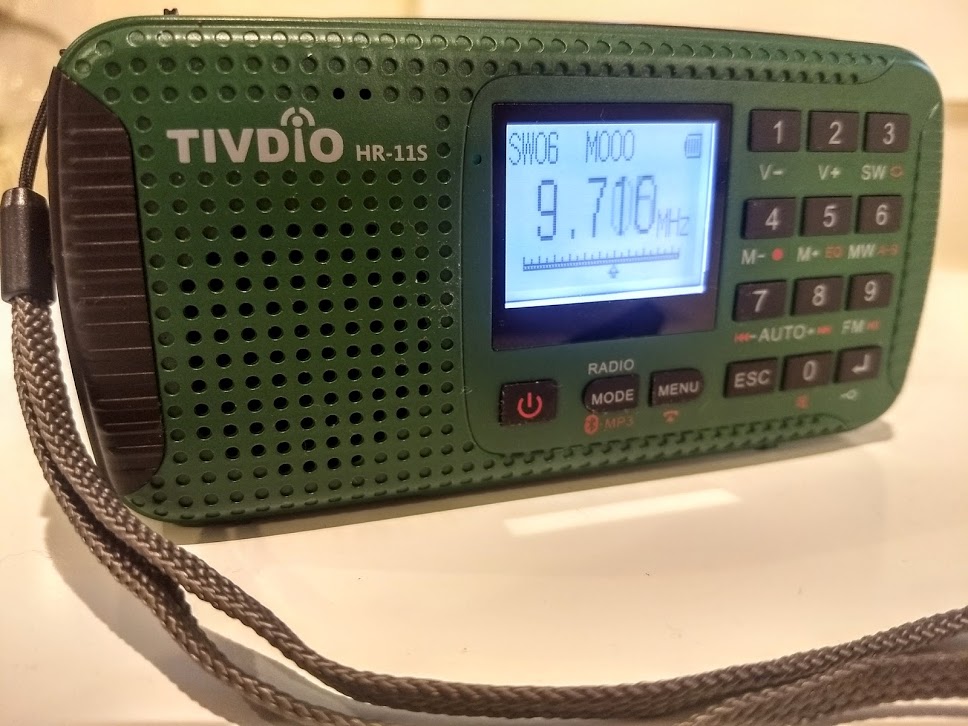
Running an ATS scan on shortwave.

As I mentioned early in this review, I must set realistic expectations when reviewing self-powered radios. When most consumers consider a self-powered radio, they’re seeking a simple, basic radio that will provide information during times of need: power outages, natural disasters, or while hiking, camping, boating, or simply in an off-grid setting.

Internally-generated noises––especially on the AM band––will disappoint radio enthusiasts. If Tivdio could address this in future iterations of the HR-11S, it would substantially improve this unit.

My overall impression is that the HR-11S is chock-full of features, but none of them are terribly refined. There are even some internally-generated noises in Bluetooth mode, which really surprised me as it seems like an oversight by engineering.

I see the Tivdio HR-11S is a bit of a “Swiss Army Knife” of a self-powered radio. It has more functionality and connectivity than any other self-powered radio I’ve tested to date. Its features will, no doubt, appeal to the average consumer––and a quick look at Amazon reviews seem to support this theory. As a radio enthusiast, however, I would pass on the HR-11S until the internally-generated noises have been addressed.

Click here to view to the Tivdio HR-11S on Amazon.com (affiliate link supports this site).

See coupon codes below.

For those who are interested, Tivdio passed along several coupon codes that SWLing Post readers can use to save money, should they decide to purchase the HR-11S:

For a 5% discount, use code: