Category Archives: Broadcasters

Thailand military suspends TV and radio programming

Original Image by Zuanzuanfuwa via WikiMedia Commons

Thailand’s army chief, General Prayuth Chan-ocha, declared a coup today (Thursday, May 22), and detained key party leaders while suspending the constitution in “a bid to restore order” after nearly six months of ant-government protests.

General Prayuth Chan-ocha has also ordered all domestic TV and radio outlets to halt normal broadcasting and only include content the military provides until further notice. Only yesterday, a group of Thai media bodies accused the Peace and Order Maintaining Command (POMC) of violating the constitution when the POMC banned 14 satellite TV outlets. Now that the constitution is suspended, I suppose it is no longer an obstacle.

I’m curious if Radio Thailand will be on the air today–if so, I assume broadcasts will contain military sanctioned content. I would encourage you to tune to Radio Thailand and, if possible, even record a broadcast to archive if they are indeed on the air.

The following is Radio Thailand‘s English broadcast schedule per Shortwave.am:

  • 9390 kHz, 1230-1300 UTC, Target: Oceania
  • 9390 kHz, 1400-1430 UTC, Target: Oceania
  • 9390 kHz, 1900-2000 UTC, Target: Europe
  • 9390 kHz, 2030-2045 UTC, Target: Europe
  • 15590 kHz, 0000-0030 UTC, Target: Eastern North America
  • 15590 kHz, 0030-0100 UTC, Target: Western North America
  • 15590 kHz, 0200-0230 UTC, Target: Eastern North America
  • 17640 kHz, 0530-0600 UTC, Target: Europe

Thailand is no stranger to full-blown military coups; this is their twelfth since 1932. I’ll be following this story closely as events unfold.

Change to VOA’s mission draws “intense debate”

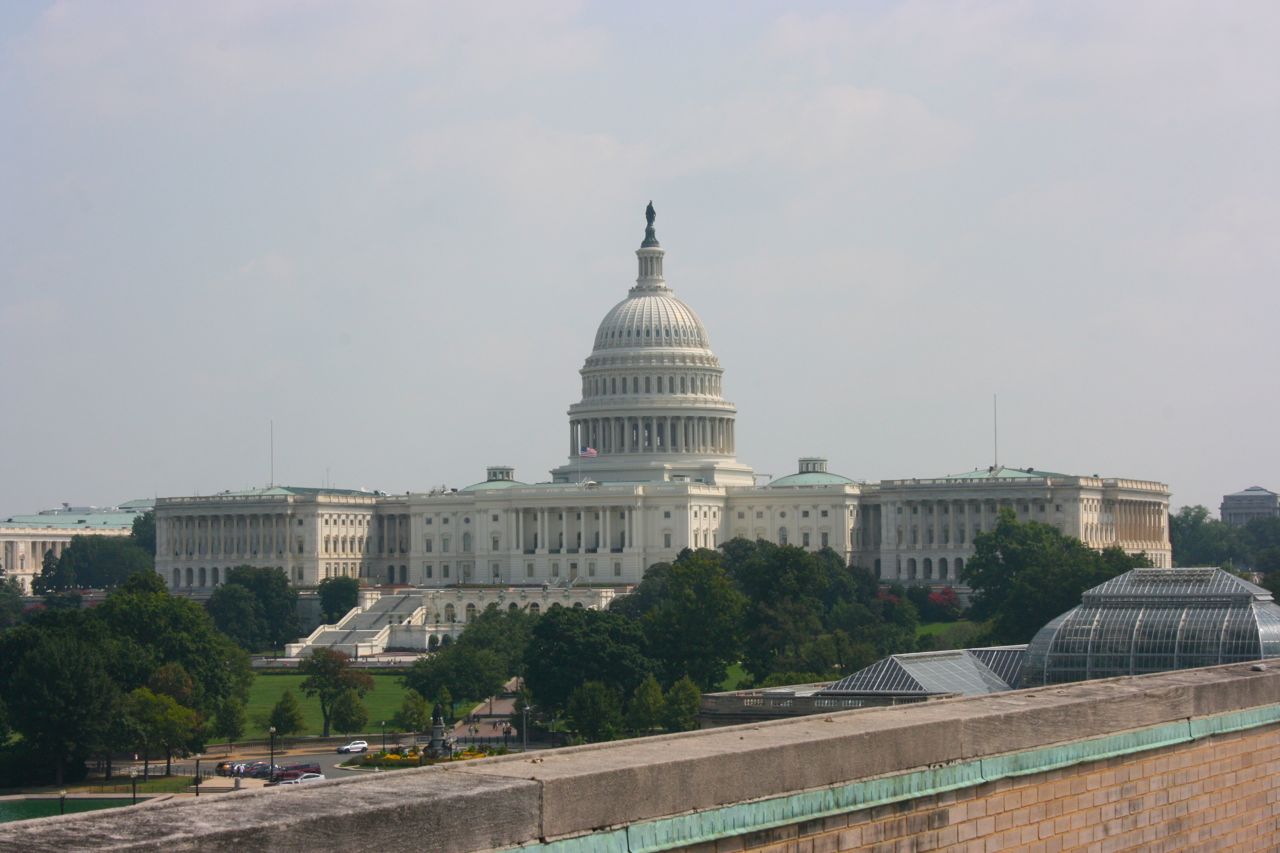
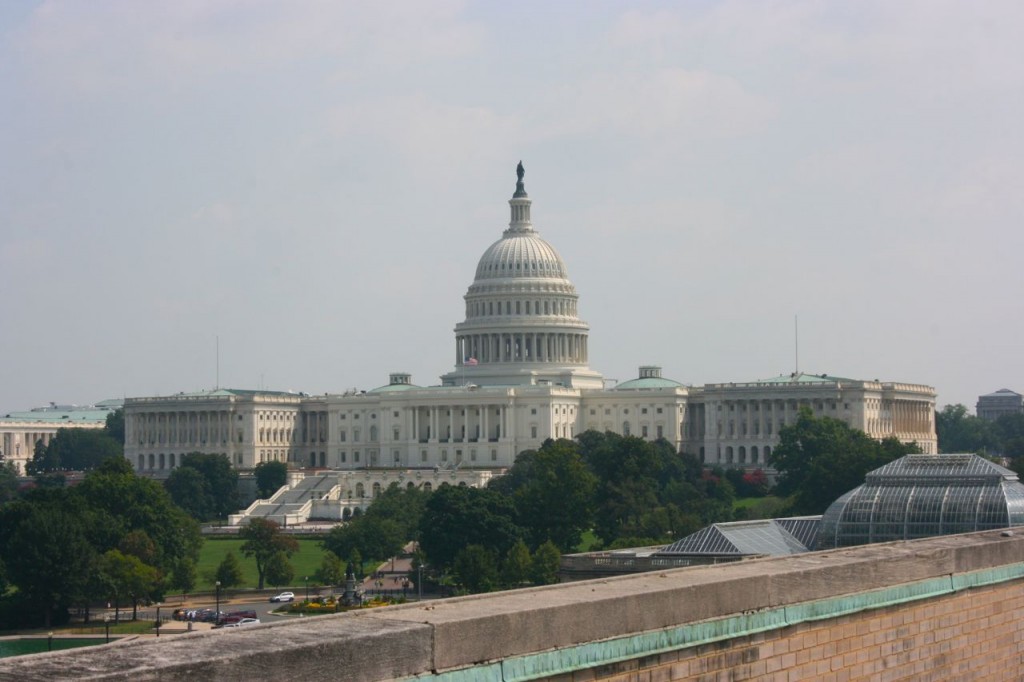
View of the Capitol Building from the roof of the Voice of America on 330 Independence Ave., S.W.

View of the Capitol Building from the roof of the Voice of America (330 Independence Ave., S.W.)

Many thanks to Dan Robinson for pointing out this article by Ron Nixon in the New York Times.  Here’s a clip:

“A bill to overhaul Voice of America has prompted an intense debate among supporters of the legislation who say it will better enable the broadcast news service to counter Russian disinformation and opponents who say it will turn the service into an American propaganda tool.

The legislation, which recently passed the House Foreign Affairs Committee with bipartisan support, would make changes to the mission of the government-financed Voice of America that its sponsors say would more clearly define its role in support of the United States. Specifically, the bill revises the language of Voice of America’s mission to explicitly state that the outlet has a role in supporting American “public diplomacy” and the policies of the government.

The full House is expected to take up the bill as early as this summer. The Senate is working on a similar bill.

Representative Ed Royce, the California Republican who is chairman of the Foreign Affairs Committee, said the legislation was essential in the face of negative and inaccurate information increasingly disseminated about the United States abroad. “While countries like Russia have been working 24/7 on their information campaigns, V.O.A. has abandoned its mission to effectively promote the policies of the U.S. even though its charter is clear in this regard,” Mr. Royce said.

But the bill, the latest in a decades-old debate in foreign policy circles about the role of Voice of America, has prompted a backlash from journalists, many of whom work at the news service once run by Edward R. Murrow and who pride themselves on the organization’s independence.

“The only thing V.O.A. has left is its reputation, built over decades, as a credible news organization,” said one veteran journalist at the service who asked not to be identified criticizing the legislation. “Changing our focus from straight news to policy promotion will undercut any efforts to keep or build our audience.”

[Continue reading at the NY Times website…]

You’ll also want to read the comments in this article.

It is a conundrum: will this legislation save the VOA from budget cuts, or will it rob the broadcaster of credibility and objectivity?

VOA reporters I know have always taken comfort in the firewall that was created by the VOA Charter in 1960, then later signed into law on July 12, 1976, by President Gerald Ford. The charter reads:

The long-range interests of the United States are served by communicating directly with the peoples of the world by radio. To be effective, the Voice of America must win the attention and respect of listeners. These principles will therefore govern Voice of America (VOA) broadcasts:

  1. VOA will serve as a consistently reliable and authoritative source of news. VOA news will be accurate, objective, and comprehensive.

  2. VOA will represent America, not any single segment of American society, and will therefore present a balanced and comprehensive projection of significant American thought and institutions.

  3. VOA will present the policies of the United States clearly and effectively, and will also present responsible discussions and opinion on these policies. (Public Law 94-350)

Many would argue that it’s impossible for a taxpayer-supported broadcaster to “present the policies of the United States” without being somewhat biased. Still, in the past, I’ve heard a number of reports from the VOA that are critical of life here in the US; reports I’ve never heard the likes of from, for example, the Voice of Russia or China Radio International.

If HR 4490 becomes law, perhaps the proof–VOA’s integrity–will be in the pudding. This is certainly a complex and multi-faceted issue. Regardless: we will be listening.


WPLN host, Bradley George, says shortwave radio shaped his career

SX-99-DialMany thanks to SWLing Post reader, Richard Cuff, for sharing this article written by Bradley George of Nashville Public Radio:

“From ages 11 to 15, I spent hours hunched over a tiny Magnavox radio, straining to hear the world’s shortwave radio stations.

The big dogs of international broadcasting — BBC World Service, Voice of America, Radio Canada International, and Radio Netherlands were easy to pick up. Their signals were strong, and the cheap receiver I had would find them automatically.

Otherwise, listening to shortwave takes patience and lots of fine tuning. Signals bounce off the earth’s ionosphere, and travel further at night. Stations fade in and out. Imagine someone talking in a gigantic tin can on a beach — a hollow, static filled sound.

But through that static comes a grand, global audio bazaar.[…]”

And it still does today…! In fact, we just posted a recording of the Voice of Korea on the Shortwave Radio Audio Archive; George mentions Radio Pyongyang as memorable QSL.

Click here to read Bradley George’s full post, with photos, at WPLN.

Sean crunches the language numbers

Sean Gilbert, International Editor at WRTH, writes:

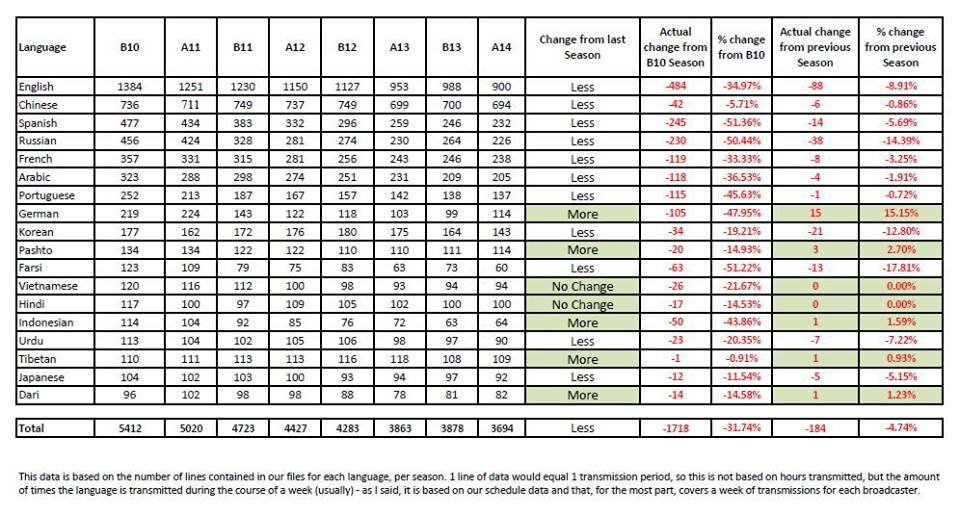
I have completed my season-on-season analysis of the top 18 languages used by SW broadcasters. I chose 18 because it is the number we use in our bargraph file (odd number I know, but 18 just fits nicely and it is difficult to find many more colours that are sufficiently different from one another to be easily distinguishable in print).

SeanGilbert-Analysis

If you study the image [click to enlarge], you can see the how the output of various popular languages is declining with each passing season. There are a few surprises, like the 15% increase in German output this season over B13 (but the bigger picture is that it has reduced by nearly one half since B10 -when I first started this analysis). English output has been cut by over 1/3, Spanish, Russian, Farsi, Indonesian, Portuguese and German have all reduced by about 50% from B10.

A couple of languages, however, stand out as being fairly static – Chinese and Tibetan. Chinese (that is mainly Mandarin and Cantonese dialects) has reduced by a mere 5.7% since B10, and Tibetan output by less than 1%.

There can be no doubt that International Shortwave Broadcasting is in its ‘twilight years’ now, but there is still a goodly amount of different programming to listen to, from a large number of stations.

To emphasise that point, for the A14 season, we have the full schedules of 196 international and clan/target broadcasters in our A14 schedules pdf file (which can be downloaded for free from the WRTH website).[…]

I may, at some point in the future, delve in to my archives and see if I have any usable data that will allow me to go further back with this study.

Many thanks to Sean Gilbert and the WRTH for making this analysis available!

You can pick up your copy of WRTH at Universal Radio or Amazon.com.

Shortwave Radio Recordings: HCJB 45th Anniversary, December 25, 1976

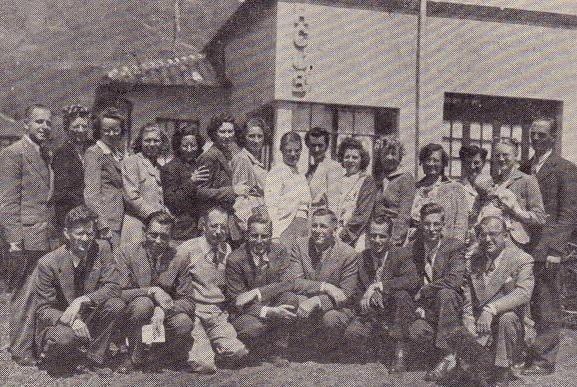
HCJB radio station staff in 1946, including engineer Clayton Howard (front row left), co-founder Clarence Jones (front row right) and future HCJB president Abe Van Der Puy (front row, fourth from left) -- Source: Wikipedia

HCJB radio station staff in 1946, including engineer Clayton Howard (front row left), co-founder Clarence Jones (front row right) and future HCJB president Abe Van Der Puy (front row, fourth from left) — Source: Wikipedia

I’m very grateful to Shortwave Radio Audio Archive contributor, Greg Shoom, who is digitizing shortwave radio recordings he made in the 1970’s.

His latest contribution is a 1976 recording of HCJB’s 45th Anniversary broadcast. This is a special program, broadcast on Christmas Day of 1976 to commemorate the 45th anniversary of the founding of HCJB. Greg made this recording from his home in Kingston, Ontario, Canada on December 25, 1976, starting at 02:30 UTC on 6,095 kHz.

Click here to download the recording as an MP3, or simply listen via the embedded player below. Please subscribe to the SRAA podcast to receive future recordings automatically.

Chrissy Brand on the joy of shortwave

SX-99-Dial

I love reading Chrissy Brand’s posts on her blog, DX International.

Yesterday, she posted “The Joy of Shortwave,” in which she talks about the advantages of tuning in the world via shortwave radio. As she mentions all of the stations that she casually logs in the UK, I realize how fond I am of the same stations, and how Chrissy and I–though an ocean apart–may often listen to the same shows at the same time. Because on the shortwaves, local is global, not to mention instantaneous.

Take it from Chrissy: Shortwave radio is very much alive, all you need to do is listen.

Chrissy also writes the Broadcast Matters column for the UK magazine Radio User, and blogs regularly on the Mancunian Wave.

I would encourage you to bookmark DX International–which celebrates shortwave radio programming with a touch of nostalgia.

WRTH 2014 Summer (A) season available for download

wrth-2014(Source: Sean Gilbert, WRTH)

The WRTH Editorial team is pleased to announce that the A14 International broadcast season schedules are now available for free download from the WRTH website, navigate to: http://www.wrth.com and follow the links.

The file is in PDF format and will require the free Adobe Acrobat reader (http://www.adobe.com).

Included in the 76 page, 3MB, file are the full summer ‘A’ Season broadcast schedules for International and Clandestine & Other Target broadcasters and DRM, Selected language broadcasts. Also a by frequency listing of the above schedules and a table of sites and site codes used.

We hope you find this a useful accompaniment to the printed WRTH edition.

Please feel free to pass this information on and/or repost on social media as you wish.

73, and good listening!
Sean D. Gilbert, International Editor –

WRTH (World Radio TV Handbook)
On behalf of the WRTH Editorial team.