Category Archives: Broadcasters

BBC Predicts Internet-Only Radio in the Future

BBC-logo(The following is part news / part editorial)

According to a report going to Parliament for the BBC’s broadcast charter proposal, the BBC is preparing for an Internet-only world for broadcasting. This has prompted an investigation of other radio broadcasting services by Radio World magazine to get their take on this perspective. Part of the article “Is Broadcast Radio Doomed”  follows:

 Conventional radio and television broadcasting are doomed, eventually. Or so one might reasonably assume from reading “British, Bold, Creative,” the BBC’s broadcast charter proposal for the next decade of its mandate. The BBC’s 10-year broadcast charter is up for renewal in 2016. The proposal is the Beeb’s funding pitch to Parliament.

To be sure, the BBC didn’t use the word doomed, or put a timetable on it. However, over the next 10 years, “We will be moving to an Internet-fit BBC, to be ready for an Internet-only world whenever it comes,” states the BBC proposal. The only limiting factor will be to “move at the pace of our audiences”; ensuring that older subscribers have access to content on radio and TV as long as they need it.

Subsequent to issuing this proposal, the BBC announced that it is reorganizing its internal divisions along content rather than platform lines. For instance, “Each overarching division would have subsidiary divisions such as BBC Youth, a mooted subdivision of BBC Entertainment, which would include the online channel BBC Three, and pop music station Radio 1,” reported The Telegraph newspaper . . . .

In the current transitional environment, it is impossible to see just where broadcast radio will be in 10 and 20 years’ time. The BBC’s prediction of an inevitable “Internet-only world” notwithstanding, there are still many parts of the Third World where one-way radio broadcasts remain the only economical, effective way to reach mass audiences; no matter what advances are being made in 4G-and-beyond smartphones in the First World. Add broadcast radio’s resiliency in the face of natural and man-made disasters — compared to the frequent overloading and failure of cellular telephone networks during such incidents — and the notion of shutting down broadcast lifelines seems unlikely in these regions.

– See the full article at: http://www.radioworld.com/article/is-broadcast-radio-doomed/278577#sthash.YrBAkCfQ.dpuf

The demise of broadcast radio has been predicted many times in the past 50-60 years and yet it remains. Still there is a growing mindset in what I call  the Western culture’s business mindset that the pervasiveness of the Internet is the dominant factor in future media decisions. This is the same justification for various governments reducing or eliminating SW Broadcast budgets. After all “Everybody has the Internet now!”

This is a mistake, and belies a Western-centric view of the world. I cannot claim to know the real numbers, but I have little doubt the numbers representing Internet availability are inflated, partially because of assumptions and partially for selfish business interests.

In an ever-competitive entertainment market broadcasters (and governments) are naturally worried about such things as market share and the like, but this is only looking at things from one side of the coin. Anyone who uses the Internet outside of the home knows data fees can become enormous, and therefore we watch just how much traffic we pass through our wireless devices. (Yes I admit it – any place I go regularly which has “free Internet” gets loaded into my list of networks so as to keep my data charges down.)

How many people are going to listen to radio streams like they do now to radio broadcast stations? Are you going to drive home with your radio on through the Internet? I doubt it. Similarly how many people listen to the radio in places where there would be no coverage of wireless? I believe the market share would decrease rather significantly in these same western cultures where the Internet is indeed plentiful, but not certainly not free.

Having been involved in the early days of the public Internet back in the 90s, I remember meeting with city planners when they were looking to offer free Wi-Fi within the city so everyone could have access. While the idea sounded good, the logistics of equipment, and more importantly the expense of such an ongoing system, quickly laid such plans to rest for most government budgets.

I hope the pendulum swings back over time and business leaders and government officials recognize the value of both shortwave and OTA radio broadcasts. The Internet is a shiny diversion to be sure, but it is not the answer to all of our media needs. And whether folks like to admit it or not, the Internet is a fragile thing. As the old saying goes, a chain is only as strong as its weakest link. How many times a year does your Internet service go out for no apparent reason, much less because of weather or other disasters?

Broadcast radio needs to be supported for many of the same reasons as shortwave radio – there simply is no more reliable way getting information out to the most number of people over the greatest possible coverage area.

Robert Gulley, AK3Q, is the author of this post and a regular contributor to the SWLing Post. Robert also blogs at All Things Radio.

Nothing to hear on shortwave? Jacques disagrees…

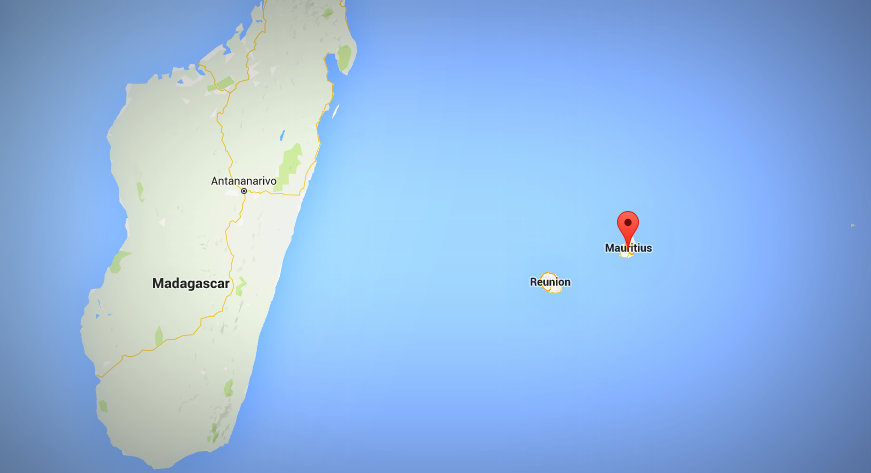
MauritiusIsland-IndianOcean-SM

Many thanks to SWLing Post reader, Jacques Catherine, who left the following comment on our post from 2012: Is there anything to listen to on shortwave?

“I live in Mauritius Island in the Indian Ocean and I’ve been listening to Shortwave since I was a kid (I’m 58 today) on my dad’s good old Phillips wooden valve radio.

I’m sorry, but shortwave is certainly not dead. After having read all the comments above, I come to the conclusion that reception definitely depends on your location.

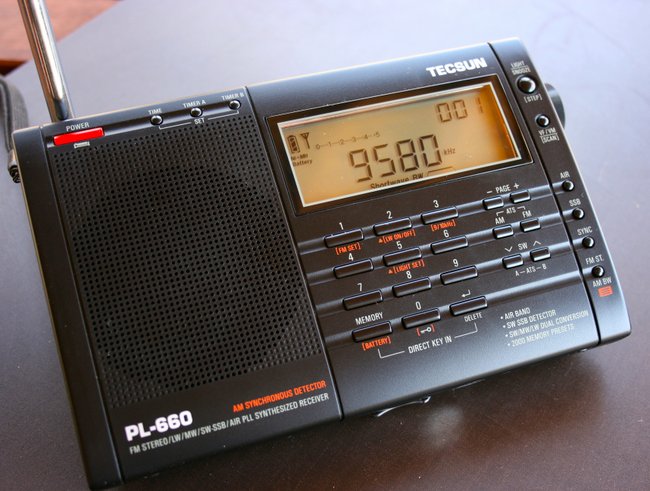
The Tecsun PL-660.

The Tecsun PL-660.

I have two Tecsun receivers ( Tecsun S 2000 and PL 660) hooked to a Windom antenna and an ATU. I receive dozens of stations from all over the world here as well as a lot of stuff on ssb, including – in the morning – New York MWARA (8825.0 usb), Gander (8831.0 usb) or, in the evening, Brisbane (5634.0 usb).

Broadcast stations from Japan, Taiwan, India, Iran, Australia, Singapore, China, Africa and even the US, come in here loud and clear with very little static, depending on the season and time of the day. I think I’m privileged to be located where I am !

And I bought some years back a pair of cheap small wooden amplified speakers in Hong Kong that reproduce exactly the sound of my dad’s old valve radio!”

Thank you for your comment, Jacques. You’re right: it’s all about your location…and you certainly live in a prime spot!

I’m most fortunate that I live where I do–quite far away from sources of noise that plague our urban readers/listeners (and that have plagued me in the past). My location is not ideal (from a radio/receiving standpoint) because my ground conductivity is very poor and I’m in North America where very few broadcasts are targeted these days. I do, however, have the space for a rather large horizontal delta loop antenna that serves me well across the HF bands. I might have invested $50 in the antenna wire and components five years ago.

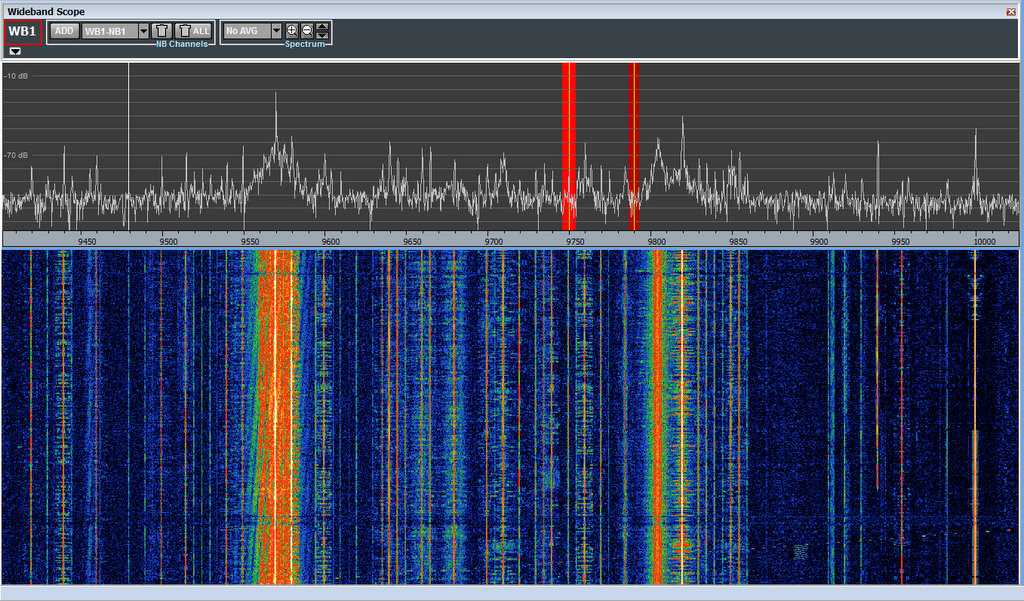
When propagation is good, some broadcast bands are actually packed tightly with signals. Indeed, Thursday last week, I could’ve easily logged two dozen stations on the 31 meter band alone.  Here’s a screen capture from the spectrum display of my SDR:

TitanSDRPro-Spectrum-31MB

If you live in an urban area and feel that you’re missing out on the action, consider taking your receiver outdoors and away from interference. Take your receiver on hikes, camping trips or to the beach. You might be surprised by the number of stations you’ll log!

Recently, our friend London Shortwave has been posting an amazing array of broadcast recordings he’s made in a park in the middle of London, England. He’s the guru of mitigating urban interference.

When I have time to curate the recordings, I hope to do a 2016 update of “Is there anything to listen to on shortwave?“–it’s been on my to-do list for a while now.

Jacques, thanks again for your comment and reminding us to keep listening!

Update: German communications regulator to allow AM digital modes

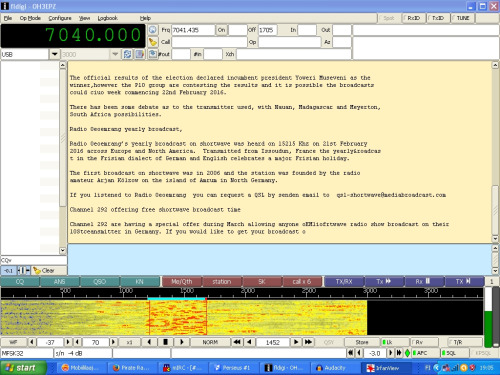
FLdigi-VOARadiogram

As a follow-up to a previous post, many thanks to several SWLing Post readers who noted this news on the VOA Radiogram website:

The German communications regulator Bundesnetzagentur has changed its mind about allowing digital modes on shortwave broadcast transmitters in Germany. Apparently BNetzA thought that Channel 292 was transmitting the text and images in single sideband (SSB), which is how amateurs, military, etc, transmit the digital modes. Now that they know that the MFSK32 and other modes are sent as program audio on an analogue amplitude-modulation shortwave transmitter, their objections were withdrawn.  (It’s similar to A2A modulated CW.)

BNetzA prefers that the term MFSK32 not be used to describe these broadcasts, but we have to specify the mode so that you can set Fldigi or other decoding software to the correct mode. In any case, the weekly MFSK32 transmission will resume on The Mighty KBC, and DigiDX will return to Channel 292.

Meanwhile, VOA Radiogram this weekend will be all MFSK32 except for the transmission schedule in Olivia 64-2000 under the closing music.                       

Video: Demolition company’s view of VOA Site A towers falling

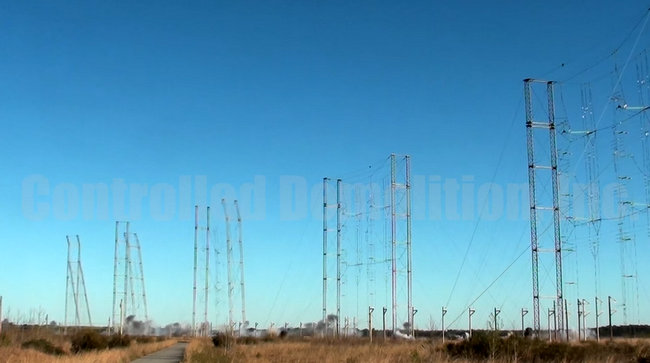
Fullscreen capture 472016 113932 AM

While it’s fascinating to watch the video footage of the VOA Site A towers falling, it’s also a little heartbreaking.

As I mentioned in a previous post, I spent time last week at the VOA Site A’s twin site: VOA Site B (now the Edward R. Murrow Transmitting Station).

While it’s a little tough for me to watch, imagine how difficult it is for the engineers who lovingly cared for these giant antennas for so many decades. Still, VOA Site A’s antennas needed to be demolished–they hadn’t been in operation since 2006 and would have soon become a hazard to anyone on the site.

It’s just tough to see these powerhouse curtain antennas collapse:

Click here to view on YouTube.

Post Readers: I’m hoping to have time this weekend to put together the photos I took last week and responses to your questions.

VOA Site A antennas and towers demolished

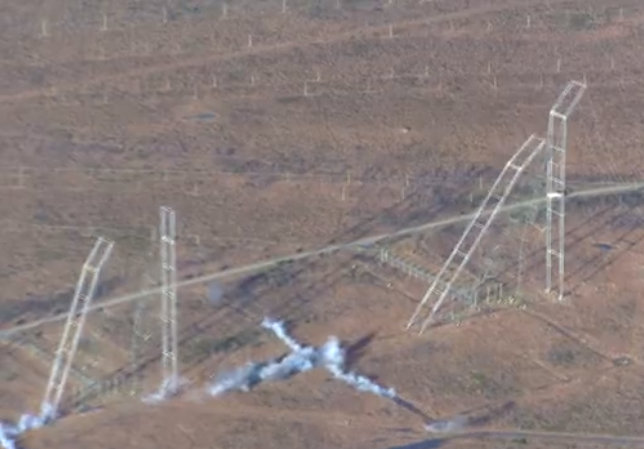
Fullscreen capture 442016 83022 PM

Helicopter view of the curtain antenna array falling.

On Friday, I spent the afternoon at the Edward R. Murrow Transmitting Station (a.k.a. VOA Site B) in Greenville, NC.

While there, I was told that the VOA Site A towers, which have long been abandoned, were slated to be demolished this morning. Here’s the report from local NBC TV station WITN:

(Source: WITN)

BEAUFORT COUNTY, NC (WITN) – A series of implosions is all it took to bring down 48 radio towers that have been a part of U.S. history for over 50 years.

It happened Monday morning at the old Voice of America Site A in Beaufort County.

Not used since 2006, the VOA site was sold to Beaufort County as surplus U.S. property.

Environmental Holdings Group of Morrisville teamed up with Controlled Demolition Incorporated to implode and haul off the 48 towers.

It took less than a minute for it all to come down.

Voice of America still broadcasts from Site B to Latin America, Cuba, the Caribbean, and Africa.

Click here to read the full article and watch the video at WITN.

Update: From the Isle of Music

IsleOfMusic

Many thanks to SWLing Post reader, Bill Tilford, who shares this From The Isle of Music update:

From the Isle of Music can now be heard Tuesdays from 1900-2000 UTC on Channel 292, 6070 KHz, a station in Germany, in addition to Tuesdays 0000 UTC (8-9pm EDT Mondays in the Americas) on WBCQ 7490, a station in the US

We are now able to send e-Qsls for reception reports for both options, we can be sent to [email protected]. Please be patient with us about response time as our resources are very limited.

Our April 4 (in the Americas) / April 5 (for the rest of the world) program will include Cuban Jazz trombonist Eduardo Sandoval, one of the most exciting trombonists in Cuba since Juan Pablo Torres. We will also begin a beautiful new concert music album, Danzas Para Piano de Ignacio Cervantes, and we’ll have some Cuban rock from Tesis de Menta along with some of Pello el Afrokan’s Mozambiques.

Two listening options on shortwave:

  • WBCQ, 7490 KHz, Tuesdays 0000 UTC (8pm EDT Mondays)
  • Channel 292, 6070 KHz, Tuesdays 1900 UTC (2100 CEST)

See our Facebook page for more information.

Radio Canada International back on shortwave via Radio 700

RCIMany thanks to SWLing Post contributor, Richard Langley, who shares the following message:

TheLinkRCIOnly a barely-detectable carrier [of Radio Canada International] on 7310 kHz from Radio 700 Kurzwellendienst (or Radio 700 Shortwave Service using the web-interfaced University of Twente SDR receiver at 15:00 UTC. However, the online streaming of Radio 700’s 7310 kHz transmission came through clearly 😉 and, indeed, an RCI program is being transmitted. In fact, it’s this week’s “The LINK Online”!

So, finally, RCI is back on shortwave. Too bad the signal for the English program isn’t stronger. I was waiting for the scheduled start of the French RCI program at 14:30 UTC on 6005 kHz but when I tuned in via Twente at 14:15 UTC it was already in progress with a good signal! So, obviously it starts at an earlier time. Perhaps 14:00 UTC? What’s the point of having the English and French programs on at the same time? Some of us might want to listen to both.

TamTam[…]The French-language RCI program was the weekly program “Tam-Tam Canada” (with the familiar tam-tam drum signature music) and it was today’s edition that was broadcast. Good reception via Twente. It ended at about 14:52 UTC with then a switch briefly to Radio 700 programming. I have queries out to both Radio 700 and RCI about these programs and will report back if I get further information.

[…]I wonder if there’s an active collaboration of RCI in this effort?

Please let us know what you discover, Richard! Though I imagine this broadcast of The Link and Tam-Tam Canada may be a limited broadcast run, it would be incredibly cool to hear RCI on shortwave once again.