Category Archives: News

NASB & DRM USA Annual meetings, Birmingham, Alabama

USA NASB logoI attended and presented at the NASB meeting last year at Radio Free Asia’s headquarters in Washington DC. It was an amazing meeting and great opportunity to talk radio with industry leaders. You should consider attending an NASB meeting if your schedule allows. Here are the details:

(Source: NASB Newsletter)

The 2013 Meeting will take place May 15-17, 2013 at EWTN Television in Birmingham, Alabama.

Registration for the meeting is free of charge, and it is open to anyone with an interest in shortwave broadcasting or listening. To register, fill out our online registration form at www.shortwave.org/meeting/meeting.htm or send your name and e-mail address to Jeff White at radiomiami9 [ a t ] cs.com.

As usual, the NASB Annual Meeting will be held in conjunction with the DRM-USA platform on May 15-17, 2013, at the headquarters of NASB member EWTN (Eternal Word Television Network) in Birmingham, Alabama. NASB President Glen Tapley, Terry Borders and other EWTN staff members will welcome shortwave broadcasters, listeners and anyone with an interest in shortwave radio to the Birmingham venue.

Arrangements have been made for hotel accommodation at the nearby Holiday Inn Express for a price of $75.00 plus tax, including breakfast daily. The Holiday Inn Express Irondale (a suburb of Birmingham) is about a half-mile from the TV network, the location for Thursday’s meeting and tour of the TV studios. The hotel will provide a free shuttle service to and from EWTN and a continental breakfast. EWTN will provide lunch Thursday. On Friday, participants will take a 40-minute trip to the WEWN shortwave transmitter site high in the picturesque mountains surrounding Birmingham, and the radio staff will have a cookout on the hill for attendees. EWTN is looking forward to your visit!

TENTATIVE AGENDA FOR NASB 2013

WEDNESDAY EVENING
Reception at hotel with cocktails (including non-alcoholic) and hors d’oeuvres for all participants, sponsored by the Holiday Inn Express

THURSDAY
Meeting takes place at EWTN TV station 9:00 am-5:00 pm
The meeting will be opened by the EWTN President/CEO
Tour of TV plant
Lunch at TV plant
Afternoon presentations: DRM talks, AJ Janitschek of Radio Free Asia (on “Green Engineering”); Dr. Dowell Chow, President of Adventist World Radio; Mike Rosso, Vice President, and Dave Hultsman of Continental Electronics; Mark Allen of Rohn Tower Company; and Jerome Hirigoyen of Télédiffusion de France about TDF’s Issoudun transmitter site

FRIDAY
Tour of shortwave transmitter site – vans will pick up at the hotel. Remarks by Terry Borders.
Cookout on the mountain for lunch
Back to TV plant for business and board meetings (or on the mountain if agreeable)

HOTEL RESERVATION DETAILS

Room reservations need to be made at the Holiday Inn Express by April 16 to ensure the group rate. After that, reservations can still be made, but only based on availability. There is no cancellation fee if the reservation is canceled by 6 PM the date of arrival. Otherwise there is a one-day charge.

Attendees simply need to e-mail: [email protected] with the Subject: NASB Reservations

The hotel will send confirmation within 24 hours. The price is $75.00 per night plus tax.

Those who do not wish to use e-mail can phone the hotel at (205) 957-0555 and request to speak with Adrian or Margarita.

Information you need to provide in your e-mail or by phone:

  • Name of Guest(s):
  • Email/Phone Number:
  • Check in/out dates:
  • Estimated time of arrival:
  • Preference of room type (King or Two Queen Beds):
  • Number of People in Room:
  • Method of Payment: (Do not provide credit card number with e-mail. The Holiday Inn Express will contact you later for that information.)

If you have any questions about the 2013 NASB Annual Meeting, or would like to sponsor an event at the meeting, contact Jeff White at [email protected]

NASB Members:

  • Adventist World Radio
  • Assemblies of Yahweh
  • EWTN Shortwave Radio (WEWN)
  • Family Stations Inc.
  • Fundamental Broadcasting Network
  • Radio Miami International
  • Trans World Radio
  • World Christian Broadcasting
  • World Wide Christian Radio

NASB Associate Members:

  • Antenna Products Company
  • Babcock International Group
  • Continental Electronics Corporation
  • Far East Broadcasting Co.
  • Galcom International
  • George Jacobs & Associates
  • Hatfield and Dawson Consulting Engineers
  • International Broadcasting Bureau
  • Rohn Products, LLC
  • TCI International, Inc.
  • Telediffusion de France (TDF)
  • TDP (Belgium)
  • Thomson Broadcast & Multimedia
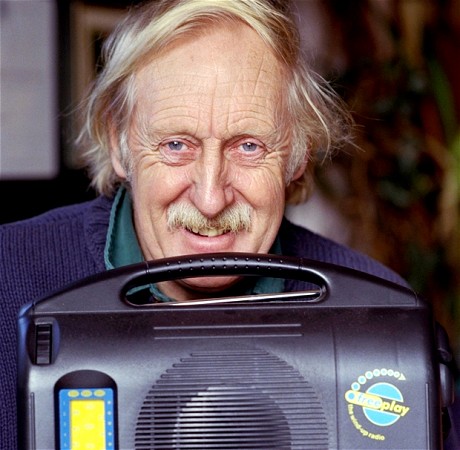
Trevor Baylis, inventor of the wind-up radio, fights for patent rights

Trevor Baylis with an original BayGen clockwork radio (Photo source: The Telegraph)

Trevor Baylis with an original BayGen clockwork radio (Photo source: The Telegraph)

The Telegraph reports that British inventor Trevor Baylis, now 75, who created the first wind-up radio, is unfortunately struggling with patent laws in the UK. The eccentric gentleman (Trevor, I mean this as a compliment) cites the lack of government protection for inventors’ rights in Britain; unlike in the US and other countries, where patent theft is considered a criminal offense, in the UK it is merely a civil one.  Meanwhile, Bayliss, who has received many honorary degrees for his work, and an OBE from the Prince of Wales, is currently in a bit of a financial struggle.

This is sad.  Radio truly owes Trevor Baylis a great debt of gratitude; his invention spawned an era of self-powered technologies such as those we use at Ears To Our World, that have brought life-saving information and lighting to the most rural, remote parts of the world.  He has truly made a difference to people’s lives, especially where there’s no reliable access to electricity.

I still keep an original BayGen radio at my house, just like the one Baylis is pictured with above. It’s an amazing invention, indeed–loud, clear, room-filling shortwave audio from a radio that doesn’t require batteries; only a little winding, as simple as winding your wrist watch, delivers this remarkable sound.

The Telegraph tells the evolution of the BayGen radio into the Freeplay radio, and then Bayliss’ loss of revenue as the original patent for the clockwork radio was not honored when Freeplay began using the same mechanism, with a modification, to charge an internal battery. Ironically, Freeplay spawned The Freeplay Foundation, now known as Lifeline Energy,  a worthy organization with the goal of helping others.  And obviously, Baylis is not financial guru:  he did sell his shares in Freeplay and parted ways with the organization over a decade ago.

But to be fair, Baylis is an inventor, not a businessman.  I can see his side of the argument:  if you wish to build your life around inventing, your creations and intellectual property need to be properly protected. It should not require another degree–or another full time job–simply to protect your ideas.  If Baylis’ inventions had been properly guarded, he would probably still be churning out inventions at age 75 instead of fighting to keep his house and to protect other inventors from the same fate. Baylis–and The Telegraph, in turn–are placing the focus on beefing-up the patent laws in the UK to help protect innovations. In Baylis’ case, I believe it may be a lack of international protection that has had an effect on his bottom line.

How can we help Trevor Baylis?  We’re determined to find a way.  Stay tuned…

Meanwhile, click here to read the article in The Telegraph.

Many thanks to Ed Cummings for sending the Telegraph link!

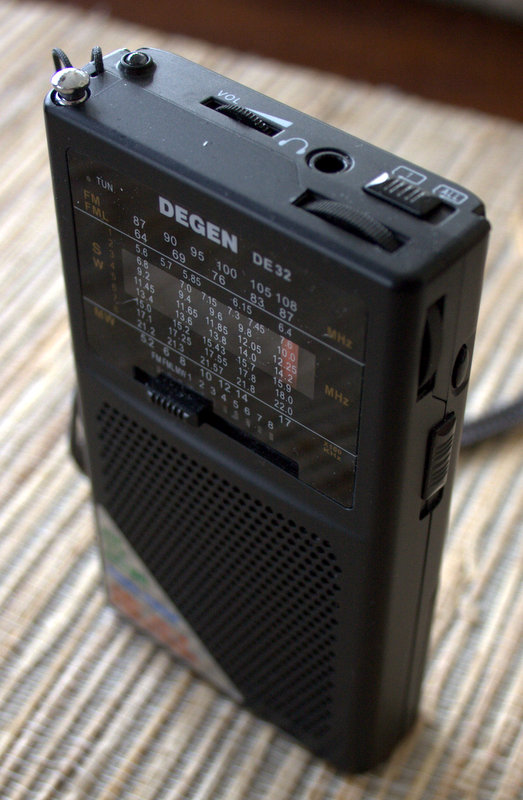
A review of the Degen DE32 shortwave radio: compared with the DE321 and Tecsun PL-380

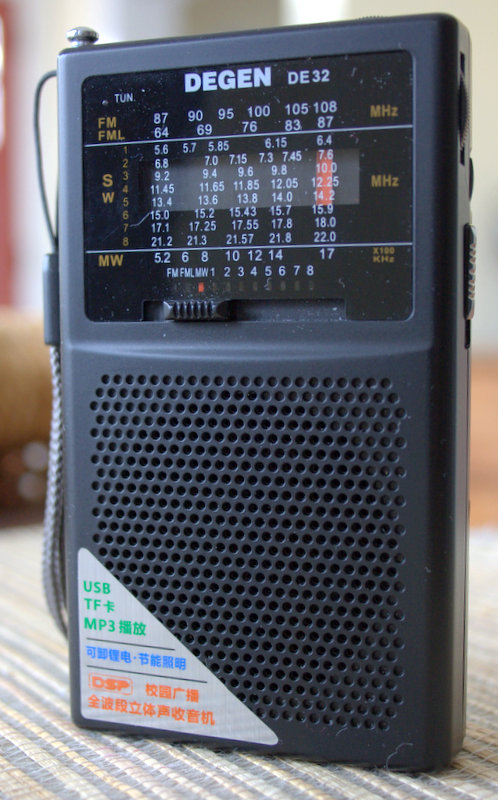
The Degen DE32 (Click to enlarge)

The Degen DE32 (Click to enlarge)

The Degen DE32 is one of the latest DSP-based analog radios to hit the market. In the past, I have reviewed two others: the Degen DE321 and the Kchibo KK-9803. Tecsun had announced a version of their own–the Tecsun R-2010–which I had eagerly anticipated, but I now believe it’s been dropped from their future offerings. [Update: Not true–the Tecsun has been released as the R-2010D, see review].

I purchased my Degen DE32 from this China-based seller on eBay. To my knowledge, eBay is the only place the DE32 can be purchased, at time of posting. As with the other radios mentioned above, my expectations were quite low for this little radio.  After all, at $27 US (shipped), you can’t expect top-notch performance characteristics.

IMG_5886

The DE32 un-boxed (Click to enlarge)

The DE32 comes with a carry strap, USB cable, a carry pouch, slim rechargeable battery, and operating instructions in Chinese. It does not come with a USB wall adapter (you’ll have to plug it into a USB port on your PC or other USB wall charger) and it does not come with a Micro SD card (for digital audio playback).

Audio

The DE32 has a small built-in speaker. The sound is a bit tinny, but is actually better than I expected from a speaker of this size. It makes for comfortable listening at close range–especially of spoken-word broadcasts. Happily, plugging in a good set of earphones helps audio fidelity tremendously.  This is the only way I would listen to music on the DE32 for an extended period of time. On FM, in fact, audio via earphones is surprisingly good (again, for a $27 radio–check out the audio sample below).

(Click to enlarge)

(Click to enlarge)

Performance

The DE32 covers three radio bands: medium wave (AM), FM and shortwave (5.6-22 MHz). Performance between bands varies greatly. The best band, by far, is FM. Again, no surprise here, as the DE321 and KK-9803 performed quite well on FM.

Here’s a 20+ minute audio sample of a local classic rock radio station I recorded, 95.7FM The Ride:

From my home, I can pick up my benchmark distant NPR station quite easily if I hold the radio in my hand. If I place the radio in a window sill, its performance degrades somewhat and contains more static as the extra grounding (from holding the radio) made a positive difference. The audio, though, is still perfectly intelligible. Local FM stations come in quite clear and fidelity (through headphones) is excellent.

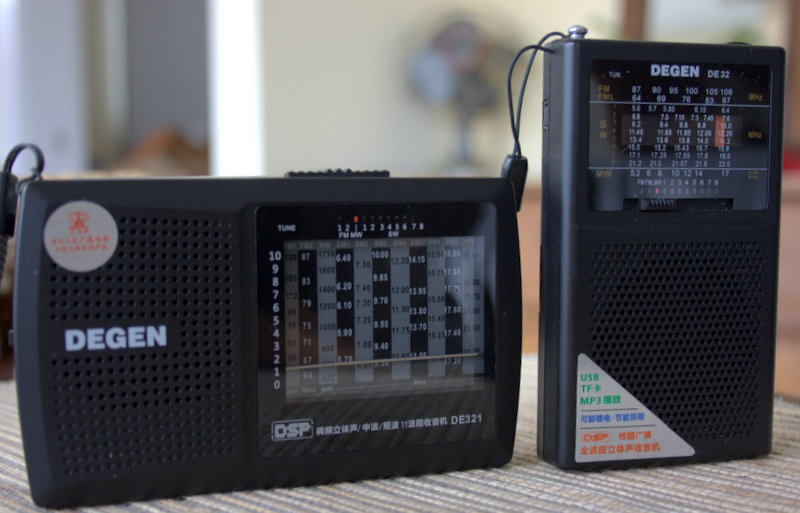
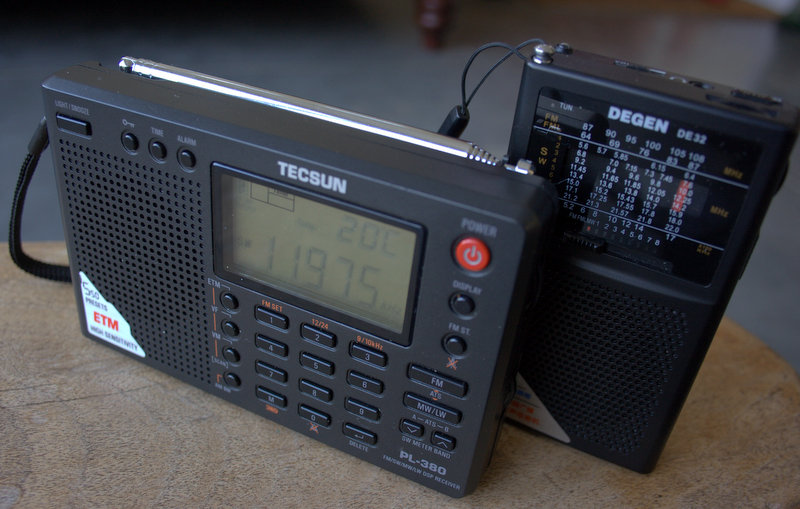
The Degen DE321 (left) and DE32 (right)

The Degen DE321 (left) and DE32 (right)

I found that strong local medium wave (AM) stations sound quite good on the DE32–better than its cousin, the DE321, by a small margin.

While traveling over the holidays in December, I recorded extended samples of local station (630AM WAIZ) with both the DE32 and the DE321. You can listen to audio samples below, but first it’s important to note that I recorded these (and the FM sample above) with my Zoom H2N digital audio recorder, with radios at a comparable volume and via an audio patch cord.

Note that these recordings represent what each radio sounds like via headphones, not their internal speakers.

This is WAIZ on the Degen DE32:

Compared with WAIZ on the Degen DE321:

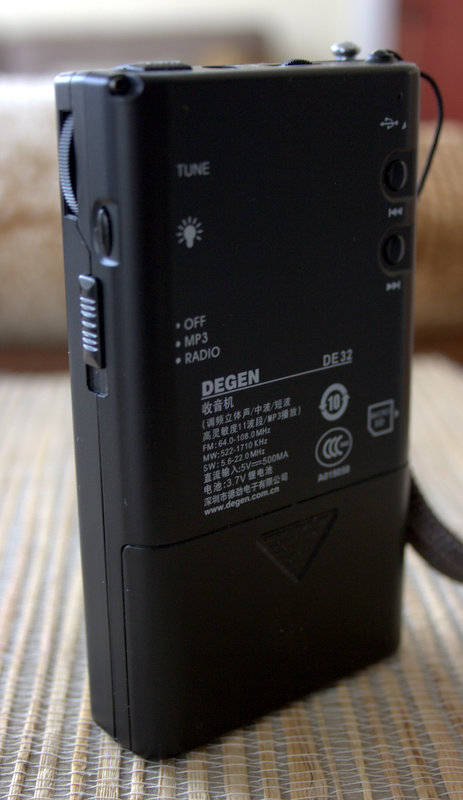
(Click to enlarge)

(Click to enlarge)

You’ll note that the DE32 sounds a little fuller than the DE321, but reception is nearly identical on this local strong medium wave (AM) station. I also found that the DE32 was quite effective at nulling out local RFI (electrical noises) on medium wave. At the beginning of the recordings, above, you’ll hear the static increase and fade as I null out the noise by turning the body of the radio. The DE321 couldn’t null out the local noise quite as effectively as the DE32.

For medium wave DXing, though, you’re better off finding a different ultralight radio. The AGC simply can’t handle marginal signals. Indeed, the same AGC problems plague the shortwave bands as well. DXing would be very unpleasant as the AGC circuit simply can’t cope with weak signals or fading.  All in all, as with medium wave, shortwave radio reception is fine for most strong signals.

Tecsun PL-380: What a difference an extra $23 makes

On shortwave, I decided to also compare the DE32 ($27) to the Tecsun PL-380 ($50). I tuned to a Radio Australia broadcast on 11,945 kHz. The comparison between these three portables is interesting:

First, the Degen DE32:

Now, the DE321:

Both the DE32 and DE321 struggled to receive the Radio Australia signal. In fact, if you really wanted to hear those broadcasts and had to listen on either radio for 30+ minutes  it would be frustrating and fatiguing. Notice, however, the difference when listening to the same broadcast with the Tecsun PL-380:

The Tecsun PL-380 receives circles around the DE32 and DE321 on shortwave and medium wave

The Tecsun PL-380 receives circles around the DE32 and DE321 on shortwave and medium wave (Click to enlarge)

There’s no comparison, really. In other words, you can hear it. The PL-380 has a lower noise floor, a fuller sound and no AGC problems as with the DE32 and DE321.  Hence the reason I always take the PL-380 while travelling–and as a back-up if I plan to record a broadcast on-the-go.

On the shortwaves, as with medium wave, the DE32 is respectable when tuned to a strong signal. For comparison to the weaker signals above, here is a short recording of the DE32 tuned to Radio Havana Cuba:

Not too bad, really. Keep in mind, though, that in my part of North America, Radio Havana broadcasts are so strong that I can pick them up without even extending the whip antenna on most portables.

Conclusion:

The DE32 has a built-in LED flashlight (Click to enlarge)

The DE32 has a built-in LED flashlight (Click to enlarge)

I haven’t tested the digital audio playback on the DE32 yet, although I expect the audio to be pleasant enough.  Of course, it lacks a display to show any information about the audio you’re playing, but it would be great to load a few podcasts or audio books on.

In summary, I’ve tabulated the pros and cons below from the moment I took the DE32 out of the box, below. Note that these pros and cons take into account the $27 price level of this radio:

Pros:

  • Very portable and lightweight
  • With micro SD card, storage for hours of pre-recorded content (though not tested in this review)
  • Adequate shortwave coverage (5.6 to 22 MHz) (see con)
  • Good audio fidelity, via headphones, on strong stations, slightly better than the DE321
  • Above average FM reception
  • Great nulling ability on medium wave (AM)
  • Features a built-in LED light (see con)
  • Overall build quality seems to be acceptable
  • Standard analog volume control (not digitally incremented levels)
  • Red LED tune light (see con)

Cons:

  • Shortwave sensitivity and selectivity are poor
  • Shortwave coverage lacks the lower tropic bands
  • Bandwidth is not adjustable and too broad for crowded conditions
  • AGC (as with many DSP portables in this class) cannot deal with weaker DX stations
  • Medium wave (AM) imaging on the shortwave bands if strong local station present
  • Antenna slightly loose in antenna hole when fully extended
  • No battery level indicator
  • No back stand
  • Tinny sound from tiny built-in speaker
  • To operate LED flashlight, you must press a button continuously to keep illuminated and LED  bulb orientation does not help with reading display in dark (see pro)
  • No option for standard AA or AA batteries–only included li-ion rechargeable pack
  • LED tuning light only works with very strong stations (see pro)
Conclusion? Though slim, lightweight and inexpensive,  I wouldn't find the DE32 DSP radio/digital audio player a useful radio in my collection.

Conclusion? Though slim, lightweight and inexpensive, I wouldn’t find the DE32 DSP radio/digital audio player a useful radio in my collection.

If I were you, would I buy it?

If you’re looking for a very inexpensive MP3/Digital Audio player with AM/FM and shortwave, and your expectations are fairly low, the Degen DE32 is a reasonable $27 piece of kit. Especially if you only plan to use the FM band.

If the digital audio playback abilities are not important to you, I would go with the cheaper ($18 US) Degen DE321.

But if you really want performance on medium wave and shortwave, and you could care less about digital audio playback, spend the extra $23 ($50 total) and buy the Tecsun PL-380, instead.  As you can hear above, it’s a much, much better receiver.

Finally: Official trailer for the movie The Numbers Station with John Cusack and Malin Akerman

The long-awaited trailer for the new movie, The Numbers Station:

We first mentioned the The Numbers Station in 2011, when it was still being filmed.

In this film, John Cusack’s character, Emerson, has been given the task of protecting Katherine (Malin Akerman), the operator of a shortwave numbers station that broadcasts encrypted messages to operatives. When the station is compromised in a surprise attack, they must work together to secure it and prevent distater.

According to the website The Digital SpyThe Numbers Station is scheduled for release in the US on April 26, though a UK release date has not yet been confirmed.

If you’re new to shortwave radio and wish to listen to numbers stations, follow the category Numbers Stations–we will post updates on the movie as well as several recordings of real numbers stations still in existence.

Voice of Russia: World celebrates all-uniting role of radio

WorldRadioDay(Source: Voice of Russia)

February 13 is World Radio Day. It’s a young holiday, just two years old, established on the initiative of the United Nations Educational, Scientific and Cultural Organization (UNESCO) in 2011. Representatives of all of the world’s major radio broadcasters, the Voice of Russia among them, have gathered at the UNESCO’s central headquarters in Paris to celebrate World Radio Day.

February 13 is not a random date. On that day in 1946, Radio UN aired its first broadcast. In his World Radio Day-2013 message, UN Secretary General Ban Ki-moon said that as a boy growing up in a poor village after the Korean War with neither phones nor television people still had something that connected them to the world outside their small village – they had radio. Since its invention more than 100 years ago, radio has sparked imagination and opened doors for change, entertaining, informing, promoting democracy and connecting people wherever they are, and “in conflict situations and times of crisis, radio is a lifeline for vulnerable communities,” Ban Ki-moon remarked.

About 95% of all people throughout the globe listen to radio regularly, chief of the UNESCO’s Communication and Information Sector Mirta Lourenco told the Voice of Russia:

“Radio remains the most easily accessible mass media. You can listen to it in the remotest corners of the Earth. Thanks to radio, people who cannot read or write have access to information. Radio plays a crucial role in emergencies, natural disaster warning and during rescue operations. For the UNESCO, World Radio Day is the acknowledgment of the tremendous use of which radio has been to humanity over more than a century.”[…]

Read the full article at the Voice of Russia website.

The relevance of shortwave radio for UNESCO’s World Radio Day 2013

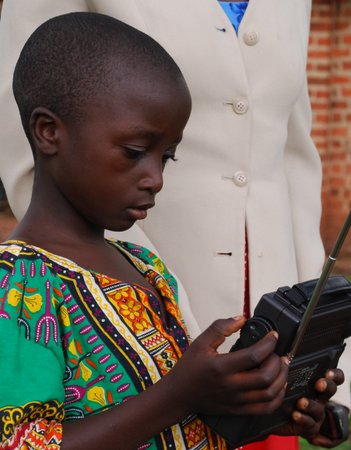
ChildSWRadioUganda

Student in Uganda tunes an Ears To Our World self-powered shortwave radio. (Photo: ETOW partner, The Empower Campaign, Uganda)

Wednesday, February 13th 2013 is World Radio Day.  UNESCO describes World Radio Day as “a day to celebrate radio as a medium; to improve international cooperation between broadcasters; and to encourage major networks and community radio alike to promote access to information and freedom of expression over the airwaves.”

A worthy cause.

UNESCO asked me to record a segment about our non-profit, Ears To Our World, and the relevance of radio in honor of World Radio Day.

Here’s my (brief) contribution: