Category Archives: Nostalgia

Photos from the 2022 Milton Ontario Hamfest

Many thanks to SWLing Post contributor, Mike (VE3MKX), who writes:

The following pictures are from a Hamfest which was held yearly at the Milton Fairgrounds in Milton Ontario, Canada. (Located 20 minutes west of Toronto).

The Burlington Amateur Radio Club organizes the event and confirms that they had 108 vendor spaces sold and over 475 general admin passed through the gates.

A great day of meeting friends, lots of deals and smiling faces!

Thank you so much for sharing this, Mike! I haven’t been to a hamfest yet this year, so it’s great to catch a glimpse of what looks like a very successful one! 

Readers: This is a large gallery of 132 photos courtesy of Kevin (VA3RCA) and Mike (VE3MKX). If you would like to view the entire image gallery click on the link to see more.  Continue reading

John recommends “A Call to Spy”

Many thanks to SWLing Post contributor, John (AE5X), who writes:

Hi Thomas: There’s an interesting movie now on Netflix that your readers might enjoy:
A Call to Spy.

Based on the story of Virginia Hall and two other female spies in WW2. She was trained in Morse Code and used a Paraset radio in helping the French Resistance in 1941-42.

Quite an amazing story, told more fully in Wolves at the Door.

John AE5X

Click here to read John’s full post on his excellent blog.

Thank you for the tip, John!

Adi spots an Eddystone among other radios in the Netflix series Spycraft

Many thanks to SWLing Post contributor, Adi, who writes:

Hi Thomas,

I just finished watching “Spycraft” on Netfilx. It’s 8X30min parts documentary.

The last part is “Recruiting the best spy“.

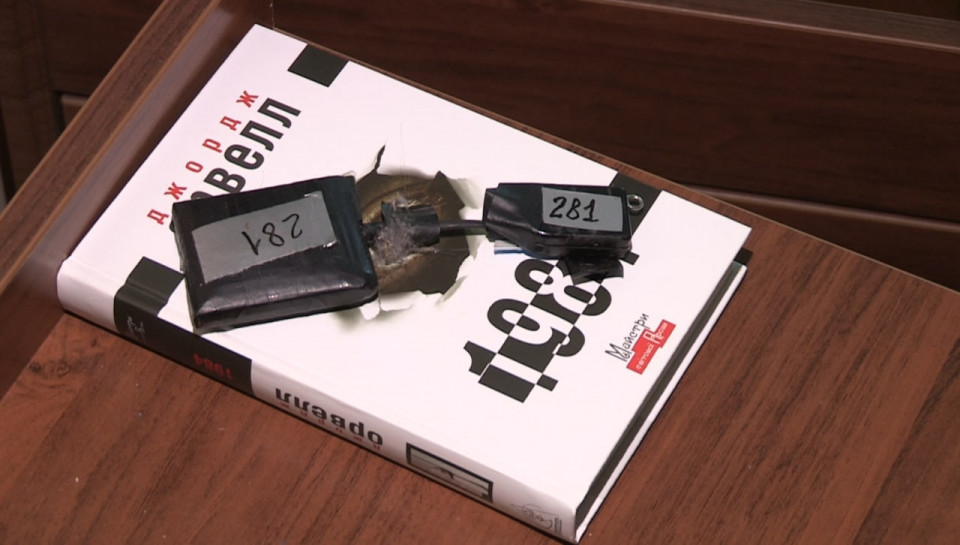
I first spotted this lovely 880 Eddystone receiver but coming into the ~20 min was the story of the ICF-2010 and how an American spy for Cuba used it to receive the “numbered” code massages.

Later on there is nice illustration how the code was used.

There are few other radios pop here and there on this documentary as you can expect from the Spy Craft .

73’s Adi

Thank you so much, Adi!  Some years ago, I actually read the book upon which I believe this series was based. Many thanks for the tip!

Dave spots a Realistic PRO-16 in WKRP episode

Many thanks to SWLing Post contributor, Dave (N9EWO), who shares the following:

“WKRP In Cincinnati” – “Tornado” S01 E12 (February 1979)

“The station staff finds themselves in danger when Herb unplugs a teleprinter just as it is receiving a local tornado warning.”

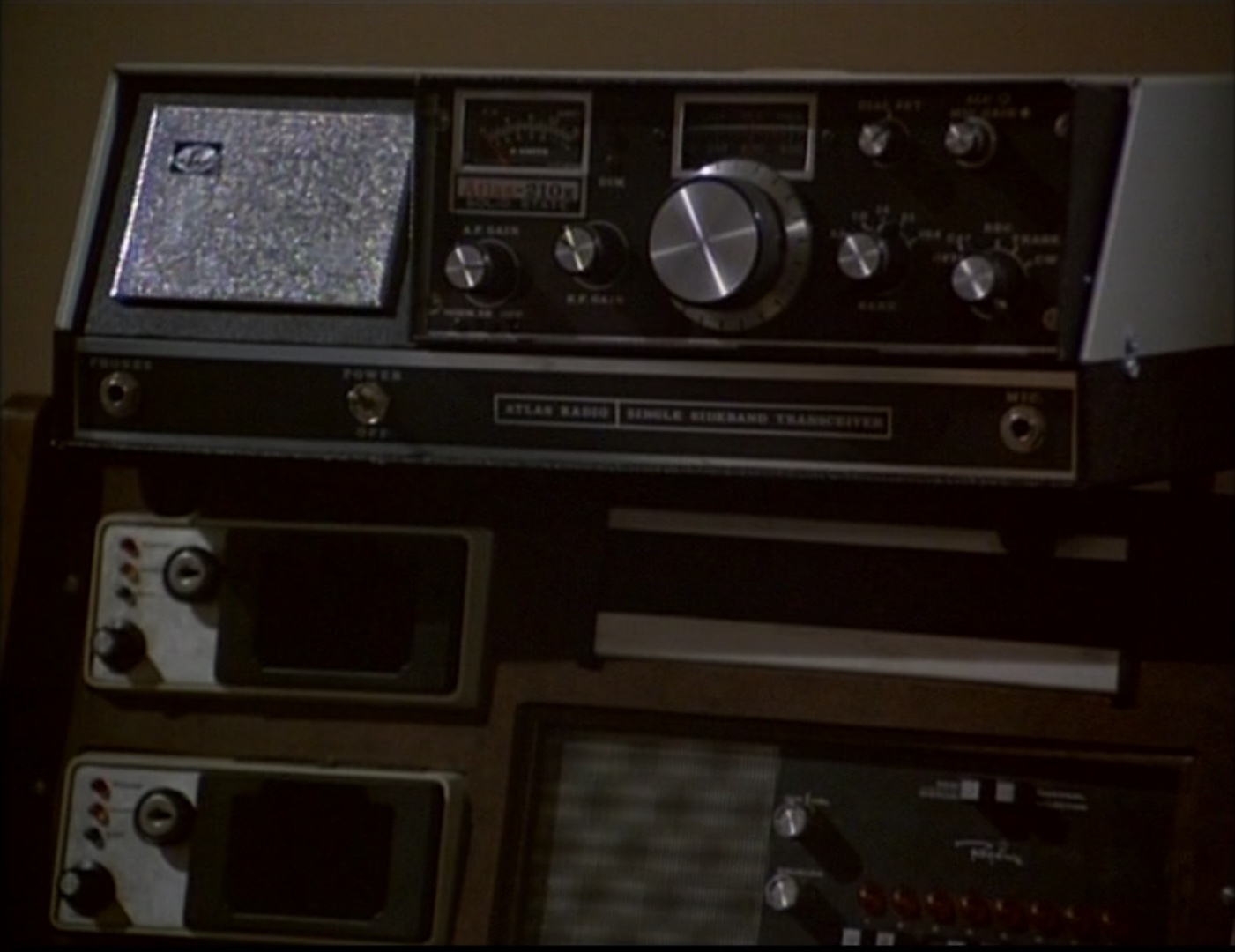
Look for the Radio Shack Realistic PRO-16 (cat no. 20-165) scanner receiver at 35:15 in this dual episode “Internet Archive” video. A Midland 13-902 weather radio sits on top of the PRO-16 scanner.

Dave Zantow N9EWO
Janesville WI

Sharp eyes there, Dave!  Thank you for sharing this! WKRP is classic!

Alexander shares a few photos and notes from Hamradio 2022 in Friedrichshafen

Many thanks to SWLing Post contributor, Alexander (DL4NO), who shares the following photos and notes from Friedrichshafen:


First Hamradio After Two Years

Alexander (DL4NO)

Finally the biggest amateur radio event in Europe happened again: Last weekend hams from Germany, Austria, Switzerland, France, Italy, Poland, Belgium, Netherlands, GB and more gathered in Friedrichshafen. The location is quite attractive, in Germany but near Austria and Switzerland. I could not get any numbers yet. But the event was quite a bit smaller than in 2017 when I was there the last time.

As every year amateur radio societies from Europe and the ARRL had booths. The most remarkable was from the Austrian OeVSV with their own stage. They had their own, quite interesting lectures. For example Austrian Hams have used the geostationary satellite QO-100 for LoRa experiments. They are quite active with LoRa as this technology allows to transmit data quite slowly, but quite far and with a minimum of power. Their project is called MeshCom. Continue reading

Radio Nostalgia: Bob’s first radio

Many thanks to SWLing Post contributor, Bob Colegrove, who shares the following guest post:


My Very First Radio

By Bob Colegrove

Sears and Roebuck Co., Silvertone, Catalog No. 8003, Model No. 132.818-1

I don’t remember much from 1949.  I was seven years old and still in the first grade.  I do remember being gifted a radio by my mom and dad on my birthday.  It was a Sears and Roebuck Co., Silvertone, Catalog No. 8003, Model No. 132.818-1.  I don’t really remember asking for it.  I’m sure mom and dad did not have a clue as to how consumed I would become with radio over my lifetime.  In truth, this was not the radio that got me totally absorbed, rather that function would be filled in 1958 by the Howard Radio Co. Model 308 combination MW/SW radio-phonograph console which had been relegated to the basement in favor of the TV set.

In 1949 television was on the cusp of success, and AM radio was still the one-way Internet of its time.  I recall my mother listening to countless soap operas during the afternoon.  The Howard was still in the living room and we listened to all the popular programs at night.  Anyway, the Silvertone was mine.  It took up residence in my room and I could independently explore the wonder of five local stations broadcasting in Indianapolis at that time.  There were no parental guidance settings on the Silvertone, nor was there any need.

The Silvertone was not a world-class radio with all the sensitivity, bells and whistles I would later desire.  Below WXLW, 950 kc it was deaf.  It was, in fact, one tube short of an “All American Five.”  However, one of its four tubes was dual function, if you counted the detector.  It was what was called an “ac-dc” radio.  This meant it could be powered by either 110 Vac or Vdc.  Granted, there were a couple communities in the US which were still serviced by dc power at this late date, but that fact certainly did not warrant advertising.  The whole thing always seemed to me no more than a marketing ploy on the part of manufacturers to cover for the lack of an expensive isolation transformer in the circuit.  Given the fact that electrical standards of the time did not provide for polarized outlets and power cords, these things could be quite hot, and it’s amazing so many tinkers, myself included, are around to talk about it.

One Tube Short of an “All American Five”  

The dial was very crude, and the tiny tuning knob swept all 107 available channels in a 180-degree twist of the variable condenser.  My mom, always handy with a paint brush, took to marking favorite stations  with a dab of nail polish.  1430 kc was WIRE and 1070 kc was WIBC.  Perhaps she got the idea from Bill Halligan who used little red dots on the controls to indicate the setting that would likely produce some noise.

The printed media were sizeable and substantive in the 1940s.  The Indianapolis Star’s morning edition for Friday, April 13, 1945 was particularly mournful as the U.S. woke up to the news that the president had died the day before.  I was later given to understand that many stations broke from the normal schedule for a few days to play somber music.  Notwithstanding, the first section still bore the quintessential hourly radio program schedule from 6 am to midnight for each of the four local stations.  We always kept clippings of station logs for each day of the week.

My interest in baseball grew over the next couple years, and the Silvertone played an important role in my keeping up with the local AAA team.  The static on a summer night was atrocious.  Further, in those days, the broadcasters were not compelled to fill the air with chatter between pitches.  There were no recitations of mindless statistics and no color commentators to describe the nuances of sliders and curve balls.  Consequently, between pitches there were often long pauses of nothing but dead air.  If you happened to tune in during a pause you had little idea where WISH, 1310 kc was on a hopelessly crude dial.

Most minor league broadcasters did not travel with the team.  When the team went on the road, they used an old Model 15 clickety-clack Teletype machine in the studio.  A local guy at the distant ballpark would observe a pitch or play, and quickly type a cryptic message on his Teletype.  On the radio you would first hear the receiving Teletype spring to life in the studio as the message came in.  The announcer would quickly interpret it, and then embellish the play with some excitement as best he could.

Teletype Model 15
Copyright Museums Victoria (Licensed as Attribution 4.0 International
https://creativecommons.org/licenses/by/4.0/)

During those times, it was not too uncommon for the Teletype to suddenly go down during the game.  What to do?  An announcer was suddenly left to his own creativity to fill in airtime.  Possible solutions were to describe the lengthy process of extricating a stray animal from the field, or a sudden cloudburst and consequential rain delay.  An intrepid announcer went on as nothing happened, making up the play-by-play over the interval.  Invariably, when the Teletype came back up, he found himself not quite in sync with the game and possibly a few runs behind.  At that point the challenge was to patch in the necessary play and go on to complete the game to the satisfaction of an otherwise unsuspecting audience.

Well, after 73 years, I’ve seen my share of radios.  In the meantime, the Internet has made it possible to DX the entire world at any time on a fifty-dollar Kindle – excellent fidelity, no interference, no noise, no fading.  But, after all these years, I still cherish those static-filled ballgames and teletype machines heard on the Silvertone a long time ago.

Quietly Waiting for the Next Pitch

Radio Waves: Future of AM in UK, BBC and Nuclear War, SAQ Unable to Air on Alexanderson Day 2022, ITU Ham Station Celebrates 60 years, and RRI International Quiz

Radio dial

Radio Waves:  Stories Making Waves in the World of Radio

Welcome to the SWLing Post’s Radio Waves, a collection of links to interesting stories making waves in the world of radio. Enjoy!


Opinion: The Future of AM Radio
England, Scotland, Wales and Northern Ireland (FrequencyFinder.co.uk)

Summary

AM radio in the British Isles is now in terminal decline with audiences dropping and many transmitters closed already. The majority of the remaining transmitters will likely close by the end of 2027. Over the next few years, the BBC and major commercial broadcasters will be looking to minimise their AM transmission costs by reducing transmission powers at the high-power sites and closing some of the low-power transmitters serving small audiences.

A coordinated AM shutdown may then follow at some point, most likely in 2027, though some independent broadcasters may continue using AM beyond this. This article explores these issues in more detail.

Click here to download the full PDF of this article.

The Last Word – The BBC and Nuclear War (Atomic Hobo Podcast)

This episode of the Atomic Hobo podcast focuses on the role of the BBC before and after nuclear attack:

https://soundcloud.com/user-494087291/the-last-word-the-bbc-and-nuclear-war

Click here to listen via Soundcloud.

SAQ unable to air on Alexanderson Day (The Alexander Association)

Note: the The Alexander Association has announced that they will be unable to put SAQ on the air this year on Alexanderson Day. There are no more details other than the title of their post (the content still reads as if the transmission will happen as planned).

Check the Alexander Association website for more details.

ITU’s ham radio station celebrates 60 years on air (ITU)

By Nick Sinanis, callsign SV3SJ, President of the International Amateur Radio Club (IARC), and Attila Matas, callsign OM1AM, Vice-president and Station Manager, IARC

Did you know that the United Nations specialized agency for information and communication technologies owns and operates its very own radio station?

Residing at the headquarters of the International Telecommunications Union (ITU), the 60-year-old amateur station operates under the callsign 4U1ITU.

It started broadcasting on 10 June 1962 and was officially inaugurated the following month by then UN Secretary-General U Thant and ITU Secretary-General Gerald Gross – himself a ‘’ham” radio enthusiast known by the personal callsign W3GG.

Recognized as a unique “country” in the ham radio community, 4U1ITU operates in accordance with privileges extended by ITU and the Government of Switzerland. It has also earned the DXCC (or ham radio “century club”) award from the American Radio Relay League (ARRL), confirming air contacts with 100 or more countries.

From its long-time home on the 5th floor of the Varembé Building in Geneva’s international district, this unique broadcasting outlet still today serves as a model for the highest standards of amateur radio station operation everywhere.

From one to a million

4U1ITU’s first contact, or “QSO” in ham radio parlance, was made with a German station called DL4VK. Further QSOs followed, amounting to over 1,300 contacts worldwide in the first 24 hours.

In the six decades since, ITU’s radio station has made over a million contacts using Morse code carrier wave (CW), voice (SSB), and digital operational modes, based on more than 20,000 two-way QSOs with radio amateurs around the world.

4U1ITU can operate on most of the frequency bands allocated to amateur and amateur-satellite services as identified in Article 5 of the Radio Regulations.

Aside from letting licensed radio amateurs in ITU, its Member State representatives, and its conference and meeting delegates contact fellow radio hams, the station promotes international goodwill and cooperation across the community. It also allows hands-on demonstrations of amateur radio communications for delegates and meeting participants. [Continue reading…]

RRI Voice of Indonesia: International Quiz 2022


Do you enjoy the SWLing Post?

Please consider supporting us via Patreon or our Coffee Fund!

Your support makes articles like this one possible. Thank you!