Category Archives: Radio Modifications

Guest Post: Communications Service Monitors – A Radio Hobbyist’s Perspective

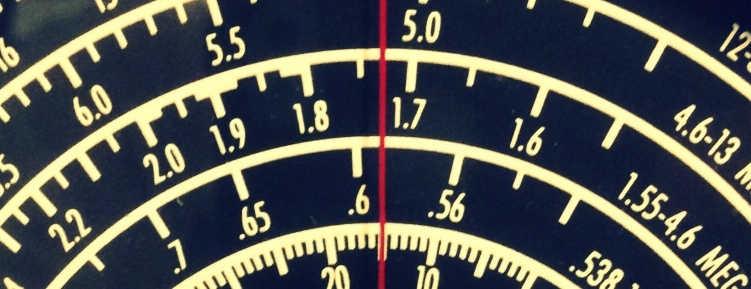
SX-99-Dial-Nar

Many thanks to SWLing Post contributor, Mario Filippi (N2HUN) for the following guest post:


Communications Service Monitors – A Radio Hobbyist’s Perspective

Mario Filippi, N2HUN

(All photos courtesy of author)

Over the past few decades I lusted after a communications service monitor for my radio hobby but prices were always prohibitive; several thousands of dollars for a new model and tens of thousands for high-end ones. Not being a working professional in the communications field made it difficult to justify purchasing a piece of equipment whose price tag rivaled a down payment on a house. So, fast forward a few decades later and now life and times have fortunately changed for the better; the house is paid for, the job is secure, the income is finally steady, life is good financially, and to boot many of these older service monitors manufactured by Ramsey, Motorola, Wavetek, IFR/Aerotek, Cushman etc., are currently being sold on the pre-owned market at a fraction of their original decades-ago hefty prices. These service monitors are finally in financial reach of electronics hobbyists who will find many uses for these former electronic workhorses that toiled many years in the industry and now, in their golden years are being retired and becoming available for a second life via reuse/reincarnation/repurposing/reinvention.
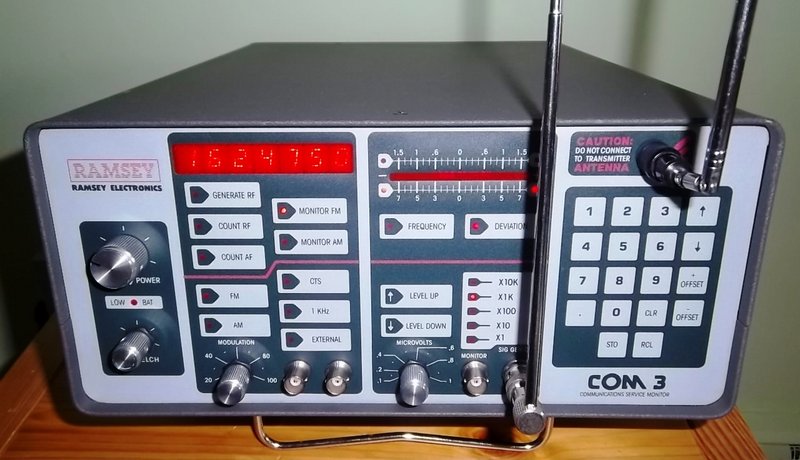
Work of Art: Author’s Ramsey COM3 Service Monitor

Work of Art: Author’s Ramsey COM3 Service Monitor

So what exactly is a communications service monitor, or “service monitor” as the folks in the trade refer to? Well it is an instrument for servicing AM and FM radio equipment, although some units also have the ability to service SSB equipment. The service monitor is basically a highly accurate and precise receiver and low-power signal generator all in one allowing a technician (or electronics hobbyist) to perform service, repair, or alignment of radio equipment. Most of us have had the experience of owning a malfunctioning radio whether it is an AM or FM broadcast radio, two-way radio such as a CB (Citizen’s Band) radio, pager, or a ham radio transceiver, and that is where a service monitor proves its value and utility because now you, the hobbyist, can perform the work yourself.
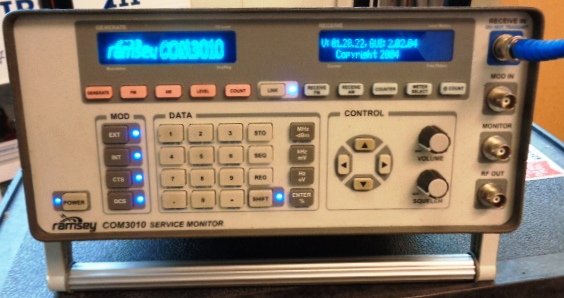
My Friend’s Ramsey COM3010 Service Monitor, Big Brother of the COM3

My Friend’s Ramsey COM3010 Service Monitor, Big Brother of the COM3

As a radio enthusiast (shortwave, ham radio, satellite communications) for over half a century, I’ve definitely owned more radios than shoes; everything from AM, FM, shortwave receivers to CB radios to ham transceivers, all in different stages of health and vintage. For years I relied on standalone RF signal generators, audio generators, frequency counters, and CTCSS decoders to aid in rehabbing, troubleshooting, and aligning each of the many units that paraded past my radio shack. Then one day a friend showed me his service monitor, the Ramsey COM3010, another venerable workhorse still in production, and it was a defining moment; the time had come to invest in one.
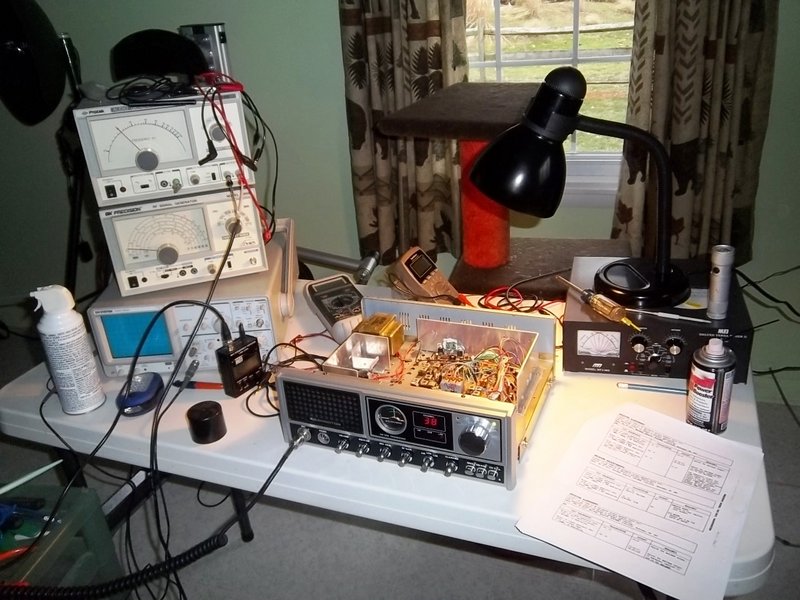
Aligning a Uniden President Washington CB Radio Prior to Owning a Service Monitor

Aligning a Uniden President Washington CB Radio Prior to Owning a Service Monitor

My Ramsey COM3, purchased second-hand from an Internet auction site for $400.00 is a no frills, basic unit without the features found in more sophisticated service monitors having built-in oscilloscopes, spectrum analyzers, frequency sweeping ability, and frequency scanning ability. The COM3 was in production from the late 1980’s to around 2003 at a price of around $2500 (ca. 1989) and was considered a workhorse in its time, weighed 13 pounds with the internal battery, and was easily luggable from site to site. It covers from 100 KHz to 999.999 MHz and has become an invaluable tool in my radio shack for measuring a transmitter’s operating frequency and deviation, measuring receiver sensitivity, S meter calibration, and checking CTCSS tones on my two way VHF/UHF radios. My unit evidently had an easy former life as the only needs were to replace the internal battery, perform an external cleaning, check transmitter and receiver accuracy and check accuracy of the internal audio generator. Interestingly, Ramsey Electronics (www.ramseytest.com) still services and calibrates COM3s.
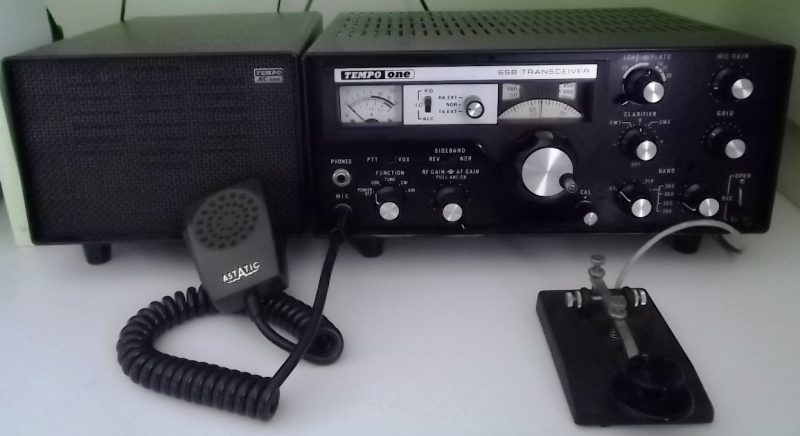
Vintage Tempo One Transceiver Restoration Was Made Easier with the COM3 on the Bench

Vintage Tempo One Transceiver Restoration Was Made Easier with the COM3 on the Bench

So, if you’ve been dreaming of owning your own communications service monitor either as a hobbyist or small repair radio shop proprietor then start looking as there are plenty of used units out there; you’ll pay top dollar when buying from a commercial vendor but at least you’ll get some form of warranty. If instead you travel the same road I did, via an Internet auction site, there’s lots more risk involved, but the plus is you’ll save big if you do your homework by checking past auctions, seller feedback scores, and determining what price the market is bearing by looking at the winning bids. In closing, the COM3 owner’s manual is available on line by doing a simple search, and a review of the Ramsey COM3 by Larry Antonuk which appeared in the August 1989 issue of 73 Amateur Radio Magazine is also available as a free download.


Mario, thank you for another brilliant guest post! I always learn something new from your articles. By the way: I have that same Nye Viking straight key–it obviously pairs beautifully with the Tempo One!
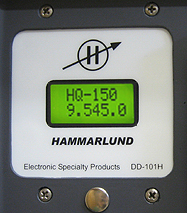
Hammarlund HQ series: A digital display modification

HQ-DisplayMany thanks to SWLing Post reader, Jeff (KB7AIL), who shares the following:

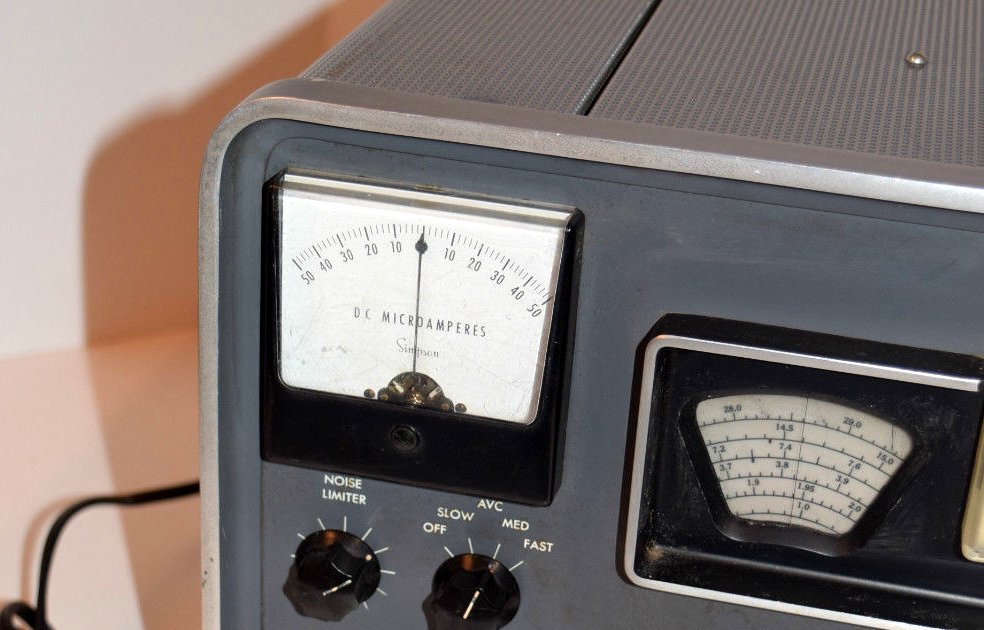
Saw the article on the DC meter in a Hammerlund HQ180.

Another mod I have seen is replacing the meter with a digital display.

http://www.electronicspecialtyproducts.com/dd101.html

It integrates with the HQ180 nicely.

They also have digi-displays in cases or use with other receivers/transceivers.

Very cool, Jeff. While I know a digital display might kill the vintage look for some enthusiasts, I have to admire such a useful modification to replace a broken Hammarlund clock/meter.

As Jeff mentions, Electronic Specialty Products has a number of external digital display boxes as well. Check out their full line of products on the ESP website.

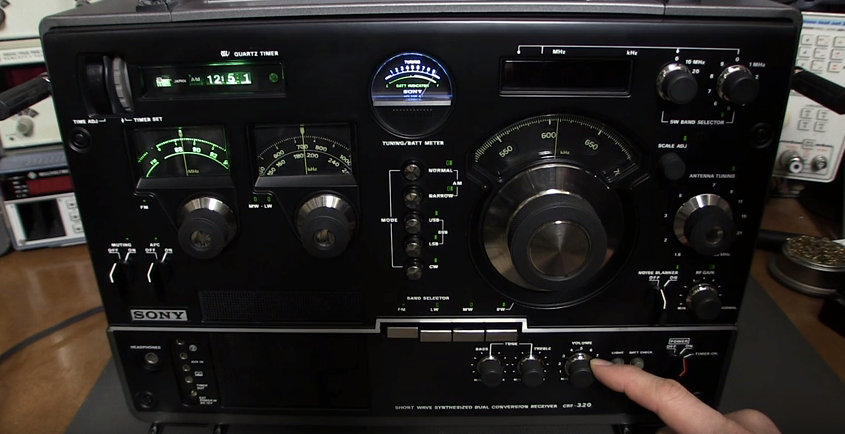
Video: Repairing, restoring and modifying a Sony CRF-320

Sony-CRF-320

Many thanks to SWLing Post contributor, Ken McKenzie, for sharing the most comprehensive video you’ll ever find on restoring the Sony CRF-320 receiver:

Click here to watch on YouTube.

Make sure you check out Mr. Carlson’s YouTube channel, Mr. Carlson’s Lab where you’ll find repair videos ranging from solid state to tube gear.

Thanks for the tip, Ken!

Dan notes a unique modification on this Hammarlund HQ-180A

Hammarlund-HQ-180A

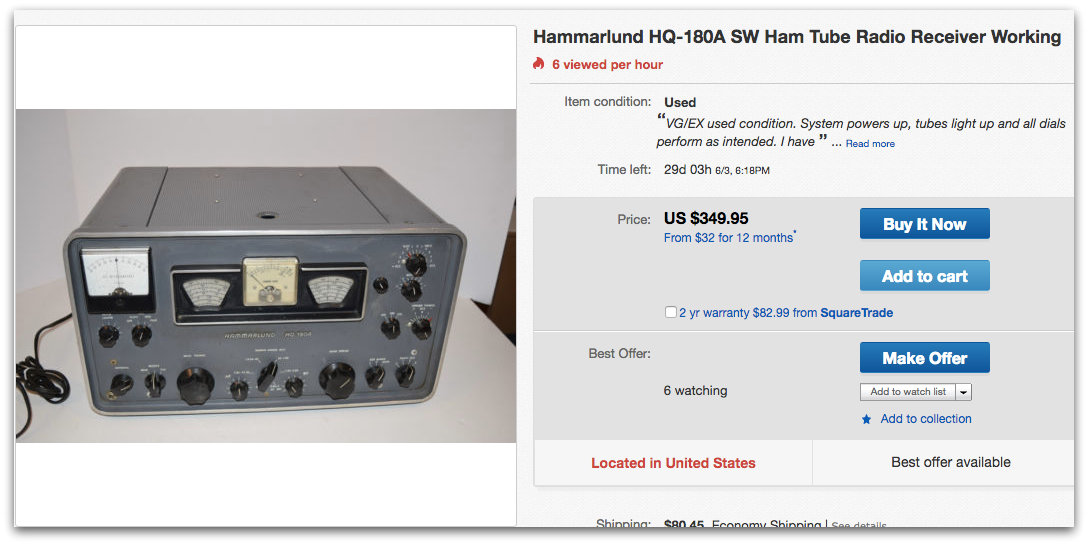
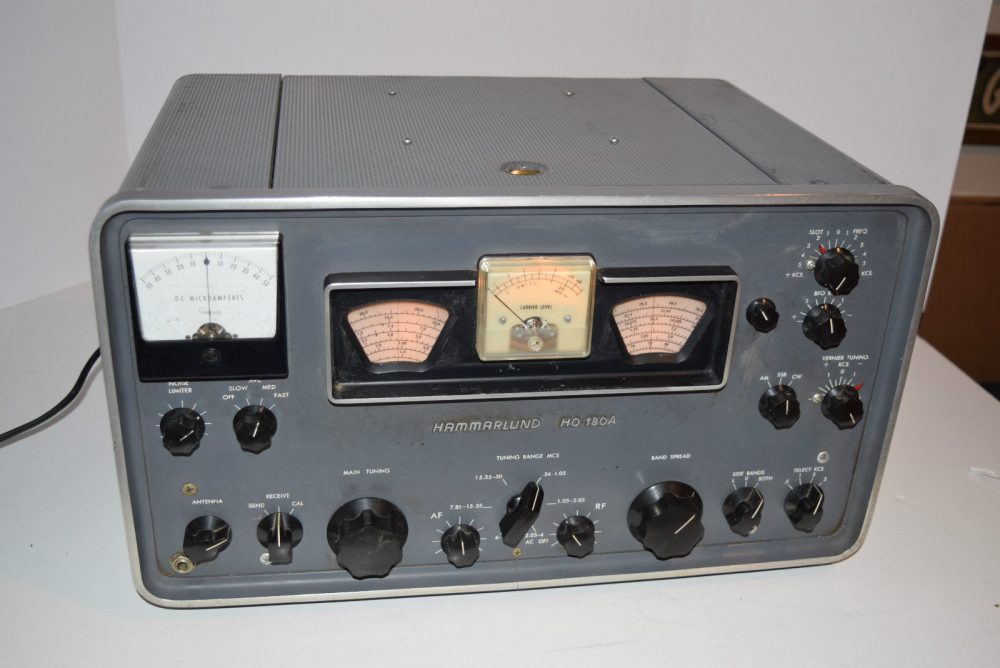
Many thanks to SWLing Post contributor, Dan Robinson, who shares a link to this eBay listing of a Hammarlund HQ-180A and notes:

Whoever owned this Hammarlund HQ-180A installed a DC meter where the clock or crystal unit usually is.

Hammarlund-HQ-180A-Mod

s-l1600 (1)

And the screws on the top of the hatch seem to indicate installation of a DC supply perhaps?

Click here to view on eBay.

Like you, I’ve never seen this particular mod to the HQ-180A, Dan.

I’m curious if the owner installed the DC meter to replace a broken or missing clock?  Though I’ve never searched for one, I suspect those Hammarlund clocks are getting more difficult to find on the used market.

LimeSDR is now in the crowdfunding stage

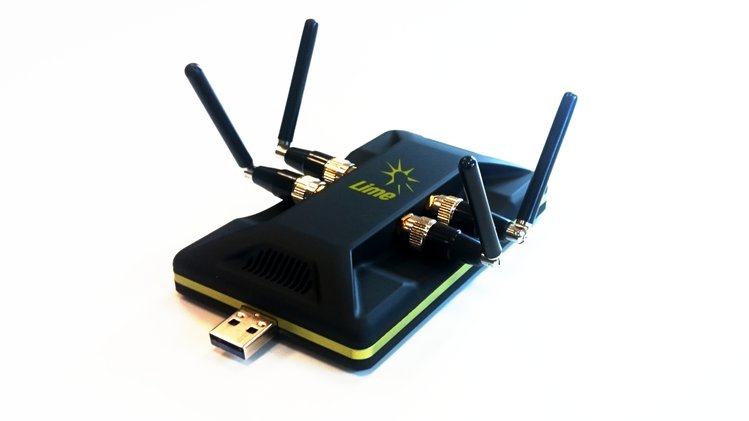
Lime-SDR-Aluminium-Case

There’s a new SDR under development–one that is promoted as a “Flexible, Next-generation, Open Source Software Defined Radio.”

The LimeSDR‘s goal, essentially, is to democratize what I call the “RF of things.”

My friend, Bernie S, told me about the LimeSDR a couple months ago and I’ve been following progress since then.  It’s a fascinating concept and one that is being supported by the likes of Canonical Ltd.

Earlier today, LimeSDR launched a crowdfunding campaign on CrowdSupply. If early activity is any indication, I expect the team will easily exceed their goal of $500,000 (already 10% funded at time of posting).

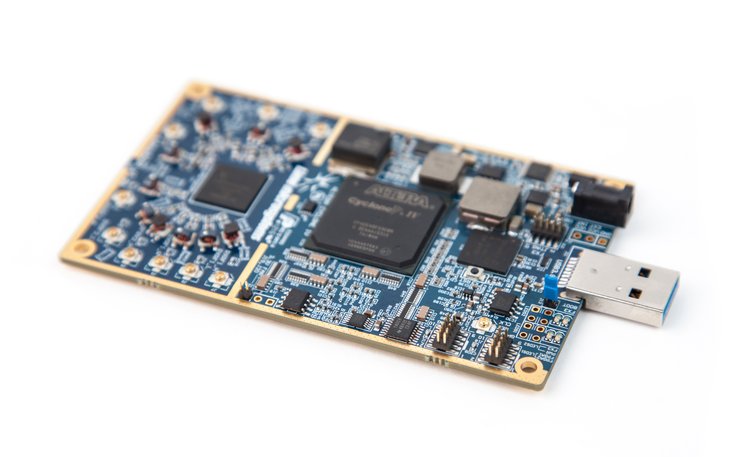
limesdr-8_jpg_project-body

Here’s information from LimeSDR’s CrowdSupply page:

A Software Defined Radio for Everyone

LimeSDR is a low cost, open source, apps-enabled (more on that later) software defined radio (SDR) platform that can be used to support just about any type of wireless communication standard, including UMTS, LTE, GSM, LoRa, Bluetooth, Zigbee, RFID, and Digital Broadcasting, to name but a few.

While most SDRs have remained the domain of RF and protocol experts, LimeSDR is usable by anyone familiar with the idea of an app store – LimeSDR is the first SDR to integrate with Snappy Ubuntu Core. This means you can easily download new LimeSDR apps from developers around the world. If you’re a developer yourself, then you can share and/or sell your LimeSDR apps through Snappy Ubuntu Core as well.

The LimeSDR platform gives students, inventors, and developers an intelligent and flexible device for manipulating wireless signals, so they can learn, experiment, and develop with freedom from limited functionality and proprietary devices.

From Radio Astronomy to Personal Telcos

Here are just some of the applications that are possible with the LimeSDR:

  • Radio astronomy
  • RADAR
  • 2G to 4G cellular basestation
  • Media streaming
  • IoT gateway
  • HAM radio
  • Wireless keyboard and mice emulation and detection
  • Tire pressure monitoring systems
  • Aviation transponders
  • Utility meters
  • Drone command and control
  • Test and measurement
  • Many more…

With state-of-the-art technical specs, a fully open hardware and toolchain, and integration with Snappy Ubuntu Core’s app distribution platform, LimeSDR is limited only by our collective imagination.

Features & Specifications

  • RF Transceiver: Lime Microsystems LMS7002M MIMO FPRF (Datasheet)
  • FPGA: Altera Cyclone IV EP4CE40F23 – also compatible with EP4CE30F23
  • Memory: 256 MBytes DDR2 SDRAM
  • USB 3.0 controller: Cypress USB 3.0 CYUSB3014-BZXC
  • Oscillator: Rakon RPT7050A @30.72MHz (Datasheet)
  • Continuous frequency range: 100 kHz – 3.8 GHz
  • Bandwidth: 61.44 MHz
  • RF connection: 10 U.FL connectors (6 RX, 4 TX)
  • Power Output (CW): up to 10 dBm
  • Multiplexing: 2×2 MIMO
  • Power: micro USB connector or optional external power supply
  • Status indicators: programmable LEDs
  • Dimensions: 100 mm x 60 mm

Bernie has encouraged me to evaluate the LimeSDR. I may very well attempt to do so, but frankly, I don’t have the experience to truly unlock this device. I am curious if it would make for an amazingly useful little all-in-one HF/VHF/UHF digital decoding device. In fact, I’m pretty sure it would be an easy task for the LimeSDR.

Any Post readers out there plan to back the LimeSDR project? If so, please comment and tell us how you plan to use the LimeSDR.

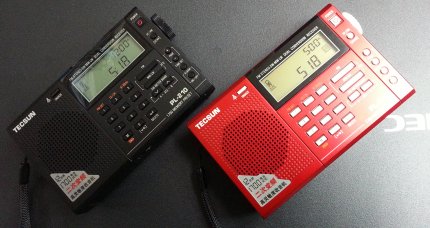
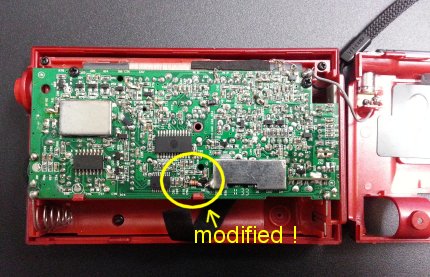
Simple modification to disable soft mute on the Tecsun PL-210

pl210_mod4

Many thanks to SWLing reader, Mini, who wites:

I am Japanese short wave listener.

I found the method that disable soft-mute of TECSUN PL-210.
And, I posted the article in my blog.

pl210_mod1

Please forgive me that may be difficult for you to understand the content.
It is automatic translation from Japanese my blog.

Thanks mini

Click here to read Mini’s blog post via Google translate.

Click here for the original in Japanese.

Thank you, Mini! I don’t have the PL-210, but if I did I would certainly disable the soft mute as I find it very distracting during routine band scans.

Aluminum foil: Larry’s simple AN200 antenna modification

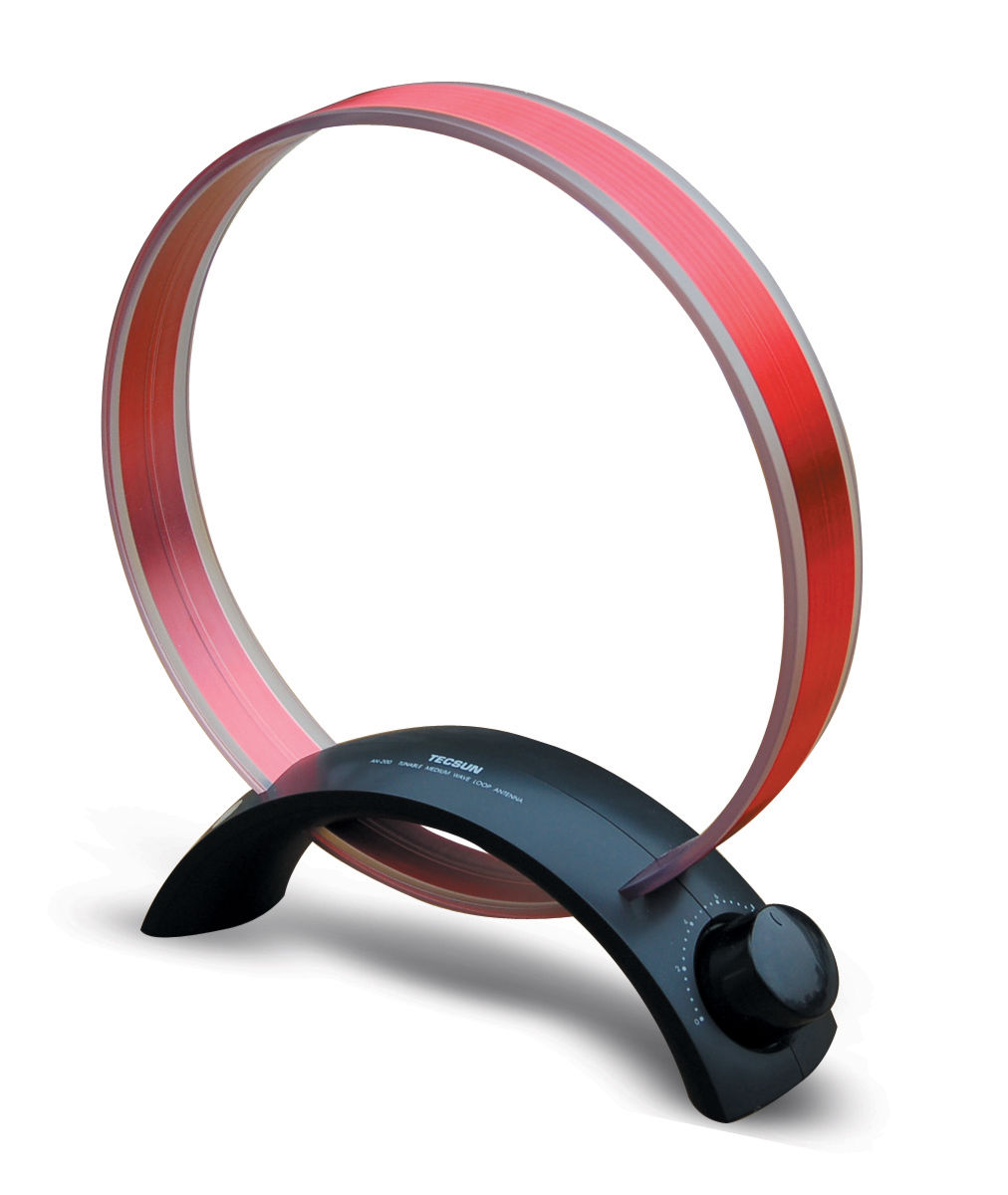
TecsunAN200

Many thanks to SWLing Post reader, Larry Caracciolo, who comments:

I bought the AN-200 in the spring of 2015 off of eBay. I was favorably impressed with the product. Comparing it to my old 9′ diameter tuned/shielded loop from 1992, there are some similarities and differences.

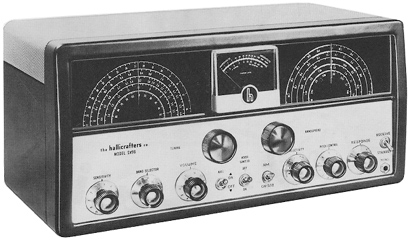
The Hallicrafters SX-96 (Image: Universal Radio)

The Hallicrafters SX-96 (Image: Universal Radio)

I live in an apartment complex so plenty of radiated electromagnetic noise is present. I use a modified [Hallicrafters] SX-96 (AVC ckt was modified for improved modulation acceptance). The AN-200 does null out local static sources, somewhat, but not well enough to dig out weak stations. The tuning range for the loop is just at the bottom of the AM band (about 535 khz) to just over 1700 kcs.

On a whim, I wrapped aluminum foil around the loop and grounded it to the SX-96 chassis – in wistful hope of achieving some shielding from the RF has. As soon as I connected the aluminum foil ground clip to the rx chassis, all RF noise ceased and signals appeared from the mud. However, the tuning range is attenuated above 1200 kcs.

My favorite frequency on the AM band is 590 kcs. During the night, as many as seven different stations rose from the noise and provided station IDs at just the right moment. My best catch here in Everett, WA is KCSJ, a 1KW station in Colorado Springs.

From time to time, stations on the low portion of the AM band are accompanied with echoes – what I took for two stations and a small time delay between the same broadcast was actually multi-path to the degree that nearly 1/2 second separated the arriving signals. Short-delayed echoes, anyone? I’ve not observed this on frequencies above 1000 kcs.

Other sources of RF noise can come from the laptop, the cable modem, and even CFBs in other rooms. For truly noise-free listening environment, I place the laptop in sleep mode and unplug the cable modem. I’m quite happy with the AN-200 loop. Affordable, easy to use, easy to tune.

Thanks so much for sharing your experience with the AN200 loop antenna, Larry!

As anyone who grew up in the era of TV rabbit ears knows, aluminum foil can simply work magic in a pinch! There is no easier material to work with either!

As I pointed out in previous posts, the AN200 loop antenna is quite affordable.  I just did a quick price search: