Category Archives: Radios

MLite-880 Review: Advanced SDR Performance in a Traditional Portable Design

Many thanks to SWLing Post contributor Dan Robinson, who shares the following review:

MLite-880 Spectrum Display Portable:  Advanced SDR Performance in Traditional Portable Clothes

by Dan Robinson

For years, radio listening hobbyists (as many of us who are still around in 2026) have had numerous choices when it comes to portable receivers.  Those of us who got our start as DX’ers/SWLs in the 1960’s (some earlier) or 1970’s have seen a lot of hardware come around the corner.

Some years ago, the Malahit/DSP receivers, firmware, and hardware designed and made in Russia appeared.  There was the Belka, amazingly small but a superb receiver that many of us still use.  Although shortwave broadcasting has generally been on the decline, we were lucky that companies such as Tecsun, Sangean (reported to have now stopped all production of SW portables), and other China/Taiwan-based companies continued to make impressive portables.

ICOM, Yaesu and Kenwood began putting spectrum scopes in displays a long time ago.  ICOM’s IC-R9000 (produced 1989 to 1998) was the first to bring that feature. The more recent Icom 7300, 8600, and 9500 demonstrated far more advanced spectrum displays, as did Kenwood.  Ten Tec in its original form put rudimentary spectrum display capability in its RX-350/Jupiter receiver/transceiver.

Today, we’re seeing a number of HT units with some kind of spectrum display.  The Radtel 950Pro is one example of this.  ICOM’s IC-R30, discontinued but a superb wide band unit, also has a spectrum option though quite limited.  Various China-based companies started putting spectrum displays into the ATS series of receivers, and scope displays became standard on transceivers by Xiegu and others.

Malahiteam in Russia licensed firmware out to a range of China-based manufacturers.  The China-made “ATS” portables available from AliExpress and Banggood have been through numerous versions, including the ATS25 Pro + AIR desktop, the ATS25 Ultra, ATS25 XF (see https://www.youtube.com/watch?v=LJC-pAu4nUk), and these are increasingly emphasizing the spectrum option on the display. There have been some very interesting front panel designs such as the DP-666 based on the TF6686 chip, and the AMNVOLT ESP138, the first with dual 4732/6686 architecture (see:  https://www.youtube.com/watch?v=m1njJskDSUI&pp=ygUMZXNwMTM4IHJHzGlv)

What we had not seen until recently was anyone putting a spectrum display into a “traditional” portable cabinet (some years ago, I had suggested to County Comm/Maratac which has carried a re-badged Tecsun PL-368 that they consider doing so. At one point I received from them a photo of a prototype which looked like a PL-368 with a spectrum display at the top.  But to my knowledge nothing was done to advance that to market).

WHAT IS THE MLite-880?
There have been a number of reviews/demonstrations on YouTube of the MLite-880, including by Tech Minds (see:  https://www.youtube.com/watch?v=cmO8TIr_VFo).  One of the most extensive is a nearly hour-long review by a Russian YouTuber RADIOCHIEF.RU (see:  https://www.youtube.com/watch?v=ut6cY2jZv7Q&t=1065s) and another excellent overview by Radio Bunker here:  https://www.youtube.com/watch?v=wgcRoha-mfM).

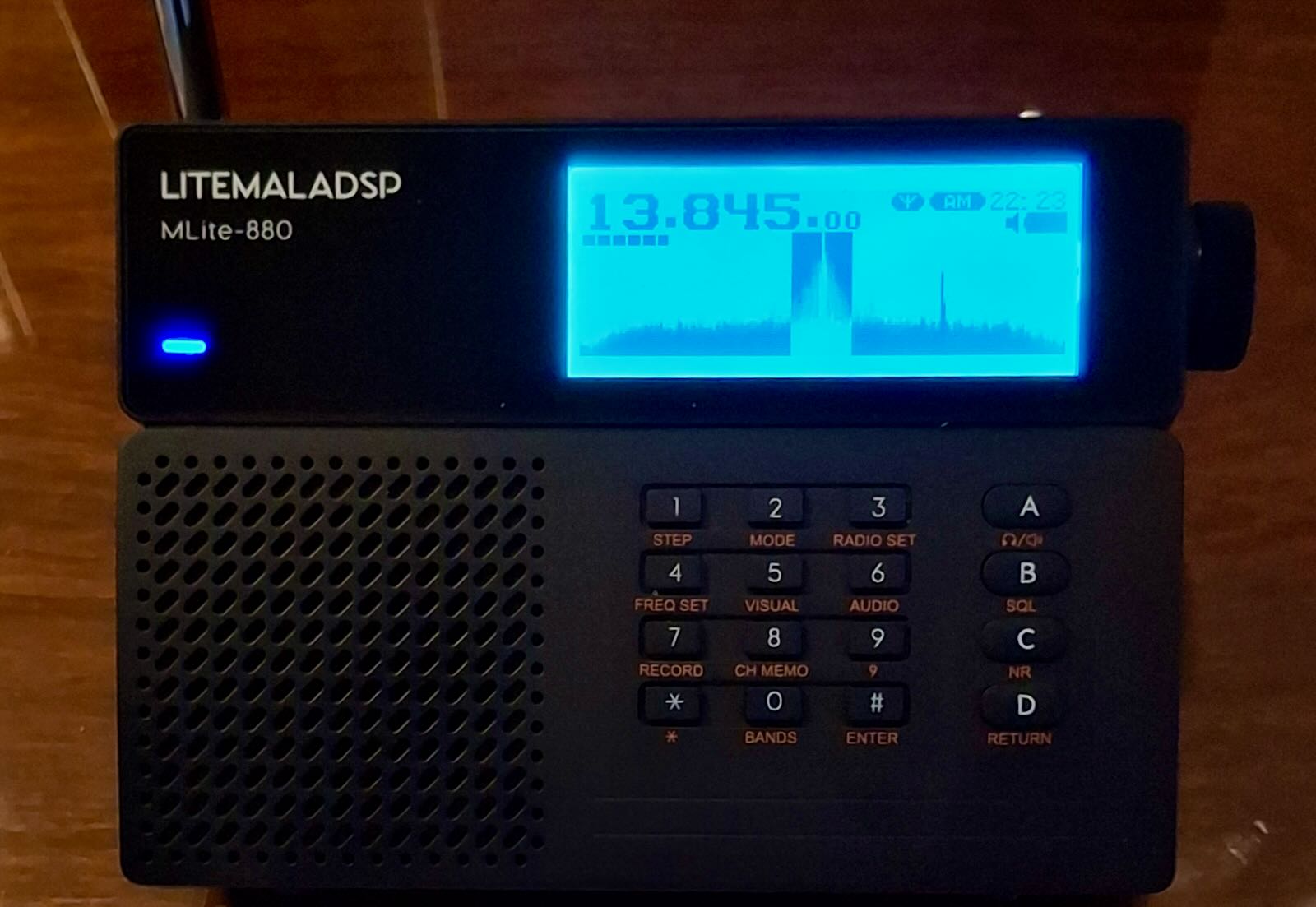
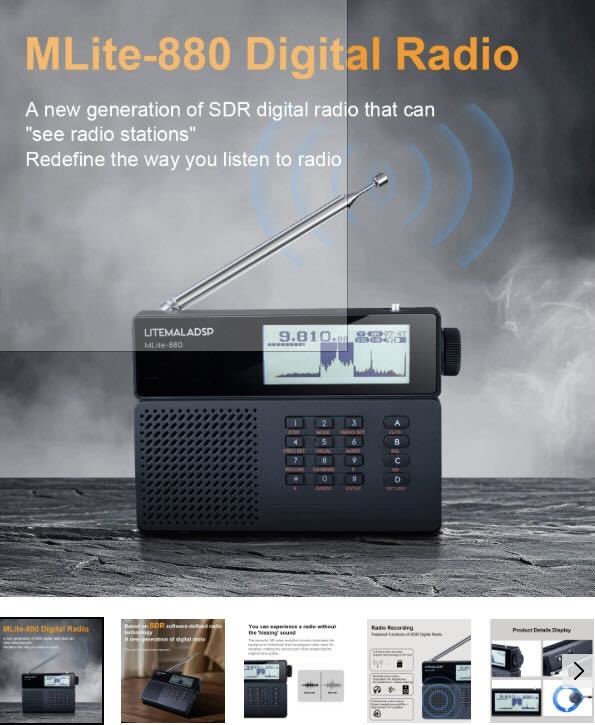
The major feature can be seen at power on.  Instead of just a digital/numerical display of frequency we see the frequency AND below, a 40 kHz slice of spectrum.  As the advertising description on the Elecevolve.com website states:

“A new generation of SDR digital radio that can “see” radio stations” . . . and “the radio in people’s impressions stays in the last century.” 

The message that Malahiteam wants to convey is clear:  this is a major step forward from portable design of the past.

The radio is very light, with a back-stand and a fairly robust whip antenna which stands at an angle when the receiver is being used with the back-stand (unfortunately, the antenna base does not allow it to go vertical).
Around the cabinet, there are a minimum of controls:  on top, we have a simple power-on/off switch and a microSD slot (more about that later).  USB-C and headphone jack are on the right, and an external antenna jack on the left.  The frequency display module of the radio looks like just that — it’s on top above the multi-function keypad and ABCD keys.  As for mode displays, there are battery and Bluetooth lights below and next to the LITEMALADSP letters.  On the back, we find the 21700 battery compartment, and on the back-stand, we find information about the receiver, but no “Made in…” information whatsoever.

From the videos, and certainly from the name of the radio (LITEMALADSP) we have the impression that the MLite-880 is a cost-reduction version of the Russian DSP/2/3 receivers.  Neither 4732 nor TEF 6686 chips are used.  While one video review states that an MSI-SDR-M1 chip is inside, Georgiy at Malahiteam states that this is not so.

There was obviously a deliberate choice of the 21700 battery rather than 18650 used in Tecsun, Choyong, and other portables.  First adopters say that so far, this battery keeps the receiver going for hours, something I can confirm.  Anyone unfamiliar with professional type batteries like this should invest in a good standalone charger; if you already own a Tecsun PLxxx or D808 portable you will be familiar with 18650 and similar cells.  [UPDATE]:  Larger size 21700 battery does not fit — the battery provided with the radio is a EVE INR21700/50E

The inclusion of a backstand is very welcome, since Russian DSPs and China-made SDR portables often lack one.  The whip antenna is not thin and flimsy like those found on some China-made small portables.  There’s a mini to SMA adapter included in the box.

One reviewer notes that high-speed microSD cards are needed because files are recorded in WAV format.  Georgiy at Malahiteam states that 16 and 32 GB cards have worked, BUT one user reports a 256GB card worked.  Recording capability is a feature seen on other portables like the Raddy RF919.  A good sized speaker is on the left.  The tuning knob has a dual push-pull function for volume and frequency change.

And the radio has Bluetooth capability, which worked fine when I first tried it with a Bluetooth speaker.

In menus under “About” we see “Designed in Russia/Made in China.” I recommend that readers view the various videos available online.  While I was in the process of writing, I was surprised when the MLite-880 I had ordered from Banggood showed up on my doorstep.  So, I’m able to provide initial impressions, and when a second unit arrives here, I’ll do some unit-to-unit comparisons.  [NOTE:  Testing done using only the onboard whip antenna]

VIDEO: UNBOXING AND DEMO

Click here to view on YouTube.

“LITE” BUT NOT LIGHT ON FEATURES
If this is supposed to be a “Lite” version of the Malahit DSP receivers, whether the original Russian-made units or those from China, that would not be apparent to someone using this receiver for the first time.  Numerous options are brought over from the Malahiteam DSP.  We have synchronous reception (but see below) and the ability to correct calibration variations.  Recalibration and BFO fine adjust is something we see on Tecsun portables, and China-made SDRs, and the AFEDRI SDR.

I won’t list everything, but we also see Hi-Z/50 Ohm, BiasT, Attenuation, and options for adjusting display brightness, spectrum average, spectrum fill, and RDS view.  That is quite a lot of flexibility and reminds me of what we find on receivers costing thousands of dollars.  Under Audio settings, we see Filter Type, Filter Low Freq, Filter High Freq, and variable Noise Reduction.  One reviewer asserted that NR “works significantly better than on the Russian-made DSP-3, which costs near $500,” and based on my first tests, I agree.  NR runs from 0 to 15 and, once set, can be quickly activated by pressing the C button on the right labeled NR.  Overall filtering ranges:  0 to 8 Hz, 0 to 12 Hz, 0 to 15 Hz for the three designated filter positions.

AGC settings include AGC limit, AGC gain, and manual control, all settable in dB.  On a third page of options, we find NB Mode, NB Threshold, Equalizer Type, Key Beep Level, and SQUELCH Threshold.  Recording is accomplished with a direct access button (NOTE:  I had some problems getting record working with a 1GB microSD but switched to a FAT32 8 GB and it worked).  A quite nice printed manual shows the modes: USB, LSB, CW, DSB, AM, SAM, NFM, WFM.  Steps are listed as:  100 Hz, 500 Hz, 1 kHz, 2.5 kHz, 5 kHz, 6.2 kHz, 8.3 kHz, 9 kHz, and 10 kHz.
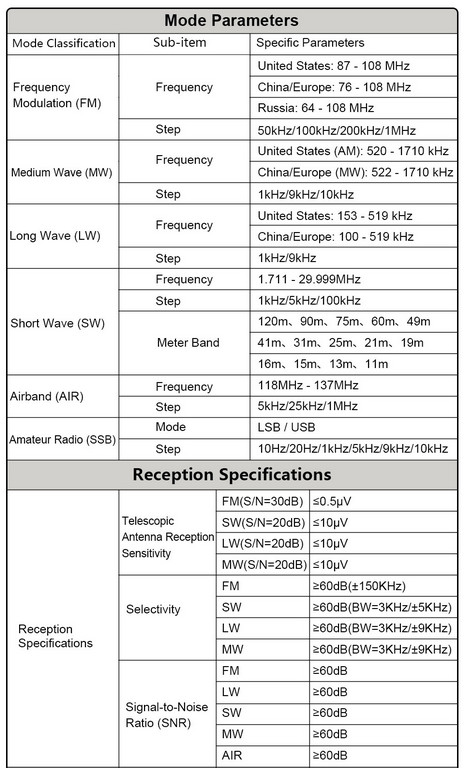
The MLite-880 contains band ranges selected by pressing the appropriate key and then A/B to scroll through those ranges.  Coverage is from 100 kHz to 519 kHz, from 520 kHz to 1710 kHz, and up to 29,999khz.  But one can directly enter any frequency in this entire range, regardless of the ranges.  Under AMATEUR BANDS, we find 135.70 kHz to 137.80 kHz (2200m), 472 kHz to 479 kHz (630m), 1800 kHz to 2000 kHz, 3500 kHz to 3800 kHz, 5351.5 kHz to 5366.5 kHz, 7000 kHz to 7200 kHz, and on up to 29.700 kHz, with 70 mHz to 70.5, and 144 mHz to 148 mHz.  Finally, FM/VHF bands include 65.9 mHz to 74 mHz (OIRT), 76 mHz to 108 mHz, and AIR band 118 to 137 mHz.

The spectrum display on the MLite-880 is 40 kHz.  For most people, especially those coming from a portable with just a digital numerical readout, I don’t think this is going to be a problem.  The 880 obviously has a smaller spectrum display than the full Russian DSP or Chinese-originated portables.  Under VISUAL settings, we have choices of:  BRIGHTNESS LEVEL, BRIGHTNESS OFF TIME, SPECTRUM AVERAGE, SPECTRUM FILL.

I have not opened my MLite-880, but RADIOCHIEF.RU on YouTube shows the cabinet back removed (around the 29-minute mark).  We see extensive shielding with metal covers over key sections. Very impressive, and it finds me wishing that other manufacturers would have done this.  How much better the short-lived “Elite Satellit” by Eton might have been with better internal shielding.

What remains to be seen is the extent to which the MLite-880 monochrome display throws off interference, a well-known issue with the original Russia-made Malahit units and China-made portables.  See my interview with Georgiy of Malahiteam, who notes that not all noise is gone.  “We weren’t able to completely eliminate the noise,” he says, adding that “it still occurs in places, mostly on the long and medium wavelengths. However, significant attention was paid to the screening, and turning off the display completely solves the issue.”  The screen shutoff he mentions is accomplished as of now by pressing the “9” key.

We learn from the few available YouTube reviews that the main microcontroller in the MLite-880 is the STM32H743, which one reviewer says is “about the same as the older version in the Malahit DSP-3”.  And he adds:  “It’s a full-fledged SDR like the DSP-3 that is, unlike all sorts of superhet Tecsuns and DEGENs on chips with all sorts of soft mutes, the Malachite works just as well but significantly better. . .”

Unfortunately, so far we see that firmware updating is accomplished using the STMCube program used by the Russia and China units and the excellent AFEDRI.  I find STMCube to be clunky and often frustrating, though it seems straightforward when explained in the ML-880 manual.

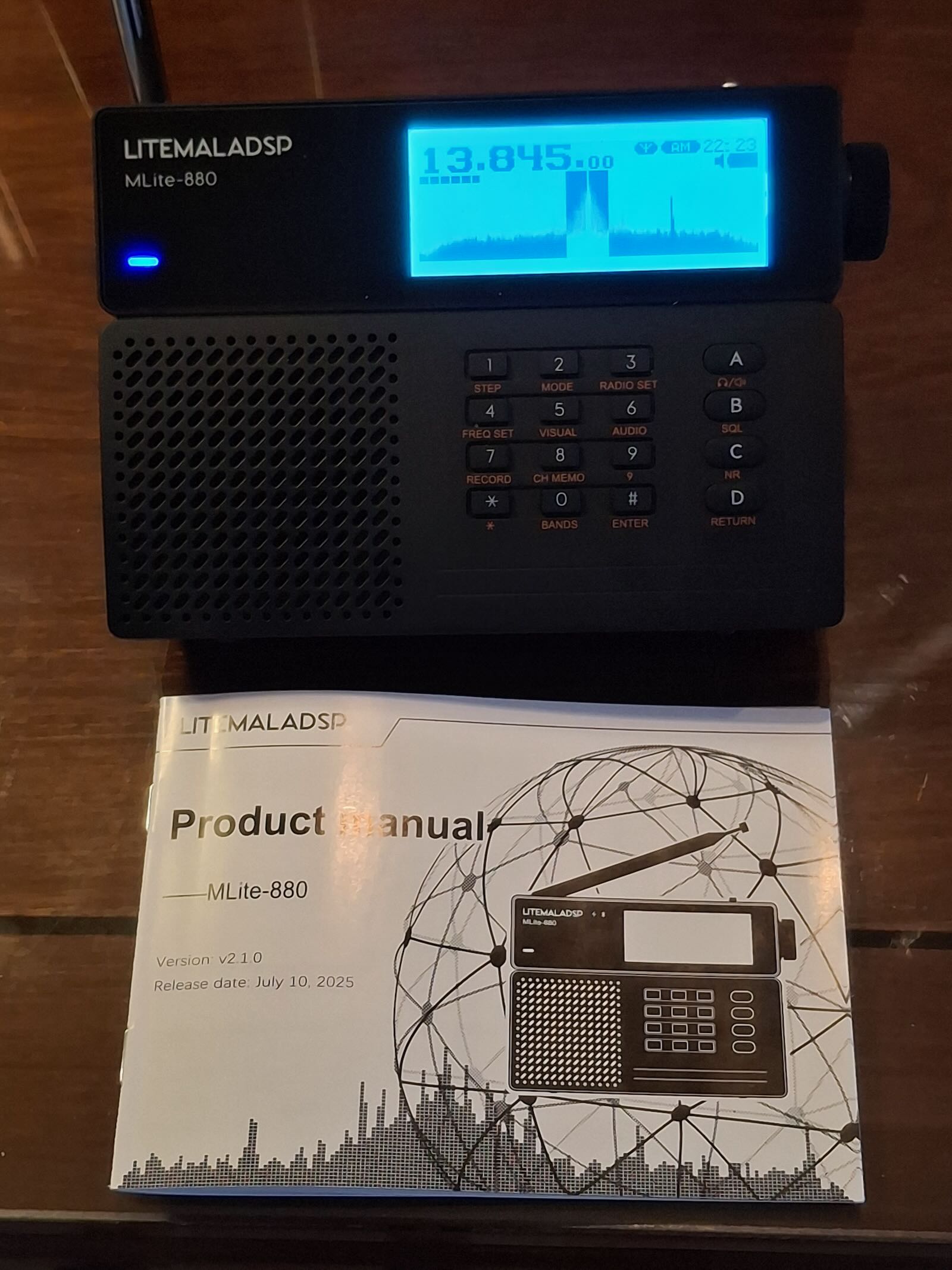
RADIOCHIEF.RU on YouTube provides a demonstration of the MLite-880, comparing it with an ICOM IC-R20 and a DSP-3.  He notes that while there are flaws in the 880 they appear to be fixable via  firmware upgrades.  In the downloads section of the elecevolve website we see version 1.2 dated 6 February 2026.  The unit delivered here has 1.1  The printed manual shows “v2.1.0 Release date July 10, 2025”.  I’m not aware of videos or other online presence of the ML 880 before January 2026.

WHAT’S THE BIG DEAL?

SWLing Post readers, whether SWLs or amateur operators, may be asking what the big deal is with the MLite-880.  That’s understandable, but let me explain the significance.  Much as the Choyong LC-90 became the first receiver to provide HF and Internet radio in a traditional radio cabinet (though without any spectrum display), the 880 shows that placing such a display in a traditional portable cabinet has been quite possible for some time — it just took someone to go ahead and do it. Continue reading
Bob’s Radio Corner: What Is It About Radio Dials?

– Recollections of Bob Colegrove

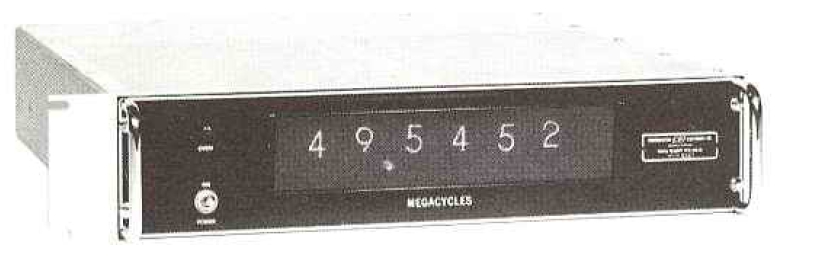
In the late ‘60s, I worked as a mechanical assembler at Communications, Electronics Inc. (CEI) in Rockville, Maryland (acquired by Watkins-Johnson Company).  We produced military-grade receivers, mainly for the military (whom else?).  These covered the spectrum from VLF through microwave.  It was the early days of electronic digital readouts.  There were no LEDs or LCDs.  Instead, some of our models featured the Numeric Indicator eXperimental, or “nixie” tubes.  These were glass tubes filled with low-pressure neon/argon gas, featuring stacked wire cathodes shaped like numerals (0-9) and a mesh anode.  An analog-to-digital circuit encoded the frequency to illuminate the correct digits.

Below is shown a DRO-50 Digital Readout from the 1968 CEI catalog.  It contained 6 nixie tubes for the frequency display, and the unit had an accuracy of ±100 Hz.  Interestingly, this frequency display was designed specifically for the Hammarlund SP-600 Receivers (R-274A/FRR (Army), R-274B/FRR (Navy)).  I never saw a DRO-50 come across our line and suspect it may not have gone beyond the prototype.  About that time, the SP-600s were ending their military service, so there wasn’t much of a market for upgrades.  It would still be a few years before I owned an SP-600 of my own, but how would I love to have one fitted with a DRO-50.

What I had instead of nixie tubes were variable capacitors or inductors, which changed the tuned frequency through a kluge of pulleys and strings, all these hidden behind a Raymond-Loewy-designed bezel and operated by the tuning knob.

What was visible on the front of the radio was an irregular representation of frequencies covering the tuning range of the radio, in other words, the dial.  As you rotated the tuning knob, you set the whole tuning mechanism in motion.  Signals were progressively tuned, processed, and reported through the speaker or headset as you advanced higher or lower.

Somehow the frequencies never quite agreed with the numbers or divisions on the dial.  It could be that the circuits inside the radio were out of alignment.  Just as likely, the design of the dial was determined using a preproduction prototype which could not possibly account for the tolerances of the components used on the assembly line.

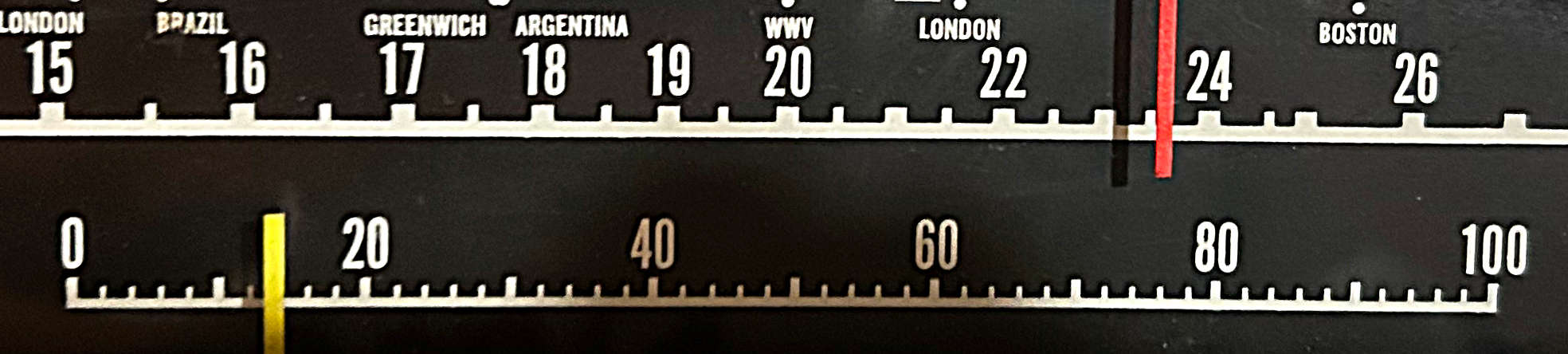
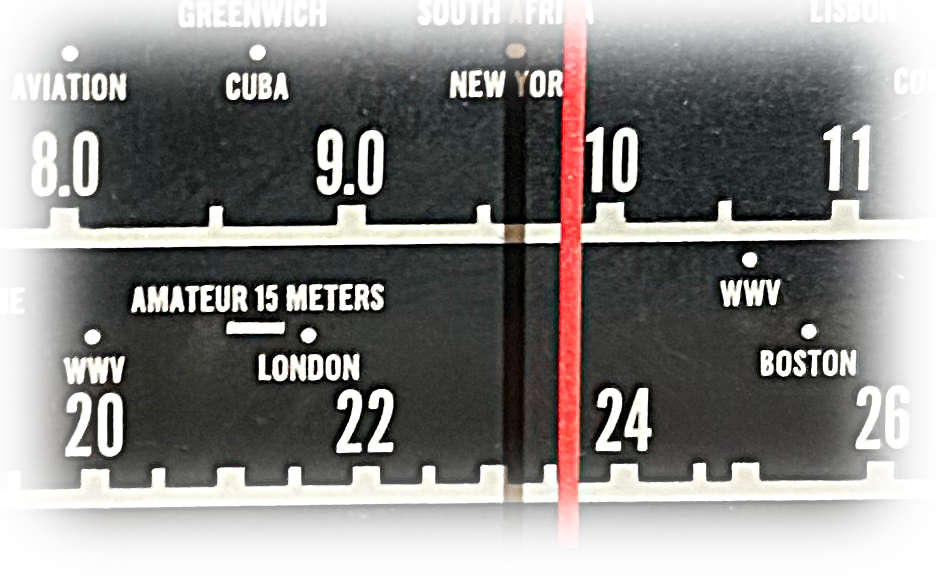
Consider the figure at the beginning of this posting.  It is a portion of the dial on a Hallicrafters S-38E – magnified somewhat.  The full dial on the E model was big and bright.  It extended across the front panel of the radio and presented frequency readout about as well as was possible.  Nevertheless, there were real shortcomings.

The figure is not only typical if communication receivers of the time but also living room console radios of an earlier period.  Take the 31-meter band as an example.  Broadcast stations were bunched roughly between 9400 kHz and 9800 kHz.  At 5-kHz channel spacing, this resulted in roughly 80 channels.  Of course, not all were in use at any given time, but still a smidgeon turn of the knob could traverse two or three stations.

This situation was relieved somewhat on communication receivers by the addition of a bandspread – a separate tuning mechanism which could effectively magnify a small portion of the main dial.  The idea was to place the main tuning dial at the high end of the desired band and the bandspread at 0.  Then, by tuning the bandspread toward the other end, lower frequencies could be tuned with greater separation.

Since the bandspread could be used at any place within the tuning range of the radio, a separate dial became a problem, so it was usually annotated with a simple logging scale incremented linearly from 0 to 100.  Thus, one had to compile a log-to-frequency conversion table or graph to interpret the frequency.  More sophisticated receivers could display the 80- through 10-meter ham bands on the bandspread dials.

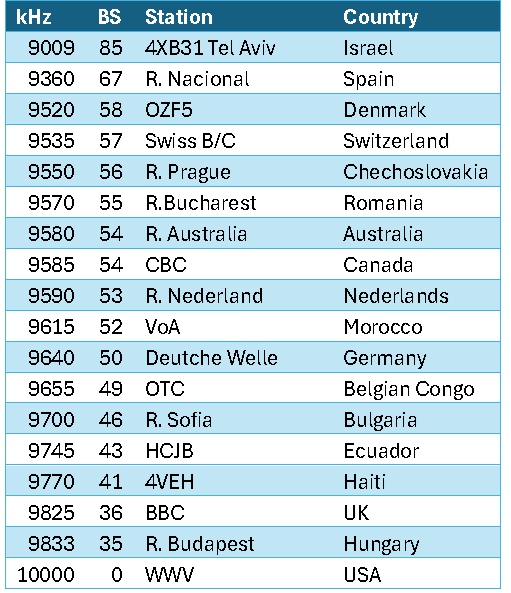
As an example, I located some notes made in 1959 using the S-38E.  The table shows the frequency, bandspread reading, station and country.  Thirty-one meters was an easy match for the bandspread, as WWV on 10000 kHz was a steady marker which you could use to calibrate the bandspread with the main tuning.  For all practical purposes, the band was bounded by the Voice of Spain on 9360 kHz and R. Budapest on 9833 kHz.  For many years, Tel Aviv was an outlier on 9009 kHz.

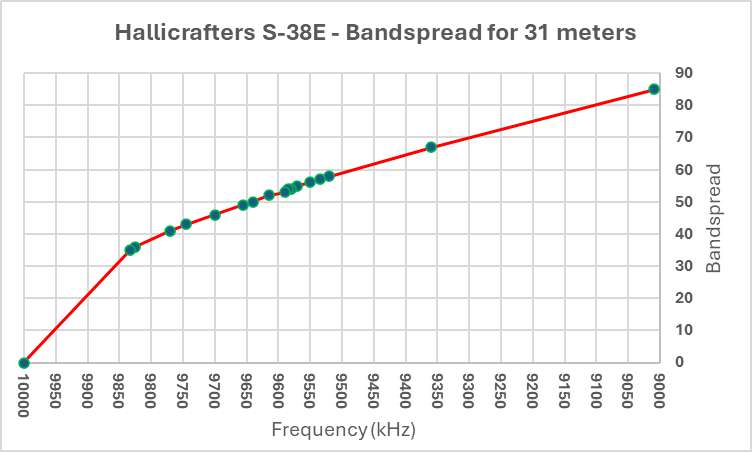
Alternately, one could construct a graph as shown below.  Unfortunately, most inexpensive radios did not produce linear tuning, so you couldn’t simply draw a straight line between two points on a graph and expect to interpolate the intermediate frequencies with accuracy.  Instead, graphs were constructed laboriously by hand adding intermediate points for known frequencies.  The figure shows the resulting parabolic function where the slope is greater on higher frequencies and gradually levels off as the bandspread is tuned lower.  Notice that most of the activity was mashed between 40 and 60 on the bandspread, then compare this with the picture of the bandspread above.

On the S-38E a bandspread was something of an improvement, but not the complete answer.  The problem only got worse as you went higher in frequency.  At 19 and 16 meters the band compression became quite severe.

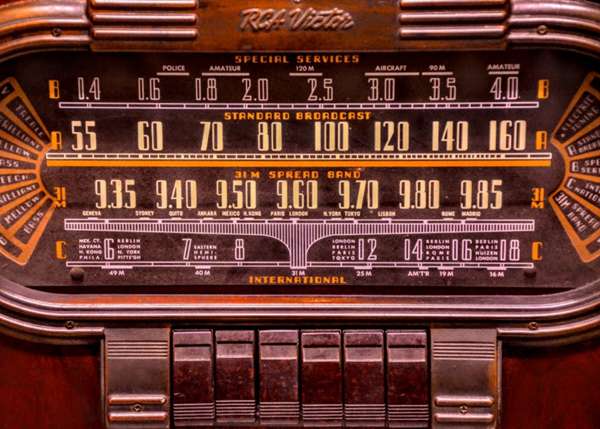
Our esteemed leader, Thomas, occasionally uses a picture of the dial shown below as a lead figure of a posting.  It is possibly an RCA Victor Model 110k console radio.  When I see this, I think, who wouldn’t give a king’s ransom to own that radio in its fully restored condition?  Note the 31-meter band has been magnified as its own separate band and appears in a near linear progression.  Thirty-one meters was arguably the center of international shortwave broadcasting in the golden age.

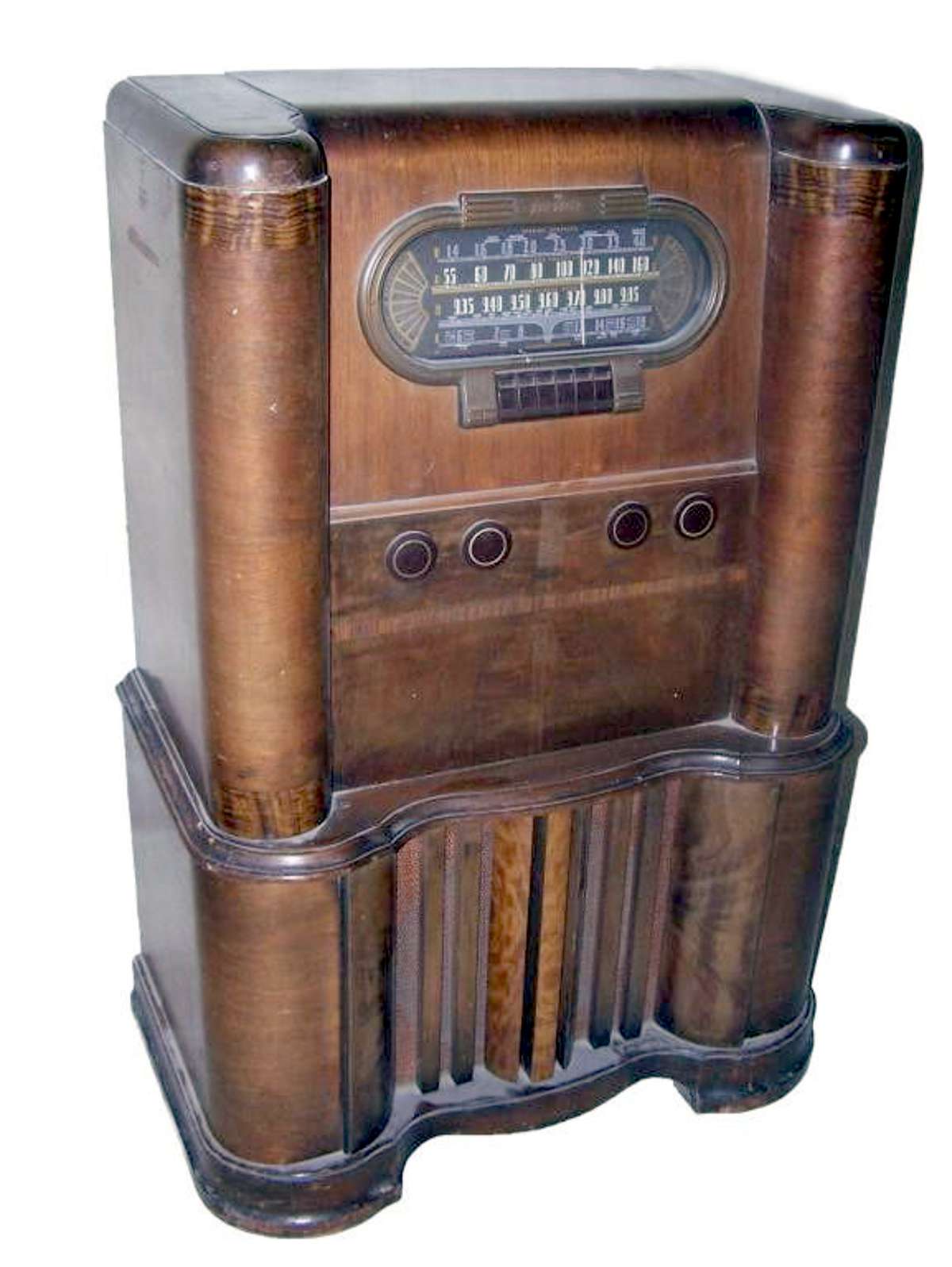
Have you ever wondered what the rest of that radio looks like?  Here’s one in sore need of some Pledge.  Now imagine yourself, perhaps 11 or 12 years old, perched in front of it on your grandmother’s needlepoint stool tweaking the dial.  If you have experienced this, no explanation is necessary.  If you haven’t, none is possible.

So, as it turns out, I have tempered my earlier conviction that a digital frequency readout is necessarily better than a classic dial.  Not to say you can easily pry the PL-880 with 10-Hz resolution from my cold, stiff hands, but I have come to realize that intrigue and mystery of shortwave listening rested in the uncertainty of knowing exactly what frequency you were on.  There was always the possibility that the elusive Nibi Nibi Islands lay somewhere near the shadow cast by the dial pointer.  It was a land of enchantment, and once you left its borders, you could never return again.

Configuring the “News Cruiser” for your emergency radio

By Jock Elliott, KB2GOM

Rob, W4ZNG, endured three weeks without electricity on the Mississippi Gulf Coast as a result of Hurricane Katrina.

When he and I spoke about his experience (and what any one of us might want in our “fertilizer hits the fan” radio kit), he mentioned that during Katrina, all of the local broadcasters were wiped out. There was a local low-power FM broadcaster who got permission to increase power to 1,000 watts and was broadcasting where to get food and water. There was a New Orleans AM station that was on the air, but all of its coverage was “New Orleans-centric.” After a few days, some local FM broadcasters, working together, cobbled together a station that they put on the air and began broadcasting news. Rob also began DXing AM stations at night to get additional news.

Hold that thought for a moment.

A few weeks ago, Andy, W2SRA, pops up on the Radio Monitoring Net (which I run on Tuesday nights) with a list of “Rolling News” medium wave stations that can be heard at least some of the time from my location in the Capital District of New York State. Rolling news stations broadcast news ‘round the clock.

The list includes:

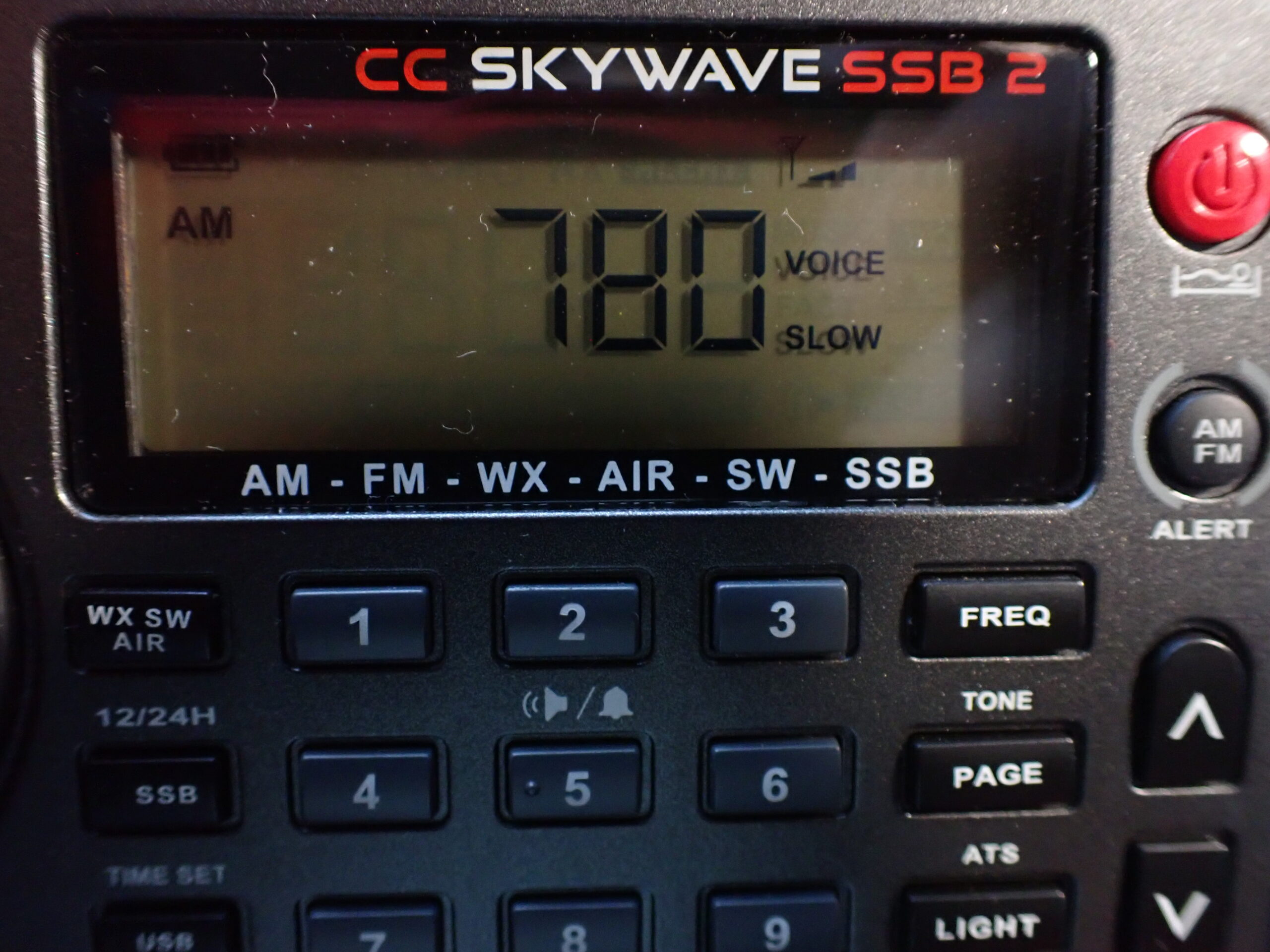
  • 780, WBM, Chicago, IL
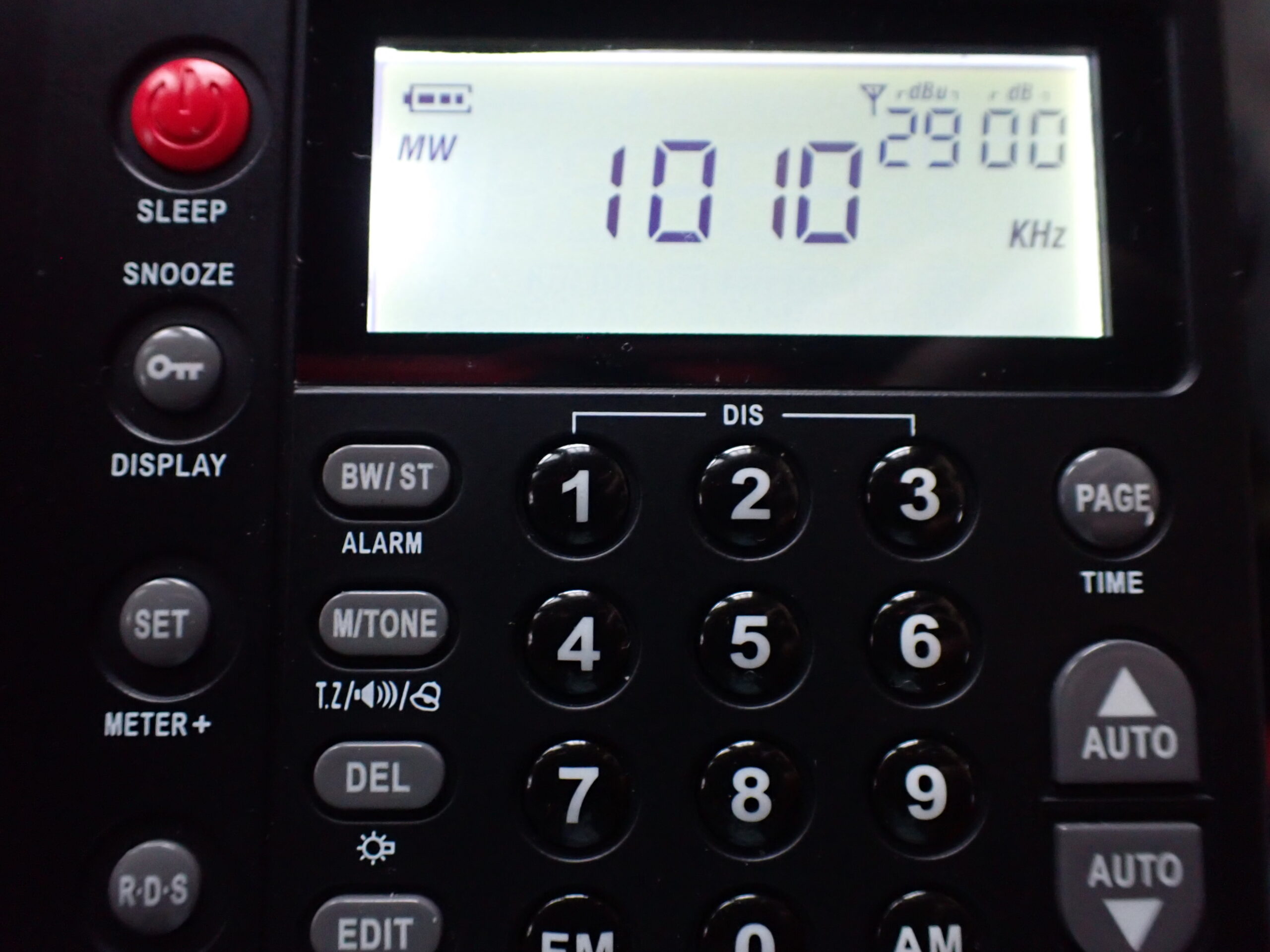
  • 1010, WINS, New York City
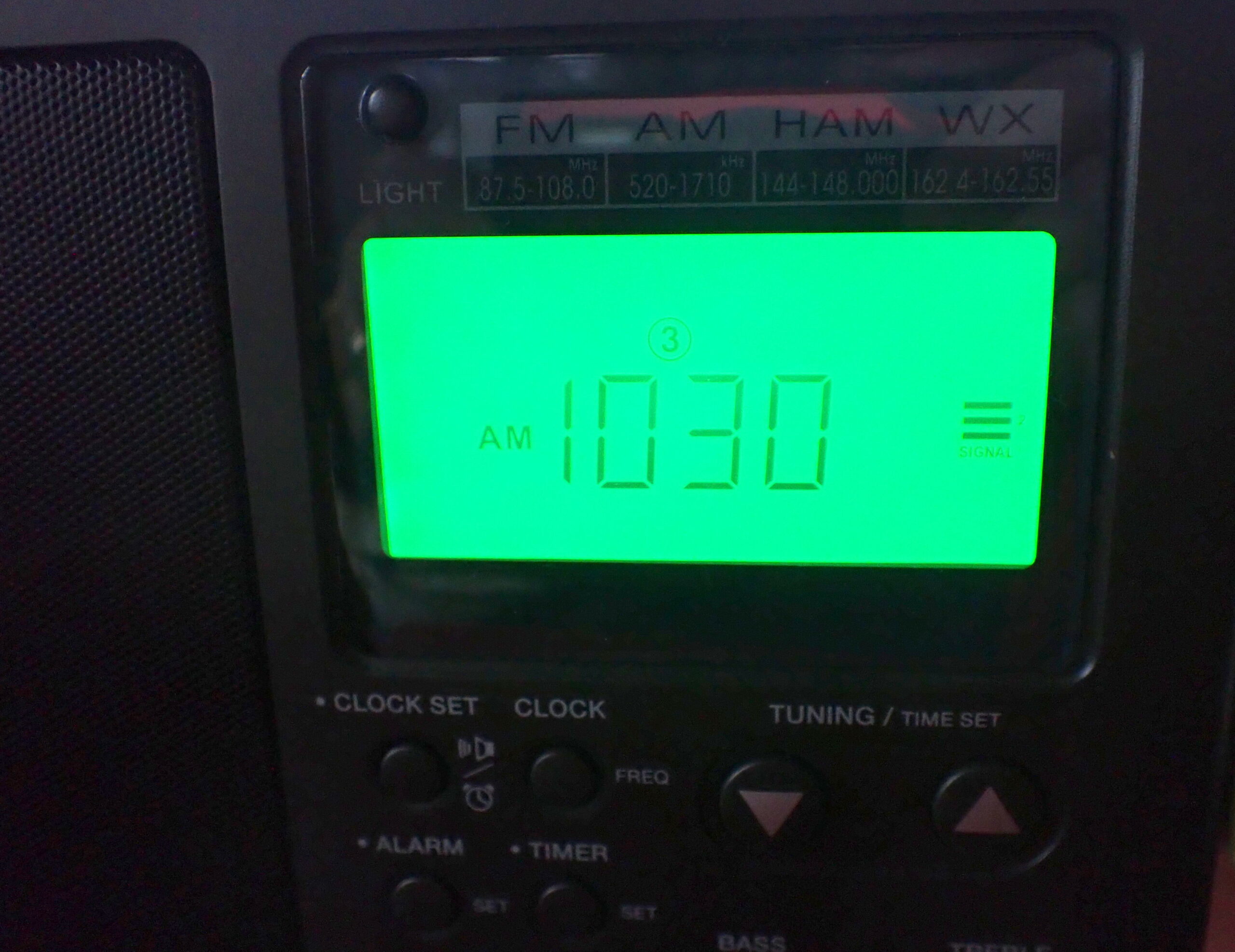
  • 1030, WBZ, Boston, MA
  • 1060, KYW, Philadelphia, PA
  • 1090, WBAL, Baltimore, MD
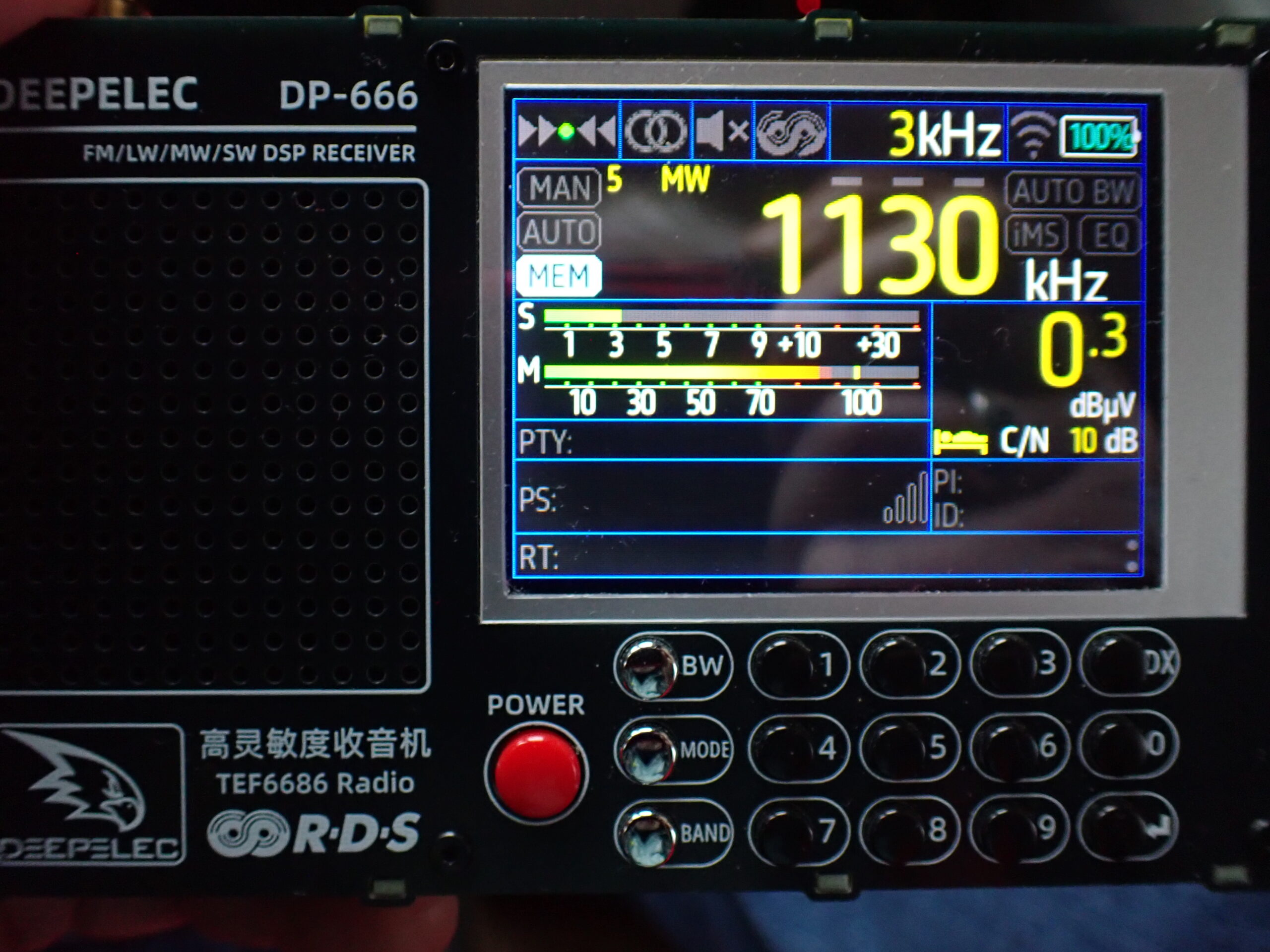
  • 1130, WBBR, New York City
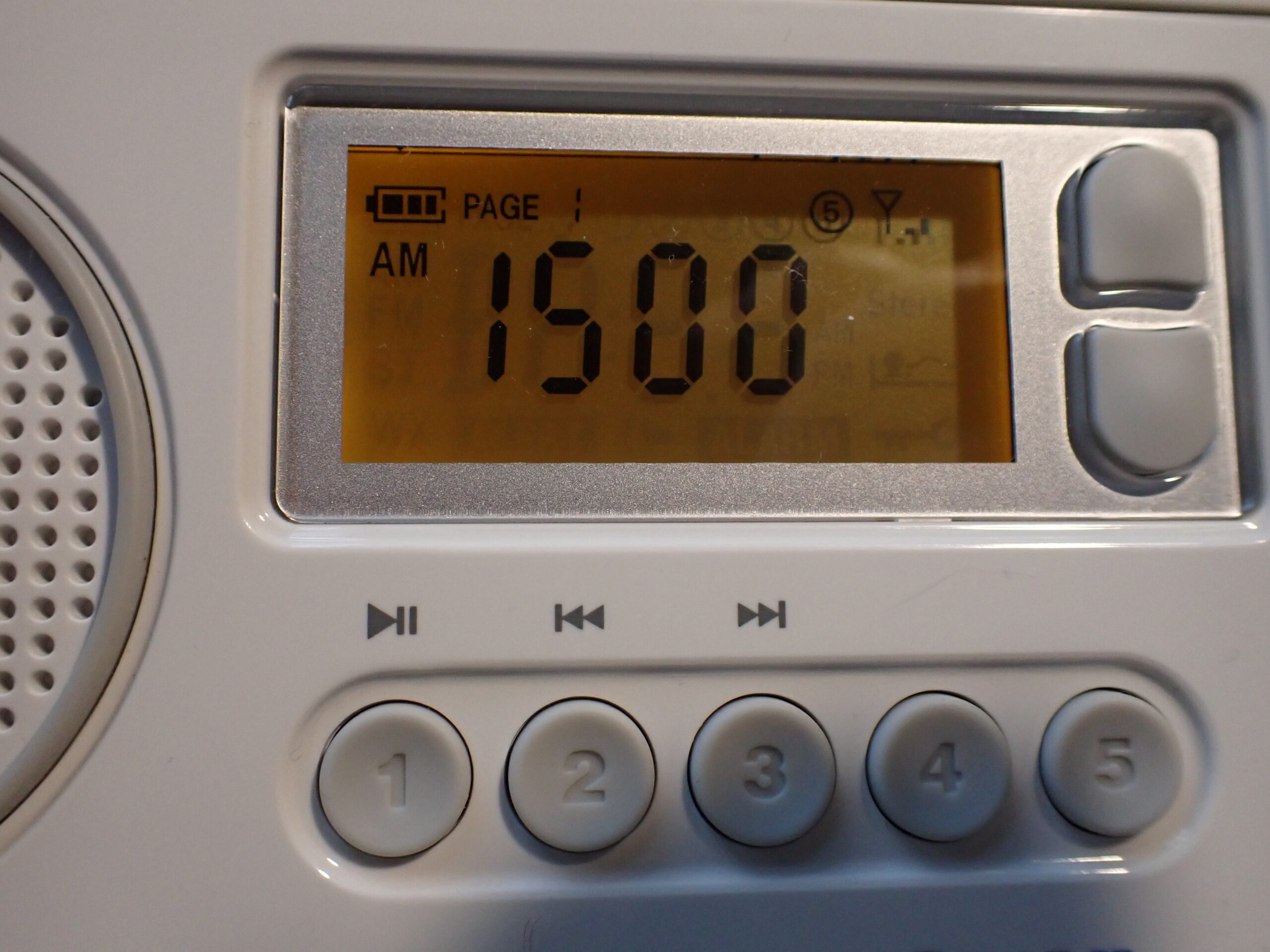
  • 1500, WFED, Washington, DC

When I saw that list, I thought “This is a pretty good resource.”

Then a day ago, something clicked, the lightbulb went on, and I realized: “This is exactly the list of stations that I would want if I were in the same situation as Rob after Katrina, where my local stations were dark, and I wanted to know what was going on! I named the list: the News Cruiser.

So, in the predawn hours, I decided to put the News Cruiser list to the test. I plugged the frequencies into several of my radios, and here is what I found. With the CCrane Skywave SSB 2, the signals ranged from copyable with noise to marginal to uncopyable, depending on the station. With the CCrane CCRadio SolarBT the results were better, but often tough to copy. Neither of these radios has the ability to connect to a medium wave loop antenna through a direct wired connection, although they can be inductively coupled to a loop such as the Terk AM Advantage.

The CCrane 2E, a much bigger radio with a much bigger internal ferrite bar antenna, produced markedly improved results. All three of these radios can be powered by off-the-shelf AA or D cells, which I considered to be an advantage during an emergency.

Two other radios, the Qodosen DX-286 and the Deepelec DP-666, which are powered by rechargeable batteries, acquitted themselves quite well when hardwired to the Terk AM Advantage loop antenna, but I prefer radios that can accept off-the-shelf commercial batteries.

If you live in North America, you can create your own News Cruiser list for your emergency radio by consulting https://radio-locator.com/ and using the search function to find stations that broadcast in the “News” format.

Once you have assembled your list, test it out with the radio you would grab in an emergency and see how well they perform. You might find the perfect combination that you like or you might discover that there is some room for improvement.

In any event, I heartily recommend that every household has an emergency radio that can be easily deployed to discover essential information when the fertilizer hits the fan. The point is to discover what works for you and to discover it before it is needed.

Further, I would very much like to know what works for you no matter where in the world you are located. Let me know in the comments below.

XHDATA D-219

The XHDATA D-219 Shirt-Pocket Radio

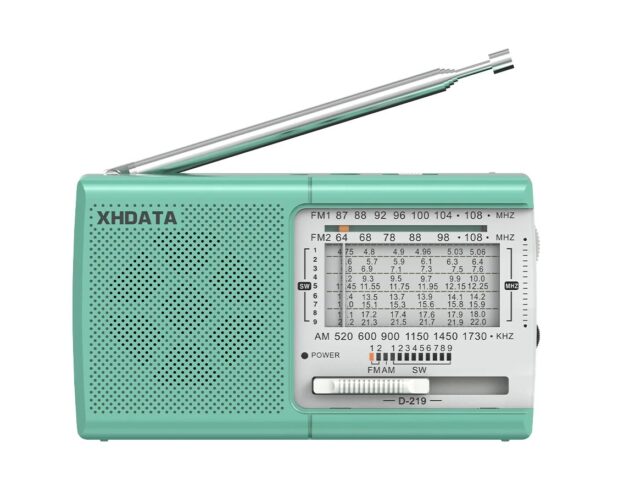
The XHDATA D-219 is a shirt-pocket radio which performs quite well, especially given the low price point of  ~$13. Paul Jamet has already done an excellent review of this radio (even the same color as mine!) which can be found here. I encourage you to check out Paul’s excellent review, as I am only going to add my experience with the review radio I was sent by XHDATA.

As I typically do, I tested the radio stock – no additional antenna support or boost. Like any portable, a clip-on wire would likely boost performance, but I test radios in their basic state when promoted as a portable radio like the D-219.

Reception was quite good from the solid antenna and (presumably) internal ferrite. AM stations were plentiful and loud; FM stations were also solid and plentiful to my rural location. Shortwave radio was surprisingly good considering the use of the telescopic antenna. The antenna is made well, rotatable, and solid enough for any typical handling.

The side tuning dial is sensitive but very controllable, with slight adjustments bringing in new stations. For such a small radio, I had no difficulty reading the analog-style display, and the front slider moved between bands easily.

Jacks and Kickstand

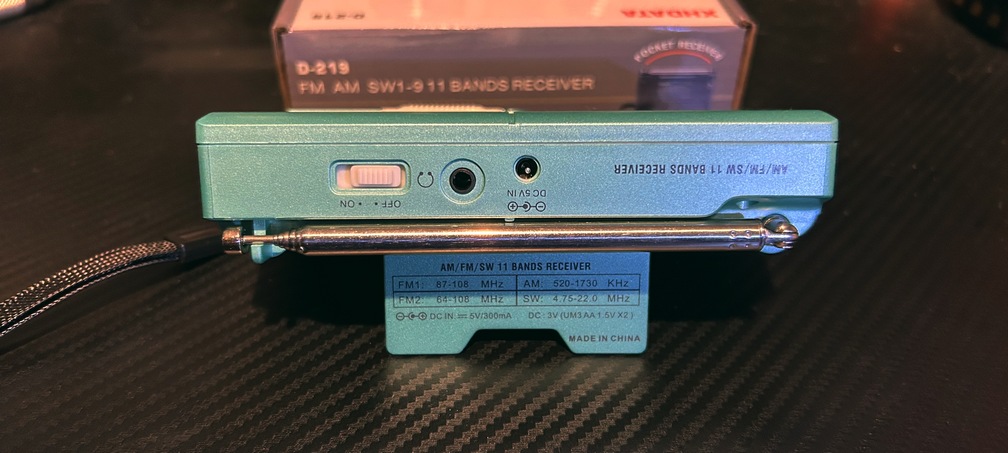
On/Off switch, DC 5V input, and headphone jack along with Kickstand

I appreciate that the radio runs on two standard AA batteries, and has a fold out kickstand. It does also have a DC 5V input (power cable not included), but I did not test it for noise/birdies as again, to me a portable radio will not, under normal circumstances, be tethered to an outlet (did I mention I hate wires?!).

With headphones plugged in the audio is strong and clear, mono, but coming in both sides for that middle of the head effect. Of course, it also works with a single earbud with a mono or stereo plug on the end. Audio without the headphones is also good – as I have noticed with many of the newer Chinese radios, miniaturization allows more room for speakers, and the D-219 does not disappoint.

At this price-point it is hard to find fault with the radio. Within its reasonable limitations, it performs way above what one might expect, as do many of the new radio offerings. Analog looks with digital precision – what’s not to like?! Besides, being a retro kind of guy, I like these portable radios for on-the-go listening!

73, Robert K4PKM

Paul Reviews the Radtel RT-880G

by Paul Jamet

Looking for a versatile radio?

Which radio listener hasn’t dreamed of owning a portable multi-band receiver allowing them to explore the widest possible radio spectrum?

For nearly a year now, walkie-talkies have appeared on the market which, beyond the classic VHF–UHF functions, also allow listening and transmitting on CB (27 MHz) as well as listening to LW/MW/SW bands (LSB/USB/CW). The RADTEL RT-860 has won over those who have tested it.

Read here: Dan Reviews the Radel RT-860

The arrival of the Quansheng TK-11 — available in three versions — has caused quite a stir on social networks. Then, almost at the same time, the RADTEL RT-880 and RT-880G (G for GPS) appeared, also sold under other names such as iRadio UV98.

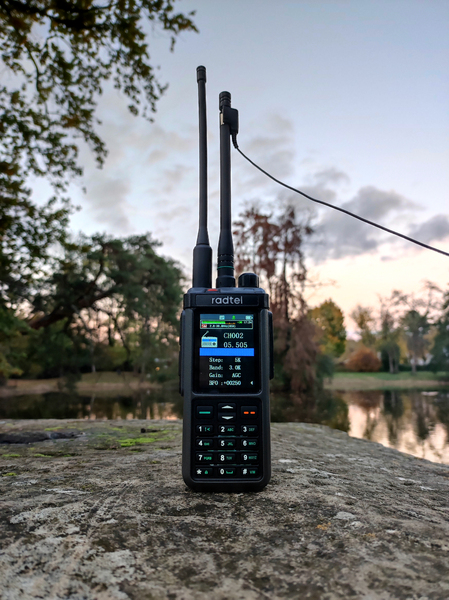
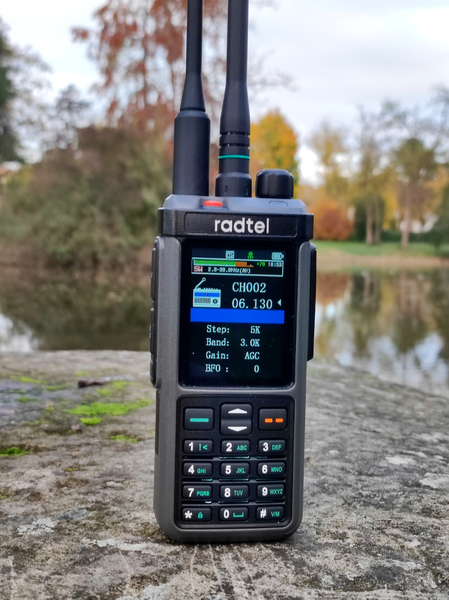
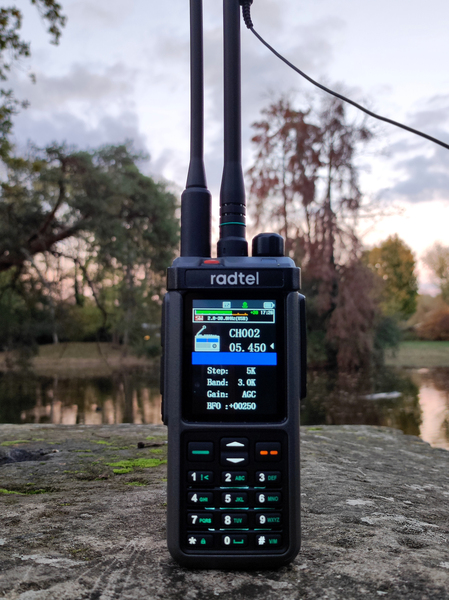
Among all these available models, I chose — as a radio listener, especially when I’m traveling — the RADTEL RT-880G. My choice is explained mainly by its antenna connectors (SMA-Female and SMA-Male), its large color display, its GPS module, its thousand memory channels, and the possibility of simultaneously monitoring three VHF/UHF frequencies. This device is highly customizable, but its user manual would deserve to be much more detailed and explicit.

The RT-880G comes with a “standard” 18 cm antenna for VHF-UHF bands, which is also used for FM station reception. I haven’t yet tested the device on the 27 MHz (CB) band, for which a dedicated antenna is preferable. No antenna is provided for LW/MW/SW listening.

For listening to LW/MW/SW bands, the device is often shown with small donut-type loop antennas (10 cm diameter).

However, for easier transport, I simply chose this small telescopic SMA-Male antenna, 48 cm long (weight: 20 g): to which it is possible to clip a wire antenna, such as the SONY AN-71, which can prove very useful.

I also used an antenna normally intended for CB, the ABBREE 27 MHz telescopic antenna (130 cm), admittedly heavier (weight: 78 g) and bulkier, but which gives very good results for the HF band.

The purpose of this contribution — which concerns only listening — is to arouse curiosity among mobile (or stationary) listeners, to invite those who own this walkie-talkie to come here and share their experience, and to collect your comments. It is therefore not a full review of the RT-880G, but simply an illustration of what it offers for listening to LW/MW/SW bands.

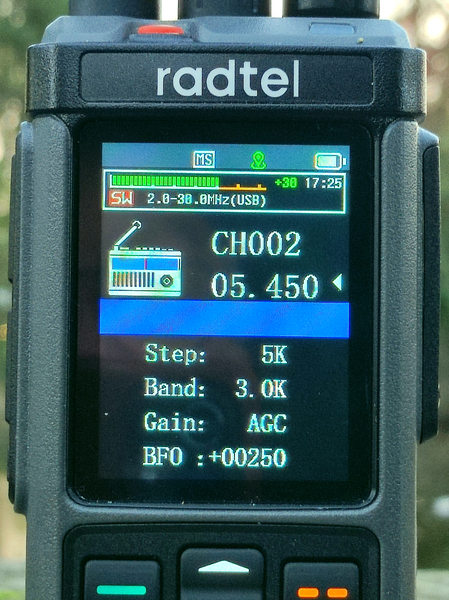
For LW/MW/SW bands, the RT-880G allows you to set the:

  • step to 1 – 5 – 10 – 50 – 100 – 500 – 1,000 – and 9 kHz],
  • bandwidth [0.5 – 1.0 – 1.2 – 2.2 – 3.0 – 4.0],
  • AGC (Automatic Gain Control)
  • BFO – (Beat Frequency Oscillator) – used for fine tuning SSB reception (the minimum step being 1 kHz).

Sample Recordings

Local park where some of the recordings were made.

Here are a few audio files that will help you form an opinion.  The recordings were made with a smartphone placed near the receiver.  The recordings were made using a smartphone placed near the receiver. The sound quality is quite good, even surprising. Continue reading
Raddy RF750Plus: A Miniature Wonder!


Robert K4PKM

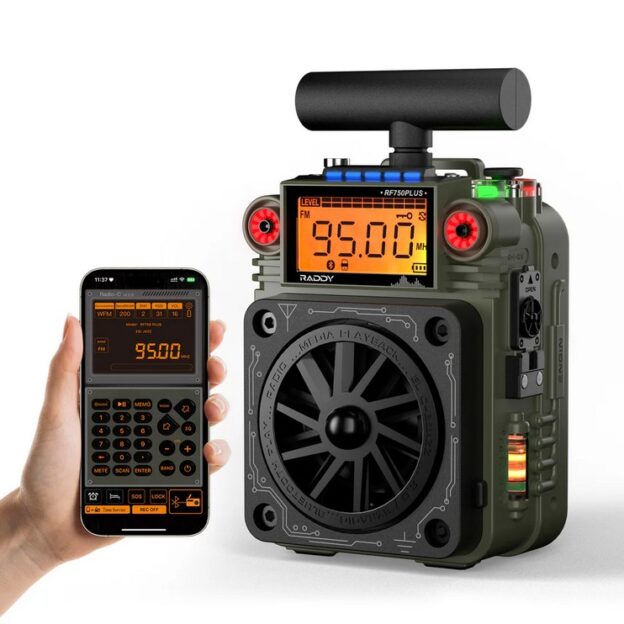
Raddy has come out with what I call a miniature wonder – a feature-rich radio that really does fit in the palm of your hand!

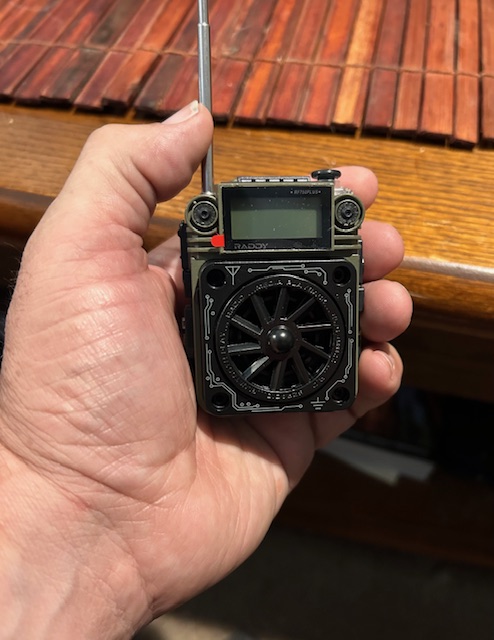
The Raddy RF750Plus is a very small radio. It measures roughly 2”x3”x1-1/2” without either antenna extended/attached. In fact, one of the reasons I agreed to review yet another shortwave radio from Raddy was because this was so small. Frankly, I was curious whether this radio would have real usability, or would it just be a cute little “toy” radio. Well, it definitely falls into the “real usability” category for those who want to take a small radio along with them wherever they go, even in their shirt pocket!

Truly hand-held!

This is truly a hand-holdable radio!

Quite the size difference!

Quite the size difference!

Okay, enough about the size, for now. This radio has most of the typical features we have come to expect from small portable radios these days. Rather than repeat what features it has myself, here is the main information from Raddy’s website:

RF750 PLUS Brings You:

Multi-band and 3-in-1 Receiver: BT speaker, SD card music player.

APP Control.

Enhanced AM Reception with an extra T-type antenna.

User-friendly features like USB-C charging & headset port, a replaceable lithium battery, and SOS alarm

Specifications
Reception Range:
FM: 64.0-108MHz
AM: 520-1710KHz
SW: 4.75-21.85MHz
WB: 162.40-162.55MHz(Only US)
Receiving sensitivity: FM/WB: ?18dB / AM: ?86dB / SW: ?30dB
Preset Stations: Total 297
Quiescent current: ?50uA
Max current: ?800mA
Speaker: 4? 3W
Bluetooth version: Ver 5.2
Min working voltage: 3.4V
External input voltage: DC5V
Lithium battery: 3.7V
TF card playback Format: MP3/WMA/WAV /APE/FLAC
TF card capacity: ?256GB
Battery: BL5C 3.7V 1000mAh
Earphone output: Type-C
Dimension: 2.2×3.0x1.7 inches / 75x56x44 mm
Weight: 7.9oz / 226g

What’s in the box?
1 x RF750 PLUS Shortwave Radio
1 x T-Type Antenna
1 x Type-C Charging Cable
1 x Type-C to 3.5mm Adapter
1 x Strap
1 x Carabiner
1 x User Manual

I have tested the app on an iPhone and it worked right out of the box, using the same app as other Raddy radios, and I have to admit, it’s the way to go if the radio is stationary. It is easy to tune through the app keyboard, as well as change various settings.

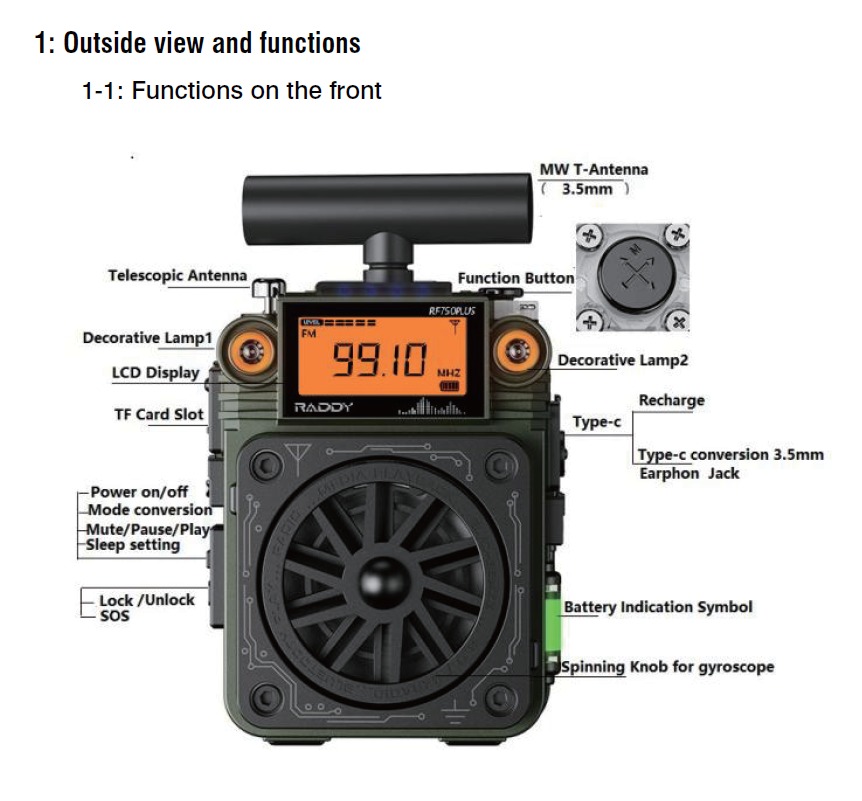
Several nice features deserve special mention with the radio. One is its heft. This is not a lightweight radio compared to its size. It will easily stand on its own without blowing over in reasonable conditions. As one might expect, the weakest point is the antenna – one must be aware of its limitations. It is telescopic, but not rotatable. In reaching for the radio, it stands quite a bit taller than the radio itself, so you should be careful to look at what you are grabbing!

A second nice feature is the included external AM antenna which does rotate, and which does a nice job of pulling in signals. You may already have similar, larger external antennas which will also work with the radio, but the one included performs well.

A third feature I find well-thought out are the covers for the various jacks, such as the external antenna cover, the USB-C cover, and the TF card cover. These open easily, but also snap into place to provide a good level of dust and moisture control.

Finally, the included cables for charging and for adapting a set of earphones/headphones are a welcome touch at this price point.

You will definitely want to read the manual to operate this radio!

Performance

Audio quality is good, with full sound despite the speaker being housed in a small unit. FM sounds excellent (though not in stereo through the earphone jack/adapter, but does come out of both sides), as does AM with strong signals. Naturally weaker AM signals are typical of any radio, but there is some adjustment possible with the equalizer settings available should you want to experiment.

Shortwave reception is adequate given the length of the antenna, but not a powerhouse, which is to be expected for a radio in this class. Stronger stations come in fine with good audio, but this is not a radio with which you will go DX hunting on the SW bands. Like many small portable radios, this is primarily an AM/FM/Weather radio, with shortwave thrown in as a bonus.

As for the NOAA weather stations, I receive only one of the stations at my home, while other portables may receive up to three. Of course, location is the primary factor here, so your mileage may vary. The one it receives is very strong, and a second station is very faint – but that might also be due to being inside when testing.

Pros and Cons

Pros

  • Small size (see also Cons)
  • Solid case with good weight
  • Good sound
  • 2-speed scanning – hold the joystick to start tuning and then release, or hold it a bit longer and get much faster tuning, great for shortwave bands
  • Excellent app for iPhone (and likely excellent for Android)
  • Dust/Moisture covers
  • Lots of lights 🙂
  • Included cables and replaceable battery
  • External antenna included
  • Includes a bubble level – who knows when that might come in handy?!
  • SOS feature
  • Price (currently $34.99 on Raddy site during anniversary sale)

Cons

  • Small size (see also Pros) – large hands may have difficulty switching modes with the power button
  • Power button requires quick double press to change modes – at first I thought it was not working until I moved more quickly.
  • Multi-function joystick has a lot of tasks depending on mode – being small might make this more difficult to operate or achieve desired action. I did adjust pretty quickly to this.
  • Antenna is flimsy, but if handled properly still should last without issue.

Conclusions

This is a nice little radio which takes up very little space, can be carried in a shirt pocket, and has a lot of features packed inside its solid frame. The price is very reasonable for what it offers, and the ability to use an app to control it is a great feature given its small footprint. Frankly, I cannot see how one could make a smaller radio with all this functionality, except perhaps in a James Bond movie! We do live in rather amazing times! Cheers!

Available at Raddy ($34.99 USD at time of writing; $41.99 regularly)

Available at Amazon


Bob’s Radio Corner: The Last Radio I Really Needed

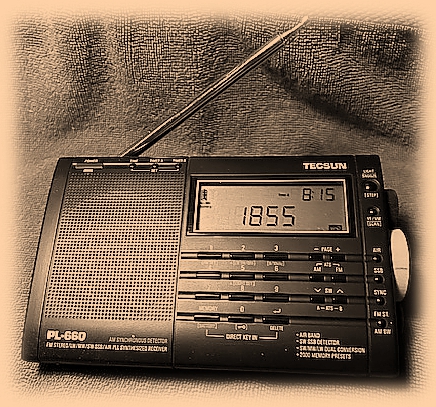
My original PL-660 has high mileage but still
has its original kick stand and whip antenna.

The Last Radio I Really Needed

By Bob Colegrove

Like most folks, I have a favorite radio.  My favorite radio is the one I happen to be listening to at the time.  Each radio has its own attractions.  The fact that one particular radio is turned on indicates that, at least for the moment, it is my favorite.

I also have a special radio.  It is special because, ever since I bought it, there has never been a compelling reason to buy another radio.  That said, there is no accounting for irrational behavior which has subsequently caused me to buy several more radios, always with the hope that the next radio would somehow provide better performance than my special radio.

My longstanding experience has been with vacuum tube radios.  I have used multiband radio consoles.  I have used everything from a Hallicrafters S-38 to a Collins R-390A and most everything in between.  I tried a couple of analog, multiband, solid-state portables in the 1960s and ‘70s.  I bought a Sony ICF-2010 early on and still have two of them fully functional.  For many years, the -2010s were my go-to radios.

Then, I happened to read the review of the Tecsun PL-660 in the 2012 WRTH.  The price seemed reasonable, and I decided to buy one.  From the very beginning, I was not disappointed.  Selectable sidebands and synchronous detection – not a Sony, but very good.  Further, the -660 was notably smaller and packed quite easily.  I could include a pair of earphones, a length of wire and this radio, set up away from the shack, and operate.

So why is this radio special?  It is not perfect.  But for LW, MW, SW, and FM, there is nothing I can hear on any of my radios that I can’t hear on the Tecsun PL-660.  Reception seems to be especially sensitive and clear.

I must qualify the claim above.  Normally I use external antennas.  External antennas are the great equalizers.  Properly matched they make a radio perform at its best.  Radio reviews and comparisons will often include judgements about sensitivity.  Unfortunately, many reviewers do not specify the conditions under which they tested the radio.  The reader must assume that these judgements are based on the use of stock internal antennas — most often the LW and MW ferrite loop and the SW and FM whip.  For portable radios this makes sense, as internal antennas are paramount to the radio’s transportable versatility.

Not Perfect

I will spare everyone yet another review of a radio now in its adolescent years.  I merely focus on a couple of picks I have with the PL-660.  There are others which are well documented.

Birdies

Probably the worst fault with the -660 is birdies.  There are a few along the LW spectrum but the worst by far is one which generally appears between 950 kHz and 1000 kHz in the MW band.  I have read where this is traceable to the DC-DC converter but have never found a remedy.  This nasty signal is very rich in harmonics and will replicate through the entire SW spectrum.  Further, the fundamental birdie and its harmonics tend to slowly drift upward for about an hour after the radio is turned on.  The drift accelerates with multiples of harmonics.  For example, while the fundamental birdie is creeping up 1 kHz, the second harmonic will travel 2 kHz, the third 3 kHz, and so forth.  There are many harmonics where no harm is done; however, the 4th harmonic will blaze a trail squarely through the 80-meter ham band.  Wait a while and it will drift onward but ultimately stop at some equally inconvenient location.

Poor Encoder

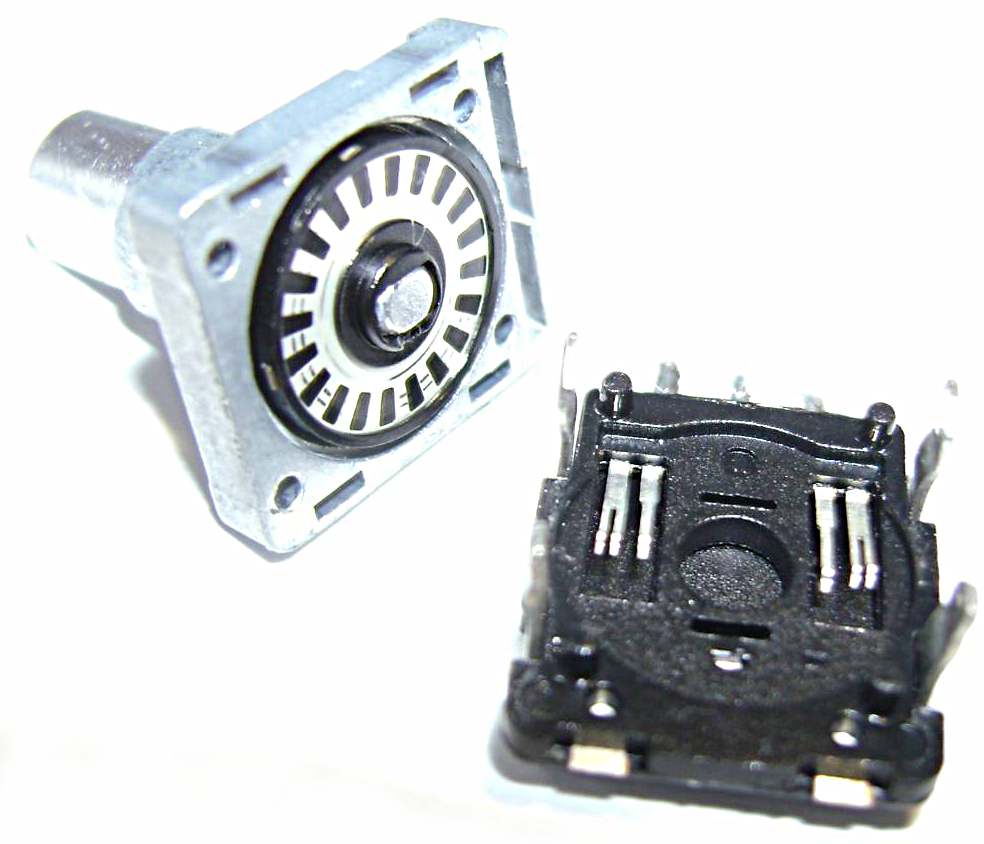
The PL-660 tuning encoder, as with its cousins in the -600 and the -680, is … well, very poor.  From the get-go it will jump erratically forward or backward.  This becomes worse over time, particularly with any prolonged periods of disuse.  I have not determined whether this is dirt, poor contact, or just poor design.  I have found that vigorous exercise forward and backward with the tuning knob is the best temporary remedy.  This will generally bring the encoder back to tolerable performance.

Replacement encoders are available at modest cost.  I went this route as a last resort but managed to lay up my -660 for several months having failed to make the replacement work at all on the first attempt.  A few months later with renewed determination, followed by a series of deep cleansing breaths, I reopened the radio and discovered that my mistake was just a solder bridge between two of the encoder pins.  Note to self: For the future, this surgery should only be performed by people with good vision and steady hands.  After several months of storage there was unbounded joy when the 12-year-old -660 came alive and began to tune perfectly – well as perfectly as it could.

My Mods

One of the reasons why the Tecsun PL-660 is special to me is that it is a tangible link to my tinkering past.  In former times, much satisfaction was obtained by aligning RF and IF stages, restringing dial cords, and replacing leaky capacitors.  For most tinkers, the advent of large-scale, solid-state integration and surface-mounted components has made tinkering virtually impossible.  Detailed data are scarce, parts much more specialized, and soldering skills more demanding.

The PL-660 came along at a point where vacuum tube tinkering was still within recent memory and the skills for maintaining and modifying high-tech radios had not become so intimidating.  To summarize, with just a few exceptions, today’s radios are for all practical purposes unrepairable, unmodifiable, and therefore more readily disposable.  What a pity.  The term “parted out” has entered our vocabulary, whereby a defective radio is cannibalized to provide its serviceable vital organs to its remaining siblings.

Dynamic Squelch

Briefly, the Tecsun PL-660 dynamic squelch function automatically adjusts the signal threshold based on its strength.  Ostensibly, this helps prevent the radio from being overwhelmed by noise when no signal is present while still allowing strong signals to be heard.  The “dynamic” part of the term refers to the feature turning itself on or off as the situation demands.  The downside is twofold:  a) weak signals may be totally blocked with squelch engaged; and b) the feature may oscillate on an off as a signal fades and then gets stronger.  There are several demonstrations of this on YouTube.

In 2012, a Russian radiofile managed to identify the transistor that switched the feature on and off.  By the simple expedient of grounding one of its leads, it could be permanently turned off, eliminating its drawbacks.  An optional further modification provided for the tone control switch to be repurposed to manually enable or disable the basic modification.

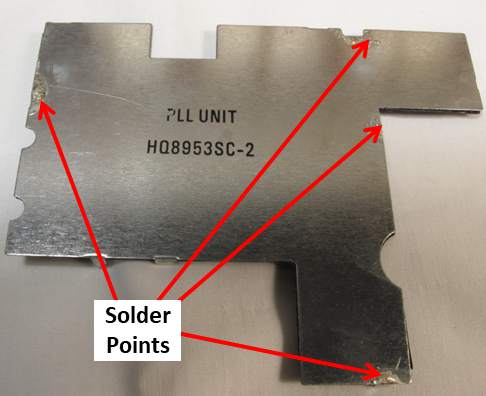
The relatively simple concept turned out to be rather involved surgery requiring a large metal circuit shield to be unsoldered and removed to access the transistor.  The old Yahoo PL-660 Group was abuzz with interest at the time.  Many folks were doing the modification.  Had it not been discussed so widely, I would likely have ignored it.  But being a wild, impulsive 70-year-old at the time, I had to give it a go and fortunately was successful.

Disablement of the dynamic squelch required removal of a shield on PCB

External LW and MW antennas

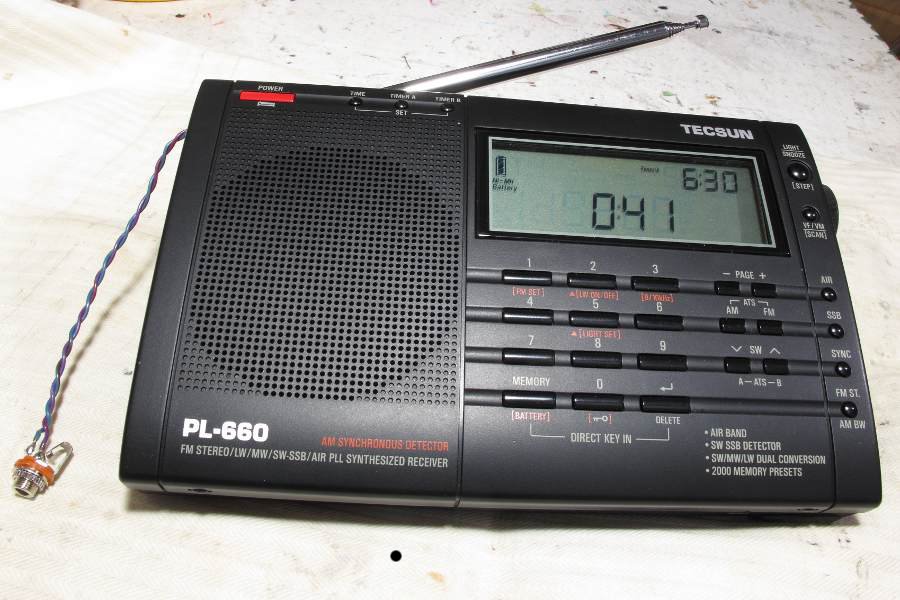
I do not like to be limited by the lack of an external LW/MW antenna connection.  The PL-660 has no means to switch one on.  You can easily inductively couple an AN-100/200 or Terk Advantage loop and get good results, but I wanted more.  I took the classic approach of winding a 5-turn transfer coil around the ferrite bar.  Initially I simply connected this to a twisted pair which ran out the unused hole for the wrist strap.  The twisted pair was connected to a phone jack and dangled out of the radio like a pig tail.

Pigtail used the hole in the case vacated by the wrist strap.

Sometime after my mod, Geir Laastad, LA6LU, published a paper with a much more elegant solution.  He discovered that the PL-880 used a stereo external antenna jack, the center (ring) terminal was not used, and the cumbersome pigtail could be eliminated by connecting the added transfer coil between this center terminal on the jack and the radio ground.  This necessitated use of a stereo plug to mate with the jack for connection of a LW/MW external antenna, but the jack could otherwise be used normally for SW.  I found that Tecsun used the same stereo jack approach on the -600, -660, and -680, and was able to connect the transfer coil to each radio the same way.  Geir’s paper is at https://groups.io/g/Tecsun-PL-880/files/_Tecsun_PL-880_LW_&_MW_Antenna_Mod.pdf, but you may have to request membership in the group to download it.

Enlarged fine tuning knob

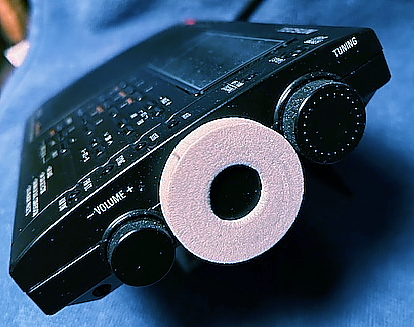
One of the weak features of the -600, -660 and -680 is the fine-tuning pot.  Zero-beating a signal is a bit touchy.  The problem is exacerbated by a mechanical detent in the control’s center of rotation, that is, the point where zero beat is likely to be encountered.  I found a foam, doughnut-shaped packing spacer from a spindle of CDs had just the right internal and external diameters to slip over the fine-tuning knob and provide some added gear reduction.  By pressing the foam against the case, the effects of the detent could be mitigated.

Well, unfortunately, CDs are going the way of cassette tapes these days, so the availability of the packing spacers may not be so good.  It may be within the realm of possibility to fabricate one.

Wrist Strap

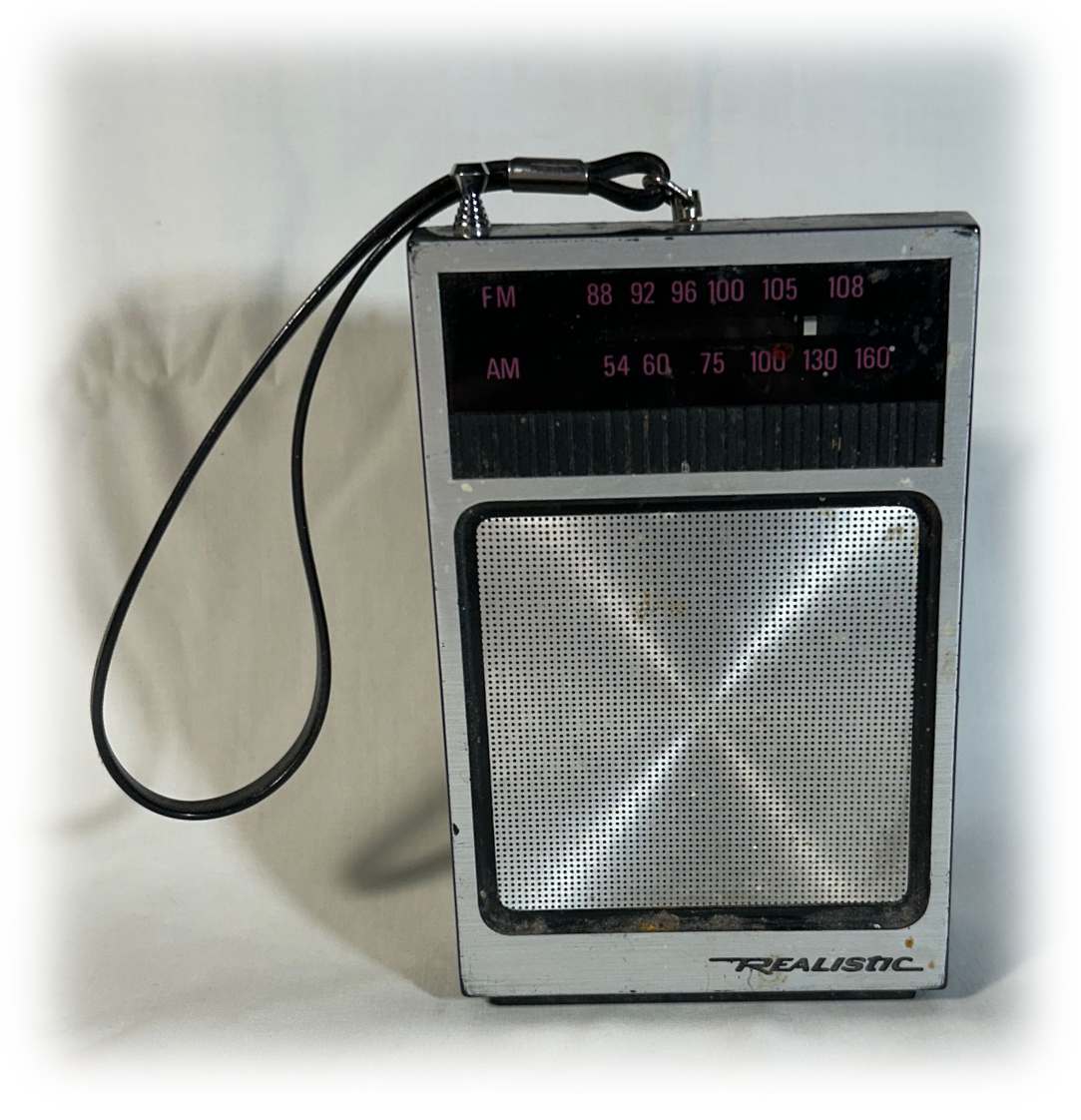
My final alteration is not so much a modification as it is a simple omission.  On the first disassembly of the -660 I omitted reinstalling the wrist strap.  IMHO, this piece of ribbon is no more useful than fender skirts on a ’57 Chevy.  Besides, it’s usually in the way.  Sometime in the murky past, this appendage made its appearance on a small portable radio.  Since then, nearly every manufacturer has felt compelled to include one.  I envision someone grabbing the radio by the strap and sashaying down the street with it dangling precariously by one’s side.  I have tried to imagine how its purpose might be inverted into a safety feature – perhaps first looping the strap around the wrist and then grabbing the radio with the hand.  But somehow, I can’t imagine anyone going to that trouble.  Maybe I’m missing something.

The wrist strap on this Realistic 12-714 AM/FM pocket radio from 1984 is hard to ignore.

The reader may be aware of other modifications to the PL-660, but mine are limited to those described above.

Epilogue

The old -660 has never been coddled.  Neither has it been subjected to the same vicissitudes as a soccer ball.  It remains a relatively handsome, finely crafted instrument still capable of soldiering on in the frontlines of the DX battle.

Is my old PL-660 a better-than-average “creampuff” off the Tecsun production line?  Does that make it special?  During the three or four months it was laid up with the encoder problem, I took the precaution of buying one of the last production units – this on the chance it might be my only opportunity of having an operational PL-660.  The newer one looks like its predecessor; it operates like its predecessor, even to the extent that it has the same birdies and the erratic encoder.  It does have the added feature of dial recalibration – a feature totally unnecessary on the original PL-660.  Somehow, it’s just not the old PL-660.  That one is special.

Maybe you have a special radio.