This article originally appeared in the February 2014 issue of The Spectrum Monitor Magazine.

QSL from Radio Gallifrey Intergalactic
Even as many legacy international broadcasters are abandoning the shortwave bands, shortwave remains active and vibrant in another quadrant: namely, on shortwave pirate radio. Over the past few years, I’ve found that one of my favorite listening activities has become searching for unique pirate radio stations, and readers of my blog appear to have followed suit. Among the most popular queries made by readers is, “How can I find and hear pirate radio stations?” To help answer this question, I’m writing this primer.
Who are pirate radio stations?
Many are confused by the term “pirate radio,” otherwise known as “free radio.” Either term is sufficient, and some stations prefer one designation or the other. For consistency’s sake, I will use the term “pirate radio” in this article.
So what is pirate radio? Andrew Yoder, author and publisher of the 2012 Pirate Radio Annual, defines pirate radio as:
“[A]ny unlicensed hobby broadcast operation that is using more power than the legal limit.”
As Yoder goes on to explain in his introduction of the 2012 Pirate Radio Annual, pirates are often confused with radio bootleggers (who conduct unlicensed two-way conversations), clandestine stations (usually political stations), and jammers (who intentionally try to block broadcasts).
While debunking myths about pirates, I can say that in my years of pirate radio listening I’ve never heard a pirate intentionally jam a legal broadcaster. Pirates tend to occupy swatches of the shortwave spectrum that are relatively quiet, avoid intentionally broadcasting on top of one another, and typically operate at fairly low power. I believe this is why authorities like the Federal Communications Commission (FCC) place shortwave pirates comparatively lower on their enforcement priority list.
And while pirate radio stations can be found across the radio spectrum, especially on AM and FM in urban areas, in this primer I’ll be focusing on those that inhabit the shortwaves.
What do pirates broadcast?
Pirates broadcast a wide variety of content, but are usually motivated by sharing their message–or favorite music–on the air. Some pirates simply key down their mike and begin talking, sharing their political or social views; others offer near-professional music productions, complete with listener feedback, and often acknowledge listener reports with QSLs (radio postcards).
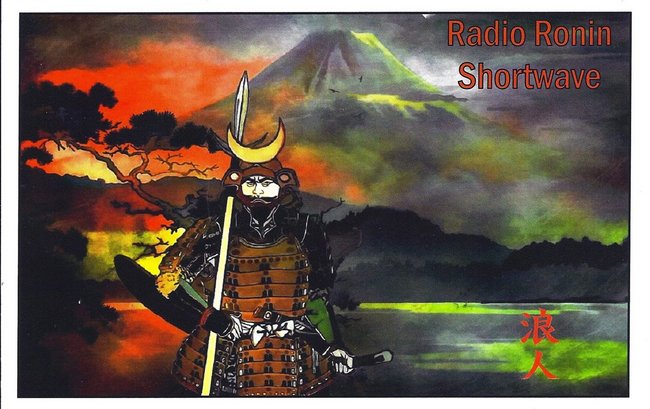
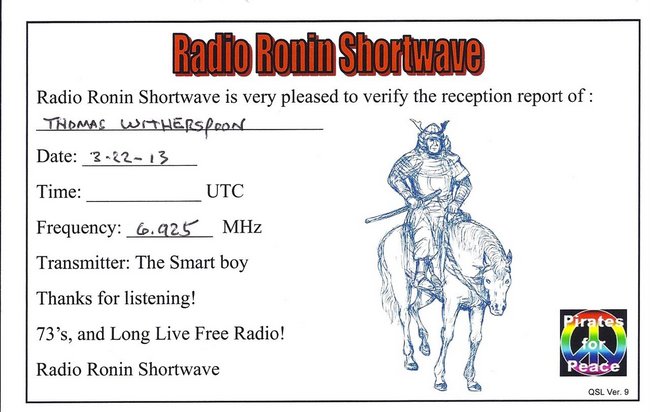
I received this QSL from the amazing Radio Ronin Shortwave shortly before he received “the knock” from the FCC and stopped transmitting. (Listen to one of Ronin’s broadcasts below.)
 As a self-proclaimed “content DXer,” what interests me in pirate radio is that the listener never knows what to expect, but you can guarantee that the content will be different from that of the major broadcasters.
To prove my point, here are some MP3 recordings of some of my favorite recent pirate radio stations/broadcasts:
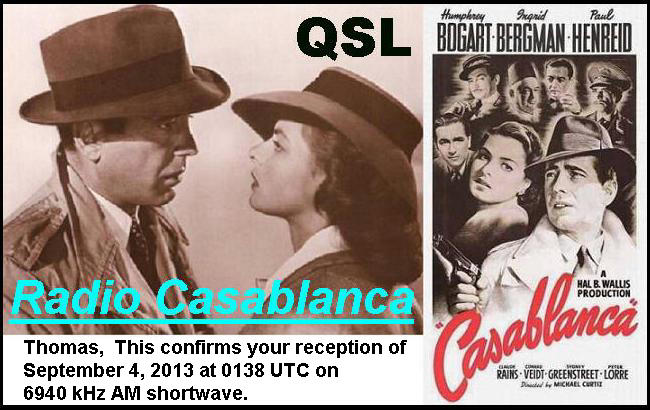
Radio Casablanca
Boards of Canada HF
Wolverine Radio
Hard Tack Radio
Radio Strange Outpost 7
Radio Ronin Shortwave
Where do pirates broadcast?
 Though pirates can be located anywhere on the planet, and therefore can broadcast, hypothetically, anywhere on the radio dial, patterns are actually fairly predictable in order to draw a listening audience. Pirate stations want listeners to discover them, so they broadcast in various “watering holes.”
With that said (and for reasons I don’t fully understand) depending on where you live in the world, you will either find it very easy to locate pirates…or extremely difficult. If you live in North America–particularly on the east coast–or in Europe, you’re in luck: these are the hottest geographic locations for shortwave pirate radio activity. If you live in other parts of the world, pirate hunting can pose serious DX challenges.
Again, I turned to Andrew Yoder for insight about pirate radio activity in the rest of the world; his reply:
“I’m always amazed at how few areas in the world have pirates that are connected to any scene. Back when KIWI was on the air regularly in the ’90s, I assumed that pirate radio would explode in Oceania and Asia. Not just Aussie and NZ pirates, but stations in places like The Phillipines…maybe Japan, South Korea, or Thailand. Nothing. Radio G’Day came on from Australia occasionally, but no one else. And when KIWI went silent, that was it. South America was strong for a while in the ’90s, but that has also fallen silent. I know that lots of pirates operate there, mostly on AM and FM, but no one is on SW…and if they are, they aren’t sending QSLs, [or] operating in places where radio hobbyists would hear them…”
Yoder actually addresses this apparent restriction, to some degree, in the 2013 Pirate Radio Annual, which has only just been released.
Hunting equipment
Before we talk about where to hunt pirates, however, we need to talk about the necessary equipment–i.e., your radio and antenna.
Unlike trying to locate China Radio International, Radio Australia, or the BBC World Service, hunting pirates requires a decent-quality radio and antenna. Keep in mind that pirates are relatively low-power broadcasters. While the magic of shortwave radio can transport a small signal vast distances, to hear pirates regularly and clearly, some precision is required.
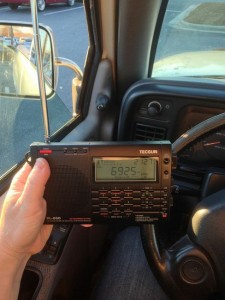
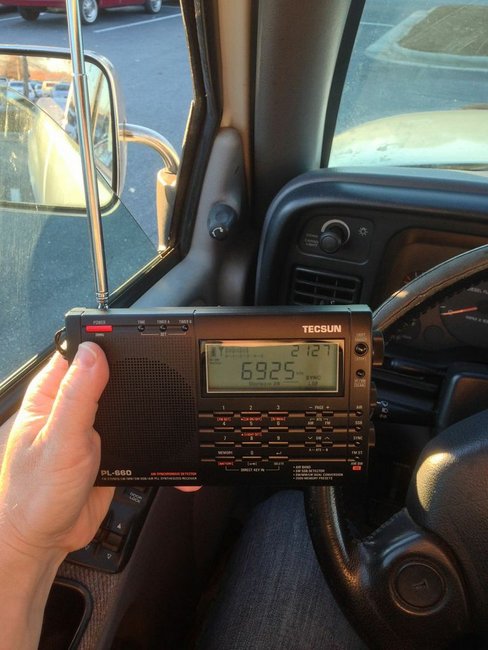
Listening to Channel Z in a parking lot.
If you live in a geographic hotbed of pirate activity (again, eastern/central North America and Europe) you might find a portable radio ample for hearing a number of pirates. Indeed, this past November, I listened to the pirate Channel Z while sitting in my truck; I was only using a Tecsun PL-660 with the antenna extended out of my opened driver’s-side window.
Though Channel Z was broadcasting in AM, as many do, it’s best to hunt pirates with an SSB-capable portable. Why? Unlike major broadcasters, many pirates don’t stick to AM as a preferred mode. Indeed, since pirates are operating at lower power, they get much more bang-for-the-watt out of SSB. To track pirates, you’ll need a radio with both AM and SSB modes. It will also help to have some sort of adjustable bandwidth filter (wide/narrow). I’ve hunted pirates with a range of such radios, among them the Sony ICF-SW7600GR, the Grundig G3, the Grundig G5, the Tecsun PL-600 and PL-660, and even the new Tecsun PL-880.
It’s much better, of course, if you have a table-top receiver, software-defined radio, or ham radio transceiver with a general coverage receiver hooked up to a resonant outdoor antenna–especially if you live outside Europe and North America. I’ve had great results in the past with an old Icom IC-735 and a 40-meter dipole antenna. The important thing here is that you invest in a receiver with a respectable degree of sensitivity and selectivity. You might need that sensitivity and an outdoor antenna to pull these relatively low-powered signals from the ether.
How to hunt pirates
Back in the 1980s, before the Internet and its online bulletin boards, I thought finding pirates was truly a hunt–random and altogether unpredictable. Now I know that finding pirates is reasonably achievable; at least, it is possible to know roughly where, and generally when, to find them. Fortunately for the beginning pirate-hunter, there are now online message boards, free radio logs, and even publications (like Yoder’s excellent treatise on the subject) to help guide your tuning (see resource links below).
 Pirate radio operators usually have day jobs–like most of us–thus only transmit while home from work. While you can hear some on weekdays, your best bet is Friday, Saturday and Sunday nights, local time. So, for example, if you’re listening for North American pirates from Europe, you’ll need to plan accordingly. Pirates are always active during holidays, too, most especially on Halloween (31st of October), which seems to be pirates’ favorite holiday.
I’ve noticed increased pirate radio activity during the winter months, as well. This is likely due to the early sunsets and cold winter nights of the northern hemisphere that tend to keep people indoors, which in turn encourages pirates to hit the air. Moreover, summer conditions in the North American “43 meter” band are often much noisier, thus pirates know they’ll be fighting static crashes to be heard during the summer months. In the quieter winter months, stations seem to pop out of the ether.
North American Pirates
The bulk of the pirate radio broadcasters I log transmit just below the 40-meter amateur radio band: anywhere from 6,850 kHz to 6,970 kHz and typically on a frequency spaced at 5 kHz. The most popular frequency is arguably 6,925 kHz, but I often log pirates on 6,935 and 6,950 kHz.
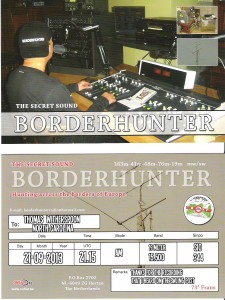
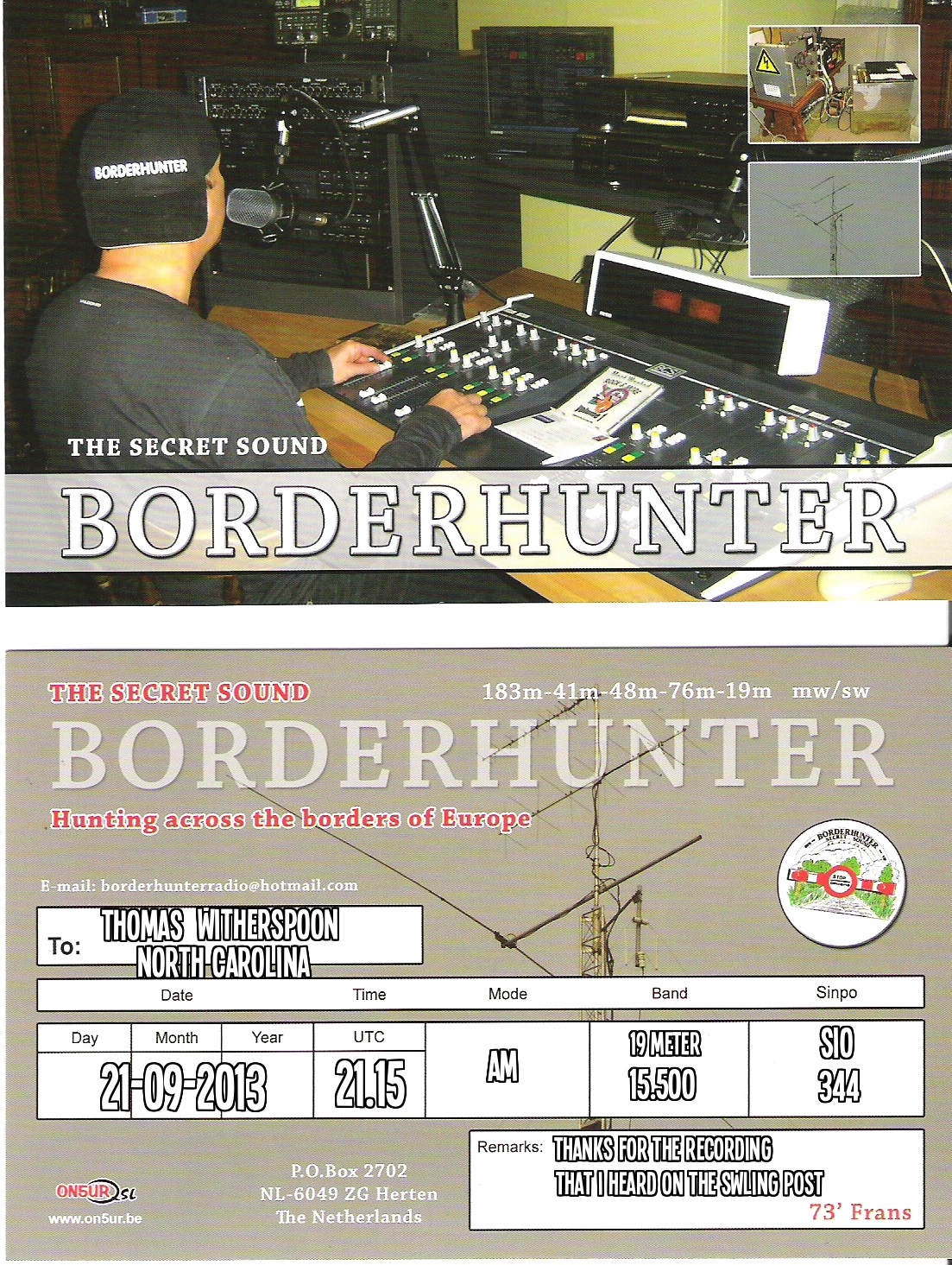
Borderhunter Radio is one of the strongest Euro Pirates I’ve ever heard. (Click to enlarge)
Euro pirates typically broadcast in the 48 meter band (6,200 – 6,450 kHz), but the HF Underground notes that you will also hear Euro pirates on the 75 meter band between 3,900-4,000 kHz, on the 19 meter band (15,000-15,100 kHz and 15,700-15,900 kHz), and even on the 13 meter band (21,000-25,000 kHz). My most recent logging of a Euro pirate from North America was Radio Borderhunter on 15,500 kHz; his signal was quite amazing.
Outside of the pirate world? Fear not
If you live outside of North America and Europe, that doesn’t mean there aren’t pirate radio stations to be found. Ask your local radio club or search the Internet for local/regional pirate stations. Additionally, you can always tune a remote receiver, via the Internet on the Global Tuners website, or via the University of Twente’s SDR in the Netherlands.
We’ve now covered the who, what, where, when, and how of pirate hunting–but what about why?
Why chase pirates?
Whether you’re a QSL collector, a “content” DXer, or the casual SWLer, I find there’s something in pirate radio listening for everyone. Speaking for myself, I’m passionate about pirate radio listening because it combines my listening/technical skills, my appetite for highly unique content, and for building a collection of quirky QSL cards. Compared to big-gun broadcasters, pirates are much more elusive game as very few announce their broadcasts in advance, and there’s no telling where a pirate’s transmitter is located: it could be in their home, on a boat, or a portable one dropped in a remote location and later retrieved.
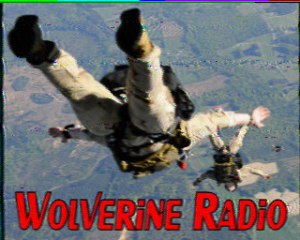
I decoded this Wolverine Radio SSTV QSL on the SSTV iOS App
Chasing pirates has also increased my technical know-how. For example, though I’m a ham radio operator, I had never even attempted to decode the SSTV (slow-scan TV) mode until prompted to do so by Wolverine Radio: at the end (and sometimes in the middle) of their broadcasts, Wolverine is known to send electronic QSL cards via SSTV.
I’ve also been encouraged by pirates to hone my weak-signal DXing using exalted carrier reception (ECR)–zero-beating an AM signal in SSB–in an attempt to hear weak AM pirate stations. It’s a simple technique, and although it takes some practice, will work on most any radio with a stable BFO (beat frequency oscillator).
And did I mention the cool QSL cards? Pirate cards are among the most unusual of QSL cards, that often incorporate obscure or vintage imagery–humor, horror, or other graphic oddity–or cast the pirate in a unique character representation. They can be highly entertaining or thought-provoking, and thus are, themselves, a unique art form.
Don’t believe me? Do a little pirate radio hunting yourself. Like me, you might just get hooked!
My favorite pirate radio resources:
The Pirate Radio Annual:
This little book by Andrew Yoder is the equivalent of the WRTH (World Radio TV Handbook) of the pirate radio world. I keep a copy handy as it helps me identify stations and better understand their format. Additionally, you’ll find contact information for QSL requests and mail-drop addresses as well. Each issue also contains a CD of sound clips from various pirates, several articles about the state of pirate radio, and other relevant info.
The HF Underground: http://www.hfunderground.com
An excellent and active pirate radio forum hosted by Chris Smolinski. Loggings are in real time and there are very few–if any–off-topic posts.
Pirates Week: http://shortwavepirate.info
Ragnar Daneskjold hosts an occasional podcast serving the shortwave pirate community; it includes pirate radio news, off-air recordings, and more.
Hobby Broadcasting Blog: http://hobbybroadcasting.blogspot.com/
Pirate radio guru Andrew Yoder started his own pirate blog last year, and has already began populating it with regular updates, QSLs, and recordings.
Free Radio Weekly:
The FRW is an email-only newsletter devoted to the hobby of pirate radio listening, and is distributed free to those who contribute. You can sign up for the newsletter by emailing any of their edittors: John Brewer ([email protected]), Ragnar Danskjold ([email protected]), Harold Frodge ([email protected]), Dave Turnick ([email protected]) or Larry Will ([email protected])
The SWLing Post
OK, I suppose I must also mention my own humble blog, where I continue to amass numerous pirate radio loggings and off-air recordings. Just browse the pirate radio category: https://swling.com/blog/category/pirate-radio/
Note: Even though it is illegal to broadcast on the shortwave bands without a license, and those who do so are subject to hefty fines, it is not illegal to listen or to send and receive QSL cards from such operators.