Category Archives: Shortwave Radio

Free Radio Skybird flies again!

Many thanks to SWLing Post contributor, DJ Frederick, who shares the following announcement:

Free Radio Skybird flies again

Just a quick note to let you know that Free Radio Skybird will be heard this Sunday [October 17, 2021] on WRMI 9395 kHz at 2300 UTC. Lots of oldies, known and obscure.

Thanks for the tip, DJ Frederick! We’ll be listening!

Guest Post: Simple Android Database Part 2

Many thanks to SWLing Post contributor, Bill Hemphill, who shares the following guest post:


Simple Android Database-PART 2

by Billy Hemphill, WD9EQD

In the first part, I showed how you could easily take a spreadsheet and create a simple database for viewing on an Android phone/tablet. The examples used in that article was two spreadsheets of radio schedules – one for Shortwave and one for FM Radio Programs. See the following link to the original article: https://swling.com/blog/2021/10/guest-post-radio-schedules-in-a-simple-android-database/

There are many lists on the internet of various radio databases. If the database can be downloaded as either a CVS file or a spreadsheet, then it is possible to load it into the PortoDB app on the phone tablet. I’ll show how this can be done with two popular databases that I reference all the time.

EIBI Data Base

Most of you are probably familiar with the EIBI database of shortwave schedules. Many of the Shortwave Schedule apps on the Phones reference this database. For example, I use the Skywave Schedules on my phone. While it does allow for me to search by many parameters, I thought it might be fun to have it in a PortoDB database. Plus it would be interesting to see how PortoDB performs with a large data set. Continue reading

Guest Post: Jock explores the Tecsun PL-880’s ATS system

Many thanks to SWLing Post contributor, Jock Elliott, who shares the following guest post:


Oh, no, it’s broken – NOT! And other observations on the PL-880

by Jock Elliott, KB2GOM


Okay, okay, I’ll admit it: I’m an oldster, currently enjoying well over 70 trips around that Big Orange Ball in the sky. Further, I’ve been out of SWLing for a while.

Coming back into the hobby after more than a decade’s absence, has been eye-opening. Back when I wrote for Passport To World Band Radio, my main interest, equipment-wise, was tabletop communications receivers hooked to serious outdoor antennas.

Today, however, tabletop communications receivers are hard to come by (there are few new offerings), and, in my situation, serious outdoor antennas present a series of logistical problems that aren’t going to get solved quickly.

So that has brought me to today’s crop of portable shortwave receivers, and – bottom line – they are pretty darn cool, offering worthy performance on a number of levels. My latest acquisition is the Tecsun PL-880.

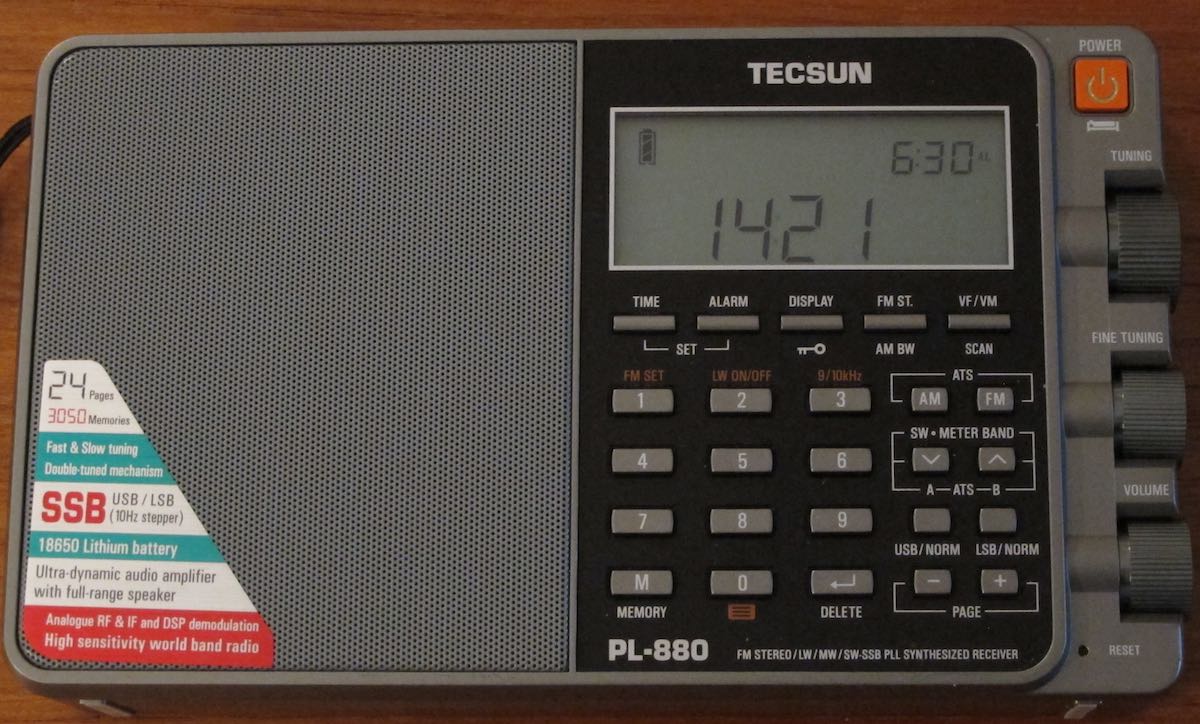
Like many of the current SW portables, it offers a system for scanning the SW bands and automatically storing the stations it finds into memory. On the PL-880, it’s called ATS (for Auto Tuning Storage.) Oh, you knew that. Yeah, but did you know that the PL-880 has, essentially, two ATS systems?

The down arrow activates ATS Mode A, and the up arrow activates ATS Mode B.

Check it out: If you press the DOWN arrow button (in the SW-METER BAND rectangle), the ATS Mode A system searches the band you are in (FM, MW/LW or SW, including ALL the SW meter bands), automatically stores stations it finds, and “previously stored radio stations will be replaced automatically by the newly found stations.” Each band has its own set of memories, so that SW stations will be stored in SW memories, FM stations will be stored in FM memories, and so forth.

ATS Mode B, however, behaves differently. You can activate it by pressing the UP arrow (in the SW-METER BAND rectangle). If you are in SW frequencies, ATS Mode B will search and store stations only within the current SW meter band. Further, it will NOT overwrite memories, but will start storing stations it finds, starting with the first available unused memory. Pretty neat.

You can, however, fool yourself. I ran ATS Mode A on SW frequencies one night and found a station that was broadcasting unusual stuff (Kennedy assassination, UFOs, and the like). A couple of nights later, I wanted to see what the night’s topic was on that station, so I punched the button to access memories and found . . . nothing! Oh, no, it’s broken!

Then I realized I was in SSB mode, and, it turns out, the PL-880 has a separate set of memories for SSB. (And the manual says that explicitly.) I switched off the SSB mode, and – tah-dah! – the SW memories reappeared. Sometimes it really does pay handsome dividends to read the manual.

One of the slick things about the PL-880’s memory setup is that, when you are in memory mode for a particular band, you can easily scroll through the memories simply by turning the tuning knob.
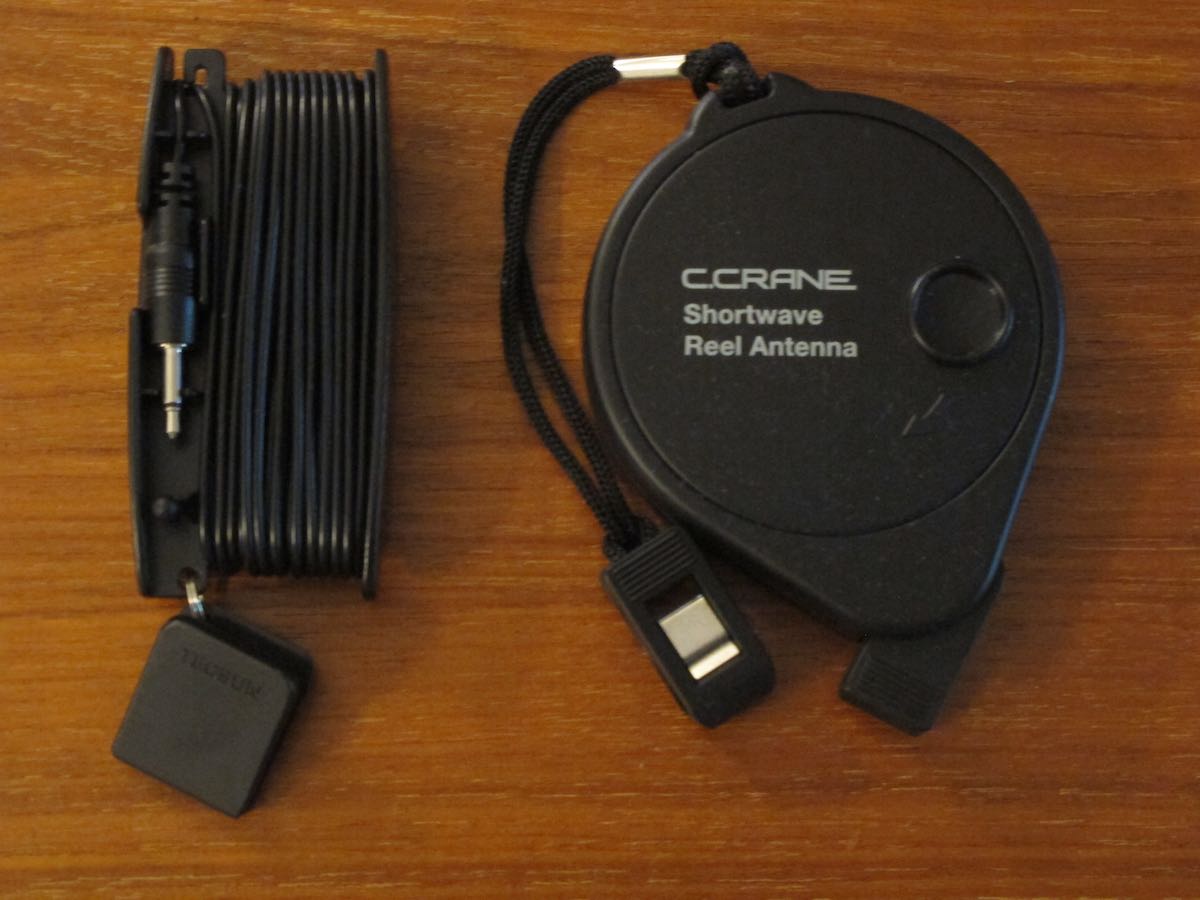
Wire antenna reels come in different styles. PL-880 (left) and CCrane Skywave SSB. But both improve performance for their respective radios.

The PL-880 has a nice long whip antenna (nearly twice as long as the CCrane Skywave SSB’s antenna), and it seems to be quite sensitive operating off the whip. But if you take the time to deploy the external wire antenna that comes with the PL-880, there is a considerable gain in sensitivity. Tuning around the 40-meter ham band, with the external wire antenna plugged into its socket, I could hear two stations in conversation, one louder than the other, but both copyable. When I tried to listen to the same pair of stations with just the PL-880’s whip antenna, the fainter station disappeared entirely, and the louder station was “down in the mud” but copyable. So the external wire antenna is clearly worth using.

So far, I am well pleased with the PL-880.

PS: Here’s a link to a really good article on extending the wire length of the reel-up antenna that came with the PL-880: https://www.hamuniverse.com/shortwavereelantenna.html

Radio Waves: Radio Bulgaria Online, Small Town Station is Backbone of Community, 1949 Radio Contact, and BBC World Service Performance Review

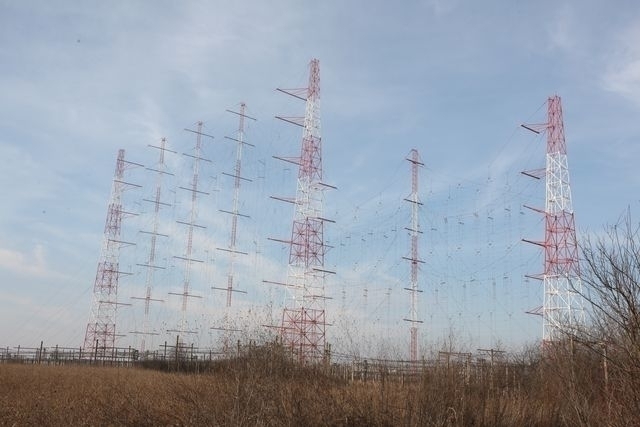
Photo by Flickt user Shirokazan via Wikimedia Commons.

Radio Waves:  Stories Making Waves in the World of Radio

Because I keep my ear to the waves, as well as receive many tips from others who do the same, I find myself privy to radio-related stories that might interest SWLing Post readers.  To that end: Welcome to the SWLing Post’s Radio Waves, a collection of links to interesting stories making waves in the world of radio. Enjoy!


Hear the voice of Bulgaria – in 9 languages from Radio Bulgaria (Radio Bulgaria)

On the website of the Bulgarian National Radio – www.bnr.bg you can now listen to the new podcast of Radio Bulgaria, “Bulgaria Today” in English, German, French, Spanish, Russian, Serbian, Greek, Albanian and Turkish.

BNR has resumed its programmes in foreign languages after a 5-year pause. The change coincides with the 85th anniversary of the first foreign-language broadcasts for foreign audiences celebrated by Radio Bulgaria in 2021. Continue reading

Radio Romania International: Listeners’ Day 2021

RRI’s Tiganesti-based shortwave transmitter centre (Photo source: Radio Romania International)

Many thanks to SWLing Post contributor, David Iurescia (LW4DAF), who shares the following notice from Radio Romania International:

Listeners’ Day on Radio Romania International

Sunday, the 7th of November 2021, will be Listeners’ Day on Radio Romania International, celebrated a week after the Romanian Radio Day marked on the 1st of November. 2021, just like the previous year, has been affected by the Covid-19 pandemic, which has profoundly changed our lives, keeping us apart from family and friends and influencing our way of spending free time.

Bombarded with all sort of news and information, we realised that it is sometimes difficult to distinguish between true and false stories. During the pandemic, public radio and TV stations have been doing their best to offer quality journalism and reliable information. This effort has been repaid, as most people have returned to public stations as their main source of reliable information.

In this year’s edition of Listeners’ Day on RRI we ask you, again, what has been your most trusted source of information on the pandemic? Have you removed from your list the sources of information proven to be spreading fake news and misinform the public? Which is the role that radio, the public radio in particular, plays in your life at this time of uncertainty?

We are looking forward to receiving your answers, which will be included in our shows on the 7th of November! You can email them to us, at [email protected], post them on Facebook or send them as a comment to this article on RRI’s website at www.rri.ro. If you like, you can also send us pre-recorded answers via WhatsApp, at +40744312650, or you can send us your telephone number so we can call you from the studio and record your opinions. Thank you!

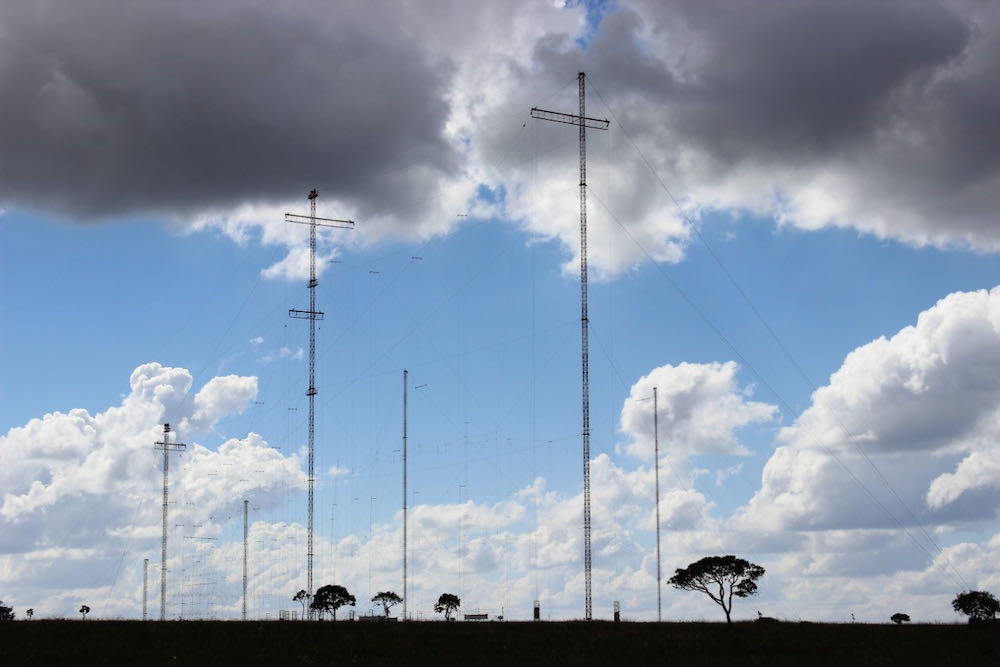
Radio Nacional da Amazonia prepares for DRM broadcasts

Photo: DRM Consortium

Many thanks to a number of SWLing Post contributors who share the following news from the DRM Consortium:

Brazil prepares for domestic DRM transmissions to Amazonia (DRM Consortium)

DRM broadcasts from a locally produced transmitter will be originated for the first time in Latin America, as Brazil will officially start digital (DRM) shortwave transmissions through The National Radio of the Amazon towards the vast area of the northern Amazon region, mainly inhabited by indigenous populations.

In another first, Empresa Brasil de Comunicação (EBC), the public broadcaster, placed the order for the high-powered transmitter with a local manufacturer, the BT Transmitters company from Porto Alegre. BT Transmitters signed a contract with EBC for the production of a 100 kW transmitter in the DRM digital system.

The equipment will be used on the 11,780 kHz frequency in the 25-meter band, which is one of the shortwave channels used by Rádio Nacional da Amazônia since 1977.

The purchase for R$3.5 million is the result of an auction held in August 2020, in which other equipment for EBC’s public radio broadcasts is planned to be acquired.

At the end of last year, Nacional da Amazônia carried out tests with the DRM technology using a transmitter of 2.5 kW with the digital power of just 1 kW.  EBC demonstrated then, for the first time in the country, the use of multi-programming and the transmission of interactive multimedia applications.

Despite this low power of the transmitter supplied by BT Transmitters, recordings were reported from different regions of the country and even from North America and Europe (Radiolab – Começam transmissões de rádio digital DRM em onda curta no Brasil).

The results of the tests were published last month by the DRM Consortium.

The DRM (Digital Radio Mondiale) standard provides power savings of up to 80% in electricity consumption, a sound quality equal or superior to FM, as well as allowing images and other data to be sent to the radio receiver.

DRM is a worldwide consortium, and more information can be found at www.drm.org.

This story was also noted in Radio World:

DRM Shortwave Will Serve Amazon Region (Radio World)

National Radio of the Amazon orders a 100 kW BT transmitter

National Radio of the Amazon plans to use DRM shortwave transmissions to serve indigenous populations in the northern Amazon region, according to the Digital Radio Mondiale Consortium.

Public broadcaster Empresa Brasil de Comunicação (EBC) ordered a 100 kW BT transmitter to broadcast in DRM at 11,780 kHz in the 25-meter band, a shortwave channel used by Rádio Nacional da Amazônia.

The purchase, valued at about $650,000 USD, was the result of an auction held a year ago for purchase of equipment for EBC public radio broadcasts.

This is believed to be the first domestic DRM installation on a locally produced transmitter in Latin America.