Category Archives: Shortwave Radio

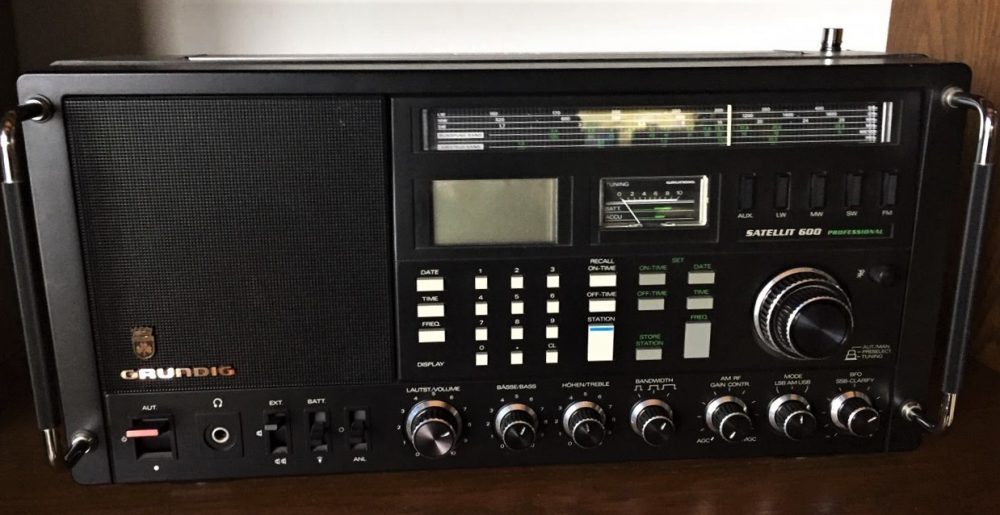
Free to a good home: A Vintage Grundig Satellit 600 Professional

I was recently contacted by Allan Rosenbluth, a particularly generous SWLing Post reader.

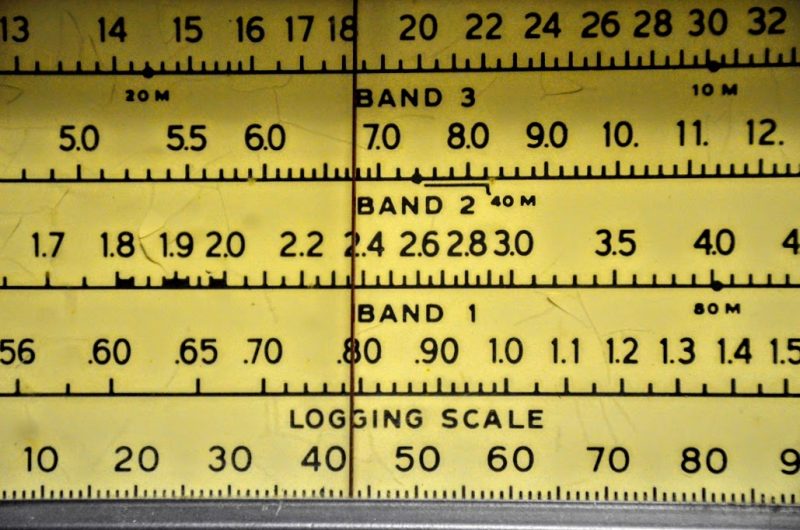
Allan contacted me because he would like to give away his cosmetically excellent Grundig Satellit 600 Professional (see photo above) with all the original paperwork. He said that the radio turns on, but does not work or produce sound.  Allan purchased this radio for his father who has sadly passed away.

I would assume the 600 might need to be re-capped, or it might only need a little DeOxit on some of the contacts.

We’re not looking for someone to fix the 600 and flip it on eBay, we would simply like his dad’s Satellit 600 Pro to find a good home.

Allan is not interested in the hassle of shipping this radio–he only want to arrange a local pickup.

If you live near Encino, CA (91436) and are interested, simply contact Allan via his email address.

Thanks again, Allan!


Do you enjoy the SWLing Post?

Please consider supporting us via Patreon or our Coffee Fund!

Your support makes articles like this one possible. Thank you!

Airspy Youloop and Homebrew Passive Loop Antenna designs

Almost two weeks ago, at the 2020 Winter SWL Fest, I gave a presentation called “A New Era in Portable SDR DXing.

The presentation was essentially an in-depth version of an article I published in the January 2020 issue of The Spectrum Monitor magazine (see cover above).

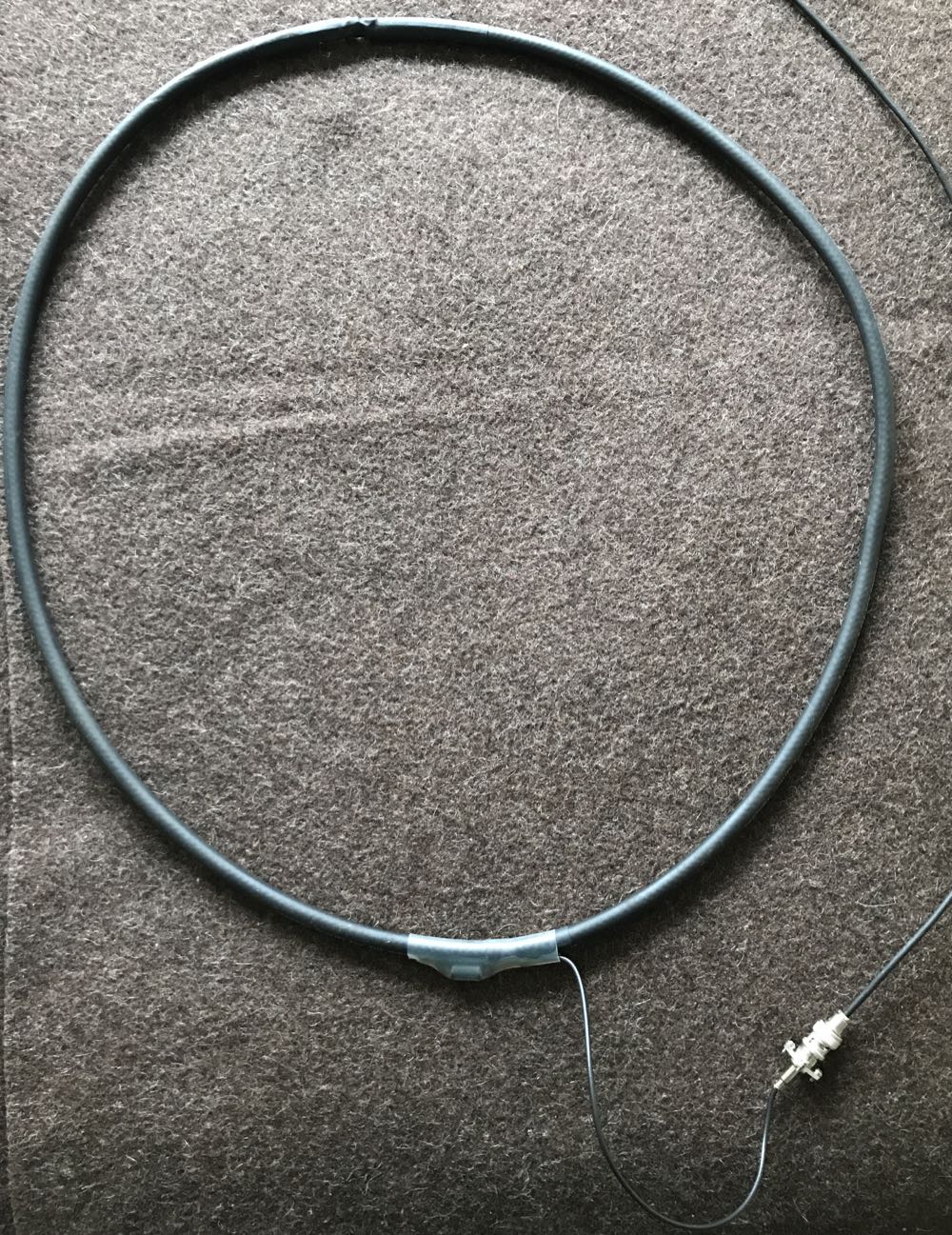
I devoted a good portion of the presentation describing how to build a passive loop antenna design by Airspy’s engineer and president, Youssef Touil. This passive mag loop takes advantage of the Airspy HF+ Discovery‘s exceptionally high dynamic range and is an impressive performer.
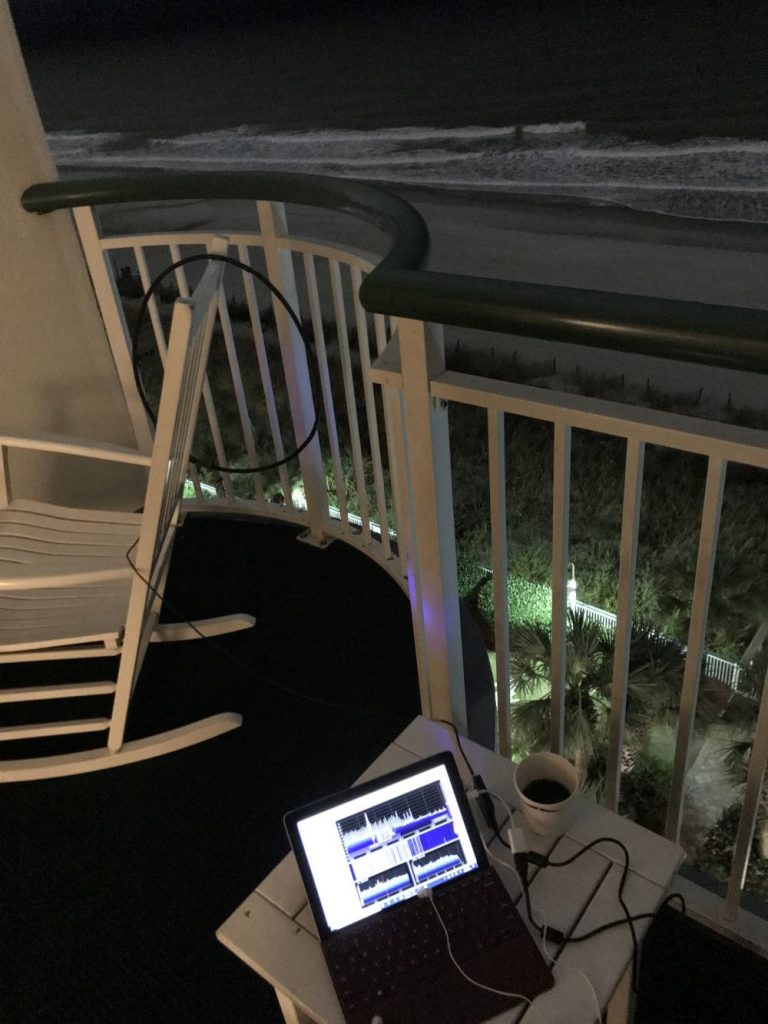
The homebrew loop on the balcony of a hotel.

You may recall, I posted a short article about this loop in November after enjoying a little coastal DXing.

In short? This passive loop antenna pairs beautifully with the Airspy HF+ Discovery. I’ve also been very pleased with results using the new SDRplay RSPdx on the mediumwave band where the receiver now sports a high dynamic range mode.

Overdue corrections…

After returning from the Winter SWL Fest last week, I was hit with an upper respiratory bug. No doubt, a souvenir of my travels!  It wasn’t the flu (I was tested), nor COVID-19, but it did knock me off my feet for a few days with fever, coughing, and headaches. You might have noticed a lot less posts last week and almost no replies from me via email. I’m only now feeling totally human again and trying to catch up with my backlog.

Shortly after my SWL Fest presentation, I realized I made (at least!) two mistakes. I had planned to post corrections here on the SWLing Post last week, but the bug delayed all of that, so here you go:

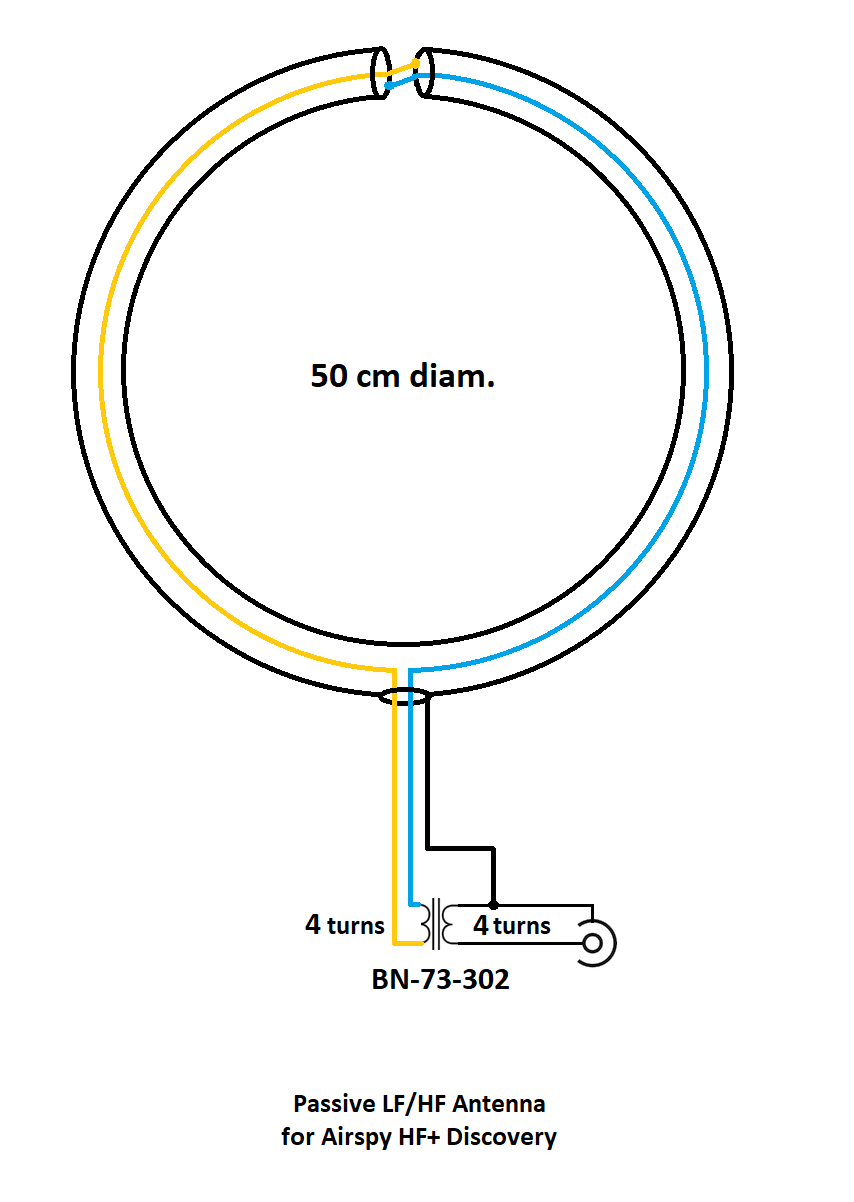
#1 Schematic of my homebrew passive loop antenna
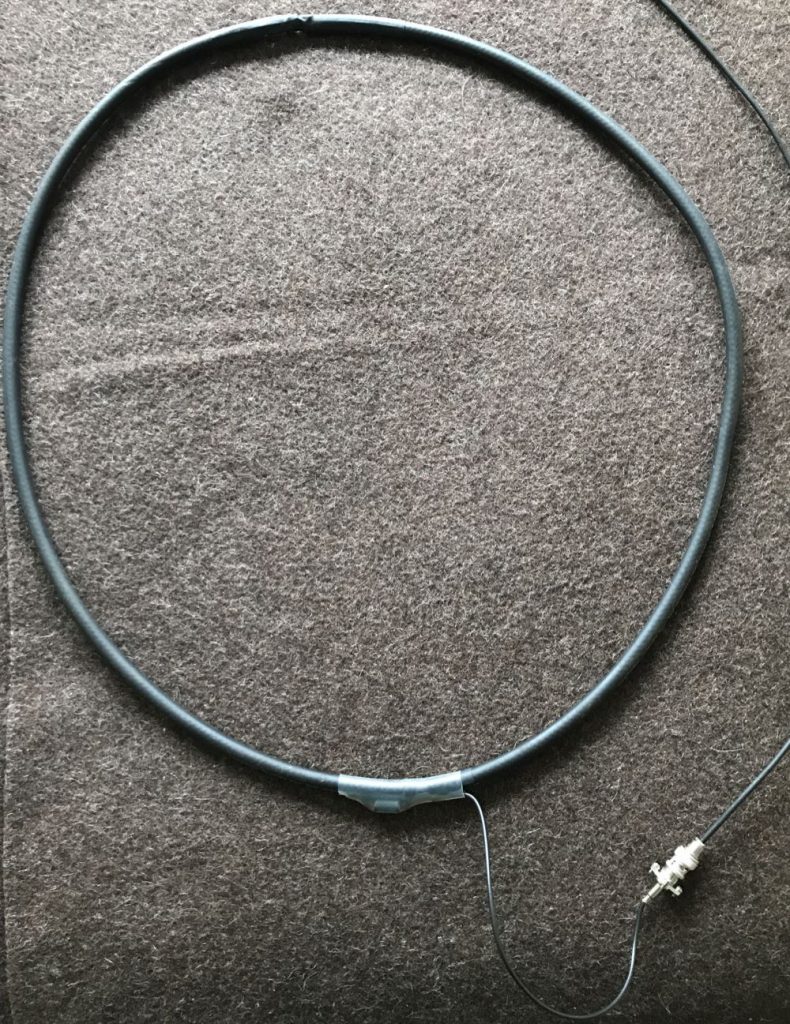
When Youssef started experimenting with passive loop antenna designs, he posted a few schematics of at least three build options.

Although I described how to build my passive loop antenna, I grabbed the wrong schematic for my presentation slides. Many thanks to those attendees who noticed this.

Here is the schematic I should have shared:
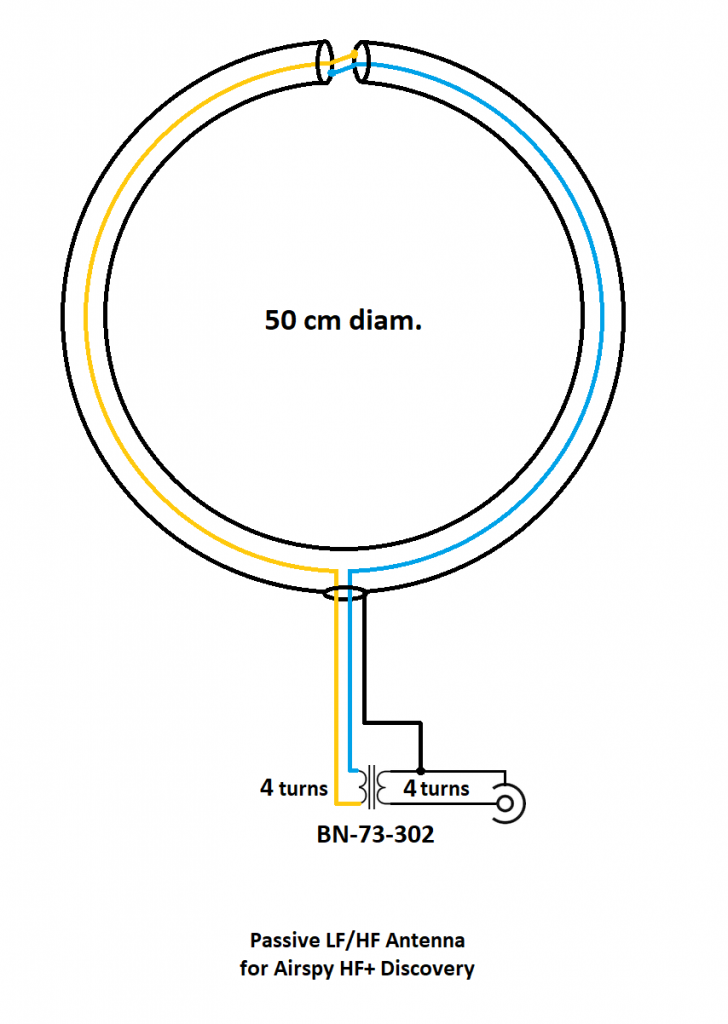
Note that the transformer has four turns on both sides (the one in the presentation had 4:2).

Again, apologies for any confusion.

#2 The Airspy Youloop passive loop antenna

If you’re not inclined to build your own passive loop antenna per the diagram above, Airspy is planning to manufacture and sell a lightweight, high-performance loop of a similar design.
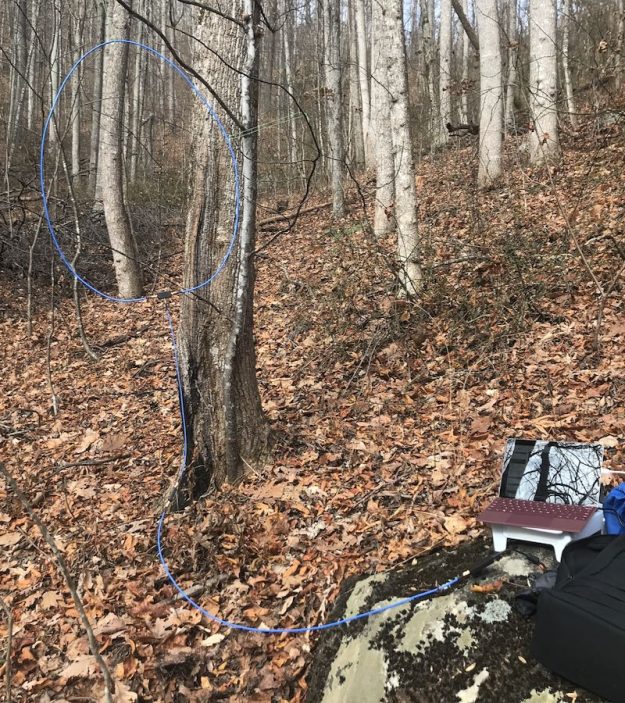
Prototype of the Airspy Youloop in the field (note bright blue cable jacket)

During the presentation, I called the future AirSpy antenna, the “Spytenna.” I was incorrect. (Turns out, I got this name from an early antenna schematic and somehow it stuck in my head!)

Airspy is calling their passive loop antenna the Youloop. Youssef posted the following note in the Airspy email discussion group:

We are currently arranging the shipping of the affordable passive version to Airspy.us and RTLSDR Blog.

Btw, It’s called “Youloop”

Many thanks to Richard Langley and a number of other readers who pointed this out last week.

I’ve had a prototype of the Youloop since November and brought it to the SWL Fest and presentation. It’s a quality antenna and incredibly compact when disassembled and rolled up.

When the Youloop is available to order, we’ll post links here on the SWLing Post.

More to come!

Once I catch up here at SWLing Post HQ, I plan to publish detailed construction photos of the homebrew loop antenna.

Many of you have questions about how to tap into the center conductor at the mid-point of the loop. These photos should help guide you.

Stay tuned!


Do you enjoy the SWLing Post?

Please consider supporting us via Patreon or our Coffee Fund!

Your support makes articles like this one possible. Thank you!

Dean solves second interval signal mystery

(Image source: Madrid.org)

In response to our second mystery interval signal challenge, SWLing Post contributor, Dean Bianco replies:

Mystery solved!

This is the “interval signal” (more accurately, a placeholder with a musical station identifier) for the Compañía Telefónica Nacional de España (CTNW) from Madrid, Spain.

They were a point-to-point HF radiotelephone terminal that provided overseas telephone and telegraph services in the days before satellites became common.

As a young SWL, I would receive all manner of strange musical identifiers for these utility stations. Most of these HF telecommunication services had gone to satellite by the early 1980’s. The HF bands were chock-a-block with signals, whether they be broadcast or utility services.

Glad to help!

To verify his claim, Dean shares the following embedded audio file made by Willi Passmann in the mid 1970s (via the excellent UtilityRadio.com website):

Well done, Dean! Thank you once again for coming to the rescue!

In case you didn’t know, dear readers, Dean Bianco is a force to be reckoned with in the shortwave radio world. 🙂 This year, he won the 3rd Annual Fest Trivia Quiz at the 2020 Winter SWL Fest! An impressive accomplishment, indeed. Not only that, but Dean’s an incredibly nice guy, great friend, and always willing to help out those new to the hobby!

Thank you, Dean!

Radio Northern Europe International and This is a Music Show broadcasts

Many thanks to SWLing Post contributor, Roseanna, who shares the following announcement posted on her blog [with apologies for the late plug!]:

Radio Northern Europe International has worked with This is a Music Show to make a broadcast consisting of 30 minutes of RNEI and 30 minutes of TIAMS, that’s 1 hour of great music!

We really love what TIAMS has made for us and we can’t wait to share it with you!!

Radio Northern Europe International show #2 will have music from Iceland, Norway, Ireland, Sweden, Denmark and Finland this month, I really love the music we are playing and we hope to introduce you to some new music this month!
Songs 4,5 and 6 are my favourites this show!

Broadcast Times:
We have good news to those of you not in Europe and those of you nearer the transmitter, multiple times throughout the month! RNEI #2 will broadcast 5 times on 6070 kHz at the following times:

Saturday the 7th of March 2020, 10-11UTC
Saturday the 7th of March 2020, 19-20UTC
Friday the 13th of March 2020, 11-12UTC
Saturday the 21st of March 2020, 19-20UTC
Sunday the 29th of March 2020, 01-02UTC (this time is very experimental!)

Digital modes:
In RNEI Show #2 the final song will have the MFSK32 embedded into it. This time: text, Emoji and some Icelandic art! (Note, an app like TIVAR shows the emoji!)
TIAMS’ contribution will contain some MFSK64 text and an MFSK64 image!
Many thanks to one of our listeners for suggesting our final MFSK song!

Audio Processing:
This show Daz has been working hard making an audio processor to try and expand the audio range of RNEI! We have decided on trying to broadcast a flat signal to combat the noise floor. This means that the highs might come across a bit too bright and the bass might feel bit lacking.
Don’t worry, a little bit of EQ on the receiver should reverse it ending up with a better frequency range than before! Most standalone radios should already apply a high frequency reduction however SDRs can omit this!

You can send your reception reports, feedback and suggestions for RNEI to [email protected]!
Wishing you good reception conditions and all the best,
-Roseanna

For more info, check out Roseanna’s blog.

Let’s solve another interval signal mystery!

Last month, we published a post asking SWLing Readers to help Brian (W9IND) identify an elusive interval signal. Turns out, the interval signal belonged to the Voice Mirror of the PTT Habana, Cuba station.

This month, SWLing Post contributor, David Crawford is asking for help to ID another interval signal which likely belongs to a utility station. David writes:

In follow-up to the La Habana utility mystery, here’s another one from the same era, 14985 kHz or thereabouts. Somewhere along the line I came to the conclusion that it might be El Salvador, but I don’t remember what led to that. The [recording embedded below] isn’t my own recording of it.

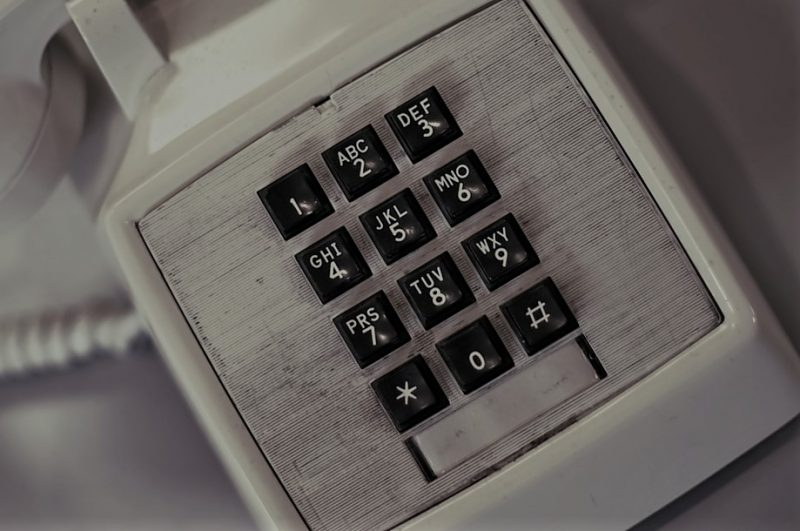
The tune is composed of individual DTMF tones, and when I was a bored youth I discovered that it could be played on an AT&T desk touch tone phone by pressing two keys at a time to remove the second tone. This one would repeat for hours at a time, interrupted by manually patched telephone calls.

Readers: Can you positively ID this interval signal? If so, please comment!

Tecsun PL-990 (pilot run) now on AliExpress

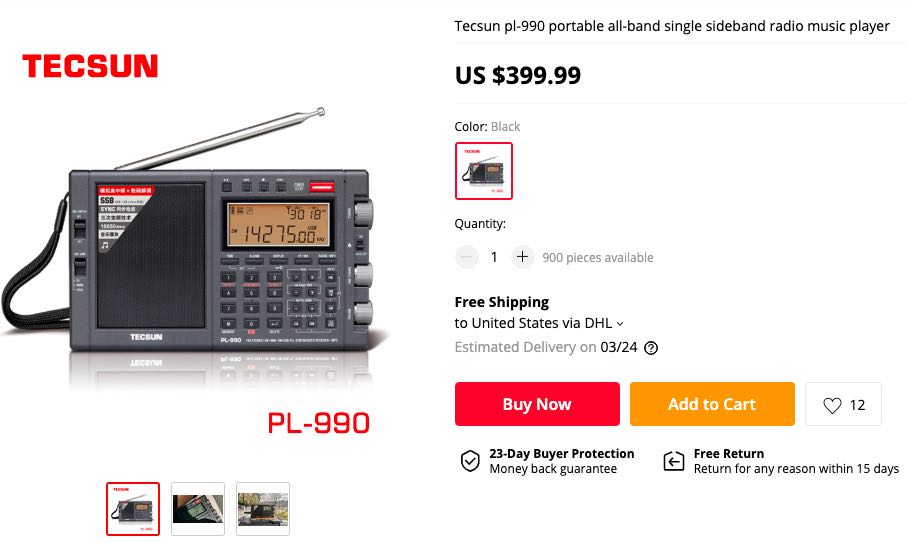
Many thanks to SWLing Post contributor, Dan Robinson, who notes that the Tecsun PL-990 has now appeared on AliExpress.com.

The price is a steep $399 US shipped via DHL with an estimated delivery of late March. They claim to have about 900 units available.

You can check out the PL-990 on the AliExpress website, but it might require registration even via this direct link.

Frankly, I would wait until the PL-990 is available at Anon-Co since they’re an authorized Tecsun distributor, have proven customer service, and will likely have a more competitive price. I would also question if the AliExpress units are the new export version we’ve been waiting for, or simply the units that were available within China last year. The AliExpress page gives us no clear indication of the production version at time of posting.

UPDATE: Turns out, these are the pilot Chinese versions of the PL-990. I can’t recommend purchasing one–especially at this price.

I hope this might indicate that the PL-990 is close to release. Covid-19 has certainly stopped much production and development in China. Thanks again for the tip, Dan!

Radio Waves: Plant-powered Satellite Comms, BBC Pips, Filter Basics, and Replacing Shortwave

Radio Waves:  Stories Making Waves in the World of Radio

Because I keep my ear to the waves, as well as receive many tips from others who do the same, I find myself privy to radio-related stories that might interest SWLing Post readers.  To that end: Welcome to the SWLing Post’sRadio Waves, a collection of links to interesting stories making waves in the world of radio. Enjoy!

Many thanks to SWLing Post contributors Marty, Dennis Howard, Dennis Dura, Kris Partridge and Richard Langley and for the following tips:


Plant-powered sensor sends signal to space (Phys.org)

A device that uses electricity generated by plants as its power source has communicated via satellite—a world first.

[…]The device can inform farmers about the conditions of their crops to help increase yield, and enable retailers to gain detailed information about potential harvests.

It transmits data on air humidity, soil moisture and temperature, enabling field-by-field reporting from agricultural land, rice fields or other aquatic environments.

The extremely low power device sends signals at radio frequencies that are picked up by satellites in low Earth orbit. It was developed by Dutch company Plant-e and Lacuna Space, which is based in the Netherlands and the UK, under ESA’s programme of Advanced Research in Telecommunications Systems (ARTES).[]

The eccentric engineer: a tale of six pips and how the BBC became the national arbiter of time (Engineering and Technology)

This edition of Eccentric Engineer tells the story of the BBC Time Signal and how, over the years, it has just got more complicated.

Every engineer needs to know the time, if only so as to not miss lunch. Since 1924, many Britons have been checking their watches against the BBC time signal, known affectionately as ‘the pips’.

The history of the ‘pips’ is almost as long as the history of the BBC itself. The first transmissions from what was then the British Broadcasting Company began in late 1922 and soon afterwards there were suggestions of broadcasting a time signal under the control of the Royal Observatory at Greenwich – then the arbiter of time in the UK.

No one seems to have seen a need for this degree of precision, but early broadcasts did use their own ad hoc ‘pips’, marking the 8pm and 9pm news programmes with a time signal consisting of the announcer playing the Westminster chimes on a piano and later a set of tubular bells. This proved rather popular with listeners, who could now adjust their clocks and watches daily, so the BBC decided to invest in some more high-tech clocks from the Synchronome Company. These provided audible ‘ticks’, which the announcer then simply counted down.[]

What Is Replacing Shortwave? (Radio World)

A joint effort is necessary to bring the digitization of radio to a successful end

Analog shortwave will celebrate about 100 years of existence in 2028 when many hope 5G will have been properly defined, tested and applied, though broadcasting is low on its long list of perceived advantages.

It’s true that shortwave was typically a medium of the Cold War that peaked in 1989 and that afterward its listenership dwindled. Many international broadcasters gave up on it as the post-war transmitters got rustier and the energy bills kept mounting.

After all, when budget cuts are needed, no transmitter will go on strike or write to the press, as happened when the BBC World Service tried to unsuccessfully close its Hindi shortwave transmissions in 2011. In 2020 these broadcasts stopped, when committed BBC Indian listeners, writers and thinkers who opposed it in 2011 did not protest too much.

The slow death of shortwave has been blamed on the internet and satellite. As technology and content are inextricably linked, shortwave created its type of content that is no longer favored by the savvy FM listener, internet user and cellphone obsessed.[]

Filter Basics: Stop, Block and Roll(off) (Nuts and Volts)

A casual observer might think that wireless systems consist primarily of filters connected by the occasional bit of circuit! Block diagrams of transceivers often include as many filters as any other function. This is true at the system level, just as it is at the circuit level — and many circuits behave in a filter-like way, whether intended to be a filter or not! That makes understanding filter basics important for wireless success.[]


Do you enjoy the SWLing Post?

Please consider supporting us via Patreon or our Coffee Fund!

Your support makes articles like this one possible. Thank you!