Category Archives: Shortwave Radio

A review of the SDRplay RSPduo 14-bit dual tuner SDR

The new SDRplay RSPduo

Moments ago, I posted a press release from the UK-based software-defined radio manufacturer, SDRplay, announcing their latest product: the RSPduo: a 14-bit Dual Tuner SDR.

I should start with the disclaimer that, not only was I sent an RSPduo to review and evaluate, but SDRplay has been a supporter of the SWLing Post for a few years now.  You’ve no doubt seen their ads in the upper right corner of our site. After I reviewed their first SDR (the RSP1) I discovered that SDRplay––all of their staff and supporters––welcome constructive criticism and even invite frank discussions. They’re a company with integrity.  No doubt, this is why I agreed to alpha- and beta-test their SDRs. Fortunately, I’ve not been disappointed.

As a company, moreover, SDRplay breaks the mold––and in very good ways:

  • SDRplay is a small company that employs actual radio enthusiasts. Their designs and software cater to DXers, SWLs, hams, scanner enthusiasts, amateur astronomers, experimenters, and makers, among others.
  • SDRplay designs and builds their products in the United Kingdom. No doubt they could increase their profit margin by using manufacturing centers in China, but they choose not to do so, to the benefit of their products.
  • The quality of the company’s products is, at least to date, excellent.
  • SDRplay’s product pricing is nonetheless quite affordable

That last item, in particular, is a head-scratcher.  Considering these facts, how does SDRplay still manage to keep their pricing so competitive? I only wish I knew.  When the company released the RSP1A last year, I had already spent a few months with alpha and beta units, mulling over their respective merits (and there were many).  So I was simply gobsmacked when they announced that the price would be just $99 US. I rather figured the company was leaving money on the table, although I was pleased to announce this price to my readers here.

Fast-forward to two weeks ago: I received the new RSPduo to review. And the price this time? $279 US. While this is currently the priciest product in the SDRplay line, let’s go over what makes this SDR special…and why I still think SDRplay may be leaving money on the table.

Introducing the SDRplay RSPduo


The RSPduo is unlike any other SDR in the SDRplay product line, and, indeed, unlike most of the budget SDRs currently on the market.

As “duo” implies, this RSP features dual independent tuners, both piped through a single high-speed USB 2.0 interface. With the RSPduo, you can explore two completely separate 2 MHz bands of spectrum anywhere between 1kHz and 2GHz.

SDRplay lays out several use-scenarios in their press release:

  • The ability to simultaneously receive on two totally independent 2 MHz spectrum windows anywhere between 1 kHz and 2 GHz
  • Simultaneous processing from 2 antennas enables direction-finding, diversity, and noise-reduction applications
  • Ideal for cross band full-duplex reception, e.g. HF + VHF, or VHF + UHF
  • Simultaneous Dump1090 and VHF ATC reception
  • Simultaneous monitoring and recording of 2 ISM bands
  • Use SDRuno to seamlessly control and manage the dual tuner in a single environment.

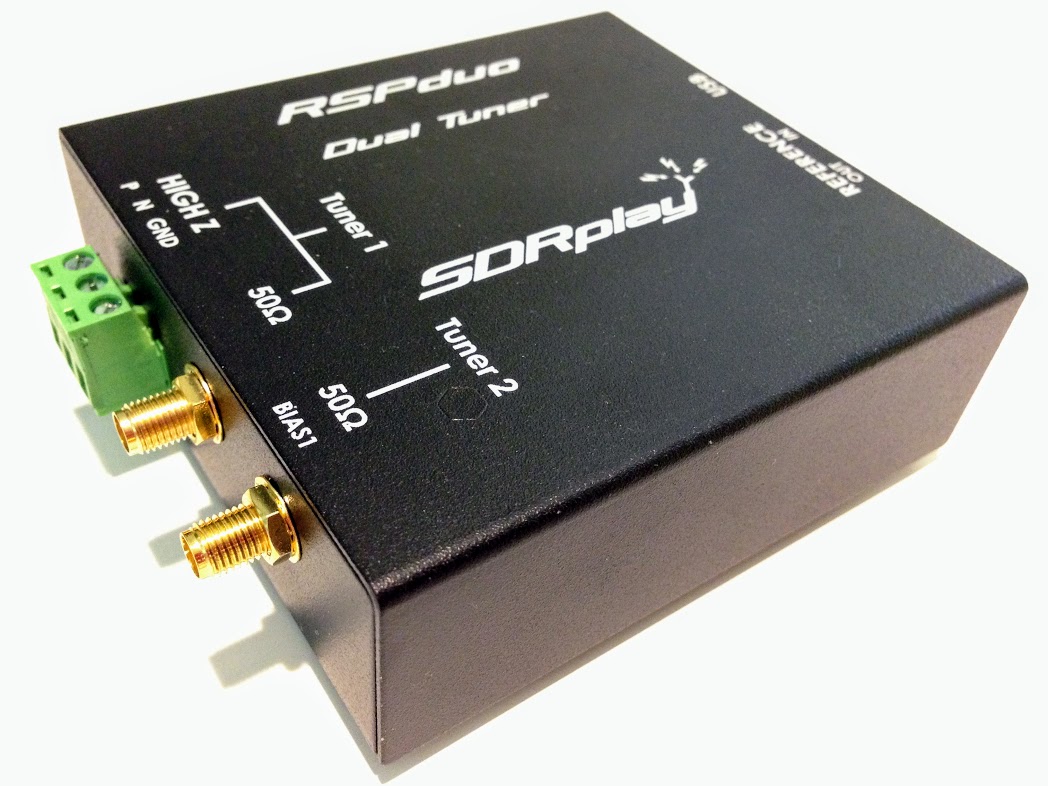
Externally, the RSPduo bears a strong resemblance to the RSP2pro. Internally, however, it’s quite different.
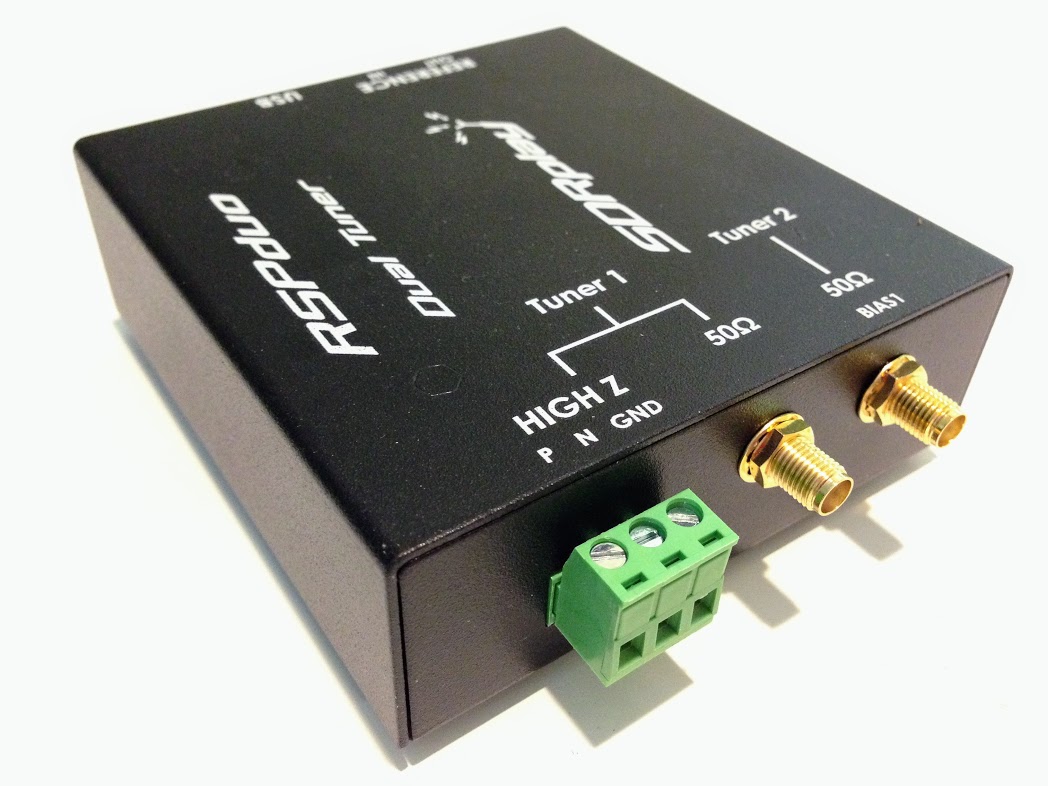
Besides featuring a second independently controlled tuner, the RSPduo also sports 14 bit ADCs and a completely re-designed RF front end, which enhances receiver selectivity and improves dynamic range.

In short, the RSPduo is like having two SDRs in one.

Performance

I received the RSPduo during a very busy time of the year: the build up to the Hamvention in Xenia, OH.

One of the first things I noticed about the RSPduo is its weight. When I picked up the package from SDRplay, I could tell it weighed at least twice that of the RSP1A. One reason for the extra heft is that the RSPduo, like the RSP2 Pro, has a metal enclosure. I’m willing to bet the RSPduo also has more shielding––adding even a little extra weight.

I’ve had the RSPduo on the air for more than a week now, and have checked out all of its major functions and begun to learn the nuances of navigating the dual receivers in the latest version of SDRuno.

SDRplay will, I feel sure, post a primer video on using the various dual tuner functions in the coming weeks.


Installation of the software, even in pre-production, was totally a “plug-and-play” experience. Simply install the SDRuno software package with the RSPduo disconnected from the USB port.  Plug in the RSPduo, and wait for the USB driver to load, then open SDRuno. That’s it. You’re on the air!


As I’ve indicated, the RSPduo is really like having two RSP1As in a single RSP2 Pro package. One of these dual receivers––the master––can utilize either a standard 50 ohm SMA antenna port, or a Hi-Z port. The second receiver uses one 50 ohm SMA antenna port just like the RSP1A.
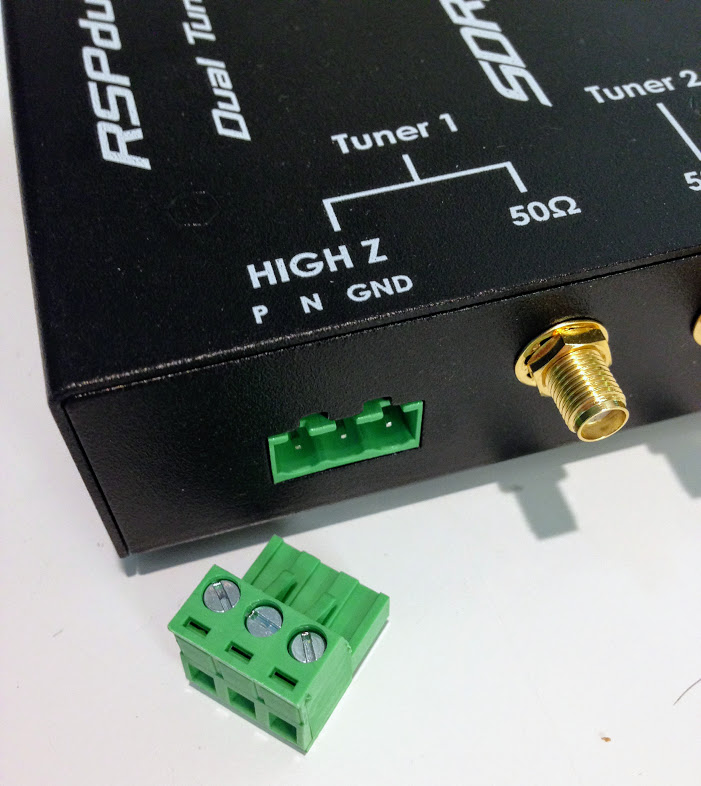
I much prefer using the Hi-Z port for everything longwave and mediumwave.  I did hook up both antenna ports on the master receiver, however, and switched back and forth between the two. At least in my antenna setup, I feel like the Hi-Z option lends itself to improved sensitivity on these bands. It’s not a dramatic difference––indeed, looking at the spectrum display one barely notices the difference––but my ears told me the noise floor was lower and signal strength slightly better with the Hi-Z port. Above 2 MHz, the Hi-Z port is not prefered since it lacks the same level of RF pre-selection as the 50 ohm ports provide.

Unlike the Hi-Z port with the RSP2, the RSPduo treats the Hi-Z port more like an auxiliary antenna port. When I employed the Hi-Z port in the HF bands, I did notice small spurious noises, but this might have been due to my antenna port configuration here in the shack (my Hi-Z connector is simply attached to the shield and center conductor of my coax).

Again, however, for anything above 2 MHz, SDRplay suggests using the 50 ohm ports.

How to set up dual receivers on one screen/monitor
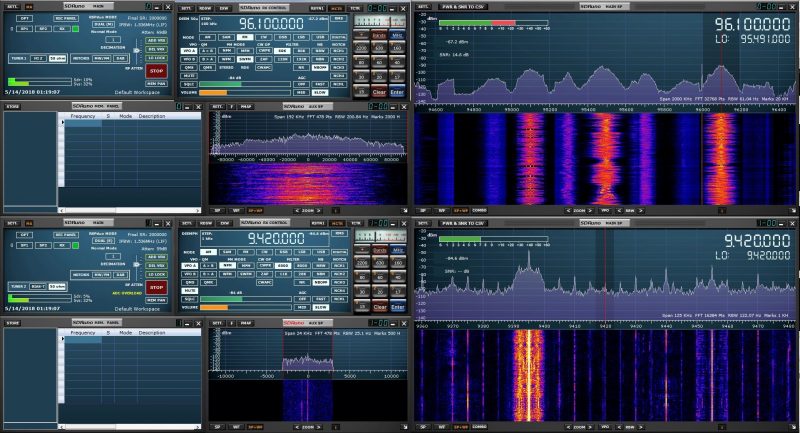
Listening to the FM broadcast band on the main receiver and Voice of Greece shortwave on the second receiver.

One of the first things I was eager to do was to run the dual receiver functionality on one monitor.  Although SDRplay makes this a pretty simple process in the latest version of SDRuno, I still stumbled a bit as I learned to navigate the controls.

Here’s a quick primer to get both receivers on the air on one monitor/screen:

  • First, open SDRuno in “single receiver mode” (the typical SDRuno default).
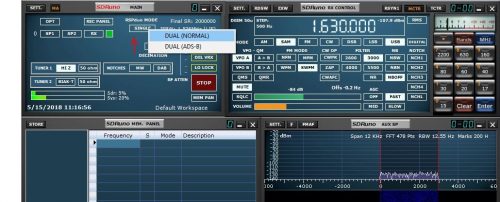
  • Next, click on the “RSPduo mode” button and select one of the modes.  In this case, I’m not running the ADS-B application, so I’ll choose “DUAL (NORMAL)”.
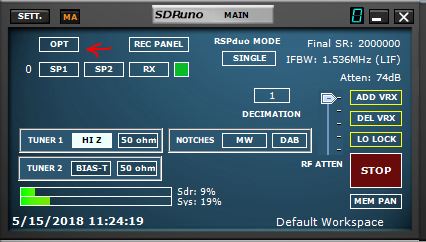
  • Now, to format the “Master” receiver windows so they only use the top half of the monitor, click on the OPT button.
  • Select “Auto Layouts” and “RSPduo Master.”
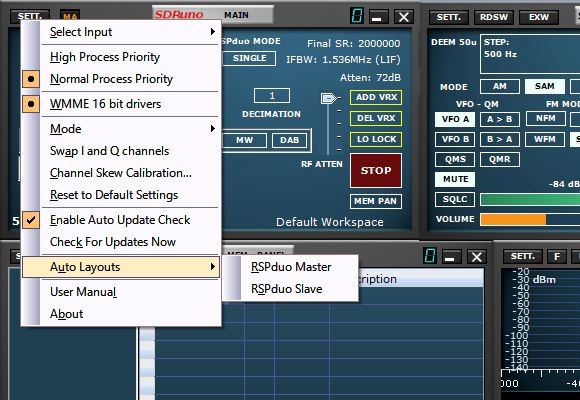
If you’ve followed these steps with me, your screen should look something like this:
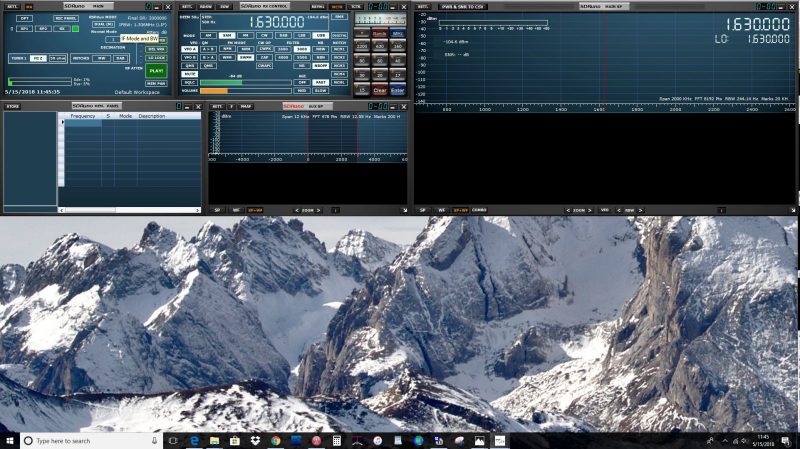
Now you’ll want to start the second receiver. Do this by opening the SDRuno application again (as if you were opening SDRuno for the first time). Make sure you’ve selected your RSPduo if you have more than one RSP connected.

The new instance of SDRuno will fill the entire screen by default, so you’ll need to format it to occupy the lower half of the screen.

Simply click on the OPT button again, select “Auto Layouts,” and “RSPduo Slave.”
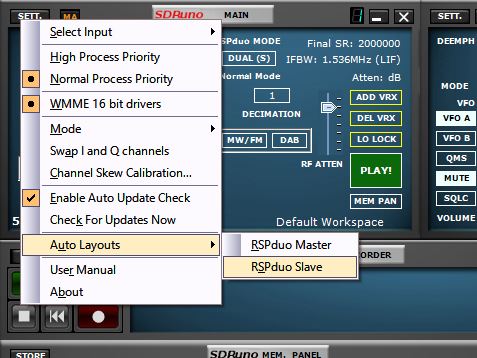
Your full screen should now look something like this:
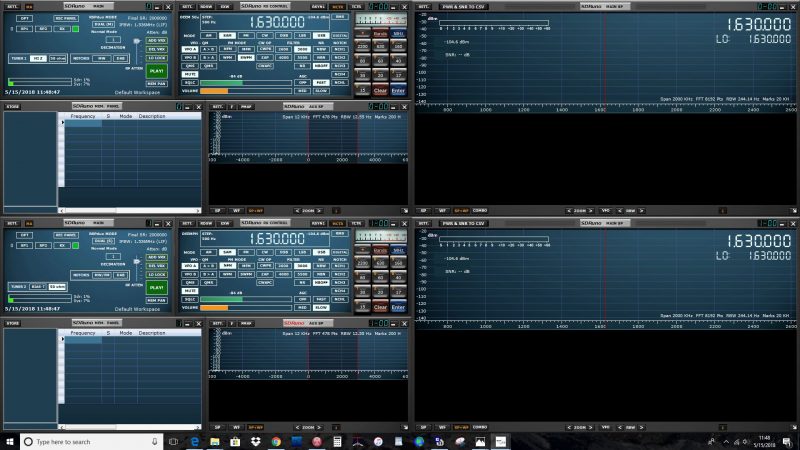
Now you can start using both receivers, but you’ll have to always start the “Master” receiver first. In fact, the “Master” receiver must always be active in order to operate the “Slave” receiver. You can always close the “Slave” receiver without affecting the “Master” receiver; however, if you close the “Master” receiver, you will effectively close both receivers.

Again, I fully expect SDRplay will soon produce a demonstration video showing how you can navigate SDRuno’s new dual-receiver functionality.

Comparisons

As I’ve mentioned in most previous SDR reviews, I do like to take a considerable amount of time to set up SDR comparisons.

Herein lies the difficulty of reviewing an SDR’s performance. Because the user has so much power to control variables and thus shape the receiver’s function, it’s actually quite hard to make an “apples-to-apples” comparison––insuring that all important filters, gain controls, DSP, etc., are as close to identical as possible.

One tool that helps me do this is SDR Console, since it can control a number of SDRs and receiver parameters can be set up identically.  Unfortunately, the RSPduo is so new, SDR Console doesn’t yet support it.
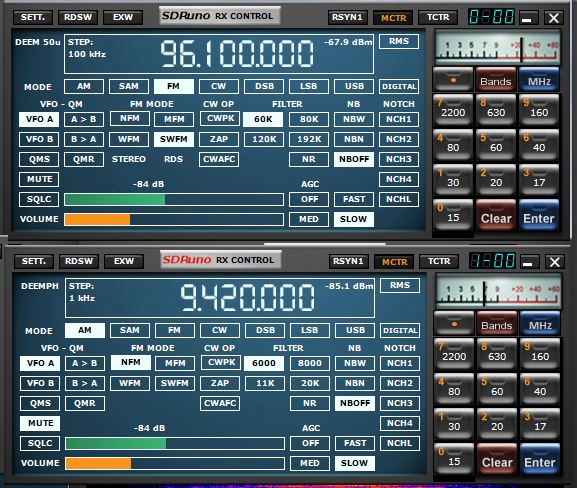
I did use SDRuno to compare the RSPduo with the RSP1A. Fortunately, I could actually run two separate instances of SDRuno simultaneously (and on different monitors, in my case). Both were hooked up to the same antenna via my ELAD ASA15 antenna splitter amplifier.

The RSPduo’s improved dynamic range gives it an advantage in terms of noise floor, sensitivity, and selectivity.

The improved performance is not dramatic––but I understand it might be especially detectable to those who want a receiver with a more robust front end.

In fact, the RSPduo’s 50 ohm coaxial ports have quite an array of automatically configured front end filters:

Low Pass

  • 2 MHz Band Pass
  • 2-12 MHz
  • 12-30 MHz
  • 30-60 MHz
  • 60-120 MHz
  • 120-250 MHz
  • 250-300 MHz
  • 300-380 MHz
  • 380-420 MHz
  • 420-1000 MHz

High Pass

  • 1000 MHz

And an array of notch filters

FM Notch Filter:

  • >30dB 77 – 115MHz
  • >50dB 85 – 107MHz
  • >3dB 144 – 148MHz

MW Notch Filter:

  • >15dB 400 – 1650kHz
  • >30dB 500 – 1530kHz
  • >40dB 540 – 1490kHz

DAB Notch Filter:

  • >20dB 155 – 235MHz
  • >30dB 160 – 230MHz

The thing is, I live in an RF quiet area, so I can’t fully take advantage of the SDRuno’s more robust front end.

In head-to-head comparisons with the RSP1A, the RSPduo’s performance edge is discernible. Again, I suspect it would be a bit more obvious if I lived in an urban setting with blowtorch stations in the neighborhood. Using the Hi-Z antenna port in the mediumwave portions of the band, the RSPduo has a performance edge over the RSP1A, as well.

Should you grab the RSPduo?

The new SDRplay RSPduo

Anytime a new product hits the market, I ask myself if this is the sort of product that would tempt me to reach for my hard-earned cash.

The short answer?  Absolutely! Take my money, please!  There is no other sub-$300 SDR on the market currently that has the dual tuner functionality of the RSPduo. Thing is, I’ve only had the RSPdup a couple of weeks–there’s so much yet I want to explore here–especially diversity reception!

But what if you already have an SDRplay SDR? Afterall, the RSP1A was only released a few months ago, and the RSP2 series only a year before that.

Here’s my opinion:  If you’re an RSP1A or RSP2 owner who is pleased with this SDR’s performance, I wouldn’t necessarily urge you to purchase the RSPduo simply for the modestly enhanced performance characteristics. SDRplay hasn’t retired the RSP2 and RSP1A designs because each model still holds its own, has a purpose, and obviously enjoys a healthy market.

The RSP1A is the affordable yet high performance entry model in the SDRplay product line. It’s really the best value in the radio world, in my humble opinion, at just $99 US.  Som enjoy.

The RSP2 and RSP2pro provide excellent performance, three software-selectable antenna inputs, and clocking features, all of which lend it to amateur radio, industrial, scientific, and educational applications; it is a sweet SDR for $169 or $199 (Pro version). I know of no other SDRs with this set of features at this price point. If I liked the characteristics of the RSPduo, but didn’t really need a dual receiver for my application, I’d probably reach for the RSP2 Pro.

But if you have the original RSP, and like SDRuno and the SDRplay community, then I would certainly consider this an opportunity to upgrade. For $279, you’re getting a dual receiver SDR with excellent performance characteristics that will easily surpass the original RSP––considering that you’re essentially getting two very good SDRs in one.

And if you’re all over the spectrum (aren’t we all a bit––quite literally?) in terms of usage, the RSPduo is a fascinating machine for running, say, an ADS-B receiver while independently using the same SDR box to monitor other parts of the spectrum. Or one can listen for FM DX on one receiver while trying to snag elusive LW DX on the other.
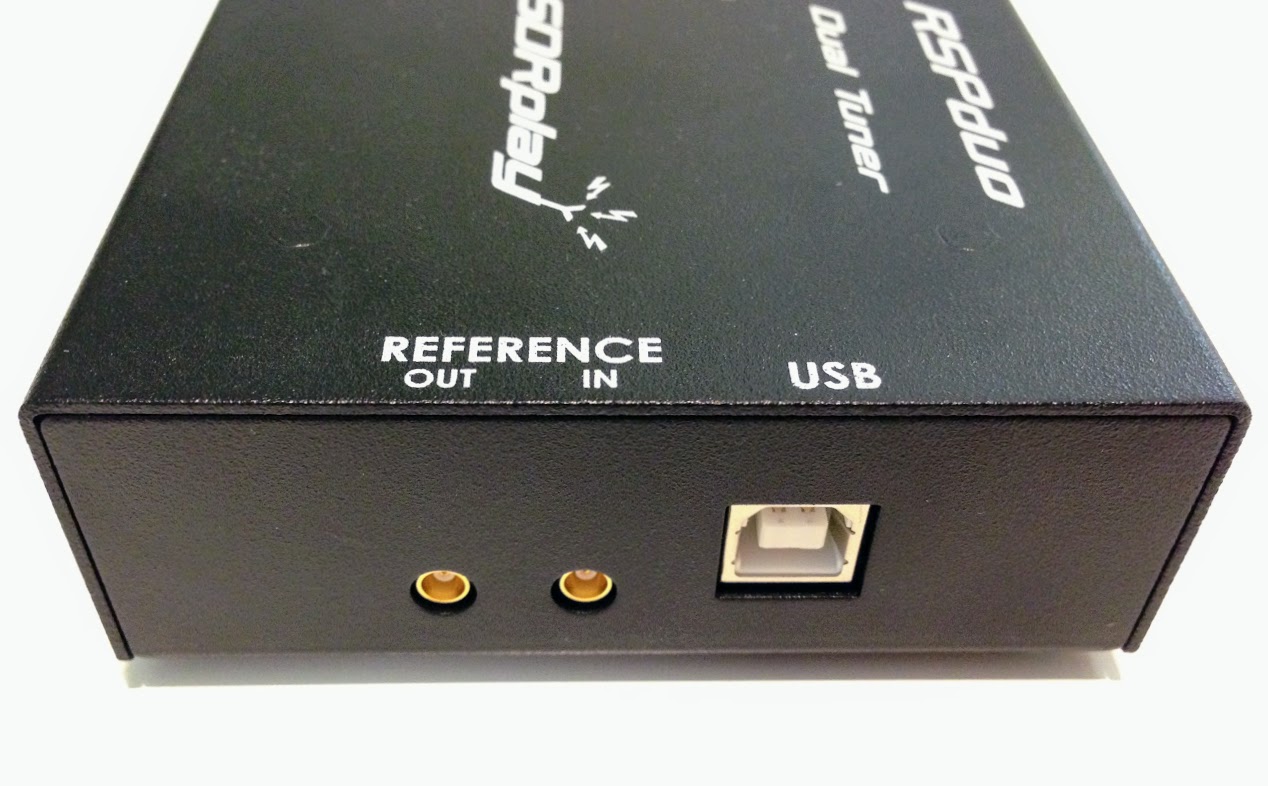
Better yet, the RSPduo only uses one USB port––an important factor if you’re using a laptop or tablet. Of course, having two receivers on two different antennas, while sharing one data port, means syncing them for diversity reception is especially effective. This alone will sway many SDR experimenters in favor of this rig.

I have yet to compare the RSPduo with the brilliant little AirSpy HF+. The AirSpy HF+ is not a wideband receiver like the SDRplay RSP series; it only covers 9 kHz to 31 MHz and 60 to 260 MHz. But if your primary concern is HF performance, the HF+ and its excellent dynamic range will impress you, if you’re anything like me. It’s also a bargain at $199––very hard to beat!

The RSPduo is a good value, in my opinion––and an inexpensive upgrade to a proper dual receiver SDR––so if that’s the sort of thing you’d like to add to your shack, go ahead and bite the bullet!

In fact, I suspect SDRplay will quickly sell out of all of the units they bring to the 2018 Hamvention (SDRplay: pack some extras!). I’m happy to see the company continue to push the price and performance envelope to such exceptional ends. I’m also looking forward to the many applications SDRplay customers (and our readers) find for the RSPduo.

Stay tuned! I plan to post more comparisons in the future.

And if you acquire an RSPduo and find some new and fun applications for it, please share!

Click here to check out the RSPduo at SDRplay.com.

SDRplay announces the RSPduo: A 14-bit Dual Tuner SDR

(Source: SDRplay Press Release)

SDRplay announces the RSPduo – A 14-bit Dual Tuner SDR

Today at the Dayton Hamvention, SDRplay Limited is announcing the launch of a new Software Defined Radio product – the RSPduo.

The RSPduo is a radical new addition to the RSP line of SDR receivers from SDRplay. Architecturally, it is different from any previous RSP in that it features dual independent tuners, both piped through a single high-speed USB 2.0 interface.

The SDRplay RSPduo is a dual-tuner wideband full featured 14-bit SDR which covers the entire RF spectrum from 1kHz to 2GHz giving 10MHz of spectrum visibility. Initially using Windows based ‘SDRuno’ supplied by SDRplay, you can simultaneously monitor two completely separate 2MHz bands of spectrum anywhere between 1kHz and 2GHz.

Superficially the RSPduo looks identical to the highly popular RSP2pro and will be able to operate in a very similar way.

However, it also allows a completely new and exciting set of usage scenarios such as:

  1. Simultaneous monitoring of two widely spaced bands – e.g. 40m (HF) and 2m (VHF)
  2. Mixing and matching applications simultaneously – e.g. ADS-B and ATC scanning
  3. Phase and time coherent demodulation of two receivers

Scenario 3 is very difficult to achieve with two separate USB devices because of the uncertainty of USB latency. The RSPduo overcomes this limitation because all traffic goes through a single USB interface, thus enabling the possibility of the development of various types of diversity demodulation such as: spatial, frequency and polarisation which can bring
huge benefits in terms of improved performance.

Jon Hudson, Marketing Director at SDRplay commented:
“As well as adding a second independently controlled tuner, which in itself, offers a whole new set of exciting usage possibilities, the SDRduo features 14bit ADCs and a completely re-designed RF front end. These changes provide better RF selectivity and even more dynamic range, offering outstanding performance under extremely challenging reception conditions. The combination of performance and features makes the RSPduo our highest spec RSP yet and sets a new benchmark in the sub $300 SDR market”

Due to its exceptional combination of performance and price, the RSP family of receivers have become very popular and the RSPduo provides the next level of functionality for both amateur radio enthusiasts as well as the scientific, educational and industrial SDR community.

As well as being demonstrated at Hamvention, the RSPduo is available direct from SDRplay or via SDRplay’s network of channel partners and resellers

The RSPduo is expected to retail at approximately $279 USD (excluding taxes) or £199 GBP (excluding taxes).

For more information visit the SDRplay website on www.sdrplay.com

About SDRplay: SDRplay limited is a UK company and consists of a small group of engineers with strong connections to the UK Wireless semiconductor industry. SDRplay announced its first product, the RSP1 in August 2014

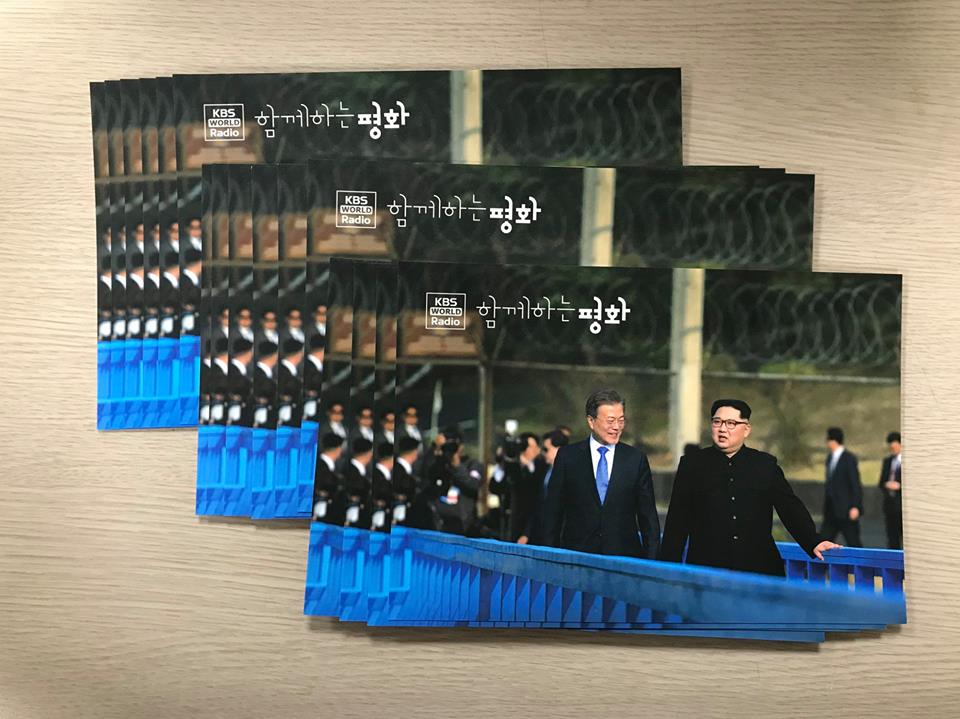
KBS World’s latest QSL card honors the 2018 Inter-Korean summit

Many thanks to SWLing Post contributor, David Iurescia (LW4DAF) who writes:

[Here’s a] picture of the new QSL Card from KBS World Radio dedicated to the Inter-Korean Summit that took place last April 27th.

Whoever sends a reception report to KBS will be answered with this QSL Card.

Thank you, David! You’d better believe I’ll snag one of these QSL cards. Certainly a keeper!

ELAD introduces new products

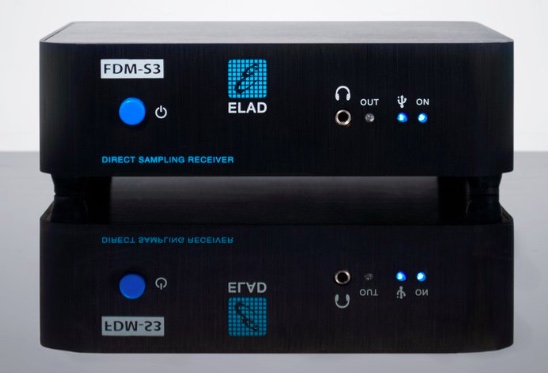
Elad FDM-S3

Many thanks to SWLing Post contributor, Mike Hansgen (K8RAT), who notes that Italian manufacturer, ELAD, has introduced a new speaker, an amplifier and the FDM-S3 SDR is now available to purchase.

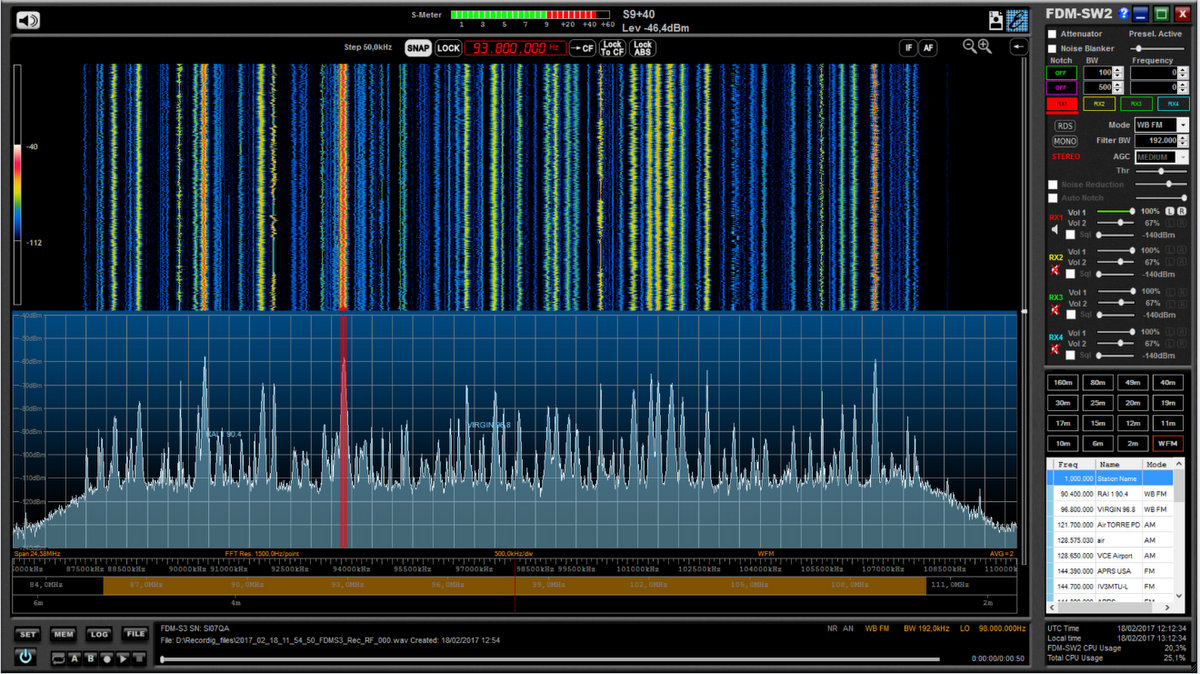
Elad-FDM-S3 Screenshot

The ELAD FDM-S3 was first announced last year, but has only recently started shipping. We know its processing bandwidth is impressive–wide enough to include the entire FM broadcast band! The price is 949.90 EUR.

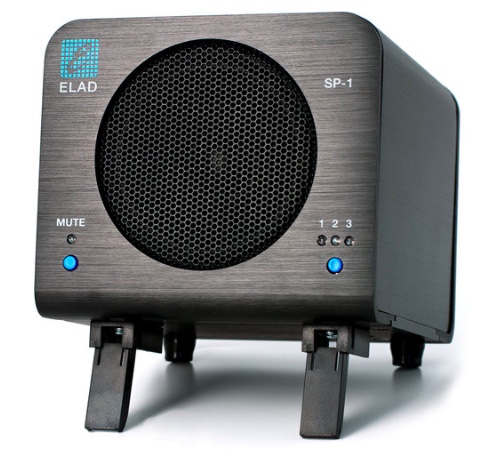
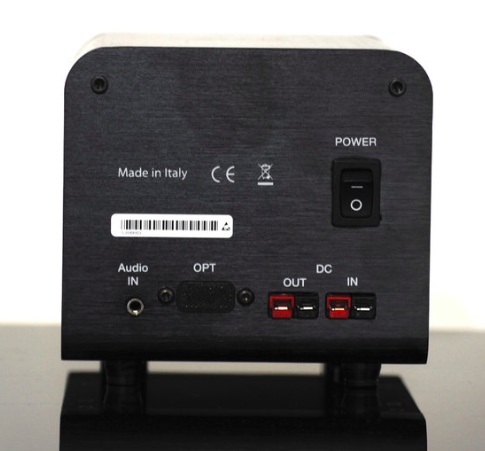
ELAD has also introduced a matching amplified speaker–the SP1:

ELAD SP-1 Speaker Front

ELAD SP-1 Speaker Back

If I owned an FDM-DUO transceiver, I would grab this matching speaker! Knowing ELAD, I imagine the audio is impressive.  The price of the SP-1 is 140.30 EUR.

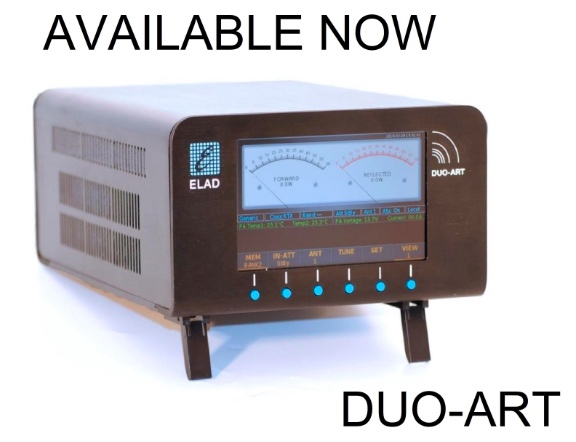
And finally, ELAD has also posted a photo of what appears to be a new amplifier:

Elad Duo art amplifier

I have no details about the SP1 speaker or DUO-ART amplifier–and few details about the FDM-S3–but I will meet with ELAD at the 2018 Hamvention in a few days and gather more details.

Follow the tag ELAD for updates.

WBCQ reveals organization behind their new 500 kW transmitter

In March, we mentioned that WBCQ is building a new multi-million dollar 500 kW shortwave station on their transmitting site in Monitcello, Maine. WBCQ did not mention the name of the private investor behind the construction.  Many thanks to SWLing Post contributor, Kim Elliott, who shares the following note:

On “Allan Weiner Worldwide”[…]Allan mentioned that World’s Last Chance in the organization behind the new 500 kW transmitter.
https://www.worldslastchance.com/

I was not familiar with World’s Last Chance, so over the past few days, I’ve been reading through their website.

Among many other things, they believe the Earth is flat.

With a state-of-the-art transmitting station and Ampegon rotatable array antenna, I’m sure we’ll all hear WLC on the shortwaves.

On the eve of the 2018 Hamvention, we review the 2017 Hamvention

Later this week, I’m looking forward to attending the 2018 Hamvention in Xenia, Ohio. Hamvention is always a highlight of my year.

Last year, the Hamvention moved to their new location at the Greene County Fairgrounds in Xenia, Ohio.

As the 2018 Hamvention quickly approaches, I’ve been asked by a number of readers and friends what I thought about the new location. No doubt, many are trying to decide if the pilgrimage will be worth it as they live several hours drive, or a flight away.

Last year, I was asked to give a report of the 2017 Hamvention for The Spectrum Monitor magazine. I realized I never shared this report on the SWLing Post, so I thought I’d do so now, just a few days before Hamvention commences.

In the past year, we’ve received several updates from DARA who host the Hamvention.  I’ll include updates at the end of this piece.

Note that the following article first appeared in the July 2017 issue of The Spectrum Monitor magazine:


2017 Hamvention Report

When the ground was dry, the flea market was accessible and offered some of the best diversity this treasure-seeker has seen in years.

The long-anticipated 2017 Hamvention in Xenia, Ohio has now come and gone. As with each year of the Hamvention, what I enjoy more than anything else, along with learning about all of the latest innovations in our dynamic hobby, are the people: old friends and new, old friends and young. And of course, I also love browsing the flea market for vintage treasures!  But this year, the relocation of the Hamvention drew many who wanted to see how a new venue might improve, impede, or simply change the event, and I was also among these.

Many have asked about my experiences at the Greene County Fairgrounds–the new Hamvention venue–so I thought I’d offer an overview of the experience.

But first, a little history.  For decades, the Hamvention––the largest gathering of ham radio operators and enthusiasts in the world––has been held at Hara Arena in Dayton, OH, hosted by the Dayton Amateur Radio Association (DARA).  But Hara’s owners folded their business last year [2016], resulting in DARA’s immediate need to relocate the event. Since many national and international vendors risk big bucks to attend, and since comparable events in, for example, Germany and Japan take place in sleek, modern venues, expectations for a new venue were somewhat elevated.

So last year when DARA announced the Hamvention would now be held at a county fairground in the small town of Xenia, OH, many were surprised, and a number expressed concern. DARA assured vendors and attendees that the Greene County Fairgrounds was up to the challenge.  Regardless, the shift was certain to bring the unexpected. In truth any event that hosts 25,000 – 35,000 attendees will be a complex endeavor to organize, and that the Hamvention is also subject to this complexity became obvious as the weekend unfolded.

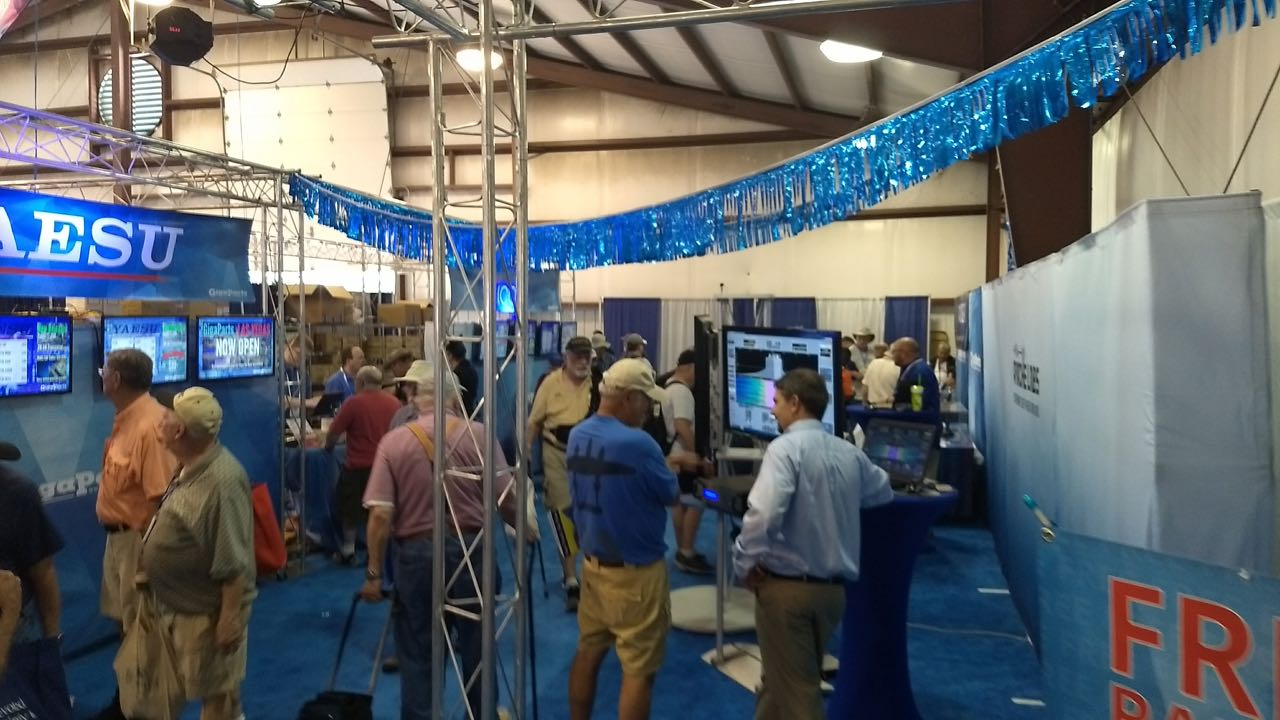
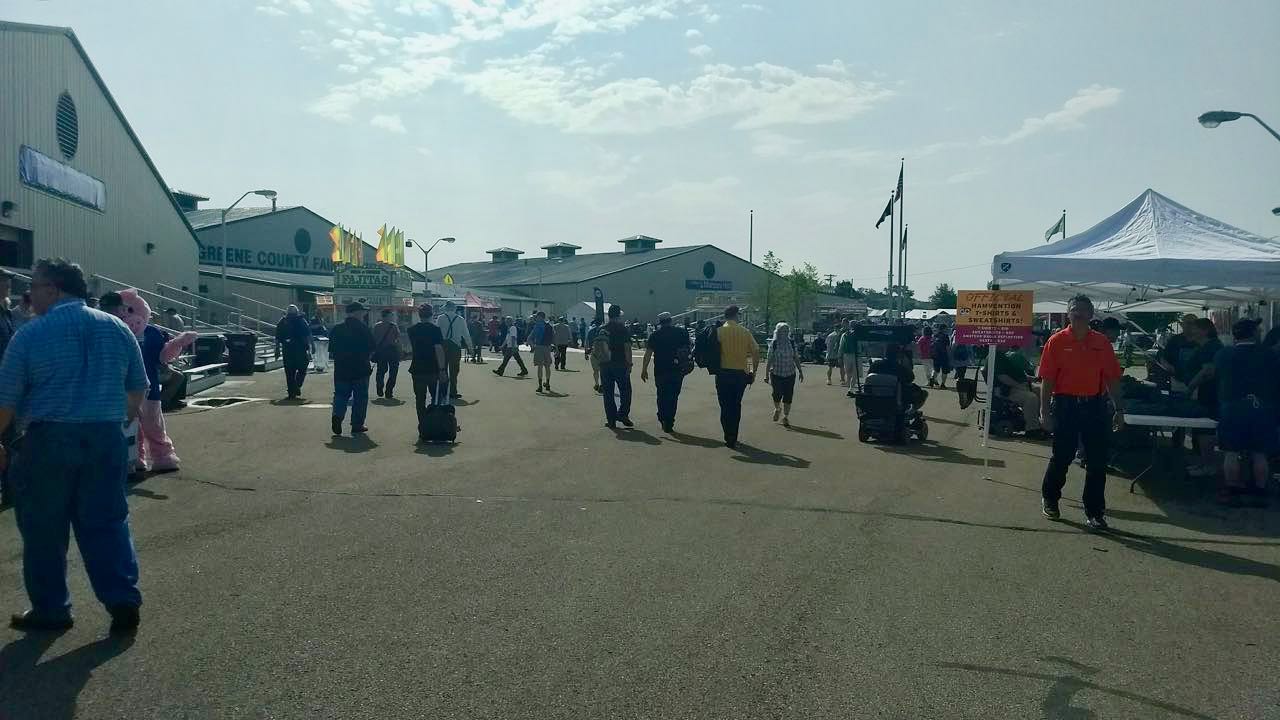
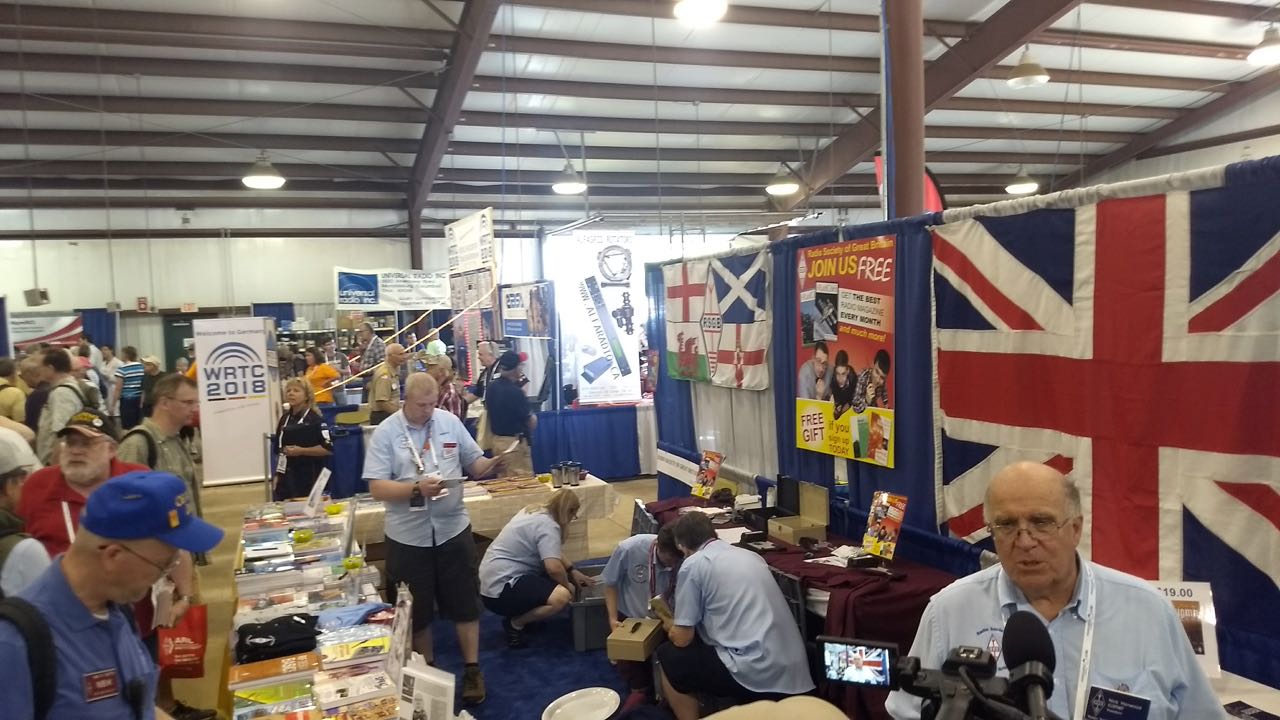
Hamvention has always attracted a large international amateur radio crowd.

In years past, the experience of most Hamvention attendees, exhibitors, and flea market vendors is likely to have been similar.  Hara Arena had been deteriorating for years while adequate maintenance of the facility seemed indefinitely deferred, so if you asked the average Hamvention attendee what they thought about Hara Arena as a venue, the reply might have been, at best, “Meh.”

Yet, the event continued:  for, though Hara had many issues, the venue did manage to house the entire Hamvention crowd on one site, and––especially important to those with limited mobility––on one level. And fortunately the Hamvention is limited to only three days, so repeat attenders were likely to have mastered the requisite survival techniques for Hara. Even during rainy spells, the event attracted large crowds, and the outdoor flea market endured even mud since it was held on a large broken asphalt parking lot. (Yes…I am conveniently overlooking the year a pond of sewage bubbled up in the parking lot during the flea market…True story).

But problems continued to, um, surface, and it seems inevitable that the owners finally decided to call it a day.  No doubt, Hara’s days as a Hamvention venue were numbered, particularly because the dilapidated infrastructure continued aging without the the necessary reinvestment to keep it current––or even safe.  Moving the Hamvention was now the only option.

Xenia Fairgrounds: A “Five-Star” Facility–?

Despite Hara’s shortcomings, many worried that a fairground didn’t seem like much of an upgrade. Still, DARA representatives gave assurance in numerous video interviews as well as at the W4DXCC conference that the Greene County Fairgrounds would make for a “five star” event.

Now that the 2017 Hamvention has been and gone, was it a five star event?

Honestly, I think the answer would depend on your perspective as either an attendee, an inside exhibitor, or a flea market vendor.  To be fair, let’s look at some of the key areas that make or break large conventions like the Hamvention, and what conditions were like at this new venue.

Traffic


The fairgrounds are essentially located in the middle of a neighborhood. The roads leading in offer two lanes with two-way traffic, not designed to handle vast amounts of traffic.

Hamvention organizers worked with specialists to sort out the flow of traffic into the Greene County Fairgrounds. No doubt, it was a complicated feat.

If you attended Hamvention on Friday as an attendee, you were likely upset with how long it took to make that last mile to Hamvention. Several folks told me it took them almost one and a half hours to move the final 1.3 miles to enter the fairgrounds and park. Most folks who came that morning were naturally frustrated by this, and many were quite vocal about it.

Friday evening, with the aid of Greene County Sheriff Gene Fischer and the local public service team, the traffic flow team sat down to hammer out a plan, and the traffic issue was almost magically resolved. I heard no complaints about traffic on Saturday or Sunday. Great job, folks!

Parking

If it had been a dry, sunny weekend, I think the average attendee would have been pleased with Hamvention parking.

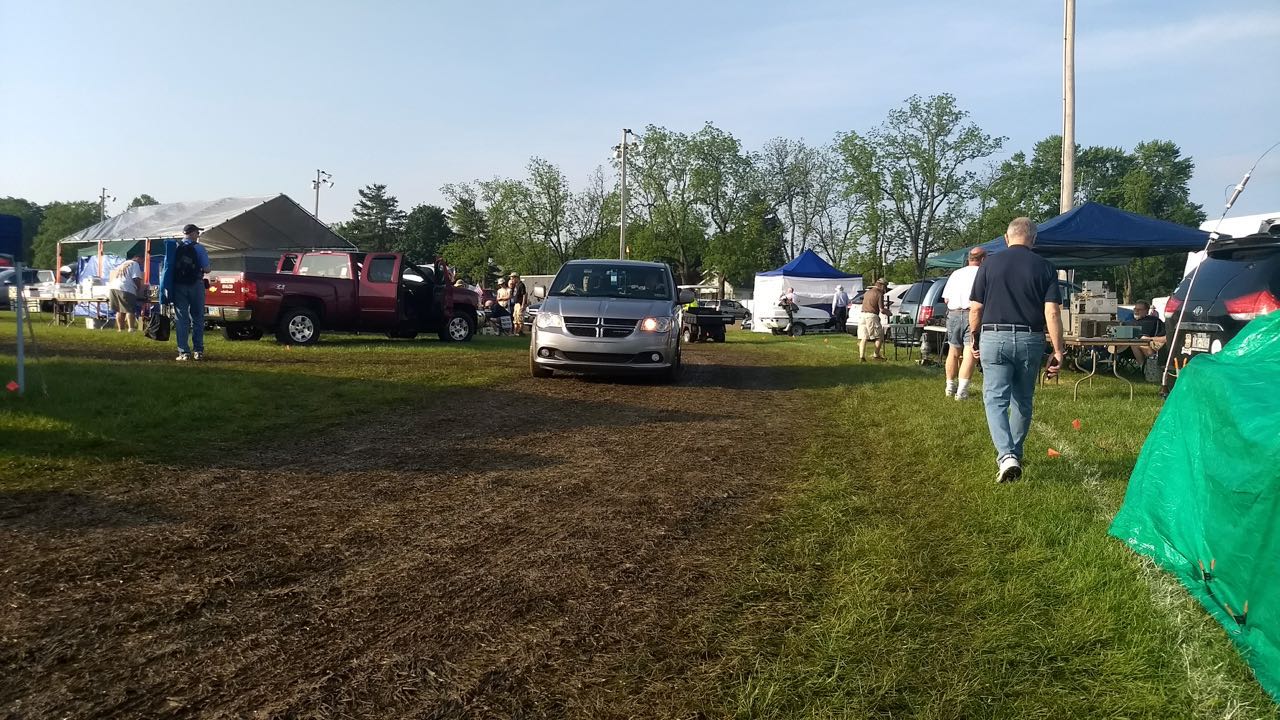
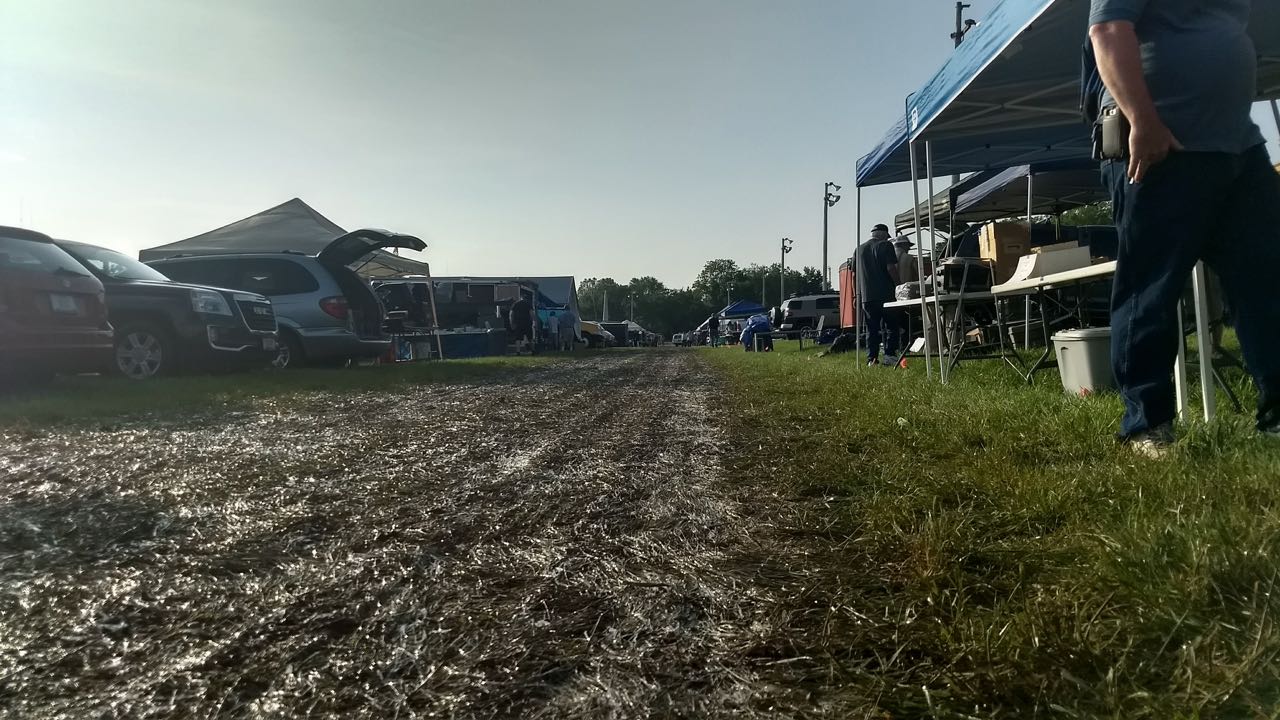
Sadly, as it was not. Herein lies the greatest negative about the new location: mud. Lots of mud.

While there were satellite parking lots with buses that ferried people to the event, many attendees, perhaps most, parked on the fairgrounds grass lots. The fairground fields are vast and hold lots of cars, but they are almost completely grass-covered.

Many Hamvention visitors expressed concerns last year about the ability of the fairgrounds fields to handle the incredible amount of traffic of Hamvention, should it rain. We were reassured that the fairgrounds were well-drained and that the grass could handle the traffic. After all, they do hold fairs, and it had never been an issue.

Unfortunately, the Hamvention weekend was punctuated with periods of heavy rain, fairly typical in spring. Both Friday and Saturday, it was largely sunny and the rain only lasted a quarter of an hour or so, but during the night storms passed through.  The grounds were already somewhat saturated, so any additional rain resulted in––you guessed it––mud. Lots and lots of it.

In short: if you parked at the Greene County Fairgrounds on Saturday, there was a good chance you might have gotten stuck in the mud. And the mud was truly thick, slippery, and nasty, designed to make locomotion difficult. At one point, I ventured into the parking lot and managed to tour it on a golf cart. I saw no less than two cars being towed out of deep mud. One, in fact, had sunk to the point it appeared to be floating on a sea of mud. During this time period, it was not only difficult to park your car upon arrival or to get your car out of the parking lot upon departure, but it was challenging to simply walk in the parking lot, or skirt around the deep muddy areas to enter the main gate.  For those with disabilities, it must have been near impossible.

In short: because of the rain, parking on site on those days was pretty undesirable.

I’m not sure how DARA will sort this out next year, but I imagine it will involve numerous satellite parking lots if weather is bad.  Gravel would be good, too.

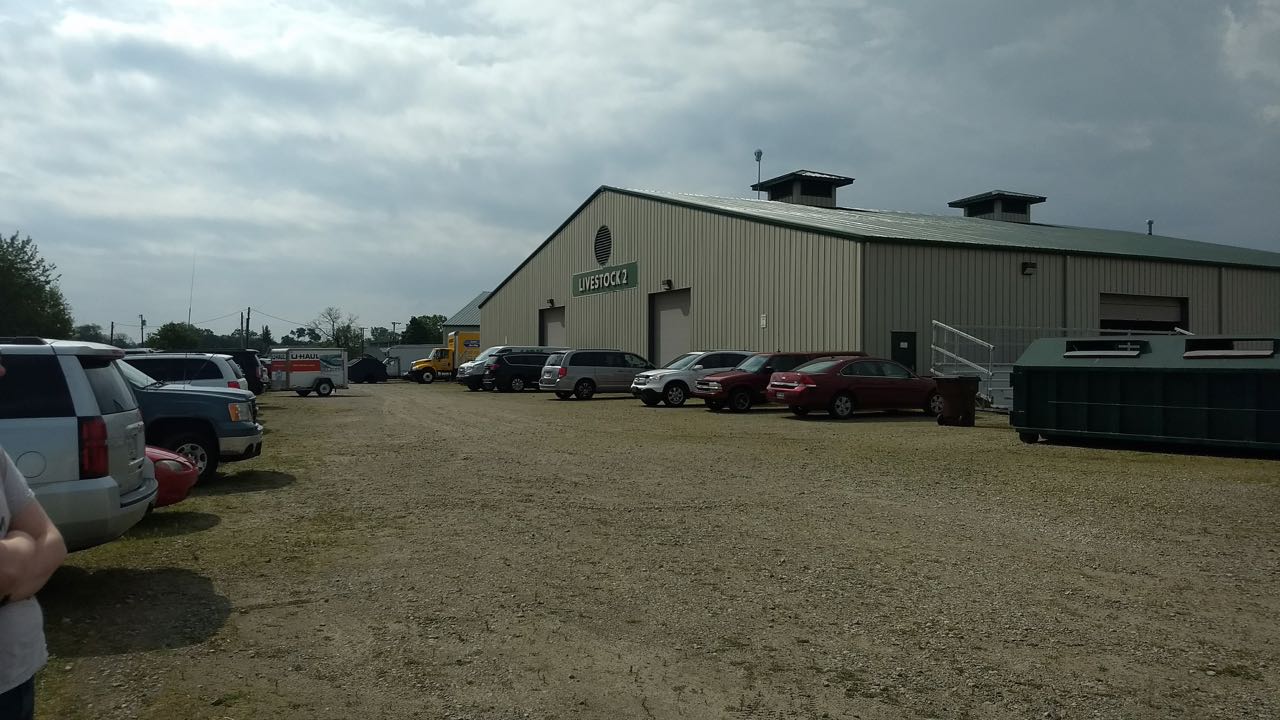
In contrast, as an inside exhibitor, I was very pleased with parking on all three days. We had a separate entrance with dedicated staff, and parking was close to the buildings where we had to set up each day. We had the advantage of parking on hard-packed gravel. It was a much better arrangement than the days of Hara Arena, even. All of the inside exhibitors I spoke with were pleased with parking.

But I felt truly sorry for attendees parking in the field.

Flea Market

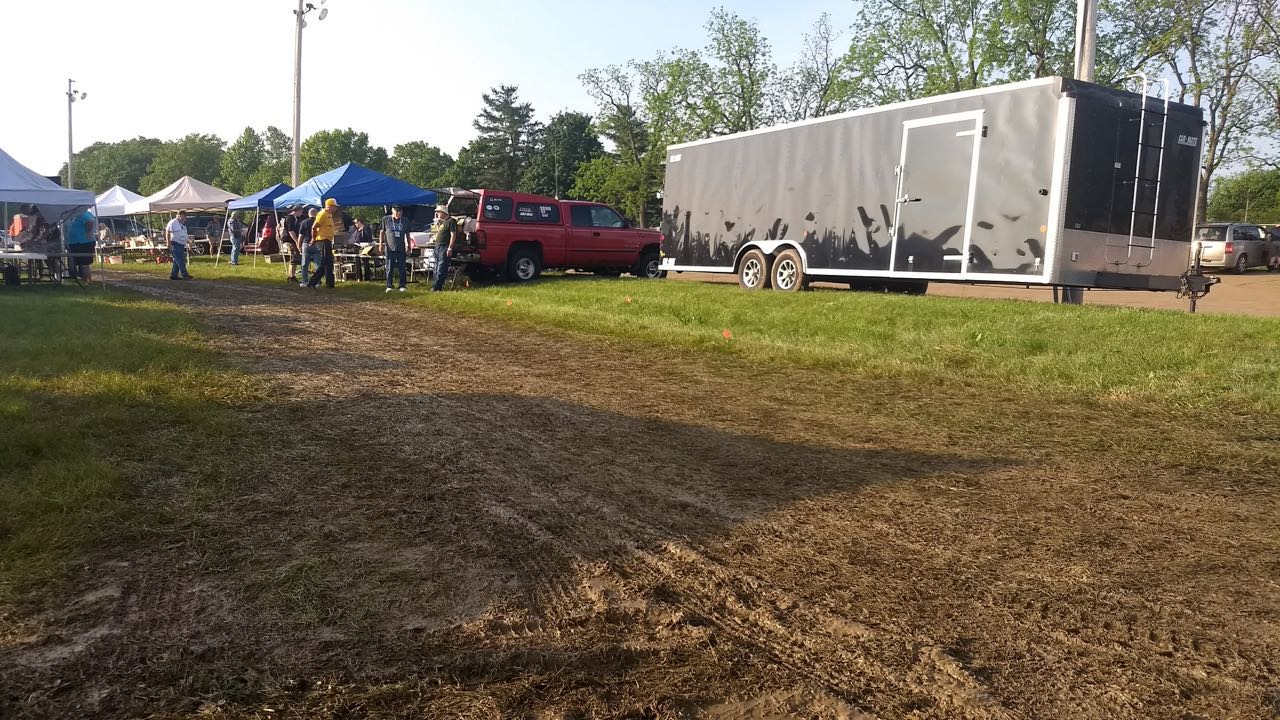
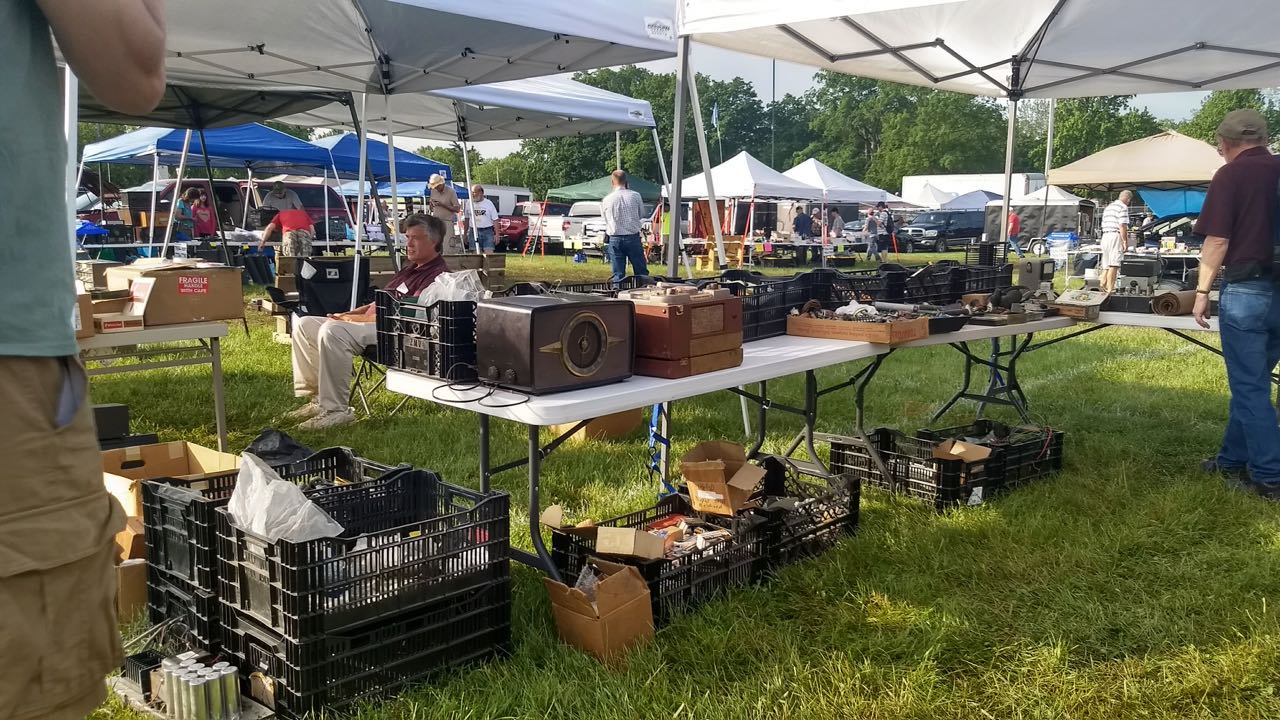
Like the on-site general parking, the flea market was on the grassy fields of the fair grounds. Due to spongy wet ground and the number of heavy vehicles full of gear that had to enter and leave each day, even as early as Friday morning it was clear it was soon going to be a muddy mess.

he mornings and after periods of rain made moving around the flea market quite challenging for some attendees and vendors.

Friday morning was indeed muddy, but Friday afternoon, the sun came out and dried out much of the mud. It seemed a lucky break.  That is…until a late afternoon thunder shower soaked the saturated ground again.

The water table just couldn’t hold it all.  So, Saturday and Sunday…? It was unfortunately  muddy all day.

Even the golf-carts manned by volunteers to help attendees ferry heavy purchases back to their cars could not enter many of the flea market paths for fear of getting mired down. Personal mobility scooters really had a difficult time, and many got stuck. I don’t think the bulk of the flea market was accessible to anyone in a wheelchair.

In short, I imagine most flea market vendors were frustrated with the mud.

This being said, I must say that the selection of goods at the flea market was even better than I’ve seen in previous years. If it had been a dry weekend, it would have made for very pleasant gear goggling and treasure hunting.

Inside Exhibits: Steel-Framed Agricultural Buildings

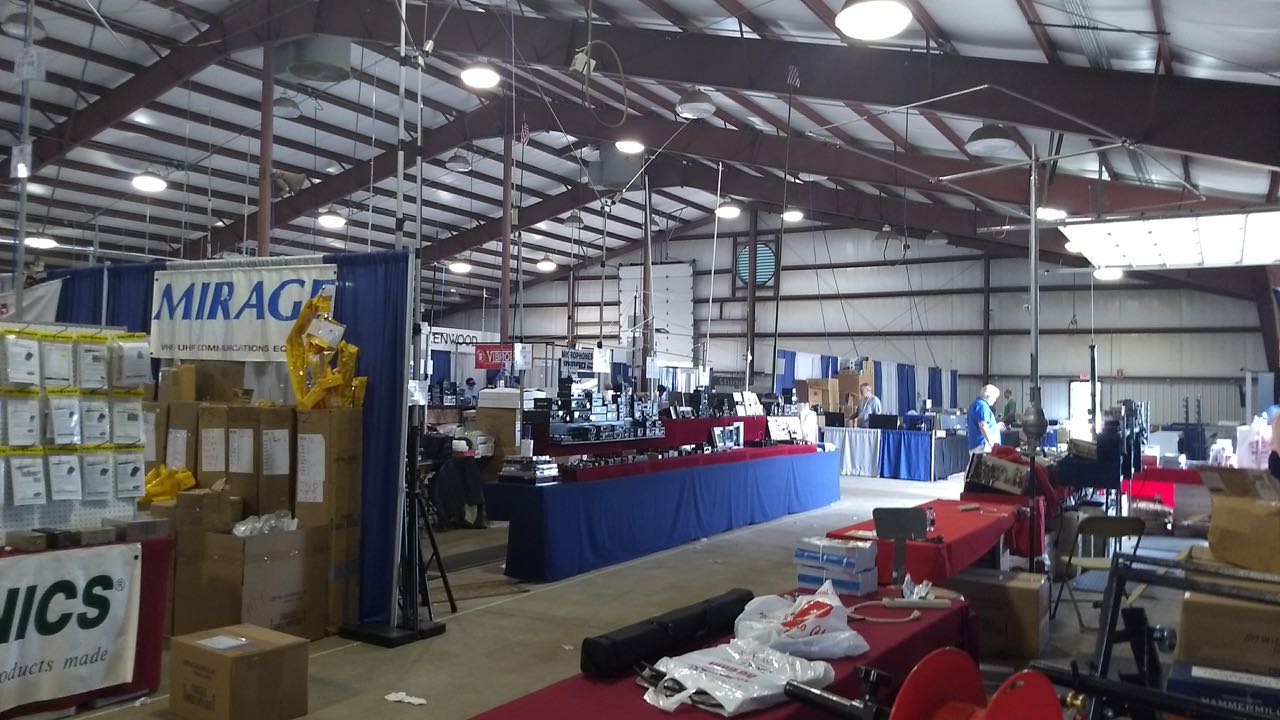
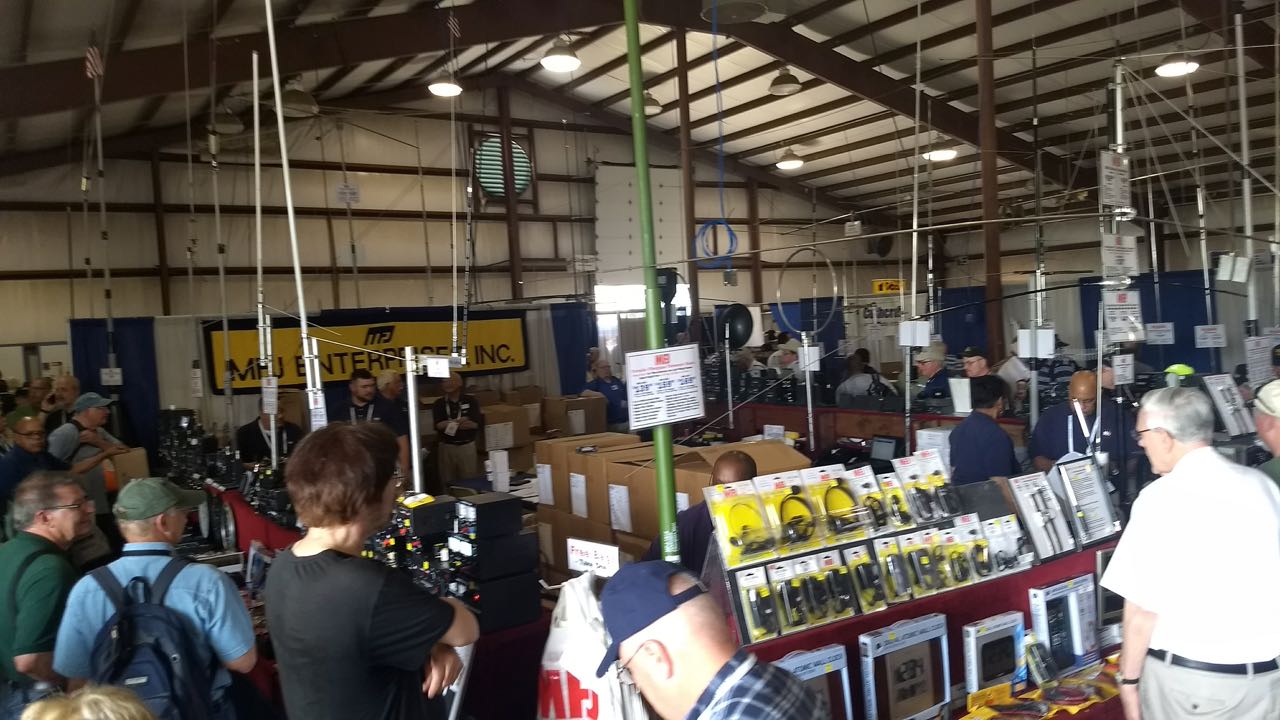
Taken during setup the day before the Hamvention opened to the public. Note the healthy amount of space between vendor tables.

Though I was a bit skeptical about the fitness of the large metal-framed agricultural buildings for inside exhibits, I was pleasantly surprised: these buildings are large, clean, well-lit, with an open, airy feel. Much better, in short, than most of the spaces at Hara Arena.

All of the inside exhibitors I spoke with were, in general, pleased with these buildings. They were also pleased with the spacing between booths which allowed for improved traffic flow. There were a few complaints about outlets hanging from the ceiling, a feature likely used when the building is in service to show livestock.

Inside exhibitors were overall very pleased with the steel buildings at the Greene County Fairgrounds.

A few vendors felt it got a bit toasty indoors in the middle of the day when the sun made a cameo appearance. Still, I got the impression that most attendees felt the buildings were well-ventilated and relatively cool, and overall, an upgrade on Hara.

Inside Exhibits: Event Tents

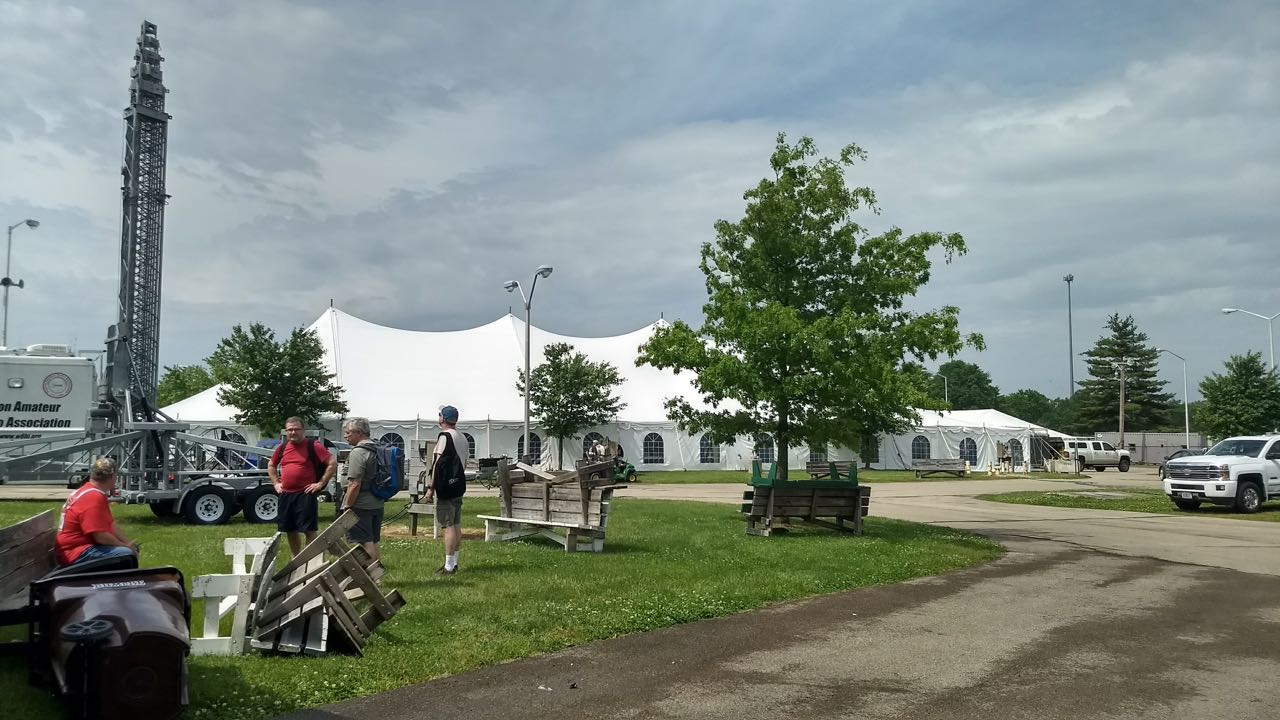
The large, white event tents did house a large number of vendors.

Because there were not enough permanent buildings on site to house all of the inside exhibits, DARA arranged for a large events tent––labeled “Building 6″–– to house all of the extra booths and tables. Many of us believed this could be a great alternative.

However, I heard that very late in the game, DARA was informed that the large tent they had on order fell through. They had to find a last-minute alternative, which ended up being three smaller (though still large) event tents arranged in close proximity.

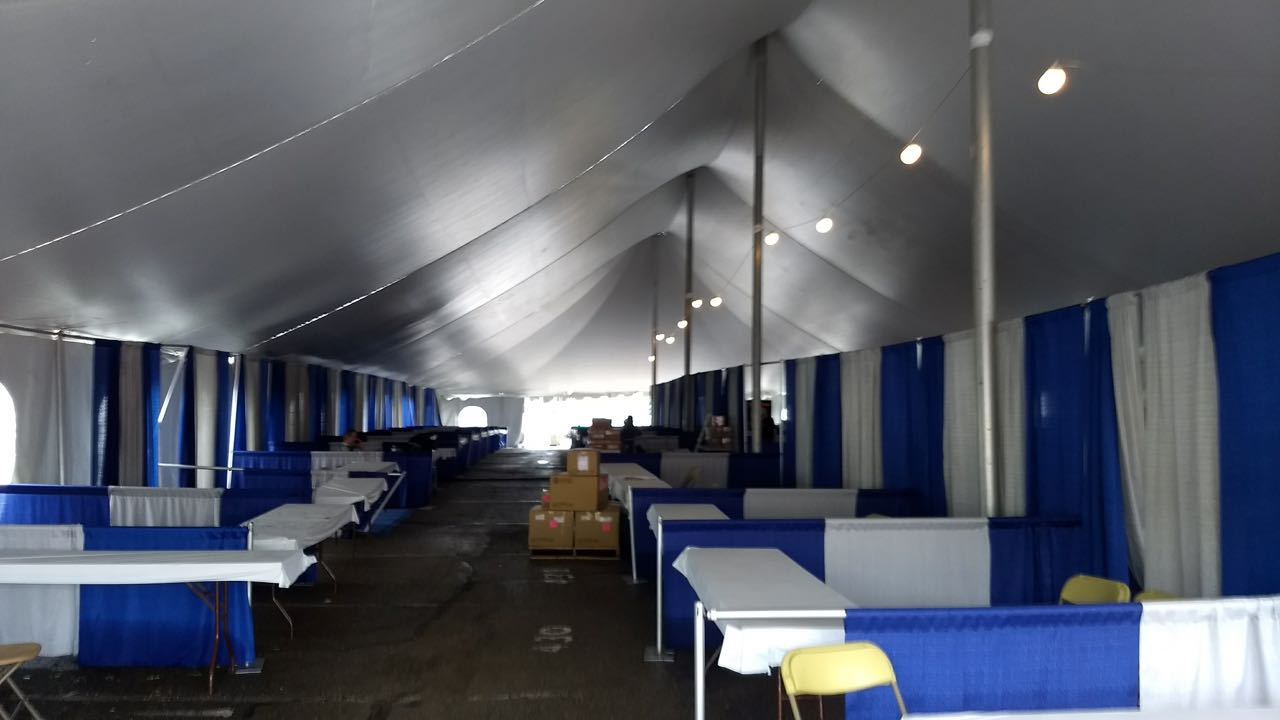
The interior of the large vendor tents were rather dark. Note the light penetrating the tent seams. This shot was taken before vendors had set up.

The booths in the tent were not marked or numbered in advance, so this lead to a lot of confusion for both vendors and (later) visitors.  Adding to the confusion was the relative darkness of the interior of the two long tents.

Later, during a series of thunderstorms that produced a lot of wind, it became obvious that the replacement tents also didn’t have adequate sand-bagging to hold down the side walls, which began flapping quite violently.

The darkness of the interior of the two long tents was mitigated slightly by some decorative  globe lights hanging from the center poles of the tent, but these provided very little in the way of lighting. When it was bright and sunny outside, it wasn’t too much of a problem, but when it clouded over, as when the thunderstorms passed through, it became very dusky and dim, indeed.

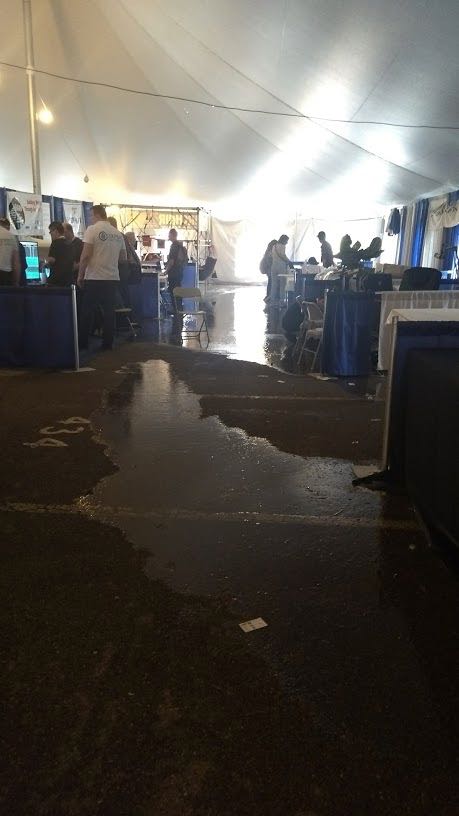
During periods of rain, the tent vendors and attendees had to cope with water.

The worst problem by far in these tents, however, was water penetration.  The tent ceiling and seams were littered with holes. So, during downpours, water would shed off the sides of the tent then enter the perforations, raining down into the tents and forming minor rivers on the asphalt en route to the drains. Significant water in the presence of so many electrical drop cords became a rather risky shock hazard.

During rain, tent vendors had to either move their displays…or just get wet.

It’s telling that not a single tent vendor that I spoke with was pleased with their site.

I spoke with a DARA representative about this, and he was very apologetic:  clearly, DARA was not at all pleased with the last-minute tents. One of the volunteers I spoke with told me that as early as next year, there may be another permanent agricultural building or two to house all of the vendors that were in tents this year. This could be an excellent upgrade, and I do hope, should the Hamvention continue at this site, that it comes to pass.

Hamvention Staff

The Hamvention volunteer staff were incredibly helpful–and there were a lot of them, as well.

I spoke with so many vendors who were also very pleased with the on-site security. These folks were friendly, helpful, and customer-focused. Thank you, volunteers!

Food

The outdoor food court was spacious and offered some excellent choices.

No question: the concessions were better this year than any previous year I’ve been to the Hamvention. I heard compliments all weekend. Excellent job, food service staff!

Forums

Hamvention forums were held in a dedicated, large air-conditioned building. The forum space was much better than that at Hara, and I expect most attendees were pleased.

Summary

If I were doing a review of the Hamvention structured like one of my radio reviews, I’d summarize the experience with these pros and cons:

Pros:

  • Friendly, helpful staff––especially considering the weather and other challenges
  • Excellent attendance
  • Compact layout (compared with Hara)
  • Permanent buildings allowed for easy traffic flow between vendor areas (compared with most of Hara’s spaces)
  • Adequate, clean restrooms and port-a-potties compared with Hara; very few lines
  • Concessions of great variety and accessibility
  • Steel-framed agricultural buildings were clean, comfortable, well-lit, and airy
  • Traffic flow to on-site parking improved on Saturday and Sunday (see “con” re Friday)
  • Steel-frame building exhibitors seemed to enjoy improved sales numbers

Cons:

  • Frustratingly slow traffic flow to on-site parking on Friday (see “pro,” Saturday and Sunday)
  • On-site parking exceedingly wet and muddy (following rains)
  • Flea market paths too muddy in wet weather, inaccessible or problematic for those with limited mobility
  • Vendor tent booth spaces unmarked, leading to vendor confusion during set-up
  • Vendor tents inadequately lit
  • Vendor tents leaking and therefore unsafe when rain water entered, contacting electrical equipment
  • In metal-sided buildings, interiors could be hot when ventilation fans weren’t in use

So, the upshot?  Whether or not you enjoyed the new Hamvention venue in 2017 probably depended on who you were:

If you were an attendee on Friday, other than coping with traffic to the site, you were likely pleased with your experience at the Xenia 2017 Hamvention. By noon or so, the ground had dried up and most of the flea market was accessible; it wasn’t until late afternoon that it began raining.  If you were an attendee during or following the rains, or on Saturday or Sunday, you may have enjoyed the event, but were likely quite frustrated with the mud.

If you were a flea market vendor, no doubt, you were frustrated with the mud, which dramatically decreased foot traffic.

If you were a tent vendor, you were likely frustrated with the poor lighting and water penetration–all of which affected customer traffic, especially during rain.

If you were an inside exhibitor in one of the permanent agricultural buildings, you may have had the best sales, traffic, and overall Hamvention experience in decades. Most inside exhibitors I spoke with were very pleased with the facilities. I spoke to at least four major vendors that experienced record sales.

Moving forward…

While I’m not sure this year’s Hamvention can claim “five stairs,” I’d offer five stars for effort, and for improving upon Hara in a number of respects.

Many thanks to all of the volunteers, staff, and attendees that helped create a terrific Hamvention despite its inevitable bumpy, muddy course following relocation.

Obviously, lessons are to be learned from the 2017 Hamvention.  Thoughtful consideration of this year’s problems are sure to benefit next year’s Hamvention if Xenia is to continue as its new home. I’ve written this review in hope that the stewards of the Hamvention will take this feedback in the positive spirit in which it’s intended, so as to improve upon the experience for next year’s Hamvention.

Since traffic flow was sorted out Saturday and Sunday, to the great credit of those who reorganized it, there are really two main areas that truly need improvement: mud/water mitigation (yep, that’s a big one), and better accommodation for this year’s exhibitors that were in tents.

Moreover, I think it’s essential that DARA provide prompt feedback and updates to those attendees and vendors who had frustrating experiences, reassuring them that their concerns were heard, will be addressed, and that circumstances will indeed improve next year.

But ultimately, the Hamvention belongs to the entire ham radio community.  We’re radio folks, which means we listen, we communicate, we design, engineer and build––just the qualities needed to help make the relocated Hamvention even better. So, let’s ask: what can we do to help?

Let’s show up again next year with renewed vigor and a commitment to make the 2018 Hamvention a six-star event!  As. of course, we can.


Updates

Here are the latest updates from DARA regarding improvements to the 2018 Hamvention:

Inside exhibitor space

In December 2017, DARA announced plans to add an additional prefabricated metal building to house most of the inside exhibitors that were in tents last year. DARA then made the following announcement in February 2018:

Despite all of the best efforts and intentions by Greene County, the Greene County Agricultural Society and Hamvention, we have learned the anticipated new building will not be constructed in time for Hamvention 2018. The prefab sections bid on and architecturally required are currently backlogged. We expect construction to be delayed until after our show and the Greene County Fair. We expect completion of construction yet this year and ready for our use in 2019. We regret this; however it is well out of our control.

We will have increased Inside Exhibits space with the addition of the vacated Furniture Building.

DARA conducted a lottery to pick vendors who would get a space in the vacated furniture building.

I also spoke with the Inside Exhibitors coordinator early this year–he said they hope to use a different tent vendor this year.

Mud mitigation

As I mentioned above, mud was a serious issue last year–making both parking and flea market access problematic.  In February 2018, DARA noted the following improvements:

After consultation with professionals, we are in the process of solving the mud issue in the Flea Market area. We anticipate work to start as soon as weather allows.

We are rearranging the soccer field parking to eliminate use of the low areas where we had problems last year. We will also have a revised exit plan.

Additional offsite parking will be available, along with easily used maps to help you navigate. Transportation from parking areas to the show will still be at no cost.

I understand they’re also making more satellite parking areas available to keep the amount of visitors parked onsite to a minimum–this would also help with traffic congestion. An Inside Exhibitors team member also mentioned that they may take measures to regulate the amount of foot traffic going through the main gate to help mitigate mud; possible making a secure space to hold heavy purchased items.

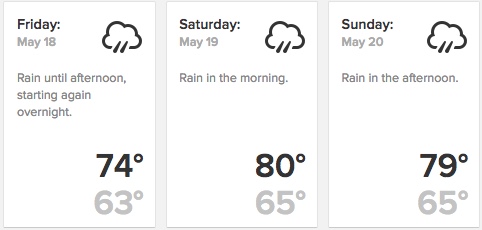
The latest long-term forecast at time of this posting (on Monday, May 14) shows a chance of rain for Friday and Saturday of Hamvention:

This forecast is four days out, however. With any luck, perhaps we won’t have the thunder showers we had last year. If the fairgrounds remain dry, many of DARA’s problems will be solved.

I’ll be bringing my Wellingtons anyway.

Of course, as I do every year, I’ll take hundreds of photos at Hamvention and post them here on the SWLing Post during the event. Stay tuned!

Dean records Voice of Korea’s Panmunjon Summit coverage

Front page of the North Korean newspaper “Rodong” on April 28, 2018. (Source: Mark Fahey)

Many thanks to SWLing Post contributor, Dean Denton–our intrepid 13 year old DXer. Dean writes:

How are you doing? I have found a recording on the archives of a recent North Korean recording of the Voice of Korea on the Panmunjon Summit, between both North and South Korean leaders.

Not only am I pleased with the news, but I have uploaded the full 1 hour recording of the English broadcast on my YouTube Channel:

https://youtu.be/6uyhtWTVBxA

Click here to view on YouTube.

Click here to check out Dean’s YouTube channel.

Great job snagging this particular VOK recording! You’re following a long tradition of SWLs before you who’ve made an effort to capture these fascinating bits of radio history. Keep up the great work, Dean!