Shortwave listening and everything radio including reviews, broadcasting, ham radio, field operation, DXing, maker kits, travel, emergency gear, events, and more
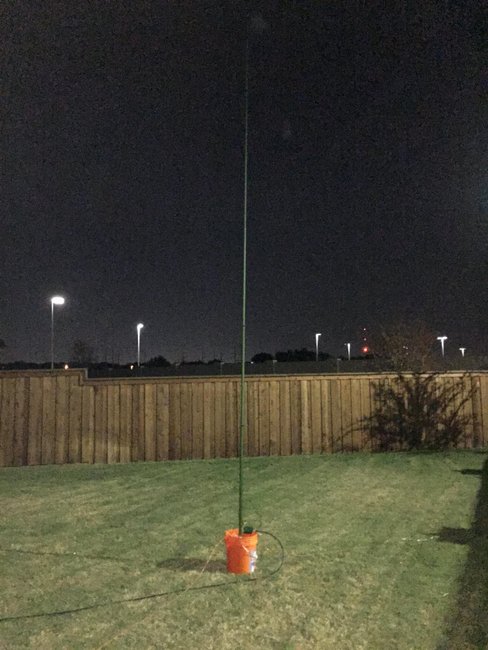
A few months ago I purchased a couple S9V18 18′ vertical antennas for $65 at cheapham.com, with the intention of deploying a quick HF aerial at my HOA-laden home for ham radio use. I found they work great for SWL.
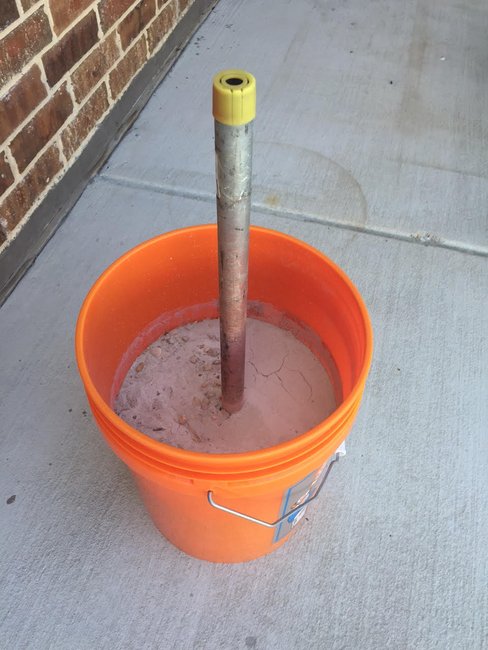
The S9V18 antenna is made to slip over a 1″ o.d. pipe driven into the ground at least a foot, with 12″ of the pipe rising off the ground. You can pound a two foot pipe half-way into the ground, or do as I did and fill a bucket with cement and stick the pipe in that half-way.
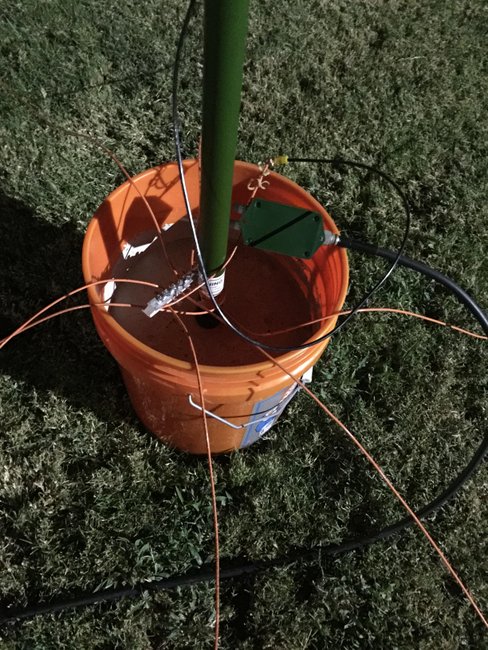
This is a ‘close-up’ of the bucket. Note the plate the ground radials are attached to–it’s from Home Depot, it’s a bus bar designed to bond the ground wire for each circuit in a breaker box.
After adding a reasonable ground plane of 8x 14 ga wire cut about 15′ long I hooked up a 4:1 balun and ran it to my Kenwood TS-570D.
What I found was the aerial not only worked well on 20 meters, it also made a great shortwave aerial! Stations were booming in here in Texas at night.
The antenna slides over the pipe sticking out of the concrete in the bucket. Here is a picture of the bucket before the antenna base is slipped over it.
My ‘discovery’ was that a nice, modest vertical antenna can really improve reception on SW bands…
I suggest anyone buying this antenna seriously consider buying additional clamps at the same time, they are just a few dollars and will help extend the life of the antenna:
For shortwave broadcast listening a direct connection without balun would probably suffice, but I used an LDG 4:1 balun to support multi-band ham transmitting:
And we thank you for sharing your discovery, Ken!This is a great, simple solution for those who cannot erect a permanent “high-profile” antenna. I’m especially impressed with how budget-friendly your solution is, Ken.
Post Readers: If you have other suggestions for inexpensive low-profile antennas, please contact me or comment below!
Despite dismal propagation, I was quite happy to receive a relatively strong signal earlier this week (31 August 2015) from Channel Africa, starting around 16:40 UTC on 15,235 kHz.
This recording begins with the French language service (already in progress), followed by the English language service. Receiver used was a WinRadio Excalibur connected to a large horizontal delta loop antenna.
The Mighty KBC will be making their seasonal move to 7,375 kHz on Sunday September 6, 00:00 – 03:00 UTC.
The Mighty KBC’s Giant Jukebox is an easy catch for listeners in much of North America and Europe–if you’ve never heard the show, you’re certainly in for a treat.
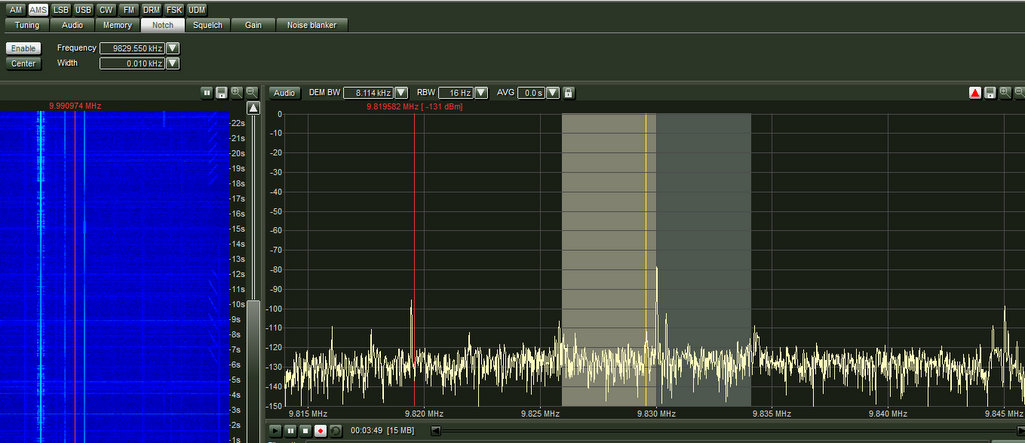
The lighter shaded side of the AM carrier indicates a lower sideband sync lock. (Click to enlarge)
A few days ago, I tuned to 9,420 kHz and found a relatively strong signal from the Avlis transmitter site of the Voice of Greece. The broadcast was quite clear until a heterodyne (het) tone popped up out of nowhere.
I checked the spectrum display of my Excalibur to find two steady carriers located about .5 kHz off each side of VOG’s AM carrier. I assume this may have been a faint digital signal centered on the same frequency as VOG.
The noise was annoying, but SDRs (and many tabletop radios) have tools to help mitigate this type of noise.
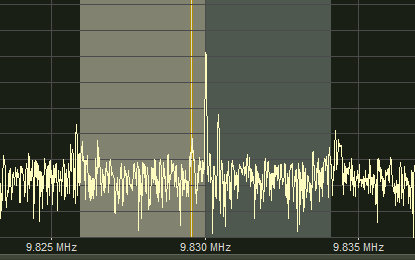
The het tone was originating from both sidebands of the VOG AM carrier (see spectrum display above). I had planned to use my notch filter to eliminate the noise, but I had two carriers to notch out and only one notch filter.
Synchronous detection to the rescue…
The simple solution was to eliminate one of the carriers using my SDR’s synchronous detector which can lock to either the upper or lower sideband. In this case, it didn’t make any difference which sideband I locked to because both had similar audio fidelity and were otherwise noise free. In the end, I locked to the lower sideband, thus eliminating the het in the upper sideband.
Next, I enabled my notch filter and moved its frequency to cover the annoying het carrier in the lower sideband; I kept the notch filter width as narrow as I could to preserve VOG’s audio fidelity. You can see the notch filter location and width in the spectrum display above (the notch filter is the thin yellow line).
I should note here that the great thing about using an SDR–or tabletop receiver with a spectrum display–is that you can see where the noise is. I was using my WinRadio Excalibur, but pretty much any SDR in my shack could have handled this task.
The results? No het tone and I was able to preserve the great audio fidelity from the Voice of Greece broadcast!
Here’s a 3.5 hour recording I made after cleaning up the signal. I believe at one point in the recording, I switched off the notch filter to demonstrate how loud the het tone was:
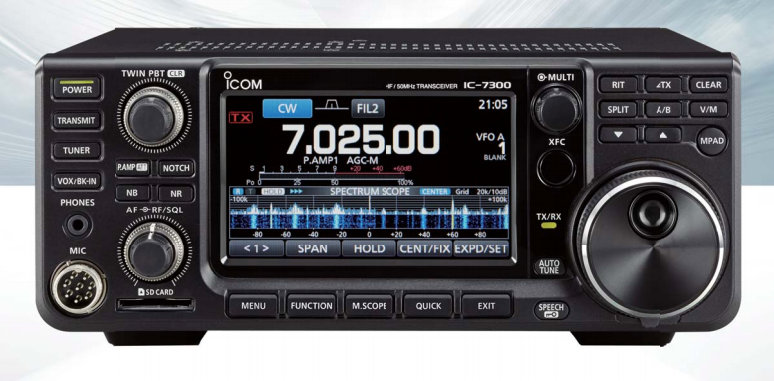
Icom introduced a new general coverage transceiver this year at the Tokyo Hamfair: the Icom IC-7300.
Icom has released a preliminary spec sheet (click here to download), but no pricing information yet. The IC-7300 will most likely be the least expensive Icom transceiver with a full spectrum display.
At first glance, I like the form factor and touch screen display–the panel appears to be less cluttered than many other large-display models. The ‘7300 has dedicated knobs for passband tuning and AF/RF gain (major plus in my book). It also comes with a built-in automatic antenna tuner.
I’ll post more info once Icom releases pricing and availability.