Category Archives: Shortwave Radio

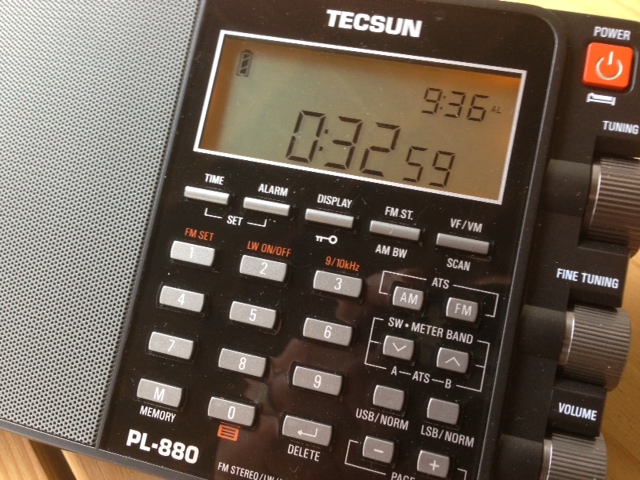
New large portable shortwave radio in the works?

(Source: bbs.tecsun.com.cn)

(Source: bbs.tecsun.com.cn)

Gary writes:

It looks like a new, large portable radio — along the lines of the Redsun RP2100 — is on the way. At least this one includes a direct-entry keypad and SSB, like the RP3100 is supposed to.

http://herculodge.typepad.com/herculodge/2013/04/another-large-portable-all-band-radio-to-be-released.html

I hope they can do good QC, and keep the sample to sample variation low.

Thanks, Gary. It does look like a variation of the of the RP3100. Sounds like it’s not a Redsun product, but may have been ported from one of their engineers for JiDian. It certainly has the trademark look. If this is true, there’s a possibility that C.Crane could bring this to North America. Perhaps it’s the next radio in line to succeed the CCRadio SW?  Though a great radio, the CCRadio-SW is getting a little long in the tooth.

No-Spoiler Review: “The Numbers Station” with John Cusack and Malin Akerman (no spoilers)

The-Numbers-Station-PosterThe following is a no-spoiler review, as I assume many of you may be waiting for the film to hit the big screen, and I wouldn’t want to reveal any cinematic surprises.

We first mentioned The Numbers Station back in late 2011 –and admittedly, I was eager to see public attention drawn to this public-yet-covert shortwave communications medium that’s still in existence today. Indeed, it’s no wonder that a numbers station became the subject of a film; the subject is truly mysterious. Only a few days ago, while describing numbers stations to a visiting friend who had never heard of them, I played a recording of a numbers station that I made last year–her initial response upon hearing the recording was, in her words, that she experienced “chills” running up her spine.

But what is a numbers station?

Numbers stations, for those of you not familiar with them, are shortwave radio broadcasts that contain only strings of what seem to be random numbers.  In truth, these numbers are encrypted messages for operatives in the field (otherwise known as secret agents). The operatives tune in the station with a simple shortwave radio, then decode the message with a one-time decryption key.  Once the message has been deciphered, the message pads are immediately burnt or destroyed (or, at least, they’re meant to be…).  Oddly, even though this is a very public communication which anyone with a shortwave radio can hear, only one or two individuals will likely ever decode the message.  Such messages have been known to exist in a variety of languages at least since the time of the Cold War, but strangely did not conclude with the Cold War’s supposed end–they are ongoing even today. (Click here to check out our other numbers station posts.)

John Cusack as Emerson (Photo: Image Entertainment)

John Cusack as Emerson (Photo: Image Entertainment)

The Movie

In the movie The Numbers Station, John Cusack’s character, Emerson, is a seasoned field operative–a “black-ops” agent–who faces a life-changing dilemma in the field which places his career in jeopardy.  In an attempt to give Emerson some time to reconcile his emotions, his leader (Liam Cunningham) assigns him to what should be a simple, routine assignment: to protect Catherine (Malin Akerman), a cryptologist who broadcasts at a rural remote numbers station in the UK.

Things go terribly wrong when the station is compromised and Cusack finds himself again facing the same dilemma that sent him to this assignment in the first place: whether to  “retire” his asset (namely, Catherine) in order to fulfill his duty, by cutting off loose ends? Or will his conscience–and tenuous friendship with Catherine–take him in another direction? It’s a difficult ethical dilemma, one Emerson has been attempting to avoid.

Malin Ackerman as Catherine (Photo: Image Entertainment)

Malin Akerman as Catherine (Photo: Image Entertainment)

I’ve seen a number of John Cusack films over the years, and while he’s an extraordinary talent, The Numbers Station unfortunately doesn’t quite allow us to see his full range as an actor simply because his character, Emerson, is stoic and quite introspective. But the chemistry between Emerson and Catherine is complex and tense, and one can’t help but believe he cares deeply for her.

On the action front, The Numbers Station is a much greater success:  pacing is good, with a few moments to collect your breath; still, there’s always looming conflict. The bulk of the film is set in a dimly lit, underground bunker-come-numbers station, and there are actually very few shoot-’em-out scenes, yet the tension and suspense are constant.

I won’t comment on how the plot resolves, but I can say that if you like dark films with tension, moral decisions, action, and intrigue, this is well worth watching.  I enjoyed it.

Moreover, if you love shortwave radio, and are intrigued by numbers stations, you will be pleased to discover that this film treats the concept with due respect and more accuracy than I would have anticipated.

(Photo: Image Entertainment)

(Photo: Image Entertainment)

How accurate is The Numbers Station?

While those who write about numbers stations have presumably never worked for one, there’s an existing body of knowledge out there built on thousands of hours of listening, cataloging stations and even court documents from cases involving spies.  This gives us a fairly accurate idea of the true nature of numbers stations.

Likely inaccuracies

  • Though it is possible, I have never heard of a numbers station which has a live voice behind the microphone, reading numbers; these would most likely be advance-recorded or computer generated.
  • In the film, Malin Akerman’s character, Catherine, only seems to read a string of numbers for a matter of seconds, not minutes; in reality, this would take much more time.
  • I heard no preamble of numbers to ID the correct decipher key.

And yet…likely accuracies

  • In the film, under standard operating conditions, no one at the station knows the nature of the messages being broadcast–this reflects a probable fact about such stations.
  • The numbers station is located in a rural and remote part of the UK, a convincing setting for a numbers station (though some may broadcast from major broadcasting sites).
  • Once the station has been compromised, Cusack’s character explains in some detail how numbers stations work on the operative’s end; this description is very true to what is known or believed of actual numbers stations.

So, should you see it?

I anticipate that most any shortwave radio enthusiast will enjoy The Numbers Station. As a non-movie-reviewer–in other words, as a regular joe public movie-goer–I give it 8 stars out of 10.  Go ahead!

Click here for show times and on-demand viewing.

If you’ve seen The Numbers Station, please comment below.

Videos: The Numbers Station Trailer and Featurettes

The official trailer:

Video Clip 1: The Assignment

Video Clip 2: We need that cypher

Featurette

Switzerland In Sound comes with a familiar voice

The host of Switzerland in Sound, Bob Zanotti.

The host of Switzerland in Sound, Bob Zanotti.

For any of you who listened to Swiss Radio International (SRI) on shortwave radio, you’ll no doubt know the name of long-time radio presenter Bob Zanotti. For me, his deep, rich voice was synonymous with SRI.

What you may not know is that Zanotti hosts his own website called Switzerland In Sound. It is chock-full of up-to-date Swiss information, news (Tina Turner became Swiss?), interviews, thoughts, musings and a wealth of vintage recordings from SRI.

SwitzerlandInSoundIf you were a fan of The Swiss Shortwave Merry-Go-Round, you’ll be pleased to discover the many recordings he has of The Two Bobs (Bob Zanotti and Bob Thomann).

Bob also manages a Facebook page for Switzerland in Sound. If you’re on Facebook, I encourage you to join his group.

Check out Switzerland In Sound:
http://www.switzerlandinsound.com

Shortwave Radio Recordings: Radio Romania International

Victory Avenue (Calea Victoriei), a major avenue in central Bucharest (Source: Wikimedia Commons)

Victory Avenue (Calea Victoriei), a major avenue in central Bucharest (Source: Wikimedia Commons)

Today at 20:30 UTC, Radio Romania International’s signal on 11,745 kHz was  quite strong, as it so often is.  RRI is one of the few broadcasters that still target Europe and the eastern US on shortwave.

RRI is a treasure of a station, too, with true local flavor–Romanian news, music, and mini cultural documentaries. This Sunday broadcast features the program Inside Romania, Romanian Without Tears (a language program which always reminds me of the similarities between French and Romanian), DX Mailbag, and Roots.

Click here to download the full broadcast as an MP3, or simply listen via the embedded player below. This recording features their interval signal before and after the broadcast:

If you enjoy Radio Romania International, I encourage you to send an accurate and descriptive reception report to: [email protected] Maybe your letter will be featured on their DX Mailbag!

Shortwave Radio Recordings: NHK Radio Japan

Tokyo, Japan (Source: Wikimedia Commons)

Tokyo, Japan (Source: Wikimedia Commons)

For you listening pleasure: thirty minutes of NHK Radio Japan’s English language service.

This broadcast was recorded an hour ago, at 10:00 UTC on 9,625 (April 19, 2013).  Though NHK has dropped their English language services into North America, you can still receive their broadcasts targeting other regions quite easily.

Click here to download the full recording, or simply listen via the embedded player below. note that I include a full five minutes of their interval signal:

Enjoy!

Heritage Foundation: BBG isn’t listening

BBG-Logo(Source: Heritage Foundation)

U.S. international broadcasting strategy again landed under congressional scrutiny in Wednesday’s House Foreign Affairs Committee hearing.

Representative Brad Sherman (D–CA) wanted to know why the Broadcasting Board of Governors (BBG) ignored the congressional mandate to keep broadcasting to Pakistan in several local languages. In spite of a specific $1.5 million appropriation for broadcasting to Pakistan, everything has been cut except programming in Urdu. “You would not dream of broadcasting to Los Angeles in only one language,” said Sherman.

While Secretary of State John Kerry did not offer an explanation, the problems at the BBG cry out for a solution. The agency leadership time and time again has angered and frustrated Congress by ignoring its mandates to keep radio broadcasting lines open to areas of the world where free and dependable media do not exist. Instead, the broadcasting governors and the BBG bureaucracy are grappling with their own agenda and the impact of technological advances, with the result that the core mission gets short shrift.

In the President’s fiscal year 2014 budget request, the BBG accounts for $731 million, a not insignificant amount of funding. Yet at the same time, deep cuts in language services positions and broadcasting hours are proposed in the budget following already announced cuts resulting from sequestration.

[…]There is no doubt, though, that the BBG structure itself stands in dire need of overhaul. The nine-member, part-time board (on which the Secretary of State or his designate sits) is a poor mechanism for executive oversight of a complex broadcasting system, and board member terms are routinely allowed to expire without timely replacement. The most recent board meeting on April 12 was attended by just two board members.

A composite map of the world at night produced by NASA shows the vast areas of the globe—mainly Asia and sub-Saharan Africa—where there is no power grid to light up cities at night. Many of those areas, where reliance on Internet or television is impossible, are precisely the beneficiaries of U.S. international broadcasting. Let us not lose sight of that fact.

Read the full article on the Heritage Foundation website.

For those of you not familiar, note that the The Heritage Foundation is a US conservative think tank based in Washington, D.C. whose mission is to “formulate and promote conservative public policies based on the principles of free enterprise, limited government, individual freedom, traditional American values, and a strong national defense.”

Thanks, Ted, for the tip!