Category Archives: Shortwave Radio

Call me anachronistic, but I listen to digital tech shows on shortwave

BBC_ClickWhile I’m passionate about shortwave radio–a technology that has, of course, been around for many decades–I also love to hear about emerging digital technologies, especially those that make our world a better place.

These days, I listen to several shows about technology, many of which are only available as a live stream or podcast (like TWIT, for example).

There are two shows, however, that I like to listen to on shortwave radio when my schedule allows.

One such show is the BBC World Service technology show, Click (formerly Digital Planet). I’ve listened to Click for years, and have even been interviewed on the show by its marvelous host Gareth Mitchell (click here to listen). I especially love the show’s focus on technologies that have a positive impact in developing countries (hence my interview, about my non-profit, ETOW). Mitchell, I’m delighted to add, is quite the fan of shortwave radio as well, and is not afraid of reporting on technologies that are not exclusively tied to smart phones and the like.

DownloadThisShow-RadioAustraliaAnother show I’ve been listening to for a few months is Download This Show on Radio Australia. It’s a fun and informative technology program and always has a great panel discussion on technology news. What I really love about this show is its take on Australian technology in particular, and how this compares with technology in the rest of the world.

Since Download This Show is broadcast via Radio Australia’s Shepparton transmitting site, the signal is quite strong here in North America and easily received on portable shortwave radios.

Click here to download over two hours of Radio Australia, including Download this Show, or listen via the embedded player below. This broadcast was recorded on August 2, 2013, on 9,580 kHz, starting around 13:00 UTC.

You’ll find Download This Show in the second hour of the recording, following the news headlines at 1:05.

Jeff designs an SDR “Go Kit” around the Softrock Ensemble

SoftrockGoKit1Jeffrey Fritz (WB1AAL) contacted me with details about his SDR (Software Defined Radio) “Go Kit” and has kindly allowed me to post it.

Jeff writes:

As a reader of the SWLing blog, I know that you are very interested in SDR. And you probably know that a “Go Kit” is a portable ham radio system in a case that can be moved at a moment’s notice and set up at another moment’s notice virtually anywhere.

I have a VHF Go Kit made up for emergency events. It is complete with waterproof carrying case, Aden PCS-7000H two-meter transceiver, a Kenwood VHF tuner, a Kenwood SW-100 VHF SWR bridge and two antennas (a 2-meter J-pole made out of twin lead and a two meter mag mount.) But what if there is a need to monitor the HF bands during the same event?

Now that I own a Flex-1500 SDR transceiver, the Softrock Ensemble SDR receiver that I bought a while ago has become somewhat redundant. It is still a serviceable radio and works fine, but it can’t hold a candle to the amazing Flex-1500. While I could turn it into a panadapter or sell it on eBay, eHam, etc., I had a better idea.

To monitor the HF ham bands, I could use something like my Grundig G3 shortwave radio in my Go Kit. While it is portable, battery operated and will tune LSB and USB, listening to SSB or even CW in an emergency situation with the G3 can be a bit of a chore. (Think of the old boat anchors with their main tuning and fine tuning band spread dials, but now make both dials tiny and you’ll get the idea.) Instead, why not build a 12-volt battery supply with common, easy to obtain batteries? I could connect it to the Softrock Ensemble and then via a USB audio interface to a battery powered laptop. Add a pair of headphones and we are in business.

That is just what I’ve done.

I’ve attached some photos of my most recent project–done this past weekend actually. [Check out photos above and below] It’s an SDR Go Kit. One of the attached photos shows the laptop and the Softrock Ensemble SDR receiving 40-meter band SSB while entirely being operated on battery power. There is no power switch. You simply pull the DC jack out of the Softrock Ensemble SDR radio when it isn’t in use. Simple as it gets! The other photo shows the battery pack built into a (ahem!) Preparation H Pad holder pack. (Now, I am not saying who used this!)

Ah but what will battery life be like with 8 C cells in series driving the receiver? It’s too soon to say because I just put it together an hour ago. But here’s a guess:

SoftrockGoKit2The Softrock Ensemble draws 18 mA at 12.6 volts (my measurement.) An Alkaline ‘C’ battery can supply up to 8,000 mAh, so doing some math and assuming fresh batteries, the battery pack should run the radio for roughly 400 hours. (Hopefully my math is correct!) If so, then I think that the laptop batteries will give out long before the life span of the C Cell is reached!

73,

Jeff, WB1AAL

Jeff, this is an excellent use for the Softrock Ensemble. I imagine it will run for a very long time drawing only 18 mA. I have a “Go Kit” for QRP ham radio purposes and one for SWLing during travels. You’ve inspired me to piece together a proper receiver “Go Kit” to be used in case of emergencies.

Readers: If you have a project, like Jeff, that you’d like to share on the SWLing Post, feel free to contact me with details!

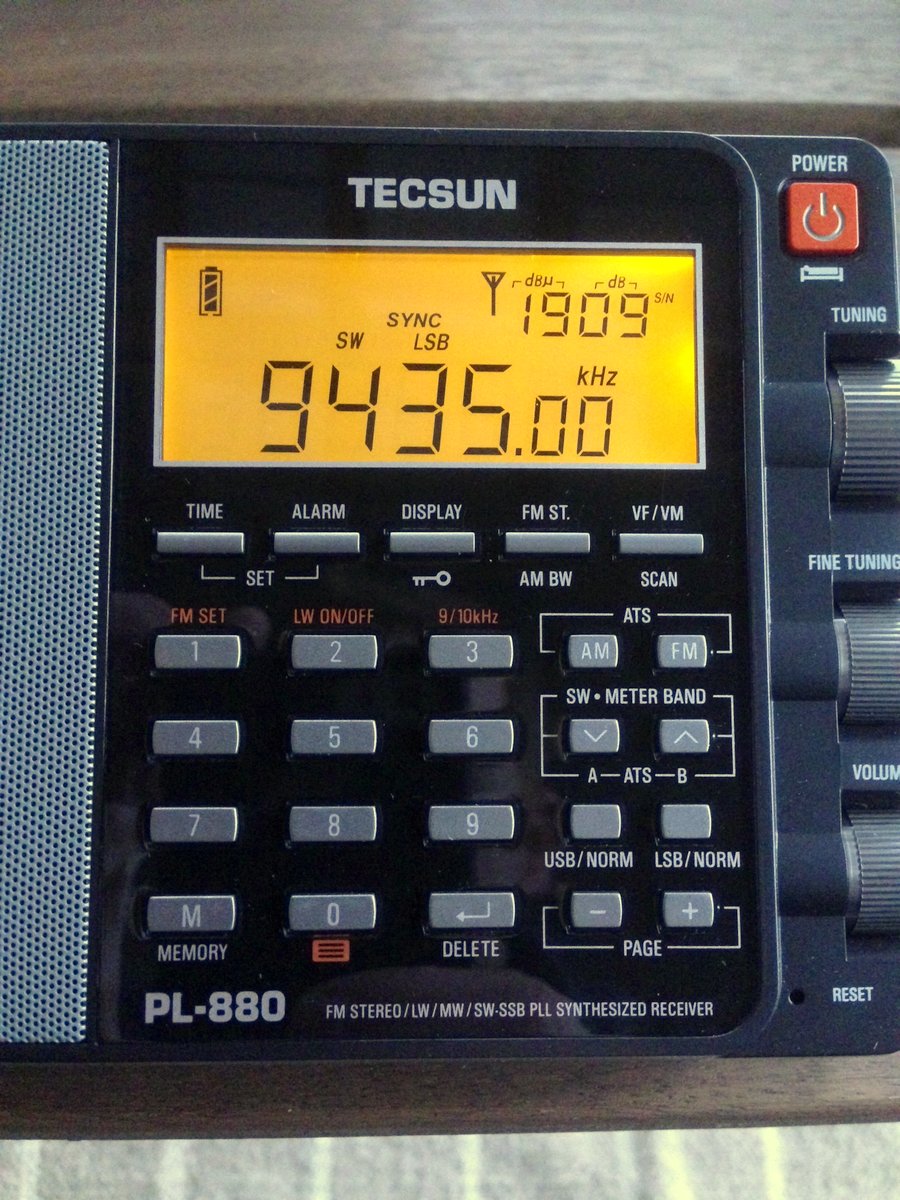
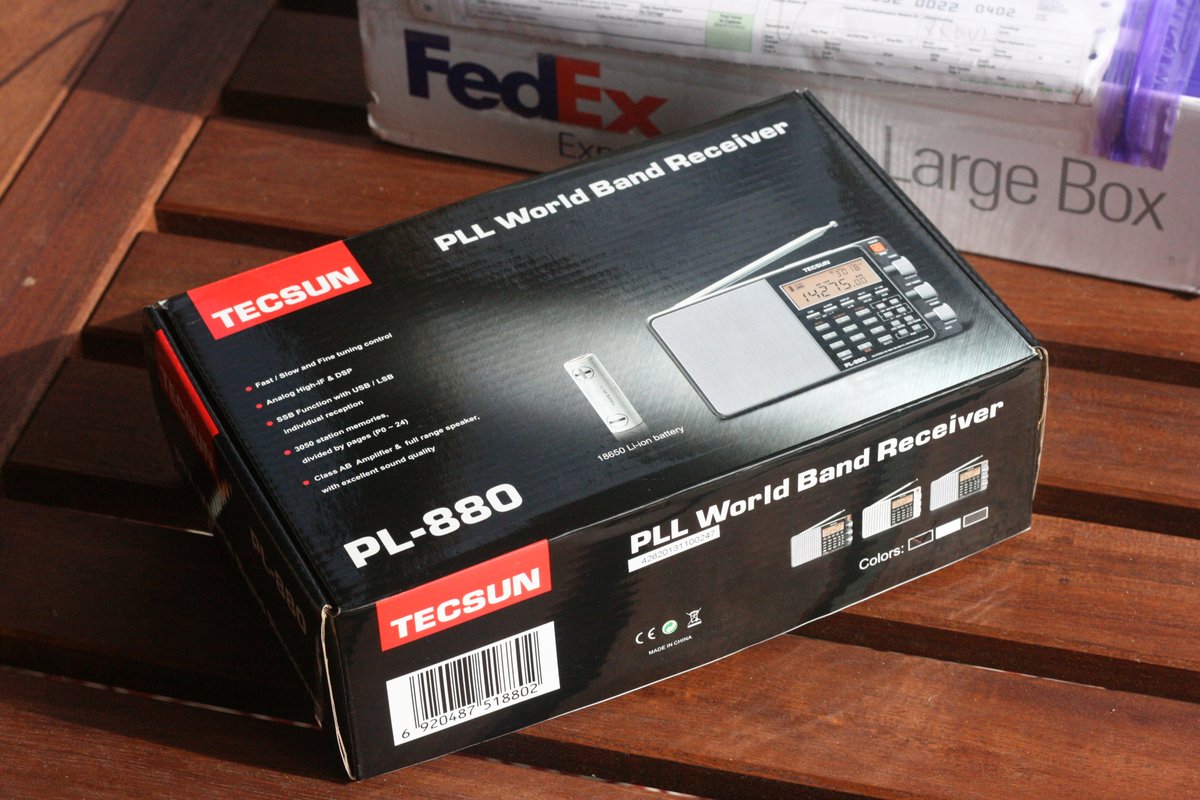
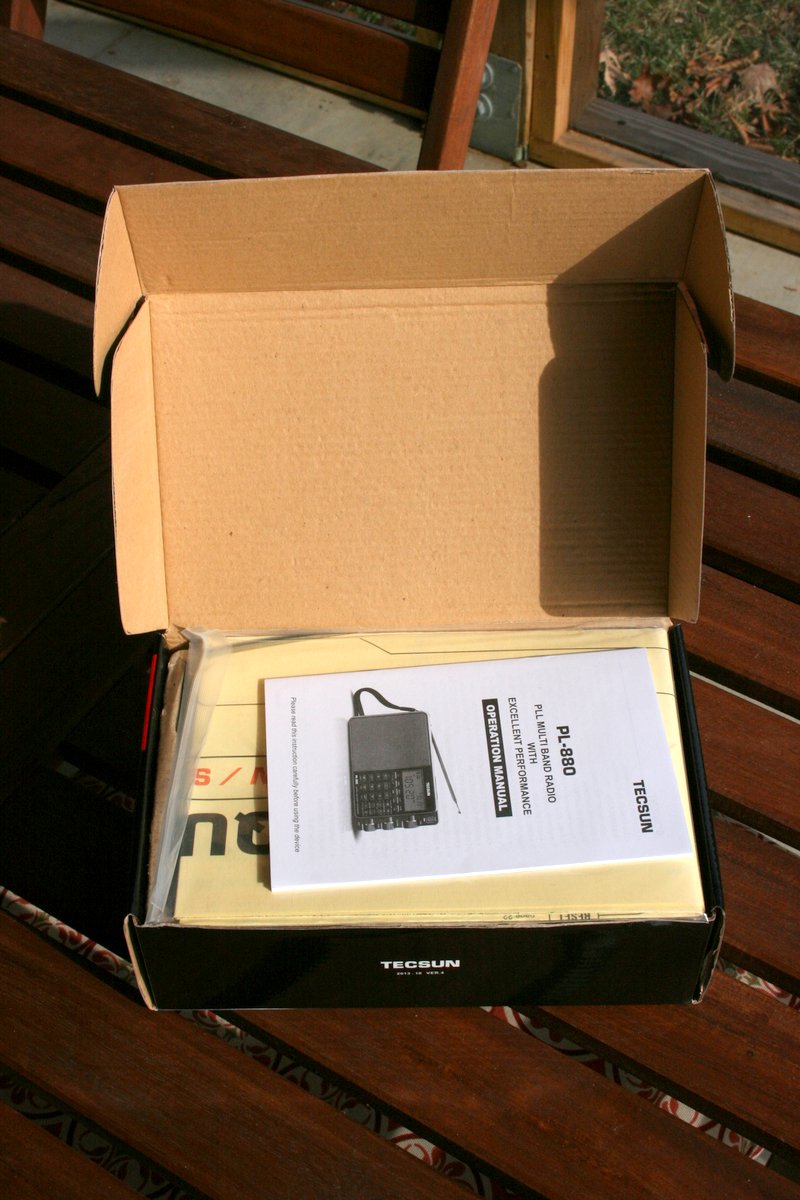
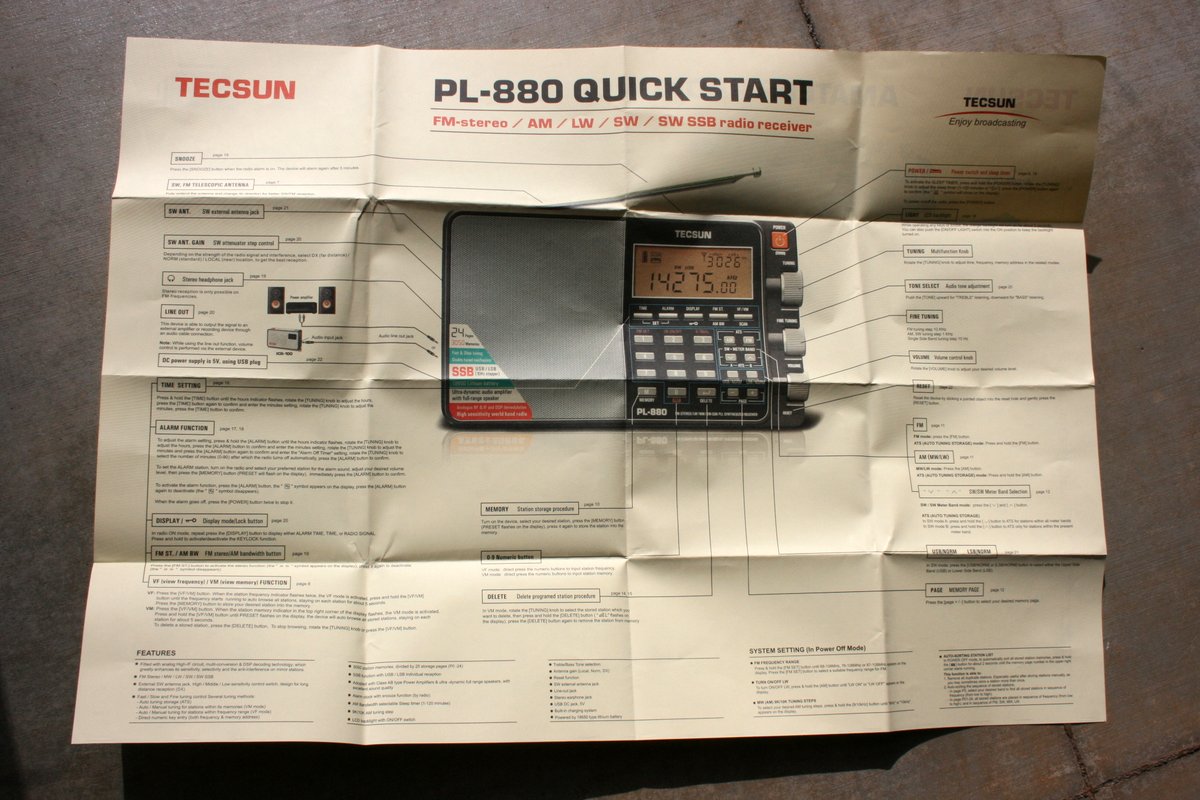
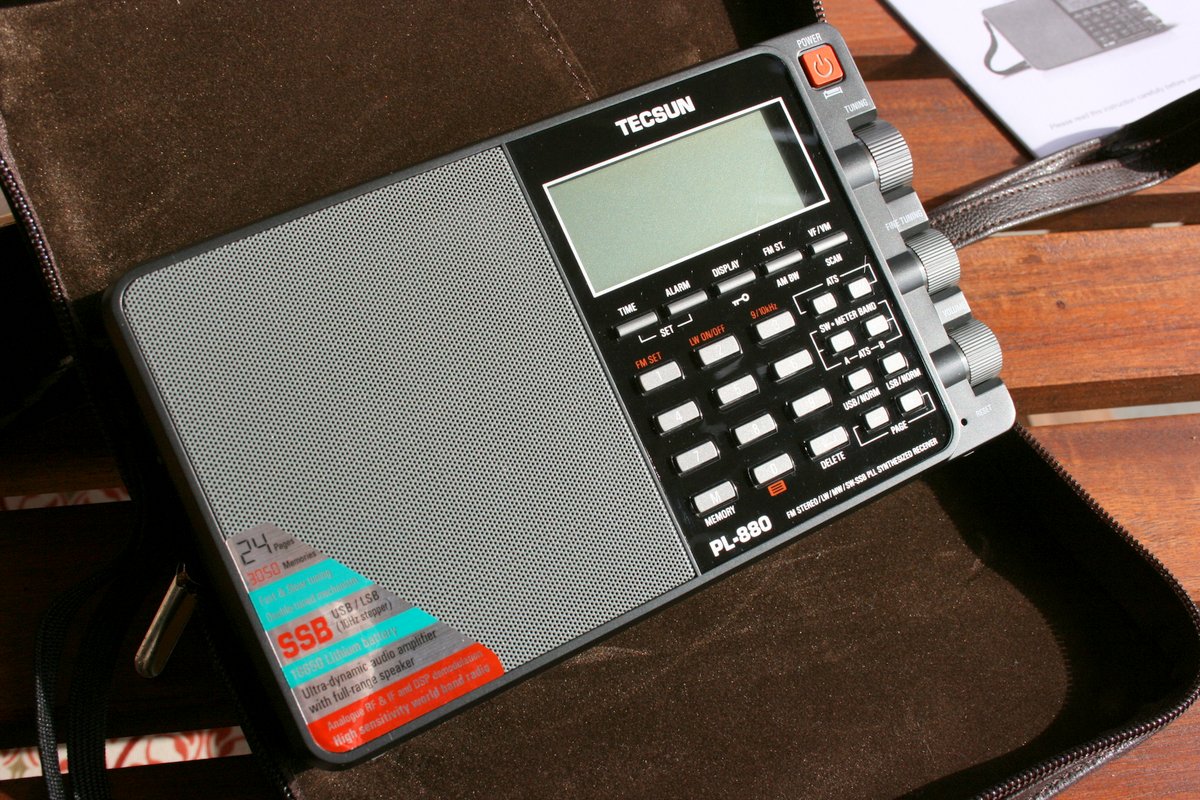
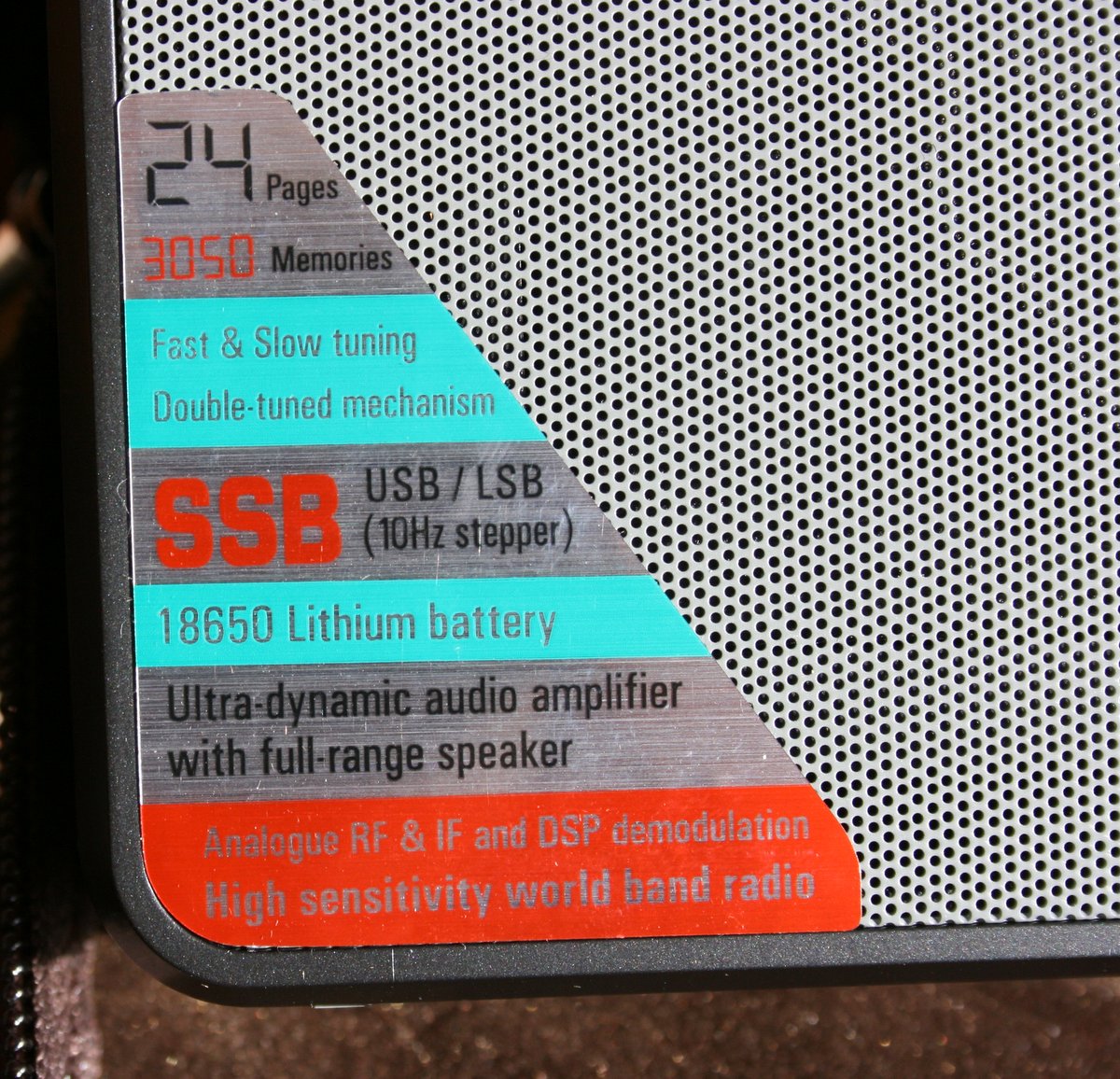
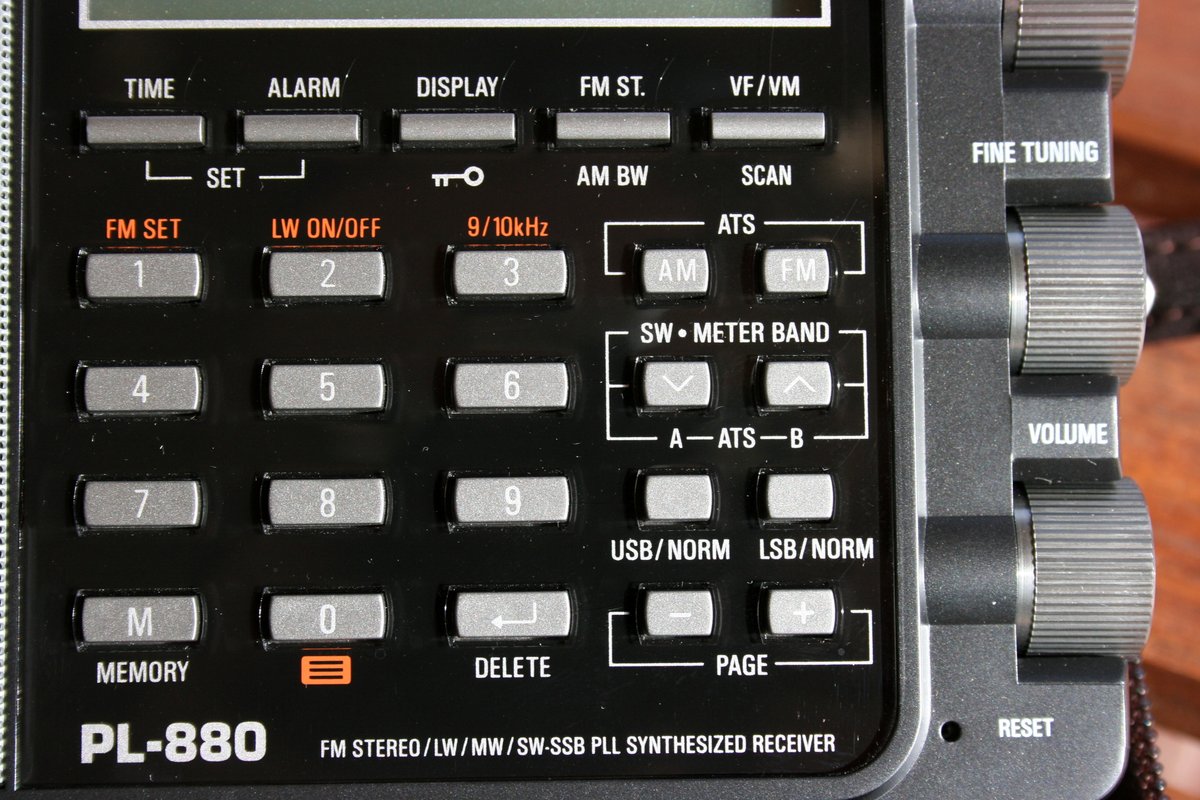
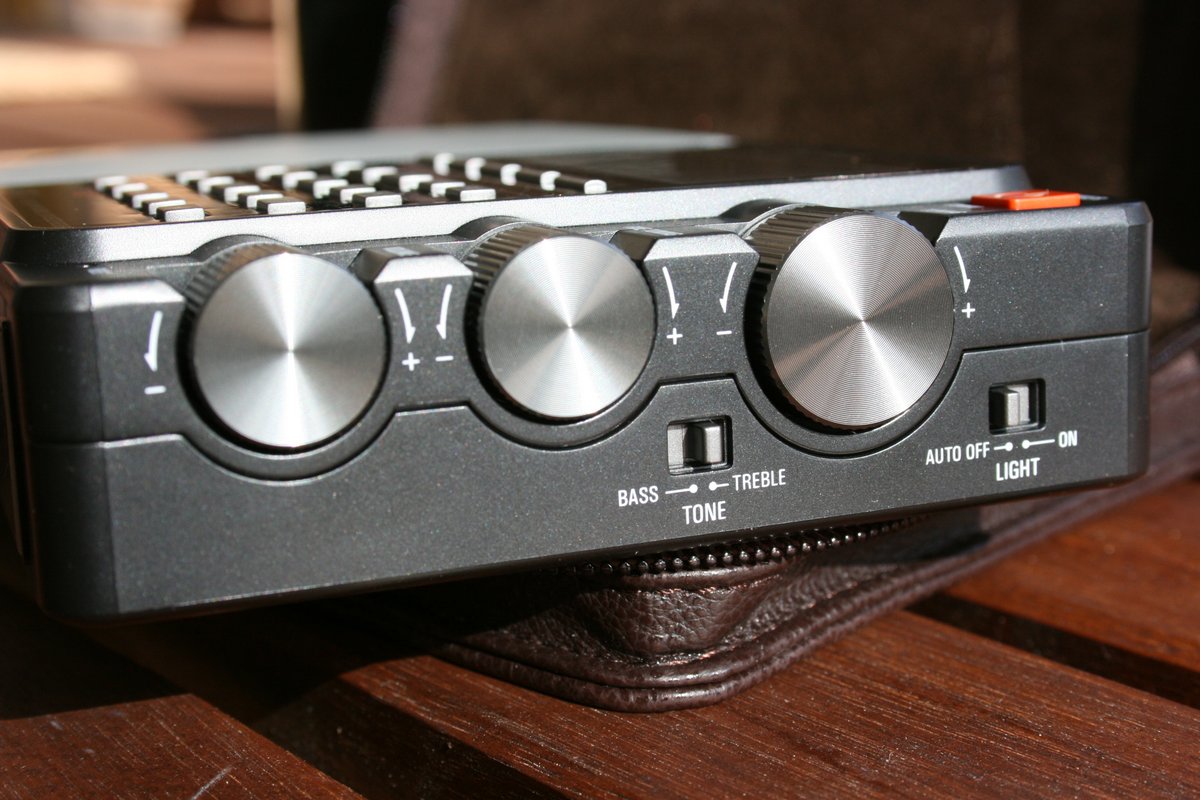
The new Tecsun PL-880 sounds promising

The Tecsun PL-880 (Photo: bbs.tecsun.com.cn/)

The Tecsun PL-880 (Photo: bbs.tecsun.com.cn/)

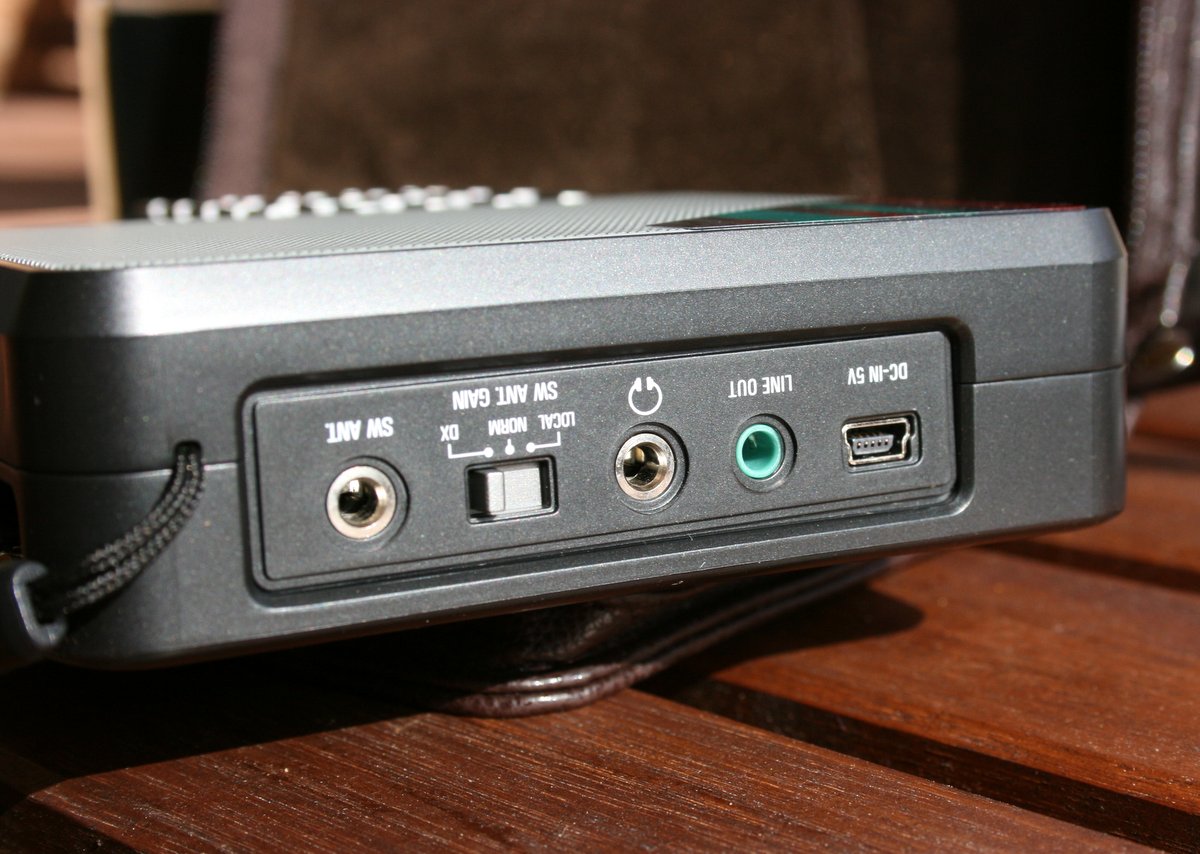
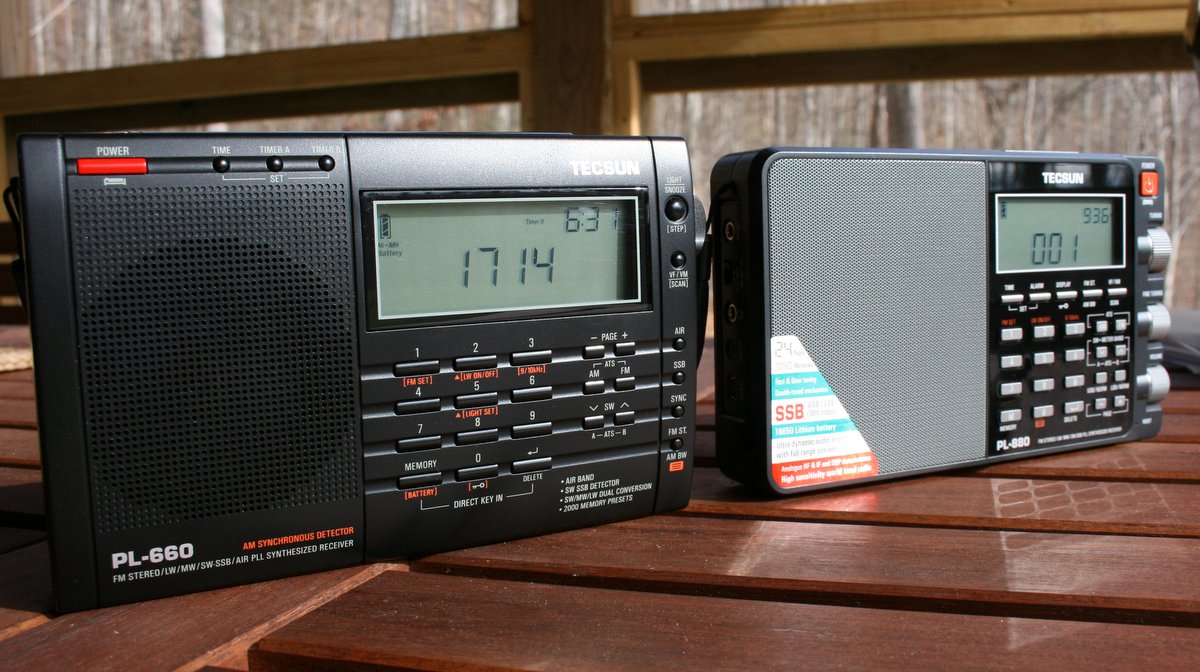
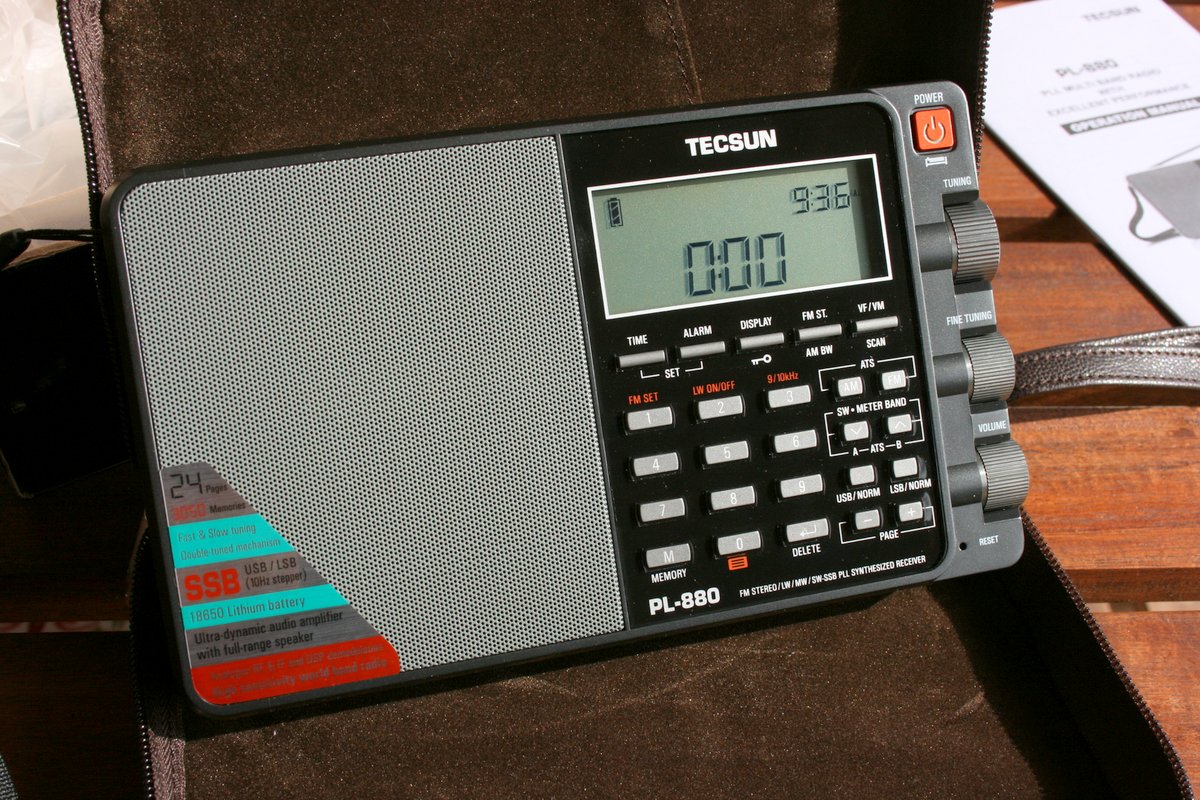
Last night, I discovered news of the new Tecsun PL-880 on Jeff’s excellent blog, the Herculodge.

Out of all of the current shortwave radio manufacturers, Tecsun seems to be one of the only companies making new models for the radio hobbyist–models with important features like SSB, bandwidth control, fine tuning steps, capable AGC, etc.

According to a comment Owl left on this post, it sounds like the PL-880 could be a performer:

Two photos of Tecsun’s new model PL880 appeared yesterday. It uses an analog+DSP architecture similar to ATS909X but has made some significant improvements (4 AM bandwidth + 5 SSB bandwidth) and better audio compared to previous Tecsun portables.

http://herculodge.typepad.com/herculodge/2013/08/new-tecsun-pl-880-on-its-way.html

I will plan on reviewing the PL-880, once it hits the market. If it’s no larger than my Sony ICF-SW7600GR, it might make for a great travel radio.

TecsunPL-880Box

(Photo source: bbs.tecsun.com.cn)

Retirement Sale: Grove Enterprises liquidating inventory

grovewebheaderIt appears that Monitoring Times is not the only division of Grove Enterprises that will close shop when owners, Bob and Judy Grove, retire.

Indeed, Grove Enterprises is liquidating their entire inventory in a retirement sale. There are deals to be found in their shortwave radio selection and entire catalog of products.

Still, sad to see this reputable radio retailer close shop. I’m grateful that Universal Radio and C.Crane are still in business. I’m a strong believer in purchasing from radio retailers rather than online sources like Amazon.com. No doubt, Amazon has competitive pricing and good customer service, but frankly they could care less about the radio hobby in general.  To Amazon, shortwave radios are simply a few dozen consumer electronics products out of the tens of thousands they offer.

Universal Radio and C.Crane both support radio clubs, events and hobby-related activities–Amazon does not. Plus, pricing is often very close or even lower than that of Amazon. This is why I always purchase from them if they have what I seek.

Victor Ashe joins CUSIB after leaving the Broadcasting Board of Governors

Victor Ashe

Victor Ashe

Without a doubt, Victor Ashe has championed US international broadcasting on the Broadcasting Board of Governors and has voiced his support for continued funding of the Edward R. Murrow Transmitting Station. He will now join The Committee for U.S. International Broadcasting Advisory Board:

(Source: CUSIB Press Release)

The Committee for U.S. International Broadcasting (CUSIB – cusig.org) announced that departing Broadcasting Board of Governors (BBG) member Victor Ashe has joined CUSIB Advisory Board.

CUSIB is a nonpartisan, independent NGO supporting U.S. international broadcasting. CUSIB has worked with individual BBG members, heads of BBG entities, members of the U.S. Congress, and media to identify and correct management problems that hamper effectiveness of U.S. international broadcasting. CUSIB members were active in successfully opposing proposed cuts to Voice of America (VOA) radio and satellite television programs to China and VOA radio programs to Tibet. CUSIB also defended dozens of Radio Liberty journalists in Russia who were fired by the previous Radio Free Europe / Radio Liberty (RFE/RL) management. Some of the journalists were rehired after the BBG hired Kevin Klose and acting RFE/RL president. Klose initiated management reforms at RFE/RL.

At the BBG, Victor Ashe was a champion of accountability and transparency. He won respect of rank and file employees for his willingness to communicate with them and address serious management issues. Ashe insisted that top agency executives not ignore the problem of record low employee morale under the management of the International Broadcasting Bureau (IBB), as measured by the Office of Personnel Management (OPM) Federal Employee Viewpoint Survey (FEVS).

Ashe said in a statement: “I am honored to serve on this [CUSIB] Board and appreciate their dedication to transparency and fairness. There is still much work to do for international broadcasting by the United States due to serious management issues which still exist.” “I am hopeful the new BBG Board with the leadership of Jeff Shell will make the decisions necessary to move BBG forward,” Ashe added.

“You are listening to the Free Hellenic Radio”

TheParthenonAthensYesterday was the first day in nearly a month that I had turned on my SDR to record broadcasts. Between my travel schedule, getting the PC fixed, and near-constant summer thunderstorms, my SWLing has been limited to portables and sporadic travel listening. It felt so great yesterday to turn on the WinRadio Excalibur and do a little band-scanning. As I skimmed across the bands, I checked in with my good friend, the Voice of Greece, on 9,420 kHz. And, as I listened, I flipped on the “record” switch.

What I recorded was more than three hours of uninterrupted Greek music. Click hear to download the full recording, or listen via the embedded player below:

Three hours of music with no commentary (save a little dead air) is certainly not a typical format for the Voice of Greece, so I took note. If you’ve been reading The SWLing Post for long you’ll know that the Voice of Greece and its domestic broadcasting counterparts have been going through a major shake-up. In the wake of the government closure of ERT on June 11th, within hours, former ERT journalists defiantly got back on the air. Until courts ordered the immediate re-opening of the Greek national broadcaster, the Voice of Greece was, in a sense, a very powerful pirate radio broadcaster. Interestingly, since the shakeup in June, I learned that the Voice of Greece has barely been off-air.

Since I don’t speak or understand Greek, and since they’ve only made a few public statements in English, I turned to my friend and SWLing Post reader/contributor, Christos, for details.  He writes:

I will try to describe…the current situation regarding the ERT issue, I hope in an objective way.

…[I]n front of the Radio House in Aghia Paraskevi suburb…all the fence[s] and part of the building [are] covered by banners. Almost every [evening], concerts take place in the yard. The participant artists express their solidarity [with] those who run the ERT since 11 of June, when the government fired 2,650 employees in order to recruit some 2000 again.

The so-called occupiers of the Radio House demonstrate signs of [fatigue] as less producers and known journalists appear in the programmes. Their programme is transmitted from medium waves 729, 1008, 1260 1404 and 1512 KHz…enough to cover the whole country during night time. I checked the short wave frequency of 9420 KHz; they [host] a different musical programme…the one you receive in [the US] [hear this above]. I think that this is a dead end for those who continue, as 3,000 people in the media business have applied for job[s] in the new ERT. The vice minister responsible…will recruit only 500 of them…

Two days ago, we had a night of tension as some protesters appeared on the mountain where the antennas are located…[P]olice arrested some of them.

You can get an idea of this incident [by] watching the following two videos:

Another source of [information about] the ERT occupiers is:

http://www.ertopen.com/news-in-4-languges/english

…[T]here have not been announcements about the future of the Voice of Greece. Think that some 10 million…Greeks live in the country, and some 10 [million] more [live] abroad.

[The pace of] Greek summer…[is] slow. People go to the beaches or to their native villages. Everybody looks exhausted as the last two days the temperature reached 39 degrees Celsius which is 102.2 degrees Fahrenheit. Today the SKAI, one of the biggest private radio stations, fired 10 journalists add[ing] to [the] 50 [previously fired]. Now they repeat older programmes and there [is] no news broadcasted.

Remaining journalists in ERT refer to [the broadcasting service] as: Hellenic Radio – The Voice of Freedom, and often announce, “You are listening to the Free Hellenic Radio.”

Once again…giving you an idea [of the political] climate here…this morning the government announced the names of 2,122 teachers – public servants from technical education [–] who lost their job[s].

I hope this will be of…interest.

Christos, we thank you so much for your insight and opinions about the state of Greek national and international broadcasting!  We at The SWLing Post support freedom of press in Greece, and commiserate with those who have lost their jobs, especially in such an oppressively hot summer. Please do continue to keep us informed.

I have sincere doubts about the longevity of the Voice of Greece (or Free Hellenic Radio) on shortwave. With the serious budget cuts the new ERT must be built on, I doubt they’ll consider funding shortwave radio in Greece. I feel like it may only be a matter of time before we lose yet another shortwave broadcaster.  I certainly hope I’m wrong…

In the meantime, I’ll be dedicating more hard drive space to spectrum recordings of VOG.

Bucking the trend, Taiwan invests in shortwave infrastructure

(Photo: Ampegon)

(Photo: Ampegon)

While countries like Canada are preparing to tear down their state-of-the-art transmission site, Taiwan appears to be investing in theirs.

Thanks to Andrea Borgnino for sharing a press release from the Swiss manufacturer, Ampegon, who has been contracted by RTI to upgrade two shortwave radio transmission sites in Taiwan.

Ampegon will “manufacture, install and commission a total of ten 300 kW DRM shortwave transmitters and twelve rigid dipole broadcast antennas HR2/2/0.3 securing low and efficient maintenance works.” Ampegon boasts that this is “the world’s biggest SW modernization project.”

Ampegon’s continues in their press release:

The transmitters are manufactured in Turgi, Switzerland while the antennas are designed in and delivered from Schifferstadt, Germany. At the first site near Taipeh four transmitters and two antennas will be installed, at the second site six transmitters and ten antennas. The new infrastructure is partially on air since May 2013 with two most modern transmitters and antennas and planned to be completed in several steps until autumn 2014.

Chi-Ming Wang, Director Engineering at RTI, is extremely satisfied with Ampegon as partner for the project: “Ampegon is very experienced and has delivered shortwave transmitters for us thirty years ago that still work to our full satisfaction. Ampegon offers a complete solution approach including transmitters, antennas, control systems and DRM integration. In addition Ampegon provides the best price/performance ratio”.

Significant benefit for the customer is a reduction in energy consumption by replacing the old equipment which leads to operation at higher efficiency rates. Savings in other operational costs are reached by a fully automated transmitter based on StationMaster Plus control system and because of a decrease in the amount of spare parts due to the market leading technology selected.

The challenges of this project are short delivery periods and the management of local logistics including building and feeder line modifications, while keeping existing old transmitters and antennas on air.

This is the largest contract for Ampegon since execution of the name change in November 2012. It means a significant factory load through 2014 for the locations Turgi and Schifferstadt. The project highlights that AM / DRM radio broadcasting keeps its important role in Asia and other areas of the world.

Tel. +41 58 710 44 00
[email protected]

Radio Taiwan International is obviously not pulling out of shortwave. Neither is neighboring China Radio International.

Note that RTI is not the only Taiwan-based broadcaster investing in shortwave radio; PCJ International has recently completed a series of test broadcasts from their new (still under construction) transmitting station.