Category Archives: What’s On Shortwave

Shortwave Radio Recordings: ERT Open (Voice of Greece)

greeceAs I prepare the largest post I’ve ever published on the SWLing Posta review and comparison of the PL-660, PL-880, ATS-909X and ICF-SW7600GR–I’ve been listening to the music I recorded Sunday night on ERT Open (Voice of Greece).

Regular readers know that I’ve always had a particular fondness of this station. Some nights they play hour long sets of music ranging from folk to modern (I especially love the folk) on 9,420 kHz. Their signal booms into North America as well; indeed, ERT Open can even be heard on a basic shortwave portable with relative ease.

Since I don’t speak or understand the Greek language, I can listen to this music while writing posts and catching up on email correspondence (I’m terribly behind at the moment).

For your listening pleasure: two hours, six minutes of ERT Open recorded on July 6, 2014 staring around 01:00 UTC.

Click here to download the recording as an MP3, or simply listen via the embedded player below:

If you’re interested in the benchmark portable radio review I mentioned above, check back on the SWLing Post later today.

RNZI: Peter Fry says goodbye to Saturday Nights

full_peter-fry-014Peter Fry, host of Radio New Zealand National’s music request program, Saturday Night, said goodbye last night after fifteen years on the air. Many SWLing Post readers have written about their love of the program, having heard Fry’s voice over the shortwaves through Radio New Zealand International’s relay.

This morning, I received the following message from SWLing Post reader, Frank:

“I caught [Fry’s final Saturday Night broadcast] on my [Tecsun PL-660] while on watch last night.

For the last 2 months I have been ‘on passage’ from Antofagasta, Chile to Auckland on my wee boat and last night, having left Bora Bora 5 days ago bound Tonga, we were sailing through the ‘southern Cooks’.

Listened to his last program while sailing into the setting moon on a balmy tropical night right down to the last ‘goodbyeeee’.
To me its what SWLing is all about.”

He continues:

“Beats listening to the footy on RA. Beats DXing in Tristan da Cunha as well….”

I must admit, I agree, Frank.  I would certainly love to be in your place: on the open water, listening to distant stations…Thanks for sharing, and safe travels to you and your crew.

And fans of the show, fear not. Though we will miss Peter, and are grateful for his years on the show. Saturday Night will continue with a new host, and I’m willing to bet that it’ll still be a treat to hear.

If you missed hearing Saturday Night, yesterday, check out the audio files below, which cover the entire final broadcast:


VOA Radiogram this weekend, July 5/6

VOARadioGram(Source: VOA Radiogram)

VOA Radiogram this weekend will include news about reductions to the shortwave transmissions of VOA and other stations of US international broadcasting. These cuts were effective on 30 June.

Fortunately, VOA Radiogram remains on shortwave, at least for now.

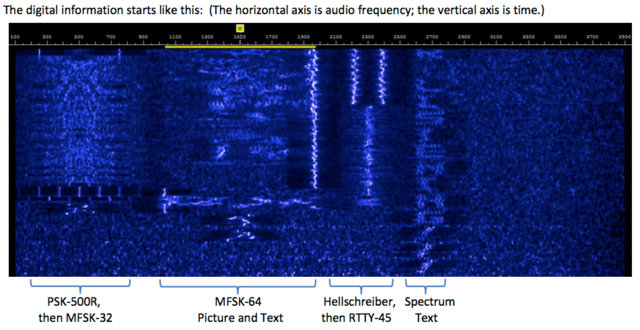
Here is the lineup for VOA Radiogram, program 66, 5-6 July 2014 (all in MFSK32 except where noted):

1:33 Program preview
2:45 Major reductions to US shortwave broadcasts, with image
8:10 Car fumes affect pollinating insects
10:10 Test of Mars landing craft a success, with image
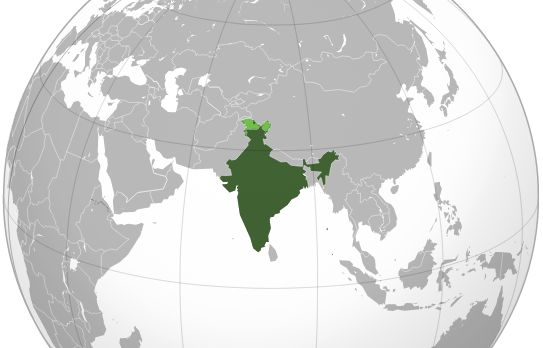
14:23 India launches satellites at low cost, with MFSK64 image
20:32 Spanish: Triple black hole discovery, with image
25:59 Closing announcements

Please send reception reports to [email protected]

VOA Radiogram transmission schedule
(all days and times UTC):
Sat 0930-1000 5745 kHz
Sat 1600-1630 17860 kHz
Sun 0230-0300 5745 kHz
Sun 1930-2000 15670 kHz
All via the Edward R. Murrow transmitting station in North Carolina.

The Mighty KBC will transmit a minute of MFSK64 Saturday at about 1130 UTC on 6095 kHz, and Sunday about 0130 UTC (Saturday 9:30 pm EDT) on 9925 kHz. Both frequencies via Germany. Reports to [email protected].

WRTH : A14 updates are now available for download

wrth-2014WRTH has just announced that updates to the A season international radio broadcasting schedules are available to download on WRTH’s website.

This update includes the cuts and changes to VOA/RFA/RFE etc.

Shortwave Radio Recordings: Radio Romania International

RomaniaMap

For your listening pleasure: Radio Romania International‘s English language service.

I recorded this broadcast with the WinRadio Excalibur on July 2, 2014, starting at 00:00 UTC on 9,700 kHz.

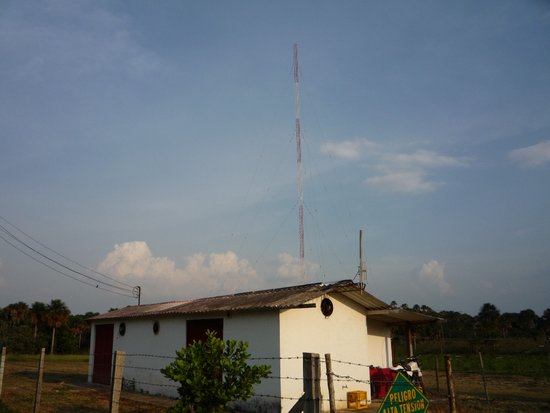
This broadcast originates from RRI‘s Tiganesti transmitter site.

Click here to download the recording as an MP3, or simply listen via the embedded player below:

Click here to view other posts mentioning Radio Romania International.

If you love shortwave radio recordings, please visit our Shortwave Radio Audio Archive which contains hundreds of archived recordings. You can subscribe to the SRAA on iTunes.

Shortwave Radio Recordings: Radio New Zealand International

RNZI-LogoFor your listening pleasure: three hours of Radio New Zealand International, recorded on June 28, 2014 starting around 7:59 UTC on 9,700 kHz.

This recording begins with the The RNZI interval signal: the charming and unmistakable call of the New Zealand Bellbird. After top-of-the-hour news breaks, you’ll hear Peter Fry’s music request show Saturday Night (click hear to read more about Fry).

SWLing Post reader, Mike, recently informed me that Peter Fry will be retiring this week.  His last show will be next Saturday (July 5th). I will certainly miss hearing Peter Fry on the air, but wish him the best in retirement.

Click here to download this recording of RNZI as an MP3, or simply listen via the embedded player below:

QSL: International Radio for Disaster Relief (IRDR)

SWLing Post reader, Michael Guerin, writes:

“Just received [this QSL card] from HFCC in Czech Republic. Heard Radio Australia’s test program with fair copy. Sent report by mail the next day to both HFCC and RA.”

IRDR-QSL-Michael-Front

IRDR-QSL-Michael-Back

Many thanks for sharing this card, Michael! I’m impressed the HFCC issued them so quickly.

Did you miss the IRDR test broadcast?  Stay tuned–I’m hopeful they’ll repeat this test in the future.