Shortwave listening and everything radio including reviews, broadcasting, ham radio, field operation, DXing, maker kits, travel, emergency gear, events, and more
Many thanks to SWLing Post reader Mike, who shares a link to this story from the blog République No.6:
Growing up in Piennes Lorraine, Radio Caroline the making of a rebel
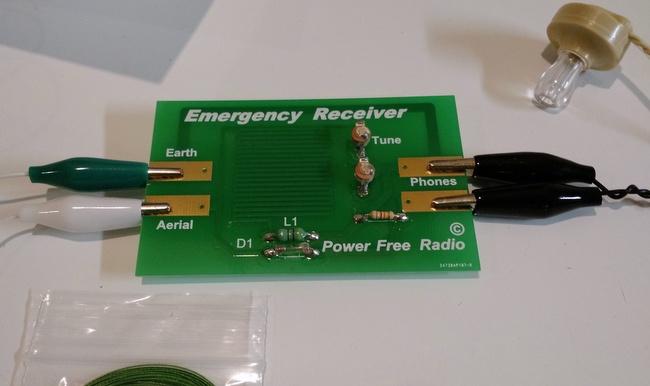
[A]t night with my younger brother we would listen to a “pirate radio station” on a boat that would put real good music on, crusing the international waters between England and France. He burst in laughter and told me: That’s Radio Caroline“. That was it. My brother and I would listen to that station nearly every night on an old “galena radio receiver” with a huge antenna hidden in the attic built with copper wire we stole at the mine. I mean we didn’t really steal it, it was everywhere. It was the wires used by miners to connect detonators to batteries when blowing new tunnels and locals were using it for all sorts of things, like holding parts in chicken coop to tie tomato or green bean plants to stakes and could be found everywhere.
Actually at first we set the antenna in our bedroom but somehow it wasn’t long enough not to mention mom who saw it and tore it down giving her an other excuse to punish us. So we decide it to place it in the attic where no one ever went.
The most difficult part was going to the attic, there wasn’t any stairs. We had to bring a ladder to the trap leading to it. Mom was watching us like a hawk, looking for any excuses to punish us.[…]
We’ve already received some excellent, creative entries in the Virtual Radio Challenge III: your opportunity to piece together the best radio for thru-hiking the Appalachian Trail.
Rememer: this year, if your entry is picked by our judge (Dennis Blanchard, K1YPP), you will win a new CountyComm GP5/SSB portable radio courtesy of Universal Radio!
While I love Dieter Rams’ designs, and no doubt this is a very rare piece in “almost perfect shape,” it is certainly well-beyond my budget at $11,000 US plus $600 shipping.
Admittedly, though, if I were building a modern house and wanted a feature piece of functional artwork, the Braun Wall Unit may very well fit the bill. Most of Rams’ designs certainly seem to hold or increase in value over time.
For now, I’ll just admire this design from a distance. Curious if it’ll fetch its BuyItNow price. Thanks again for sharing this one, David!
Many thanks to SWLing Post reader, “Mutezone,” who writes:
“I want to share a link to a video of Radio Serbia International’s English service recorded on the 4th of July 2015…
[…]I have been monitoring for RSI during the last week of July but got nothing. I have also been monitoring 6100 kHz after the July final date of transmission as according to RSI’s website, there are “Pirates stalking Serbian short wave” due to the termination of the station. However I have not received any odd transmissions on this frequency at the moment.”
Thanks for sharing this recording/video and, especially, for capturing RSI’s interval signal.
I was unable to hear RSI’s final broadcast on July 31, 2015.
Regarding the end of Radio Serbia International (or International Radio Serbia), the following final post was published on their website. I’ve included the full note, for archival purposes, in case the RSI website goes offline in the future:
The End of Radio Yugoslavia – International Radio Serbia
Thanks for sharing the recording and for including a few minutes of the RSI interval signal. RSI was always a difficult broadcaster for me to catch here in North America, though I heard them a number of times via the University Twente Web SDR.
Dear friends, Radio Yugoslavia – International Radio Serbia, ceases to exist on 31 July 2015. For you, our faithful listeners from all over the world, and also for us who have worked on this radio, the only consolation would be the fact that this only state short-wave station in Serbia, which has existed for 79 years, will be remembered as an efficient and reliable promoter of Serbia worldwide. No one has ever presented valid reasons why this media, of rich tradition, range and staff potentials, and with big plans until yesterday, should cease to exist. Unfortunately, the assessments not based on arguments were louder than serious analyses and recommendations of experts, professionals and numerous listeners that the world radio service is necessary for Serbia, that it presents the country worldwide in the best manner possible and that no serious state will renounce such an effective diplomacy.
Our significance has been confirmed by the letters of thousands of listeners from all over the world. Some listened to us because of our information programmes, some because of economic topics, while many got to love our country, Serbia, because of its tradition, beautiful and interesting landmarks and the rich heritage they were acquainted with by listening to International Radio Serbia. Regardless of your affinities, you have all told us that you were listening to us because of our objectivity and the possibility of hearing us at any time and everywhere, for such is the power of short waves.
The Serbian government, however, believes that the closing down of Radio Yugoslavia – International Radio Serbia – is a justified move. Regardless of the fact that the state of Serbia is in an economic crisis, that each saved penny is precious, that many citizens have been rendered jobless, that new work positions should be opened, it has become unclear to the very end why the only state short-wave station has suddenly become too expensive after 80 years. We are, however, certain, that Serbian citizens, taxpayers, who have financed us for all these years, would have decided differently had they been asked to.
What remains, after all, is the pride we feel because of the history of our radio as well as the hope that the voice of Serbia will reach our listeners wherever they are.
Thank you, dear listeners from all over the world, for having trusted us all these years! Radio Yugoslavia – International Radio Serbia now greets you and signs off.
Tuning in: Making a small world bigger and the big one smaller
So much of happiness, I’ve realized, depends on getting tuned in. When he was a young married, my father used to tune in the console radio in the living room of the Krohe family mansion on Manor Avenue to the live broadcasts of big-band music “from the beautiful Blue Room in the Roosevelt Hotel” in downtown New Orleans. He was able to be in two places at once thanks to WWL-AM, whose 50,000-watt clear channel signal was beamed north. For all I know, while he tapped his toe on the sofa in Springfield, Inuit couples were jitterbugging on the tundra.
For Springfield teens in the 1950s and ’60s, getting a chance to listen to what kids in bigger cities had already decided they liked was important. WCVS-AM was just crawling out of its cocoon, having crawled into it as a country station and emerging as a rock station – although in the late ’50s there wasn’t that much difference. “Rock ’n’ roll” was, in stations like WVCS that catered to mostly white markets, rockabilly and pop-ish country ballads. (Geezers will recall when Brenda Lee was, briefly and laughably, marketed as a rock artist.)
For Top 40 music, as for so many other things, if you wanted to get the really good stuff you had to go to the big city. Around here that meant WLS-AM, WCFL-AM out of Chicago (whose Ron Britain made Soupy Sales look, or rather sound, like Noel Coward), and KXOK-AM out of St. Louis. George Lucas’s American Graffiti brilliantly captured the ways that car radios, transistors, radio stations blaring over PAs in drive-ins, permeated the bubble in which teenagers then lived.
Later I learned I could hear WBZ out of Boston if I acted as the antenna on my transistor. (“Turn on, tune in, drop out” to me meant losing the signal when I lighted a smoke.) WBZ was one of the first stations with the newest 45s from Britain, which allowed us yokels to hear The Yardbirds while the records were still on their way to Midwest stations by stagecoach from Boston harbor.
Many thanks to Jarkko Mäkivaara with Siru Innovations who writes with the following update:
We have added some new features to our SDR20 portable radio!
Please see the video [below] for a demonstration of the following features:
* Smooth zoom in FFT/waterfall view
* Adaptive menu
* Frequency memory with snapshot pictures of signals
* Sliding effect between views
* Keyboard beep
* FM broadcast receiver
* Example of Ham radio transceiver with Narrow-FM mode
You also might got the email sent out Today where this is in HTML format.
SWLing Post reader, Mark, recently contact me with the following question:
“What portable shortwave radios under $300 have an option to have their memories programmed using a computer?”
I replied to Mark that I can’t think of a single shortwave portable that can be programmed via computer–at least, not a “typical” portable radio like a Sony, Sangean, Tecsun, Degen, or Redsun.
The Yaesu VX-3R HT tuned to the AM broadcast band.
I may be wrong, however, so please comment if you can help Mark identify a model.
I am aware of portable wideband communications receivers/transceivers that cover the shortwave bands: handhelds like the Icom-IC-R6, Icom IC-R20, Yaesu VX-3R, AOR AR8200 Mark III B and Kenwood TH-F6A.
Wideband handhelds are more akin to a scanner, though, and typically shortwave sensitivity is simply not on par with a dedicated shortwave portable. The AOR AR8200 Mark III B ($700+) and discontinued Icom IC-R20 may be a couple of exceptions.
Please comment if you can help Mark with his quest.
Please support this website by adding us to your whitelist in your ad blocker. Ads are what helps us bring you premium content! Thank you!