This article originally appeared in the March 2014 issue of The Spectrum Monitor Magazine.
With spring around the corner, my thoughts drift toward the outdoors…and especially, toward travel. Those who know me know that I love travelling, anywhere and everywhere–and that I prefer to travel light, with only one bag. In fact, I can easily live for two weeks out of a convertible shoulderbag/backpack (the Timbuk2 Wingman ) that’s so compact, I can fit it under the the seat of even the smallest, most restrictive aircraft. I never have to check luggage unless the nature of my travel requires extra supplies (I run Ears To Our World, a non-profit that donates radios and other technologies to powerless regions in the developing world).

My Timbuk2 Small Wingman is very compact, yet holds everything I need for two weeks (or more!) of travel.
So, why not pack everything you could possibly ever want on a journey? While this remains an option, travelling light has many advantages over the take-it-all traveler’s method. First, it gives one incredible freedom, especially when travelling by air or train. I never have to worry about being among the first to be seated in an aircraft, nor do I worry about my luggage not making a connection when I do. Second, it’s kinder on the back and shoulders, and easier to maneuver wherever I go–no wheels required–whether in a busy first-world airport or bustling third-world street market. Third, I always have my most important gear right there with me. And finally (I must admit) I find light travel to be fun, an entertaining challenge; the looks on friends’ faces when they meet me at the airport to “help” with my luggage is, frankly, priceless. Seeing me hop off a flight with my small shoulder bag, friends ask in bewilderment, “Where’s your stuff?” It’s music to my ears.
You would think that having such self-imposed restrictions on travel–carrying a small, light bag–would make it nearly impossible to travel with radio. On the contrary! Radio is requisite, in my book–er, bag. I carry a surprising amount of gear in my small bag: once at an airport security checkpoint, an inspector commented, “It’s like you have the contents of a Radio Shack in here–!” But more significantly, each piece–and radio–is carefully selected to give me the best performance, durability, versatility, and reliability.
So what do I look for in a travel radio? Let’s take a closer look.
Travel Radio Features
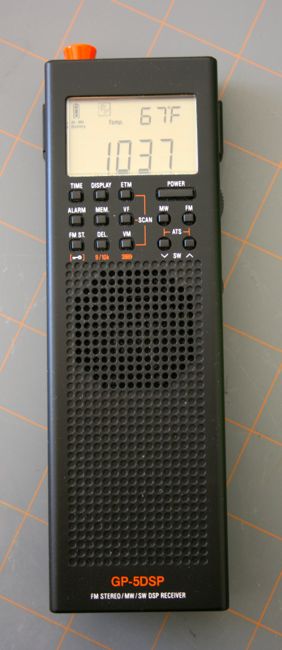
The CountyComm GP5DSP has three different ways of auto tuning stations quickly, an alarm function and the display will even indicate the current temperature. Its unique vertical, thin body might be easier to pack at times, depending on your travel gear.
In a travel shortwave radio, I search for features I wouldn’t necessarily pick for home use, where I’m mainly concerned with raw performance. I don’t want to carry an expensive receiver while traveling, either: $100.00 US is usually my maximum. This way, if I accidently break the radio (or my gear gets stolen), I won’t feel like I’m out very much money. I also prioritize features that benefit a traveler, of course; here are some that I look for:
- Small size: Naturally, it’s sensible to look for a travel radio that’s small for its receiver class for ease in packing.
- Overall sturdy chassis: Any travel radio should have a sturdy body case that can withstand the rigors of travel.
- Built-in Alarm/Sleep Timer functions: While my iPhone works as an alarm, I hate to miss an early flight or connection, so it’s extra security when I can set a back-up alarm.
- Powered by AA batteries: While the newer lithium ion battery packs are fairly efficient, I still prefer the AA battery standard, which allows me to obtain batteries as needed in most settings; a fresh set of alkaline (or freshly-charged) batteries will power most portables for hours on end.
- Standard USB charging cable: If I can charge batteries internally, a USB charging cable can simply plug into my smart phone’s USB power adapter or the USB port on my laptop; no extra “wall wart” equals less weight and less annoyance.
- ETM: Many new digital portables have an ETM function which allow auto-scanning of a radio band (AM/FM/SW), saving what it finds in temporary memory locations–a great way to get a quick overview of stations. (As this function typically takes several minutes to complete on shortwave, I usually set it before unpacking or taking a shower. When I return to my radio, it’s ready to browse.)
- Single-Side Band: While I rarely listen to SSB broadcasts when traveling, I still like to pack an SSB-capable receiver when travelling for an extended time.
- RDS: Though an RDS (Radio Data System) is FM-only, it’s a great feature for identifying station call signs and genre (i.e., public radio, rock, pop, country, jazz, classical, etc.)
- External antenna jack: I like to carry a reel-type or clip-on wire external antenna if I plan to spend serious time SWLing. Having a built-in external jack means that the connection is easy, no need to bother with wire and an alligator clip to the telescoping whip.
- Tuning wheel/knob: Since I spend a lot of time band-scanning while travelling, I prefer a tactile wheel or knob for tuning my travel radio.
- Key lock: Most radios have a key lock to prevent accidentally turning a radio on in transit–but with a travel radio, it’s especially important to have a key lock that can’t be accidentally disengaged.
- LED flashlight: Few radios have this, but it’s handy to have when travelling.
- Temperature display: Many DSP-based radios have a built-in thermometer and temperature display; I like this when I travel anytime, but especially when I’m camping.
While I don’t have a portable that meets 100% of the above travel radio wish-list, I do have several that score very highly. I also rank my travel radios by size, as sometimes limited space will force me to select a smaller radio.
Here are a few of the radios I’ve used and/or evaluated for travel–I’ll break them down by size. Note that all portable radios have alarm/timer functions, unless noted otherwise.
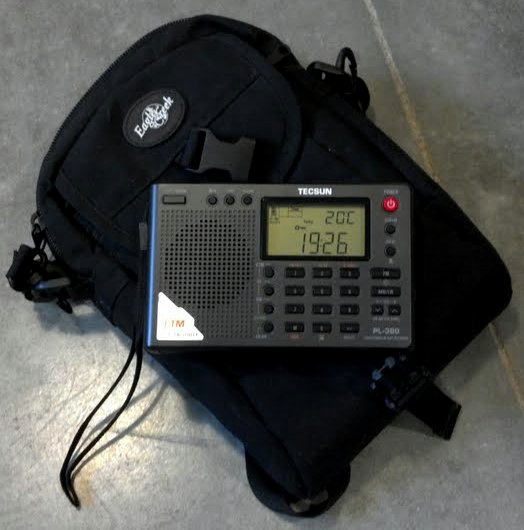
I often grab the Tecsun PL-380 for travel. It’s an ultra-portable that truly performs and even has a selection of six AM bandwidths.
Ultra-portable:
- Tecsun PL-380 • Pros: Adjustable bandwidth, great sensitivity/selectivity; • Cons: No SSB (check out this review)
- Tecsun PL-310ET • Pros: Similar to PL-380, side mounted tuning knob; • Cons: No SSB
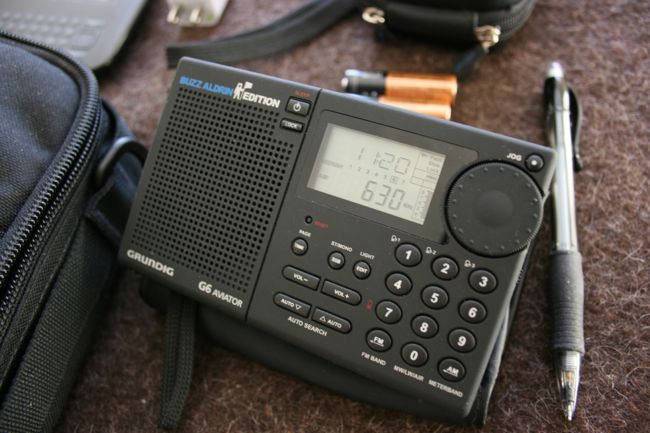
- Grundig G6 • Pros: SSB, full-featured, tuning wheel; • Cons: No longer on the market, although some used models are available (check out our review)
- Degen DE1102/Kaito KA1102 • Pros: SSB; good sensitivity• Cons: No tuning knob, poor ergonomics
- Grundig G8 Traveller II • Pros: Sensitive for price class; • Cons: No SSB, no longer produced, but has been replaced by the Eton Traveller III (which features RDS)
- C. Crane CCRadio SWP • Pros: Great sensitivity, very compact; • Cons: No SSB
- CountyComm GP-5 DSP • Pros: ETM and other scan functions; • Cons: No SSB, separate medium wave (AM) antenna
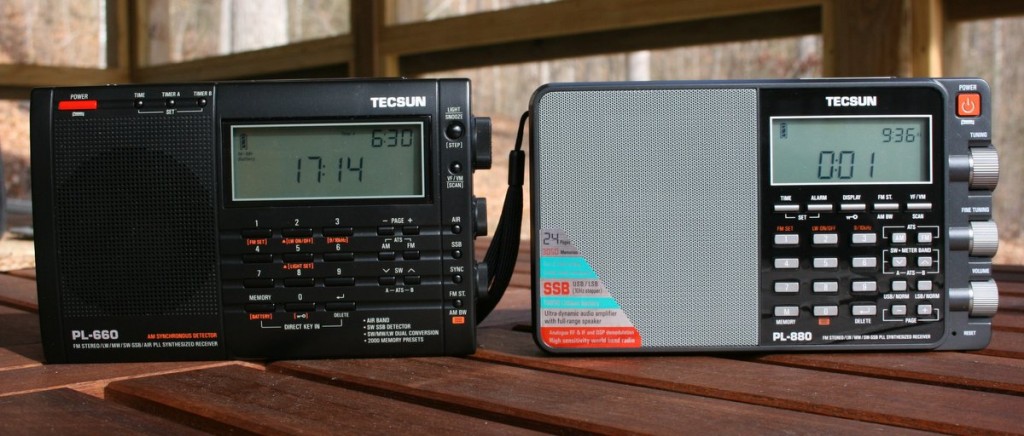
Full-Featured Portable:
I have also been known to travel with an SDR (software defined radio), especially if travelling to an RF-quiet location where I could make spectrum recordings. While SDRs all require a computer (laptop) to operate, those best suited for travel derive their power from the same USB cable plugged into the PC. Neither of the SDR models below require a power source other than what’s provided by their USB cable.
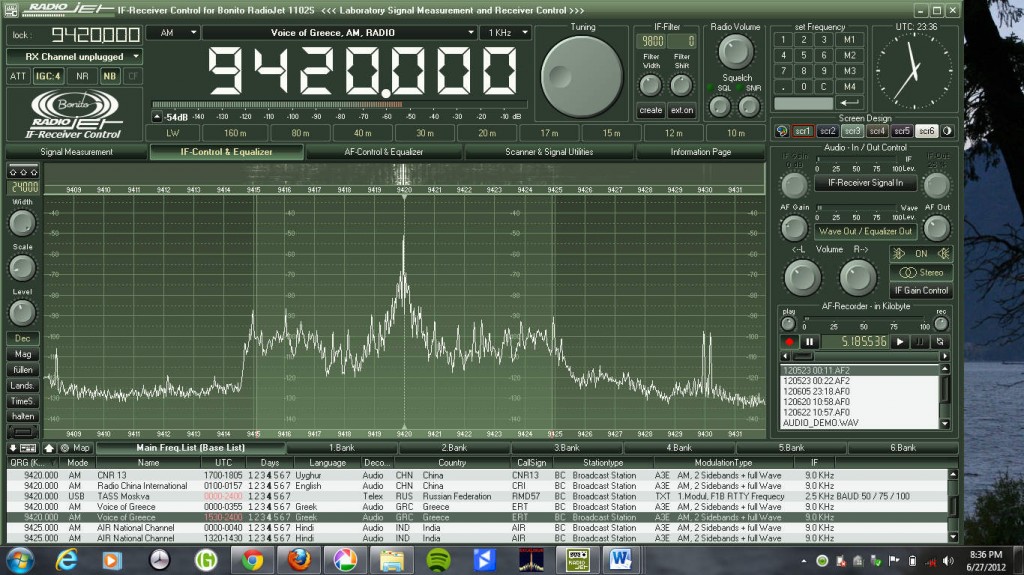
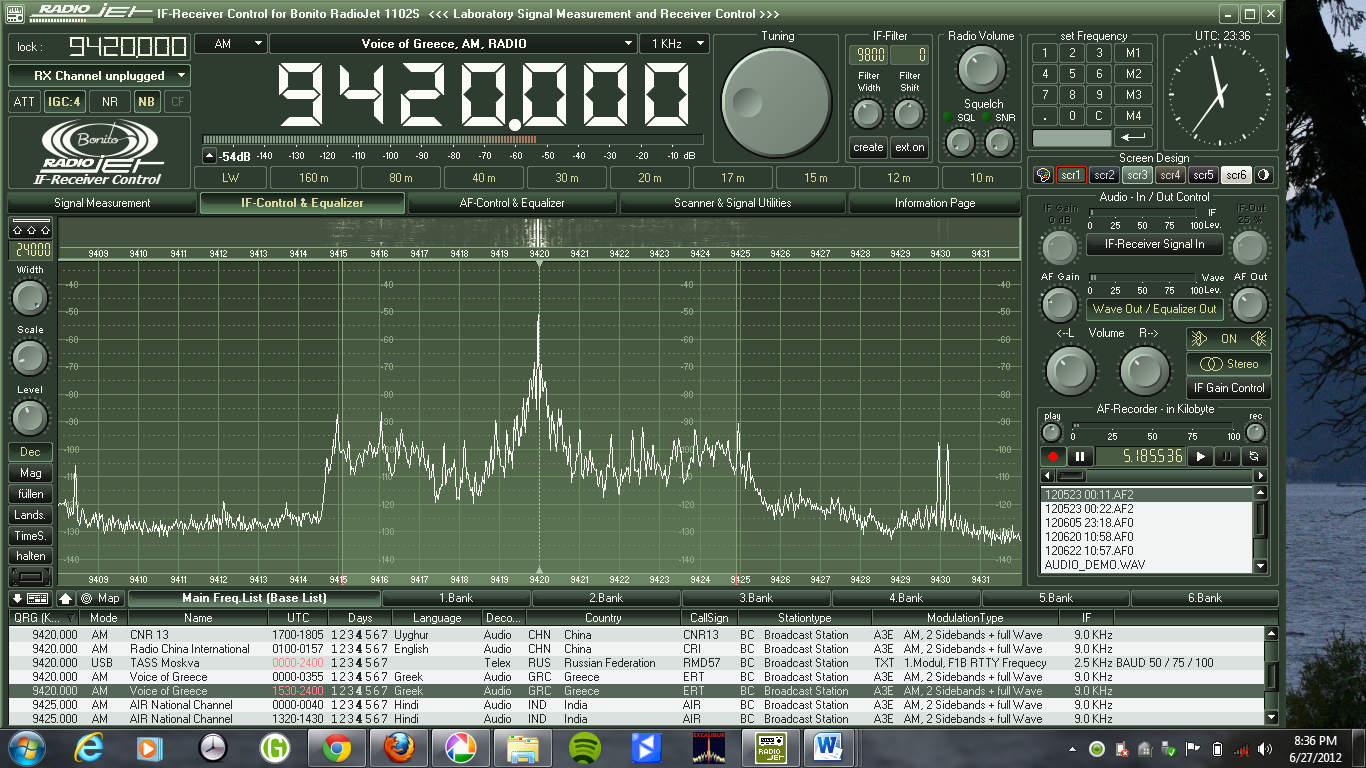
The RadioJet is an excellent travel radio: it’s an excellent performer, über-rugged and is powered by one USB cable.
“Black box” radios (SDRs & PC-controlled radios):
- RFSpace SDR-IQ • Pros: Small size, works on multiple operating systems (Windows, Mac, Linux) • Cons: front end can overload if close to strong signals
- Bonito RadioJet • Pros: Great performance, low noise floor, good audio, flexible graphic interface; • Cons: Windows only, limited bandwidth on IF recordings, no third-party applications (note that the RadioJet is technically an IF receiver). Check out our full review.
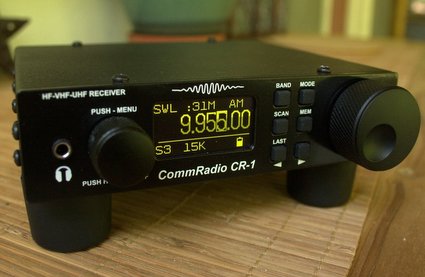
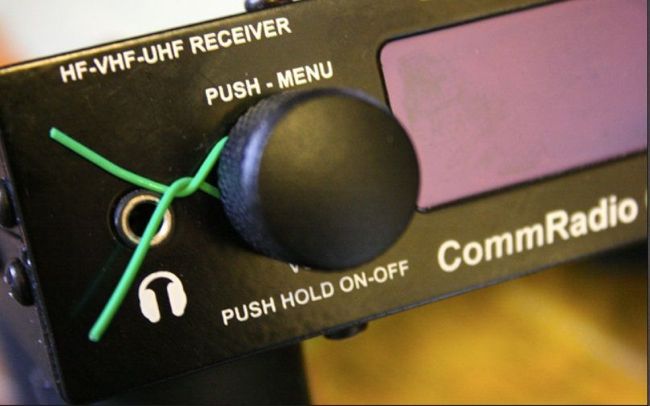
The CommRadio CR-1
Tabletop:
Seriously? A travel-ready, full-featured tabletop–? Until last year, I would have argued that it was impossible to travel lightly with a full-featured desktop radio in tow.
My view changed when I got my hands on the CommRadio CR-1 tabletop SDR. Indeed, other than it being pricey ($600, as compared with $100 portables) this rig is ideally suited to travel!
The CR-1 has an array of features–most everything you’d expect from a tabletop radio–and even covers some VHF/UHF frequencies. Its built-in rechargeable battery not only powers it for hours at a time, but meets the strict airline standards for battery safety. The CR-1 can also be powered and charged via a common USB cable. It’s also engineered to be tough and is almost identical in size to the Tecsun PL-880.
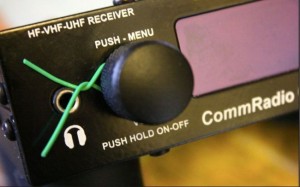 Though I’ve never needed to do so, you can even remove its resin feet to save still more space. Its only less than travel-friendly feature is the fact that it’s quite possible to accidently power up the CR-1 by bumping the volume button during travel–a problem easily remedied, however, by simply twisting an insulated wire around the stem of the volume knob (see photo).
The importance of a Go-Bag
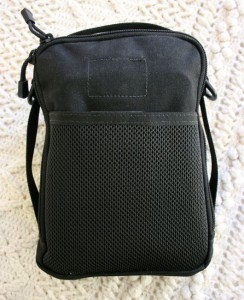
The Spec-Ops Pack-Rat
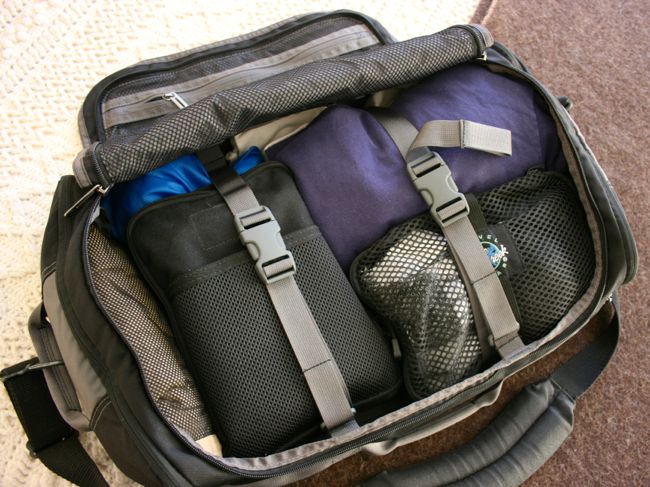
I keep a dedicated “go-bag” with radio and supplies–specifically, the Spec-Ops Brand Pack-Rat –packed and ready to travel, at the drop of a hat. Why? First of all, I know exactly what I’ll be taking, no need to ponder if I have everything.
Inside the bag, everything has its place: my portable SW radio, my Android tablet, my D-Star Icon ID-51a HT, DVAP (DV Access Point Dongle), my Zoom H2n Handy Recorder , earphones, charging cables, batteries, small notebook, clip-on wire antenna, etc.
If something’s missing, there’s an obvious blank spot in my bag. I also know exactly where and how it fits into my carry-on bag, so if it’s missing, it’s conspicuously missing. Since I’ve been using this go-bag, I’ve never left anything from my pack behind. Incidentally, this is how I pack the rest of my bag, as well: everything has its place, and any gap will draw my attention to exactly what’s missing.
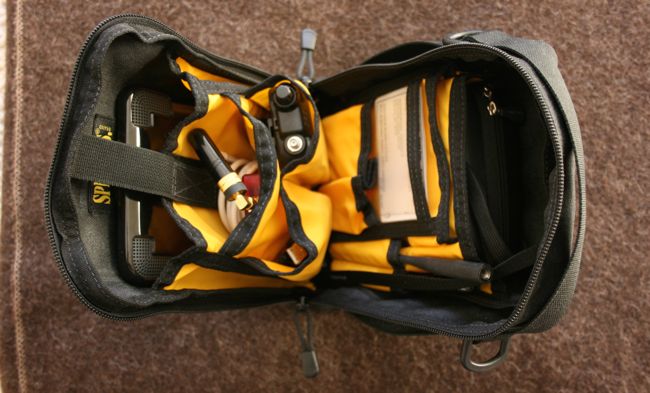
There’s another benefit to having a dedicated go-bag: when flying, before I place my carry-on under the seat in front of me or in an overhead compartment, I can pull the go-bag out of my carry-on and have my Android tablet close at hand with other electronics. As an added bonus, when going through airport security, all of my electronics can be easily removed from my flight bag by taking out just this kit.
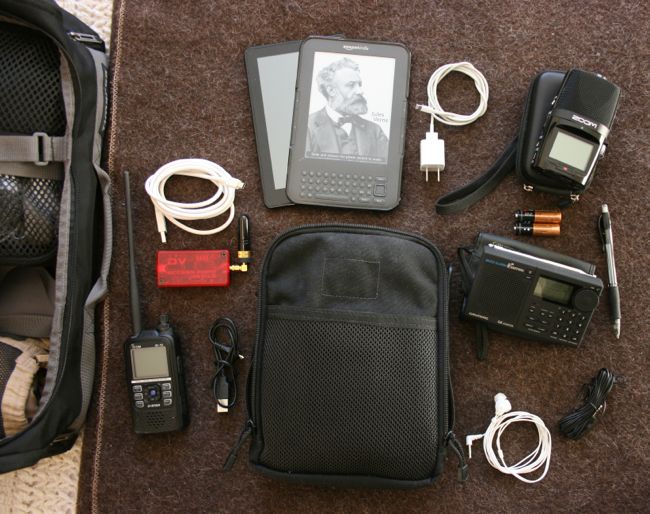
I’ve had many versions of the Go-Bag over the years, and they’ve all done a great job. What I love about the Spec-Ops Brand Pack-Rat, though, is the fact that it’s military grade–very durable–opens with all of the main storage pockets on the inside, has a bright yellow interior which makes it easy to see the contents (even in the dimness of a night flight), and it’s just the right size to hold my usual travel gear. The Spec-Ops Brand Pack-Rat also carries a lifetime, no-matter-what, guarantee.
There are thousands of similar packs on the market, and you may already have one, but you should look for something with multiple storage pockets. Small packs I’ve used in the past that only had one or two main compartments made it easy to leave something out when packing.
Radio travels
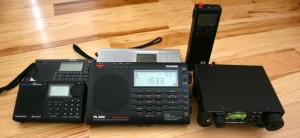
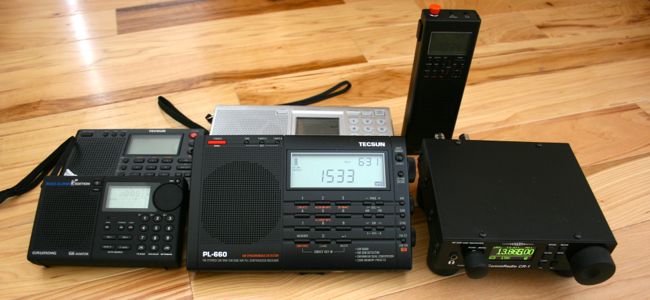
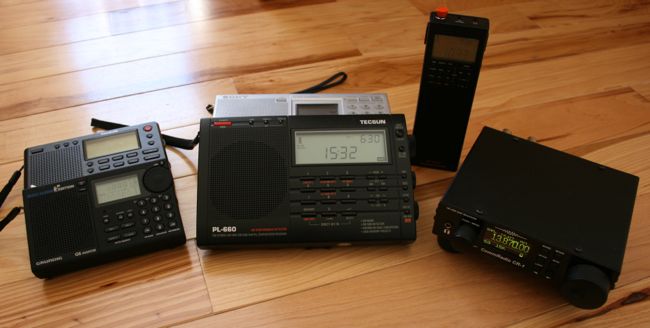
The travel radios I reach for most often. Top Row (L to R, Top to Bottom) Tecsun PL-380, Sony 7600GR, CommRadio GP-5DSP, Grundig G6, Tecsun PL-660, and the CommRadio CR-1 (Click to enlarge)
When I spent a year in France during my undergraduate studies in the early 1990s, shortwave radio was my link with home. I would listen to the VOA–the only source of English I permitted myself to hear–like clockwork, each week. Today, although I travel with a smartphone which can tune in thousands of stations, I always choose to listen to radio. Besides, if the Internet goes down or if–heaven forbid!–your trip takes you into a natural disaster, it’s radio that you will turn to to stay safe and informed.
If you take anything away from this reading, I hope it’s that even when you’re presented with travel restrictions, you won’t hesitate to take your hobby, in the form of a portable radio and a few accessories along. It contributes measurably to the fun of travel, as I’ve discovered when I’m able to tune in local and international stations so different from those I hear at home. Or sometimes, it’s just the opposite–it’s the chance to pick up a favorite broadcaster or program while you’re on the road.
After all, for me and other travelers like me, the world’s familiar voice is radio.


 Last week, I received an email from STF Radio International, a new venture that broadcasts digital modes over shortwave (similar to VOA Radiograms). I asked for a description of their mission–here’s their reply: