VOA Radiogram this weekend includes Greek and images in MFSK64 and 128

VOARadioGram(Source: VOA Radiogram)

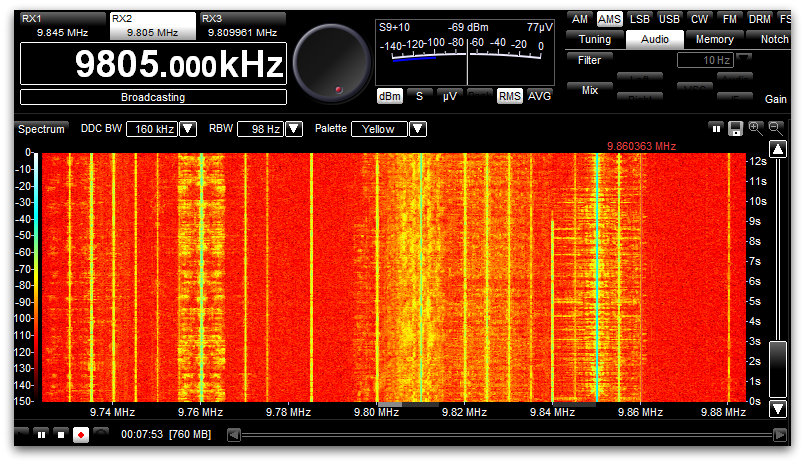
VOA Radiogram for the weekend of 21-22 September 2013 is produced using Fldigi3.21.76AB. For best results, use this version, available from www.w1hkj.com/alpha/fldigi/v3.21/

One improvement in 3.21.76AB is that it can send images in MFSK64 and MFSK128. Previously, MFSK32 was the fastest MFSK mode for sending images without the pictures appearing skewed (off center). Images do not transmit more quickly in MFSK64 and MFSK128, but they do have higher resolution.

If your decoded MFSK64 and MFSK128 images are still slanted or skewed, calibration of the receive codec might be helpful. One such method for doing this is described here: www.w1hkj.com/FldigiHelp-3.21/DigiWWV.html.

Our non-Latin alphabet of the week is Greek. You will need the UTF-8 character set for the Greek and for some of the punctuation in the English items. I forgot to change some of the typographic apostrophes ’ to typewriter apostrophes ’ , so they will not display correctly if you do not have the UTF-8 character set. In Fldigi, that adjustment is made in Configure > Colors & Fonts.

This weekend’s program includes an English VOA News item in Flmsg format. When all the text is received, the story will render, or pop up, as a new web page on your browser, suitable for saving or forwarding. To make Flmsg work with Fldigi (both can be downloaded from w1hkj.com), in Fldigi: Configure > Misc > NBEMS — Under Reception of flmsg files, check both boxes, and under that indicate where your Flmsg.exe file is located.

Much of the show this weekend is in the MFSK64 mode, which might be a bit optimistic if reception conditions are less than ideal.

Here is the lineup of modes for VOA Radiogram, 21-22 September 2013:

2:53 MFSK16: Program preview
2:40 MFSK32: Sample of Greek text
:49 MFSK32 image: VOA Greek Service logo
3:01 MFSK32: “Need to Protect the Internet”
1:45 MFSK64: Radio Free Sarawak/Discovery Channel
2:23 MFSK64 image: “Duck Commander”
:27 MFSK128: CNBC Saracens deal
:48 MFSK128 image: CNBC logo
:45 MFSK32: E-mail address
4:40 MFSK64: BBC Worldwide, Giglio TV, Voice of Greece, All India Radio
2:55 MFSK64/Flmsg: VOA News re Voyager Golden Record
2:17 MFSK32 image: Voyager Golden Record
:33 MFSK32: Closing announcements

VOA Radiogram transmission schedule
(all days and times UTC)
Sat 1600-1630 17860 kHz
Sun 0230-0300 5745 kHz
Sun 1300-1330 6095 kHz
Sun 1930-2000 15670 kHz
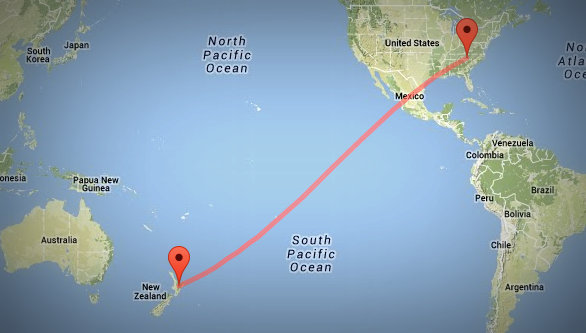
All via the Edward R. Murrow transmitting station in North Carolina.

Please send reception reports to [email protected]

Shortwave radio: the secret item found in many North Korean homes

de321dialI’m not surprised to find that North Korean families hide shortwave radios. After all, if it’s well hidden, and listened to privately, there is no way the government can monitor what is heard on shortwave, nor trace it back to the family listening. This is what separates radio from the Internet and mobile devices:

(Source: New Focus International)

Many North Korean families keep a secret item at home, whose discovery may lead to harsh punishment. Away from prying eyes and in the privacy of their homes, North Koreans enjoy using items forbidden by the state, according to North Koreans who have recently escaped from the country.

“In every North Korean home, there is at least one secret item” says Jung Young-chul* (age 34), who left Korea in 2012. He had a short-wave radio in the house and the family would secretly listen to South Korean broadcasts. To avoid being caught, they kept the radio hidden under a container for keeping rice.

They were not the only ones with a hidden radio. Jung explains, “Once, a friend described a story that I had heard the night before while listening to a South Korean broadcast. I brought it up with him one night in drink, and he confided that his family too had a radio. We laughed about it together.”

[Continue reading]

If you want to hear North Korean propaganda on shortwave radio (via the Voice of Korea), check here for the latest schedule or even listen to this recent recording.

This post tagged in the category: Why shortwave radio?

Phil identifies mystery radio as the Digitech Audio AR1945

The Digitech AR1945 portable radio

The Digitech AR1945 portable radio (Click to enlarge)

SWLing Post reader, Phil, noticed the unidentified radio from this post as the Digitech Audio AR1945.

He comments:

This radio has been released in Australia via the Jaycar Electronics Stores as the Digitech Audio AR 1945. It has all the hallmarks of Redsun radios.

I bought one and overall the performance is very good on MW and SW, FM is ok and AIR band isn’t too bad. The big drawback is the SSB. It is dreadful, by far the worst SSB demodulation I have ever come across in a radio. This needs to be addressed and once done so, will be a good receiver.

Pity it doesn’t have Synchronous detection as, if you look at the display carefully, provision has been made for this feature. I wonder how it can be activated? I would appreciate any comments on a fix for the SSB

Phil, thanks so much for the mini review. Here’s a link to the AR1945 on Jaycar’s website: http://www.jaycar.com.au/productView.asp?ID=AR1945

Has anyone found a mod to activate a potentially dormant sync detector or to improve SSB demodulation? Please comment.

I’ve posted various views of the Digitech AR1945 below, along with this full description from Jaycar’s website:

The Digitech AR1945 portable radio“Ideal for a novice ham radio licensor, keen fisherman or even just the outdoors type, this radio has everything you will ever need in a radio with the added function of single-sideband modulation (SSB). SSB is used to obtain current weather reports, so it is perfect to take to sea to avoid changing weather conditions. However with great FM and AM coverage and battery operation it is also perfect for camping, BBQs and thanks to its world/local time selection clock and alarm, it can even be used as an alarm clock! Additional features include auto tuning saving, 500 memories and keypad direct entry. This is certainly a radio of many uses! Power options are 6 x AA (not included) used with supplied 6 x D size battery adaptors, 6 x D batteries (not included) or the supplied 9V PSU. Supplied with a carry strap.”

AR1945side• FM: 87.5-108.0MHz
• MW(AM): 522-1620kHz (9kHz); 530-1710kHz (10kHz)
• AIR: 118-137MHz
• SW: 1,711-29,999kHz
• LW: 144-450 kHz

Features:
• Large back lit LCD 
• RF gain control 
• Bass & treble controls
• Key lock
• IF output 
• Line in and out 
• Earphone socket
AR1945back• Speaker 5W/4 ohms
• Local/DX antenna switch
• External antenna connection 
• Internal full range speaker 
• Mains or battery operated 
• Dimensions: 310(W) x 195(H) x 100(D)mm


Of course, this radio is most likely available in other parts of the world under different brand names. Let us know if you’ve seen it.

Dave Porter’s video tour of the BBC Woofferton transmitting site

Check out this brilliant video tour of the BBC Woofferton Transmitting Station, presented by Senior Transmitter Engineer Dave Porter (G40YX). The video is divided in seven parts, thus I’ve created a playlist that will automatically load each video in order.

Click here to start the playlist on YouTube, or simply watch the tour through the embedded video player below. Enjoy:

Many thanks to Dave Porter for hosting this video tour and to Mike Barraclough for the tip!

If you would like to read a detailed history of Woofferton, be sure to check out our post:
Shortwave Radio History: 50 years of transmitting at BBC Woofferton

DRM Test Transmission from PCJ International

drmlogoOn October 13, 2013 PCJ Radio International will conduct a two hour DRM test transmission.

Date: October 13, 2013

Time: 10:30 to 12:30 UTC

Frequency: 15,645 khz

Beam: South East & East Asia

Send your reception reports for this transmission to [email protected]

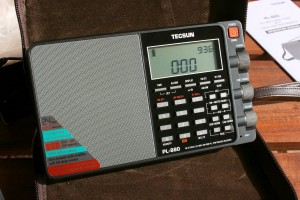
Grundig G3 discontinued, Tecsun PL-880 on the way

The Grundig G3 shortwave radio.

The Grundig G3 shortwave radio.

Not really a surprise, but I’ve confirmed that the Grundig G3 has been discontinued. They are still available, for the moment, from Universal Radio and online sources like Amazon.com. I would not advise buying from Amazon as I’ve received numerous complaints that they’ve shipped faulty units. Universal Radio, on the other hand, is testing each an every G3 leaving their shop.

With the exit of the G3, this leaves Grundig with the following selection of shortwave portables:

TecsunPL-880Box

Tecsun PL-880

Tecsun, meanwhile, is adding to their extensive line of shortwave portables. Indeed, this morning, W4ASZ comments:

“I found this link courtesy of the manly men at Herculodge :

http://tecsunradio.com/2013/09/14/new-arrival-tecsun-pl880-fm-radio-dsp-stereo-speaker-coming-soon/9030

Looking pretty good !”

I agree and I do feel cautiously optimistic about the Tecsun PL-880. Could it be my new travel radio? Though I still happily travel with the Grundig G3, Sony ICF-SW7600GR and Tecsun PL-380, a guy can’t have too many radios to choose from!

I’ll plan to review the PL-880 once it’s available. I’m particularly interested in seeing how it stacks up against the venerable Tecsun PL-660.

Stay tuned!

The Voice of Greece Avlis shortwave transmitter site may be scrapped

GREECE-ECONOMY-MEDIAAccording to TheGreekRadio.com, 39 shortwave antennas located at the Voice of Greece Avlis transmitter site may soon be sold as scrap metal. It seems this information is based on a statement by ERT employees from Monday (September 16, 2013):

“in the shortwave broadcasting center of Avlis, a representative of a company that sells metal showed up and started taking photos of the site. After we, ERT people, asked him, we got informed that he had been mandated by the Ministry of Finance to give an offer for the dismantling of 39 masts and purchasing the metal as scrap.”

[…]The name of [the] company and the registration plate of the car are available. The union body of ERT notes that this is an area of 1160 acres, featuring 39 metal masts, with a height between 30 and 70 meters each, that function as the shortwave aerials that transmit the “Voice of Greece”, the ERA-pénte, across the world.

“Greek shortwave started operating in 1938 and later was also used sent information to the Greek soldiers fighting Fascists in Albania. The only ones who dared to turn it off were the Nazis during the occupation. Since the liberation, it never stopped to link the country with Greek seafarers and the Diaspora. The Voice of Greece broadcasts information, entertainment, culture and tradition from Greece with programs in 12 languages, all over the globe”.

You can read the full article by clicking here. Many thanks to Andrea Borgnino for the tip.

I’ve predicted that the Voice of Greece may not be on the air even by the end of 2013.  I certainly hope I’m wrong, but I simply can’t imagine there will be enough money in the reincarnated ERT budget to pay for the Voice of Greece Avlis shortwave transmitter site.

Follow the tag “ERT Cuts” for the latest developments.