Smith-Mundt is a tough Act to follow

May, June and July have been very busy months for me (hence the lack of daily updates).
In May, I attended and presented at the North American Shortwave Broadcasters annual meeting in Washington DC, then spent nearly a week in Ohio at the Dayton Hamvention–June and July have been filled with sporadic travel.

During my travels in May, controversy swirled around the Smith-Mundt Modernization Act and its impact upon radio broadcasting since it passed mark-up as an amendment to the House version of the National Defense Authorization Act on May 18. The bill is now before the US Senate.

What is the Smith-Mundt act? Per Wikipedia:

The US Information and Educational Exchange Act of 1948 (Public Law 80-402), popularly referred to as the Smith–Mundt Act, specifies the terms in which the United States government can engage global audiences, also known as public diplomacy.

The act was first introduced as the Bloom Bill in December 1945 in the 79th Congress and subsequently passed by the 80th Congress and signed into law by President Harry S. Truman on January 27, 1948.[…]

There are three key restrictions on the U.S. State Department in the Smith–Mundt Act.

The first and most well-known restriction was originally a prohibition on domestic dissemination of materials intended for foreign audiences by the State Department. The original intent was the Congress, the media and academia would be the filter to bring inside what the State Department said overseas […]

The second and third provisions were of greater interest to the Congress as they answered critical concerns about a deep-pocket government engaging domestic audiences. Added to the Bloom Bill, the predecessor to the Smith-Mundt Bill in June 1946 by Representative John M. Vorys (R-OH) “to remove the stigma of propaganda” and address the principle objections to the information activities the Congress intended to authorize.

The Smith-Mundt Act is the very reason why so few US Citizens have ever heard of the international radio broadcaster Voice of America (VOA):  the law forbids them from “targeting” an American audience. In their current state, the VOA and many other BBG international broadcasting entities are not likely to be a source of the type of propaganda many fear could be unleashed with the lifting of the Smith-Mundt Act.  Speaking as one familiar with the VOA’s broadcasts–I know many who work at the VOA, I’ve listened to their broadcasts for decades and I actively read their online content–I can comfortably state that VOA produces quality journalism and certainly provides another credible voice in the cloud of international broadcasters on the air or online. Their journalists have a mandate to report the truth, even when they find it necessary to be critical of the US government.

Don’t be mislead, however; VOA is a diplomatic arm of the United States, and as such would fit the broadest definition of what might be considered propaganda. In other words, VOA represents an American viewpoint on the news. Indeed, I consider (and it’s only fair to acknowledge) that every radio or television broadcaster’s voice exhibits some bias, even if the broadcaster makes claims of “fair and balanced reporting” or says they are “reporting the truth.”  There is always a leaning, however modest.  Even at the tender age of eight, listening to my Zenith Transoceanic in my bedroom, I recognized this.

So why all of the fuss about the Smith-Mundt Act?  Even as a child, I remember finding it quite easy to tune in the Voice of America. The magic of shortwave radio almost by default means that there are no borders that can control how shortwave distributes content. It’s even more absurd to think of enforcing these restrictions now in the internet age–indeed, by clicking this link, you can freely go to the VOA website to read, watch or listen to thousands upon thousands of hours of content.

So, in reality, VOA has never been prevented from delivering its content to the US.  It’s just not well-known in our country.

But this is the state of things today:  If the Smith-Mundt Act were lifted, the US State Department could, if they choose, funnel resources into effectively targeting US audiences. In the US, you could see VOA ads on Facebook, hear ads on the radio, a VOA TV channel could be launched–FM relay stations could be established in, say, Nebraska.

Does that sound strange? Keep in mind that in the UK (and in many other countries) there has never been this division between government-funded international and domestic broadcasting. The BBC broadcasts to both a domestic audience and an international audience via the BBC World Service. They routinely recycle content between the two.

The Smith-Mundt Act has both critics and supporters on both the left and right of the aisle. The think tank, The Heritage Foundation, recently held a panel discussion with a slant towards lifting the Smith-Mundt Act. They stated:

Critics […] have charged that modernizing the Smith-Mundt Act will lift the floodgates for U.S. government propaganda aimed at U.S. citizens. Not so. Rather, the amended act will force greater government transparency and accountability and it will allow Americans insights into what Washington is communicating to audiences around the world.

Yet, many of my friends who work within the VOA see the lifting of Smith-Mundt as a means to target various diasporas within the US. Perhaps, for example, via local FM relay, VOA could broadcast in Swahili to communities the US with large populations of recent immigrants who could benefit from this news source.

The watchdog organization BBG Watch, on the other hand, describes their concerns about lifting Smith-Mundt:

While BBG Watch supports placing all Broadcasting Board of Governors (BBG) international broadcasts and other programs in the public domain for anyone to use free of charge, some of us are concerned that the proposed Smith-Mundt Modernization Act of 2012 is so broadly written that it gives BBG and other US government officials unrestricted power to target American citizens with government information marketing. We would support the modification of the Smith-Mundt Act if it included clear and strict rules and a prohibition on active direct marketing of BBG programs to US citizens and US broadcasters. There is a real fear that BBG officials would take advantage of the new law, if it passes, to move resources from international to domestic information activities.

Herein lies my fear regarding this restructuring–that the State Department could tap into the already limited resources allotted for international broadcasting via shortwave radio, in order to shift attention to a domestic audience (who already, in truth, has full access to all of the US international broadcasting entities via the world wide web).   Yet the international broadcasting need is much greater than our own–many who receive these broadcasts–in rural Africa, for example–have little else to rely upon for their understanding of the United States and their perspective on the world.  It could harm starve the United States’ relationship with people in these regions, in essence lopping off one of our valuable diplomatic arms.

A balanced approach

The best way to be informed about the progress of the act is to follow Kim Andrew Elliott’s blog on international broadcasting and diplomacy.  He does an amazing job of picking out news items relevant to the act and posting them along with his comments.  Indeed, when I last asked him about the Smith-Mundt act several weeks ago, he suggested checking out this post: http://kimelli.nfshost.com/index.php?id=13356

Within that post, there is a link to a previous post, in which he state why the domestic dissemination ban is now enforceable rather than outmoded by the internet. Dr. Elliott also commented:

Sen. Gillibrand removed the Thornberry-Smith language from the Senate version of the DAA.  Thornberry-Smith could possible return in the conference process, or perhaps even from the floor, but I wouldn’t bet on it.

In future attempts to relax the domestic dissemination ban, the BBG should not be involved. It should remain neutral. The stakeholders in the US should initiate any such legislation. Such stakeholders would include….

1) US ethnic media, who could use news about the countries of interest, in the languages of their audiences.  At no extra cost to the taxpayers, USIB could provide a valuable public service.

2) Americans who are interested in what in contained in US international broadcasting and public diplomacy

3) US domestic media who could barter their content on US domestic affairs for USIB content on world affairs.  This win-win would bring USIB content to US audiences, hence a need to relax the ban.

Note that the UK never had any qualms about domestic distribution of BBCWS.  It was available only in the overnight hours, on BBC R4, because it was assumed the content was not of sufficient interest to sustain a domestic service.  Now it’s available 24/7 via digital BBC radio bouquets in the UK and, of course, via internet.  BBC even proudly proclaims the domestic RAJAR ratings for BBCWS.

A tough act to follow…

So, is lifting or modifying the Smith-Mundt Act wise?  Only time can tell.  One thing is certain: careful consideration of all eventualities must be taken into account before action is taken, and envisioning all potential outcomes could truly prove tough.

For more on the Smith-Mundt act and hundreds of other news items that have an impact on international broadcasting and diplomacy, subscribe to Kim Andrew Elliott’s news feed.
John’s letter to RNW

John Figliozzi, noted author of the Worldwide Listening Guide, wrote the following letter to Radio Netherlands Worldwide regarding their farewell broadcast. I thought it was worth sharing with SWLing Post readers:

(Source: John Figliozzi)

RNW Farewell

It was a classy, inspired, quintessentially RNW move to open a shortwave frequency for North America for one last evening. I shut off the internet radio, set up the Eton E1 in the veranda (it’s summer here) and luxuriated in a strong, clear RNW signal from Bonaire on 6165 kHz., just like the “old days”. I enjoyed the experience so much, that I listened to the very same program three times as your target shifted hours from east to central to western North America. I recall when, after the “Save BBC World Service” effort failed to alter the BBC’s decision to shut down shortwave to North America, RNW stepped in immediately using the abandoned BBC frequencues to provide us solace and sustenance. That, too, was quintessentially RNW. There have been many such “losses” for we listeners to absorb over the last decade, but for me this one hurts the most. Thank you to all, past and present, at RNW for all you have done to make radio that truly mattered for so many years. Rest assured,!

I will be a frequent and consistent visitor to your archive so I might relive often the “golden age of radio” that RNW created and maintained for decades. Thank you and godspeed to all of you.

John Figliozzi
Halfmoon, NY

Radio Netherlands says farewell in style

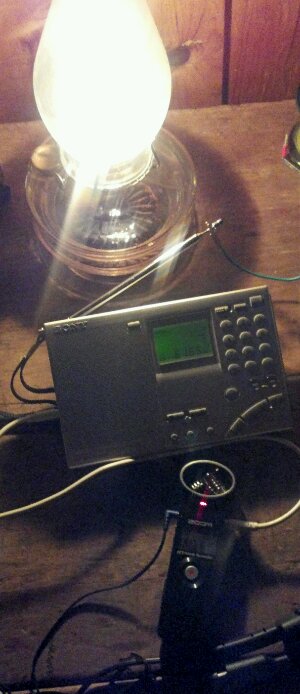
Thursday night, by the light of an oil lamp, I tuned my trusty Sony portable shortwave to 6,165 kHz. At 2:00 UTC, I was rewarded with a rich, full signal from Radio Netherlands Worldwide’s transmission site in Bonaire. Here in this off-grid cabin, on sixty rural acres, I bask in the freedom from electrical noise that might otherwise interfere with my shortwave radio listening—at least in this respect, this is the perfect DXpedition cabin.

The signal coming out of Bonaire, however, would have overcome any interference: Radio Netherlands, my dear friend of some 32 years, had opened a special frequency for those of us in eastern North America…in order to say their good-byes to the airwaves.

I can only describe the experience of listening as radio bliss…pure radio bliss…marred only by the bittersweet realization that these were RNW’s final days on the air. The experience harkened back to the day when the big broadcasters had booming signals directed toward us.

But, alas. All too brief.

The broadcast was simply entitled Farewell and Thank You. You can hear it just as I heard it—through my recording–here (actual broadcast starts at 1:15):

Then, all day Friday, for nearly 24 hours straight, RNW bid good-bye and farewell to various parts of the world via shortwave, satellite and the internet. I was lucky enough to catch two more broadcasts.

This time of day (19:00 UTC), however, I needed bigger ears than the Sony could provide. I was listening to broadcasts targeting west and east Africa, not North America. Having already charged my laptop battery, I plugged in the Bonito Radiojet (an SDR that I’m currently reviewing) and, just before 1900 UTC, directed her towards 17,605 kHz. Though my Sony found the signal barely audible, the RadioJet produced beautiful fidelity.

This RNW broadcast, entitled The First 50 Years, took listeners through the highlights and history of the Dutch radio service. Here’s the recording I made with the RadioJet:

A final sign-off

RNW headquarters in Hilversum, Netherlands (photo coutesty: RNW)

At 20:00 UTC, RNW broadcast their very final show—a repeat of Farewell and Thank You (above) appropriately targeting Africa once more. I tuned the dial to 11615 kHz and listened again to the full broadcast. This time, however, as the program drew to its close, the broadcast crew added a personal message.

Jonathan Groubert, the talented host of The State We’re In, broadcasted live from Hilversum’s Studio 4 for a deeply touching adieu. Tears were shed, and I’m not ashamed to confess that I, too, listened through a haze of them as these capable and dedicated journalists, whom I’ve grown to trust, signed off the RNW airwaves for the last time.

But listen for yourself:

Jonathan Marks, RNW’s host of MediaNetwork, also featured in the farewell broadcast, recorded the final sign-off from within Studio 4. You can listen to this and read the description on his excellent website.

Dank je wel, Radio Nederland

RNW–my dear radio friends—I’m going to miss you. Your personalities–and the collective personality of RNW itself–your award-winning content, news, reporting, and your integrity stood out amongst all those Cold War broadcasters I listened to growing up—who, as you so well put it, were merely mouthpieces for their respective governments.

Radio Nederland, I loved your broadcasting because you were fearless: you marched to the beat of your own drummer, were not afraid to turn a critical eye even upon yourself, and as a result–in a world of sham journalism, of compromise and hypocrisy—you earned my trust. You had nothing to hide, and you had so many stories to tell.

RNW: I listened.

I wish you (and your intrepid creators) the very best in all that you do. I trust your new incarnation(s), whatever form they take, will do much good in this world which so sorely needs it, and sincerely believe that your integrity will live on.

Toronto Sun: Killing RCI was shortsighted

(Source: Toronto Sun)

BY  ,QMI AGENCY

The chipping away at Canada continues apace.

Radio Canada International’s shortwave service was, quite literally, Canada’s voice to the world for nearly 70 years — through wars, through triumphs and disasters, through it all. It has been part of our history. And, now, it’s gone.

…[T]he service became a means by which we could subtly promote democracy, and the Canadian way of life, in far-flung corners of the world. In places like China, Russia and North Korea — where the Internet can be censored, but shortwave can’t be — RCI was heard by many. In post-Communist Eastern Europe, shortwave radio receivers are still the way in which many receive news from the outside world.

I know this from experience. When I was an election observer in Bosnia in 1996, billeted with a Serbian family, I was glued to my tiny shortwave radio at night. I’d listen to the Stanley Cup playoffs, and the news from back home, and I was always pretty grateful that RCI existed.

Our allies — the U.S., Britain, Germany, France and Australia — have all expanded their national shortwave service.

In Canada, meanwhile, we’ve killed it.

The Harper regime, which has taken a chainsaw to the CBC in recent months, is ultimately to blame for this short-sighted decision. They will say that government needs to tighten its belt, and they’re mostly right about that.

But getting rid of RCI’s shortwave service is pennywise and pound foolish. In all, keeping RCI on-air would have cost about 35 cents a year, per Canadian. In comparative terms, it’s as much as it cost taxpayers to rent a couple of panda bears from China for zoos in Toronto and Calgary. Or, it’s a fifth of the cost of building gazebos in Tony Clement’s riding and fake lakes for the G8/G20 summit.

Meanwhile, KPMG did a study on RCI, and found it was the most efficient — that is, cost-effective — broadcaster of its type in the world.

Why should you care? Does it matter? It matters. Billion-dollar fighter jets and super jails, before a pittance for a radio station that promoted democracy and decency around the world? The idiots who came up with this outrageous decision should all be fired.

Perhaps you didn’t notice the death of RCI because you have access to lots of media here in Canada, or because you don’t ever need to tune in to shortwave radio. But to people around the world — to our men and women in uniform — the death of RCI won’t go unnoticed.[…]

Read the full Op Ed piece in the Toronto Sun

RCI Sackville to continue relays and their North Quebec service until Oct 31st

Curtain antennas in operation at RCI Sackville

I was just informed by RCI Sackville that they plan to continue to broadcast their North Quebec service and various relays of other broadcasters until the end of October.  Specifically:

  • The North Quebec service will continue to operate until all five FM relays are in service to replace the shortwave broadcasts on 9,625 kHz. So far, only two of the five relays are in service.
  • They will continue to broadcast the following station relays until October 31st, 2012, unless the various broadcasters decide to pull out early. Below are a list of relays:
    • Voice of Vietnam
    • NHK
    • KBS
    • Vatican Radio (which,  reportedly, will continue to broadcast until end of July 2012)

Again, this schedule is subject to change and the October 31st date could be altered depending upon when VOV, NHK and KBS decide to either discontinue their relays or broadcast them from elsewhere. The implication is that the North Quebec service on 9,625 kHz will be removed, perhaps even without warning, as soon as the remaining three local FM relays are in service.

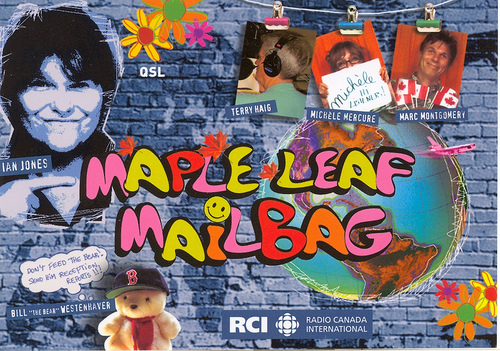
Final episode of the final Maple Leaf Mailbag now online

On Facebook, Wojtek Gwiazda kindly shared the following message from Terry Haig (who has been subbing for Ian Jones on the MLMB):

Dear Friends,
I am distraught that the final edition of the MLMB did not go out properly this past weekend because of technical glitches. The show can be heard on line by clicking on the search button on the RCI website and writing in “Maple Leaf Mailbag.” Then hit “programs” and click “listen.”

My apologies that we could not spend our final hour together as planned. Once again, I thank you all for your undying love, support, insight, graciousness and generosity. You are wonderful and magical.

I shall never forget you. Be well, everyone. Au Revoir and peace!
Terry H.

———————————————————
To hear the programme just click here:
http://www.rcinet.ca/english/archives/program/the-maple-leaf-mailbag/home/

I should note that, the Maple Leaf Mailbag was one of my favorite RCI shows to catch on shortwave. It was informal, quirky, interactive and always fun. It also had a very strong international listenership. Terry has been an excellent sub, but admittedly, I’ve really missed hearing my good friend Ian Jones on the show.

Aung San Suu Kyi visits the BBC World Service with thanks, criticism

Aung San Suu Kyi (photo: Wikimedia Commons)

Noted Burmese opposition leader, Aung San Suu Kyi, visited the BBC World Service last week. Her visit served, in part, to thank them for their broadcasts, which became a lifeline of information for her during her fifteen-year imprisonment in Burma between 1995 and 2010. Shortwave radio connected her with the outside world in the solitude of her prison years.

Sadly, many of the programs offered by the BBC World Service have been cut since Ms. Suu Kyi’s imprisonment. She voiced a few comments about the cuts:

(Source: BBC World Service)

Ms Suu Kyi’s schedule on Tuesday – her 67th birthday – involved a visit to BBC World Service staff at the new Broadcasting House in central London.

“Because of the BBC, I never lost touch with my people, with the movement for democracy in Burma and with the rest of the world. For that, I would like to thank all of you very sincerely,” she said.

But Ms Suu Kyi also said she was “a little sad” about changes to programming on the World Service.

“I feel that the BBC World Service is not as versatile as it used to be – or perhaps I’m not listening at the right times,” she said.

“There used to be so many different programmes, and every time I listen to it now, it’s news and commentaries. I miss the other old programmes… Bookshelf, Just a Minute, and so many others which I don’t seem to hear now…

“It’s not what it used to be,” she said.

During her four-day tour of the UK, Ms Suu Kyi is due to meet members of the Royal Family and address the UK Parliament.

Of note as well was the praise she showered on veteran British DJ, Dave Lee Travis, whose music request program she called “a jolly good show” for making her world “much more complete. I can relate, at least to some degree: you see, music, it seems, still delights listeners on shortwave.