In Zimbabwe, “if you want to hear the truth…listen to Shortwave Radio Africa…listen to VOA”

This is a brilliant piece on the lack of press freedom in Zimbabwe and the importance of shortwave radio. It was broadcast yesterday on Weekend All Things Considered. Links to the show and audio are below.

(Source: NPR)

In Seke, a rural community 40 miles outside Harare, James Chidakwa and his father eat roasted nuts and cornmeal inside a small brick hut. They’re farmers who rely heavily on maize and chickens to survive. James Chidakwa says that like many, his family refuses to listen to government TV or radio broadcasts.

“They always lie to the people,” he says. “Everything they say is a lie.”

So at 6 p.m. most evenings, they turn on a battery-powered, short-wave radio and tune in to a “pirate radio station.” Chidakwa says Shortwave Radio Africa and Voice of America are their favorites.

“If you want to hear the truth, wait for the end of the day to listen to Shortwave Radio Africa, to listen to VOA,” he says.

The stations, which are based in the U.K. and the U.S., send their signals through radio towers in countries that border Zimbabwe. That means Zimbabwean officials — who claim these broadcasts are illegal — have little recourse. In the past, they’ve confiscated short-wave radios. Chidakwa says that forces some people to listen undercover.

“Some of them, they will take the radios into their bedrooms and, low volume, they listen to the news. But the truth is, there is fear in them,” he says.

But for Chidakwa and his father, it’s a risk they are prepared to take.

The stations, which are based in the U.K. and the U.S., send their signals through radio towers in countries that border Zimbabwe. That means Zimbabwean officials — who claim these broadcasts are illegal — have little recourse. In the past, they’ve confiscated short-wave radios. Chidakwa says that forces some people to listen undercover.

“Some of them, they will take the radios into their bedrooms and, low volume, they listen to the news. But the truth is, there is fear in them,” he says.

But for Chidakwa and his father, it’s a risk they are prepared to take.

You can listen to the full story from Weekend All Things Considered, by clicking here (mp3), or read the transcript on this page.

This is just one more story we’ll file under “Why Shortwave Radio.”

RCI, and others, I wish you were listening. Those in Zimbabwe certainly are.
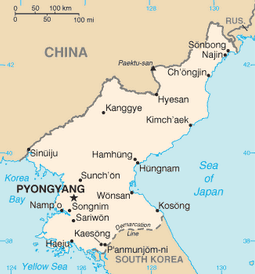
North Korea: Jamming shortwave radio 18 hours a day

(Source: Times Union)

[…]Martyn Williams, who writes the blog NorthKoreaTech.org, said that the government’s intense use of its scant resources and electricity to jam foreign news broadcasts reflected its concern about the impact of outside media.

North Korea targets between 10 and 15 frequencies used by international short-wave broadcasters, such as U.S.-funded Radio Free Asia and stations operated by South Korea’s government, for up to 18 hours a day, and on major occasions like the April centennial, it jams radio signals around the clock, Williams said.

The North appears to have recently installed more sophisticated transmitters acquired from a Chinese company, although jamming operations have been up and down this year, likely because of technical problems or power shortages, he said.

Read the full article, the bulk of which deals with social media and mobile phones, on the Times Union website. Obviously, North Korea feels that shortwave radio is a threat to those in power. They should be afraid–shortwave radio signals easily cross their fortified borders. This article will be filed under why shortwave radio.

The Link talks about the politics of saving RCI

On Friday’s edition of The Link, Mark Montgomery spoke with Amanda Pfeffer about how international radio is being cut around the world and, more specifically, Canada. They discuss how this happened, who is aware of it and if there is any way to save the service.

It’s an informative segment (though see my correction below).

Since this is one of several features in the show, I’ve recorded this specific segment and posted it for listening below.

You can also listen to the segment by downloading the mp3 here.

Please note that Amanda is a little mis-leading about the bureaucratic structure of US international broadcasting. It is rather confusing.

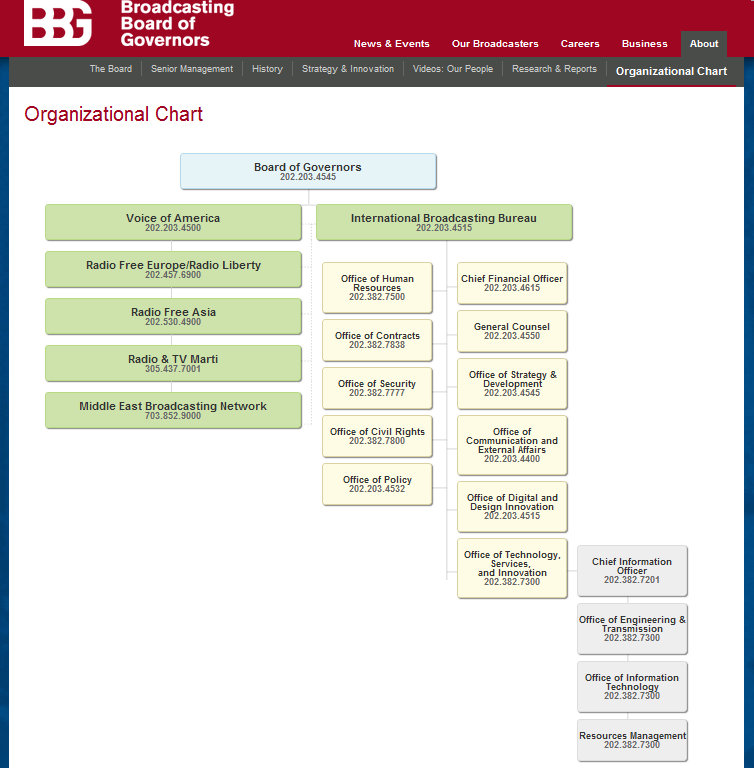
The BBG (Broadcasting Board of Governors) is the governing body of US international Broadcasting. The IBB (International Broadcasting Bureau) is over all of the broadcast/transmission facilities, engineering functions, human resources, finances and other agency support services. To be clear, the Voice of America, Radio Free Asia, Radio Free Europe, Radio Marti and the Middle East Broadcasting Network all take direction from the BBG, not the IBB.

The organizational chart (below) can shed some light on this.

The BBG Organizational Chart as of May 2012 (Click to enlarge)

Updates to the WRTH Summer A12 schedules are now available for download

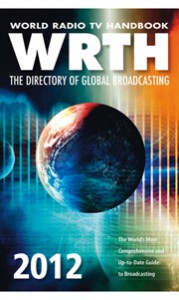
The World Radio TV Handbook (WRTH) A12 schedules updates file is now available to download, free of charge, from the WRTH website. This is a comprehensive update and supplement to the printed 2012 WRTH.
(Source: Sean Gilbert, WRTH)

The WRTH Editorial team is pleased to announce that the Summer/’A’ season broadcasting schedules file is now available to download, free of charge, from the WRTH website – click on http://www.wrth.com/ and follow the link “Latest PDF Updates”.

The file is in PDF format (you will require the free Adobe Acrobat reader to open this file. If you do not have the Acrobat reader, please visit http://www.abobe.com/ to download and install it). The 86 page file is approximately 4500kB in size and contains the following information:

Summer / ‘A’ Season broadcasting schedules for over 200 international and Clandestine/Target stations;

Frequency listing of the above stations to facilitate band scanning;

Broadcasts in English, French, German, Portuguese and Spanish;

International DRM broadcasts.

Please feel free to pass this information on so that we may reach as many SWL’s, DX-er’s and professionals as possible.

For contact details, transmitter sites and much more, please refer to the printed WRTH, which is available to order from the website.

We hope you find this a useful accompaniment to the printed WRTH.

On behalf of the publisher and editorial team at WRTH, happy listening!

73,
Sean D. Gilbert,
International Editor – WRTH (World Radio TV Handbook)

Edward R. Murrow Transmitting Station: re-dedication videos

Last week, we noted the upcoming re-dedication of the Edward R. Murrow Transmitting Station and the significance of this particular broadcasting location.

Videos of the event have now been posted on the BBG Watch website, including this one, which features the original dedication of the site in 1963:

Local CBS affiliate, Channel 9, provided raw video feeds from the event, which are also posted.  Of particular note is the footage of Governor Victor Ashe’s speech and the tour of the station.

Victor Ashe:

Station tour:

As I previously mentioned, in December 2012, I had the honor of receiving a five-hour tour of the Edward R. Murrow Transmitting Station. Following that marvelous tour, I  wrote a piece for the March 2012 issue of the Monitoring Times in which I describe the day’s experiences; the article has already received many kind comments (thanks!) and continues to draw interest to the station. I think this may be one of the best articles I’ve ever written, and the clear reason for this was my sheer delight in the tour, a dream come true for me.  Moreover, I had early information about the re-dedication of the site, and was immensely pleased that  those who work there should receive such well-deserved accolades.

BTW:  While I have a busy travel schedule this summer, I intend to publish some items of interest in my absence that I’ve been saving for the purpose. This will include the article I wrote for the MT–the full, un-cut version–along with dozens of hi-res photos from the site. It’s quite long, thus will be posted in manageable sections; each post will be tagged: VOA Greenville. Keep an eye open for those!

But if you just can’t wait, you can always download an electronic version of the March issue on the MT’s website.  Hope you enjoy it…!

And to our good friends at VOA Greenville:  thanks again, and congratulations!

Andy Sennitt: The Media Network years – the noughties

Media Network, which covered international broadcasting developments at Radio Netherlands, recently ended a 30-year run on RNW. In a series of four articles, Andy Sennitt mentions some of the highlights, and then looks ahead to how international broadcasting might develop in the next ten years.

Part 3 of this series, “The Media Network Years: the noughties” is now available on RNW’s website

Grandfather of WWV’s atomic clock

I just discovered a film produced by the National Physical Laboratory (NPL) Film Unit in the 1950s explaining the principles behind the first accurate atomic clock. The clock was designed by Louis Essen and built at the National Physical Laboratory in 1955.

This film gives fascinating insight into the physics that run atomic clocks like those behind the WWV and CHU time stations. Better yet, the science is easy to swallow with the traditional “BBC” style voice narration. Enjoy!