Tag Archives: Fighting QRM

Taming the Noise: Don Moore’s Simple, Cheap Filter Solution for Traveling DXers

Many thanks to SWLing Post contributor Don Moore–noted author, traveler, and DXer–who shares the following post:


A Cheap and Simple Noise Filter

By Don Moore

Don’s traveling DX stories can be found in his book Tales of a Vagabond DXer [SWLing Post affiliate link]. If you’ve already read his book and enjoyed it, do Don a favor and leave a review on Amazon.

My DXing career started over fifty years ago in an upstairs bedroom in tiny Milesburg, Pennsylvania. I had a consumer-grade multi-band radio and some copper wire strung from the roof to a nearby tree.  It was a simple setup but it worked very well. Do you know what I didn’t have? A noise problem. The only time I remember noise ruining my DX was when my mother was using the electric mixer and that meant she was making cookies or a cake. I never complained.

Times have changed, haven’t they? What DXer doesn’t complain about noise these days? I know people who have left the hobby because the place they lived at and DXed at for decades gradually became so noisy they couldn’t DX anymore.

Unsurprisingly, a lot has been written about how to find and eliminate noise in your home. However, most of my DXing is done as I wander the globe. I try to find places to stay at that should be good for DXing. But no matter how good a place looks beforehand, there’s no way of knowing what the noise level will be until I get there.

As a traveling DXer, I need quick, easy, and compact noise solutions. The best solution I’ve found are these CCTV distortion filters (ground loop isolators) that Brett Saylor recommended to me several years ago.
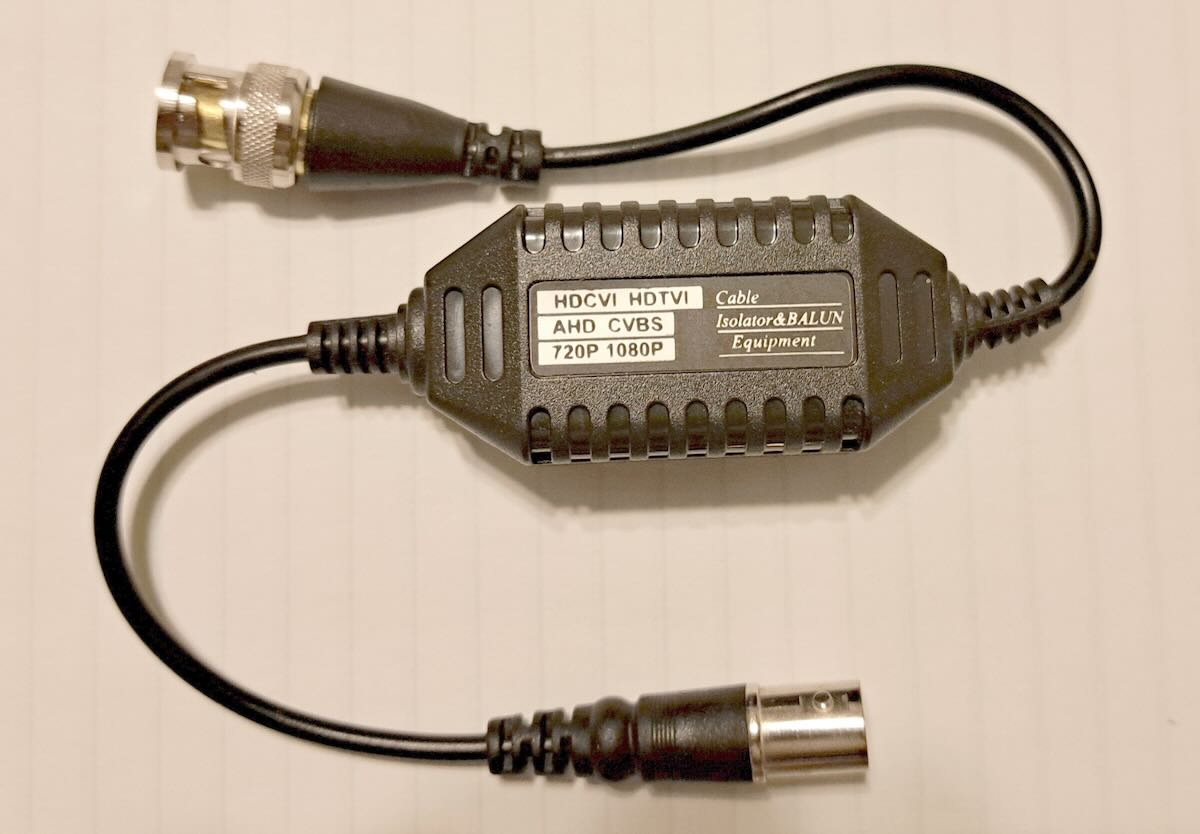
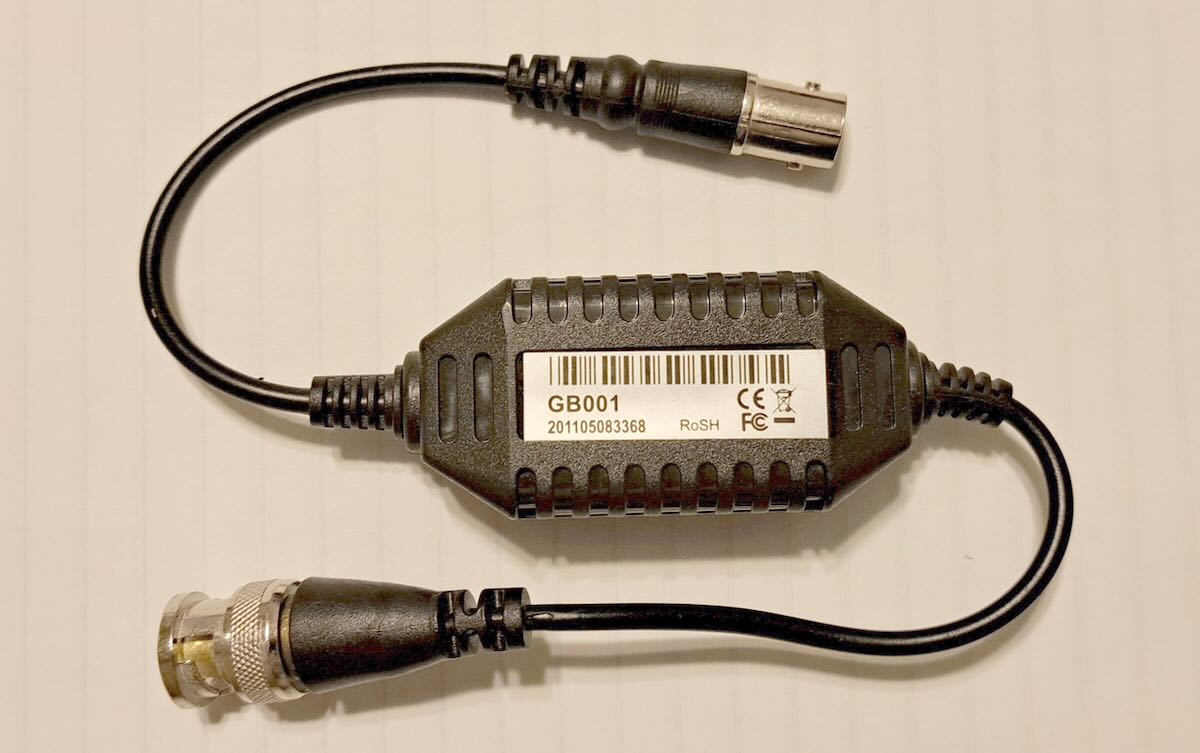
No, these weren’t designed for radio use. And they aren’t a miracle solution that will eliminate all the noise that plagues DXers. Sometimes they’re no use at all. But I’ve DXed in dozens of locations over the past ten years and there have been multiple occasions where one of these filters has turned what would have been a disappointing stay into a good DX session. I don’t go anywhere without two of these packed in my mobile DX shack.

But let me show you some results. All of these SDR screenshots were made with SDR-Console using an Airspy HF+ Discovery SDR connected to a PA0RDT mini-whip antenna.

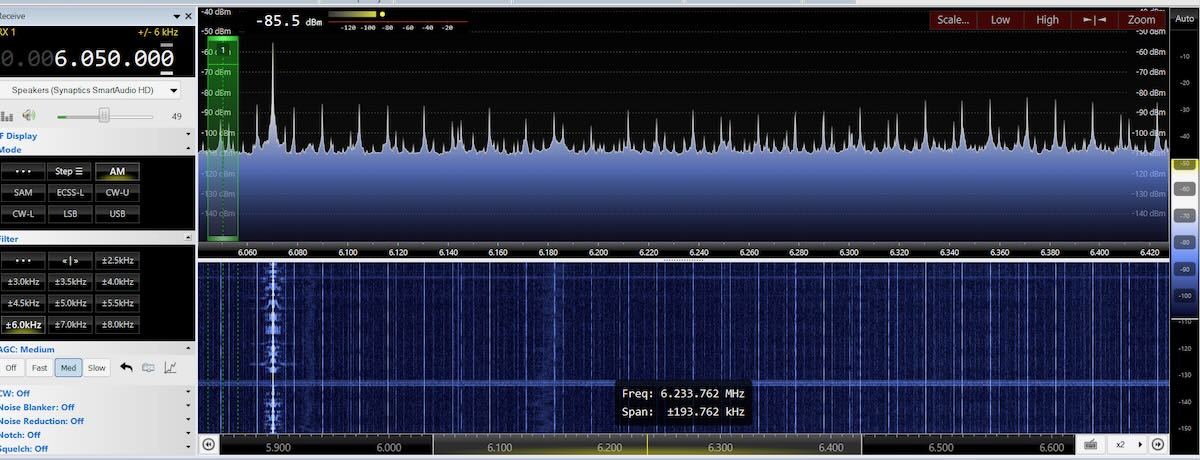
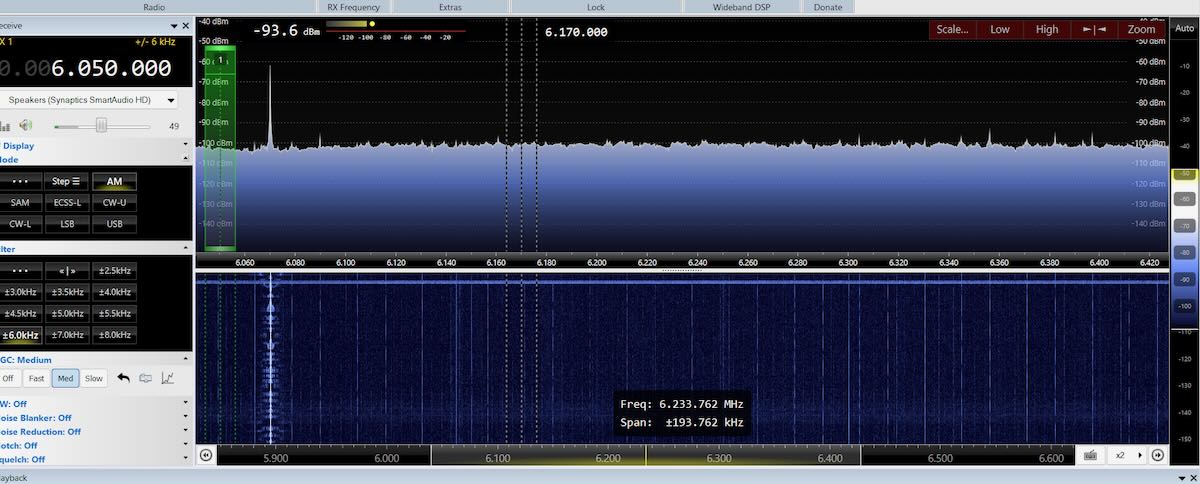
I spent last summer in the north suburbs of Chicago and several times went to a park to test my DX equipment. Around midday, the lower shortwave frequencies were filled with noise peaks. On this first image, it’s hard to pick out WWV on 5 MHz from all the noise peaks. In the second image the filter hasn’t totally eliminated the noise, but WWV’s signal is now strong and clear.
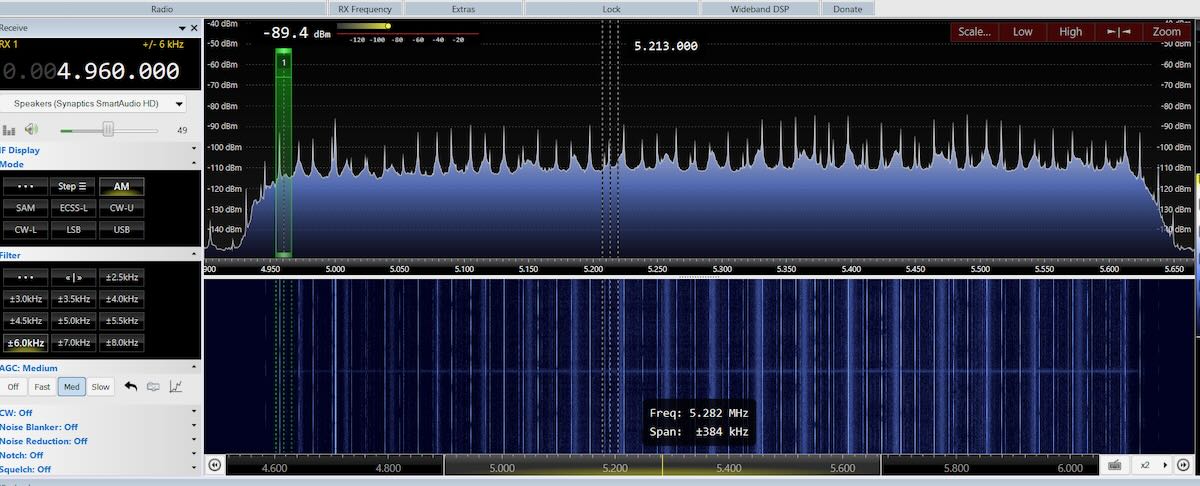
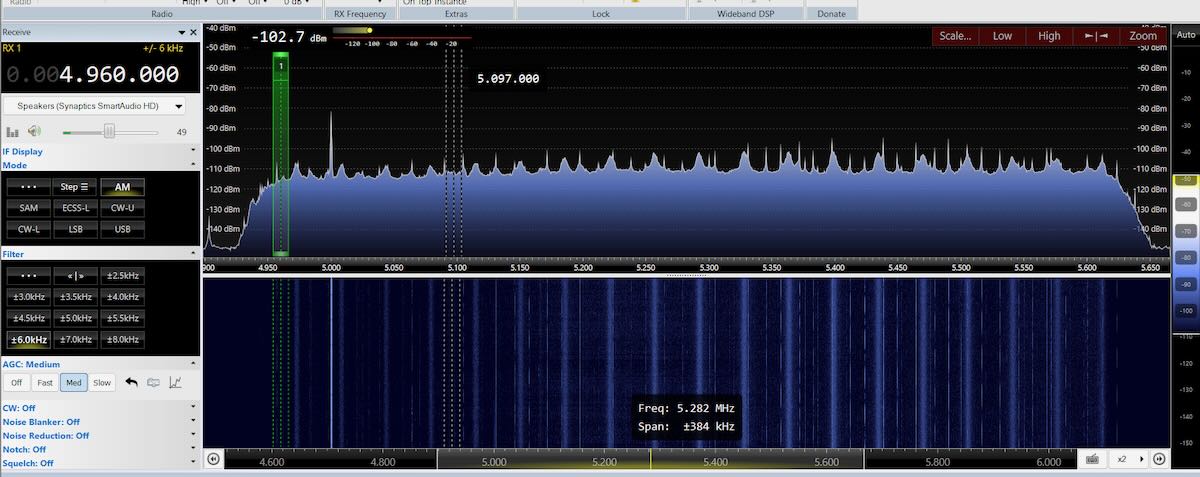
The noise was nearly as strong on 49 meters but the filter almost totally eliminated it. CFRX’s signal on 6070 kHz was slightly weaker with the filter, but it was significantly more listenable without the noise.
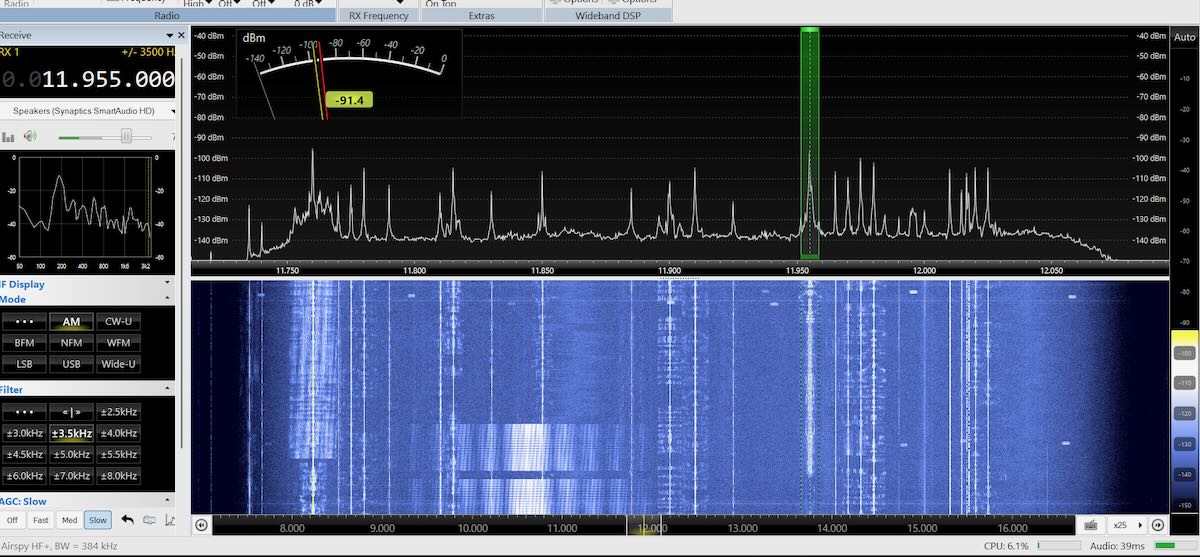
Which frequencies noise affects can vary between locations. At that park the noise was gone above about 11 MHz.  While traveling across the US in mid-October, I stopped at a park just west of Kansas City to do some more DXing and equipment tests.  The noise there was bad in the middle shortwave bands, such as in the 25 meter band.
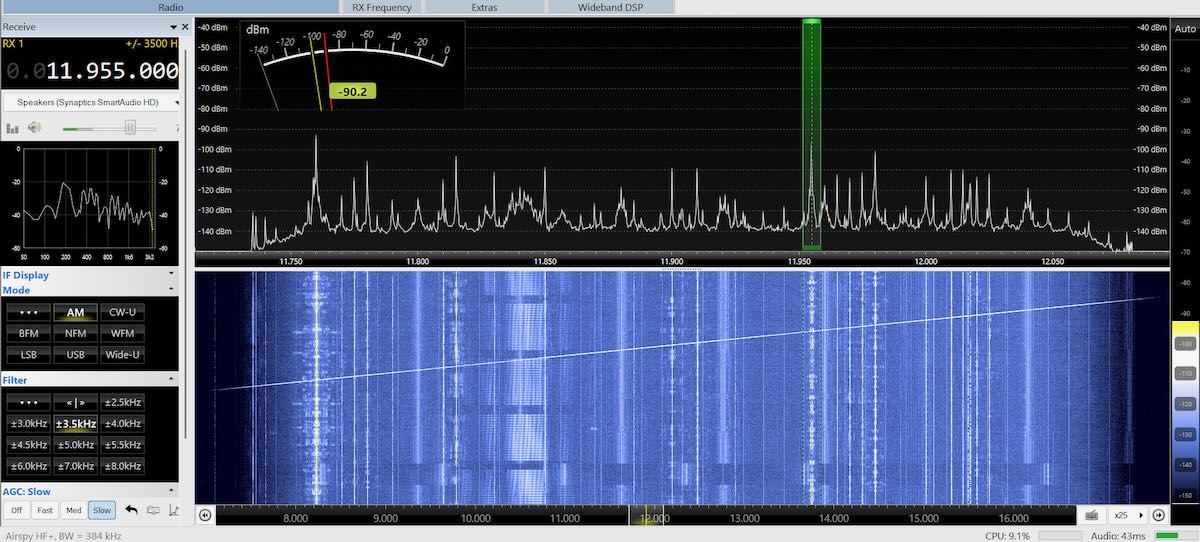
But the filter did a good job cleaning it up.
Finally, about two years ago when I was DXing in Rafina, Greece, the noise was bad on the higher bands. Here are before and after screen shots on the 16-meter band.
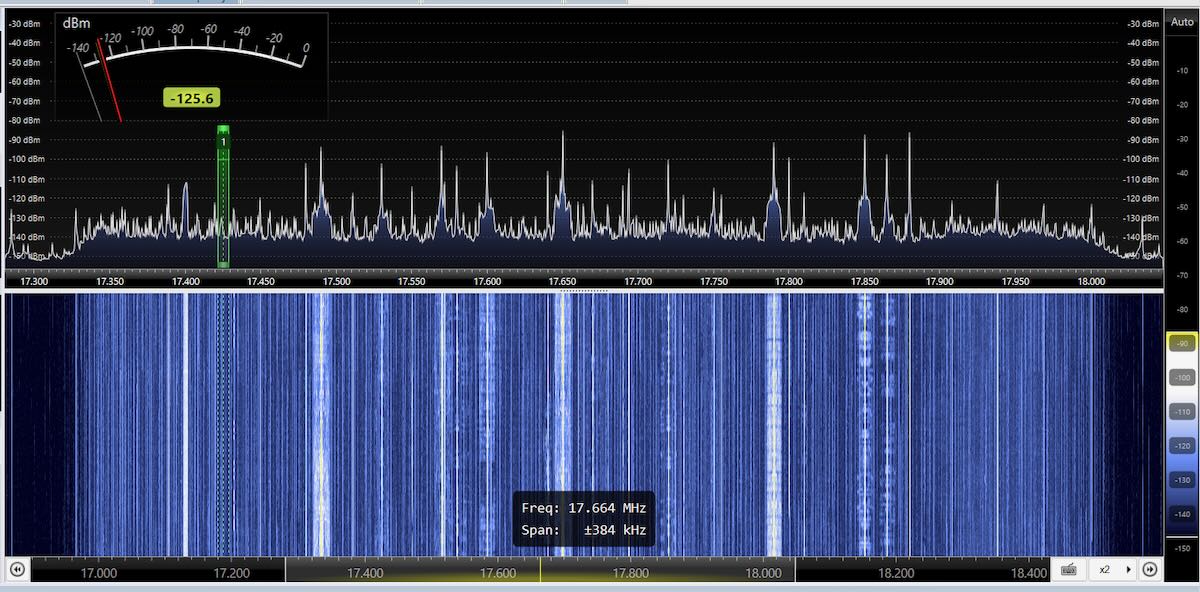
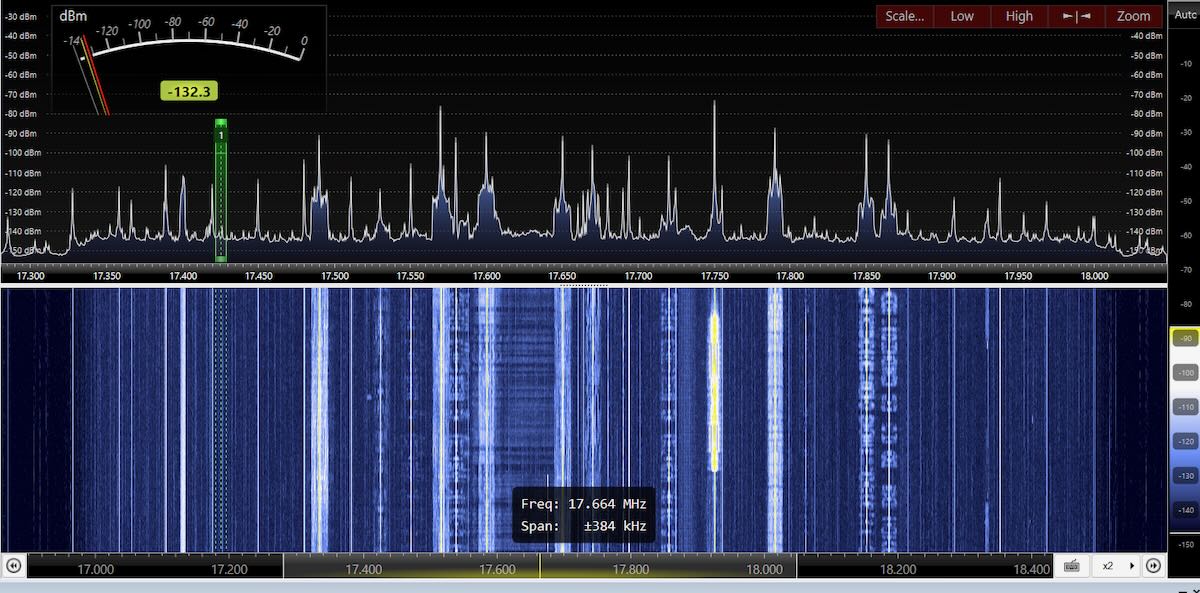
These filters should work with any coax-fed antenna. I’ve used them with beverages, Wellbrook loops, the PA0RDT, and the MLA-30+ loop. If the antenna has an interface, such as the last three mentioned, the filter goes between the interface and your receiver (and not between the interface and the antenna).  I’m not sure what the impedance on these is, but I’ve used them with both 50- and 75-ohm coax cable.

Sources of the Filters

An Internet search for “CCTV Ground Loop Isolator” brings up all kinds of products. They are probably all the same but I have no way of knowing that. So I recommend getting the exact ones that I have purchased. Just compare the product to the pictures of mine.

Here are links to three current sources for these exact ones on Amazon. They can also be found on eBay and other sites. [Note that all of these links are affilliate links that support the SWLing Post at no cost to you.]

A Few More Ideas

At just a couple dollars each, every DXer should have a few of these filters in their shack. But types of noise vary and at several places I’ve DXed from using one of these filters made no difference at all. When that happens I have a few other solutions to try.

The first thing I try is to either move the antenna or, if it’s directional, to point it in a different direction. On several occasions that’s all it has taken to totally eliminate what at first seemed like an impossible noise problem.

If the noise is coming in through the power lines, unplugging the laptop and DXing off of battery power might do it. (I only use SDRs powered off the USB connections on my laptop.)  If you do that, be sure to unplug the cord from the outlet and move it away from the wall.  If you unplug the cord from the laptop and leave the other end plugged into the outlet, it may act as an antenna and radiate the noise from the power lines into your SDR. And, yes, I learned that lesson the hard way!

Do you have any interesting experiences or solutions to the DX noise problem? Please leave them in the comments section. 
Guest Post: Indoor Noise and Ferrites, Part1

Many thanks to SWLing Post contributor, TomL, who shares the following guest post:


Indoor Noise and Ferrites, Part 1

by TomL

My magnet wire loop antenna on the porch reminded me to revisit aspects about my noisy Condo that I still needed to understand.  Some RF noise I could control if I could find the right kind of information that is understandable to a non-engineer like me.  There is a lot written about the general problem of noise and radio listening, for instance this ARRL article with web links to research – www.arrl.org/radio-frequency-interference-rfi, but I needed to get more specific about my particular environment.

I had tried some common clamp-on TDK ferrites I had obtained from eBay a long time ago but they only seemed to work a little bit.  I have since found out these are probably the ones which are widely used on home stereo system connections used to reduce noise on those systems.  There must be a better way.

The more I researched topics, like a portable “Loop on Ground” antenna, or, using RF chokes on the magnet wire loop, it dawned on my feeble, misguided brain that I was wrongly thinking about how to use ferrite material.  For one thing, the material used to suppress RF noise is made with a certain “mix” of elements, like Manganese-Zinc, that electrically “resists” a specified frequency range.  Fair-Rite has a useful Material Data Sheets web page which lists the Types of ferrite material.  For dealing with noise (at the Source causing the problem), I needed to use the right kind of “Suppression” materials and proper placement.  So, it (partly) made sense why the TDK snap-on ferrites might not fully work to reduce certain noise coming from my computer screens, LED lights, USB devices, and cheap Chinese-made power adapters.

A very good  paper is by Jim Brown (K9YC) of Audio Systems Group entitled, “Understanding How Ferrites Can Prevent and Eliminate RF Interference to Audio Systems [PDF]”.  There is a longer paper speaking directly to Amateur Radio folks, but the Audio version is simpler and it uses some of the same  graphs and ideas.  I was drawn to the very detailed Impedance measurements of many different “Types” of ferrite material used for different noise mitigation.  I remember the traumatic pain of my college experience trying mightily to understand the Van Vlack Materials Science text book to no avail.  But Jim’s paper reminded me of the importance of using the correct type of ferrite material and in an optimal way that reacts favorably in the target frequency range to solve a particular noise problem.  So, what are my problem areas?

Shortwave Noise

Loop antennas have been what I have experimented with the most.  They do not pick up as much man-made noise (QRM) and they have a space saving footprint.  Fortunately, there is a wooden porch where these things have been tried.  I had successfully built a broadband amplified “ferrite sleeve loop” (FSL) in the past.  It was useful for a while but it fell into disrepair and also the Condo building has steadily increased in noise output.  The amplifier was just amplifying the noise after a while.  I also tried phasing two antennas but found the ever increasing noise cloud was coming from all directions and I could not null it out.  I even tried a “mini-whip” from eBay but that just produced a wall of noise.

I recently tested AirSpy’s YouLoop written about before, and the results were good.  However, it seemed obvious to me that it was too small as a passive loop to capture shortwave signals strongly enough without resorting to another amplifier attached at the antenna and would not improve the signal/noise ratio.  My current solution is a unamplified stealth magnet wire loop about 32 feet in circumference.  In that article, I mention things like common mode RF chokes at both ends of the antenna connection, horizontal polarization, and basically accepting that only the stronger shortwave signals will be received in a predictable manner.  I think for now, this is about all I can do for shortwave and mediumwave noise, as far as my own Condo-generated noise. Neighborhood noise is a different topic.

VHF Noise

I then started to isolate which devices caused which kind of noise when listening to my outside amplified antennas for FM/VHF and UHF-TV transmissions.  Many consumer Power adapters make a lot of noise from VLF up into UHF ranges.  One thing I did right was to try a 10 pack of these little miracle “Wall Wart” toroids from Palomar Engineers.  One by one, I put one of these small toroids (19mm inside diameter) on my home AC adapters as shown in the pictures, and the noises started disappearing.  It does not explicitly say, but I believe it is Type 75 material which suppresses the noise generating AC adapter (at very low frequencies) when wrapped 8 – 12 times.

Most egregious of these was my CCrane FM2 transmitter.  A strangled warbling sound kept emanating from the monitor closest to my laptop. Installing ferrites on the laptop and back of the monitor were not working.  I moved the FM Transmitter and noticed a reduction in noise.  So, I put one of these little toroids on the power input of the device and the noise disappeared.  Apparently, it was picking up noise from the monitor (as well as its own power adapter) and rebroadcasting it to all my other radios!  The strangled warbler is no more, I choked it (HaHa, sick bird joke).

While looking for the monitor noise, I put the eBay TDK ferrites on all the USB ports and HDMI ports.  This has helped greatly on VHF and confirms my suspicion that these cheap TDK ferrites are indeed a common type of ferrite material.  Some informative graphs can be seen in Jim Brown’s Audio paper mentioned before.  One example might be Figure 22, which shows the #61 Series Resistance which peaks around 100 MHz when using a toroid with three “Turns”.  More confused, I could not find a definition of a “Turn”.  Eventually, in his longer paper to Amateur Radio operators, he defines it, “…is one more than the number of turns external to the cores”.  Somewhere else he describes using many single snap-on ferrites being electrically equal to just one toroidal ferrite with multiple Turns.  And interestingly, more Turns shifts the peak impedance substantially lower in frequency.  So, using the graphs he supplies, one can target a noisy frequency range to try to suppress.

I then put 6 of the TDK ferrites on the VHF input to the AirSpy HF+.  Some FM grunge was reduced and was thankful for that.  The rest of the background noise truly seems to be coming from the outside picked up by the amplified antenna.

Also, I juggled a couple of the amplifiers around and now have separate VHF/FM and UHF/TV amplifiers which cleaned up the FM reception a little bit more – https://www.youtube.com/watch?v=zkDsy95et2w .

UHF TV Quality

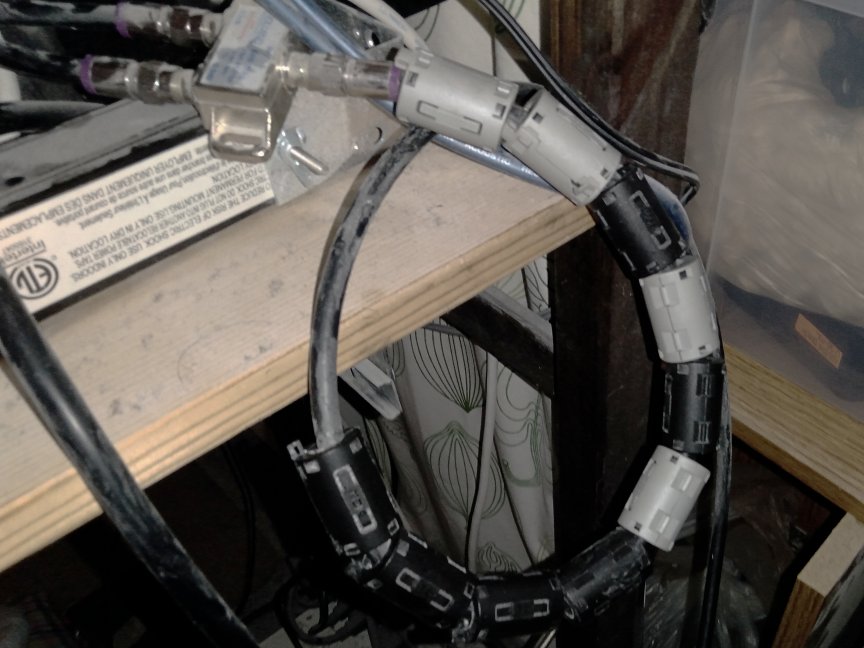
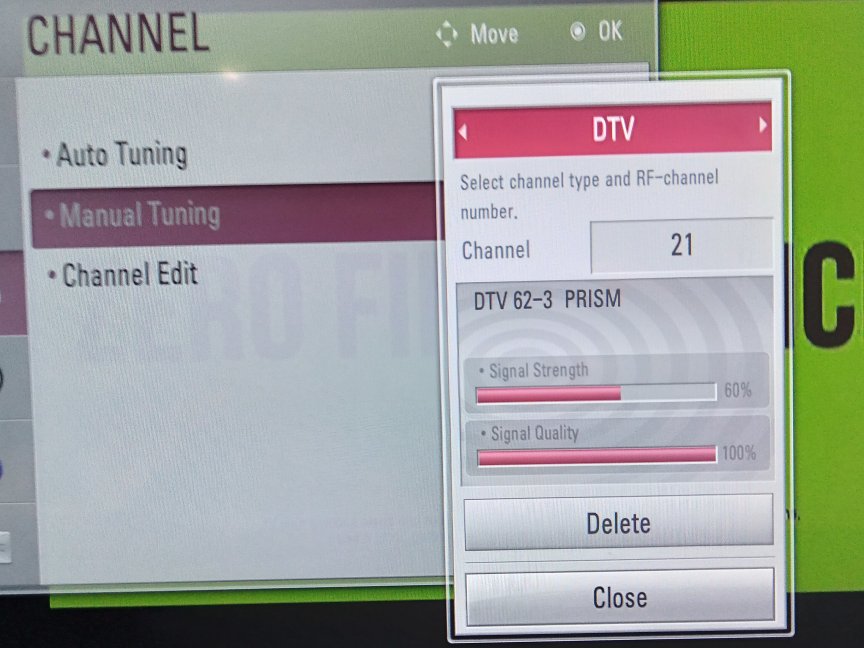
On a whim, I put the balance of the TDK ferrites on the FM/TV splitter input cable, 10 in all.  The FM reception did not improve but the Over The Air UHF TV reception Quality improved noticeably.  My weakest TV station now has a stable Signal level and the Quality is pegged at 100%.  This is a nice surprise since it means that now all local TV stations on UHF will come in cleanly without dropouts and I can view all digital subchannels.  I was even able to rescan and added two more low-power stations never seen before. ?

LED lights

I have common LED lights hanging over a number of fish tanks and some grow lights over an indoor plant box and can hear this noise on upper shortwave and higher radio bands.  In a future article, I will explore RF noise from lights as its own special topic. For instance, why do some LED lights generate RFI and how to know before buying (I am using BR30 spot bulbs from name brands)?  Also, there is a new kind of LED “filament” light out now that uses much smaller LED’s on both sides of an aluminum strip, greatly reducing electromagnetic noise output (or do they??).  More questions than answers.

I will explore creating my own customized AC power cord attached to the AC power strips of the LED lights.  I will need to test this for safety and efficacy, so I will want to take some time to do this right.  The hope is that, using Jim’s info, I will be able to create a broad spectrum RFI suppression AC power cord and cost less than $30 each cord.  We’ll see.

Finally, I will look at “stacked” toroids using different mixes of ferrite Types, creating a custom RF suppression better than using just one Type of ferrite material, using AC cords as the main examples. For instance, the best set of graphs in Jim’s paper, in my opinion, are Figures 21 and 24 compared to each other.  Something I did not know before is that one can not only use multiple turns on a single toroid to get a lower, peaked frequency response, but also stack multiple toroids of the same Type to get a smoother frequency response.  Then on top of this, combine that set with other Types to create a customized frequency response curve.

Radios are quieter now.  Those pesky grow lights are still a problem as well as the upstairs neighbor’s lights which seem to be on a timer, making FM reception noisy again after 5pm!

Jack finds that chokes have a huge impact on switching power supply noise

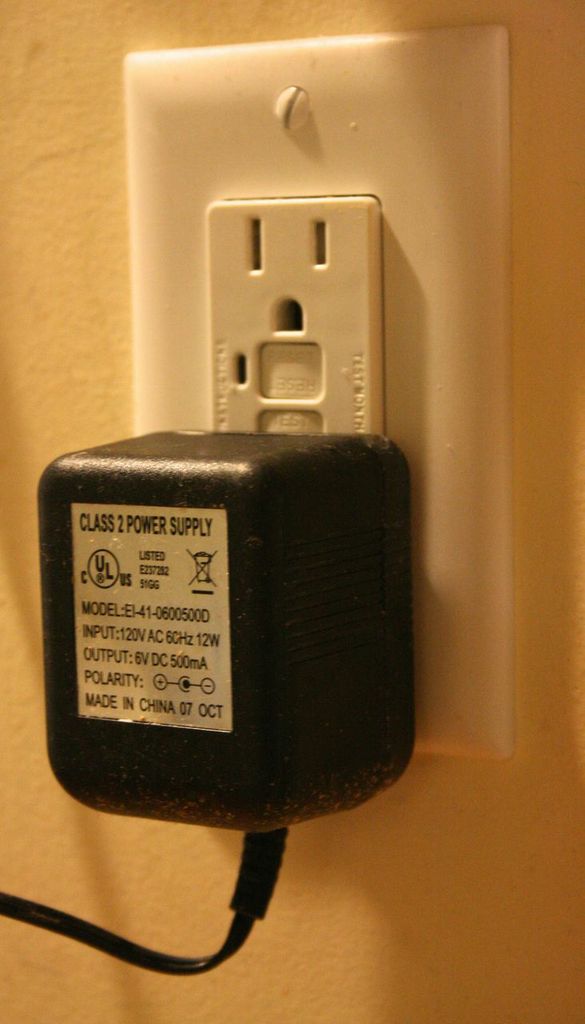
These “Wall Wart” type adapters can create a lot of RFI

Many thanks to SWLing Post contributor, Jack Dully, who writes:

I was putting some things in my radio junk parts box and came across some chokes. So I tried a test with my Tecsun PL-880 on battery and the Tecsun supplied switching AC adapter, with and without chokes on the adapter.

WOW!

I tuned to a vacant station on battery power with headphones on. Then on AC power, the hash and static were incredible. Putting one large choke on the adapter power cord, wrapped about four times and it decreased considerably. So I attached a second choke and once again the static & hash decreased even more, almost to the point of sounding like I was running just on battery power.

Those chokes really do work well.

Thank you for sharing this, Jack. I almost never operate my portables while connected to a power supply, so I often forget about the importance of using a choke with inexpensive, lightweight radio power supplies. Thing is, so many things in our houses and shacks are powered by these QRM generators. In the shack, I’ve added chokes I’ve picked up at hamfests to a number of various power supplies. It does certainly help decrease the noise level. I’ve even used them on power cords for other appliances in the house that tend to spew RFI.

If you ever find a deal on chokes at a hamfest or electronics store, grab some. They can be an affordable solution for those noisy power supplies we still rely on.

Thank you for the reminder and  tip, Jack!

Video: How to fight radio noise in urban areas

LondonLondon Shortwave, a regular contributor to the SWLing Post, lives in London, England and copes with serious amounts of radio noise (QRM) at his home. Unlike many urban radio listeners, the QRM didn’t chase him away from the hobby, rather he looked at it as a challenge. Besides taking his radio kit outdoors to escape the noise, he also has a noise mitigation set-up at his home which has been refined over the years.

London Shortwave shared this video demonstration earlier this year on his YouTube channel. Here’s his description:

In this video I demonstrate an improvement to indoor radio reception quality, which is possible to achieve in an urban environment.

I compare using a Tecsun PL-390 portable receiver to a radio set-up that combines Lowe HF-150’s sync detector, the Wellbrook active loop antenna and real-time noise reduction software.

I recently told London Shortwave that he’s a QRM-fighting Samurai; I believe he certainly deserves the title!

Any other QRM Samurai’s out there?