Tag Archives: Voice of America

Broadcasting Board of Governors (BBG) rebranded as U.S. Agency for Global Media (USAGM)

(Source: BBG/USAGM Press Release)

WASHINGTON, Aug. 22, 2018

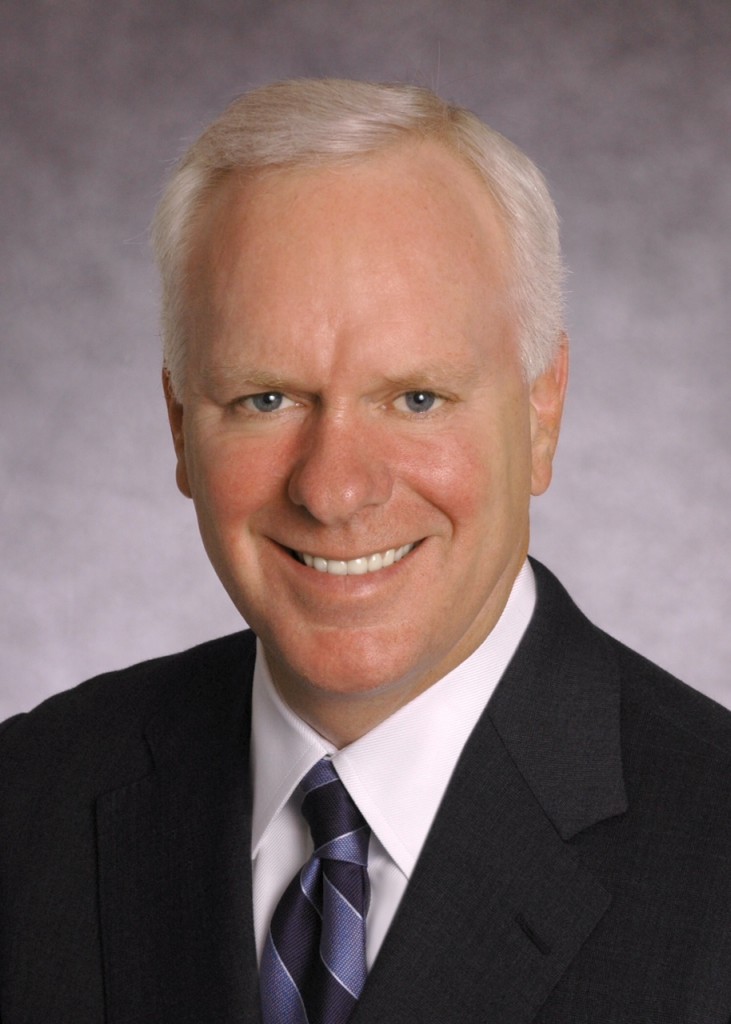
John Lansing (Source: BBG)

Effective immediately, the Broadcasting Board of Governors (BBG), an independent U.S. government agency that employs thousands of talented journalists, storytellers, and media professionals, is now the U.S. Agency for Global Media (USAGM).

The U.S. Agency for Global Media is a modern media organization, operating far beyond the traditional broadcast mediums of television and radio to include digital and mobile platforms. The term “broadcasting” does not accurately describe what we do. The new name reflects our modernization and forward momentum while honoring our enduring mission to inform, engage and connect people around the world in support of freedom and democracy.

We recognize the overdue need to communicate the evolving, global scope of our work as well as our renewed, urgent focus on the agency’s global priorities, which reflect U.S. national security and public diplomacy interests. USAGM is an independent federal agency that provides accurate, professional, and objective news and information around-the-globe in a time of shifting politics, challenging media landscapes, and weaponized information. Our identity and name will now address these realities.

The decision to change our name was a result of thorough research and extensive consultation with numerous internal and external stakeholders, including the BBG Board of Governors, agency staff and leadership at all levels, the five networks, Congress, the Administration, and interagency colleagues.

As with the BBG, the U.S. Agency for Global Media encompasses five networks: the Voice of America (VOA), Radio Free Europe/Radio Liberty (RFE/RL), the Office of Cuba Broadcasting (Television and Radio Martí), Radio Free Asia (RFA), and the Middle East Broadcasting Networks (MBN). These networks collectively reach an unduplicated weekly audience of 278 million people in 59 languages and in more than 100 countries. Insulated by a firewall from political influence, these networks will continue to deliver truth and professional journalism to people living in some of the world’s most closed societies.

Now more than ever, people around the world need access to the truth. USAGM continues to tell the truth, and illuminate the world like no other news organization in the world.

Video: Lansing On USAGM

Click here to view on YouTube.

Learn more about U.S. Agency for Global Media 

For more information

Nasserie Carew

US Agency for Global Media Public Affairs

202-203-4400

[email protected]

VOA’s Music Man For Africa, Leo Sarkisian, dies at 97

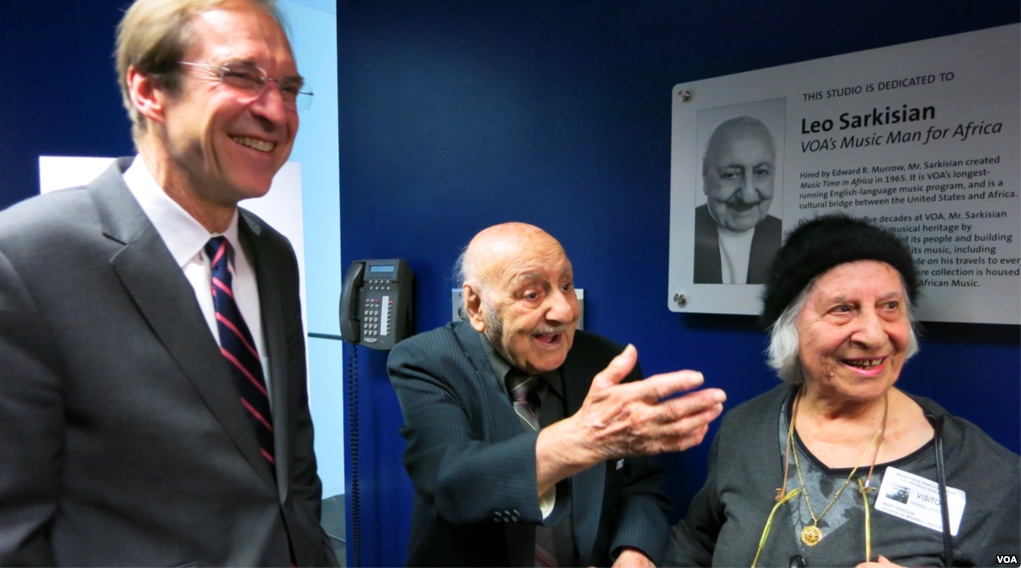
FILE – Leo Sarkisian, center, his wife, Mary, and VOA Director David Ensor smile during a celebration that followed the renaming of VOA Studio 23 in Sarkisian’s honor, Jan. 29, 2014. (Source: VOA News)

In February 2013, Leo Sarkisian and his sweet wife, Mary, invited me to their home and studio in Maryland and I recorded what turned into a 3+ hour audio interview.

Sitting with him, time seemed to disappear as I was absorbed by stories about his travels and experiences. He was so kind and gracious–he even insisted that I walk away with one of his amazing drawings which I’ve since framed for my office.

Leo passed away on June 8, 2018 at the age of 97. Rest in peace, Leo.

Here’s the story from VOA News:

(Source: VOA News)

Leo Sarkisian, the creator and longtime producer of The Voice of America’s “Music Time in Africa,” has died. He was 97.

Known by his fans as the “Music Man of Africa,” Sarkisian spent a half-century traveling Africa, listening to local musicians and capturing their performances. Those recordings became the basis of VOA’s longest-running English program.

“Leo always left you feeling like you were special. He didn’t treat anyone less or greater based on their social standing or age or anything, it seemed. He was a true gentleman and optimist and lover of the beautiful things in life,” said Heather Maxwell, an ethnomusicologist who succeeded Sarkisian as the host of “Music Time in Africa.”

Meeting Murrow

Sarkisian arrived in Africa as a soldier in the U.S. Army. In 1961, a fateful encounter changed the course of his life. Edward R. Murrow, newly minted as the director of the U.S. Information Agency, came to Sarkisian’s apartment in Conakry, Guinea, and asked if he’d like to join The Voice of America. Four years later, he went on the air with “Music Time in Africa.”

He spent the next 47 years traveling the continent with his wife, Mary, whom he married in 1949. Together, they met thousands of local musicians and gave their art a global stage.

Sarkisian’s travels put him at the vanguard of African music. Maxwell said a favorite recording from Sarkisian’s collection was of Nigerian musician Fela Kuti, before he developed the Afrobeat style that would become his world-famous trademark.

Sarkisian was himself a musician and artist. He sketched performers, audience members and dignitaries. Some of his illustrations can be found in “Leo Sarkisian’s Faces of Africa,” a collection of portraits of people he met in his travels.

But his greatest legacy will perhaps be the original collection of about 10,000 recordings that he curated, representing every African country. In 2014, the University of Michigan acquired the collection from VOA on long-term loan. Their work involves digitizing the collection and preserving it for generations to come.

‘I feel as if I’m just beginning’

Sarkisian retired in 2012, when he was 91.

“I feel as if I’m just beginning,” he told VOA’s Vincent Makori in an interview that year.

When asked what African music meant to him, Sarkisian said, “It’s been my entire life. It’s from my childhood right up to today, and maybe into the future. I’ll still be doing my art, and I’ll be dancing with my music. What else? It is passion.”

Sarkisian’s parents emigrated to the U.S. from Turkey in the early 1900s, according to The Washington Post. Born in 1921, Sarkisian studied art and drew maps for the Army, the Post reported.

Sarkisian lived by Murrow’s “last three feet” motto, Maxwell said. That meant the most important part of communication, even across international borders, came from a personal, human connection.

“We still care about Africa,” Sarkisian said in 2012. “We care about them. We love the African culture. And in turn, of course, we have their love, also. And that is the satisfaction of our work.”

Leo and Mary Sarkisian, after spending most of their lives living in Africa, settled in Boston. Leo Sarkisian died June 8 and will be buried in North Andover, Massachusetts, with full military honors.

Click here to read this story at VOA News.

Michael Pack nominated as CEO of the Broadcasting Board of Governors

Many thanks to @experimradio who notes that Michael Pack has been nominated as CEO of the Broadcasting Board of Governors (BBG) and shares the following information links.

Michael Pack’s nomination announcement via WhiteHouse.gov:

NOMINATIONS SENT TO THE SENATE:

Veronica Daigle, of Virginia, to be an Assistant Secretary of Defense, vice Frederick Vollrath, resigned.

Peter A. Feldman, of the District of Columbia, to be a Commissioner of the Consumer Product Safety Commission for the remainder of the term expiring October 26, 2019, vice Joseph P. Mohorovic.

Karen Dunn Kelley, of Pennsylvania, to be Deputy Secretary of Commerce, vice Bruce H. Andrews, resigned

Brian A. Nichols, of Rhode Island, a Career Member of the Senior Foreign Service, Class of Career Minister, to be Ambassador Extraordinary and Plenipotentiary of the United States of America to the Republic of Zimbabwe.

Michael Pack, of Maryland, to be Chief Executive Officer of the Broadcasting Board of Governors for the term of three years. (New Position)

Elad L. Roisman, of Maine, to be a Member of the Securities and Exchange Commission for a term expiring June 5, 2023, vice Michael Sean Piwowar, resigned.

Geoffrey Adam Starks, of Kansas, to be a Member of the Federal Communications Commission for a term of five years from July 1, 2017, vice Mignon L. Clyburn, term expired.

Casey Wardynski, of Alabama, to be an Assistant Secretary of the Army, vice Debra S. Wada.

Michael Pack’s biography via The Claremont Institute:

Michael Pack,
Manifold Productions (Photo: The Claremont Institute)

Michael Pack is a Senior Fellow of the Claremont Institute, formerly serving as president from 2015 to 2017. Pack founded Manifold Productions, an independent film and television production company, in 1977.

Mr. Pack has written, directed, and produced numerous award-winning, nationally broadcast documentaries, principally for PBS, as well as corporate and educational films. His major credits include: Rickover: The Birth of Nuclear Power, narrated by Joan Allen (2014); Rediscovering Alexander Hamilton hosted by Richard Brookhiser (2011); God and the Inner City, narrated by Phylicia Rashad (2003); Rediscovering George Washington, hosted by Richard Brookhiser (2002); The Fall of Newt Gingrich, narrated by Blair Brown (2000);The Rodney King Incident: Race and Justice in America, narrated by Robert Prosky (1998); Inside the Republican Revolution: The First Hundred Days, hosted by Don Lambro (1995); Hollywood vs. Religion, hosted by Michael Medved (1995); Campus Culture Wars: Five Stories about Political Correctness, narrated by Lindsay Crouse (1993); and Hollywood’s Favorite Heavy: Businessmen on Prime Time TV, hosted by Eli Wallach (1987).

From 2003-2006, Mr. Pack served as senior vice president for television programming at the Corporation for Public Broadcasting, where he restructured the programming department and launched several new initiatives. These included: America at a Crossroads (a series of 20 documentary films addressing issues facing America in the wake of the attacks of 9/11) and the American History and Civics Initiative (innovative, new media designed to address the crisis of historical amnesia in middle and high school students).

In 2002, President Bush nominated and the Senate confirmed Mr. Pack to serve on the National Council on the Humanities, which oversees the National Endowment for the Humanities. He served from July 2002 to February 2005.

In 1993, Mr. Pack served as co-chair of the International TV Council at the Corporation for Public Broadcasting. In this capacity, he oversaw the Council’s efforts to determine the feasibility of launching a cooperative program between American public television producers and stations and their counterparts in Eastern Europe and the former Soviet Union.

Previously, Mr. Pack received a political appointment as director of WORLDNET, the U.S. Information Agency’s global satellite network. WORLDNET produced, acquired, and distributed programs to over 127 countries and over 200 cities on all continents twenty-four hours a day. WORLDNET, now called VOA-TV, has merged with the Voice of America.

Mr. Pack attended Yale College, the University of California at Berkeley, and studied film at New York University.

Clyde Haehnle: Loss of a broadcasting icon

(Source: The VOA Museum via David Snyde)

Museum Icon Passes Away

The National Voice of America Museum of Broadcasting mourns the loss of one of its major leaders and benefactors. Clyde Haehnle passed away peacefully on Sunday, April 8th.   Over the years, this icon in the development of broadcasting technology, not only locally but nationally, was the driving force behind the museum.

A veteran broadcasting engineer and executive, Mr. Haehnle was instrumental in the early meteoric development of Powel Crosley’s WLW. While working at WLW, fresh out of electrical engineering school at the University of Cincinnati, he was assigned in 1942 to work on design and construction of VOA-Bethany Station, the transmission facility of the newly- minted Voice of America. The facility operated from 1944 thru 1994 and beamed programs worldwide from the highest power shortwave transmitters built in the world at that time.

The rhombic antenna design requiring extensive mathematical calculations fell to Mr. Haehnle. His work accomplished with pencil, paper and a slide rule resulted in some of the most efficient antenna arrays ever built and enabled the VOA programs transmitted from the hilltop north of Cincinnati to be heard by eager listeners worldwide. P of Engineering at AVCO Broadcasting. He held many patents in electronic technology and continued to be a curious and thoughtful proponent of technology well into his ninth decade.

Mr. Haehnle’s untiring leadership and support has enabled the National Voice of America Museum of Broadcasting to develop into a rich educational institution celebrating the role broadcasting has made in the dissemination of programs globally encouraging democratic principles to truth-starved audiences.

The Museum plans a celebration of Mr. Haehnle’s extraordinary life later this spring.

Read more about Clyde.

“Go after North Korea with sanctions and short-wave radio”

(Source: Yahoo News)

Key GOP Lawmaker: Go after North Korea with sanctions and short-wave radio

WASHINGTON — House Foreign Affairs Committee Chairman Ed Royce, R.-Calif., called Wednesday for tough new sanctions on Chinese banks that do business with North Korea. Royce also said the Stalinist regime in Pyongyang has been losing its totalitarian grip on a population increasingly getting information from short-wave radio and contraband South Korean movies.

Royce said in an interview with Yahoo News on Sirius XM POTUS Channel 124 that he had met with a top North Korean defector who played up the impact of communications from the outside world as a way to pressure the government of Kim Jong Un.

“He told me that the one thing really shaking the resolve of people across North Korea is the information that’s coming in on two short-wave [radio stations] run by defectors,” Royce said. “They’re telling people what’s really going on in North Korea and in the outside world.”

The defector, Royce recalled, said, “You should help amp that up and get that all across the country.”

Voice of America and Radio Free Asia — descendants of Cold War-era information warfare — currently broadcast 10 hours per day of short- and medium-wave radio into North Korea, according to a congressional aide. And Congress doubled their Korean-language programming for the year ending Oct. 1 to $6 million, where it will stay for the next fiscal year, the aide said.[…]

Continue reading at Yahoo News…

VOA museum marks 75th anniversary with gala

(Source: Journal News via Howard Bailen)

WEST CHESTER TWP. The National Voice of America Museum of Broadcasting will host “Celebrate the Voice of America under the Stars,” a romantic, Big Band dinner-and-dance party on Sept. 23 from 6 to 11 p.m. at the VOA museum.

The event will mark the 75th anniversary of the Voice of America and commemorate the Sept. 23, 1944 dedication of the VOA-Bethany Station.

Carmon DeLeone and his New Studio Big Band will provide entertainment and record a program for later broadcast on public radio station WVXU.

[…]For 50 years, the VOA-Bethany Station transmitted Voice of America broadcasts to countries worldwide that lacked a free press, first in Europe during World War II and to South America during the Cold War. It was decommissioned by the federal government in 1994.

The iconic art deco building has been developed into the National VOA Museum of Broadcasting with the help of the entire community, mostly with volunteer labor. Contributions and grants have been secured from local, regional and national companies and foundations.[…]

Read the full article at the Journal News online.

Click here to view our photos from the VOA Bethany Museum.

“Shifting away from shortwave”: Significant reductions for BBG under FY 2018 budget

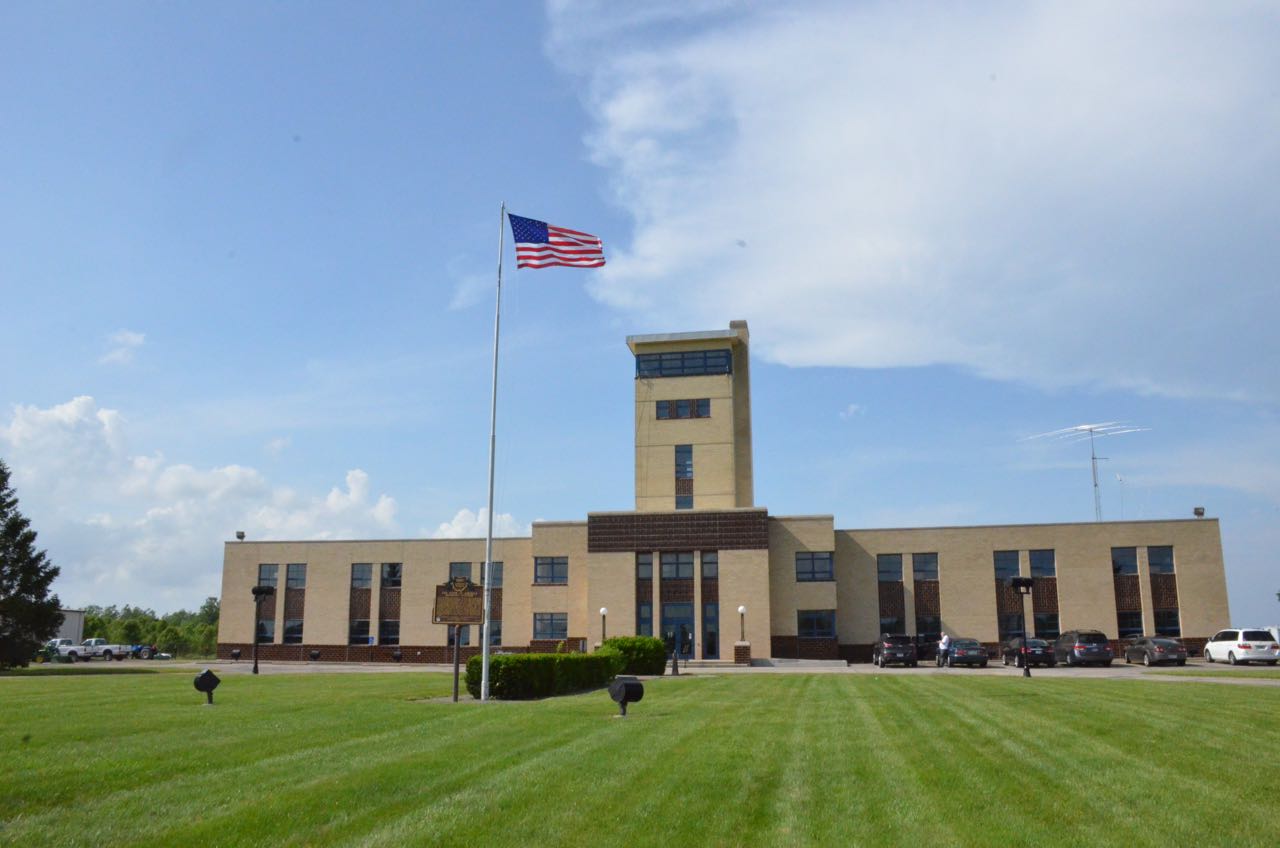
Edward R. Murrow Transmission Site near Greenville, North Carolina

(Source: BBG Press Release via Dan Robinson)

FY 2018 budget request reflects key BBG priorities amid spending constraints

WASHINGTON, D.C. — The Broadcasting Board of Governors today released the FY 2018 budget request to support key U.S. foreign policy goals by providing news and information around the world while accommodating the current tight fiscal climate.

“As is true throughout the federal government, the budgetary environment requires that we prioritize our resources while emphasizing impact and maintaining the level of excellence our audiences have come to expect,” said CEO John F. Lansing. “Despite reductions in spending, we are committed to our mission, impacting the lives of hundreds of millions of people around the world by providing accurate, unbiased, and uncensored news and information.”

The tight fiscal environment necessitates BBG to improve operational efficiencies and make difficult resource trade-offs to effectively meet performance goals and support U.S. foreign policy priorities.

The $685.1 million budget request includes transmission, program and staffing reductions across all BBG networks—the Voice of America, Radio Free Europe/Radio Liberty, the Office of Cuba Broadcasting, Radio Free Asia, and the Middle East Broadcasting Networks—and the International Broadcasting Bureau, including the Office of Technology, Services and Innovation. This includes reducing, and in some cases, eliminating certain language service capacities; shifting away from shortwave transmissions where they have the least impact; and optimizing information technology.

Although the funding request represents a 12.9 percent reduction from the FY 2017 enacted budget, it prioritizes funding for U.S. foreign policy goals, including combatting violent extremism, countering Russian disinformation, and enhancing programming for North Korean audiences. It also capitalizes on the momentum gained from the streamlining of operations in 2016 and the aggressive shift to digital already underway at each of the five networks.

The request includes $680.4 million for International Broadcasting Operations, including Federal and non-Federal networks, as well as $4.7 million for Broadcasting Capital Improvements.

The FY 2018 budget request contains proposals to continue the agency’s responsive shift to the most effective media platforms, respond readily to crises, keep pace with shifts in audience demographics and interests, and sharpen strategy and results measurement to drive performance.

BBG’s extensive network of seasoned, professional and well-connected journalists is particularly strong in regions where ISIS, Russia, Iran, China and other global actors that do not share American values are attempting to make further inroads.

“Should Congress enact this budget, there is no doubt that staff reductions would be difficult,” Lansing said. “We will do everything possible to minimize the effect on our employees by emphasizing attrition, early retirement opportunities, and agency buyouts for federal employees wherever possible. Our staff and journalists are the core of what drives our impact around the world. We will do everything we can to safeguard our greatest asset.”