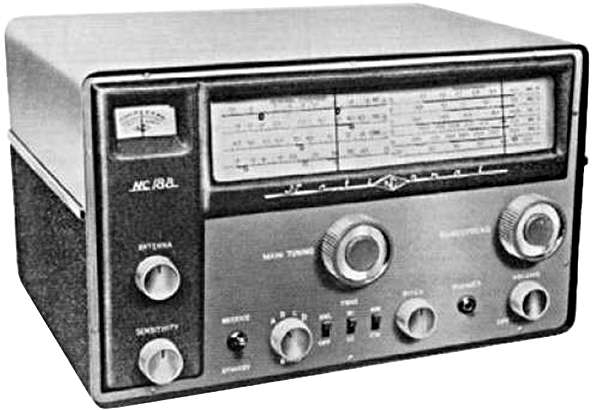
National NC-188
As recalled by Bob Colegrove
Uncle Clayton was my very first SWLing buddy. In the late ‘50s there was no Internet – very few ways for SWLs to interact with one another. There were clubs that published mimeograph bulletins every month or so. These were mailed to SWLs across the country and around the world. To come across a fellow SWL in your own town was rare. As chance would have it, Uncle Clayton and I quite independently discovered our interest in SWLing about the same time, and then only after knowing one another for several years.
Uncle Clayton was not my real uncle. He and his wife, Evelyn, were dear friends of my mother and father. You see, there was a social decorum at that time which frowned upon members of the younger generation from referring to members of an older generation by their first name. At the same time, “Mr. Smith” and “Mrs. Smith” (not their real surname) were regarded as unnecessarily formal; so, for this situation “Uncle Clayton” and “Aunt Evelyn” became the accepted form of address.
My story begins with television, not radio. By mid-1950 both the Smiths and the Colegroves had acquired their first black and white TV “sets,” theirs a 12-inch RCA and ours a 12-inch Arvin. Each of these occupied 8 to 12 cubic feet of space and required two well-fit individuals to move them. Ironically, they were termed “portable” in that they required a low table or stand for proper positioning. This contrasted with “console” models which incorporated the stand and the TV in a single cabinet.
One must understand that television at that time was what computers would become a generation later. The nation was on the cusp of a TV frenzy. My dad and Uncle Clayton jumped into it with both feet. They couldn’t let the darn things alone. Antennas were the most obvious source of tinkering. “Rabbit ears” were the customary solution but adjusting them was a skill rivaling that of playing a cello. Later, attic designs were fabricated for the new channel in Bloomington, Indiana.
Vaccum tubes, both necessarily and unnecessarily, became questionable components, and Uncle Clayton and my dad developed well-stocked arsenals of spares. In retrospect the pair were, well…a couple of hacks, and I say that lovingly. Picture two large, middle-aged men behind the RCA with the back cover off alternately trying to get a 9-pin peanut tube aligned and reinserted into its socket in the very front of the chassis – all this while trying to avoid the high-voltage discharge from the picture tube. I still recall the looks of frustration and muffled puffs of blue air. After some time, Aunt Evelyn appeared, looked over the dilemma, grabbed the tube, and jabbed it into the socket on the first try.
SWLing came along several years later. I discovered it in the fall of 1958 while idly tinkering with the Howard Radio Co. Model 308 radio-phonograph console, which by that time had been relegated to the basement. After moving it to my room and stringing up a long wire I was forever captivated. The single SW band covered 5.5 MHz through 18 MHz across a dial a mere four inches long. I milked that old radio relentlessly finally coming up with about 20 or 30 SW broadcast stations, all in English.
I have no recollection of how Uncle Clayton and I discovered we were going down the same path. He had already purchased his National NC-188 with a matching speaker and set up his shack in an unused upstairs bedroom. How I envied him. His NC-188 was everything I envisioned in a SW radio. I was still earning my way towards purchasing a Hallicrafters S-38E.
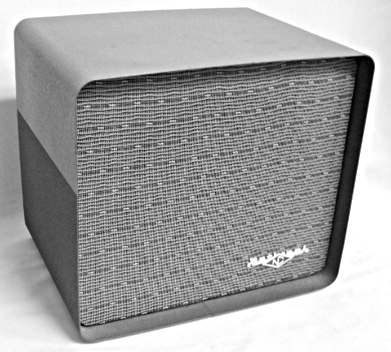
National NTS-1 Speaker for the NC-188 and NC-109.
Better radios had separate external speakers, the claim being that there was insufficient space in such feature-packed units
Uncle Clayton’s NC-188 was my first encounter with a bandspread – a term which has virtually gone out of existence. I immediately knew what it did, but it would take me a while to understand just how it worked. On my old Howard console, the dial pointer travelling less than a 16th inch could cover 100 kHz or more, conceivably containing 10 or 20 stations. Furthermore, this range was traversed by a nearly imperceptible rotation of a small knob. Conversely, the NC-188 might cover the same tuning range over a space two inches long and require four full rotations of a 2-in diameter knob. That was an incredible mechanical advantage.
For SWLs, there was a restriction on the use of the bandspread. Most receivers had scales neatly calibrated for the 10-, 15-,20-, 40-, and 80-meter ham bands. This provided reasonable frequency readout – not the precision we have with today’s digital radios, but close enough. For international broadcast bands, the listener had to rely on a 0 to 100 linear logging scale which bore no relation to frequency. This required the listener to generate several lists or graphs translating log readings to frequency.
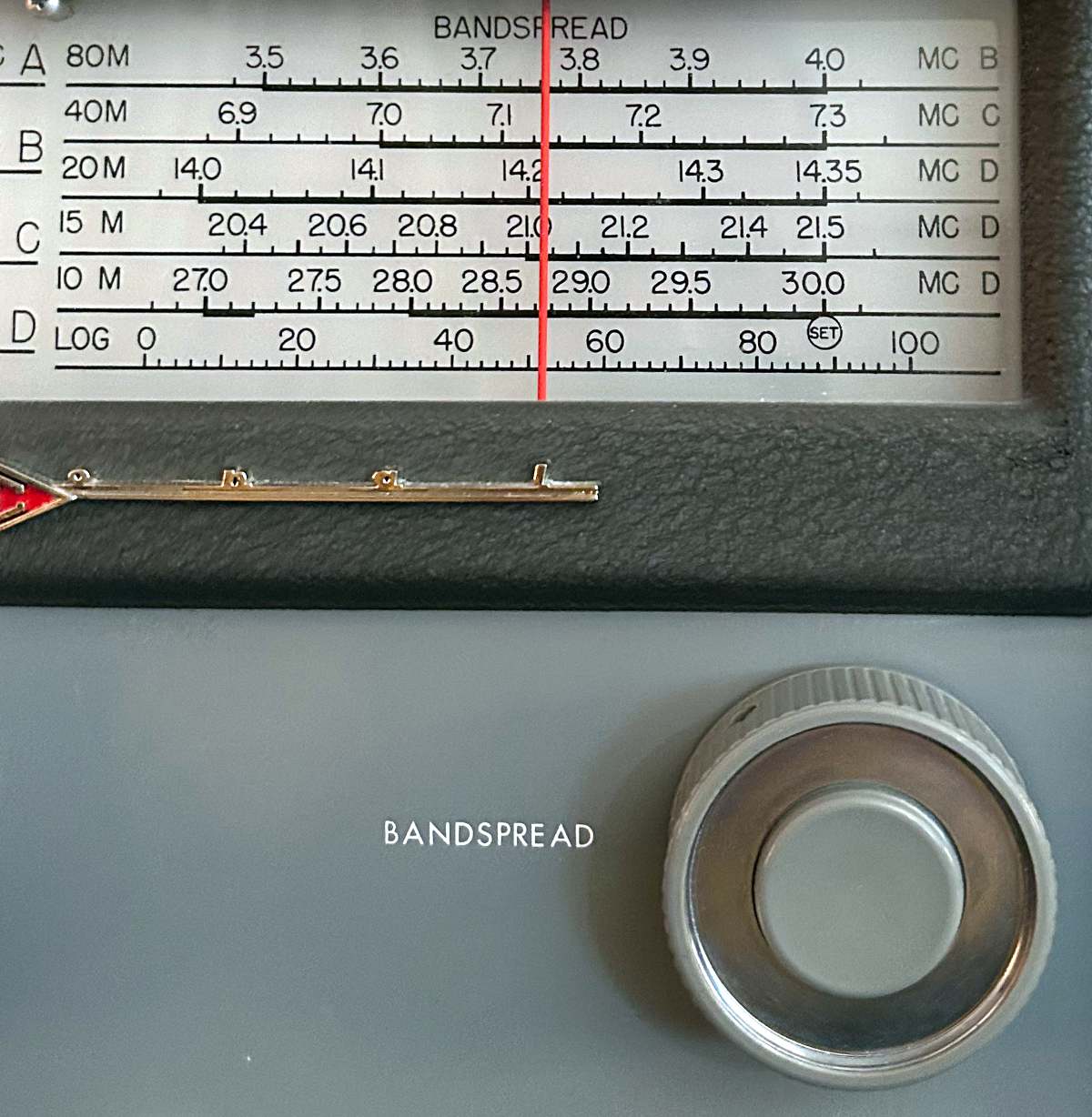
The NC-188 and -109 had 4.5” bandspreads, not as long as some, but the 2” knob required 9 full rotations to traverse end-to-end.
Everything I have described so far depended on the position of the main tuning dial. The bandspread operated electronically in parallel with the main tuning. In short, the main tuning dial had to be positioned precisely at the high end of the tuned band for the bandspread to produce the same results. Within these restrictions, a bandspread was still a marvelous device.
Uncle Clayton and I were still in our formative SWLing period when our family would visit him and Aunt Evelyn. I remember him patiently tuning across portions of the SW spectrum oblivious of the international band boundaries slowly rotating the main tuning dial and stopping at points that interested him. When my turn at the helm came, I would often seek out the General Overseas Service of the BBC and listen to the football scores or Victor Sylvester and his Ballroom Orchestra.
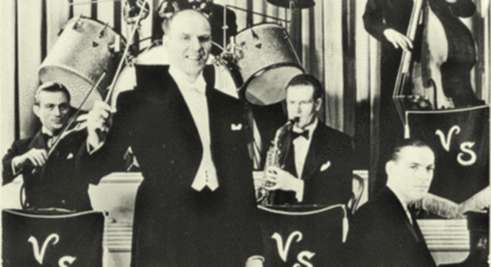
Victor Silvester conducting his Ballroom Orchestra in 1938. His orchestra was still a fixture on the BBC in the ‘50s and ‘60s. Source: Victor Silvester and His Orchestra – You’re Dancing on My Heart
Neither Uncle Clayton nor I set the bar very high in terms of DXing prowess. We had fun and made a lot of interesting discoveries. Isn’t that what it’s all about?
Some years ago, I had the opportunity to buy a fairly clean National NC-109. The -109 is an upscale version of the -188. It has a crystal filter, an early SSB product detector and a voltage regulator. Otherwise, the two radios are virtually identical. I did all the usual things, cleaned it up, performed an alignment, and restrung the main tuning and bandspread dial cords. Later I found a matching speaker. When I was finished, I had what I regard as a museum-quality radio. It occupies a prominent corner of the shack, but I don’t operate it that much. Sometimes I just sit in front of it, spin the dials and remember Uncle Clayton and how it all started.
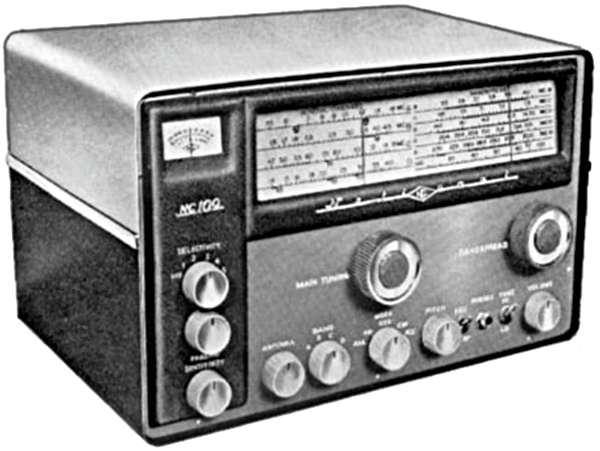
National NC-109