Author Archives: Thomas

Radio Waves: What Listeners Like, Renaissance of Radio, WOR in Photographs, DIY Faraday Cage

Radio Waves:  Stories Making Waves in the World of Radio

Welcome to the SWLing Post’s Radio Waves, a collection of links to interesting stories making waves in the world of radio. Enjoy!

Many thanks to SWLing Post contributors Dennis Dura, Mark Erdle, and Jock Elliott for the following tips:


‘It’s what listeners like’: AM radio purveyors on the Palouse hope automakers heed call to keep their medium alive (The Spokesman-Review)

The rolling, green-turning-golden hills just outside Steve Shannon’s studio window at the offices of Inland Northwest Broadcasting north of downtown Moscow aren’t just pretty to look at.

They’re also the reason the AM radio dial remains important in this expansive, rural stretch of the country.

FM broadcasting is based on line-of-sight, but the pesky thing about AM waves is that they pass through anything, Shannon explained. And they reach a monthly audience that’s still more than 82 million strong across the country, most of them in areas just like the Palouse, according to a fall 2022 survey by broadcast tracking company Nielsen.

“People are tuning in to AM because they are listening to content they can’t get anywhere else,” said Shannon, operations manager for the group that is behind six stations on both the AM and FM dial broadcasting in Moscow and Colfax.

The future of the format seemed in jeopardy just a few short weeks ago, when broadcasters convened in Washington D.C. and pushed federal lawmakers to pressure carmakers who were pondering an end to AM receivers in new cars. Electric vehicles, growing in popularity and headed for a likely continued boom, especially with Washington outlawing the sale of new gas-powered cars beginning in 2035, create interference with a signal that can make AM transmissions difficult to hear, according to automakers.

That pressure, which included the introduction of legislation that would have required manufacturers to install AM receivers in new cars, appears to have made the point. In late May, Ford’s chief executive officer announced on social media it had reversed course and would provide the service in all 2024 Ford and Lincoln models after planning to remove it from some models because of higher costs and lack of listeners. [Continue reading…]

The renaissance of AM radio: a confluence of social, regulatory and technical revitalization (Cardinal News)

AM radio, a pioneering force in the world of broadcast communications, has for several decades been an essential medium for disseminating information and entertainment. However, its appeal has been progressively diminishing due to social, regulatory and technical challenges. Nevertheless, this scenario presents an opportunity for a significant revival.

The decline of AM radio can be traced back to significant changes in content, notably the reduction in locally focused programming. Many AM station owners made strategic decisions to move away from content that directly catered to local communities, often replacing local news, events and issue discussions with syndicated programming. These changes left a void of locally relevant content, reducing listeners’ connection with stations.

The Federal Communications Commission’s abolition of the Fairness Doctrine in 1987 exacerbated the situation. This doctrine, which required broadcasters to present contrasting views on controversial issues of public importance, ensured a balanced discourse on the airwaves. Its repeal led to increased broadcasts favoring extreme political views, either heavily liberal or conservative. While this trend may have appealed to specific audience segments, it risked alienating listeners seeking balanced discourse.

Compounding these programming shifts, religious content on the AM band has considerably increased. While serving an essential audience, the sheer volume of these broadcasts reduced the variety and balance of programming, possibly leading potential listeners to turn away. [Continue reading…]

Radio Station WOR in Photographs – 1939 (AWM on YouTube)

In 1939 photographer Ralston B. Collins made a photo album of metro New York radio station WOR. This album is from the J. R. Poppele Collection at the Antique Wireless Museum.

Building a Simple Faraday Cage, by OhioGalt (SurvivalBlog.com)

This article describes the effects of EMP and CME and how to build a simple inexpensive Faraday cage.

Most readers of the SurvivalBlog are aware of the potential damage from either a Coronal Mass Ejection (CME) or an Electromagnetic Pulse (EMP) and the impact on everyday electronics. With an EMP, an electromagnetic pulse is generated at high altitudes from a nuclear explosion damaging sensitive electronics. A CME damages electronics in a similar way with the release of a large solar flare from the sun reaches carrying magnetic fluxes and plasma toward earth. These magnetic fluxes interfere with Earth’s magnetic fields and create current surges in power systems and electronics. As of this writing, there is several C and M class flare activity causing some Amateur Radio blackouts on the lower bands. To follow active solar weather visit Spaceweather.com. [Continue reading…]


Do you enjoy the SWLing Post?

Please consider supporting us via Patreon or our Coffee Fund!

Your support makes articles like this one possible. Thank you!

TomL’s Guide to Using Computer Audio PlugIns with Older Radios

Many thanks to SWLing Post contributor, TomL, who shares the following guest post:


Using Computer Audio PlugIns with Older Radios

by TomL

Older radios have a way to get audio out to speakers or another audio input device, usually just a headphone jack.  Software for processing audio are plentiful and very useful tools, called VST’s.  Furthermore, most Plugins were made for Musicians needing full frequency spectrum capability.  I will use my Kenwood TS-590S amateur radio as a test case.  I have used its speaker output to a cheap Behringer UCA-202 RCA to USB converter (it has its own volume control to keep it from overloading).

Amazon Link: Behringer UCA202

My Windows 10 Sounds Properties sees this audio as “3-USB Audio CODEC” which I have enabled on a physical USB hub with individual power switches for each port.  Thanks to Steve (K1GMM) and his YouTube channel (K1GMM Green Mountain Maniac) for describing how to use Windows plugins for processing either Receive or Transmit audio.  This article only focuses on Receive audio.

For my simpler needs, I have chosen to use VST Host.  It will run the small “apps” that usually have a file extension of .VST or .DLL.  I downloaded it right from Steve’s website:

https://kc1egu.wixsite.com/essb-ham-radio/copy-of-icom-ic7300-others

I then downloaded a number of plugins suggested by Steve on his web site (“More” Menu pulldown, DAW’s/VST DOWNLOADS).  Each VST file can be copied to a central directory/folder on your computer and all read from the same place inside the VST Host.  Most of these are Windows types but there are some for Linux if that is something you use.  I found that VST Host does NOT like a write- protected directory, so it and the VST’s reside in my top-level Documents directory.

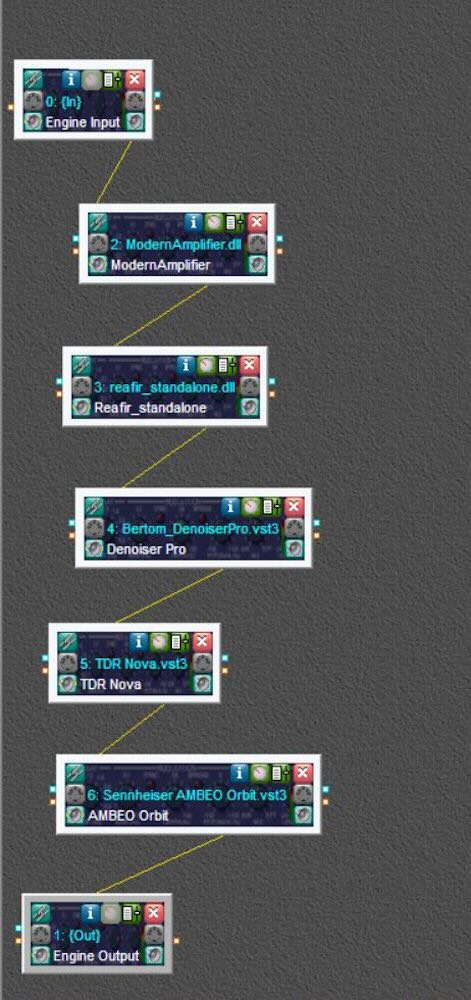
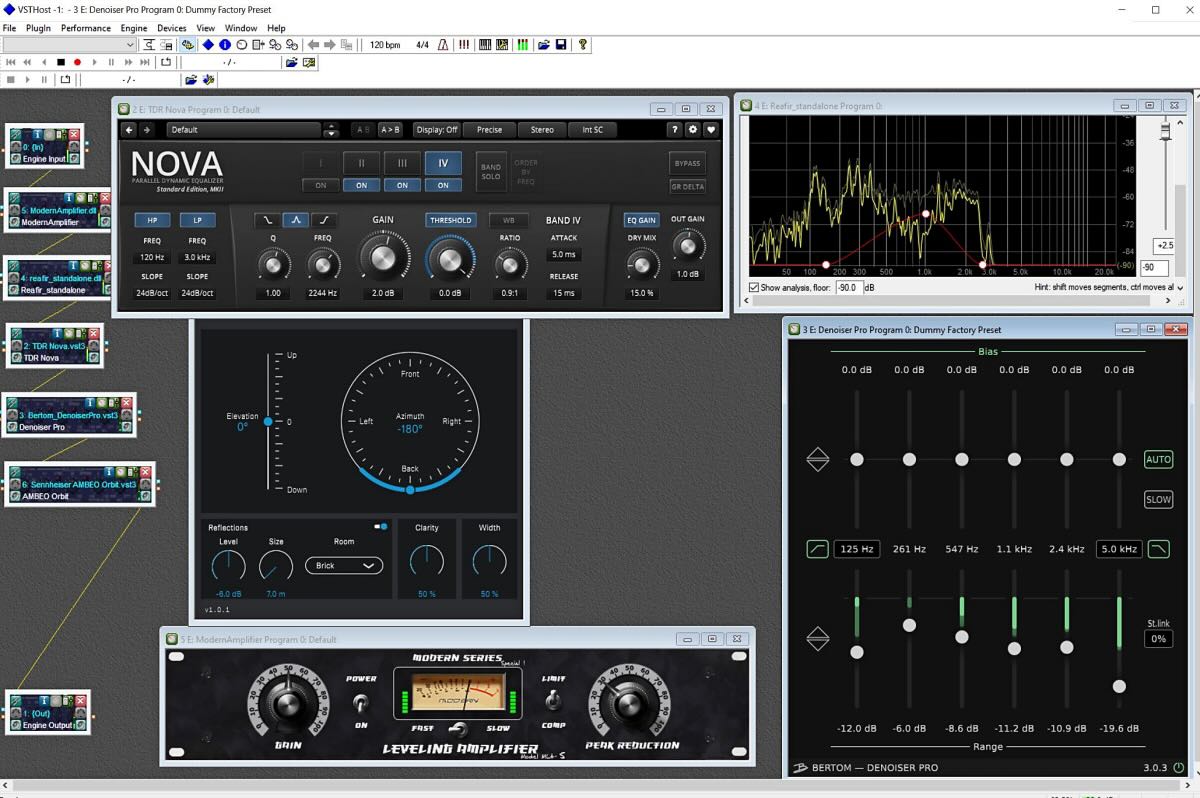
My resulting “chain” of VST’s process the audio from my 3-USB Audio CODEC in a sequential manner, which are:

  • ModernAmplifier (a Limiter to keep strong signals from overloading the processing)
  • ReaFir (an interesting “Subtract” feature where I cut down on the “roar” around 800-1200 Hz)
  • Bertom Denoiser Pro (EXCELLENT static & background noise reducer)
  • TDR Nova (a powerful, well-made Compessor & DynamicEQ combo)
  • Sennheiser-AMBEO-Orbit (a Binaural soundscape).

Once VST Host is installed, create a separate folder for the VST files.  Now just copy the VST3 or DLL file for each of the apps downloaded like the ones I list above.  If you have a 32-bit version of Windows, you will have to use the VST’s that are 32-bit, not 64-bit.

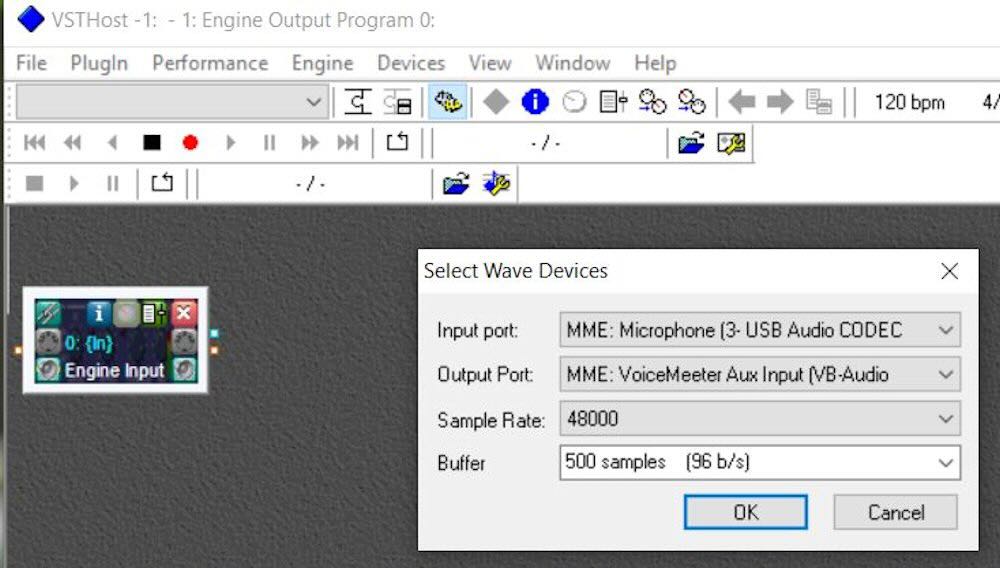
In VST Host, set the Wave Input and Output and sampling rate (Menu: Devices—Wave).  In my case it is the aforementioned 3-USB Audio CODEC for (Microphone) Input Port and VoiceMeeter Aux-Input for the Output Port.  The sampling rate is set to 48000  (You can choose Output to your “Default Speakers” which should be in the list if you do not use an extra mixer software like I do).

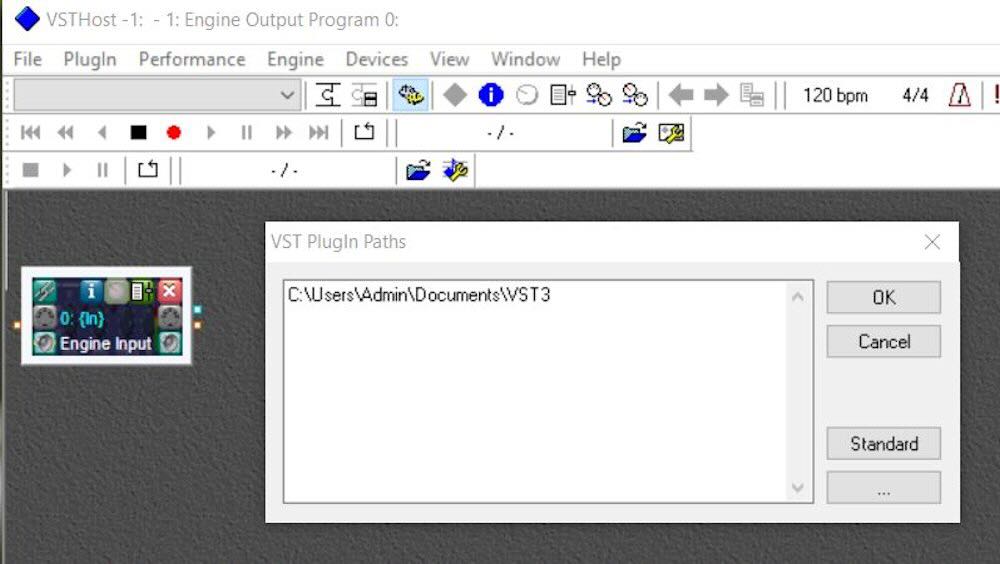
Now, go to Menu: File, Plugins and load each plugin that you want to use.  The VST3 or DLL files should all be in the same directory that you made earlier.  You may have to tell VST Host where to find them by setting the Plugin Path (Menu: File, Set Plugin Path…).

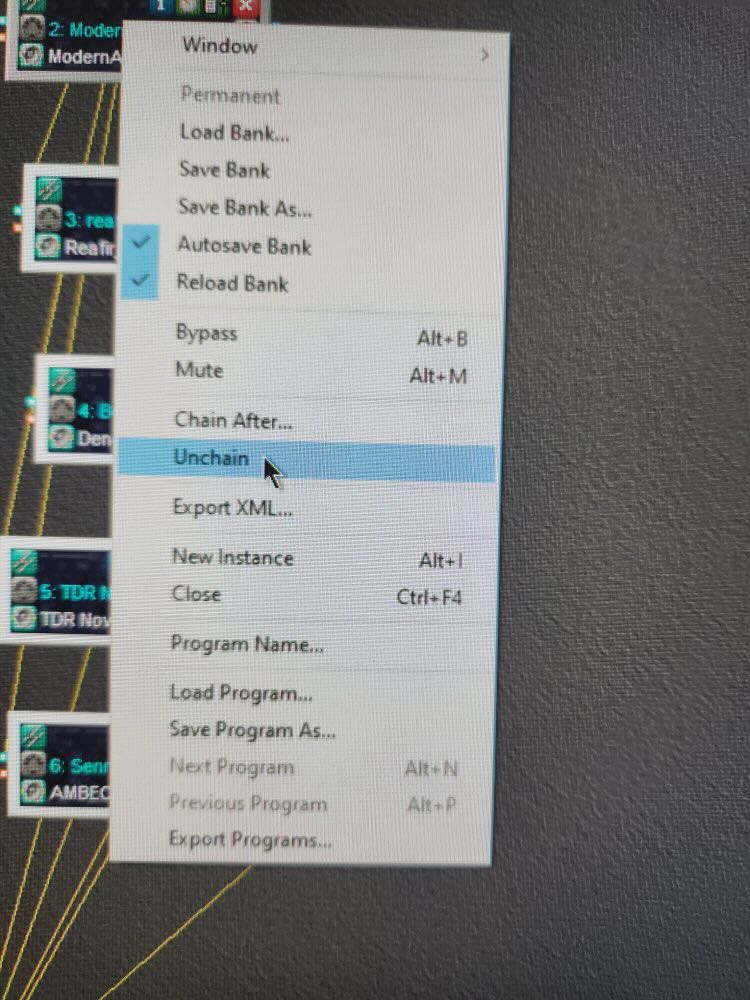
Now, once you have all the VST apps opened, you will notice that all of their individual outputs go directly to the VST Host Output.  Not good, since your computer will not have enough cores to parallel-process all of these apps at the same time.  So, Unchain them all by right-clicking on each app and choosing “Unchain”.

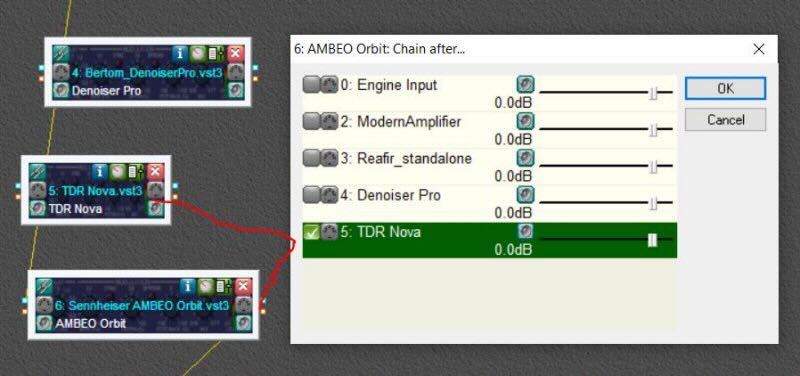
Now you will see all of the yellow connecting lines gone.  Arrange (click/drag) each app in sequential order on the screen.  Starting from the bottom up, right click on the app just above VST Output and choose Chain After…

Repeat up the chain, choosing the one above it to Chain After until you are left with a Daisy-Chain of apps, each output going to the Input of the next app in your desired order of processing:

Now turn on the radio to get audio going through the chain of apps.  Tweaking each app is part of the tedious process of learning if an app will help or not.  Just replace and Chain After in the order you want with other VST apps that you find more helpful.  Tinkering with this should yield some satisfactory results if you do not overdo applying features in each app.  To save the layout and VST settings, go to Menu: Performance, Save As and give it a name to store in the data file shown (just a name since it will put it into the default line 000 for you).  You can choose this in future sessions from the main pulldown Menu below File. (Note: It is called “Performance” because this stuff was written for Musicians to save their home studio music along with the settings for shaping the music tracks; 99% of planet earth calls this a “Layout”, a la, Microsoft Office)

Here are two examples of sound from the radio without processing and then adding in each app over a few seconds.

LZ1AA from Bulgaria. Processing 10 secs., off 15 secs., on again 8 secs.


CHU Canada. Processing on, space, processing off. Notice a little “water” effect since AM Broadcast needs quite different settings compared to SSB Ham Radio.

You can check out Steve’s “Green Mountain Maniac” YouTube channel and see for yourself what can be done with sound processing for Radio.  Some of his techniques can be used with old shortwave radio receivers as long as it has a working headphone jack or AUX Out jack:

K1GMM-RXDAP VST HOST YouTube video

Cheers and Happy Listening,

TomL

Don Moore’s Photo Album: The Museums of Galicia

Many thanks to SWLing Post contributor, Don Moore–noted author, traveler, and DXer–for the latest installment of his Photo Album guest post series:


A Coruña coast

Don Moore’s Photo Album: The Museums of Galicia

by Don Moore

Some of my favorite sites to visit while traveling are historical, marine, and military museums. I’ve always been interested in those subjects and sometimes those kinds of museums have a few old radios on display. That makes a nice bonus to the visit. Last year, I spent May and June traveling all over Spain (with some short excursions into neighboring countries). One of my favorite regions was Galicia, where I stayed for five nights in the capital of A Coruña and six days in a rural village to the east. And the museums of Galicia had some of the most interesting radio-themed items I’ve ever seen.

Galicia is that small region of northwestern Spain directly north of Portugal. It was part of the Celtic world (along with Brittany in France and the British Isles) and the coastline was home to Phoenician and Greek settlements. It later came under Roman rule along with the rest of the Iberian Peninsula.

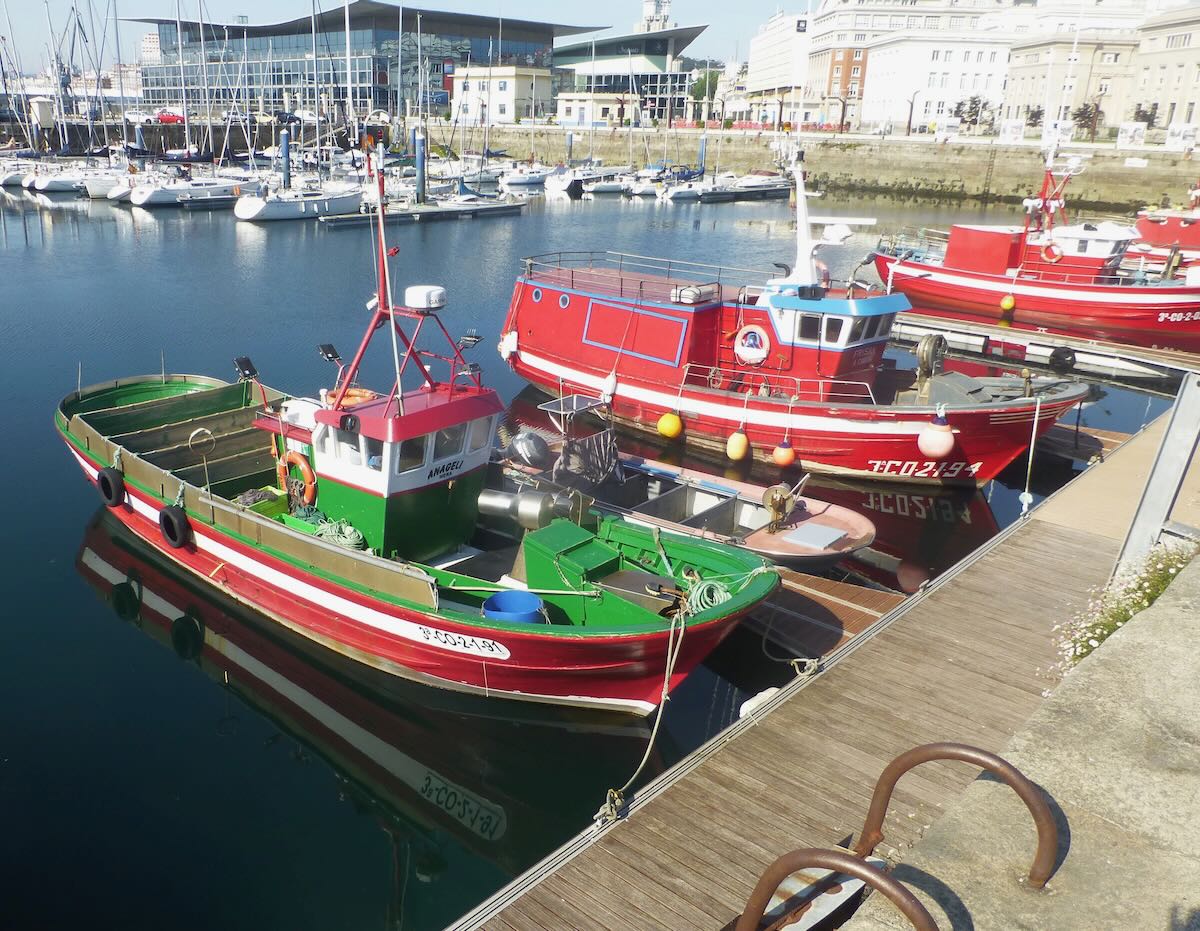
A Coruña Fishing Boats

A Coruña Fish Market

Spanish is spoken everywhere but the people are proud of their native language, Galician or Gallego. The language looks and sounds like Portuguese with a lot of Spanish influence but is actually older than either of those. Some linguists believe that Portuguese was derived from Galician.

The rugged Galician coast is one of the most beautiful I’ve ever seen with its numerous bays, estuaries, steep hillsides, and rocky shore. Most of Spain is arid but Galicia is one of the rainiest parts of Europe so the countryside is green and lush. And because of the neighboring cold Atlantic Ocean, temperatures remain comfortable even when the rest of Spain (and places further north) are baking in the summer heat.

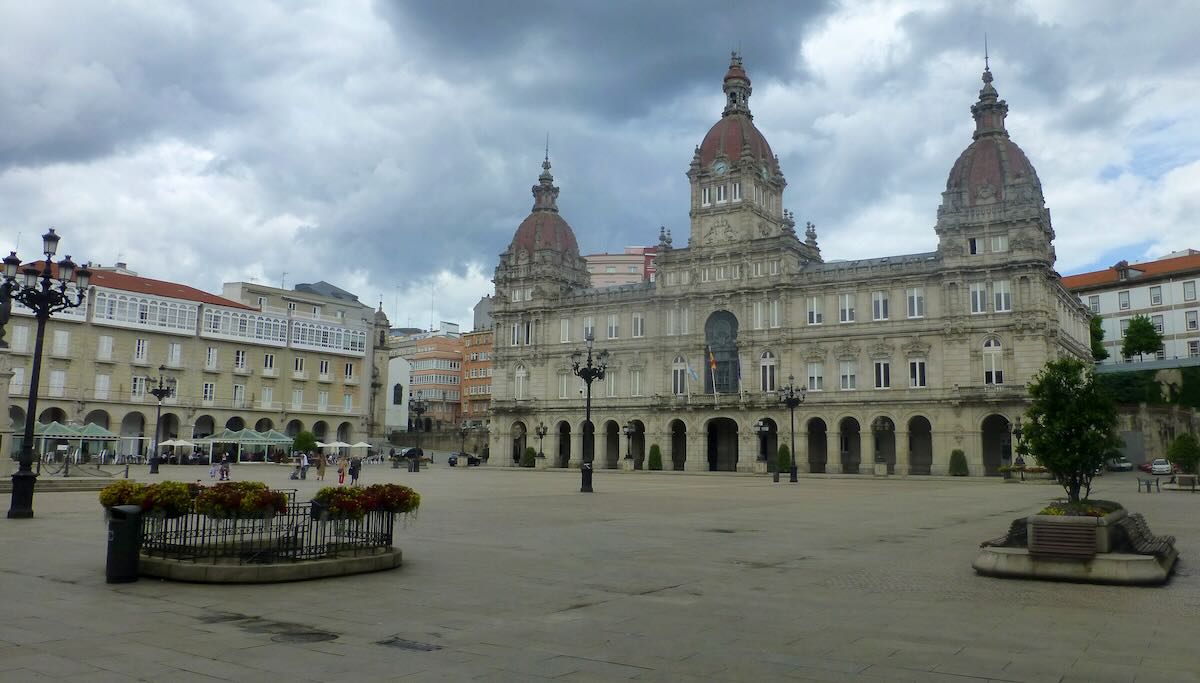
A Coruña City Hall

MOON RADIO

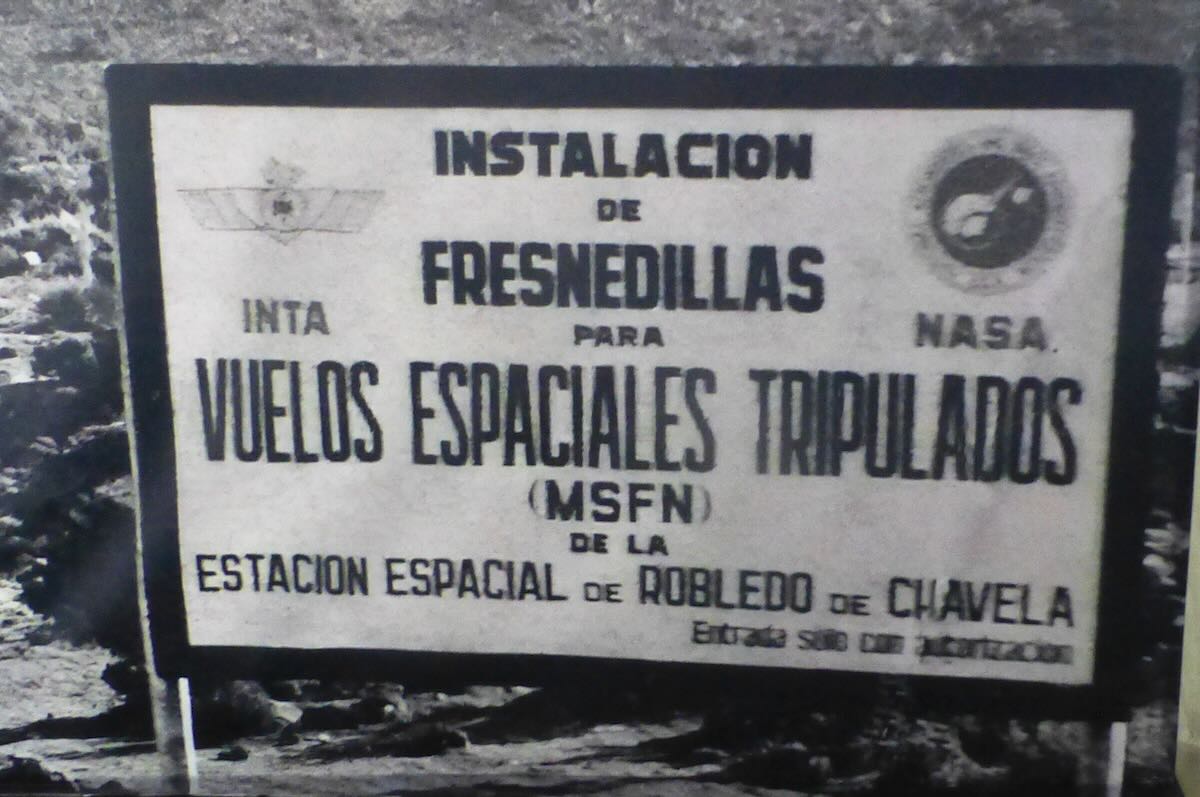
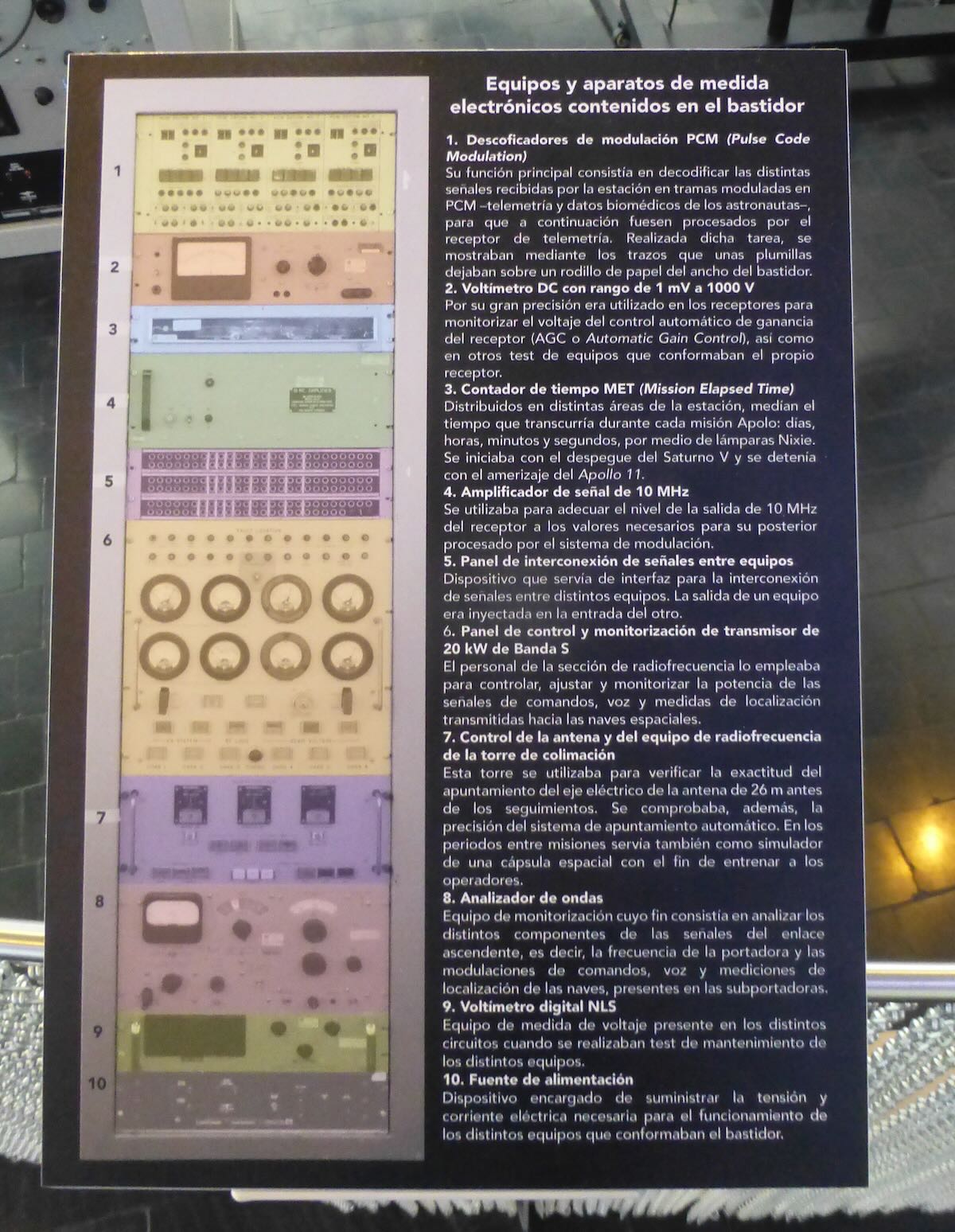
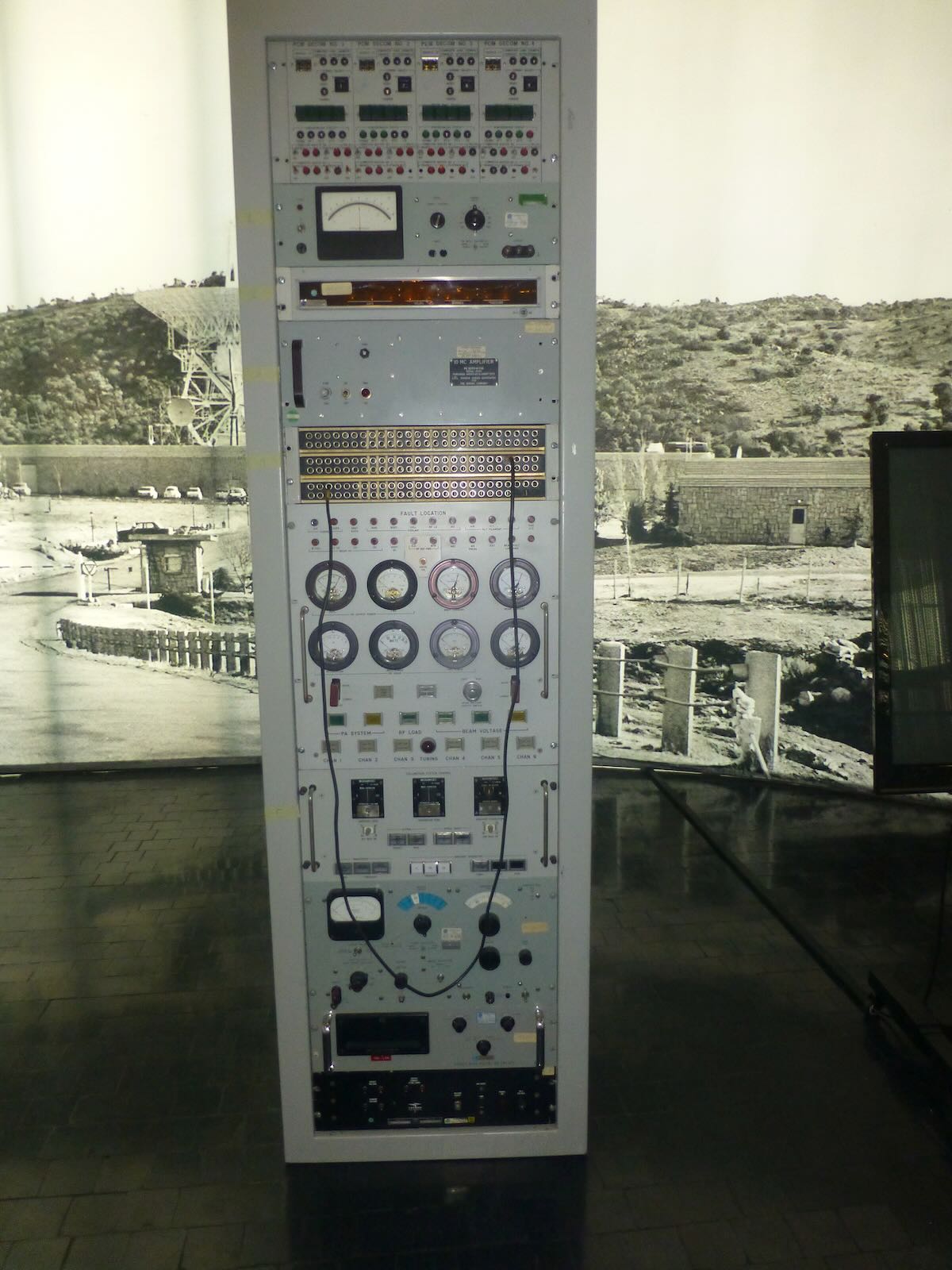
One of the first places I visited in A Coruña was the Museo Nacional de Ciencia e Tecnología on the west side of the harbor. The very first display in the museum is a piece of radio history like no other. In the 1960s NASA set up a network of communication stations around the world to maintain constant contact with the Apollo moon missions. The primary stations were located in rural California, near Canberra in Australia, and in the little village of Fresnedillas outside Madrid. When Neil Armstrong and Buzz Aldrin landed on the moon in 1969 Madrid was facing towards them and received the first radio transmissions from the surface of the moon. This museum has one of several redundant radio racks that were used to receive that historic broadcast.

After visiting the museum I wandered uphill to Monte de San Pedro Park, the best place in A Coruña to view the city and harbor. Those heights were also once vital to the city’s defenses and the park contains several mothballed gun turrets built in the 1930s. Continue reading

Radio Waves: FCC Comments on Shortwave Trading, QTC eBook, Golden Years, and SDRconnect Demo

Radio Waves:  Stories Making Waves in the World of Radio

Welcome to the SWLing Post’s Radio Waves, a collection of links to interesting stories making waves in the world of radio. Enjoy!

Many thanks to SWLing Post contributors Ron Chester, Benn Kobb, Chuck Rippel, Pietschman, Dennis Dura, and Dave Zantow for the following tips:


“Market Makers” Want to Expand Their Use of Shortwave (Radio World)

The FCC seeks comments on a proposal to use HF spectrum for financial data

The FCC is taking public comment on a proposal to revise the rules governing the frequencies above 2 MHz and below 25 MHz.

The Shortwave Modernization Coalition thinks the 2-25 MHz band is underused and wants to use it for the long-distance transmission of time-sensitive data from fixed stations. The users would be companies working with certain kinds of financial transactions; the proposal would prohibit voice transmission and mobile operations.

The firms in the coalition are “market makers and liquidity providers” for exchange-traded financial instruments.

This high-frequency trading industry has in fact been using shortwave links for several years to send trading data between U.S. and foreign exchanges, but it has done so under experimental authorizations. [Continue reading…]

QTC: I Have a Message for You (Archive.org)

Many thanks to Bill Pietschman who notes that the book “QTC: I Have a Message for You” has now been published on Archive.org for all to read and download free of charge. Bill writes:

I knew Ray Redwood, and besides being a Professional radio operator, he was indeed a Ham’s Ham. You will find here not just the story of radio, but a detailed analysis of the Titanic, from a radioman’s point of view. Part documentary, part autobiography, and part technical, it’s a great read. I’m so glad that his work has been preserved here. Future radio historians will, I am certain, find it to be a valuable record of the Ship Radio Officers Era, and Ray’s insights at the dawning of the Global Maritime Distress and Safety System as we have today which utilizes satellite technology.

Click here to check out QTC: I Have a Message for You on Archive.org.

The Golden Years of Shortwave Listening (YouTube)

There was a time, some 50 years ago when cell phones didn’t exist and computers were only owned by large corporations, that people learned of the world around them by listening to shortwave radio. This is a journey back to that time to hear the sounds and see the correspondence from shortwave stations from all over the world. Sit back, listen and enjoy!

SDRplay and SDRconnect – The Update! – Dayton Hamvention (YouTube)

Steve Brightman (KI5ENW) from SDRplay demonstrates the new updates to SDRconnect to Ham Radio Outlet’s Julian Frost (N3JF).


Do you enjoy the SWLing Post?

Please consider supporting us via Patreon or our Coffee Fund!

Your support makes articles like this one possible. Thank you!
BBC Kranji shortwave relay station to close July 16, 2023

Many thanks to a number of SWLing Post contributors who have reached out about a report on AWR Wavescan regarding the closure of the BBC Kranji relay station in Singapore.

I contacted AWR Wavescan host, Jeff White at WRMI, and asked for any details he might have since I could not locate any press release from the BBC or Encompass.

Jeff shared the following notice from AWR Wavescan:

Another shortwave station is about to go off the air for good also. Encompass TV reports that the BBC relay station that Encompass operates in Kranji Singapore will cease operation as of July 16th, after many decades of service. This will result in a reduction of BBC English transmissions to South Asia. Some transmissions from Kranji will be moved to other shortwave transmitter sites.

Many thanks for the info, Jeff.

We’ll post more details about the closure as they become available.

Returning to Shortwave: From the Isle of Music, Uncle Bill’s Melting Pot and Ginga Brasil!

Many thanks to SWLing Post contributor, Bill Tilford, who shares the following announcement:

From the Isle of Music, Uncle Bill’s Melting Pot and Ginga Brasil! Return To Shortwave

On August 6, From the Isle of Music, Uncle Bill’s Melting Pot and Ginga Brasil! return to shortwave on WBCQ The Planet, 7490 kHz. These programs will share the hour of Sundays 6pm-7pm Eastern US Time (currently 2200-2300 UTC) as follows:

1st Sunday – From the Isle of Music
2nd Sunday – Ginga Brasil!
3rd Sunday – Uncle BIll’s Melting Pot
4th Sunday – Ginga Brasil!
5th Sunday – varies

From the Isle of Music and Uncle Bill’s Melting Pot are both produced and hosted by “Uncle Bill” Tilford in the United States. Ginga Brasil! (pronounced “Zheenga”) is produced and hosted by Julio Cesar Pereira in Brazil. These stellar international music programs will immediately follow one of WBCQ’s flagship programs, Marion’s Attic, which airs Sundays 5-6pm Eastern Time (currently 2100-2200 UTC); they also precede Harry Shearer’s Le Show for a solid three hour block of quality entertainment.

Op Ed: “OK, but why shortwave?”

Many thanks to SWLing Post contributor and host of Underground Sounds, Kelsie, who writes:

Why Shortwave?

by Kelsie

A question I’m regularly asked when talking about our radio show, and radio in general, is why choose independent radio rather than publishing a podcast or streaming playlist?
The answer is not a simple one, but I feel that it’s a powerful one.

Streaming services have made it far easier for new and independent artists to publish music, but publishing is only the first step in exposing new music to a potential audience. The age old problem faced by artists and publishers since the commercialization of music, remains – how does an artist or label get their new music heard?

The sad truth is that the vast majority of artists publishing their music on streaming services such as Spotify, Apple Music, or Tidal, etc., will not get what they’re really looking for, and that’s exposure.

Streaming services present content to their users based on a limited form of mathematical artificial intelligence known as an algorithm. Algorithms work by correlating searches by users with the content of their saved playlists. If users do not know that those new songs exist and have not searched specifically for them, the streaming algorithms will not have enough data on the new releases to suggest them to a wider audience who might like them. As a result of this, people who use streaming services are not exposed to a variety of musical styles and genres, unlike those of us who grew up when terrestrial radio was the dominant format.

While terrestrial radio may still be unencumbered by algorithm-generated playlists, commercial FM and satellite radio have effectively homogenized them over the years, resulting in a similar impact to musical variety. There was a time when radio stations used to allocate time slots for shows hosted by DJ’s that played different genres and styles of music on the same frequency. Since about 2010, the DJ format has become practically extinct.

Most radio stations today play a limited selection of songs and artists based on agreements with the traditional recording industry, resulting in very little variation from station to station at any given time of day. Both frequent listeners of FM or satellite radio can attest that the same songs and artists are played daily, even if they’re played in a different order, and even switching from one station to another during a song will oftentimes result in the listener hearing a different song by the same artist on the other station. This is only getting worse now that the majority of radio stations within the United States are owned by only two major corporations.


The lack of musical variety listeners are exposed to on commercial radio and streaming services lead me to the first part of my answer:

Independent radio is not subject to the homogeneity of commercial radio or streaming services.

This is largely due to the fact that instead of playlists or algorithms, independent stations are usually focused on the communities they serve, and tend to still produce individual shows tailored to different genres and interests. Tuning in at different times of the day exposes listeners to music they just wouldn’t have heard on other formats. Not everyone will like the same songs or artists, but there is usually something for everyone and a priceless opportunity to expand one’s musical horizons.

An explanation of this usually leads to the question, “OK, but why shortwave?”, or, “Isn’t shortwave dead?”

Here is where answer is is a little more complicated.

I’m sure, at least for myself, part of the decision to utilize shortwave broadcasting is based in the nostalgia of listening to broadcasts from all around the world as a child at the peak of the Cold War in Europe, hearing songs in languages I did not understand, often in keys and rhythms unfamiliar to a Western ear, and my particularly fond memories of listening to relays of Casey Kasem’s weekly Top 40 show from back home. As a former musician myself, and an avid shortwave listener who likes to restore vintage radio receivers, I still have almost that same level of excitement when I hear musical styles that I haven’t been exposed to before, and I want to share that with anyone in the world with an ear to listen.

This being said, the most important component of my answer comes down to accessibility.

Shortwave broadcasting is accessible. While independent radio may provide the only remaining viable format for exposing listeners to music from outside the corporate mainstream, independent shortwave radio potentially allows listeners from anywhere in the world to listen to music that they might be actively prevented from hearing in their own countries through various means, such as internet censorship or national broadcasters who only play what their governments mandate or allow.

As Geddy Lee from the band Rush used to sing, “One likes to believe in the freedom of music”.

I know that we certainly do, and I’m sure our opinion is shared by many of the fine music broadcasters on shortwave radio right now. From some of the more notable national broadcasters who pepper their broadcasts with music from their countries, to independent broadcasters such as Over The Horizon Radio, Alt Universe Top 40, VORW, Cruisin’ The Decades, Memphis Weirdos, Pop Shop Radio, Laser Hot Hits, This Is A Music Show, Texas Radio Shortwave, and many, many more who play music that terrestrial or satellite radio won’t play.

While shortwave radio is also going through somewhat of a renaissance right now, in large part due to the current dire situation in Eastern Europe, I think it’s more than that. I feel that large part of it is boredom and apathy with mainstream radio and the coldness of streaming services.

Whatever the reason, what better time than now to listen to shortwave stations from around the world, or even to become a part of the music broadcast resurgence yourselves?