Author Archives: Thomas

Alan Roe’s A22 season guide to music on shortwave (version 2)

Many thanks to SWLing Post contributor, Alan Roe, who shares his A-22 (version 2) season guide to music on shortwave. Alan provides this amazing resource as a free PDF download:

Click here to download Music on Shortwave A-22 v2 (PDF)

Thank you for sharing your excellent guide, Alan!

This dedicated page will always have the latest version of Alan’s guide available for download.

Matt’s Rooftop Receiver Shootout: Round Two!

Many thanks to SWLing Post contributor, Matt Blaze, for the following guest post:


Matt’s Rooftop Receiver Shootout, Round Two.

by Matt Blaze

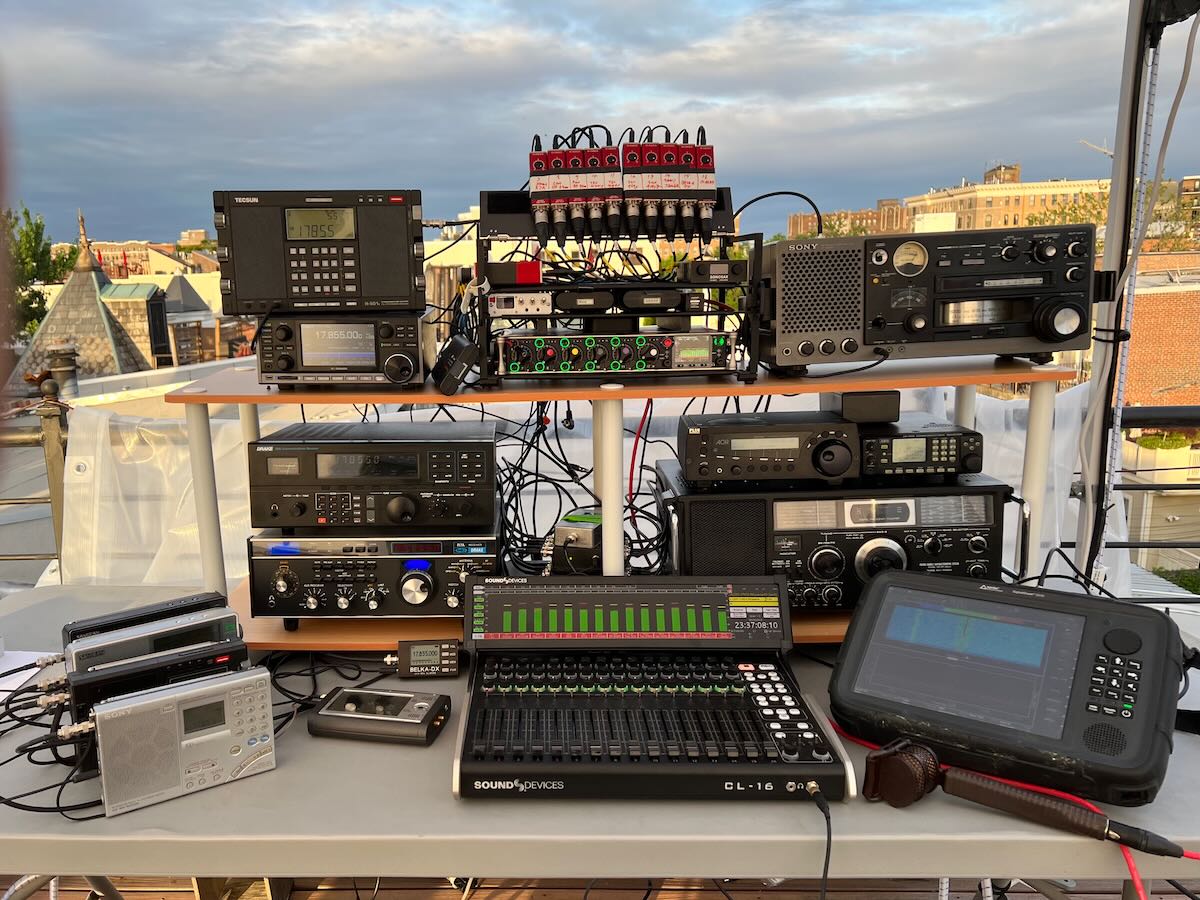
You may recall that back in April, I dragged eight of my favorite receivers up to the roof, hooked them up to a portable antenna, and compared their abilities to demodulate various signals at the same time. For the most part, the similarities between radios were more striking than their differences. I hinted that there’d be a second installment to come, including more receivers and more challenging signals, to further expose and highlight the practical real-world performance differences between the radios we use.

So, as promised, here we are with Round Two of my Rooftop Receiver Shootout.

This time around, I used approximately the same setup, but with a total of fifteen different radios. And once again, I took advantage of nice weather and brought a multitude of receivers, recording gear, cables, and an antenna up to my roof to listen to and record shortwave signals under the open sky.

Our fifteen receivers included everything from “dream radios” from the 1980’s to current-production desktop models to less expensive modern portables to high-performance bench-top lab measurement gear. I tried to curate samples of a wide range of radios you may be familiar with as well as some you probably aren’t.

The lineup consisted of:

  • Icom R-8600, a current production “DC to Daylight” (or up to 3 GHz, at least) general coverage communications receiver, with highly regarded shortwave performance.
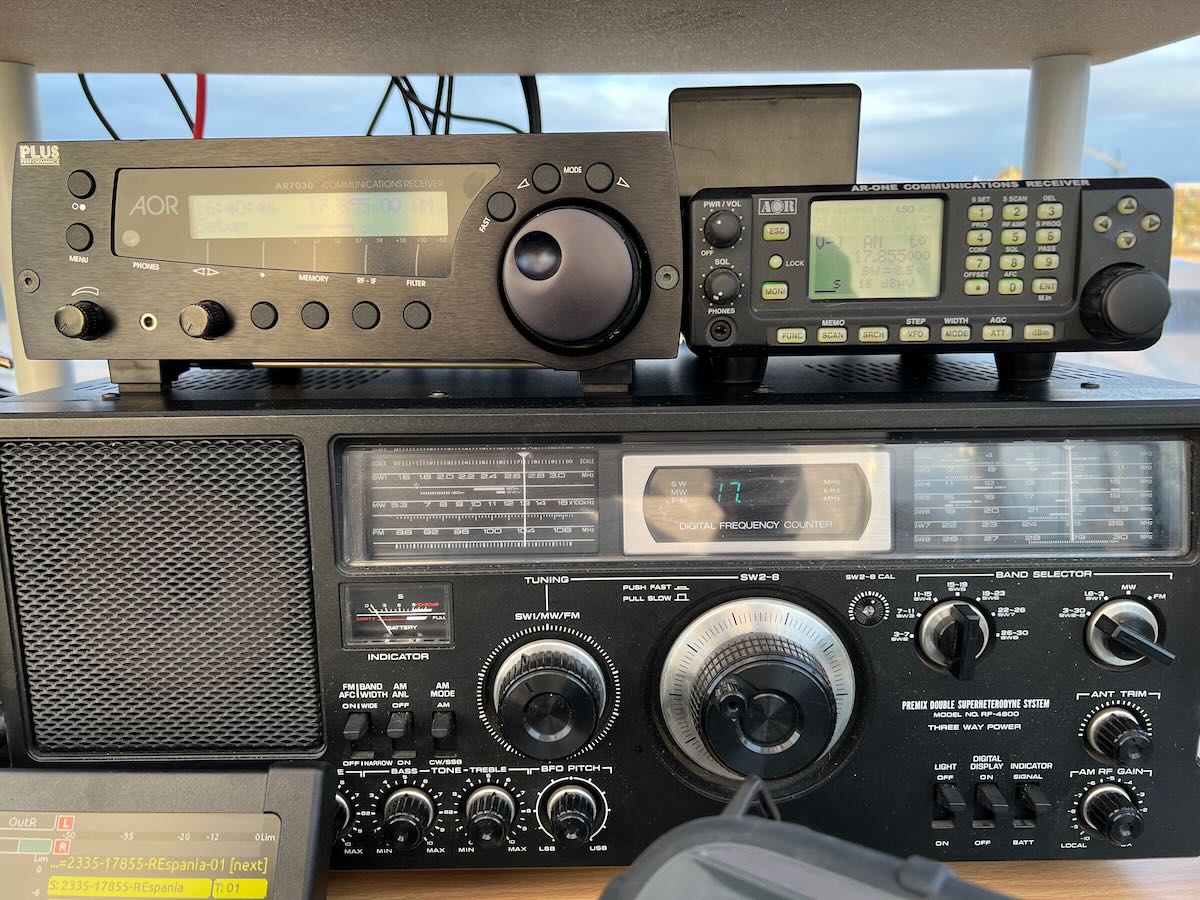
  • AOR AR-ONE, another DC to 3 GHz general coverage radio, less well known due to the high price and limited US availability. Excellent performer, but a counterintuitive and awkward (menu-driven) user interface is less than ideal for shortwave, in my opinion.
  • Reuter RDR Pocket, a very cute, if virtually impossible to get in the US, small production, high performance SDR-based shortwave portable receiver. It’s got an excellent spectrum display and packs near desktop performance into a surprisingly small package.
  • AOR 7030Plus, an extremely well regarded mobile/desktop HF receiver from the late 90’s. Digital but retaining some important analog-era features like mechanical filters. Designed and (mostly) built in the UK, it’s got a quirky menu-driven user interface but is a lot of fun once you get used to it.
  • Drake R8B, the last of the much-beloved Drake receivers. Probably the chief competitor to the 7030+.
  • Drake R7A, an excellent analog communications receiver (but with a digital VFO) from the early 80’s. It still outperforms even many current radios.
  • Sony ICF-6800W, a top of the line “boom box”-style consumer receiver from the early 80’s. Great radio, but hard to use on SSB, as we saw in Round One.
  • Panasonic RF-4900, the main competition for the Sony. Boat-anchor form factor, but (improbably) can run on internal D-cell batteries. Generally impressive performer on AM, but, like the Sony 6800, difficult to tune on SSB.

You may remember the above radios from Round One back in April. The new radios this time were:

  • Tecsun 501x, a larger-format LW/MW/HF/FM portable released last year. As noted below, it’s a generally good performer, but regrettably susceptible to intermod when connected to a wideband external antenna (as we’ll see in Part One).
  • Tecsun PL-990x, a small-format portable (updating the PL880), with many of the same features as the 501x. Like the H501x, good performance as a stand-alone radio, but disappointing susceptibility to intermod when fed with an external antenna.
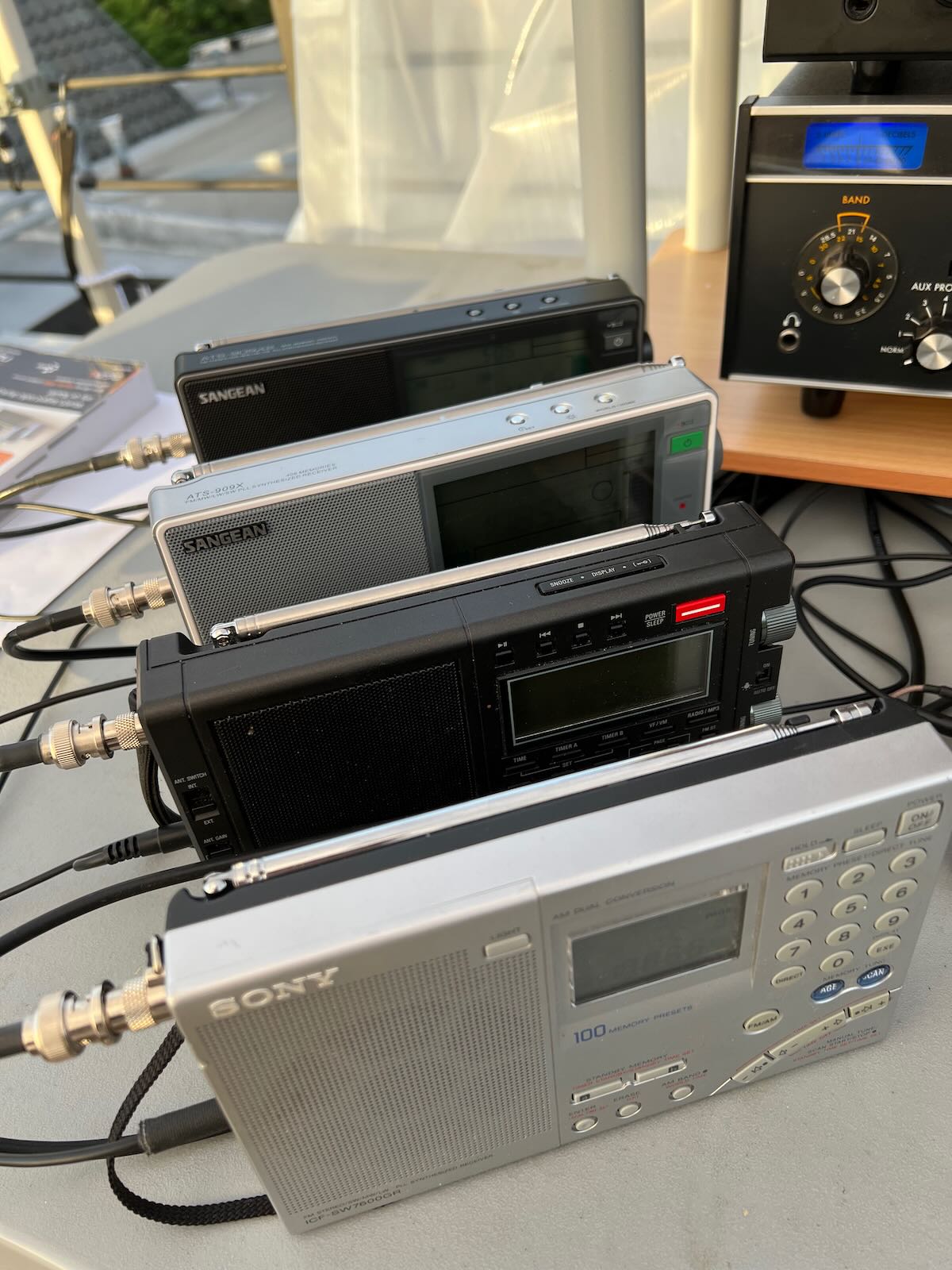
  • Sangean ATS-909x, a recent LW/MW/HF/FM portable with a good reputation as well as a few quirks, such as only relatively narrow IF bandwidth choices on HF. Excellent performance on an external antenna.
  • Sangean ATS-909×2, an updated, current production version of the ATS-909x that adds air band and a few performance improvements. Overall excellent, though I would prefer an addition wider IF bandwidth choice. My go-to travel receiver if I don’t want to take the Reuter Pocket.
  • Sony ICF-7600GR, a small-format digital LW/MW/SW/FM portable introduced in 2001 and the last of the Sony shortwave receivers. Showing its age, but still competitive in performance.
  • Belka DX, the smallest radio in our lineup, made in Belarus. You’ll either love or hate the minimalist interface (one knob and four buttons). If you’re going to secretly copy numbers stations in your covert spy lair, this is a good radio to use. Can be difficult to obtain right now due to sanctions.
  • Finally, a bit of a ringer: the Narda Signal Shark 3310, a high performance SDR-based 8.5 GHz RF spectrum and signal analyzer. As with most test equipment like this, demodulation (especially of HF modes) is a bit of an afterthought. But it has an excellent front end and dynamic range, intended for identifying, extracting, and analyzing weak signals even in the presence of strong interference. Not cheap, but it’s intended as measurement-grade lab equipment, not consumer gear. Demodulated audio is noticeably delayed (several hundred ms) compared with other receivers due to the multi-stage DSP signal path.


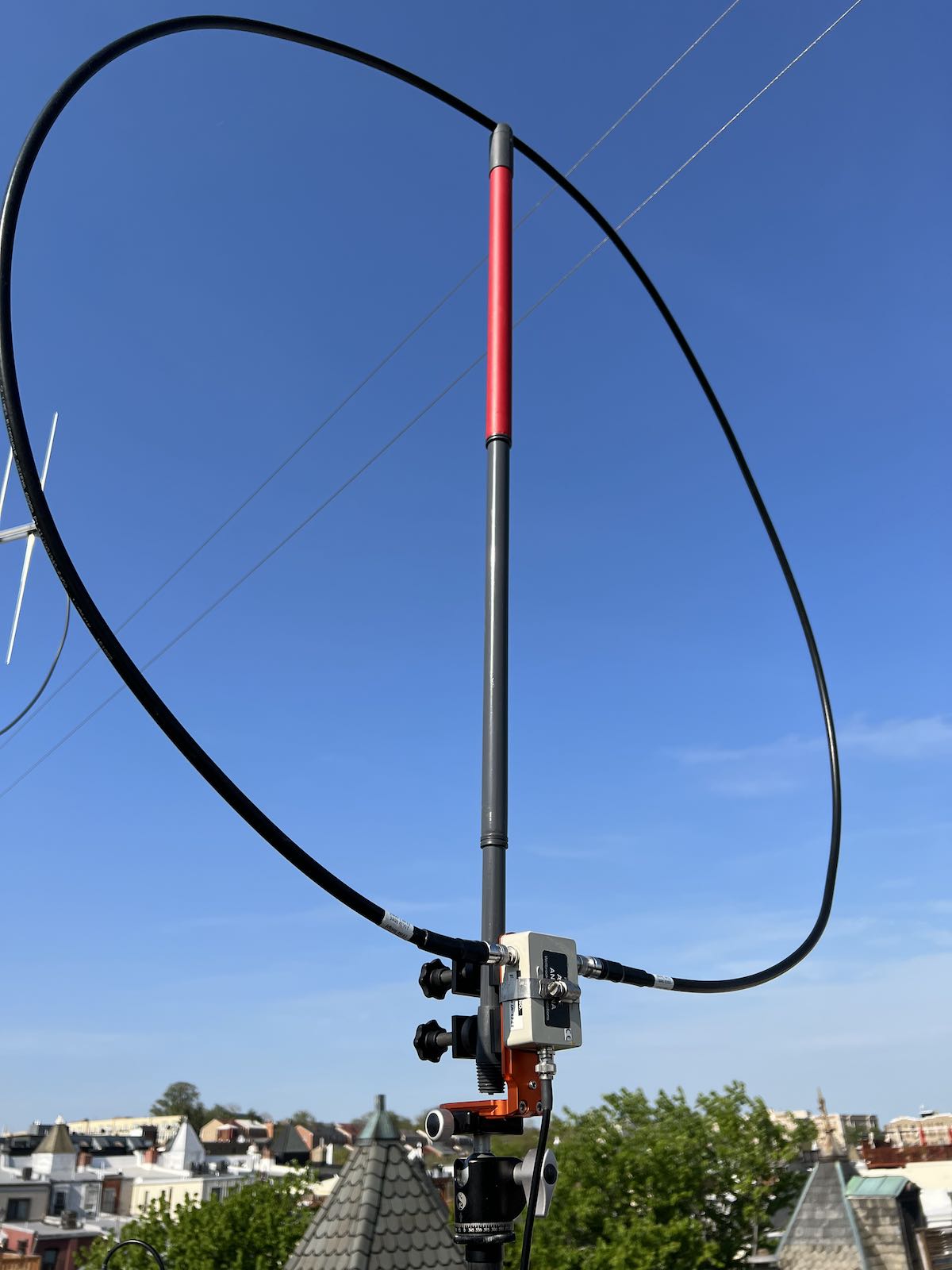
The antenna was my portable “signal sweeper” Wellbrook FLX-1530 on a rotatable tripod, using a power splitter and a pair of Stridsberg Engineering 8-port HF distribution amplifiers to feed the fifteen radios. So every radio was getting pretty close to exactly the same signal at its RF input. Continue reading

SWLing in Kiev: Vlad’s recording of VORW Radio International

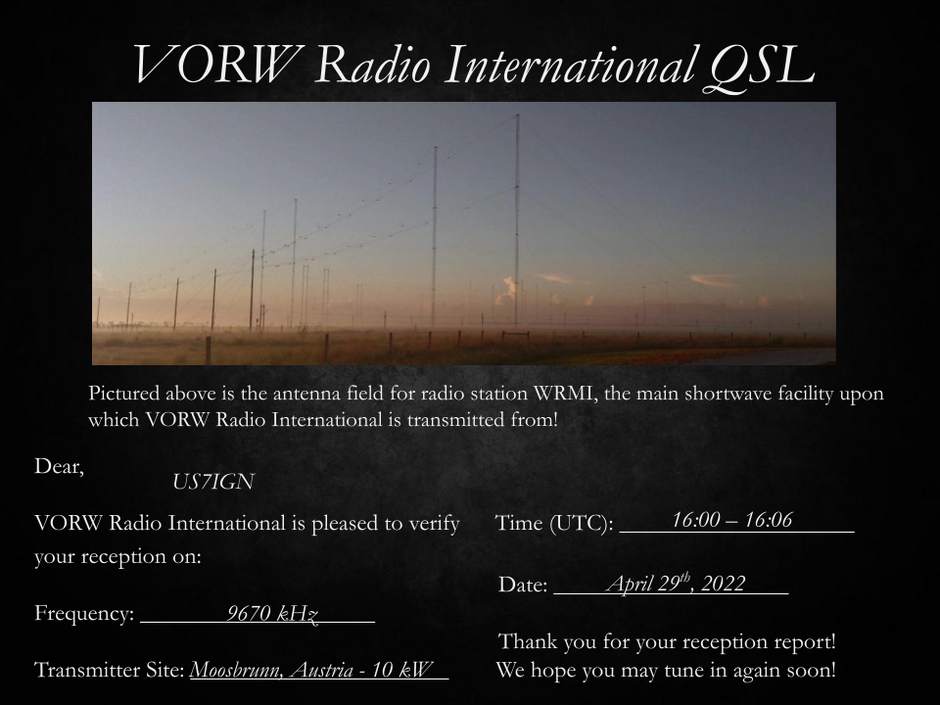
Many thanks to my friend and SWLing Post contributor, Vlad (US7IGN), who recently shared a recording of VORW Radio International he made in Kiev (Ukraine) on May 27, 2022, at 16:00 UTC using his Icom IC-756 Pro III connected to a roof-mounted GP 5 M antenna. This show was broadcast on 9670 kHz from Austria. [See details in the April QSL above.]

Here’s Vlad’s recording:

Click here to view on YouTube.

Dave spots a Sony CRF-320 in an episode of Taxi

Many thanks to SWLing Post contributor, Dave (N9EWO), who writes:

Hey Thomas,

Interesting little tidbit.

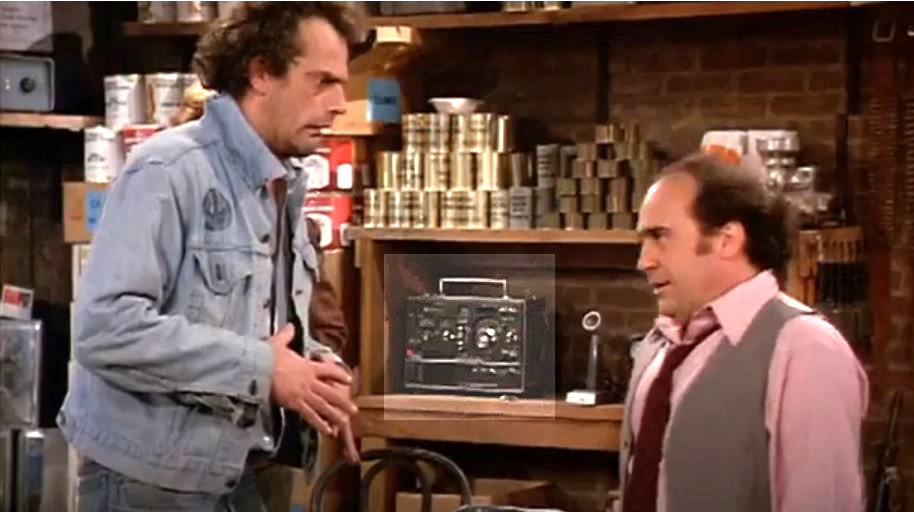
Noticed a Sony CRF-320 being used as prop in a 1982 episode of “Taxi” (Season 4 Episode 11), See captured enhanced attached photo [above].

“I Wanna Be Around” : Louie turns the tool room into a survival shelter.

YouTube (marked at a point where shortwave was made comment to) :

https://youtu.be/S0_-34fdZUQ?t=1032

Look for it just left of the CB and desk microphone.

73
Dave Zantow N9EWO

Thank you for sharing this, Dave! Wow! What a classy radio to have as a prop on display in Taxi! Great catch!

BBC World Service: Licence fee spending to be cut £30m

Many thanks to SWLing Post contributor, Jonathan Marks, who notes that BBC Director General Tim Davie announced a digital strategy along with a number cuts following the BBC licence fee settlement. This was all outlined in his A digital-first BBC speech to staff this afternoon.

I’ve pasted the full copy of his speech below, but regarding the BBC World Service, here is an excerpt: 

“The Government’s commitment to extend its £94m annual funding for the World Service for a further three years is very welcome. But UK licence fee funding for the World Service, which has been around £254m in recent years, is now running at over £290m including World News – a level that is unsustainable following the licence fee settlement.

We will set out plans in the coming weeks for how we will initially reduce licence fee spending on the World Service by around £30m by the start of 2023/24, while protecting the full breadth of languages.

At the same time, our strategic review will identify the right longer-term model for a digital-first World Service and lay out a strong case for more investment from government over the coming years. This case for a strengthened World Service is compelling but we can only expect UK licence fee payers to fund so much.”

In addition, they hope to save £500m annually by cutting services such as Radio 4 Extra, Radio 4’s Long Wave service, and Radio 5 Live’s mediumwave transmitter network.

The Director General’s speech to staff, of course, primarily focused on being a world-class digital and on-demand provider. 

Here’s the full text of the speech via the BBC Media Centre:


A digital-first BBC

BBC Director-General Tim Davie’s speech to staff on 26 May 2022

Published: 26 May 2022

Good afternoon everybody.

Today, in our centenary year, I want to set out a vision of how we keep the BBC relevant and offer value to all audiences in an on-demand age.

I will cover three things: the pressing need to build a digital-first BBC; how we spend our money now that we have the certainty of public funding for six years; and how we keep reforming the way we work. Continue reading

W9IMS: A Radio Run at the Indy 500

W9IMS: A Radio Run at the Indy 500

By Brian D. Smith, W9IND

You can’t win the Indianapolis 500 until they wave the checkered flag – and you can’t win a W9IMS Checkered Flag Award unless you contact the Indy 500 special event.

You’ll have that opportunity from now through 11:59 p.m. Sunday, May 29 in Indianapolis (0359 UTC Monday, May 30) as W9IMS fires up daily on 20 and 40 meters SSB. usually on or around 7.245 and 14.245 MHz.

The Indy 500 special event is the second of three W9IMS operations commemorating the major auto races at the Speedway. The first event of 2022, which ended May 14, honored the Grand Prix of Indianapolis, and the third will run from July 25-31, during the week preceding the NASCAR Brickyard 200.

Both hams and SWLs are eligible for the Checkered Flag certificate and the three individual QSL cards, all of which boast new designs for 2022. To earn the certificate, however, you must work (or tune in) W9IMS during all three of this year’s special events – and it’s too late to catch the first race. But even if you miss the trifecta, you can still claim collectible QSLs from the other races.

Tips on finding W9IMS:

  1. Check DX Summit (www.dxsummit.fi) for spots listing the current frequency or frequencies of W9IMS, if any. By typing “W9IMS” in the search box at upper right, you can customize it to show reports for only Indianapolis Motor Speedway special events.
  2. Go to the W9IMS web page (www.w9ims.org) and look for the heading, “2022 Operating Schedule.” Click on the Indianapolis 500 link, which opens into a weeklong schedule listing individual operators and their reserved time slots. Your odds of catching W9IMS on the air improve significantly during these hours.
  3. Prime operating time on weeknights is 6 to 10 p.m. Indy time (2200-0200 UTC). However, W9IMS can appear anytime, even on two bands at once, between now and 0400 UTC Monday, May 30.
  4. Remember that the published schedule can be shortened by adverse circumstances, such as noisy band conditions, local thunderstorms or a lack of calling stations. Don’t wait till the final hour to chase W9IMS!
  5. Operators often get on the air at unscheduled times. That’s why DX Summit is your best bet for locating W9IMS’s current spot(s).

Tecsun PL-990 Ferrite Rods

Many thanks to SWLing Post contributor, Gareth Buxton, who writes:

Hi Thomas

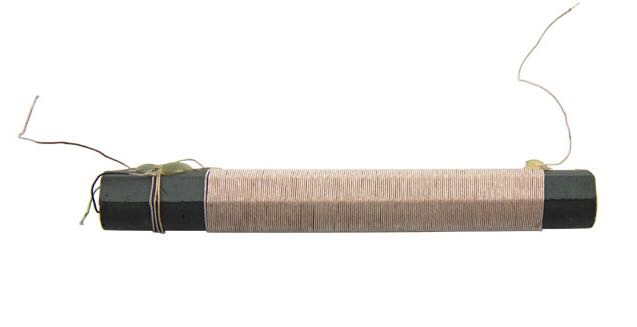
I see that Anon-co have the Tecsun PL-990 Ferrite rod aerial for sale. It even says in the product description “You can use it for your DIY projects.” I thought it might be of interest to your MW/AM radio constructors, especially if they can build a radio that receives more stations than the Tecsun using the same part!

Click here for the product page at Anon-Co.

Cheers
Gareth

Thanks for the tip, Gareth. This would indeed make it easy to construct an external MW antenna. Thank you for the tip!