Author Archives: Thomas

CBS features WRMI’s Ukraine war news over shortwave

Many thanks to SWLing Post contributor, Kim Elliott, who shares the following report from CBS Weekend News:

Florida residents broadcast Ukraine war news to Russian citizens (CBS Weekend News)

A farm in central Florida has become one of the largest shortwave radio operations in the world. Using Cold War era radio technology called shortwave, Jeff White and his team are broadcasting unbiased information on the status of the Russian war on Ukraine to listeners in Belarus, Ukraine and Russia. Miguel Amaya has more.

Click here to watch on YouTube.

Guest Post: You might be a radio nerd if…

Many thanks to SWLing Post contributor, Jock Elliott, who shares the following guest post:


How can you tell if you are a radio nerd?

By Jock Elliott, KB2GOM

Jeff Foxworthy made a name for himself with his comedy routine, “You Might Be a Redneck.”

That phrase – you might be a redneck – is always followed by a qualifier, such as: “If you ever financed a tattoo.” My favorite: you might be a redneck if you ever mowed the lawn and found . . . a car.

Taking a cue from Foxworthy, I thought I might help the readers of the SWLing Post determine if they are radio nerds.

You might be a radio nerd, if . . .

  • You think DXing NOAA weather radio stations is kinda fun. (That would be me.)
  • You made special arrangements with the National Institute of Standards and Technology to visit WWV, the NIST time station in Colorado. (That would be our very own Thomas, Maximum Leader of SWLing.com. Check out this post.)
  • You traveled to Newfoundland, Canada, to lay out hundreds of feet of wire to listen to tiny maritime weather stations in Northern Europe. (That would be Don Moore, and if you have not read Don’s posts–this one or this one–you are in for a treat!)
  • You see a display of pool “floaty” noodles, and all you can think of is: “Construction materials for ferrite sleeve loop antennas.” (That would be Gary DeBock, with this post and numerous posts on SWLing.com.)
  • You think it is fun to get up in the middle of a 10 degree Alaskan night to DX an Australian station 8,000 miles away and then find yourself on an Australian newscast. (That would be Paul Walker.)
  • You are constantly thinking about how you might improve reception at your station. (That would be most of us, I think.)
  • You have accidentally said your Amateur Radio call sign at the end of a telephone conversation. (Me, again.)
  • You find yourself using ham lingo in ordinary conversation: “I’m going to QSY to the kitchen.”

So, are you a radio nerd? If so, present your evidence in the comments below.

Radio Waves: Led Zeppelin Saved by Off-Air Recording, News on a Music Station, FFC Notice to Pirate Landlords, and Hamvention 2022

Radio Waves:  Stories Making Waves in the World of Radio

Welcome to the SWLing Post’s Radio Waves, a collection of links to interesting stories making waves in the world of radio. Enjoy!


The improvised Led Zeppelin song that was lost by the BBC for over 40 years (Far Out)

During Led Zeppelin’s 12 years together, the group released eight studio albums, each composed of tracks Jimmy Page and company believed to be the best representation of the group at that specific moment in time. When amassed, these albums trace the evolution of Zeppelin’s style, approach to production, individual musical skills, and songwriting habits. And while we might have assumed this rendering of Zeppelin’s musical life to be complete, it would seem that we’ve not been given the full picture. Indeed, there are certain Led Zeppelin songs that even some of the group’s most die-hard fans never knew existed.

Following the release of the Led Zeppelin compilation album BBC Sessions in 1997, Jimmy Page began hearing a bootleg version of a song he hadn’t heard in just under 30 years. The band had never attempted it during an album session, and it never appeared on any of their records. After a bit of digging, Page realised that the track had come from a BBC performance Led Zeppelin made in the first months of 1969. Unfortuantely, it transpired that the BBC had managed to lose the tape from that day, meaning that Page was forced to track down a copy of the song a fan had recorded off the radio back in ’69. [Continue reading…]

How One Music Station Covered The Buffalo Massacre (Radio Ink)

(By Tom Langmeyer) The unfortunate conventional wisdom that has prevailed in radio during the last 20 years is “We are a music station. We don’t do news.” Unfortunately, this sentiment represents many people who set the tone for the industry and make these proclamations proudly, as the radio business becomes more and more irrelevant.

There is some truth to the statement that a “music station should not be covering news” by those who think completely linearly. However that culturally process-driven approach that has zero to do with results.

A music-intensive radio station is not expected to do news in the traditional sense, nor should be competing with news stations. It’s not a music station’s role.

However, all radio stations must have a component of “news. Now, before folding your arms across your chest, think about it this way.

“News” is really what your listeners need and want in the radio experience. What does “news” mean for your station? What is it? How is it delivered? How much? How do we activate our listener? That’s where things are different and need to be defined.

Think about a great country station that’s talking about a concert that’s happening in town and building an experience around it. That’s NEWS.

No one is saying a music station should be WINS, WBBM, KNX or KCBS.

No matter the music format is, there needs to be a playbook for how and what information (relevant “news”) gets presented.

On the advising side of Great Lakes Media’s business, we create customized plans for stations committed to localism and winning on the revenue hill. Sure it’s different – and that’s why it works.

It’s called the “Great Lakes Media Way.” [Continue reading at Radio Ink…]

FCC Sends Pirate Radio Notices to Property Owners (Radio World)

Agents traced signals in Pennsylvania, Maryland and Oregon

The Federal Communications Commission has sent notices to several property owners of alleged pirate radio activities on their properties.

The letters from the Enforcement Bureau are headlined “Notice of Illegal Pirate Radio Broadcasting.” They remind the owners that federal law now provides for fines of up to $2 million “if we determine that you have continued to permit any individual or entity to engage in pirate radio broadcasting from the property that you own or manage.”

The bureau said its agents used direction finding techniques to source these FM signals. It mailed letters to Richard Manson for broadcasts on 103.5 MHz in Philadelphia in January; to Maria V. Hernandez of Kissimmee, Fla., for signals on 87.9 MHz in Hazleton, Pa., in January; to Edwin and Joyce Pitt of Baltimore, Md., for signals on 91.3 in February; and to Kent and Deanna Coppinger for signals on 100.5 MHz in La Grande, Ore., in March. [Continue reading…]

Hamvention to kick off this weekend in Xenia; Thousands expected to attend (Southgate ARC)

After nearly three years, Hamvention is back.

The convention is the world’s largest amateur radio gathering at Greene County Expo Center, according to the event’s website.

Around 30,000 visitors are expected to come to the event from all over the world.

Michael Kalter, the spokesperson for Hamvention, said that based on numbers from the Greene County Convention Visitors Bureau, Hamvention adds $30 million to the local economy.

He said amateur radio, also known as ham radio, is something people of all ages and backgrounds can be a part of, which is why he thinks the convention draws such a large crowd.

Kalter shared how it feels to bring so many people from around the world together. “That makes me feel really good,” Kalter told News Center 7?s Kayla McDermott. “I’m glad that the hobby seems to be really growing and flourishing,” he added.

There are no COVID-19 restrictions in place for this year’s convention. With thousands of people expected to attend, safety is a top priority. Before entering the convention center, people must have their bags checked. The Greene County Sheriff’s Department said they have prepared for the event.

Major Shawn Prall, with the sheriff’s office, said they have a plan in place to make sure traffic moves along smoothly as there are only two lanes to get to the grounds. Crews will also keep an eye on the weather, in case there is a chance for it to turn severe. Prall said this will be his fourth Hamvention and he has never had an incident. “We’re taking precautions, both that the public will see in uniform presence and also things that they can’t see. Just trying to keep everybody safe and be ready for any kind of incident, whether it be weather or manmade or anything like that,” Prall said.

The convention runs this weekend 9 a.m.-6 p.m. Friday, 9 a.m.- 5 p.m. Saturday and 9 a.m.-1 p.m. Saturday.

Source: https://www.whio.com/news/local/hamvention-kick-off-this-weekend-xenia-thousands-expected-attend/RUMUJLOHEJCUXOOSMEZJL6S22I/


Do you enjoy the SWLing Post?

Please consider supporting us via Patreon or our Coffee Fund!

Your support makes articles like this one possible. Thank you!

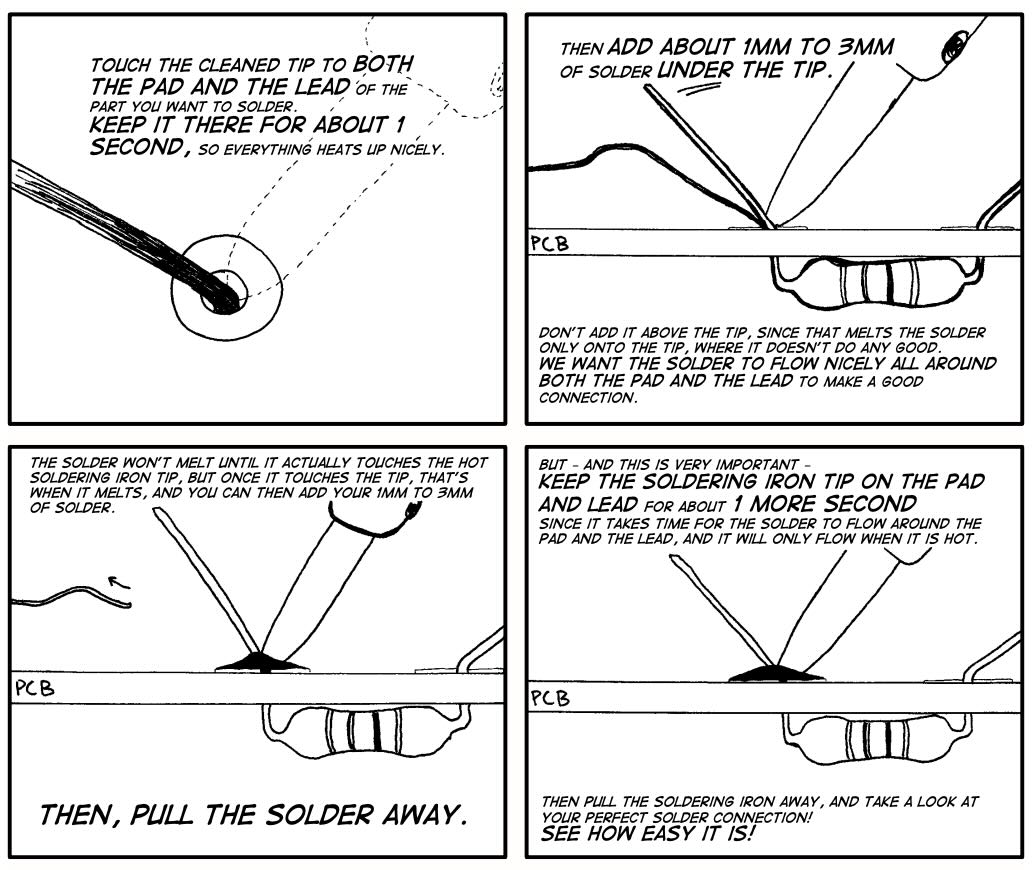
Soldering is Easy: An amazing soldering primer in comic book form

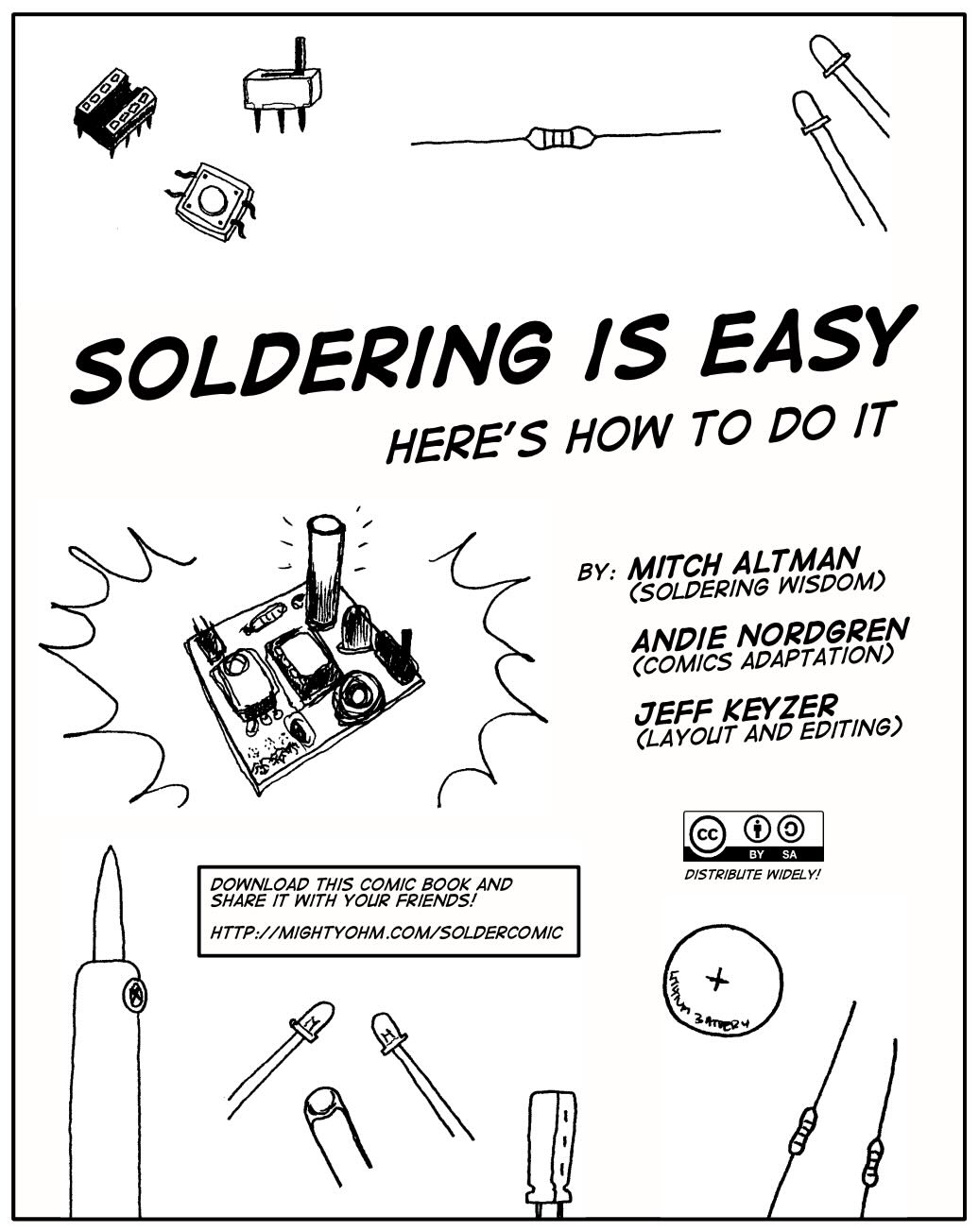
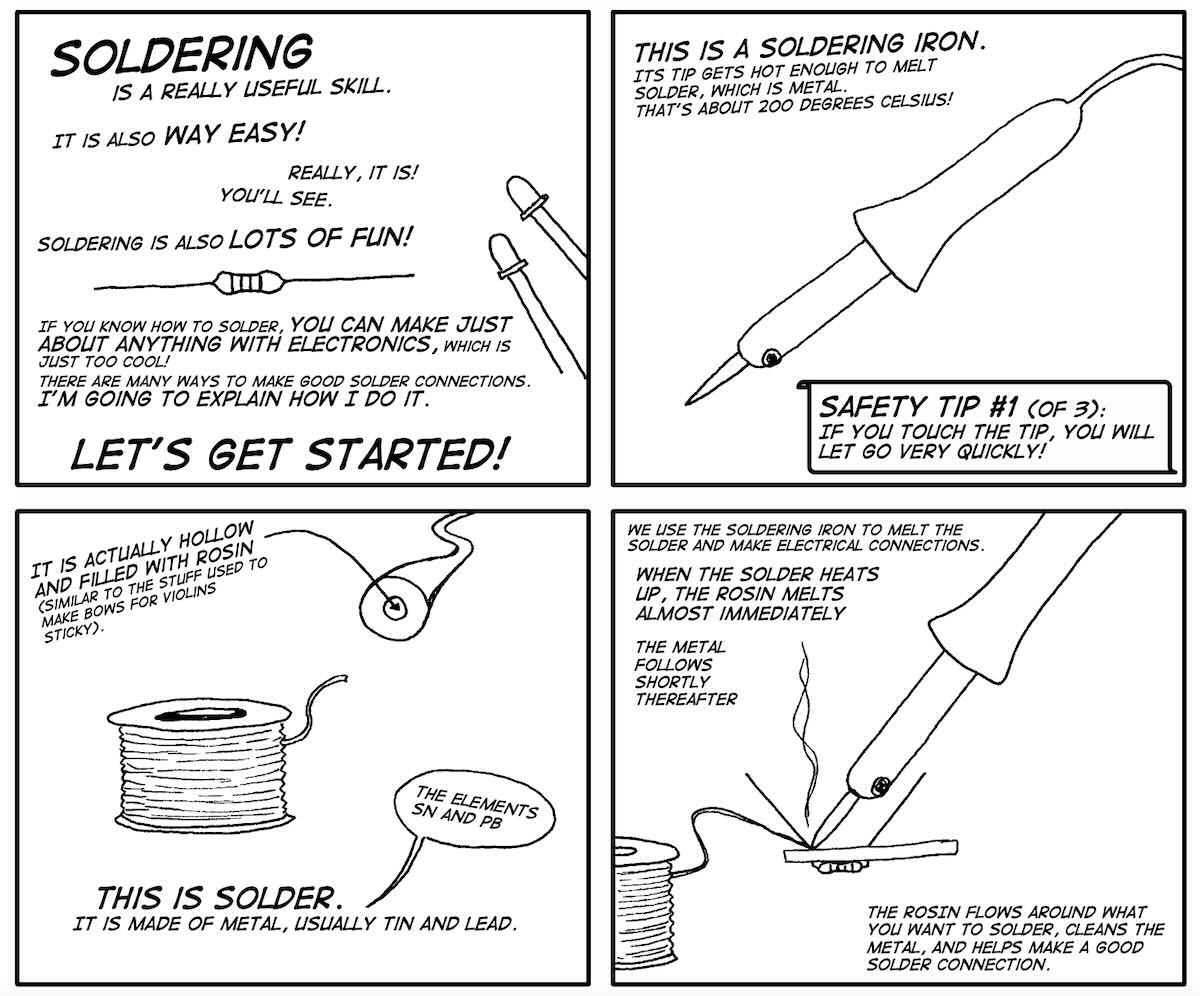
Many thanks to SWLing Post contributor, David Goren, who shares a link to this PDF which is a primer on soldering…in comic book form!

Thing is, this primer is brilliantly illustrated and all of the soldering techniques are truly textbook. No wonder, though: the amazing Mitch Altman provided the “Soldering Wisdom.” (You might recall my love of Mitch’s TV-B-Gone kit.)

David didn’t know this, but I use this comic guide very heavily when teaching classes or individuals how to solder. It connects with all generations of makers and tinkerers.

It is the benchmark, in my opinion!

Mitch specifically designed this tutorial to be spread widely, so he licensed it under Creative Commons. Share this widely!

Click here to download the full PDF.

I’ve also stored a backup copy here on the SWLing Post.

Thanks for reminding me about this tutorial, David!

How Giuseppe protects his Icom IC-705 during travels

Many thanks to SWLing Post contributor, Giuseppe Morlè (IZ0GZW), who writes:

Dear Thomas and Friends,

Giuseppe Morlè (IZ0GZW) here from Formia, central Italy.

This my latest video is about everything I have done to protect and transport my Icom IC-705.

I bought an aluminum case, light and very resistant with everything one needs inside to be able to use the IC-705.

    • 2 power banks, one of which is solar-charged to be able to recharge the battery while in operation
    • 2 wire antennas: a dipole type with BNC / banana socket with 10 meters of cable per arm and a 20 meter row, monopole, to be used in reception as you saw during the DXpedition to the Island of Ponza
    • I also bought the Mydel protective “cage” with antenna attachment on the front and PVC protection of the display

Given the high cost of this little jewel, it is advisable to take all precautions for its safety during transport and use.

Click here to view on YouTube.

I hope I made you happy …
Thank you all,
73. Giuseppe Morlè iz0gzw.

This is great, Giuseppe! Like you, I’ve taken extra measures to protect my Icom IC-705 as well. Your kit looks comprehensive–I love the fact that pretty much everything you need is inside. 

Thank you again. We always enjoy your posts from beautiful Italy. Ciao!

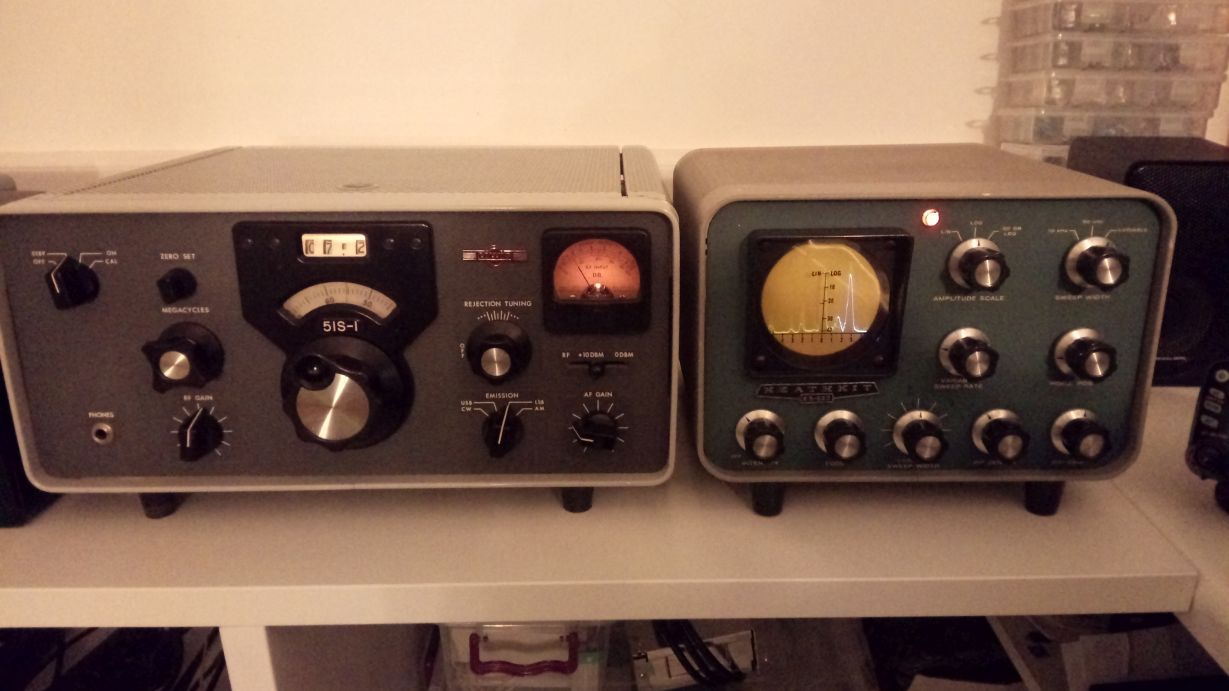
Kostas pairs his Collins 51S-1 with a Heathkit SB-620 bandscope

Many thanks to SWLing Post contributor, Kostas (SV3ORA), for sharing the following guest post which originally appeared on his radio website:


Collins 51S-1 band scope using a Heathkit SB-620

by Kostas (SV3ORA)

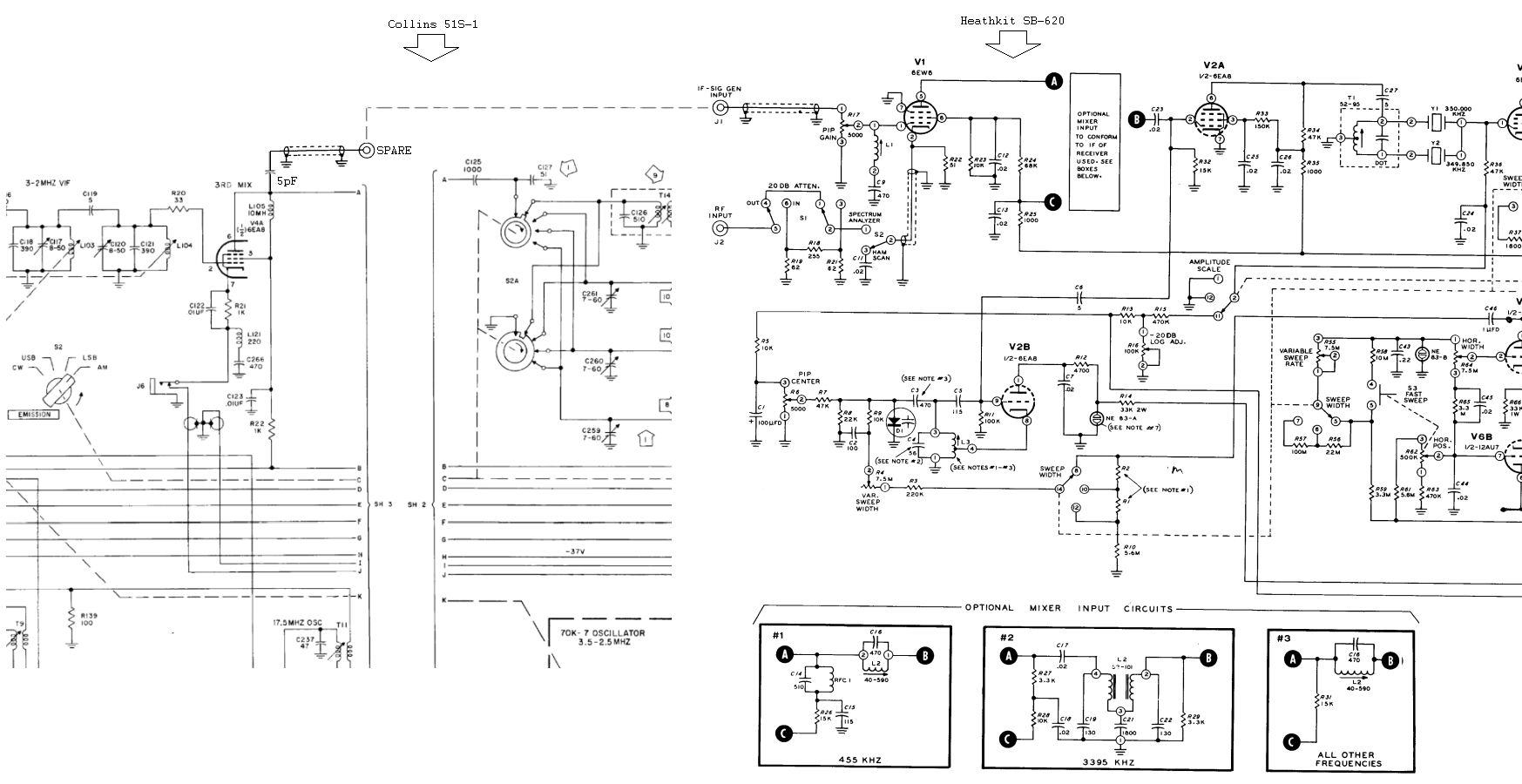
The purpose of this project, is to connect a Collins 51S-1 receiver with a Heathkit SB-620 “scanalyzer”, so as to give the 51S-1 band scope capability. Right into the schematic presented below, a slight modification is needed to the 51S-1. I usually do not do modifications to old equipment unless absolutely needed and even when I do so, I take care for them to be easily undone and to modify them as little as possible.

The modification to the 51S-1 is simply a small coupling capacitor connected to the plate of the mixer tube V4A and a short run of thin coaxial cable, connected as shown, to one of the several SPARE RCA connectors at the back of the 51S-1. Collins engineers were smart enough to include SPARE RCA connectors at the back of the radio, which are not connected to anything inside the radio circuit, to be used for different future purposes. So we do not have to drill any holes to the chassis of the precious receiver, which would be catastrophic.


Click to enlarge.

The coupling capacitor is just 5pF, so compared to C125, this presents only a tiny fraction of the loading to V4A plate, i.e. not affecting the normal operation of the receiver. Note, you cannot take directly the 500KHz IF output that is originally provided by the 51S-1 RCA in the back of the radio. This is because this IF is AFTER the filters, so it is a narrow IF. We need WIDE IF for the scanalizer to work properly, so you have to perform this tiny modification to the 51S-1.

No need to say that the SB-620 needs to be re-tuned for 500KHz instead of 455KHz. I was unlucky and my SB-620 did not have the appropriate L3 to be tuned to the IF of 455/500KHz. Mine had the L3 used for an IF of 5.2-6MHz. I converted the SB-620 to work down to 500KHz by using this original higher-frequency L3 and adding two additional inductors to it, one at its bottom and one at its top, so as to make L3 larger. The additional bottom inductor I added (connected from the bottom of L3 to the ground) was a 15uH choke. The additional top inductor I added (connected from the top of L3 to C3 and C5), was a 455KHz IF CAN transformer (the one with the adjustable yellow-painted cap) taken out of a transistor radio. Of course I have removed the internal capacitor of the transformer before using it. My transformer had something like 200-300uH in the mid-set point. It is not too critical as this is a tunable transformer.

By making this modification to the SB-620 you can bring the 5.2-6MHz L3, down to 500KHz. Of course the slug of L3 now has limited tuning range. But we can coarse tune the hybrid L3 now, by tuning the IF transformer that has been added. This solution worked like a charm and the original L3 is still fit in place, looking original and helps in fine tuning if needed. For the optional mixer input (points A, B, C on the SB-620), I used circuit #1, but I did not notice any real difference from circuit #3. RFC1 is 304uH and I connected three 100uH chokes in series to make this RFC.
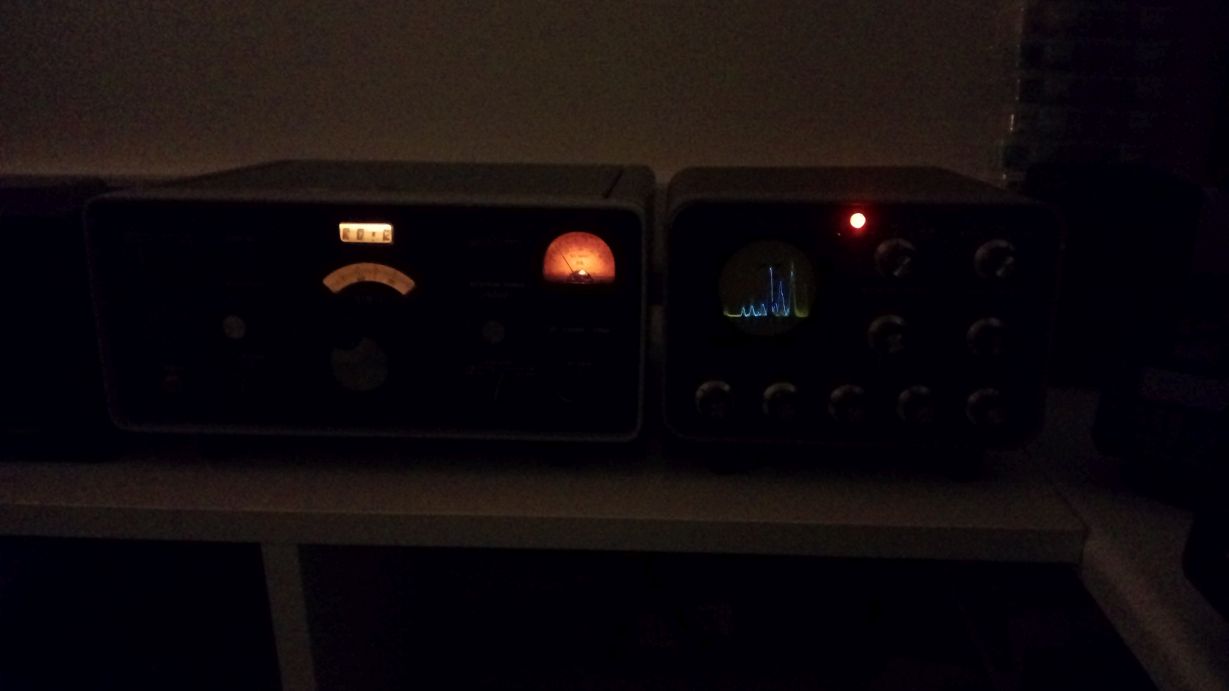
The solution described in this page, will add a huge value to your vintage receiving station. SWLing feels just different by having an all-tubes computer-free band scope. Here is a picture of the setup, nicely glowing in the night. That P7 CRT blue phosphor with its green afterglow “memory” effect looks amazing! Narrow resolution is actually only achievable, because of this afterglow of the CRT, which allows for much slower sweep rates.

Jock says, “It’s about time…and beacons!”

A WWV Time Code Generator

Many thanks to SWLing Post contributor, Jock Elliott, who shares the following guest post:


It’s about time . . . and beacons

By Jock Elliott, KB2GOM

Shortwave time stations can be incredibly useful for shortwave listeners, not just for checking the time, but also for finding out what’s going on with radio signal propagation. What makes these stations particularly valuable is that they are available all the time. I use them often when I am testing radio equipment or tweaks to my listening post.

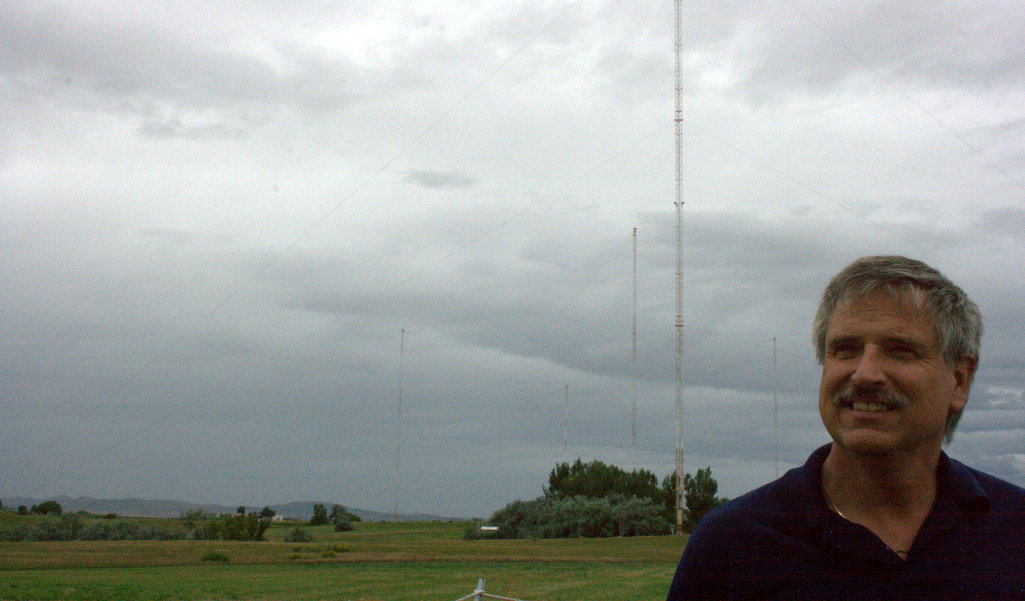
Chief Engineer Matt Deutch at WWV/WWVB. (Photo: Thomas)

The National Institute of Standards and Technology (part of the U.S. Department of Commerce) maintains a couple of stations devoted to broadcasting time announcements, standard time intervals, standard frequencies, UT1 time corrections, a BCD time code, and geophysical alerts 24 hours a day, 7 days a week.

WWV in Fort Collins, Colorado, according to NIST:

“radiates 10 000 W on 5 MHz, 10 MHz, and 15 MHz; and 2500 W on 2.5 MHz and 20 MHz. Each frequency is broadcast from a separate transmitter. Although each frequency carries the same information, multiple frequencies are used because the quality of HF reception depends on many factors such as location, time of year, time of day, the frequency being used, and atmospheric and ionospheric propagation conditions. The variety of frequencies makes it likely that at least one frequency will be usable at all times.”

In addition, WWV broadcasts the same signal heard on the other WWV frequencies on 25 MHz on an experimental basis. The power is 2500 W and, as an experimental broadcast, is may be interrupted or suspended without notice.

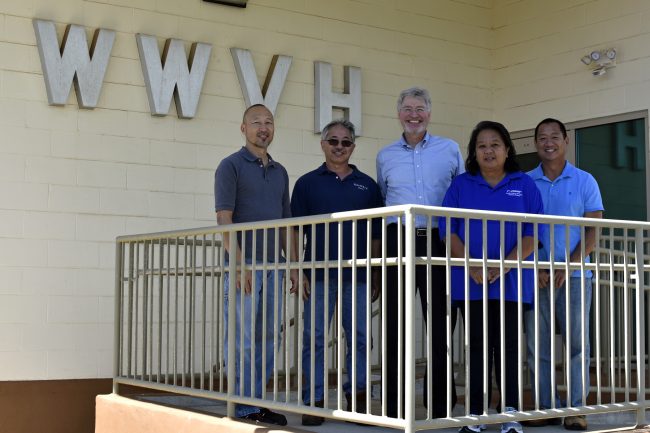
WWVH crew from left to right: Dean Takamatsu, Dean Okayama, Director Copan, Adela Mae Ochinang and Chris Fujita. Credit: D. Okayama/NIST

WWVH, based in Kekaha, Hawaii, transmits 10000 W on 10 MHz and 15 MHz, and 5000 W on 2.5 MHz. A NIST notes that the 5 MHz broadcast, which normally radiates 10 000 W, is currently operating at 5000 W due to equipment failure.

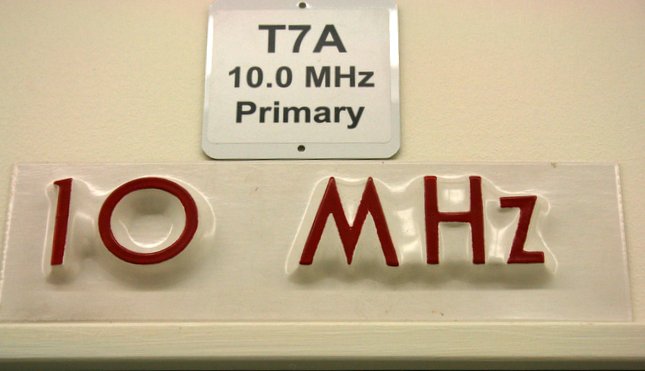
Photo Thomas (K4SWL) took in 2014 of the sign above WWV’s primary 10 MHz transmitter.

Both stations have voice announcements. WWV uses a male voice; WWVH, a female voice. They are staggered in time so that they don’t talk over each other. While doing research for this blog, one afternoon on 5 MHz and 10 MHz, I could hear the female voice, followed by the male voice, so I was hearing both Hawaii and Colorado. On 15 MHz, I could hear only Hawaii. Both stations transmit in AM mode, although I sometimes use upper sideband to pick the signals out of the noise.

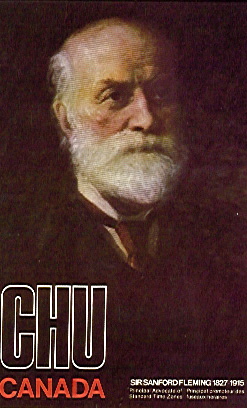
CHU’s QSL card used in the 1980s depicting Sir Sanford Fleming, father of uniform times zones.

In addition, there is a Canadian time station. CHU transmits 3000 W signals on 3.33 and 14.67 MHz, and a 5000 W signal on 7.85 MHz.

The frequencies were chosen to avoid interference from WWV and WWVH. The signal is AM mode, with the lower sideband suppressed.

The same information is carried on all three frequencies simultaneously including announcements every minute, alternating between English and French. The CHU transmitters are located near Barrhaven, Ontario.

According to a posting on Radio Reference, there is also a time beacon in Moscow, Russia that transmits on 9996 and 14996 kHz in CW mode. I have never heard that station.

If anyone knows of additional shortwave time stations, please post the information in the comments section below.

Beacons

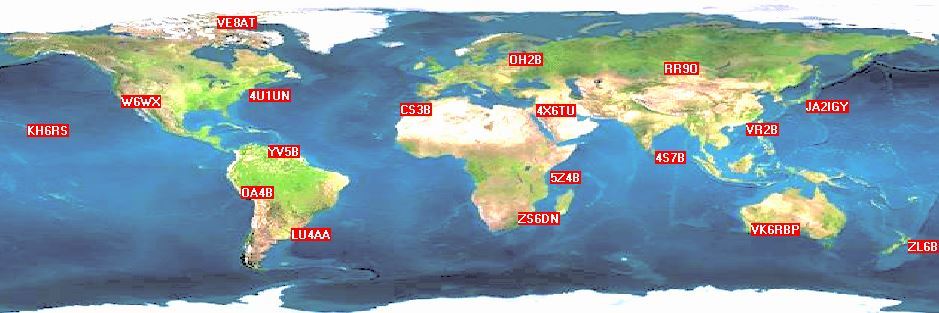
Another “standard reference” that can be used to figure out what’s happening with shortwave propagation is the International Beacons Project, a worldwide network of radio propagation beacons. It consists of 18 Morse code (CW) beacons operating on five designated frequencies in the high frequency band. The project is coordinated by the Northern California DX Foundation (NCDXF) and the International Amateur Radio Union (IARU).

This page shows the locations of the beacons and gives samples of the signals that can be heard. Each beacon transmits once on each band once every three minutes, 24 hours a day. A transmission consists of the callsign of the beacon sent at 22 words per minute followed by four one-second dashes. The callsign and the first dash are sent at 100 watts. The remaining dashes are sent at 10 watts, 1 watt and 100 milliwatts. At the end of each 10 second transmission, the beacon steps to the next higher band and the next beacon in the sequence begins transmitting.

Clicking around the International Beacons Project website will reveal a wealth of information, including a Reverse Beacon Network — https://www.ncdxf.org/beacon/RBN.html — no kidding.

Finally, if you would like to disappear down the rabbit hole of chasing shortwave beacons, here is a list of 411 beacons around the world: http://www.dl8wx.de/BAKE_KW.HTM

The listing includes the frequency, the location, and the power of the transmitter (among other things). If any reader has experience with these beacons, please post in the comments section.