Shortwave listening and everything radio including reviews, broadcasting, ham radio, field operation, DXing, maker kits, travel, emergency gear, events, and more
Many thanks to SWLing Post contributor, Alexander (DL4NO), who shares the following announcement from Markus (DL8RDS):
This year’s Software Defined Radio Academy is taking place as an online conference. Because of the great number of contributions, we are spanning the conference over two days: Saturday June 27 and Sunday June 28 2020.
We also decided to start the stream in the afternoon in order to give our overseas audience a fair chance to participate.
We have pre-recorded the talks, so there is no back-channel or interruption during the talks, but the speakers will be available in our video conferencing system and we will closely observe all the comments that will be submitted into the channel. At the end of the according slots, there is always a little time left for the speakers to respond. So there is a certain degree of interaction and we do encourage you to make use of it.
Our mother organisation, the German Amateur Radio Club DARC also decided to provide a decent online substitute to the HAMRADIO hamvention that was called off by the authorities and I’m proud to say that our team was giving the ideas and helped this really large event to take place. Alltogether our video team, the other video team from Faszination Amateurfunk and the DARC permanent staff managed to provide more than 60 hours of talks, discussions and fantastic content, which will be streamed at this weekend. For those of you who understand German, here is the streaming plan:
Many thanks to SWLing Post contributor, Bill Hemphill (WD9EQD), who shares the following guest post:
Benefits to Social Distancing
I have discovered that there is a positive side effect of social distancing. With so many organizations using Zoom and other video methods for their meeting, the volume of great videos to watch has drastically increased, with most of it residing on YouTube. Also everyone is sharing video links that they have found with other.
For example, the New Jersey Antique Radio Club (NJARC) has, for some time, posted their monthly meetings on their YouTube channel. They have very enjoyable presentations. Last night was their virtual monthly meeting for June and they had a great talk by Prof. Joe Jesson on “What You Did Not Know About the RCA AR88.”
I am a fairly new member to NJARC and must recommend them to others. They are a very active group and are currently having Zoom conferences weekly between the members. They also host the RADIO TECHNOLOGY MUSEUM at the InfoAge Technology Center.
Last week, I received an email from Mark Erdle (AE2EA) referring to some videos by the Antique Wireless Museum which is hosted by the Antique Wireless Association (AWA). From his email:
The Radios (and Filming) of “Across the Pacific” presented by AWA member Brian Harrison. Brian served as the radio consultant for the 3-hour PBS documentary “Across the Pacific”, which tells the story of the early days of Pan American Airways and of Hugo C. Leuteritz, a RCA radio engineer who helped make Pan Am’s expansion across the oceans possible with radio communication and navigation systems. Brian explains how he worked to insure that this documentary portrayed the pioneering work of Hugo Leuteritz as accurately as possible. Much of the early radio equipment that Pan American used was custom made for Pan Am, and is quite rare today, but Brian hunted it down.
In addition to Brian’s video, you can also see Tom Perera’s updated presentation of “Phil Weingarten’s Fabulous Fakes” which was originally presented at the 2007 AWA conference:
Here are some other videos that people have passed along to me that I have found enjoyable. Most of these are radio-oriented and I have omitted the many cat videos:
Thank you for sharing these links and videos, Bill! I’ve been watching Phil Weingarten’s Fabulous Fakes this morning–what a fascinating bit of history!
Post readers: Have you discovered videos and sites while social distancing (a.k.a. Social DXing)? Please comment and share your links!
Over the past few weeks, I have been building curated lists of ham radio transceivers. It all started when I needed to learn about multimode VHF/UHF transceivers for my EME project. As I got deeper into the process, I decided to make my master list of VHF/UHF multimode transceivers public. The goal with the list was to familiarize myself with the makes/model numbers and have an easy way to check out any used gear deals.
Next, I started a list of QRP general coverage transceivers–something I had been meaning to do for ages because I get so many inquiries about these from readers.
To be clear, by “general coverage” I mean radios that can receive HF and possibly MW broadcast bands in addition to ham radio bands. By “QRP” I mean radios that have output power of about 20 watts or less–some define the term QRP more strictly, but since our list has less to do with the transmitting function, I’m a little more flexible.
I like QRP general coverage transceivers because they’re often portable, have modest power requirements, and some offer superb sensitivity and selectivity for broadcast listening.
Please comment if you note a missing transceiver. I’m certain I’ve left some out. I’d appreciate model numbers and links if possible. If you’ve ever owned one, please consider sharing your thoughts on its performance from the point of view of an SWL as well.
I’ve already started working on a list including all general coverage transceivers. It’s massive so it could be a while before it’s published! I’ll certainly ask for your input then as well.
Radio Waves: Stories Making Waves in the World of Radio
Because I keep my ear to the waves, as well as receive many tips from others who do the same, I find myself privy to radio-related stories that might interest SWLing Post readers. To that end: Welcome to the SWLing Post’sRadio Waves, a collection of links to interesting stories making waves in the world of radio. Enjoy!
Many thanks to SWLing Post contributors Richard, Michael Bird, for the following tips:
LA MIRADA, CA – Two students attending Southern California Bible College were given the vision to establish the Far East Broadcasting Company, which they incorporated in 1945.
Their initial broadcasting location was in Shanghai in the midst of the Chinese people whom the Lord had laid upon their hearts. The effort was short-lived, however, when China closed its doors to all missionary work in 1948.
Some people would have considered that to be the death of the vision. Not Bob Bowman, John Broger, or their supportive pastor, William Roberts. The vision remained the same, FEBC would have to find a different location.
On June 4, 1948, FEBC regenerated from station KZAS in Manila. By 1949, FEBC was equipped to air broadcasts from the Philippines, across the South China Sea, and into parts of China.
Now celebrating its 72nd year of continuous operations, Far East Broadcasting Company has expanded multiplied times and broadened its ministry to include AM, FM, shortwave, satellite, internet, and other digital technologies.[…]
As theaters across the world have closed because of the coronavirus pandemic, they’ve scrambled to find ways get work to the public.
Some have made archival video of productions available, some have created Zoom plays and some have returned to an old art form — radio drama — but with a digital twist.
In the 1930s, with many people out of work, families huddled around radio receivers to listen to audio plays, like Orson Welles’ famous broadcast, War of the Worlds.
“Orson Welles began his career as a theater actor and director,” says Adam Greenfield, artistic director for New York’s Playwrights Horizons. “And I think he’s able to really utilize the full potential of what audio can do.”
Taking cues from Welles’ success, Greenfield commissioned a new series of audio plays for podcast called Soundstage. He planned to release them this summer, when the theater was dark, but because of the pandemic he hustled them online.
The first podcast released was Prime: A Practical Breviary by songwriter and performer Heather Christian. It’s based on the 6:00 a.m. rite, or breviary, of solo contemplation for nuns and monks.[…]
It is hard to be remembered in the electronics business. Edison gets a lot of credit, as does Westinghouse and Tesla. In the radio era, many people know Marconi and de Forest (although fewer remember them every year), but less know about Armstrong or Maxwell. In the solid-state age, we tend to remember people like Shockley (even though there were others) and maybe Esaki.
If you knew most or all of those names without looking them up, you are up on your electronics history. But do you know the name Rufus Turner?
W3LF
Turner was born on Christmas Day, 1907 in Houston, Texas. At the age of 15, he became fascinated by crystal diodes and published his first article about radio when he was 17. Rufus Turner was–among other things–the first black licensed radio operator (W3LF). He was building and operating radios in Washington D.C., where he was attending Armstrong Tech.
Turner became a licensed professional engineer in California and Massachusetts. You may have even used something that Turner worked on. In the 1940’s, working with Sylvania, he helped to develop the 1N34A germanium diode (you can still buy these if you look around for them).[…]
Register now for Free Foundation Online Training course (Southgate ARC)
The next free amateur radio Foundation Online training course run by volunteers from Essex Ham starts on Sunday, June 21
The Coronavirus outbreak and the RSGB’s introduction of online exams that can be taken at home has led to a surge in demand for free online amateur radio training courses such as that run by Essex Ham.
To cope with the high-demand from people wanting to get their amateur radio licence, the Essex Ham Team have been running an additional online training course each month. The next course starts on June 21.
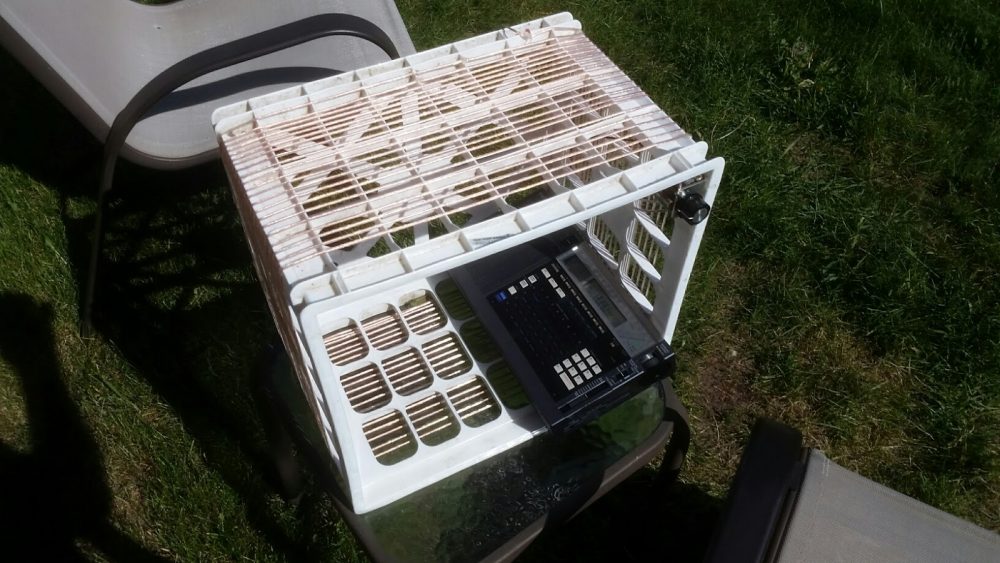
Andy would like to couple a similar antenna to a crystal receiver
Many thanks to SWLing Post contributor, Andy, who asks the following question in response to a previous post about building a Milk Crate AM Broadcast Loop Antenna:
All references to tuned loop antennas talk about no real connection to the AM radio, but merely inductive coupling.
However, I made a very elementary crystal radio which has no ferrite core or antenna.
I want this loop to be my primary (only) antenna, so I need to feed it directly to my tuning circuit. So I don’t know if I should take a wire from any particular part of the loop, with another wire to ground… and if these 2 wires should be in parallel or series with the tuning elements of the loop antenna.
Thanks!
Good question, Andy! Hopefully someone in the SWLing Post community can comment with some guidance!
After publishing a couple of posts about the Xiegu G90 QRP transceiver, I’ve gotten a number of inquiries from readers asking about the G90’s ability to receive AM broadcasts. Although I’ll address this in detail in my upcoming TSM review, I thought I’d also share a few notes with you.
One of the main reasons I decided to review the Xiegu G90 is I found so little information out there about how well the general coverage receiver worked for HF broadcast listening. The G90 has a frequency range of 0.5-30 MHz (SSB, CW, and AM), but I couldn’t find a specification showing the maximum width of the AM filter. I had seen a few display photos with the AM filter width indicated as 5.4 kHz–that’s not terribly wide, but workable.
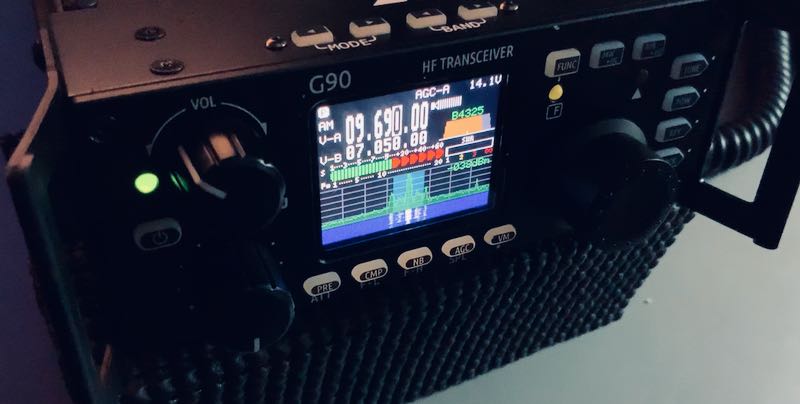
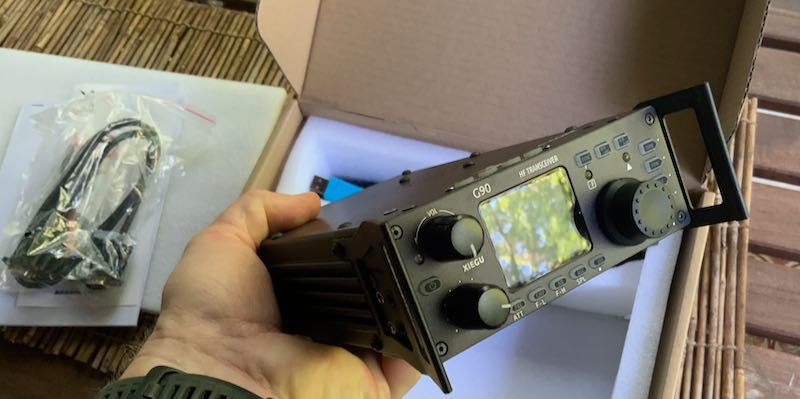
Only moments after opening the box and putting the G90 on the air, I tuned to the Voice of Greece (9,420 kHz) and learned how to change the bandwidth. I was very pleased to find that in AM mode, the indicated filter width is actually half the actual width. This means, the G90’s AM filter can actually be widened to 10.8 kHz–brilliant!
In addition, the bandwidth adjustment is variable, meaning you’re not locked into pre-determined, stepped bandwidths as with so many other transceivers.
In this short video, I widen the AM filter while tuned to the Voice of Greece:
Here’s another video of the G90 tuned to Radio Exterior de España on 9,690 kHz. Although the REE transmitter is located across the Atlantic Ocean in Spain, they sound like a local here in North Carolina:
Overall, I’ve been very pleased with the G90 on the HF bands.
Of course, there’s no synchronous detector (although users have requested this in a future firmware version) and there’s no notch filter as of yet. While I expect Xiegu may consider adding a notch filter, I doubt they’ll ever add a sync detector as this rig is primarily aimed at QRP ham radio operation. Of course, I could be wrong.
I also haven’t found a way to completely disable the transmitter or set the power level to zero watts. It’s quite possible I simply haven’t discovered the appropriate setting for this yet. Disabling the transmitter adds an extra level of protection when I use receive-only amplified mag loop antennas, for example. Also, some G90 owners may purchase the rig for listening purposes only and would rather not accidentally key the transmitter or engage the ATU.
Retailers
I purchased my Xiegu G90 from MFJ Enterprises because I wanted to support a US retailer. There are a number of other G90 distributors across the globe. Here’s a short selection:
eBay(at time of posting, the least expensive option including shipping)
I’m sure there are many other G90 retailers across the globe. Before placing an order, I would suggest you double-check availability as some retailers are on back-order.
Post Readers: Have you used the Xiegu G90 on the broadcast bands? Please comment with your thoughts!

Our mother organisation, the German Amateur Radio Club DARC also decided to provide a decent online substitute to the HAMRADIO hamvention that was called off by the authorities and I’m proud to say that our team was giving the ideas and helped this really large event to take place. Alltogether our video team, the other video team from Faszination Amateurfunk and the DARC permanent staff managed to provide more than 60 hours of talks, discussions and fantastic content, which will be streamed at this weekend. For those of you who understand German, here is the streaming plan: