 Jeff, over at the excellent Herculodge blog, shares this link to an interesting article in Slate about the future of AM/FM radio in the age of podcasts.
Click here to view the full article and check out Jeff’s excerpts on the Herculodge.

Jeff, over at the excellent Herculodge blog, shares this link to an interesting article in Slate about the future of AM/FM radio in the age of podcasts.
Click here to view the full article and check out Jeff’s excerpts on the Herculodge.
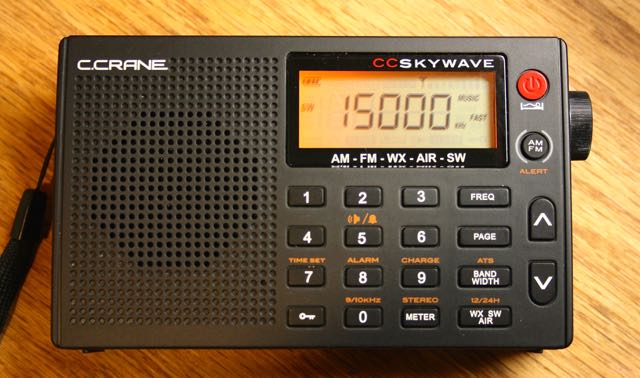 While electronics manufacturer C. Crane offers a number of unique AM/FM radios, including some of the best portable medium wave receivers on the market, they’ve traditionally only had two models of shortwave radio––namely, the CCRadio-SW, and the CCRadio-SWP. Earlier this year, however, C.Crane announced a new portable that would join their product line: the CC Skywave.
Admittedly, I was eager to give this little radio a go: C. Crane touts the Skywave as an exceptional travel radio, for which I’m always on the hunt. Last week, I had my opportunity when C. Crane sent me the new CC Skywave sample for review. I instantly got to work scrutinizing their newest offering…and here’s what I’ve discovered.
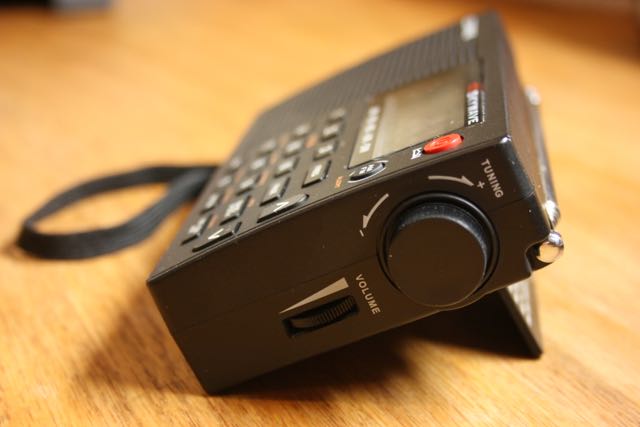
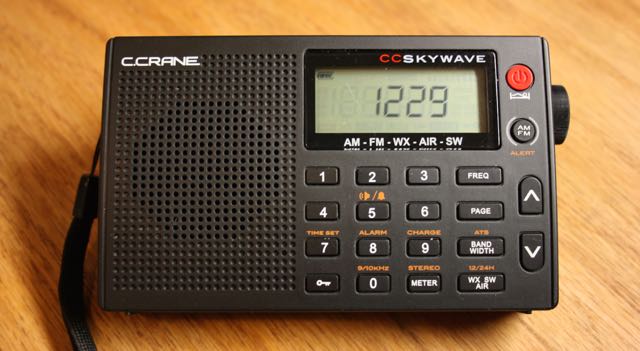 The form factor of the Skywave is very similar to C.Crane’s CCRadio-SWP pocket radio; in fact, its smooth plastic body even feels the same. While this radio doesn’t have the rubberized coating that have become popular on radio exteriors in recent years, supposedly to provide an easy-to-grip surface, I’m pleased that C.Crane does not use this, as these coatings can eventually deteriorate over time and with heat exposure, becoming somewhat tacky or sticky to the touch.
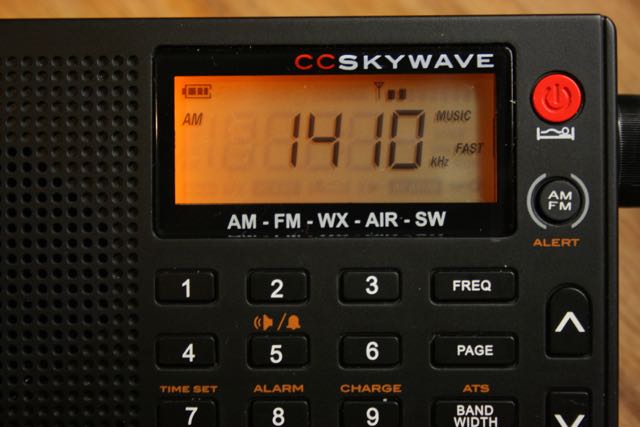 The Skywave’s backlit LCD display is small, but readily viewable from several angles. All of the buttons on the front of the Skywave have a tactile response, again, similar to the CCRadio-SWP. The buttons require slightly more pressure to activate than Tecsun and Degen models; I prefer this, especially for a travel radio: should I forget to activate the key lock, it’s much less likely that the radio will accidentally turn on during transit.
As always, I attempted first to see how many radio features and functions I could uncover without first consulting the owner’s manual. In the past, C.Crane products have been some of the most intuitive on the market. Fortunately, the Skywave did not disappoint: first, I was able to set both the clock and alarm within moments; both essential in a travel radio.
Once the radio is on, it will display either the time or frequency on the main display. While the Skywave defaults to a time display, I discovered that the lock button toggles the display between time and frequency for ten seconds. (Note: After reading through the manual later, I learned that you can actually change the default display mode to either time or frequency–very nice touch!)
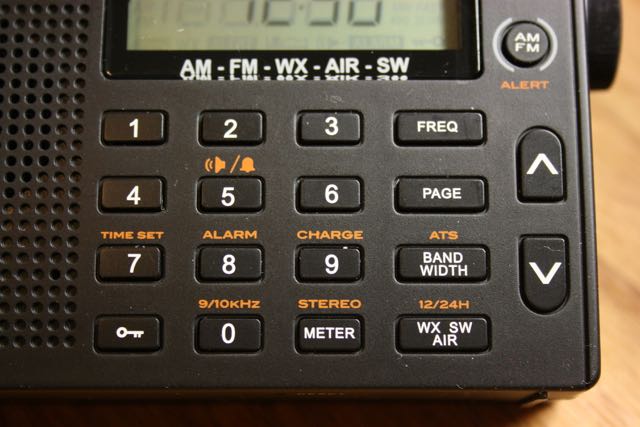
I then turned on the radio and found the memory allocation to be very straightforward: tune to the desired station, then press and hold a number button two seconds to save. Press a button quickly to recall. Memory remembers bandwidth, stereo, or mono (if FM), and any voice or music audio filters utilized–very handy!
Speaking of bandwidth, the Skywave has five on shortwave, medium wave, and air bands: 6, 4, 3, 2, and 1 kHz. By pressing the bandwidth button, you can cycle through these from widest to narrowest. The bandwidth defaults to 3 kHz, but the default can be changed by holding down the bandwidth button for five seconds (with radio powered off).
To enter a frequency in AM/FM/SW, you simply press the FREQ button, then key in frequency. To scan through the band, simply press and hold one of the up/down arrow buttons. Worth noting: the Skywave’s scan function is one of the fastest I’ve seen in a portable.
On the topic of scanning, and since this is a travel radio, I would have liked C.Crane to include an ETM function like that found in the Tecsun PL-310ET and PL-380. It’s quite a handy function for auto-populating temporary memories from a simple band scan. I assume this is not an option on the DSP chip powering the Skywave.
Owner’s manual
Once I had my fun trying to discover as many functions on the Skywave without the manual’s aid, I finally opened it and discovered a few more functions.
One feature I’ve already come to love in the Skywave: the ability to change the tuning speed, and thus frequency step-spacing on the tuning knob (option of 5 or 1 kHz steps), just by pressing the knob itself. I much prefer this to using a front-panel tuning step button because it’s so easy to operate in low-light settings (lounging in bed, for example).
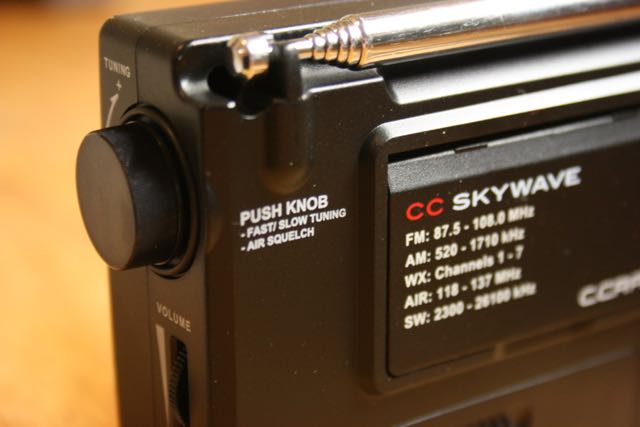 Another unique feature of the Skywave is a switchable audio filter for voice or music. With the filter set to “voice,” the audio is enhanced for human voice intelligibility. When set to “music,” it widens the audio filter, thus optimizing audio fidelity. Toggling the audio filter settings between voice and music is very easy, but not intuitive; indeed, it’s almost a hidden feature you can discover via the owner’s manual. Simply press the “1” and “2” simultaneously while listening to a broadcast to toggle the filter.
I should note that the C.Crane owner’s manual is one of the most straightforward and simple I’ve seen in ages. You can tell that, at least in the English version that came with mine, this manual was written by a native English speaker. It made for simple, clear instruction without head-scratching over obscure terms. Even the least technically-inclined user will understand these instructions, no problem.
After asking SWLing Post readers what they would like me to include in this review, a number of you responded that you wanted me to give the AM broadcast band reception a proper review.
 My foray into medium wave listening with the Skywave started off on the right foot. The very first night with the Skywave, I tuned it to 740 kHz, my favorite, albeit challenging to reach, AM station here in the North America–CFZM “Zoomer Radio” While those living in the midwestern and northeastern US can receive Zoomer radio easily enough at night, it is often a tough catch here in the southeast in the evening hours. After nightfall it competes with clear channel stations that also occupy 740 kHz. With a portable radio, the lock on Zoomer is never terribly strong and is very prone to fading.
But after tuning the Skywave to Zoomer, I received CFZM so well it sounded like a local station–in fact, I couldn’t believe it until a station ID confirmed that I was receiving it. Even more surprising was that I received it away from home, in an area plagued with RFI noise where I typically have to carefully turn a radio to null out the noise in an effort to enhance the desired broadcast. But the Skywave somehow mitigated this noise better than my other portables. Even when I turned the radio in the direction of the offending electrical noise, it wasn’t as bad as on other portables. Truly, the reception was remarkable.
With Zoomer firmly locked in, I hopped into bed, turned the volume to a comfortable level, and listened for at least half an hour before falling asleep. I was pleasantly surprised the following morning, some eight hours later, when I woke to the Skywave playing CFZM at the same level. Phenomenal! Perhaps conditions were exceptionally favorable that night; nonetheless, the Skywave couldn’t have impressed me more.
A side note–on the previous day, I’d inserted two generic alkaline AA batteries in the Skywave; after a total of ten hours playing at medium volume, the battery indicator still showed full capacity.
 Medium wave audio samples
While time won’t allow a full audio sampling of the medium wave band for comparison, I did record the following comparison between the Skywave and the Tecsun PL-310ET (which I regard as one of the more capable sub-$100 ultra-compact portables on the market).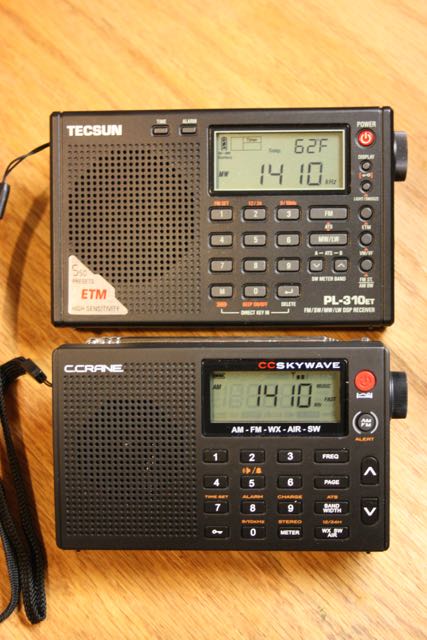
Since SWLing Post readers specifically asked to hear how the Skywave handles choppy nighttime medium wave DX conditions, I tuned to two frequencies with overlapping broadcasts, one of which was slightly dominant: 950 kHz and 990 kHz. I set the AM bandwidth to 3 kHz on both radios and made the recordings within one minute of each other. The CC Skywave’s audio filter was set to “voice.”
In the following recordings, listen for Radio Reloj (Cuba)–it’s buried deep in the noise. You might detect the ticking and “R” “R” in Morse code. These recordings were taken within one minute of each other.
The Tecsun PL-310ET on 950 kHz:
Note that the Skywave pulled out the dominant broadcaster–one I could barely hear on the PL-310ET.
I then made a recording on 990 kHz AM which had a stronger dominant station.
The Tecsun PL-310ET on 990 kHz:
To my ear, the Skywave was clearer and the commentator’s voice seemed to pop out of the noise better.
I’ve spent a great deal of time listening to the Skywave on the medium wave band this week and I feel comfortable recommending it for the medium wave DXer.
While I’ve spent comparatively less time (thus far) evaluating the Skywave’s FM band, I can say that the Skywave receives my “benchmark” FM stations with ease. Sensitivity also seems to be on par with my other DSP based portables (meaning, excellent sensitivity).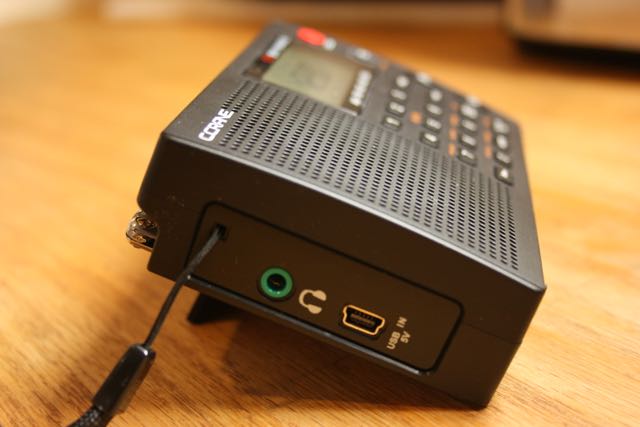
Of course, being a shortwave enthusiast, I’ve spent the bulk of my listening time since receiving the Skywave on the shortwave bands. And during this time, alas, shortwave radio band conditions have been challenging for any radio. Yet I’m happy to note that this little radio does not disappoint: it has excellent sensitivity and selectivity for a radio of its size. When I compared the Skywave with the Tecsun PL-310ET, in almost every situation, they are nearly equal in performance.
Shortwave audio samples
Below I’ve included audio samples of the Skywave on 9580 kHz (Radio Australia). Under normal conditions, Radio Australia would be a blowtorch signal here in North America, but this particular morning, propagation was quite poor. In the audio, you’ll hear both radios attempting to cope with pronounced fading, with their AGC circuits reacting to the quick rise and fall of signal strength. Both radios were set to a 3kHz bandwidth and the Skywave’s audio filter set to “voice” to help mitigate noise.
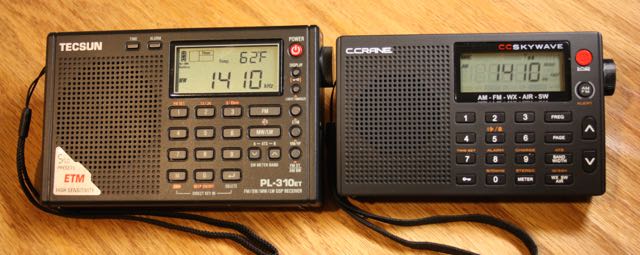
Note that Radio Australia was broadcasting music, which can be more difficult to evaluate, but the vocals were prominent enough I felt it made for a good comparison.
This morning, I also recorded WWV on 15 MHz. Again, propagation conditions were poor across the bands, so even WWV (normally very stable) was affected by quick fading (QSB). For kicks, I decided to add the benchmark Tecsun PL-660 to this comparison. If you recall, it received some of the highest marks for sensitivity in our weak signal shoot out. The Tecsun PL-310ET and CC Skywave were set to 3 kHz bandwidth and the Tecsun PL-660 to it’s narrow bandwidth (which I felt was most equivalent).
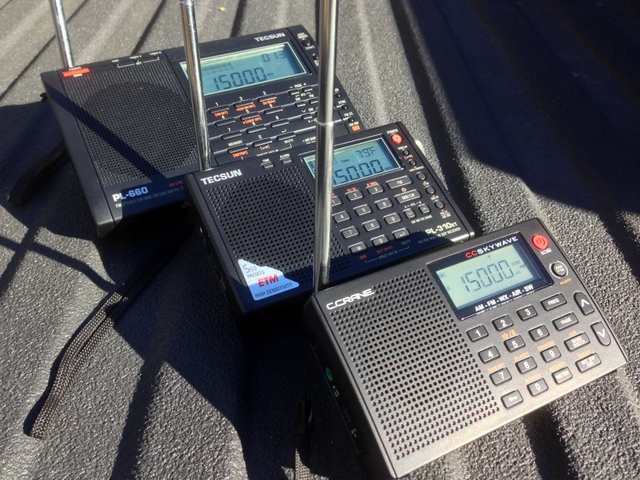
The good news is that the Skywave is certainly a sensitive and selective portable. While evaluating shortwave performance over the past week, I’ve been pleasantly surprised by how well this little radio receives.
 Those of us living or traveling in North America will appreciate the Skywave’s built-in NOAA weather radio functionality. Since I have at least a dozen self-powered radios and desktops that have built-in NOAA weather reception, I typically don’t give the band much thought. I figured NOAA reception would be a mediocre add-on with the Skyview. I was wrong.
Not only does the Skywave have NOAA weather radio, but it also has weather alerts. What’s so great about that? Imagine that you’re travelling to a rural area and weather is looking ominous; in this case, you can simply set the Skywave to the strongest NOAA channel and activate the weather alert (choose options for 4, 8, or 16 hours). If severe weather is reported for your geographic area, the Skywave will alert you.
I’m very pleased with the NOAA weather radio reception, as well. The Skywave receives NOAA stations even better than one of my dedicated weather radios.
 C.Crane included the Air band for travelers, as a means to listen to air traffic control while in an airport or awaiting a flight’s arrival. I have several portables with the AIR band, but most lack an autoscan ability (Grundig G3, G6), and performance on these tends to be mediocre at best.
I’ve traveled to three different cities over the past week and used the Skywave to tune to the local air-traffic control tower. After a bit of scanning, it eventually found the frequency, and reception was quite good. I have not yet used the AIR band in an airport (notorious for RFI) nor in a large metro area, so I can’t comment about performance under those conditions.
What really separates the Skywave apart from my other shortwave portable with the AIR band is that it actually has an adjustable squelch mode. Nice touch!
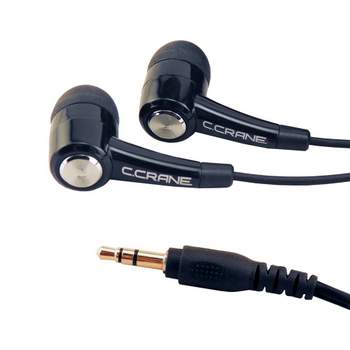 Unlike Tecsun portables which typically ship with batteries, an external antenna wire, chargers, travel cases, and the like, the CC Skywave comes with very few included accessories––just a carry case, an owner’s manual, and earphones.
Most of the headphones/earphones that accompany a shortwave radio package are of the cheapest quality. I’m happy to note that the Skywave’s included earphones are the best I’ve ever received as an included accessory with a shortwave radio.
The CC Buds Earphones are in-ear style (which I prefer, for sound isolation) with soft silicone earpieces. They are tuned to a frequency response which favors voice, an enhanced mid-range. For SWLing and MW DXing, I believe they’re nearly ideal. Indeed, I’m planning to use these with my Elecraft KX3 next time I’m operating QRP––I’m sure that SSB will sound great.
Since these are tuned for the spoken word, however, I wouldn’t necessarily favor the CC Buds Earphones over my Sony in-ear buds for music listening.
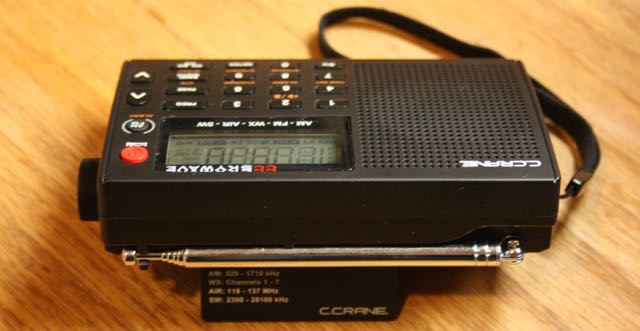
Every radio has pros and cons, and I jot down my reactions as I evaluate a new radio so as not to forget any details. The following is my list:
Pros:
Cons:
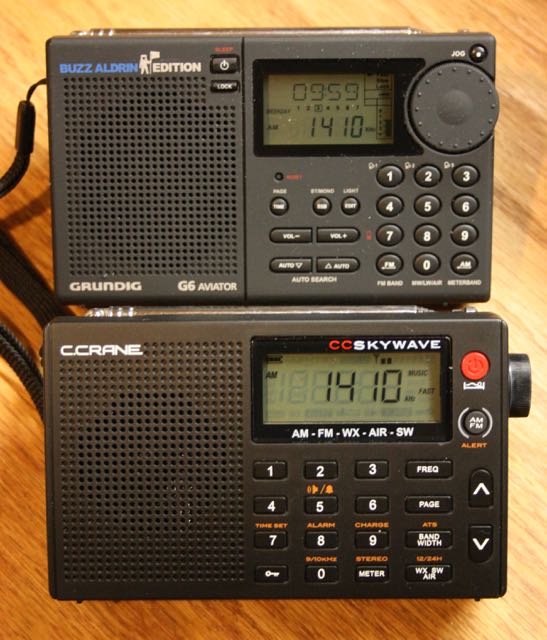
The CC Skywave is nearly identical in size to the late and great Grundig G6.
C. Crane has few shortwave radios in their product line, and all perform rather well for their price point; I know, as I have owned all of them and even purchased as gifts in the past.
But I was concerned a few months ago when I noted the similarity between the CC Skywave and the poorly-reviewed Digitech AR1733, sold in Australia/New Zealand by Jaycar.
Fortunately, it’s clear that C. Crane noticed the shortcomings of the AR1733 and has modified the Skywave’s design and firmware accordingly, which may account for the delayed roll-out of the CC Skywave. Obviously, the Skywave’s ACG circuit has been tweaked to cope with medium wave and shortwave listening, since a poor ACG circuit is one of the shortcomings of the AR1733. But, if so, wow…what a tweak.
Because all in all, the CC Skywave is a excellent little radio. Indeed, in terms of the ultra-compact portable market (models like I included in a recent shoot-out), I think it’s one of the best surprise performers I’ve seen in the past couple of years.
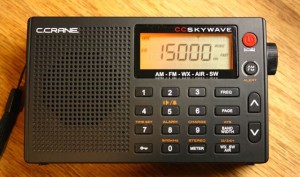 After just one week with it, I’ve already decided to take the CC Skywave along on my travels to see how it performs over time. It will replace my PL-310ET and PL-380 for my one bag domestic and international travelling. The CC Skywave is also especially well-suited for the “go”-bags and “bug-out” bags used in evacuations and other emergencies. Indeed, with AM/FM/SW/AIR plus functional NOAA radio, this little radio packs a lot––in short, the Skywave packs enough to get packed in my bag.
The CC Skywave can be purchased directly from C. Crane. It is also available at (soon) Universal Radio and Amazon.com.
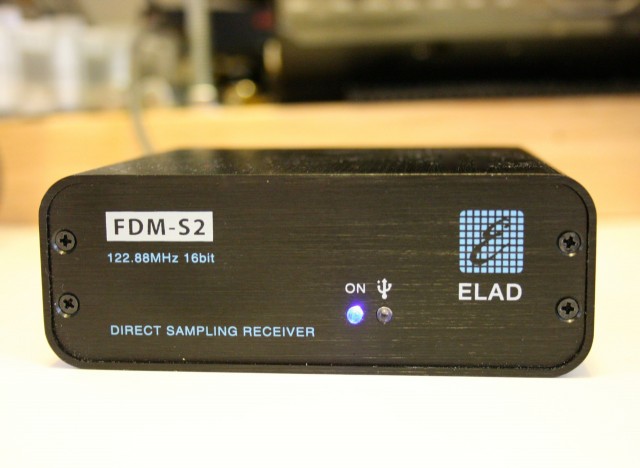
Many thanks to SWLing Post reader Eric Cottrell, who writes:
“Thanks for your excellent review of the Elad FDM-S2. I bought one and received it yesterday.
I tried out the software earlier this week by downloading 4GB of sample files from DK8OK and the Elad software. There are a lot of interesting features.
It is small! I like the use of the USB port for power. I can see how it would be a good receiver to throw into your laptop bag for trips.
I have a harsher Urban RF environment with 5KW and 1KW AM Broadcast transmitters within 2.5 miles. They reduce power at night. The Wellbrook AHA1530 Loop outputs a very high signal level from all the area’s AM stations. I have to use the attenuator on any radio at my QTH below about 2.5 MHz.
The unit having one preselection filter for LW/MW/HF is noticeable as I got ADC Clip warnings when directly connected to the Wellbrook loop. Turning on the 11 dB attenuator took care of the problem and did not seem to affect the weak signals much. It also was not as bad when I connected a Mini-Circuits ZFSC-2-6+ two port splitter between the Elad and the Wellbrook.
The Perseus has multiple preselection filters, but I noticed only one low pass filter for the 0 to 1.7 MHz range. So a MW band reject filter would be useful for Long Wave with both units. I plan on building an external preselector.
The option for multiple receivers and two RF ranges is pretty neat. I was listening to multiple FM stations at once. This morning I set one range to 31 meters and the other to 49 meters. I listened to Radio Australia on 9580 KHz using the right laptop speaker for audio, and could check their other frequencies on 31 and 49 meters using the left laptop speaker for audio.
I do HF Utility monitoring on digital signals, so I want to setup the Elad software with external decoder software. I have seen reports that the Elad can receive Airband pretty good, so I will also try receiving and decoding multiple ACARS frequencies at the same time.
So many experiment to try this Winter!”
Thanks for sharing your experience, Eric! Since I live in such a rural area, I never have to worry much about low pass filters (though I’m sure they couldn’t hurt). I’ve had the FDM-S2 since June this year. I can tell you that there are so many features, settings and possibilities with this radio, you could easily spend the winter and spring experimenting. I have yet to use the WinRad app to drive the S2.
Eric, we welcome any other discoveries you make along the way! Many thanks!
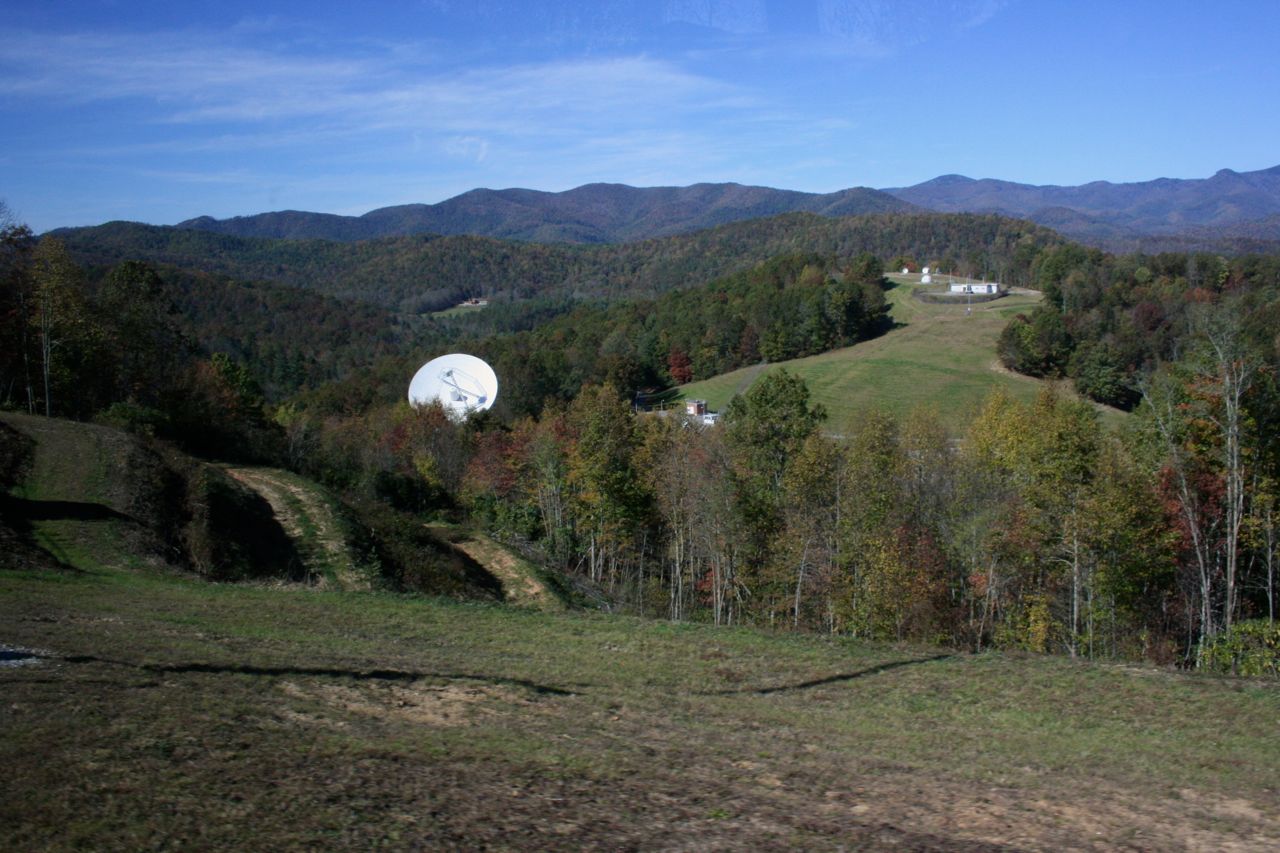 Yesterday evening, prior to my presentation at the Pisgah Astronomical Research Institute (PARI), I took the opportunity to do a little portable shortwave listening on the PARI campus.
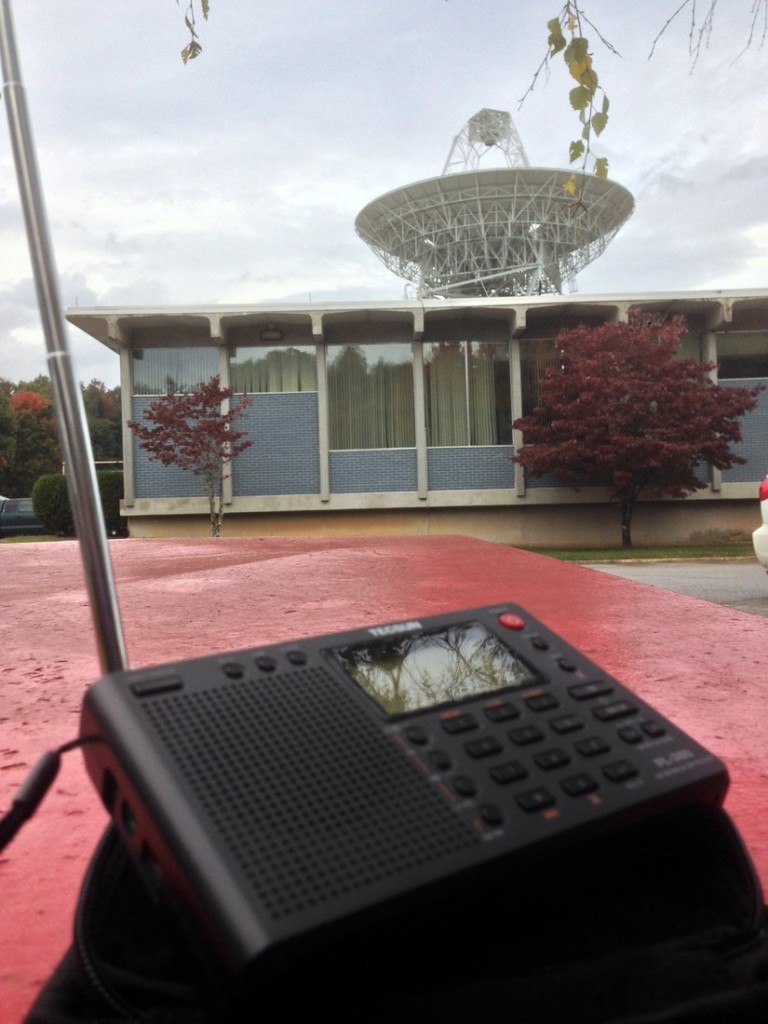
One of the great things about listening to shortwave, mediumwave or longwave at a radio astronomy site is the blissful absence of any radio noise. Radio astronomy requires seriously RF-quiet conditions, and all the better for SWLing, too. My little Tecsun PL-380 receiver easily detected most everything on the 31 meter band; All India Radio (and the Voice of Korea on the same frequency), for example, was as strong as a local station.
Next year, in October 2015, I might just organize a radio listening DXpedition at PARI. It would be a wonderful opportunity to DX in an RFI-free environment in the beautiful mountains of western North Carolina, on the 200+ acre campus of an active radio astronomy observatory and former NASA tracking station. (Really, how cool is that?!?)
PARI has agreed to handle all of the arrangements, and even provide some dorm rooms and camping space to the first registrants. There will be a fee for the event (to pay for the facilities and PARI staff time) but any profit would benefit PARI’s science education mission. The fee would be based on the number of attendees and how many nights we operate–I’d aim for two nights, on a Friday and Saturday (October 9 & 10, 2015).
If you would be interested in a shortwave listening DXpedition at PARI in Rosman, North Carolina, USA, please contact me or comment below. Click here to track the distance to PARI.
Note: the autumn foliage, for which the NC mountain region is famed, will be at or near its peak during the time of the DXpedition.
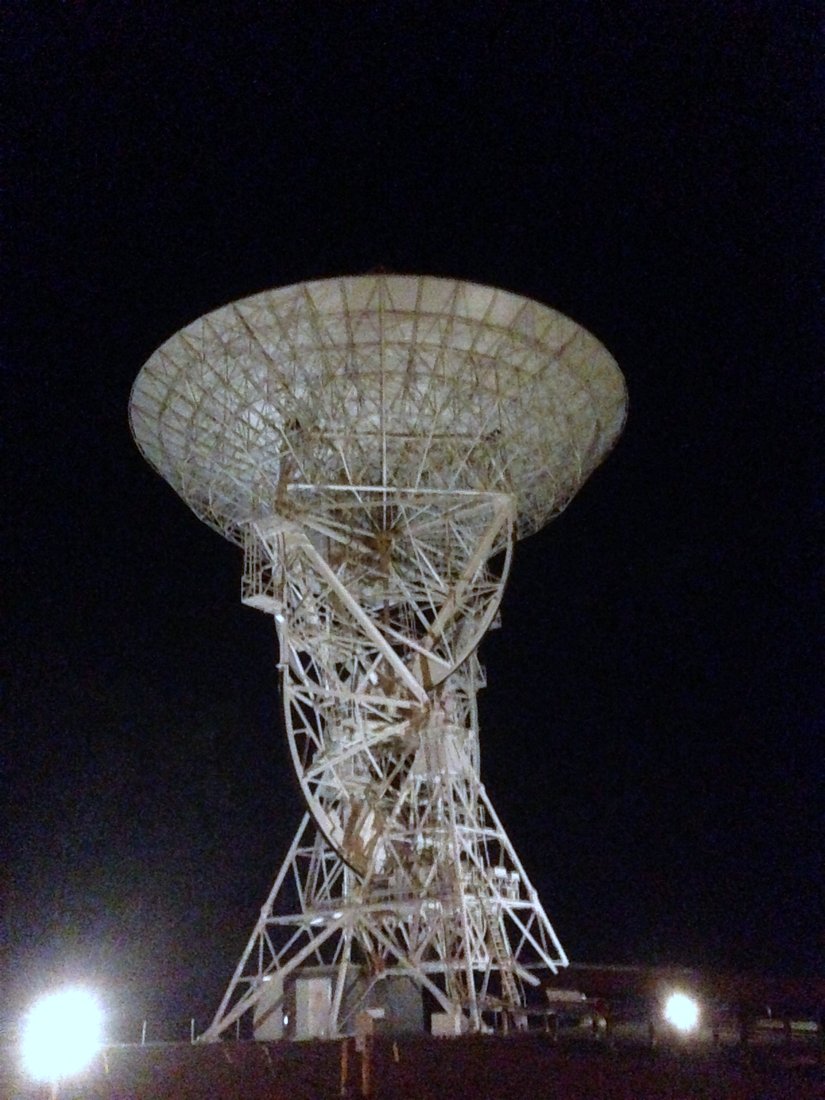
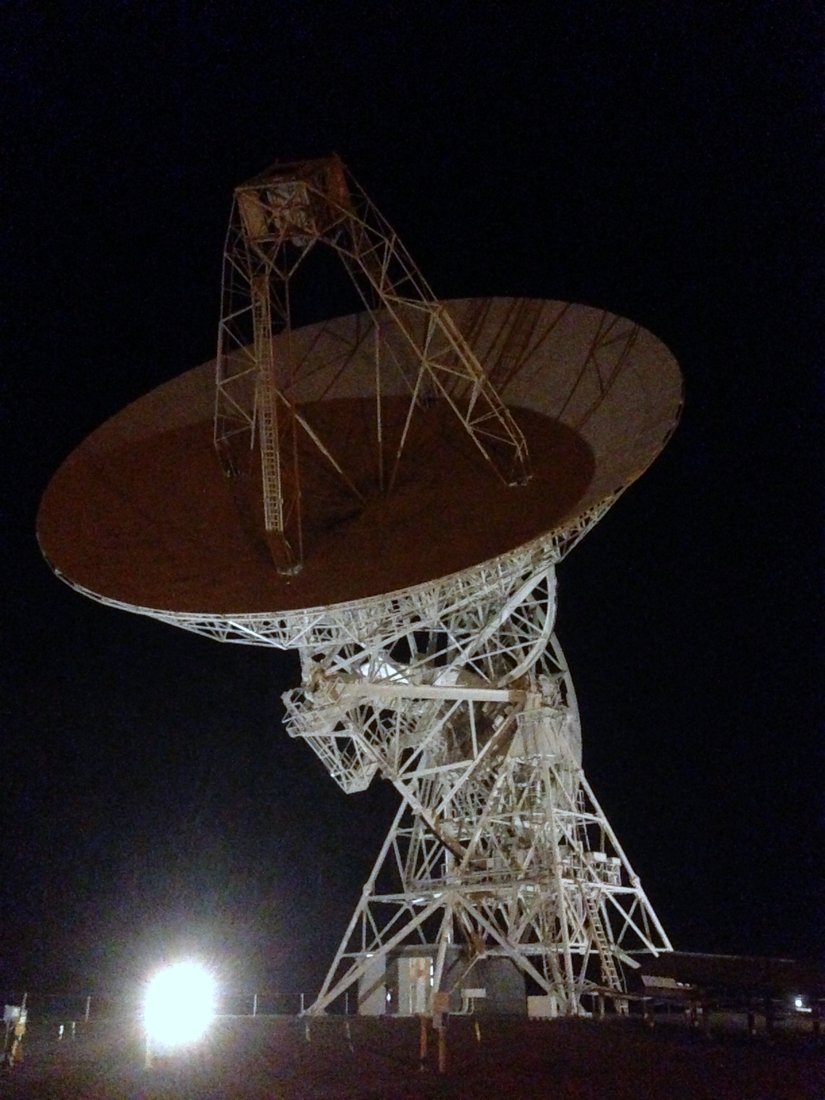
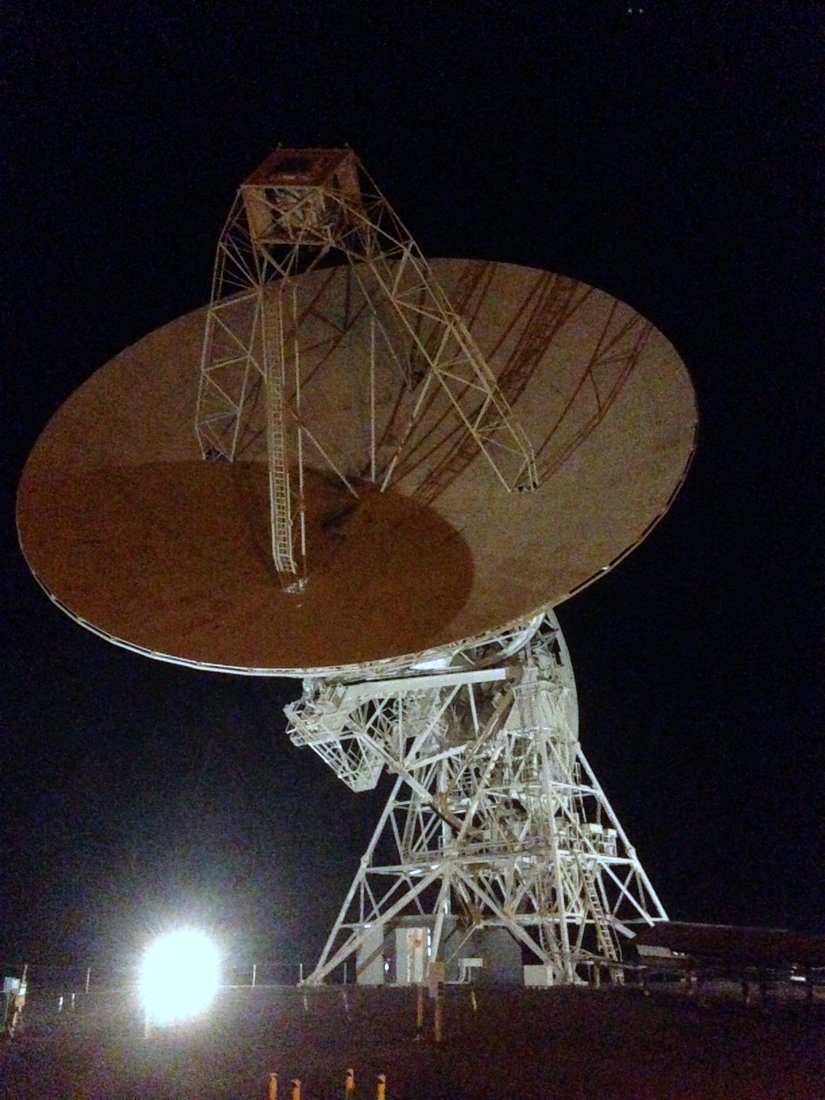
As I departed the PARI site late Friday, an astronomer programmed the rotation of the East radio telescope, an awe-inspiring 26-meter parabolic antenna. I snapped a couple of shots with my iPhone. It was truly impressive, this massive radio telescope slowly turning to some distant star or galaxy to acquire new data. See for yourself (for a sense of scale, see the fence at the base):
Many thanks to Andy Sennitt for sharing this fascinating piece of radio nostalgia:

Gizmodo columnist, Matt Novak, writes:
Jesse Walker, author of the book Rebels on the Air: An Alternative History of Radio in America, pointed me to this rather novel invention from 1937 — the refrigerator-radio combination unit. This may seem like an odd marriage of tech, but it makes perfect sense when you realise that it in the 1930s it was becoming harder to sell new radios and much easier to sell new fridges.
Despite the Great Depression, America saw an explosion of mechanical refrigerator ownership during the 1930s. In 1930, just 8 per cent of American households had a fridge. By the end of the decade, nearly half of American homes had one.
But the market for radios was pretty saturated in the late 1930s. Over 80 per cent of American households had a radio by the end of the decade. So radio set manufacturers tried to insert their products into new places that from the vantage point of the future, we can see didn’t pan out (like refrigerators) and others that did (like cars).
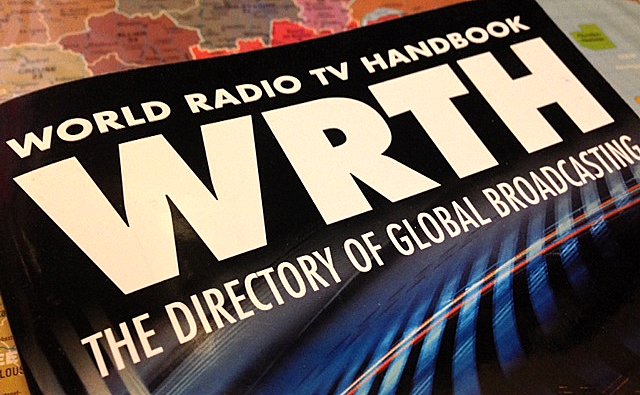
Sean Gilbert, WRTH International Editor, just posted the following information on the WRTH Facebook group:
“WRTH 2015 will be published, as usual, in early December. This will be the 69th Annual edition! Even though both International and Domestic SW is declining there is still a lot to be heard out there on those broadcast bands, so don’t consign the SW receiver to the attic (to gather dust) just yet.
There is a mix of over 200 languages and dialects to get stuck in to, plus the Clandestine broadcasters are always around from politically troubled areas.
Some of these are low powered or broadcasting to a different part of the world and can be a tough challenge to pick up.
All the details you need to stand the best chance of catching these, or any of the other broadcasters (be it LW, MW, SW or FM), can be found in WRTH.
You will soon be able to reserve your copy of the 2015 edition and be one of the first to receive it. Check the WRTH website for pre-ordering details. If the 2014 edition is still showing, try again in a few days time.”
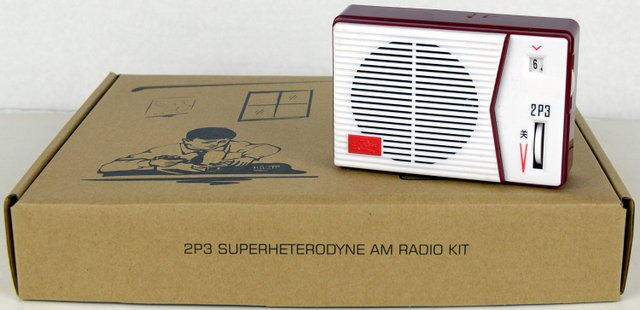
Many thanks to the excellent Herculodge blog for making me aware of this cool–nearly retro–Tecsun 2P3 AM Radio Receiver Kit on Amazon.
Should be a fun, inexpensive and relatively simple through-hole kit. I am curious how well the instructions are written in English. Has anyone assembled the Tecsun 2P3?
Update: Bob points out that the Tecsun 2P3 is also available on eBay. (for $26.99 US shipped)
