Category Archives: Broadcasters

VOA Radiogram this weekend

VOARadioGram(Source: VOA Radiogram)

Some listeners were impressed with the performance of last weekend’s surprise mode: MT63-1000 long interleave, especially as it was mixed with music. For that reason, VOA Radiogram for the weekend of 20-21 July will include a VOA News story in the MT63-2000L mode (200 wpm), followed by the same story in the MFSK64 mode (240 wpm).

Here is the lineup for VOA Radiogram, 20-21 July 2013:

2:20  MFSK16: Program preview

4:31  MFSK16: VOA News about quartz glass for data storage

2:04  MFSK32: Image of data stored in silica glass

3:59  MFSK32: VOA News about end of India’s telegram service

2:42  MFSK32: Image of sign at telegram office

2:53  MT63-2000L: VOA News about new materials for solar cells

2:32  MFSK64: Same VOA News about new materials for solar cells

1:10  MFSK32: Image of molecularspace.org logo

1:08  MFSK16: Closing announcements

1:11  Surprise image

The audio processor will not be used this weekend.

Please send reception reports to  [email protected].

ERT still broadcasting while Greek Public Television (EDT) emerges

Station name and logo of the new TV service, EDT

Station name and logo of the new TV service, EDT

I have recorded hours of the Voice of Greece on shortwave since they were supposed to shutdown weeks ago. This update, via EnetEnglish, describes a re-branded TV service; Greek Public Television (EDT):

(Source: EnetEnglish.gr)

Greek Public Television (EDT), the replacement station for ERT which was shut down last month, has commenced broadcasting a basic signal.

A screen depicting the new station’s name and somewhat uninspiring logo appeared at about 8.30am on Wednesday morning, against a backdrop depicting a globe and waves of colour.

The decision to commence the signal follows the vote on Tuesday night, at committee, of a bill establishing New Greek Radio, Internet and Television, or Nerit, the new national broadcaster.

The bill received only the support of the coalition parties, New Democracy and Pasok, with all other parties against. Debate on the new legislation will be completed on Thursday.

Despite the move, ERT staff at the station have entered their second month of continuous broadcasting via a livestream hosted by the European Broadcasting Union, which has demanded that the station reopen.

[…]ERT staff are asking whether EDT has been approved by the state’s broadcasting regulator, the Greek National Council for Radio and Television (ESR). They also ask who is paying the staff working in EDT and on what kind of contracts.

KVOH test today on 17,775 kHz

Retro Microphone(Source: KVOH)

KVOH – Voice of Hope, Los Angeles, would like to thank all those who responded to last Saturday’s test broadcast.  It was unfortunate that the time chosen for the test happened to coincide with a geomagnetic storm, but in spite of that, reports have so far been received from 13 U.S. states, as well as from Canada, Mexico, Colombia, Venezuela, Brazil, Argentina and Indonesia.

The station will be testing again tomorrow, Sunday 7th, from 1700-1900 UTC (1-3pm Eastern).  As before, the frequency is 17775 kHz, with 50 kW on a beam of 100 degrees (towards Cuba).  The same test program will be used as last week, with announcements in English and Spanish, which hopefully will be easier to copy since atmospheric conditions are better this weekend.  Reports will be very much appreciated to either [email protected] or P.O. Box 102, Los Angeles, CA 90078.  If reporting by email, please attach a short mp3 recording of your reception if possible.  If reporting by mail and requesting a QSL, please enclose return postage.  In all reports, please be sure to describe your receiver and antenna used.  Reception comparisons using handheld portable radios with telescopic antennas (outdoors) will be especially helpful.

KVOH currently expects to be able to launch a preliminary 2-hour daily schedule around the end of this month (July), and will build from there.

Ray Robinson
Los Angeles

Jonathan remembers Radio Netherlands Worldwide one year on

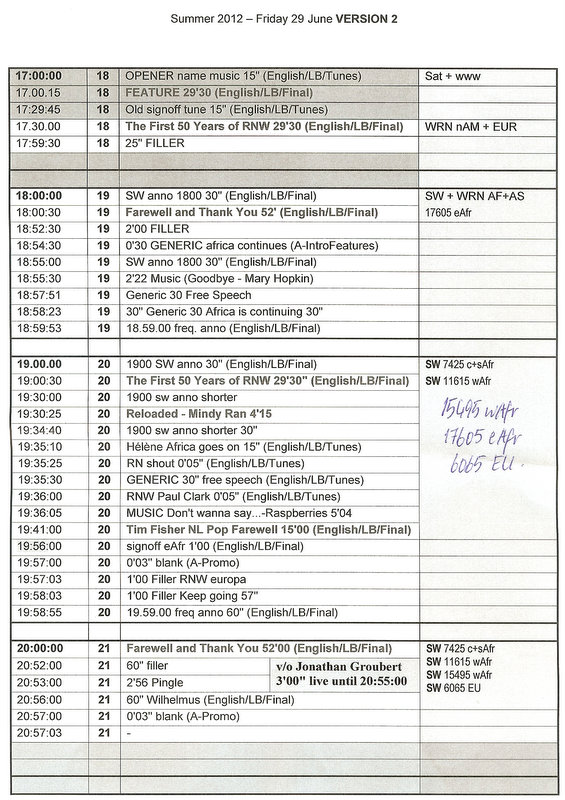
RNW's final broadcast schedule (Source: Jonathan Marks)

RNW’s final broadcast schedule (Source: Jonathan Marks)

A few days ago, former RNW employee, Jonathan Marks, was sorting out some papers in his office when something “spooky” happened:

“one sheet [of paper] fell out of a pile and onto the floor. It was the page of the last day of transmission from Radio Netherlands, English department.”

“What was weird was that this happened exactly one year ago to the day they pulled the switch. It was 2253 local time on a Friday when Jonathan Groubert, above, made the last announcement from Continuity Studio 4.”

Jonathan’s full post on his blog, Critical Distance, has some fantastic photos, notes, an interview and recording from the final moments of RNW’s final shortwave broadcast. Click here to read his post.

Jonathan’s post reminded me that one year ago, I was on a six week vacation with my family in the Canadian Maritimes.  I listened to and recorded all of the final RNW shortwave broadcasts in an off-grid cabin on the eastern coast of lovely Prince Edward Island. An SWLing memory I will never forget. You can listen to these field recordings and read my post, “RNW says farewell in style” via this link.

WWVB celebrates 50 years of quietly keeping time

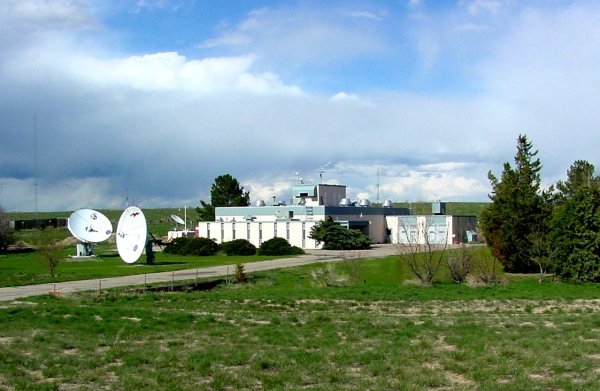
WWV building in Fort Collins, Colorado (photo courtesy: NIST)

WWV building in Fort Collins, Colorado (photo courtesy: NIST)

Thanks, David, for sharing a link to this brilliant article on the history and future of WWVB:

(Source: Wired)

Every night, while millions of Americans are fast asleep, clocks and wristwatches across the country wake up and lock on to a radio signal beamed from the base of the Rocky Mountains. The signal contains a message that keeps the devices on time, helping to make sure their owners keep to their schedules and aren’t late for work the next day.

The broadcast comes from WWVB, a station run by the National Institute for Standards and Technology. WWVB marks half a century as the nation’s official time broadcaster on July 5. Together with its sister station, WWV, which is about to hit 90 years in service, NIST radio has been an invisible piece of American infrastructure that has advanced industries from entertainment to telecommunications. (WWV’s broadcast includes a wider range of information, including maritime weather warnings and solar storm alerts).

Most people aren’t even aware that these stations exist, but they have a rich and fascinating history. Their future is uncertain, however, as newer technologies threaten to make them obsolete.

[…]WWV began broadcasting reference frequencies for signal calibration using equipment not that different from the chunk of quartz in a modern wristwatch. These days, though, a bit of quantum physics keeps the nation’s signals in sync. Cesium-133 atoms within the NIST-F1 atomic clock oscillate a frantic 9,192,631,770 times per second, acting like the pendulum of a grandfather clock. By tuning into that oscillation, NIST defines the basic unit of time, and by extension, frequency. Over the years, the reference frequencies have been so finely calibrated that they are accurate to beyond a single cycle in a trillion.

[…]WWVB’s value might have a lot to do with the type of signal it broadcasts and its location. While most commercial radio waves measure only a few meters between peaks, WWVB’s low frequency signal results in a whopping five kilometer wavelength. These long-wavelength signals can reach around the curvature of the planet by clinging to the semi-conductive surface of the Earth. On a clear night, a radio-controlled watch can pick up WWVB’s 60 kHz signal as far away as Patagonia or New Zealand.[…]

Read the full article at Wired.com.

Seeking 1970s era recordings of Radio Australia

The Shortwave Radio Audio Archive

The Shortwave Radio Audio Archive

Yesterday, I received a message from Sam, via the Shortwave Radio Audio Archive.  He writes:

Nice website! I’ve been looking (and listening) through it for the last hour or so. Nice!

I see you have some Radio Australia recordings and was wondering if you have any older ones? I’ve been trying for a couple of years now to find a recording of the top of the hour from Radio Australia in the mid 1970s. I was a youngster then and used to rush home from school to hear the station – I grew up in Northern Ireland and used to be able to get Radio Australia from around 1530 local time until maybe 1800 local, depending on the conditions. One thing I remember about it was the time “pips”, which included a pip at 10 seconds to the hour, which I had never heard before (or anywhere else since). I’d love to hear this again along with the theme to the news which came on the hour – I’ve found out that it was called Majestic Fanfare, but the version played on 70s Radio Australia is different to that played now and in every recording I’ve heard. Seems they changed the recording they used during the 80s. Even the ABC and Radio Australia can’t help as I’ve contacted them, so I’m trying every avenue which comes along.

I know it’s probably way before your oldest recording but heck, I had to ask! 😉

Many thanks.

If you happen to have 1970s era recordings of Radio Australia that you would like to share with Sam (and the world), please contact me and I would be happy to upload them to the Shortwave Radio Audio Archive.

Thanks for your inquiry, Sam!

Shortwave Radio Recordings: Voice of Greece

greeceFor your listening pleasure: over three hours of mostly music and commentary from the Voice of Greece. Recorded Sunday, June 23, 2013 on 9.42 MHz starting around 23:00 UTC.

Click here to download the full recording, or simply listen via the embedded player below:

Part of me fears that when the ERT budget is scrutinized in the near future, the Voice of Greece may struggle to stay on the shortwaves. I’ve been recording hours of their programming over several days and will have more recordings to post in the future.

Please share your recordings on the Shortwave Radio Audio Archive. Thanks!