Category Archives: Mediumwave

Wlodek Shares an Air Raid-Prompted Radio Comparison

Many thanks to SWLing Post contributor and friend, Wlodek (US7IGN), who writes from Kiev:

Hello!

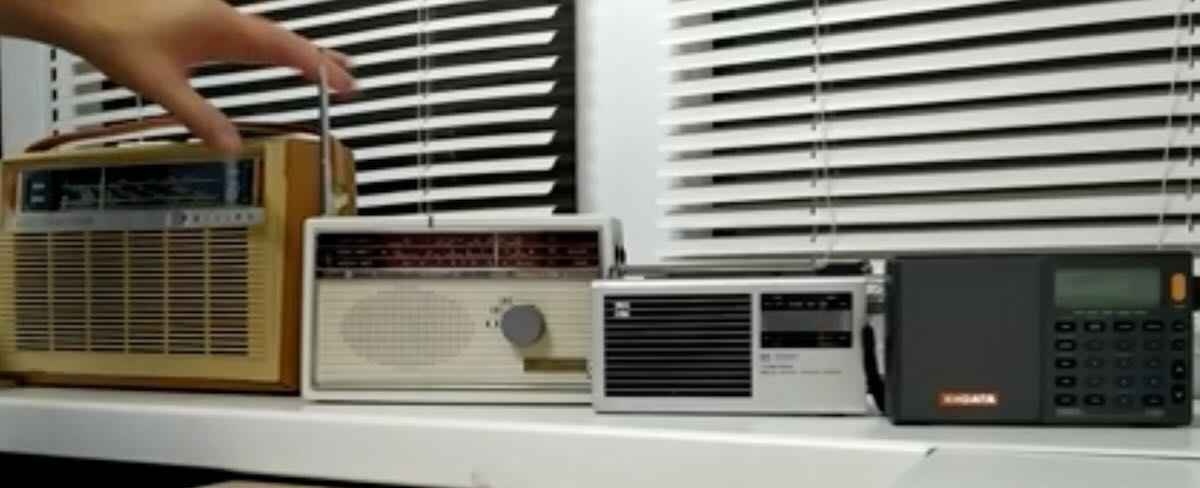
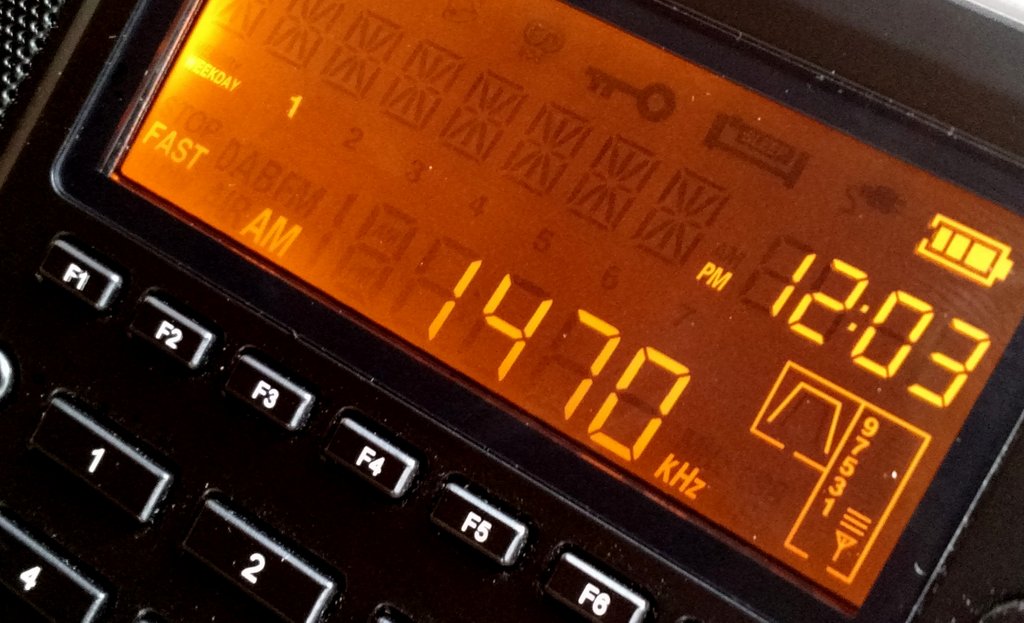
Because of another air raid alert, I can’t sleep and I decided to make a small comparison of the receivers of the 60s and the modern one.

Of course, you can not compare their size and weight, as well as some features.

This Chinese XHDATA D-808 was given to me by a friend for comparison. When he was just choosing a good receiver, I advised him to buy an old Sony 7600 series or Panasonic B65, for example. But he decided that modern technology is better at handling the task of receiving. But it turned out to be not so clear:

Click here to view on YouTube.

Radios:

73 de US7IGN!

Thank you for sharing this, Wlod. I wish the circumstances for the radio comparison were better–even though I know air raids have sadly become a fact of life for many in Ukraine, I can’t imagine sleeping through them. 

Your short comparison is interesting too. I consider the D-808 to be an excellent little DSP portable, but the audio simply can’t compare with your vintage radios. Indeed, the vintage receivers seem to handle the QRM a bit better than the D-808 as well.

Thank you for sharing this and wishing you the very best, OM.

Radio Waves: DRM Demo in Australia, Decoding the JWST, the ARDC, and EV Makers Dropping AM Radio

Radio Waves:  Stories Making Waves in the World of Radio

Welcome to the SWLing Post’s Radio Waves, a collection of links to interesting stories making waves in the world of radio. Enjoy!


Australia Demonstrates DRM on AM, FM (Radio World)

Since September 2020, ABC Radio has been quietly trialing DRM technology in Victoria

The public-service Australian Broadcasting Corp. and its transmission contractor BAI Communications Transmission Network hosted a public demonstration of Digital Radio Mondiale broadcasts on June 29, 2022. ABC highlighted the use of DRM on both AM and FM in Wagaratta, Victoria.

According to the DRM Consortium, the demonstration was the culmination of almost two years of COVID-impacted work to assess the performance of DRM services in Australia’s VHF and medium-wave bands.

Previously, the Australian Amateur Radio Experimenters Group reported that AREG member Steve Adler (VK5SFA) had been monitoring “a very un-publicized Digital Radio Mondiale (DRM) trial” on 747 kHz from Wangaratta in August 2021.

The Australian Communications and Media Authority provided ABC with a license variation to conduct the DRM 30 trials from September 1, 2020, to August 31, 2022.

At the public demonstration, senior representatives from the public, commercial and community radio sectors, along with regulators and other interested parties, were able to hear and see the capabilities of DRM broadcasting on AM from Dockers Plains and on FM from Mount Baranduda. They were also able to review the transmission equipment at Wagaratta.[Continue reading…]

Also check out the DRM Consortium’s article on this same topic.

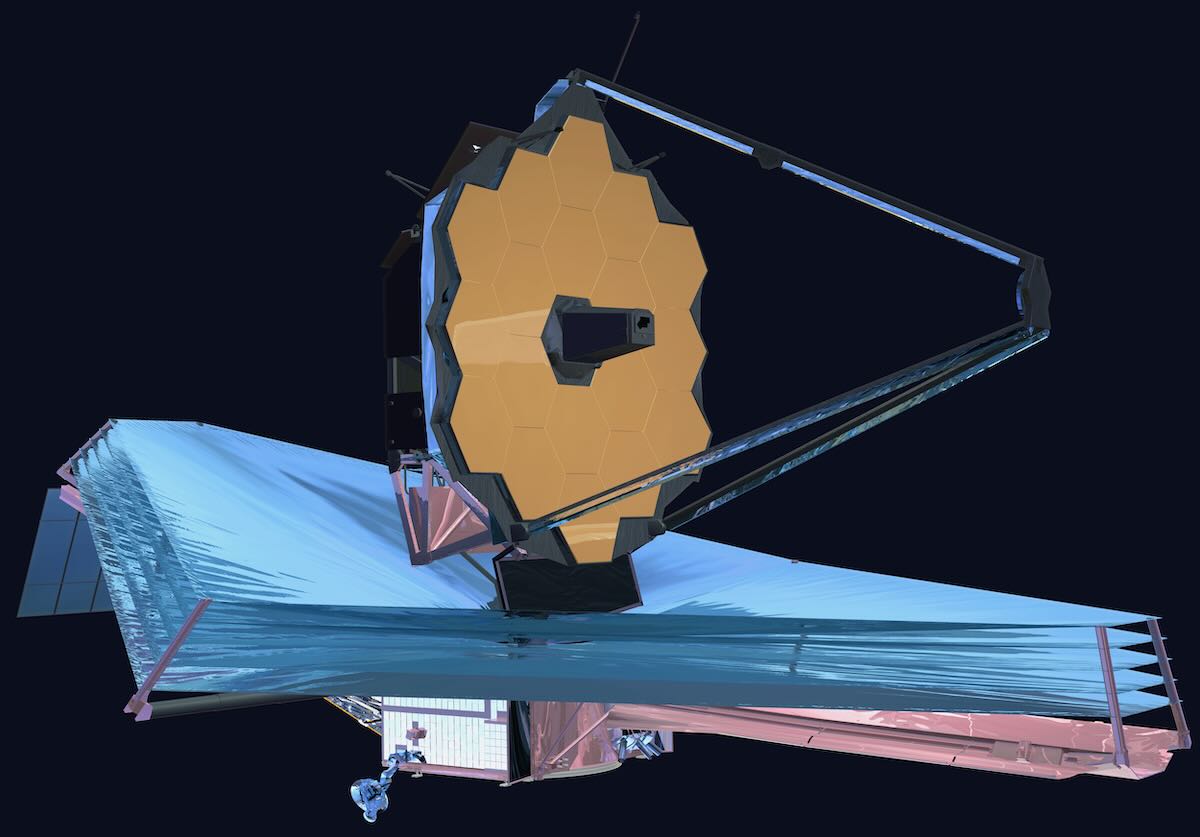
Decoding James Webb Space Telescope (Daniel Estévez)

The James Webb Space Telescope probably needs no introduction, since it is perhaps the most important and well-known mission of the last years. It was launched on Christmas day from Kourou, French Guiana, into a direct transfer orbit to the Sun-Earth L2 Lagrange point. JWST uses S-band at 2270.5 MHz to transmit telemetry. The science data will be transmitted in K-band at 25.9 GHz, with a rate of up to 28 Mbps.

After launch, the first groundstation to pick the S-band signal from JWST was the 10 m antenna from the Italian Space Agency in Malindi, Kenya. This groundstation commanded the telemetry rate to increase from 1 kbps to 4 kbps. After this, the spacecraft’s footprint continued moving to the east, and it was tracked for a few hours by the DSN in Canberra. One of the things that Canberra did was to increase the telemetry rate to 40 kbps, which apparently is the maximum to be used in the mission.

As JWST moved away from Earth, its footprint started moving west. After Canberra, the spacecraft was tracked by Madrid. Edgar Kaiser DF2MZ, Iban Cardona EB3FRN and other amateur observers in Europe received the S-band telemetry signal. When Iban started receiving the signal, it was again using 4 kbps, but some time after, Madrid switched it to 40 kbps.

At 00:50 UTC on December 26, the spacecraft made its first correction burn, which lasted an impressive 65 minutes. Edgar caught this manoeuvre in the Doppler track.

Later on, between 7:30 and 11:30 UTC, I have been receiving the signal with one of the 6.1 metre dishes at Allen Telescope Array. The telemetry rate was 40 kbps and the spacecraft was presumably in lock with Goldstone, though it didn’t appear in DSN now. I will publish the recording in Zenodo as usual, but since the files are rather large I will probably reduce the sample rate, so publishing the files will take some time.

In the rest of this post I give a description of the telemetry of JWST and do a first look at the telemetry data. [Continue reading…]

Helping Secure Amateur Radio’s Digital Future (Hackaday)

The average person’s perception of a ham radio operator, assuming they even know what that means, is more than likely some graybeard huddled over the knobs of a war-surplus transmitter in the wee small hours of the morning. It’s a mental image that, admittedly, isn’t entirely off the mark in some cases. But it’s also a gross over-simplification, and a generalization that isn’t doing the hobby any favors when it comes to bringing in new blood.

In reality, a modern ham’s toolkit includes a wide array of technologies that are about as far away from your grandfather’s kit-built rig as could be — and there’s exciting new protocols and tools on the horizon. To ensure a bright future for amateur radio, these technologies need to be nurtured the word needs to be spread about what they can do. Along the way, we’ll also need to push back against stereotypes that can hinder younger operators from signing on.

On the forefront of these efforts is Amateur Radio Digital Communications (ARDC), a private foundation dedicated to supporting amateur radio and digital communication by providing grants to scholarships, educational programs, and promising open source technical projects. For this week’s Hack Chat, ARDC Executive Director Rosy Schechter (KJ7RYV) and Staff Lead John Hays (K7VE) dropped by to talk about the future of radio and digital communications. [Continue reading…]

Interference causes EV makers to drop AM radio (Radio World via the Southgate ARC)

Radio World reports the Electromagnetic Interference generated by Electric Vehicles is causing some EV automakers to drop AM (medium wave) radio

The article says:

Some EV automakers are dropping AM altogether due to audio quality concerns, but that’s just one piece of the puzzle as radio continues to fight for space on the dash.

“As carmakers increase electric vehicle offerings throughout their lineups, the availability of AM radio to consumers is declining,” said Pooja Nair, communications systems engineer with Xperi Corp., in a Radio World guest commentary. “This is because the effects of electromagnetic interference are more pronounced in EVs than in vehicles with internal-combustion engines.”

In other words, electromagnetic frequencies generated by EV motors occupy the same wavelength as AM radio signals. The competing signals clash, effectively cancelling each other out. As EV motors grow more powerful, AM static tends to increase.

Read the full story at
https://www.radioworld.com/news-and-business/headlines/why-are-some-automakers-ditching-am-radio


Do you enjoy the SWLing Post?

Please consider supporting us via Patreon or our Coffee Fund!

Your support makes articles like this one possible. Thank you!

Giuseppe’s latest homemade ferrite antenna for MW and SW

Many thanks to SWLing Post contributor, Giuseppe Morlè (IZ0GZW), who writes:

Dear friends,

I’m Giuseppe Morlè from Formia, central Italy on the Tyrrhenian Sea.

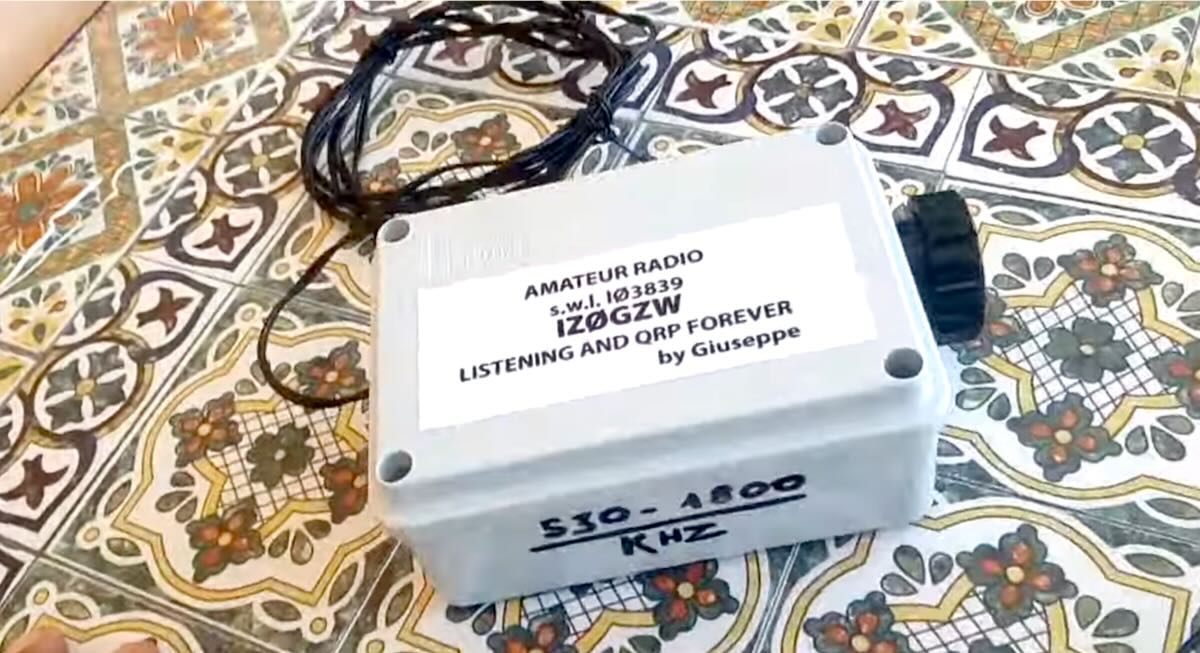
I want to share with you my latest ferrite antenna for listening; it is composed of 3 ferrites of 20 cm each in a tube for electrical systems with 2 separate windings, one for medium waves and one for short waves, 40 turns for medium waves, 4 turns for short waves. I use a 750 pf variable to tune the 2 windings and a switch is used to eliminate a winding.  Since there is only one variable, if you listen to the medium waves I interrupt the winding of the shorts.

On shortwaves it is preferable to place the system on an iron railing which, due to inductive effect, behaves like a really long wire antenna.

For the mediumwaves it is enough to bring the receiver close to the ferrites and also in this case, the induction will have its effect with an excellent increase in signal and modulation.

The range of this portable antenna is:

      • 520 to 1800 kHz
      • 3.500 to 18.000 MHz

Here’s a video from my Youtube channel where I explain how it works:

I had previously built a similar antenna but with 12 cm ferrites–very portable.

Thank you for your attention and I wish you good listening.

73. Giuseppe Morlè iz0gzw.

This is brilliant, Giuseppe! I love how you never stop building and experimenting with various antenna designs! Thank you for sharing this with us!

FM World reports that RAI will end mediumwave broadcasts later this year

Many thanks to SWLing Post contributor, Pedro Andrade, who shares the following article. Note that the following excerpt has been translated by Google from Italian to English. Click here for the original in Italian at FM-World.it:

On 11 September 2022 Rai radio broadcasts in medium wave will cease (FM World)

Before the end of the summer, Rai will end radio broadcasts in medium wave .

[…]The news, already anticipated in recent months by sector magazines such as Italradio , is made known by the Easy Web section of Rai .

Everything comes from the audio description for the blind, available for some programs in the second audio track of the TV channel concerned, but also in medium wave on Rai Radio1 .

With regard to this latter service, the site (accessible by clicking HERE) specifies that “from 11 September 2022, due to the termination of Rai radio broadcasts in medium wave modulation, the audio descriptions of television programs for the blind will be available only on dedicated audio of digital terrestrial television.

The regular Rai radio programs , therefore, will continue in FM , DAB + , web and app .

Thanks for the tip, Pedro.

BBC World Service: Licence fee spending to be cut £30m

Many thanks to SWLing Post contributor, Jonathan Marks, who notes that BBC Director General Tim Davie announced a digital strategy along with a number cuts following the BBC licence fee settlement. This was all outlined in his A digital-first BBC speech to staff this afternoon.

I’ve pasted the full copy of his speech below, but regarding the BBC World Service, here is an excerpt: 

“The Government’s commitment to extend its £94m annual funding for the World Service for a further three years is very welcome. But UK licence fee funding for the World Service, which has been around £254m in recent years, is now running at over £290m including World News – a level that is unsustainable following the licence fee settlement.

We will set out plans in the coming weeks for how we will initially reduce licence fee spending on the World Service by around £30m by the start of 2023/24, while protecting the full breadth of languages.

At the same time, our strategic review will identify the right longer-term model for a digital-first World Service and lay out a strong case for more investment from government over the coming years. This case for a strengthened World Service is compelling but we can only expect UK licence fee payers to fund so much.”

In addition, they hope to save £500m annually by cutting services such as Radio 4 Extra, Radio 4’s Long Wave service, and Radio 5 Live’s mediumwave transmitter network.

The Director General’s speech to staff, of course, primarily focused on being a world-class digital and on-demand provider. 

Here’s the full text of the speech via the BBC Media Centre:


A digital-first BBC

BBC Director-General Tim Davie’s speech to staff on 26 May 2022

Published: 26 May 2022

Good afternoon everybody.

Today, in our centenary year, I want to set out a vision of how we keep the BBC relevant and offer value to all audiences in an on-demand age.

I will cover three things: the pressing need to build a digital-first BBC; how we spend our money now that we have the certainty of public funding for six years; and how we keep reforming the way we work. Continue reading

Tecsun PL-990 Ferrite Rods

Many thanks to SWLing Post contributor, Gareth Buxton, who writes:

Hi Thomas

I see that Anon-co have the Tecsun PL-990 Ferrite rod aerial for sale. It even says in the product description “You can use it for your DIY projects.” I thought it might be of interest to your MW/AM radio constructors, especially if they can build a radio that receives more stations than the Tecsun using the same part!

Click here for the product page at Anon-Co.

Cheers
Gareth

Thanks for the tip, Gareth. This would indeed make it easy to construct an external MW antenna. Thank you for the tip!

WBOB: Last minute 50 kW DX test on 600 kHz

Many thanks to SWLing Post contributor, Paul Walker, who notes that he has only a few details about what appears to be a last minute DX test of WBOB in Jacksonville, Florida.

According to Paul’s source, WBOB on 600 kHz will be running 50 kilowatts from midnight to 3:00 AM local (04:00-07:00 UTC) on Saturday, May 14, 2022. Paul’s source noted the test will take place Friday and possibly Saturday nights, but technically these are early Saturday and Sunday times.

We’ve no other details, but Paul wanted to share what info he has. Thanks, Paul!